
Life, 1910-03-31 · page 8 of 46
Life — March 31, 1910 — page 8: what you’re looking at
What you’re looking at
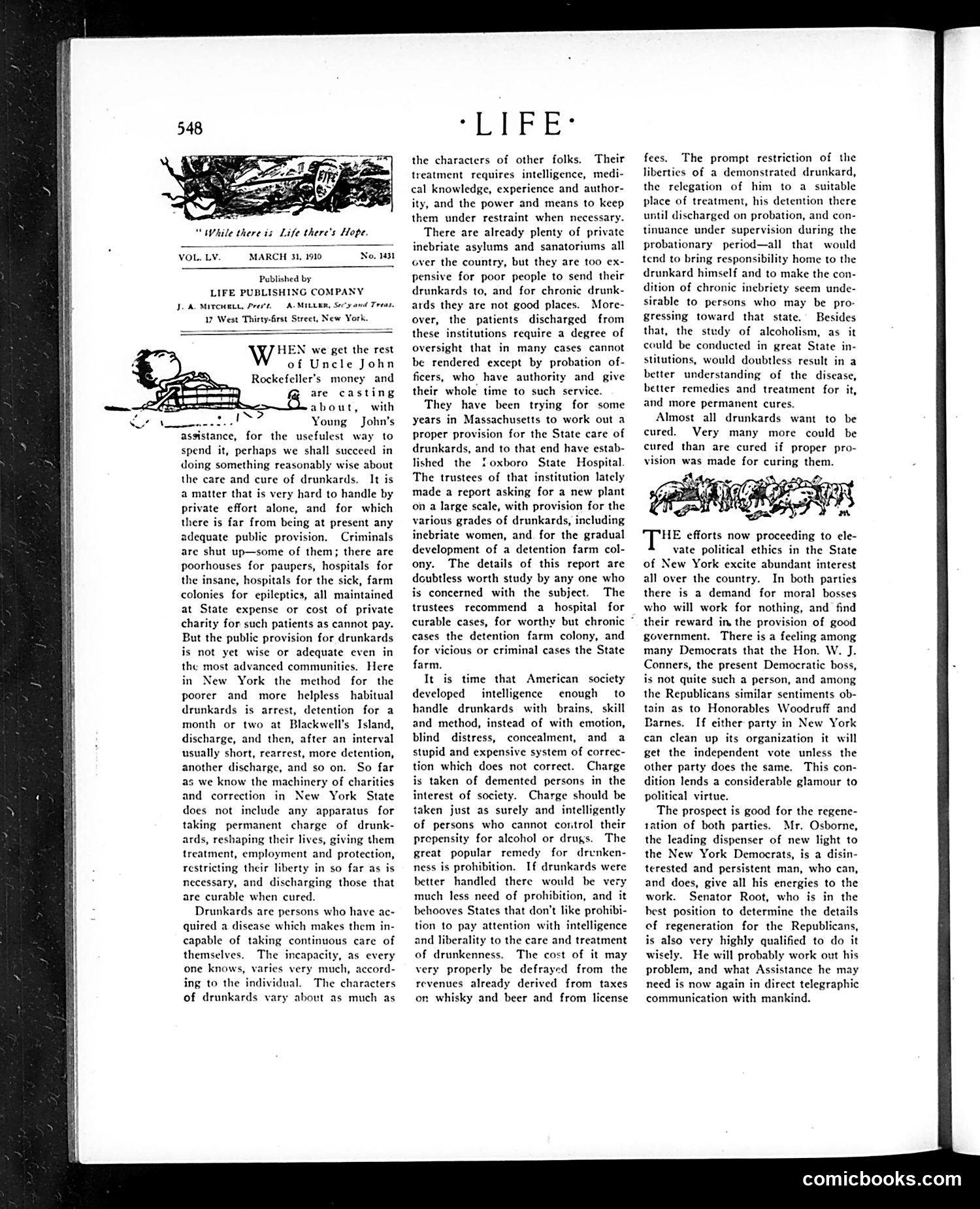
This page from *Life* magazine (March 31, 1919) contains editorial text about treating alcoholism and managing "drunkards" rather than relying solely on prohibition. The article discusses establishing proper institutions—hospitals and detention farms—for chronic alcoholics, particularly those who are poor or criminal. The small cartoon at top left shows a sleeping figure labeled "Young John's Allowance," humorously linking parental money-giving to youthful excess. The main satirical point critiques the prohibition movement then sweeping America. The editorial argues that shutting down alcohol production won't solve alcoholism without intelligent medical and social infrastructure. It suggests prohibition alone is crude policy-making, favoring instead comprehensive institutional care supervised by qualified professionals rather than emotional moral crusades.
📄 Transcribed text from this page (OCR, searchable)
Machine-transcribed from the original scan — historical spelling and the odd misread are preserved.
“While there is Life there's Hope. VOL. LY. MARCH 31, 1910 Published by LIFE PUBLISHING COMPANY JA MITCHELL Prete | ALMILLER, Sec‘y and Treas, 17 West Thirty-first Street, New York. HEN we get the rest of Uncle John Rockefeller’s money and are casting about, with Young John’s assistance, for the usefulest w to spend it, perhaps we shall succeed in doing something reasonably wise about the care and cure of drunkards. It is a matter that is very hard to handle by private effort alone, and for which there is far from being at present any adequate public provision. Criminals are shut up—some of them; there are poorhouses for paupers, hospitals for the insane, hospitals for the sick, farm colonies for epileptics, all maintained at State expense or cost of private charity for such patients as cannot pay. But the public provision for drunkards is not yet wise or adequate even in the most advanced communi Here in New York the method for the poorer and more helpless habitual drunkards is arrest, detention for a month or two at Blackwell's Island, discharge, and then, after an interval usually short, rearrest, more detention, another discharge, and so on. So far as we know the machinery of charities and correction in New York State does not include any apparatus for taking permanent charge of drunk- ards, reshaping their lives, giving them treatment, employment and protection, restricting their liberty in so far as is necessary, and discharging those that are curable when cured. Drunkards are persons who have ac- quired a disease which makes them in- capable of taking continuous care of themselves, The incapacity, as every one knows, varies very much, accord- ing to the individual. The characters of drunkards vary about as much as TE Ee the characters of other folks, Their treatment requires intelligence, medi- cal knowledge, experience and author- ity, and the power and means to keep them under restraint when necessary. There are already plenty of private inebriate asylums and sanatoriums all over the country, but they are too ex- pensive for poor people to send their drunkards to, and for chronic drunk- ards they are not good places. More- over, the patients discharged from these institutions require a degree of oversight that in many cases cannot be rendered except by probation of- ficers, who have authority and give their whole time to such service. They have been trying for some years in Massachusetts to work out a proper provision for the State care of drunkards, and to that end have estab- lished the Ioxboro State Hospital. The trustees of that institution lately made a report asking for a new plant on a large scale, with provision for the various grades of drunkards, including inebriate women, and for the gradual development of a detention farm col- ony. The details of this report are doubtless worth study by any one who is concerned with the subject. The trustees recommend a hospital for curable cases, for worthy but chronic cases the detention farm colony, and for vicious or criminal cases the State farm. It is time that American society developed intelligence enough to handle drunkards with brains, skill and method, instead of with emotion, blind distress, concealment, and a stupid and expensive system of correc- tion which does not correct. Charge is taken of demented persons in the interest of society. Charge should be taken just as surely and intelligently of persons who cannot control their prepensity for alcohol or drugs. The great popular remedy for drenken- ness is prohibition. If drunkards were better handled there would be very much less need of prohibition, and it behooves States that don’t like prohibi- tion to pay attention with intelligence and liberality to the care and treatment of drunkenness. The cost of it may very properly be defrayed from the revenues already derived from taxes on whisky and beer and from license fees. The prompt restriction of the liberties of a demonstrated drunkard, the relegation of him to a_ suitable place of treatment, his detention there until discharged on probation, and con- tinuance under supervision during the probationary period—all that would tend to bring responsibility home to the drunkard himself and to make the con- dition of chronic inebriety seem unde- sirable to persons who may be pro- gressing toward that state. Besides that, the study of alcoholism, as it could be conducted in great State in- stitutions, would doubtless result in a better understanding of the disease, better remedies and treatment for it, and more permanent cures. Almost all drunkards want to be cured. Very many more could be cured than are cured if proper pro- vision was made for curing them. HE efforts now proceeding to ele- vate political ethics in the State of New York excite abundant interest all over the country. In both parties there is a demand for moral bosses who will work for nothing, and find their reward in the provision of good government. There is a feeling among many Democrats that the Hon. W. J. Conners, the present Democratic boss, is not quite such a person, and among the Republicans similar sentiments ob- tain as to Honorables Woodruff and Barnes. If either party in New York can clean up its organization it will get the independent vote unless the other party does the same. This con- dition lends a considerable glamour to political virtue. The prospect is good for the regene- tation of both parties. Mr. Osborne, the leading dispenser of new light to the New York Democrats, is a disin- terested and persistent man, who can, and does, give all his energies to the work. Senator Root, who is in the best position to determine the details of regeneration for the Republicans, is also very highly qualified to do it wisely. He will probably work out his problem, and what Assistance he may need is now again in direct telegraphic communication with mankind. comicbooks.com