
Life, 1910-03-31 · page 13 of 46
Life — March 31, 1910 — page 13: what you’re looking at
What you’re looking at
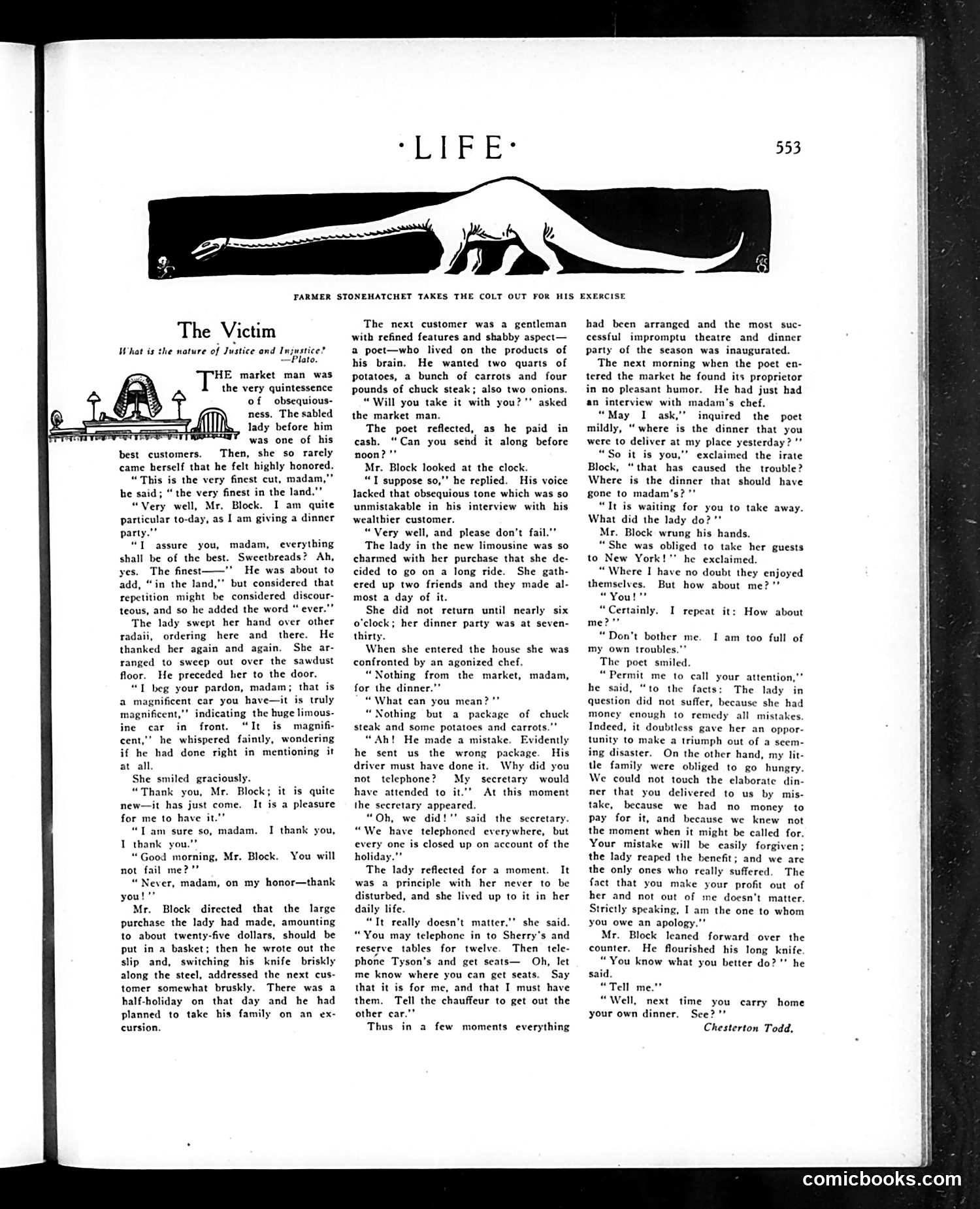
The illustration at top shows a farmer with a colt, captioned "Farmer Stonehatchet Takes the Colt Out for His Exercise" — a visual pun setting up the story below. "The Victim" is a humorous short story by Chesterton Todd about a wealthy market man who purchases expensive items from a society lady's charity sale. He buys a car, supposedly to impress people, but the transaction goes comically wrong: his secretary fails to arrange delivery, the lady's dinner party uses his car without permission, and the driver loses it entirely. The satire targets upper-class social pretension and the chaos of wealthy people's careless behavior. The "victim" is the well-meaning market man exploited by the fashionable society lady's casual dishonesty and entitlement—a common Life magazine theme mocking class absurdities.
📄 Transcribed text from this page (OCR, searchable)
Machine-transcribed from the original scan — historical spelling and the odd misread are preserved.
FARMER STONEHATCHET TAKES THE COLT OUT FOR HIS EXERCISE The Victim What is the nature of Justice and Injustice? —Plato. HE market man was the very quintessence of obsequious- ness. The sabled lady before him was one of his best customers, Then, she so rarely came herself that he felt highly honored. “This is the very finest cut, madam,” he said; “the very finest in the land."’ “Very well, Mr. Block. I am quite particular to-day, as I am ing a dinner party."” “T assure you, madam, everything shall be of the best. Sweetbreads? Ah, yes. The fines" He was about to add, “in the land,’’ but considered that repetition might be considered discour- teous, and so he added the word “ ever.”” ‘The lady swept her hand over other radaii, ordering here and there. He thanked her again and again. She ar- ranged to sweep out over the sawdust floor. He preceded her to the door. “I beg your pardon, madam; that is a magnificent car you have—it is truly magnificent,”’ indicating the huge limous- ine car in front, “It is magnifi cent,’ he whispered faintly, wondering if he had done right in mentioning it at all. She smiled graciously. “Thank you, Mr. Block new—it has just come. It for me to have i “Tam sure so, madam. I thank you.” “Good morning, Mr. Block. You will not fail me?"? “Never, madam, on my honor—thank you!’ Mr. Block directed that the large purchase the lady had made, amounting to about twenty-five dollars, should be put in a basket; then he wrote out the slip and, switching his knife briskly along the steel, addressed the next cus- tomer somewhat bruskly. There was a half-holiday on that day and he had planned to take his family on an ex- cursion. it is quite s a pleasure I thank you, The next customer was a gentleman with refined features and shabby aspect— a poet—who lived on the products of his brain. He wanted two quarts of potatoes, a bunch of carrots and four pounds of chuck steak; also two onions. “Will you take it with you?"’ asked the market man. The poet reflected, as he paid in cash. “Can you send it along before noon?"’ Mr. Block looked at the clock. “T suppose so,” he replied. His voice lacked that obsequious tone which was so unmistakable in his interview with his wealthier customer. “Very well, and please don’t fail."” The lady in the new limousine was so charmed with her purchase that she de- cided to go on a long ride. She gath- ered up two friends and they made al- most a day of it. She did not return until nearly six o'clock; her dinner party was at seven- thirty. When she entered the house she was confronted by an agonized chef. “Nothing from the market, madam, for the dinner.”’ “What can you mean “Nothing but a package of chuck steak and some potatoes and carrots.” h! He made a mistake. Evidently he sent us the wrong package. His driver must have done it. Why did you not telephone? My secretary would have attended to it At this moment the secretary appeared. “Oh, we did!"’ said the secretary. “We have telephoned everywhere, but every one is closed up on account of the holida The lady reflected for a moment. It was a principle with her never to be disturbed, and she lived up to it in her daily life. “Tt really doesn't matter,"’ she said. “You may telephone in to Sherry’s and reserve tables for twelve. Then tele- phone Tyson’s and get seats— Oh, let me know where you can get seats. Say that it is for me, and that I must have them. Tell the chauffeur to get out the other car.” Thus in a few moments everything had been arranged and the most suc- cessful impromptu theatre and dinner party of the season was inaugurated. The next morning when the poet en- tered the market he found its proprietor in no pleasant humor. He had just had an interview with madam’s chef. “May I ask,’’ inquired the poet mildly, “where is the dinner that you were to deliver at my place yesterday? ’" “So it is you,’’ exclaimed the irate Block, “that has caused the trouble? Where is the dinner that should have gone to madam's?”* “It is waiting for you to take away. What did the lady do?" Mr. Block wrung his hands. She was obliged to take her guests to New York!"" he exclaimed. “Where I have no doubt they enjoyed themselves. But how about me?’? “You!’’ “ Certainly. me?"’ “Don't bother me. my own troubles. The poet smiled. “Permit me to call your attention,’’ he said, “to the facts: The lady in question did not suffer, because she had money enough to remedy all mistakes. Indeed, it doubtless gave her an oppor- tunity to make a triumph out of a seem- ing disaster. On the other hand, my lit- tle family were obliged to go hungry. We could not touch the elaborate din- ner that you delivered to us by mis- take, because we had no money to pay for it, and because we knew not the moment when it might be called for. Your mistake will be easily forgiven; the lady reaped the benefit; and we are the only ones who really suffered. The fact that you make your profit out of her and not out of me doesn't matter. Strictly speaking, I am the one to whom you owe an apology.” Mr. Block leaned forward over the counter. He flourished his long knife. “You know what you better do?'’ he said. “Tell me."" “Well, next time you carry home your own dinner. See?" Chesterton Todd. I repeat it: How about Tam too full of comicbooks.com