
Life, 1910-03-31 · page 14 of 46
Life — March 31, 1910 — page 14: what you’re looking at
What you’re looking at
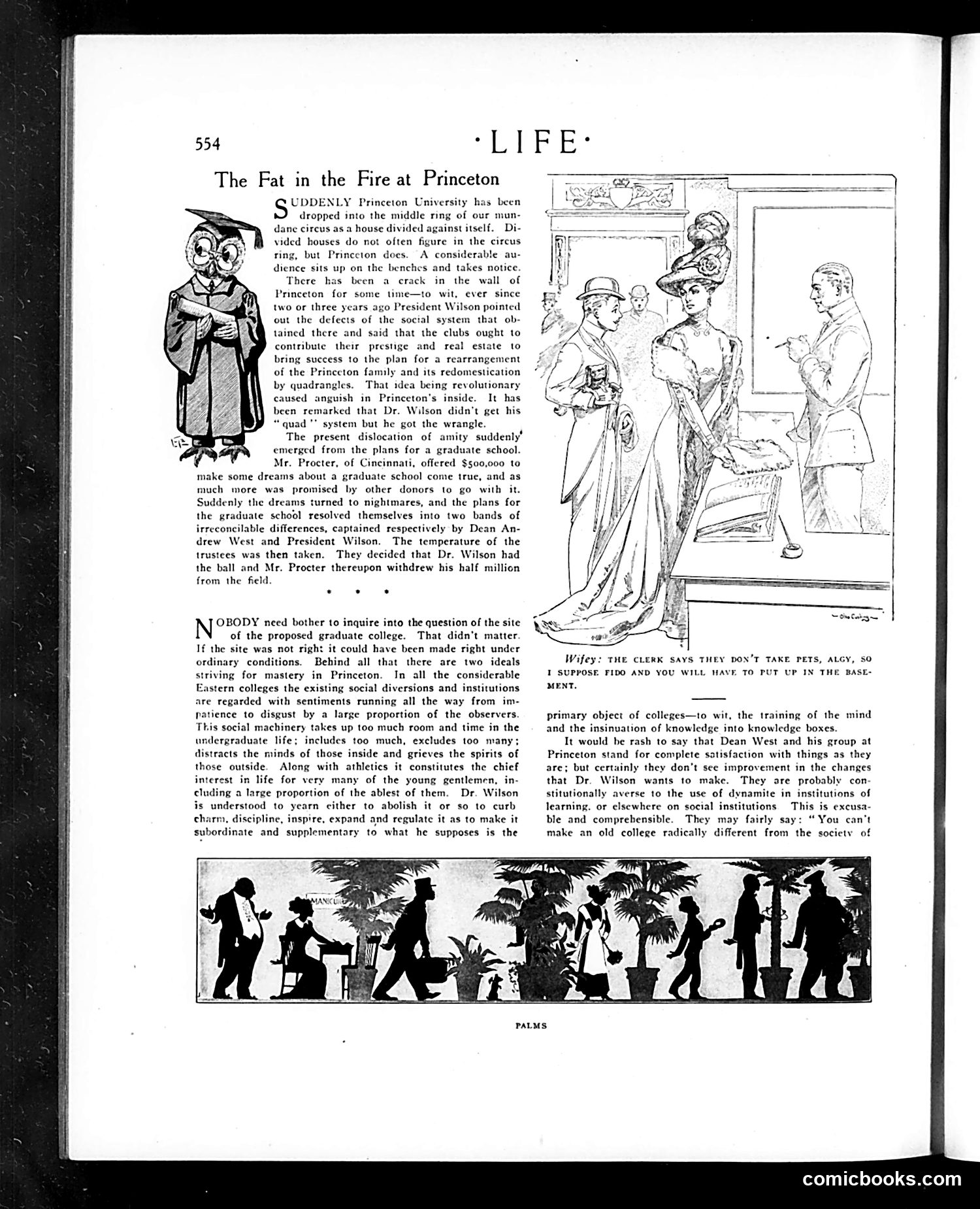
This article satirizes a major internal conflict at Princeton University under President Woodrow Wilson. The dispute centers on Wilson's attempt to reform Princeton's exclusive social club system (the "quads"), which he viewed as undermining the university's academic mission. The conflict erupted when a Cincinnati donor (Procter) offered $500,000 for a graduate school, but Wilson and Dean Andrew West disagreed fundamentally about its purpose and structure. Wilson wanted to use it to diminish the clubs' social dominance; West opposed such radical changes. The trustees sided with Wilson, causing Procter to withdraw his donation. The accompanying cartoon mocks the stuffy, conservative resistance to reform. The author argues that Princeton's social machinery—like athletics—distracts from education's true purpose: training minds. The conservatives' unwillingness to embrace "dynamite" reforms is portrayed as institutionally timid, though understandable.
📄 Transcribed text from this page (OCR, searchable)
Machine-transcribed from the original scan — historical spelling and the odd misread are preserved.
554 *LIFE: The Fat in the Fire at Princeton UDDENLY Princeton University has been dropped into the middle ring of our mun- dane circus as a house divided against itself. Di- vided houses do not often figure in the circus ring, but Princeton does. A considerable au- dience sits up on the benches and takes notice. s been a crack in the wall of There Princeton for some time—to wit, ever since two or three years ago President Wilson pointed out the defects of the social system that ob- tained there and said that the clubs ought to contribute their prestige and real estate to bring success to the plan for a rearrangement of the Princeton family and its redomestication by quadrangles. That idea being revolutionary caused anguish in Princeton's inside. It has been remarked that Dr. Wilson didn’t get his “quad "* system but he got the wrangle. The present dislocation of amity suddenly’ emerged from the plans for a graduate school. Mr. Procter, of Cincinnati, offered $500,000 to make some dreams about a graduate school come true, and as much more was promised by other donors to go with it. Suddenly the dreams turned to nightmares, and the plans for the graduate school resolved themselves into two bands of irreconcilable differences, captained respectively by Dean An- drew West and President Wilson. The temperature of the trustees was then taken. They decided that Dr. Wilson had the ball and Mr. Procter thereupon withdrew his half million from the field. OBODY need bother to inquire into the question of the site of the proposed graduate college. That didn't matter If the site was not right it could have been made right under ordinary conditions. Behind all that there are two ideals striving for mastery in Princeton. In all the considerable Eastern colleges the existing social diversions and institutions are regarded with sentiments running all the way from im- patience to disgust by a large proportion of the observers. This social machinery takes up too much room and time in the undergraduate life; includes too much, excludes too many: distracts the minds of those inside and grieves the spirits of those outside. Along with athletics it constitutes the chief interest in life for very many of the young gentlemen, in- cluding a large proportion of the ablest of them. Dr. Wilson is understood to yearn cither to abolish it or so to curb charm, discipline, inspire, expand and regulate it as to make it subordinate and supplementary to what he supposes is the a Wifey: THE CLERK SAYS THEY DON’T TAKE PETS, ALGY, SO I SUPPOSE FIDO AND YOU WILL HAVE TO PUT UP IN THE BASE- MENT. primary object of colleges—to wit, the training of the mind and the insinuation of knowledge into knowledge boxes. It would be rash to say that Dean West and his group at Princeton stand for complete satisfaction with things as they are; but certainly they don’t see improvement in the changes that Dr. Wilson wants to make. They are probably con- stitutionally averse to the use of dynamite in institutions of learning. or elsewhere on social institutions This is excusa- ble and comprehensible. They may fairly say: “You can't make an old college radically different from the society of comicbooks.com