
Life, 1910-03-31 · page 17 of 46
Life — March 31, 1910 — page 17: what you’re looking at
What you’re looking at
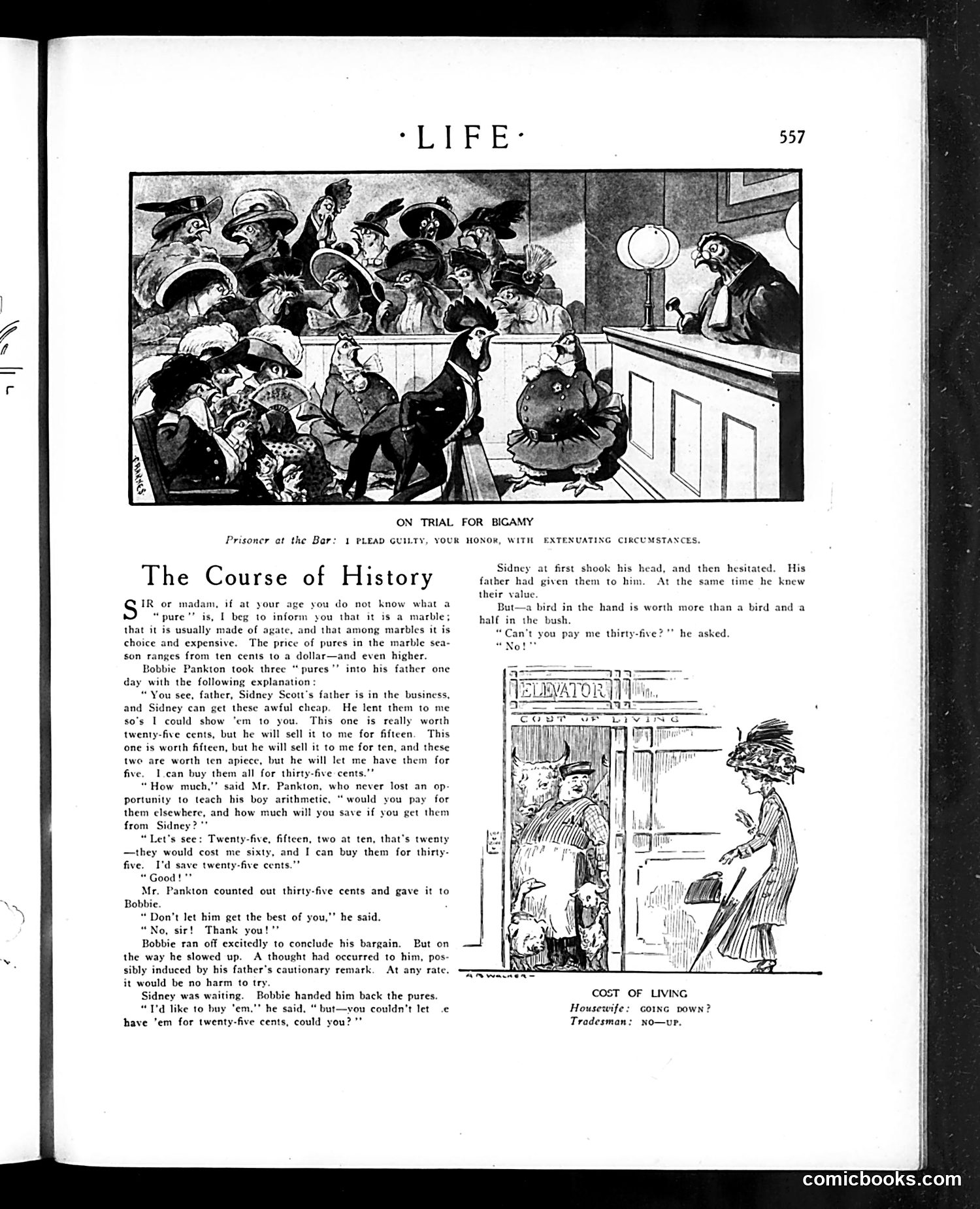
This *Life* magazine page contains two satirical pieces: **"On Trial for Bigamy"** (top cartoon): The courtroom scene mocks a defendant pleading guilty to bigamy with "extenuating circumstances"—a legal excuse. The satire likely critiques how wealthy or influential men exploited legal loopholes to escape consequences for marital infidelity, a serious crime then. **"The Course of History"** (main story): A father teaches his son Bobbie arithmetic through a marble ("pure") transaction. The boy learns to calculate savings but then attempts to renegotiate downward—undermining his own negotiation. The moral: shrewd dealing can backfire. The story satirizes American business culture's sharp practices and how even children learn such tactics. **"Cost of Living"** (small cartoon): A housewife asks a tradesman if prices are going down; he says "no—up." This reflects post-WWI inflation concerns, satirizing the rising cost of living that affected ordinary households. Together, these pieces critique American materialism, sharp business practices, and economic hardship through humor.
📄 Transcribed text from this page (OCR, searchable)
Machine-transcribed from the original scan — historical spelling and the odd misread are preserved.
ON TRIAL FOR BIGAMY Prisoner at the Bar: 1 PLEAD GUILTY, YOUR HONOR, WITH EXTENUATING CIRCUMSTANCES, The Course of History IR or madam, if at your age you do not know what a “pure” is, I beg to inform you that it is a marble; that it is usually made of agate, and that among marbles it is choice and expensive. The price of pures in the marble sea- son ranges from ten cents to a dollar—and even higher. Bobbie Pankton took three “ pures"’ into his father one day with the following explanation : “You see, father, Sidney Scott's father is in the business, and Sidney can get these awful cheap. He lent them to me so’s I could show ‘em to you. This one is really worth twenty-five cents, but he will sell it to me for fifteen. This one is worth fifteen, but he will sell it to me for ten, and these two are worth ten apiece, but he will let me have them for five. I.can buy them all for thirty-five cents.”” “How much,” said Mr. Pankton, who never lost an op- portunity to teach his boy arithmetic, “would you pay for them elsewhere, and how much will you save if you get them from Sidney?" “Let's see: Twenty-five, fifteen, two at ten, that’s twenty —they would cost me sixty, and I can buy them for thirty five. I'd save twenty-five cents.” “ Good!" Mr. Pankton counted out thirty-five cents and gave it to Bobbie “Don't let him get the best of you,"’ he said. “No, sir! Thank you!" Bobbie ran off excitedly to conclude his bargain. But on the way he slowed up. A thought had occurred to him, pos- sibly induced by his father’s cautionary remark. At any rate. it would be no harm to try. Sidney was waiting. Bobbie handed him back the pures. “T'd like to buy ‘em."* he said, “ but—vou couldn't let .c have ‘em for twenty-five cents, could you?” Sidney at first shook his head, and then hesitated. His father had given them to him. At the same time he knew their value. But—a bird in the hand is worth more than a bird and a half in the bush. “Can't you pay me thirty-five?’ he asked. COST OF LIVING Housewife: coixc pown? Tradesman: xo—uvp. comicbooks.com