
Life, 1910-03-31 · page 21 of 46
Life — March 31, 1910 — page 21: what you’re looking at
What you’re looking at
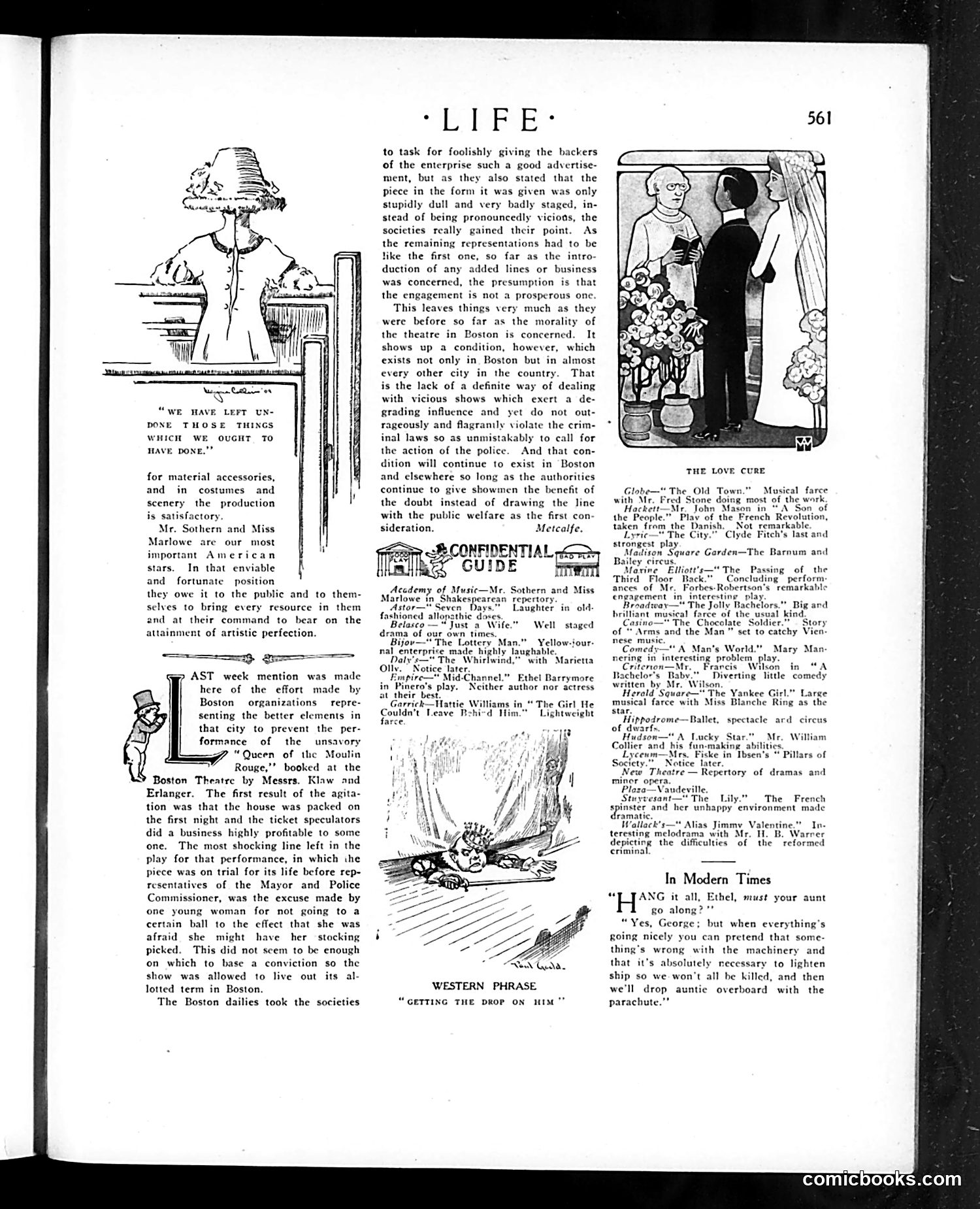
This page critiques Boston's theater censorship efforts. The main text discusses how civic organizations tried to suppress the risqué musical "Queen of the Moulin Rouge" at the Boston Theatre. Their protest backfired—the controversy packed the theater with curiosity-seekers, benefiting the producers financially. The critic (Metcalfe) notes the show was merely "stupidly dull and very badly staged" rather than genuinely obscene, and argues Boston lacks consistent standards for regulating morally questionable productions. The cartoons illustrate theatrical life: "The Love Cure" shows an elegant domestic scene, while "Getting the Drop on Him" depicts a Western confrontation. Below is a "Confidential Guide" listing Boston theaters and current productions, including Sothern and Marlowe's Shakespeare, Ethel Barrymore's "Mid-Channel," and Fred Stone's musical farce—typical of early 1900s theater offerings. The page satirizes both theatrical mediocrity and ineffective moral policing.
📄 Transcribed text from this page (OCR, searchable)
Machine-transcribed from the original scan — historical spelling and the odd misread are preserved.
“WE HAVE LEPT UN- DONE THOSE THINGS WHICH WE OUGHT To HAVE DON for material accessories, and in costumes and scenery the production is satisfactory. Mr. Sothern and Miss Marlowe our most important American stars. In that enviable and fortunate position they owe it to the public and to them- selves to bring every resource in them and at their command to bear on the attainment of artistic perfection. AST week mention was made here of the effort made by Boston organizations _repre- senting the better elements in that city to prevent the per- formance of the unsavory “Queen of the Moulin Rouge,’’ booked at the Boston Theatre by Messrs. Klaw and Erlanger. The first result of the agita- tion was that the house was packed on the first night and the ticket speculators did a business highly profitable to some one. The most shocking line left in the play for that performance, in which ihe piece was on trial for its life before rep- resentatives of the Mayor and Police Commissioner, was the excuse made by one young woman for not going to a certain ball to the effect that she was afraid she might have her stocking picked. This did not seem to be enough on which to base a conviction so the show was allowed to live out its al- lotted term in Boston. The Boston dailies took the societies are a) ah Fal al og to task for foolishly giving the backers of the enterprise such a good advertise- ment, but as they also stated that the piece in the form it was given was only stupidly dull and very badly staged, in- stead of being pronouncedly vicioas, the societies really gained their point. As the remaining representations had to be like the first one, so far as the intro- duction of any added lines or business was concerned, the presumption is that the engagement is not a prosperous one. This leaves things very much as they were before so far as the morality of the theatre in Boston is concerned. It shows up a condition, however, which exists not only in Boston but in almost every other city in the country. That is the lack of a definite way of dealing with vicious shows which exert a de- grading influence and yet do not out- rageously and flagranily violate the crim- inal laws so as unmistakably to call for the action of the police. And that con- dition will continue to exist in Boston and elsewhere so long as the authorities continue to give showmen the benefit of the doubt instead of drawing the line with the public welfare as the first con- sideration. Metcalfe. CONFIDENTIAL n> (mee GUIDE beet Academy of Music—Mr. Sothern Marlowe in Shakespearean repertory. Astor—" Seven Days.” Laughter in old- fashioned allopathic doses Belasco —“* Just a Wife.” Well drama of our own times. Bijov—" The Lottery Man.” Yellow-jour- nal enterprise made highly laughable, Daly's—" The Whirlwind,” with Marietta Olly. | Notice later, _ Empire" Mid-Channel.” Ethel Barrymore in Pinero's play. Neither author nor actress at their best Garrick—Mattie Williams in,“ The Girl He Couldn't Leave Mohi-d Mim.” Lightweight Miss staged “8 1s AEN Goda. WESTERN PHRASE “GETTING THE DROP ON MIM” | aad THE Love CURE Globe—" The_Old Town." Musical farce with Mr. Fred Stone doing most of the work, Hackett—Mr. John Mason in “A Son, of the People.” Play of the French Revolution, taken from the Danish. Not remarkable. Lyric—" The City.” Clyde Fitch's last and strongest play z : Maiiison Square Garden—The Barnum and Bailey circus Marine Elliott's—“ The Passing of the Third Floor Back.” Concluding perform ances of Mr. rhes-Robertson’s remarkable engagement in, interesting play 3 Broadway—" The Jolly Bachelors.” Big ard brilliant musical farce of the usual kind Casino—" The Chocolate Soldier.” Story of “ Arms and the Man” set to catchy Vien- medy—" A Man's World." Mary Man: nering in interesting problem play. Crite Mr. Francis Wilson in “A Bachelor's Raby." Diverting little comedy written by Mr. Wilson, Herold Square—" The Yankee Girl.” Large musical farce with Miss Blanche Ring as the ae Ball ippodrome—Ballet, of dwarfs Hudson—" A Lucky Collier and his fun-making. a Lycenm—Mrs. Fiske in Ibsen's “ Pillars of Society." Notice later. New Theatre — Repertory of dramas and minor opera. Plaza—Vaudeville. Stuyvesant—" The Lily.” The French spinster and her unhappy environment made ramati Wallack’s—" Alias Jimmy Valentine.” In- teresting melodrama with Mr. 11. B. Warner depicting the dificulties of the reformed spectacle ard circus In Modern Times ANG it all, Ethel, must your aunt go along?”* Yes, George; but when everything's going nicely you can pretend that some- thing’s wrong with the machinery and that it's absolutely necessary to lighten ship so we won't all be killed, and then we'll drop auntic overboard with the parachute.” comicbooks.com