
Life, 1910-03-31 · page 20 of 46
Life — March 31, 1910 — page 20: what you’re looking at
What you’re looking at
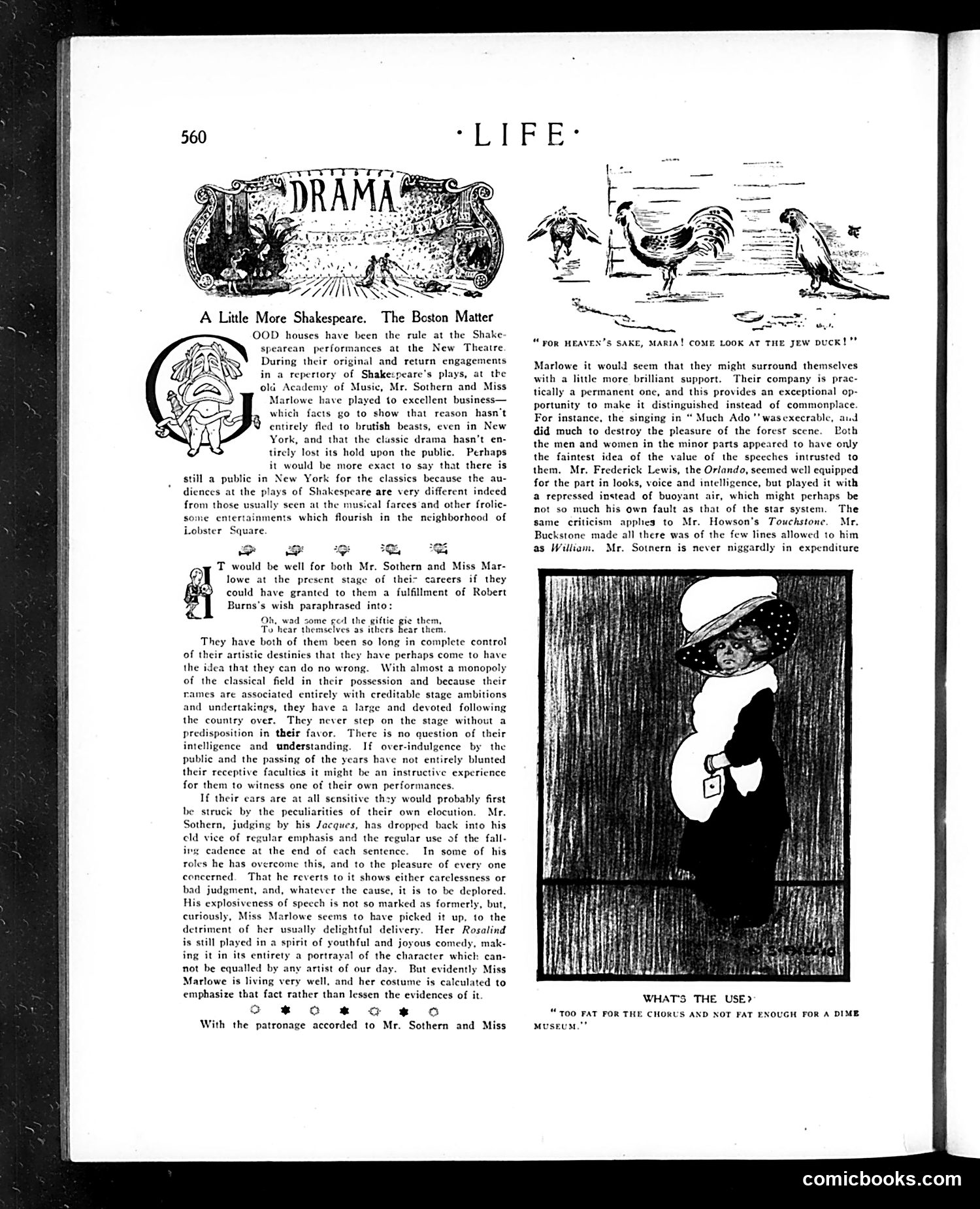
This theater review critiques actors Edward Sothern and Julia Marlowe's Shakespeare performances at New York's New Theatre. The piece praises their drawing power but faults their elocution and stage presence, suggesting they've grown complacent from years of unchallenged dominance in classical theater. The author advocates for self-awareness, paraphrasing Robert Burns to suggest they should "hear themselves as others hear them." Specific complaints include Sothern's monotonous emphasis patterns and Marlowe's adopted explosive delivery—both deteriorating habits. The review also criticizes their supporting cast as undistinguished, despite this being an opportunity for excellence. The cartoon at bottom ("For Heaven's Sake, Maria! Come Look at the Jew Duck!") appears unrelated to the review—a period humor panel typical of Life's format, though its reference is now obscure.
📄 Transcribed text from this page (OCR, searchable)
Machine-transcribed from the original scan — historical spelling and the odd misread are preserved.
ZAIRE ler 58 A Little More Shakespeare. The Boston Matter OOD houses have been the rule at the Shake: spearean performances at the New Theatre During their original and return engagements in a repertory of Shakecpeare’s pl old Academy of Music, Mr. Sothern and Miss Marlowe have played to excellent business— which facts go to show that reason hasn't entirely fled to brutish beasts, even in New York, and that the classic drama hasn’t en- tirely lost its hold upon the public. Perhaps it would be more exact to say that there is still a public in New York for the classics because the au- diences at the plays of Shakespeare are very different indeed from those uswally seen at the musical farces and other frolic- some entertainments which flourish in the neighborhood of Lobster Square T would be well for both Mr. Sothern and Miss Mar- lowe at the present stage of thei- careers if they could have granted to them a fulfillment of Robert Burns's wish paraphrased into: Oh, wad some ged the giftie gie them, To hear th clves as ithers hear them. They have both of them been so long in complete control of their artistic destinies that they have perhaps come to have the idea that they can do no wrong. With almost a monopoly of the classical field in their possession and because their rames are associated entirely with creditable stage ambitions and undertakings, they have a large and devoted following the country over. They never step on the stage without a predisposition in their favor. There is no question of their ence and understanding. If over-indulgence by the public and the passing of the years have not entirely blunted their receptive faculties it might be an instructive experience for them to witness one of their own performances. If their cars are at all sensitive thzy would probably first be struck by the peculiarities of their own elocution. Mr. Sothern, judging by his Jacques, has dropped back into his cld vice of regular emphasis and the regular use of the fall- cadence at the end of cach sentence. In some of his roles he has overcome this, and to the pleasure of every one concerned. That he reverts to it shows either carelessness or bad judgment, and, whatever the cause, it is to be deplored. His explosiveness of specch is not so marked as formerly, but, curiously, Miss Marlowe seems to have picked it up, to the detriment of her usually delightful delivery. Her Rosalind is still played in a spirit of youthful and joyous comedy, mak- ing it in its entirety a portrayal of the character which can- not be equalled by any artist of our day. But evidently Miss Marlowe is living very well, and her costume is calculated to emphasize that fact rather than lessen the evidences of it o *£ O *# G & 6 With the patronage accorded to Mr. Sothern and Miss “ Yor MEAVEN’S SAKE, MARIA! COME LOOK AT THE JEW DUCK!" Marlowe it would seem that they might surround themselves with a little more brilliant support. Their company is prac- tically a permanent one, and this provides an exceptional op- portunity to make it distinguished instead of commonplace. For instance, the singing in “ Much Ado" wasexecrable, aud did much to destroy the pleasure of the forest scene. Roth the men and women in the minor parts appeared to have only the faintest idea of the value of the specches intrusted to them. Mr. Frederick Lewis, the Orlando, seemed well equipped for the part in looks, voice and intelligence, but played it with a repressed instead of buoyant air, which might perhaps be not so much his own fault as that of the star system. The same criticism apphes to Mr. Howson’s Touchstone. Mr. Buckstone made all there was of the few lines allowed to him as William, Mr. Sotnern is never niggardly in expenditure WHATS THE USE? “100 FAT FOR THE CHORUS AND NOT FAT ENOUGH FOR A DIME MUSEUM.”’ comicbooks.com