
A complete issue · 32 pages · 1909
Life — December 16, 1909
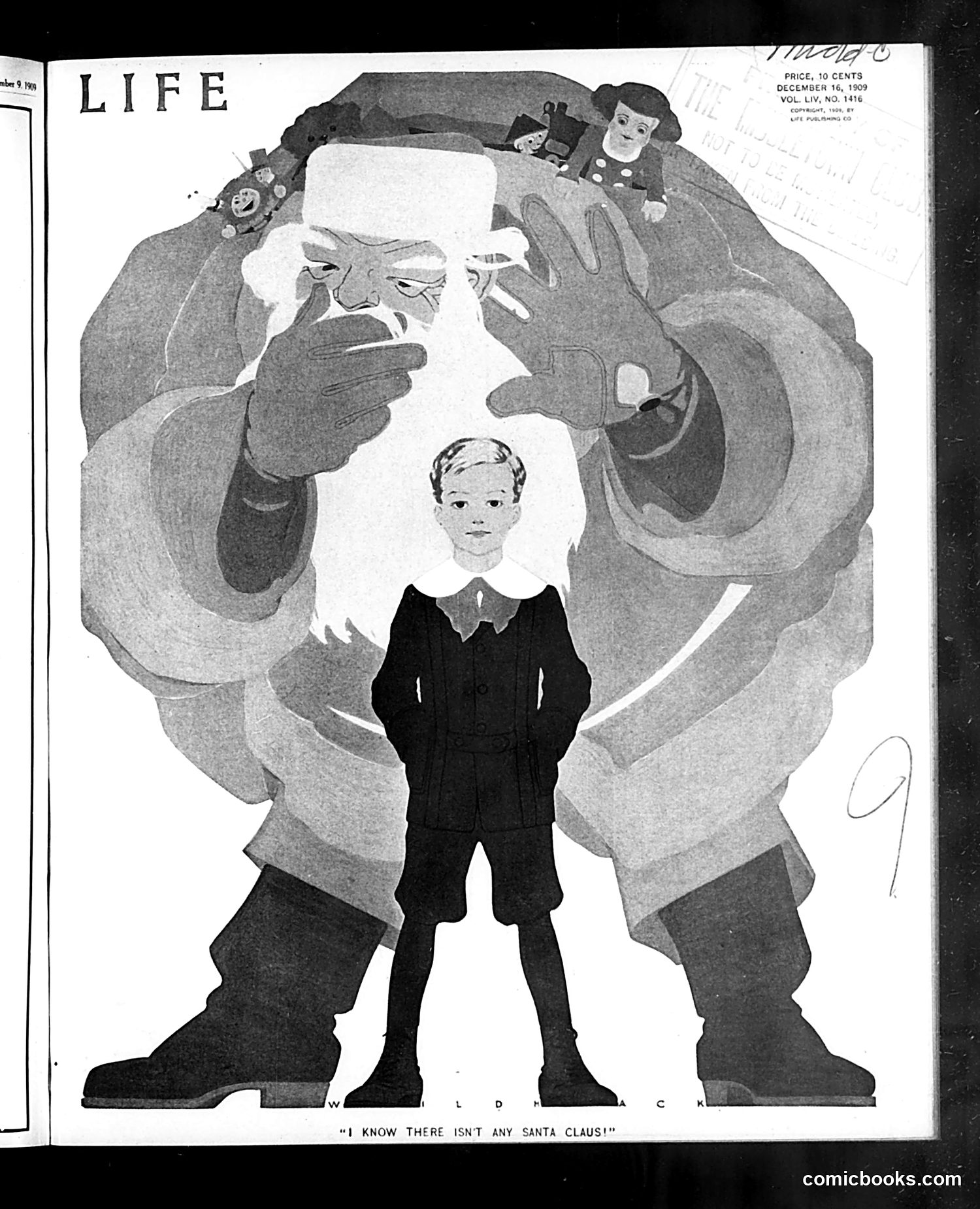
This cover depicts a young boy standing defiantly before large, menacing adult figures looming behind him. The caption reads "I KNOW THERE ISN'T ANY SANTA CLAUS!" The satire appears to target the loss of childhood innocence and the harsh realities adults impose on children. The grotesque, shadowy figures—possibly representing parents, society, or commercial interests—tower over the boy, who seems to have discovered or been told the truth about Santa Claus. The cartoon likely critiques how adults shatter children's illusions, either through negligence or deliberate disillusionment. It may also comment on commercialism's impact on Christmas and childhood wonder during the early 20th century. The boy's confident but somewhat isolated stance suggests both defiance and vulnerability in confronting uncomfortable truths.
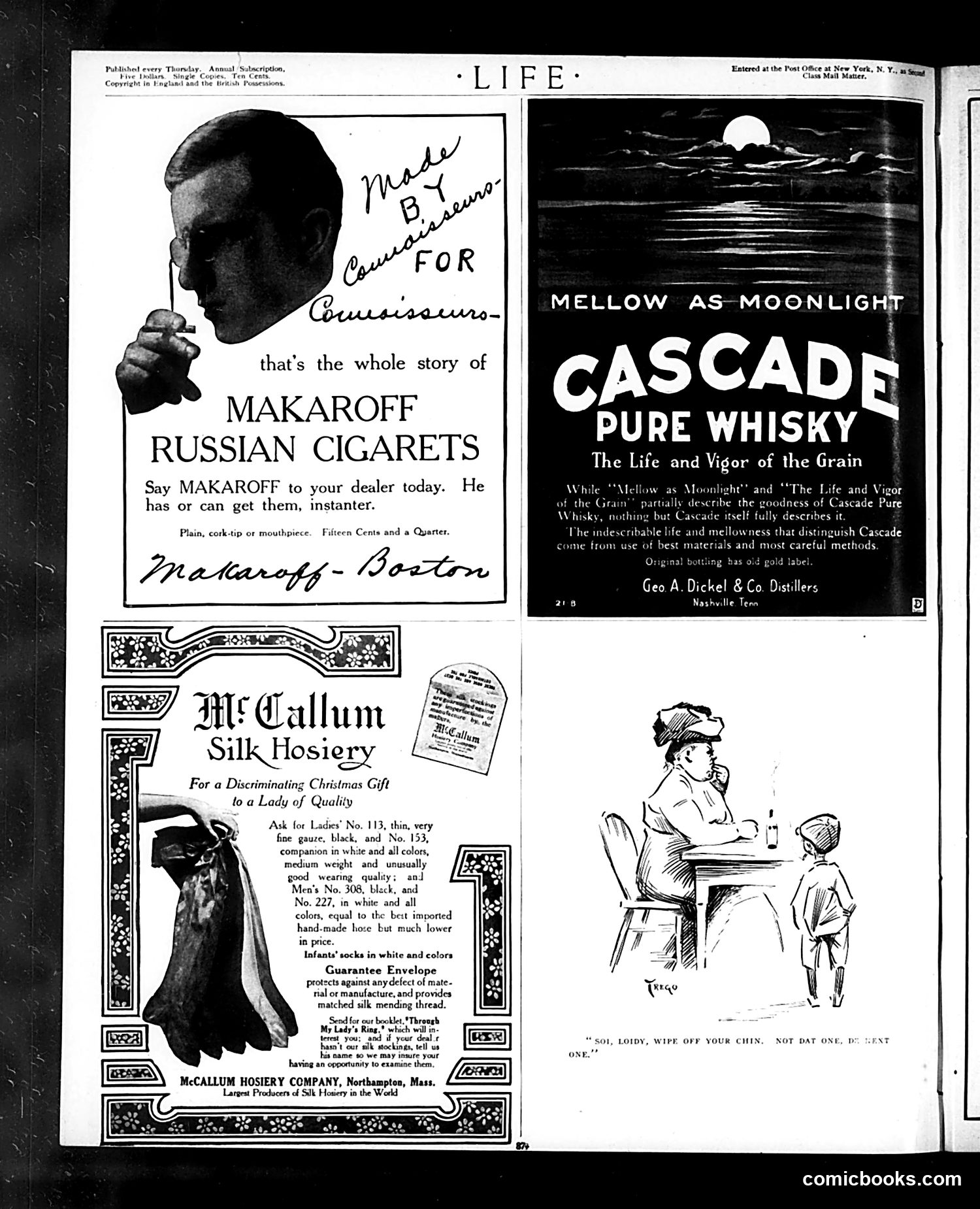
This page consists primarily of **advertisements** rather than satirical content. The ads include: 1. **Makaroff Russian Cigarettes** - features a man's profile with handwritten endorsement, selling "Plain, cork-up or mouthpiece" cigarettes for fifteen cents and a quarter. 2. **Cascade Pure Whisky** - promotes whiskey from Nashville distillers with poetic language about "Life and Vigor of the Grain." 3. **McCallum Silk Hosiery** - advertises women's stockings as Christmas gifts, emphasizing quality and variety. 4. **A single cartoon** (bottom right) depicting a woman at a desk with a child, captioned "SOI, LOIDY, WIPE OFF YOUR CHIN. NOT DAT ONE, D'SENT ONE." This appears to use working-class dialect humor, likely mocking Irish or immigrant speech patterns—a common satirical trope of the era.
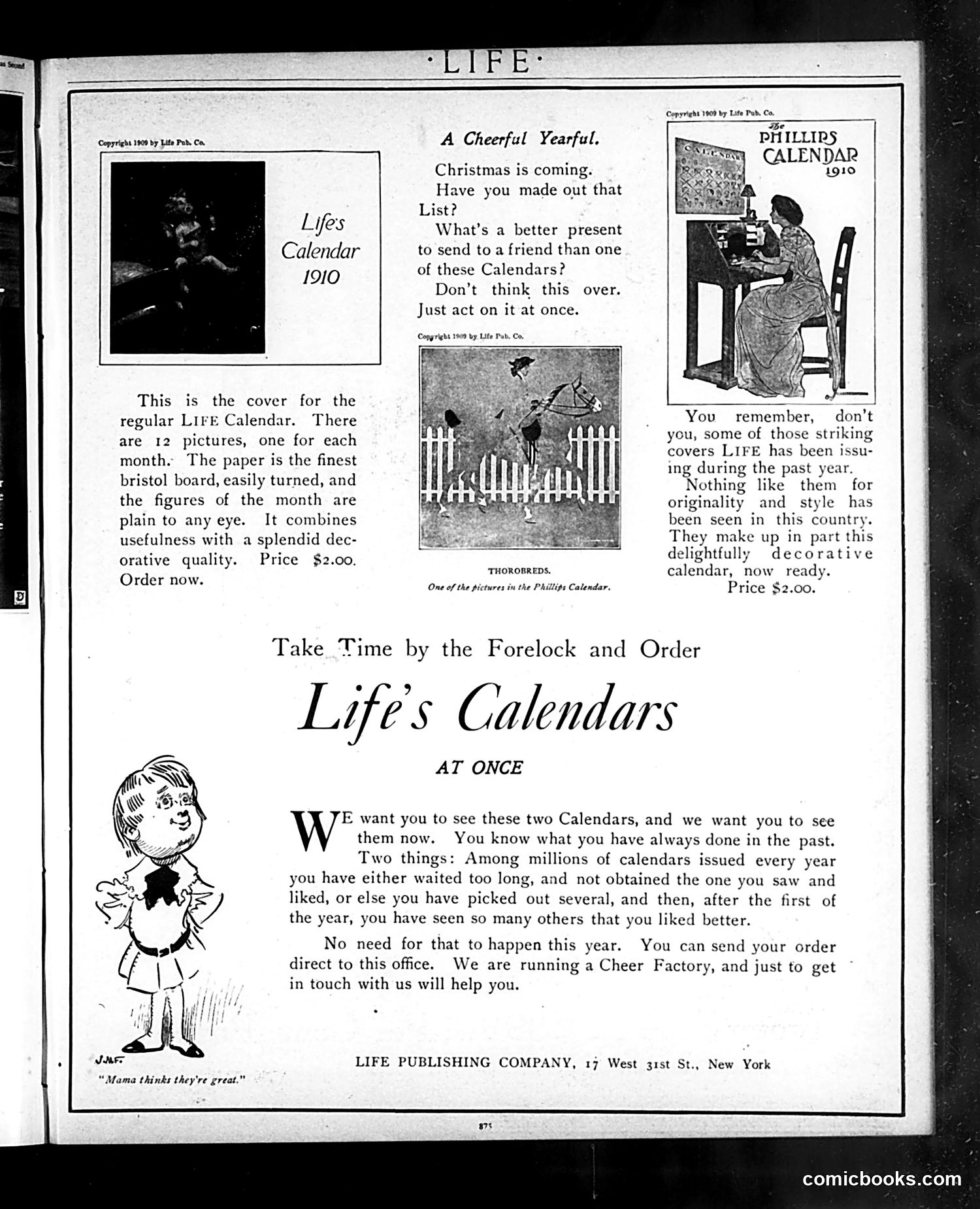
This page is primarily **advertising**, not political satire. It promotes Life magazine's 1910 calendars as Christmas gifts. The content includes: 1. **Life's Calendar 1910** — described as featuring 12 pictures on fine bristol board, priced at $2.00 2. **Phillips Calendar 1910** — similarly priced, with an illustration showing a woman examining it 3. A small cartoon of a girl with text "Mama thinks they're great" — likely endorsing the calendars as gifts 4. An editorial pitch encouraging readers to order promptly before popular designs sell out The single cartoon figure (the girl) appears to be a generic mascot rather than a caricature of a specific person. The page's purpose is straightforward product promotion timed for holiday shopping, with mild humor to make the ads more engaging.
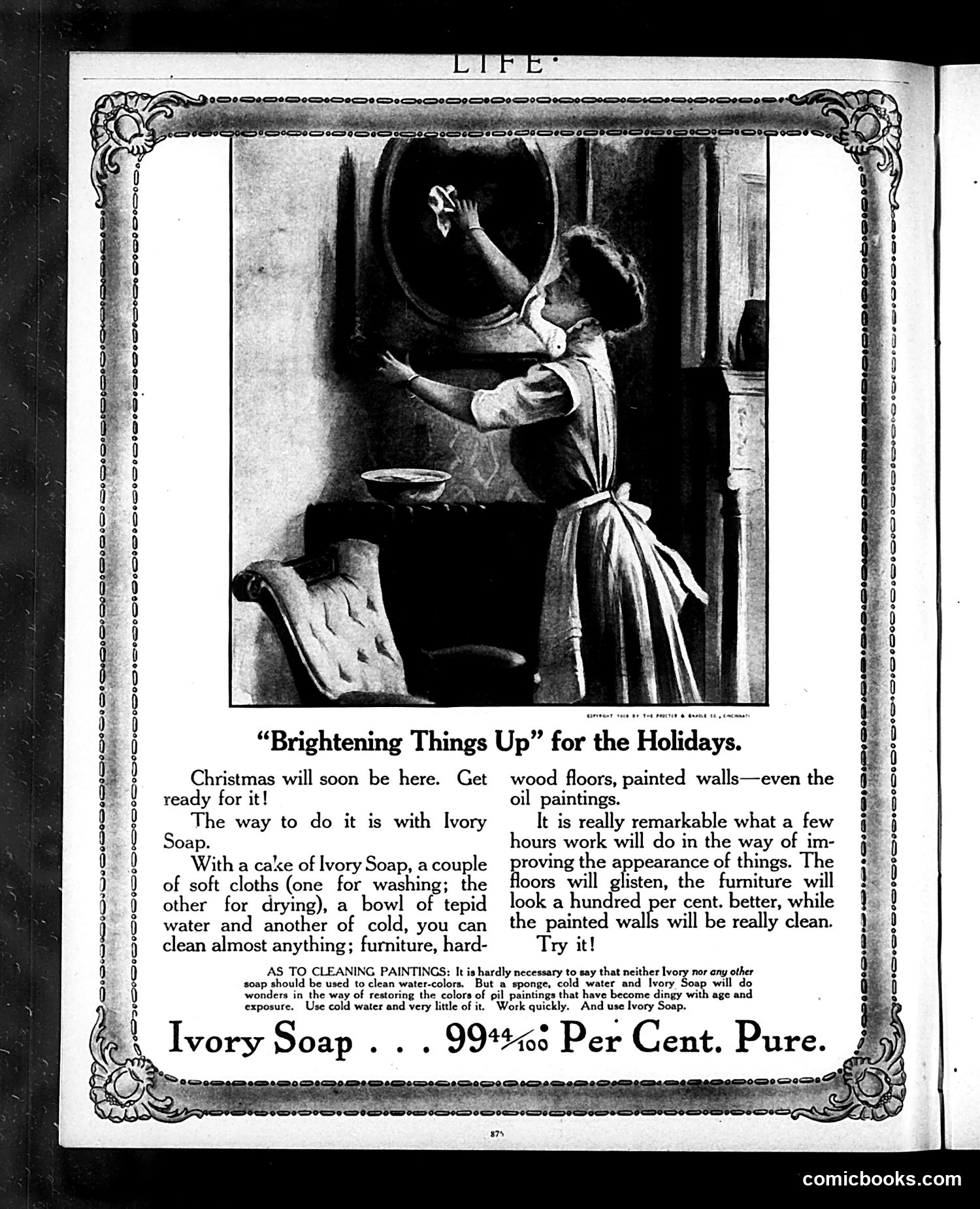
This page is **primarily an advertisement**, not satirical content. It's a commercial ad for Ivory Soap placed in *Life* magazine. The image shows a woman cleaning/polishing a large decorative bowl or mirror, promoting Ivory Soap's use for holiday home preparation. The headline "Brightening Things Up" for the Holidays" plays on the dual meaning—both literal cleaning and festive mood-lifting. The ad copy emphasizes Ivory Soap's purity (99 44/100% pure) and its effectiveness for cleaning delicate surfaces like painted walls and oil paintings. A technical note addresses concerns about using soap on art: cold water and Ivory Soap allegedly won't damage water-color paintings. This reflects early 20th-century domestic culture where holiday preparation meant intensive household cleaning, positioning the soap as an essential luxury product for genteel homemaking.
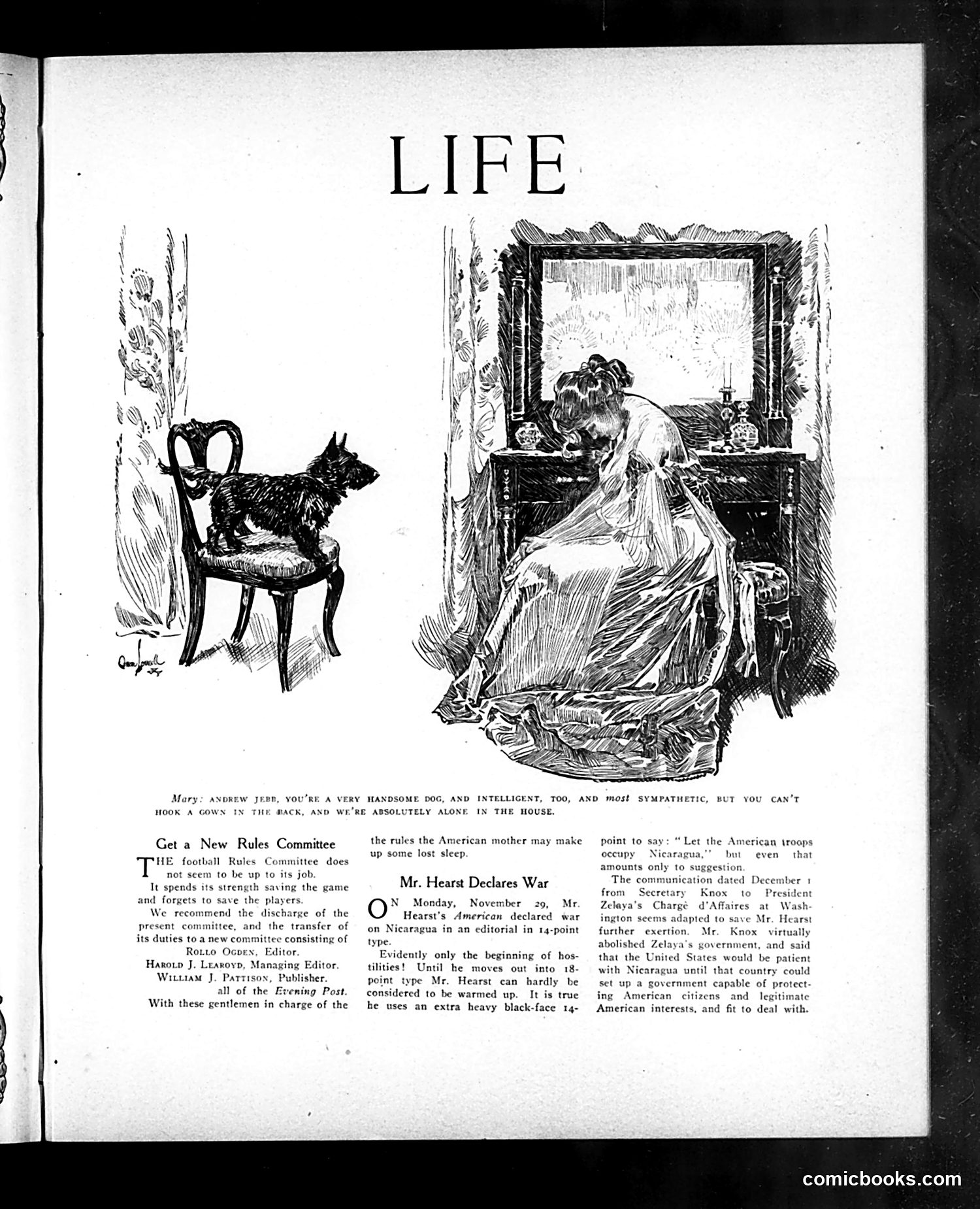
This page contains two distinct editorial items from what appears to be late November 1912. **Left cartoon**: Shows a small dog sitting on a decorative chair—a visual joke suggesting the dog is being treated as a valued committee member, illustrating the satirical article title "Get a New Rules Committee." **Right illustration**: Depicts a woman at a vanity mirror in an intimate domestic scene, accompanying dialogue where "Andrew Jerk" is addressed as "a very handsome dog" who cannot "hook a gown in the back" because they're "absolutely alone in the house." **Editorial content**: The page includes commentary on Mr. Hearst's declaration of war regarding Nicaragua, dated November 29. The text discusses American military intervention and diplomatic concerns, reflecting contemporary debates about U.S. foreign policy in Central America during the early 20th century.
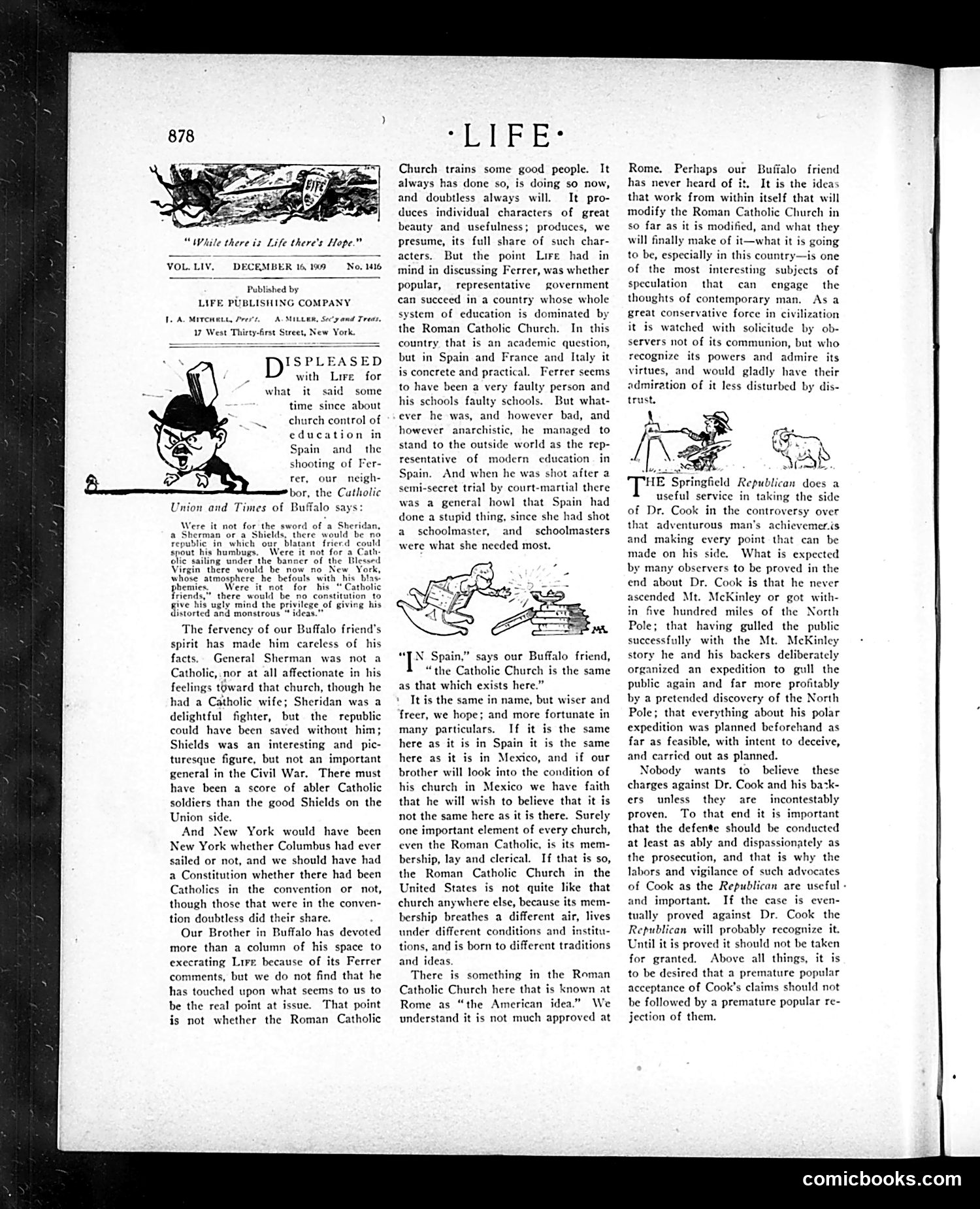
The page contains a political cartoon titled "Wait there is Life there's Hope" depicting a figure labeled "DISPLEASED" with church control of education in Spain and the shooting of Ferrer—likely referring to Francisco Ferrer Guardia, an anarchist educator executed by Spain in 1909. The cartoon satirizes the tension between progressive education reformers and Catholic Church dominance over Spanish schools. The text discusses whether the Roman Catholic Church should control education systems, using Ferrer's execution and controversial legacy as a focal point. The page also critiques Dr. Cook's Arctic expedition claims and discusses the Springfield *Republican* newspaper's coverage of these controversies. The overall tone is anti-authoritarian and skeptical of both religious institutional power and sensationalist exploration narratives.
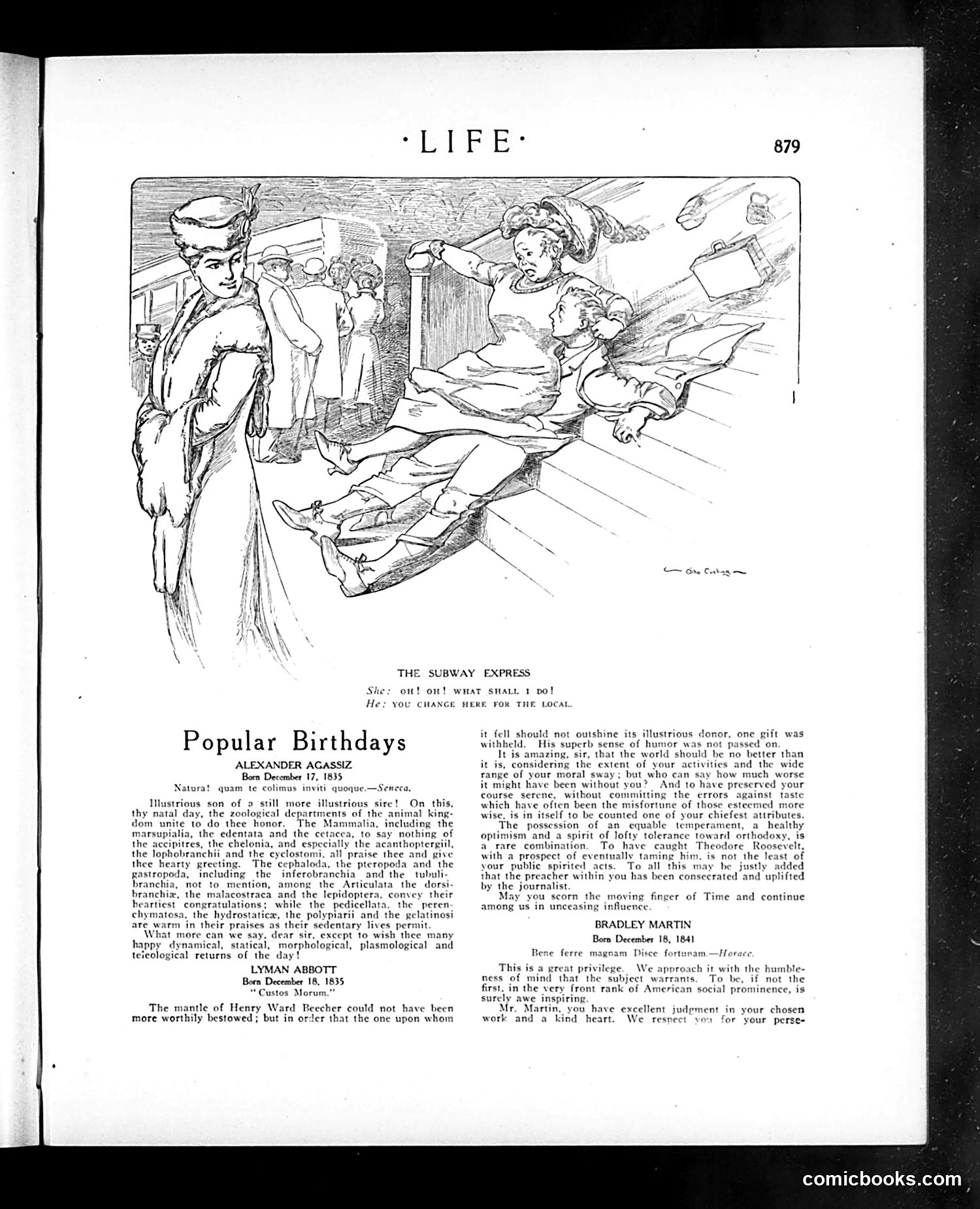
This cartoon satirizes the chaos of early 20th-century New York City subway crowding. A well-dressed woman stands apart, looking distressed, while multiple passengers are crammed together in exaggerated, contorted positions. The caption reads: "She: oh! oh! what shall I do! / He: you change here for the local." The joke targets the absurdity of subway congestion—the man's casual suggestion to "change for the local" is darkly humorous given the packed, nearly unmanageable conditions already shown. The woman's panic contrasts with his indifference, mocking both the transit system's failure to manage passengers and commuters' resigned acceptance of these conditions. The cartoon critiques the strain of rapid urban transit on daily life in New York.
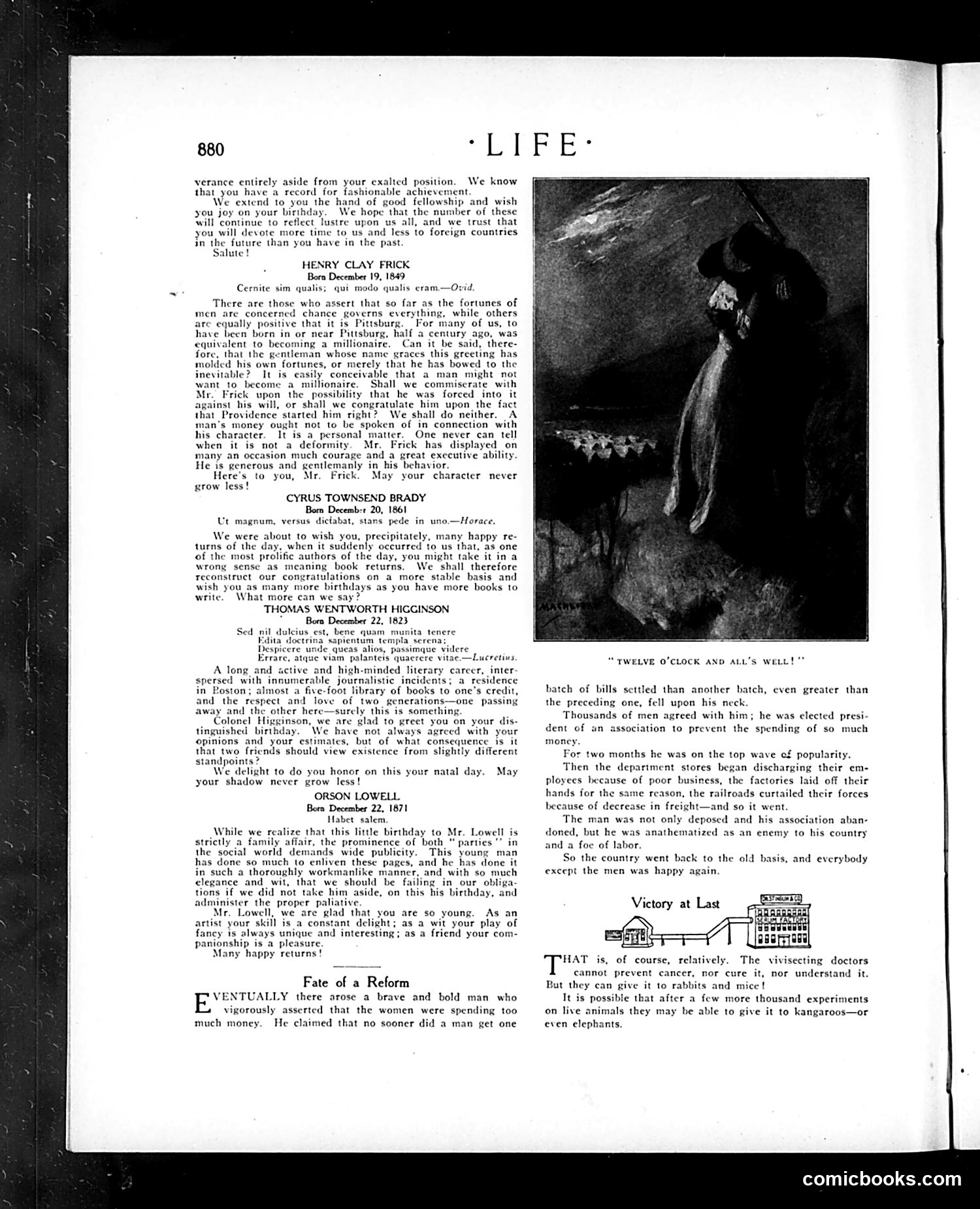
This page contains birthday congratulations to prominent figures (Henry Clay Frick, Cyrus Townsend Brady, Thomas Wentworth Higginson, and Orson Lowell), followed by two satirical sections. **"Twelve O'Clock and All's Well!"** appears to be a cartoon about labor disputes and business shutdowns. It references factory closures, railroad curtailments, and workers' associations preventing excessive spending—likely commentary on early 20th-century labor unrest and economic pressures. **"Fate of a Reform"** satirizes a reformer's complaint about women's spending habits. A "brave and bold man" claims women spend too much money, but the satire suggests such reform efforts are ultimately ineffective or hypocritical—mocking both the reformer's ambitions and gender-based economic criticism. The page reflects Progressive Era concerns about labor, consumption, and social reform.
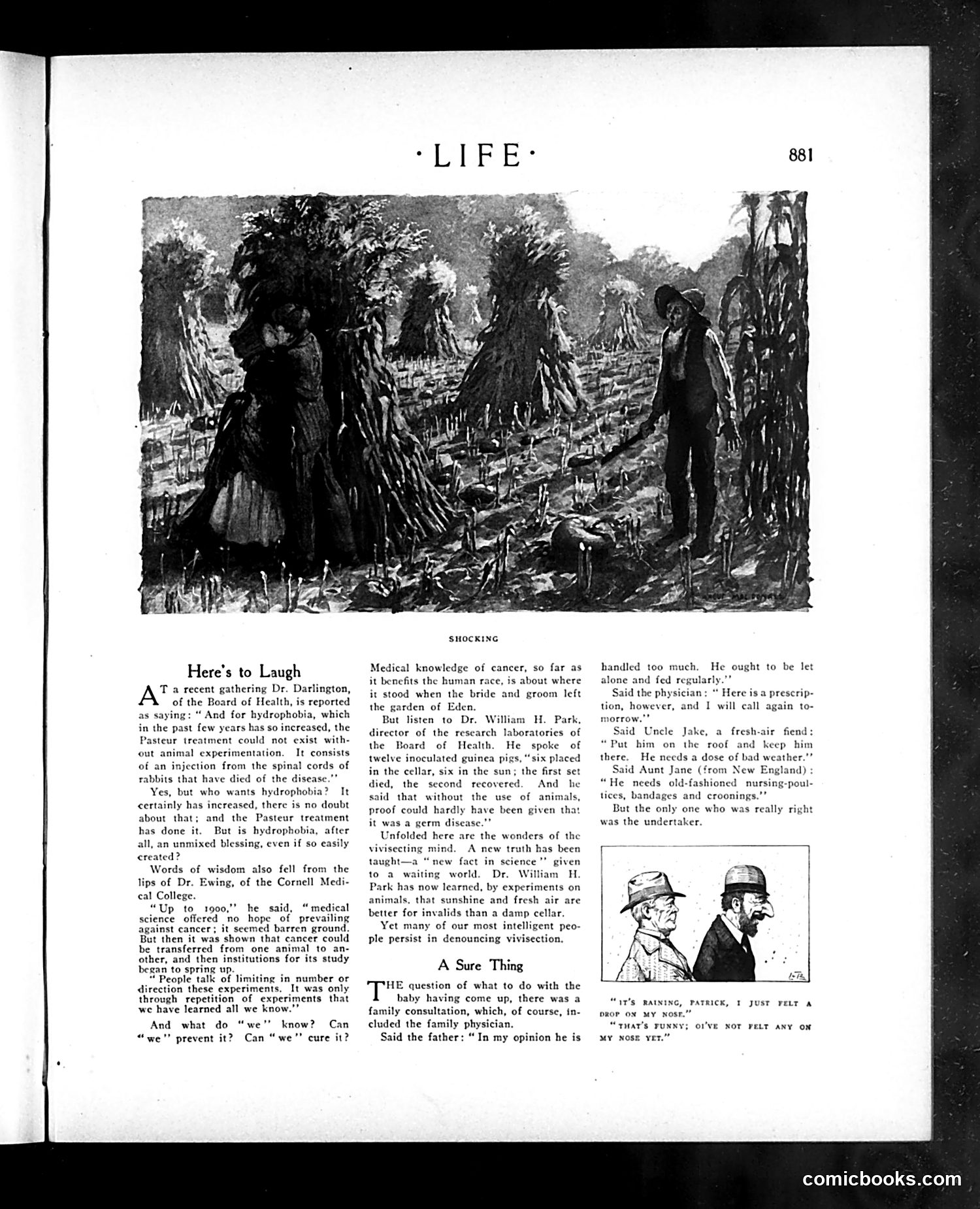
This page contains two satirical pieces about medical and scientific topics. **"Here's to Laugh"** mocks the anti-vivisection movement—opponents of animal testing. The article reports that the Pasteur treatment for rabies required guinea pig experiments, yet anti-vivisectionists opposed this life-saving research. The satire highlights the contradiction: people who denounce animal testing also benefit from medical advances that depend on it. **"A Sure Thing"** appears to be a brief comedic anecdote about parenting advice, shown in the small cartoon at bottom right. The main illustration depicts a cornfield scene, likely illustrating one of these narratives, though the specific connection isn't entirely clear from the text alone. The overall thrust criticizes what Life viewed as misguided moral absolutism that would prevent scientific progress.
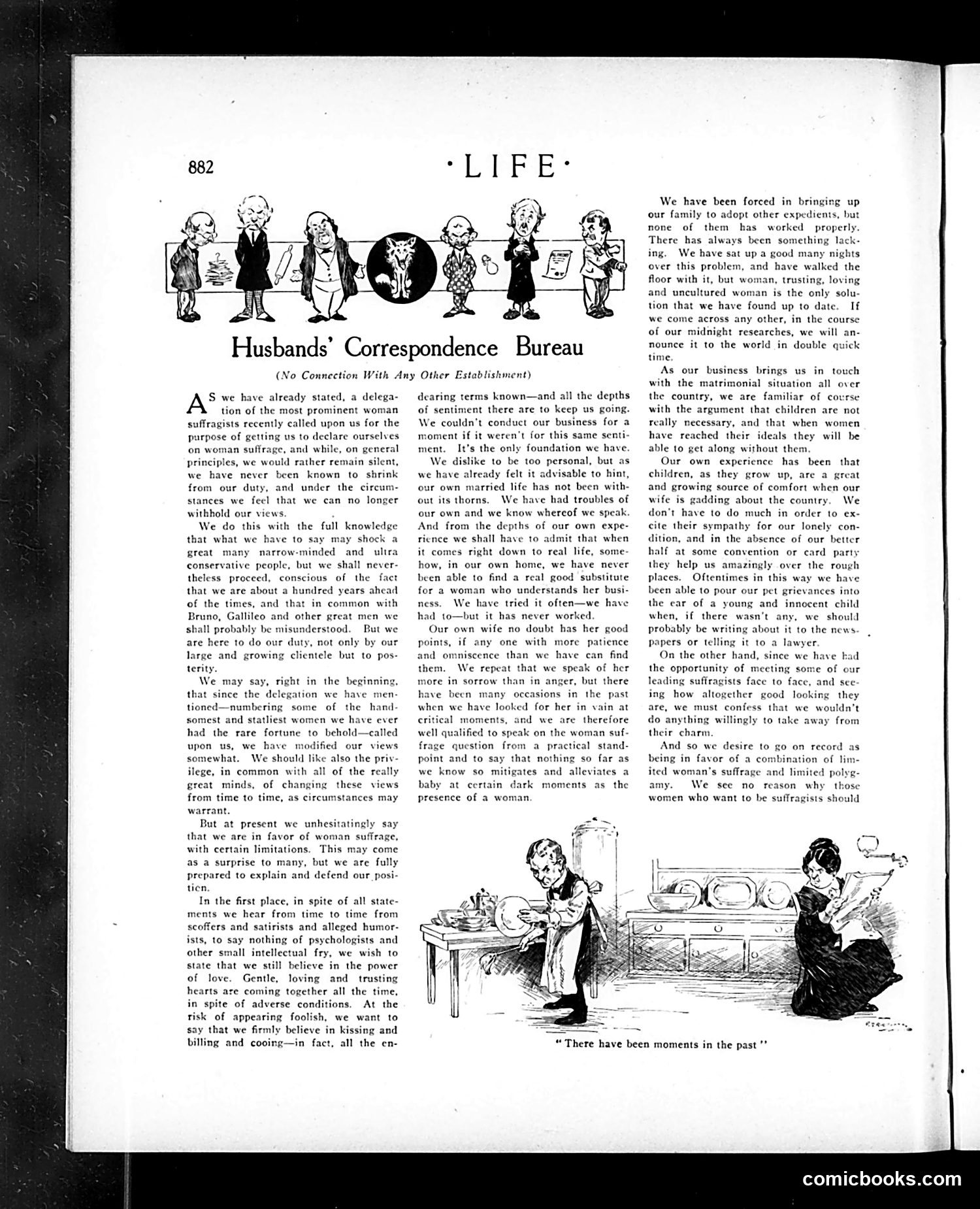
This satirical piece mocks the early women's suffrage movement through a fictional "bureau" addressing marital discord. The cartoon depicts husbands complaining about their wives' activism, presenting suffragists as neglectful homemakers obsessed with politics rather than domestic duties. The bureau's response defends women by arguing that wives have attempted to support their husbands adequately, but men remain unsatisfied. It suggests that women's grievances about marriage are legitimate and that suffrage activism represents a reasonable response to marital unhappiness. The illustration shows a woman washing dishes while another appears to lecture or argue, satirizing the conflict between domestic expectations and women's growing political engagement. The piece essentially uses humor to defend women's right to pursue causes beyond housekeeping while critiquing male complaints about changing gender roles.
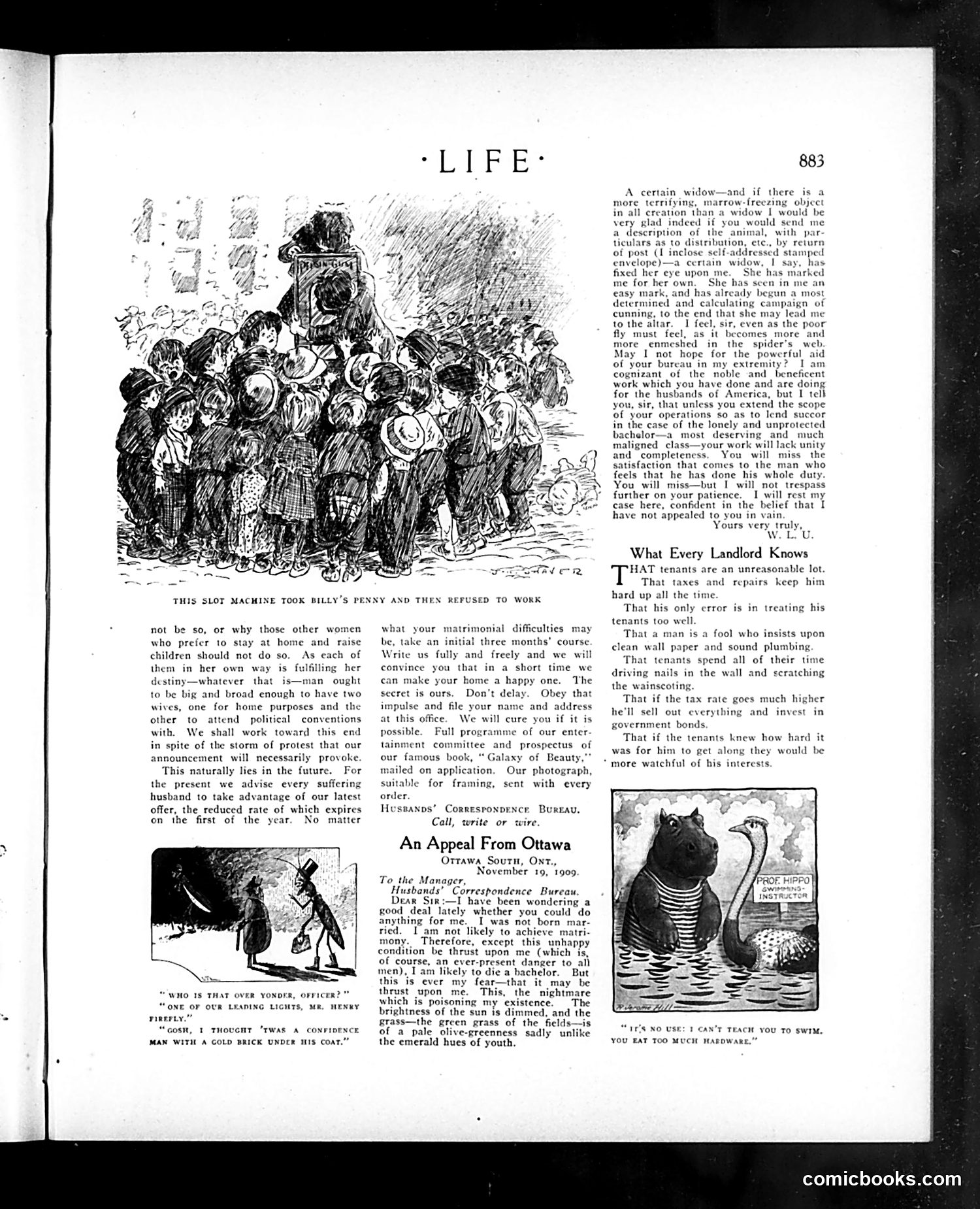
This page contains several distinct pieces: **Main Illustration (top left):** A crowded scene labeled "THIS SLOT MACHINE TOOK BILLY'S PENNY AND THEN REFUSED TO WORK" - satirizing malfunctioning slot machines that took coins without delivering goods, a common consumer complaint of the era. **"What Every Landlord Knows":** A satirical advice column mocking landlords' exploitative practices—overcharging tenants, neglecting repairs, demanding perfect conditions while providing poor plumbing and maintenance. **"An Appeal From Ottawa":** A humorous letter from someone expressing concerns about remaining unmarried and dying a bachelor, fearing bachelorhood's social stigma. **Bottom right illustration:** Appears to show someone refusing swimming instruction, with the caption "IT'S NO USE; I CAN'T TEACH YOU TO SWIM, YOU EAT TOO MUCH HARDWARE." The page demonstrates Life's satirical approach to consumer complaints, housing issues, and social anxieties of early 20th-century America.
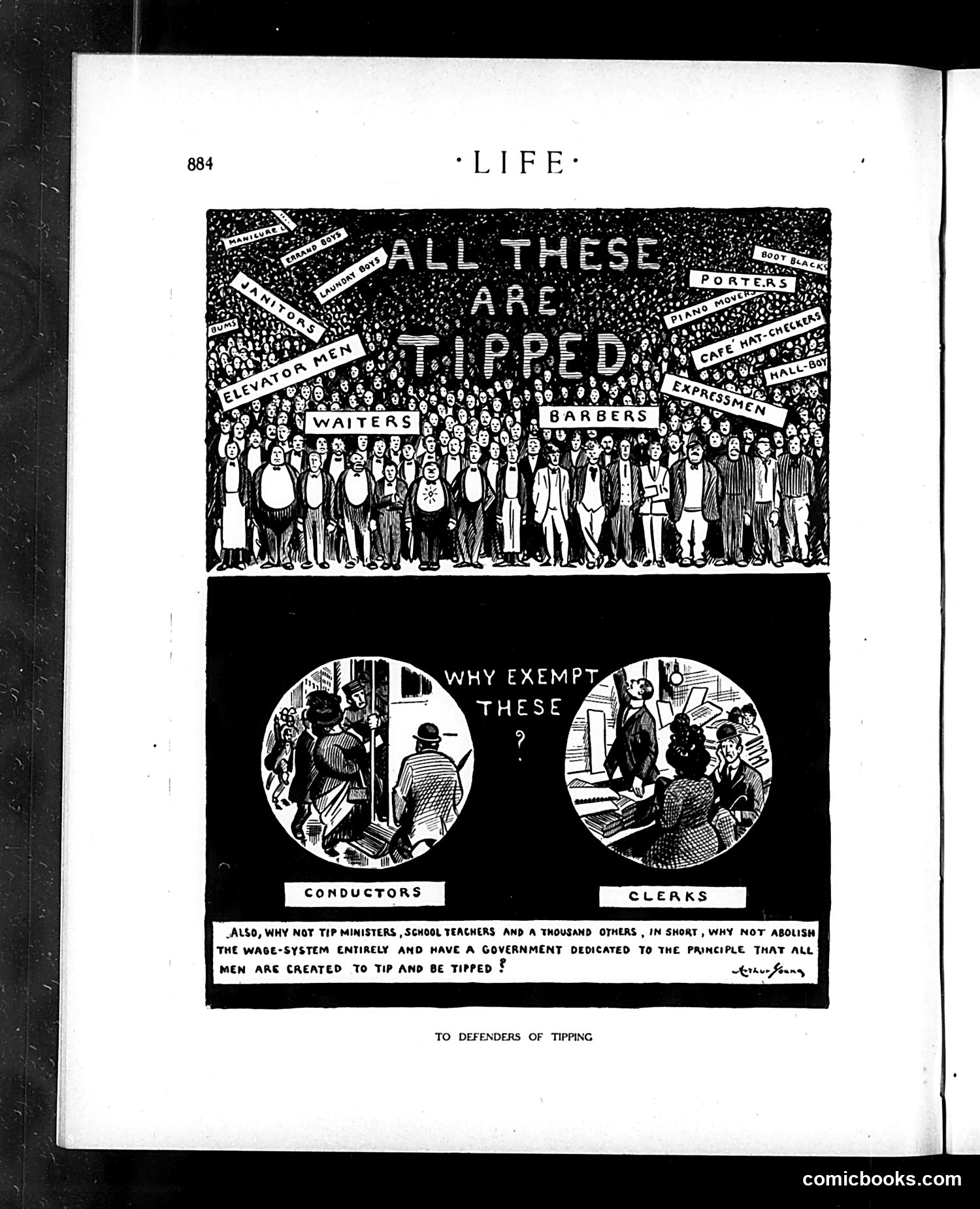
This page advocates for eliminating tipping customs entirely. The top panel shows various service workers ("Waiters," "Barbers," "Porters," etc.) labeled "ALL THESE ARE TIPPED," depicting them as a massive crowd—suggesting the practice affects numerous professions. The lower section asks "WHY EXEMPT THESE?" showing Conductors and Clerks, arguing these professionals aren't tipped despite performing similar service work. The satirical point: the tipping system is arbitrary and illogical. The accompanying text (partially visible) proposes abolishing tipping entirely and instead establishing government-guaranteed wages where "all men are created to tip and be tipped." This advocates for systematic wage reform rather than relying on customer generosity—a progressive economic critique of the early 20th-century wages system.
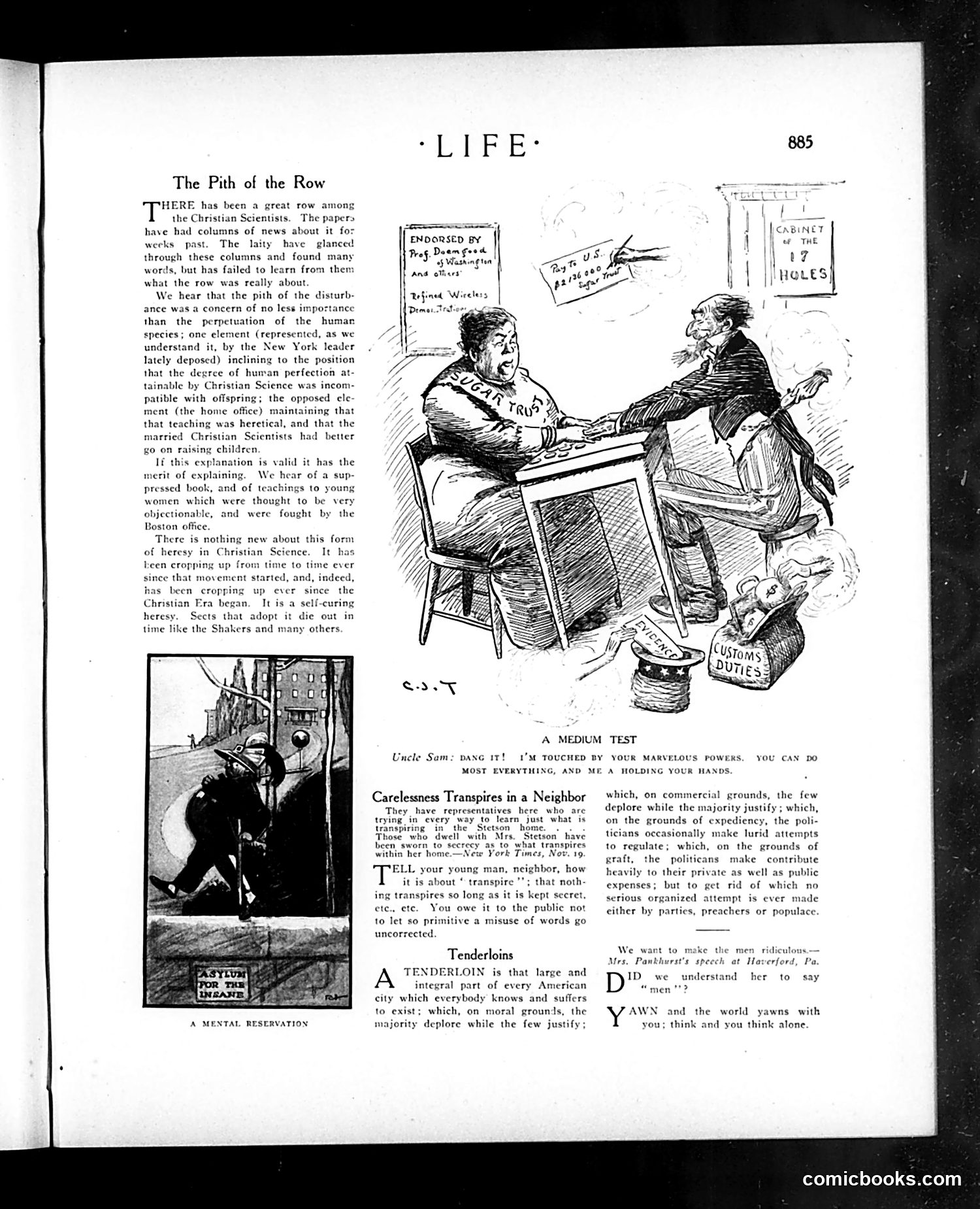
This cartoon satirizes the "Christian Science" movement's claims about healing and human perfection. The main illustration shows Uncle Sam being manipulated like a puppet by a practitioner, with the caption stating Uncle Sam is "touched by your marvelous powers. You can do most everything, and me a holding your hand." The satire targets Christian Scientists' assertions that they could achieve "human perfection" through their teachings, contrary to mainstream religious doctrine. The cartoon suggests Uncle Sam (America itself) is being dangerously manipulated by these occult-seeming powers. The surrounding text critiques the movement's "heresy," comparing it to historical sects like the Shakers. The page presents this as a cautionary warning about pseudoscientific religious movements deceiving the public and national interests.
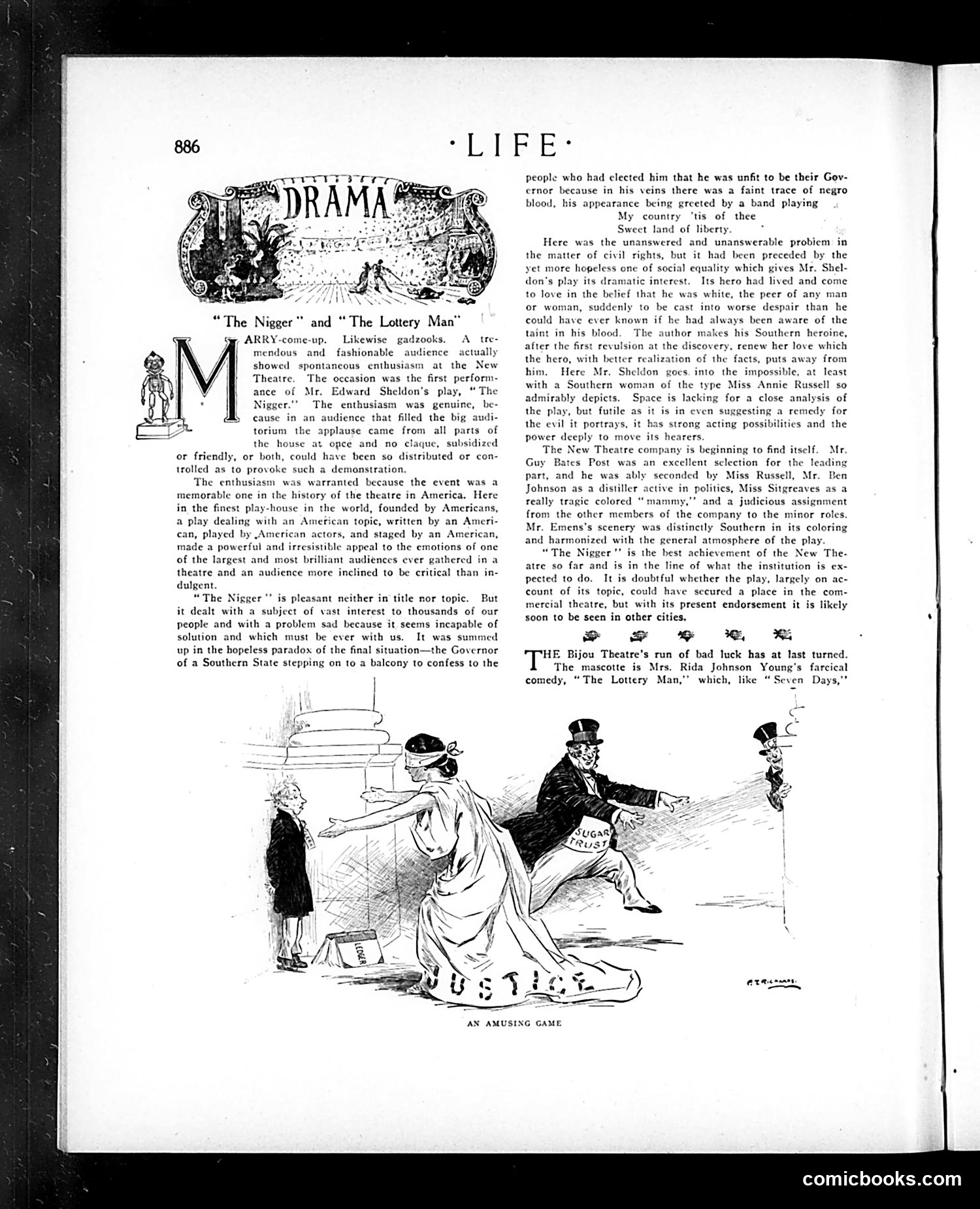
This page reviews Edward Sheldon's 1909 play *"The Nigger,"* which premiered at New York's New Theatre. The drama concerns a Southern governor who discovers he has Black ancestry and publicly confesses his "unfitness" to lead, revealing the paradox of American racial prejudice: a man deemed acceptable as governor becomes unacceptable upon learning of mixed ancestry. The text praises the play's serious treatment of an urgent social problem—civil rights and racial equality—while acknowledging it offers no solution. The reviewer highlights strong performances, particularly Annie Russell as a Southern woman who initially rejects the protagonist but later reconsiders. The bottom cartoon, titled "An Amusing Game," satirizes the legal system's treatment of racial justice. Lady Justice appears blindfolded and manipulated by politicians and men in top hats labeled "sugar trust," suggesting the judiciary is compromised and justice itself is merely a game controlled by corrupt interests rather than an impartial institution.
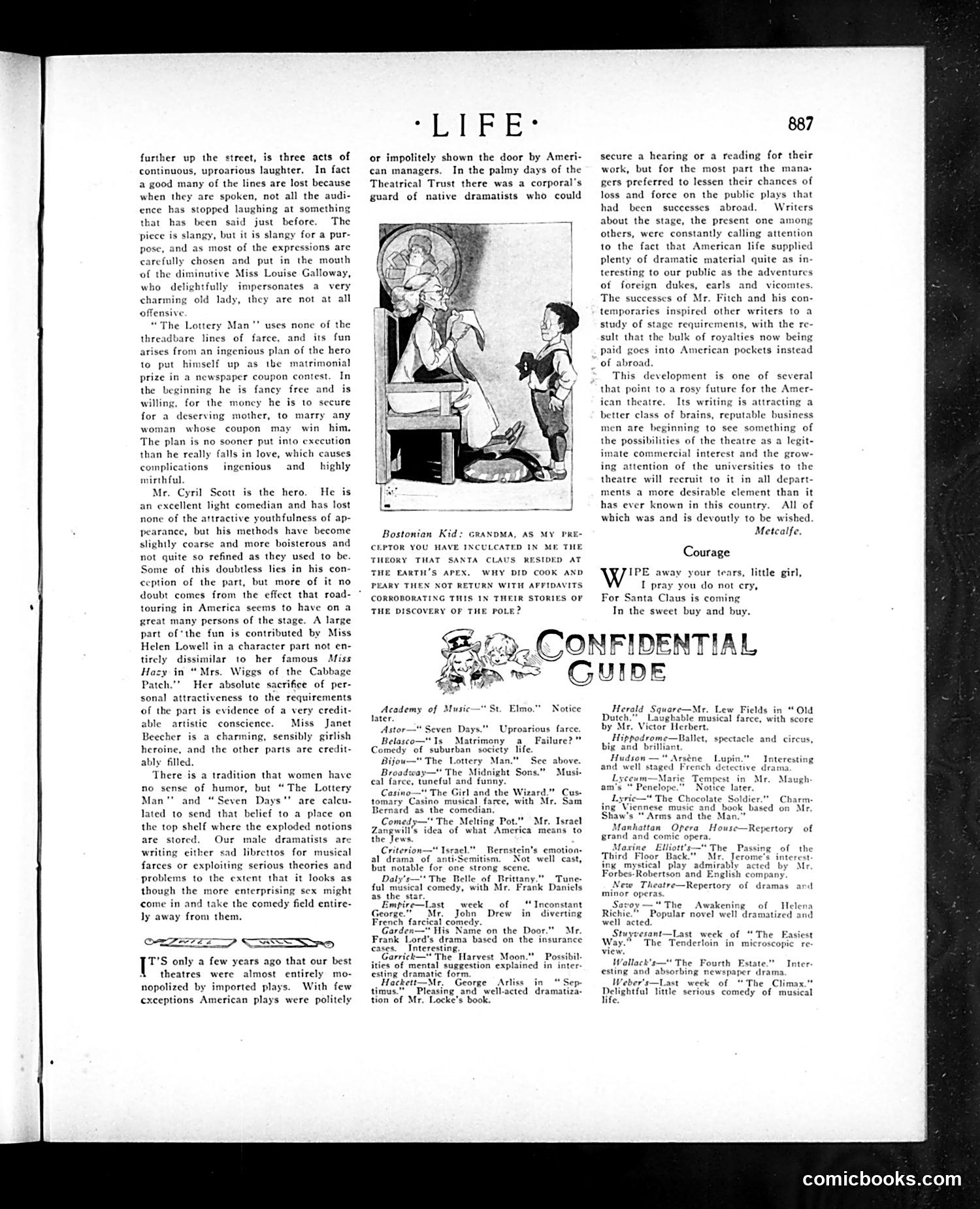
This page discusses American theatrical development, celebrating that native dramatists have finally gained respect after years of European plays dominating American stages. **The Main Cartoon** depicts "The Bostonian Kid," a child challenging his grandmother's claim that Santa Claus lives at the Earth's Apex. The boy references explorers Cook and Peary's recent Arctic expeditions, sarcastically asking why they didn't return with "affidavits corroborating" Santa's polar residence. This is **satire on pseudo-intellectual Boston children**—the joke mocks overly precocious youngsters who weaponize recent news events to deconstruct childhood myths with absurd logical "evidence." The surrounding text praises American plays like "The Lottery Man" and "Seven Days," noting that American dramatists are finally creating comedy rivaling imported European works. The passage expresses optimism that American theatre is maturing as a commercial and artistic enterprise worthy of university study.
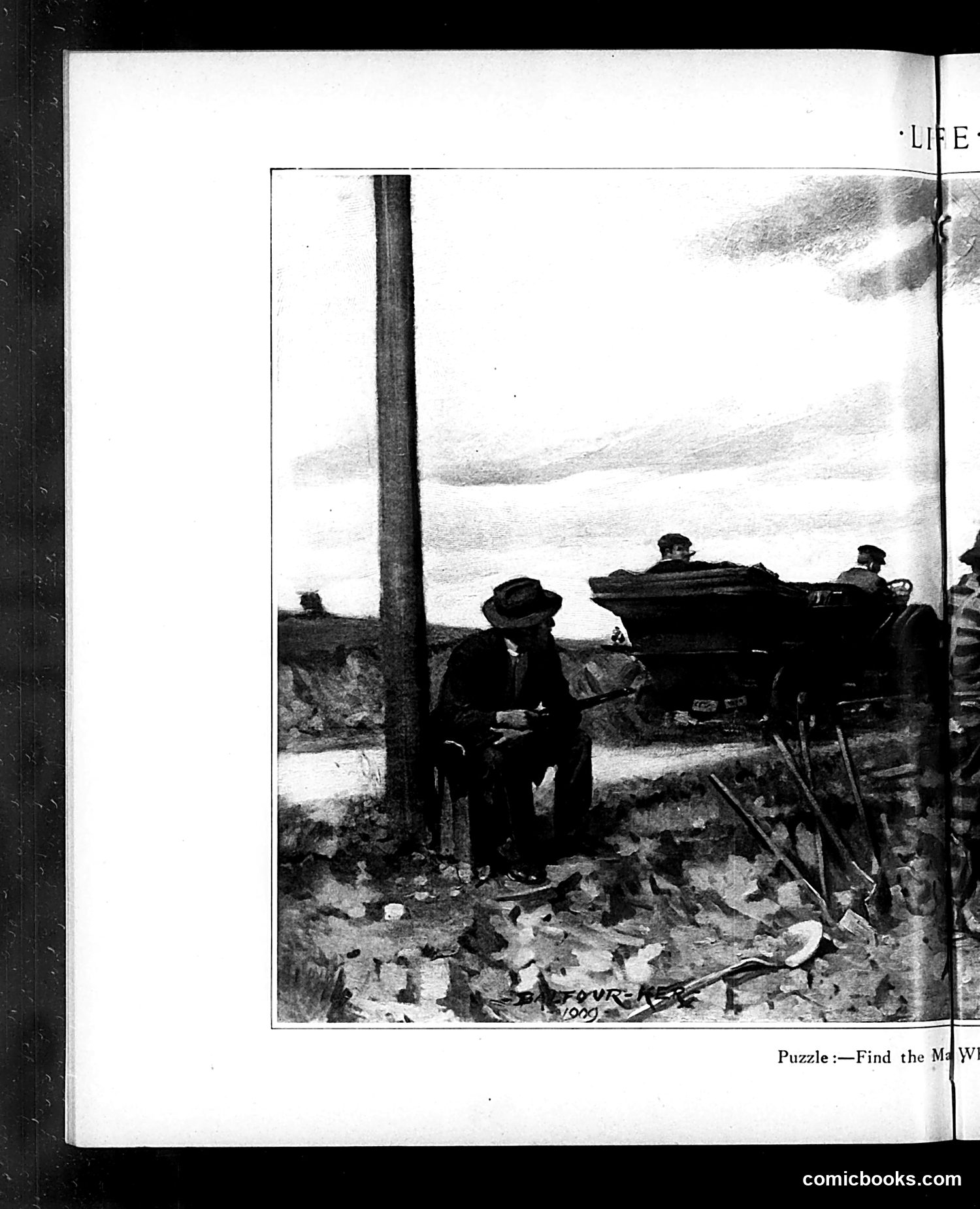
This appears to be a puzzle or "find the hidden object" feature common in Life magazine. The photograph shows what looks like a World War I or early 20th-century scene with soldiers, a horse-drawn cart, and a tall wooden post in a rural, muddy setting. The caption reads "Puzzle:—Find the M[?] W[?]" (text is partially cut off). This suggests readers were challenged to locate something specific within the image—likely a person, object, or military equipment hidden or camouflaged in the scene. Without the complete caption or date, the specific reference is unclear, but such puzzles were popular Life magazine features that entertained readers while potentially commenting on wartime conditions or military logistics through humorous challenges.
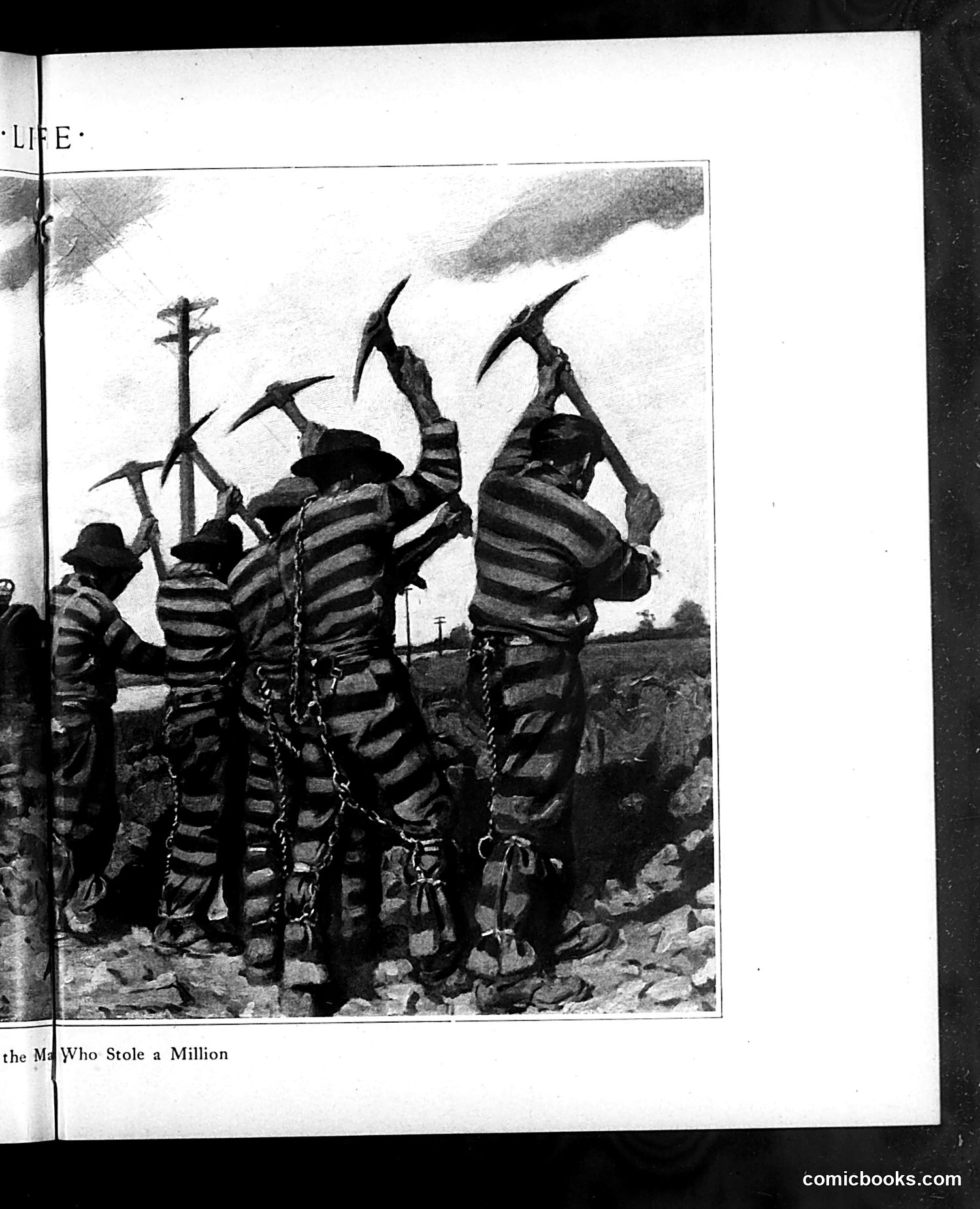
This appears to be a satirical cartoon from *Life* magazine depicting convicts in striped prison uniforms wielding pickaxes or similar tools, set in what looks like a quarry or work gang setting. The title "The Man Who Stole a Million" suggests commentary on a significant theft or embezzlement case. The image likely satirizes either a real criminal case or broader themes about white-collar crime versus manual labor punishment. The contrast between the title (suggesting a major financial crime) and the image of common laborers in prison suggests irony—perhaps criticizing how wealthy criminals were treated compared to ordinary prisoners, or commenting on a specific high-profile theft case of the era. Without the full article text, the specific historical reference remains unclear.
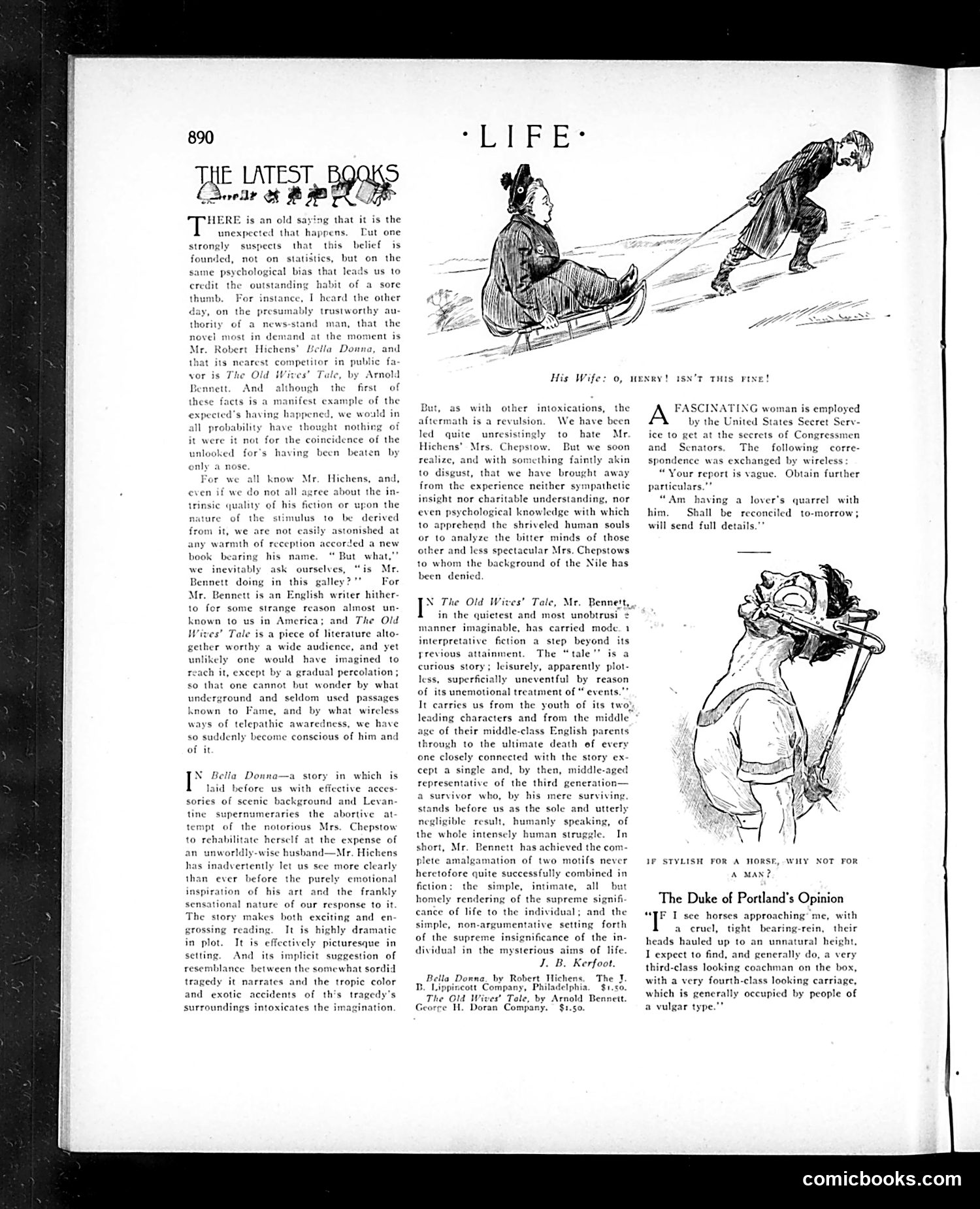
This page reviews three recent novels, with two accompanying illustrations satirizing literary and social pretension. The **top cartoon** shows a couple sledding: the wife sits contentedly on the sled while the husband strains to pull it, captioned "His Wife: O, Henry! Isn't This Fine!" The satire mocks gender dynamics and male effort—the husband labors while the wife enjoys leisure, inverting traditional expectations. The **bottom illustration** labeled "If Stylish for a Horse, Why Not for a Man?" depicts someone in an exaggerated riding outfit, ridiculing fashionable affectation and perhaps gender-nonconforming dress. The text reviews novels by Robert Hichens (*Bella Donna*) and Arnold Bennett (*The Old Wives' Tale*), debating their literary merit and unexpected popularity. The reviewer notes Bennett's work, though initially overlooked, has unexpectedly succeeded—illustrating the page's opening theme that "the unexpected happens" in publishing, defying statistical predictions about literary success.
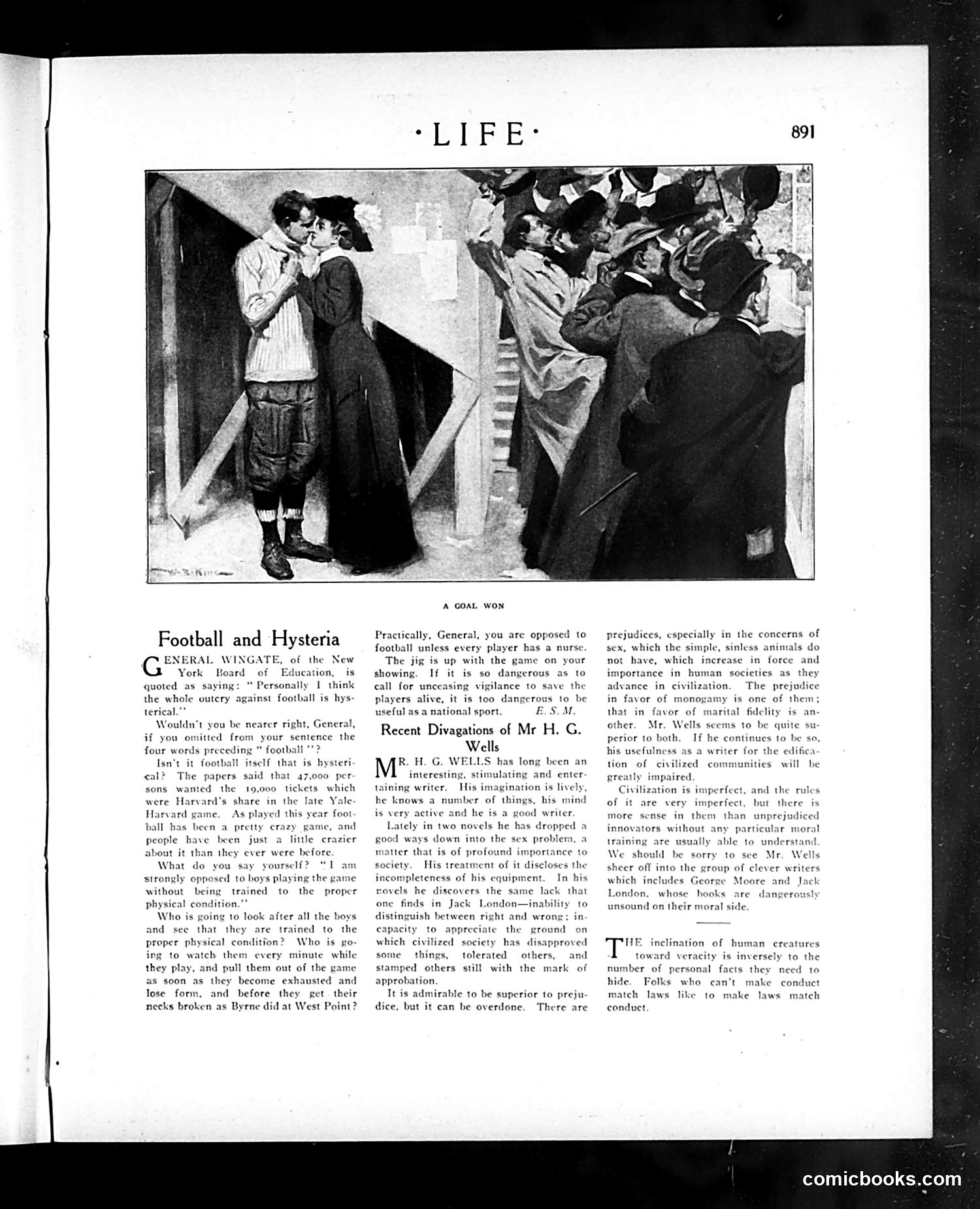
This page satirizes two contemporary issues: **"Football and Hysteria"** (top): Critiques General Wingate's dismissal of safety concerns about college football as "hysteria." The cartoon mocks his position by pointing out the logical contradiction: if football is only safe with constant medical supervision (implicitly "a nurse" for each player), then it's inherently too dangerous for a sport. The satire argues Wingate can't have it both ways—either acknowledge football is dangerously violent, or stop calling concerns hysterical. This reflects genuine early-1900s debate about football's brutality (the text references a fatal accident at West Point). **"Recent Divagations of Mr H.G. Wells"** (bottom): Criticizes the acclaimed author H.G. Wells for abandoning literary restraint in recent novels addressing sexual morality. The critique argues Wells, in rejecting conventional prejudices about monogamy and marital fidelity, has become reckless—confusing intellectual superiority to prejudice with abandoning moral judgment entirely. The satire suggests Wells's usefulness as a cultural guide is thereby compromised.
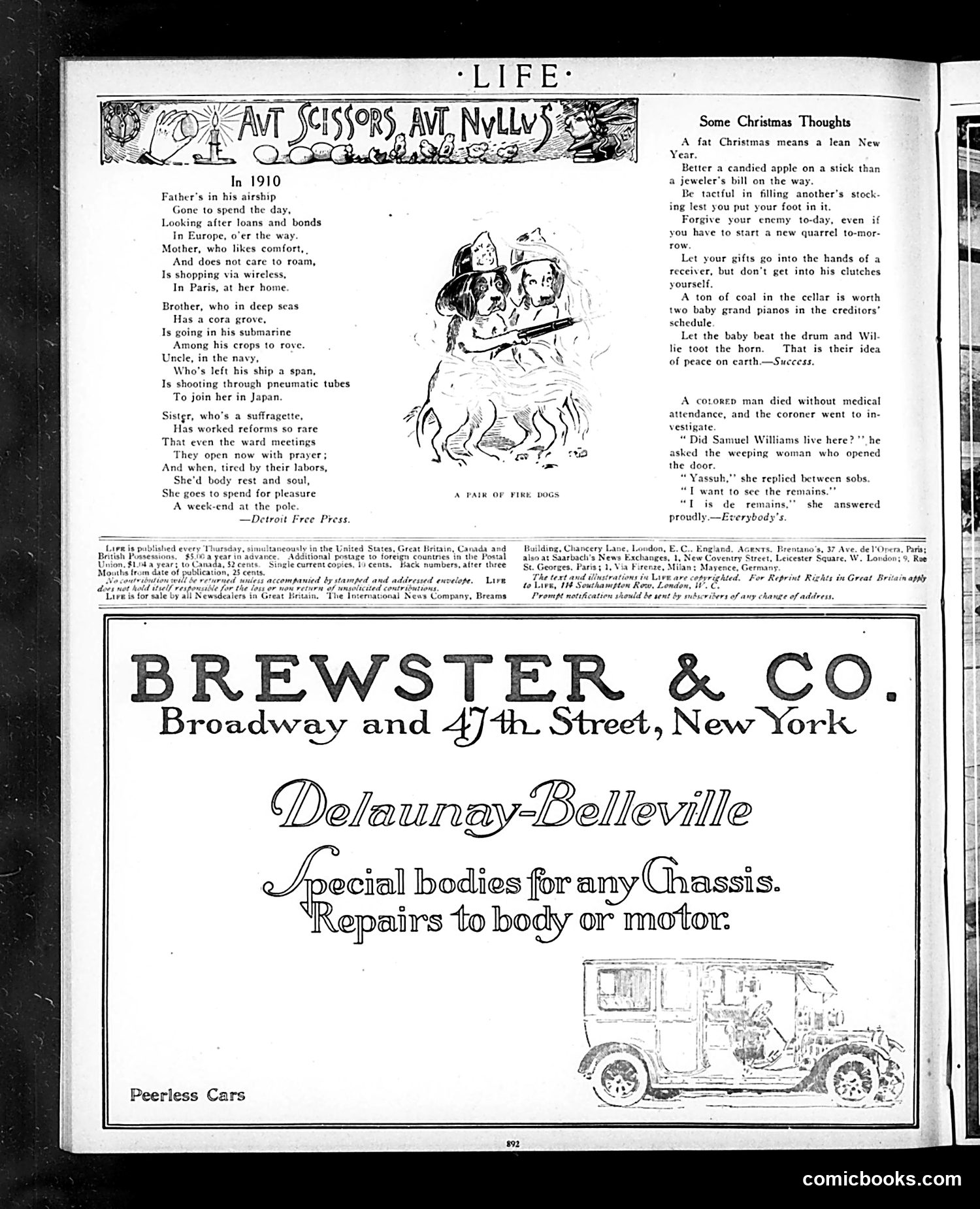
This satirical poem mocks the wealthy leisure class of 1910, depicting an absurdly futuristic family scattered across the globe pursuing frivolous pursuits. The joke hinges on extravagant technology enabling excessive consumption and idle pleasure-seeking. Key figures include: Father conducting international banking via airship; Mother shopping in Paris wirelessly from home; Brother tending underwater coral farms by submarine; Uncle traveling via pneumatic tubes to Japan; Sister, a suffragette, paradoxically spending leisure time at the North Pole after her reform work. The satire targets: conspicuous wealth and disconnection from reality, the obsession with technological novelty, gender role contradictions (the "modern woman" activist who still prioritizes leisure), and the isolation of the ultra-rich from ordinary life. The accompanying illustration of dogs in formal dress reinforces the theme of absurdity and pretension. The title "Aut Scissors, Aut Nullus" (Either Scissors or Nothing) remains unclear in context but likely references Life's satirical cutting commentary.
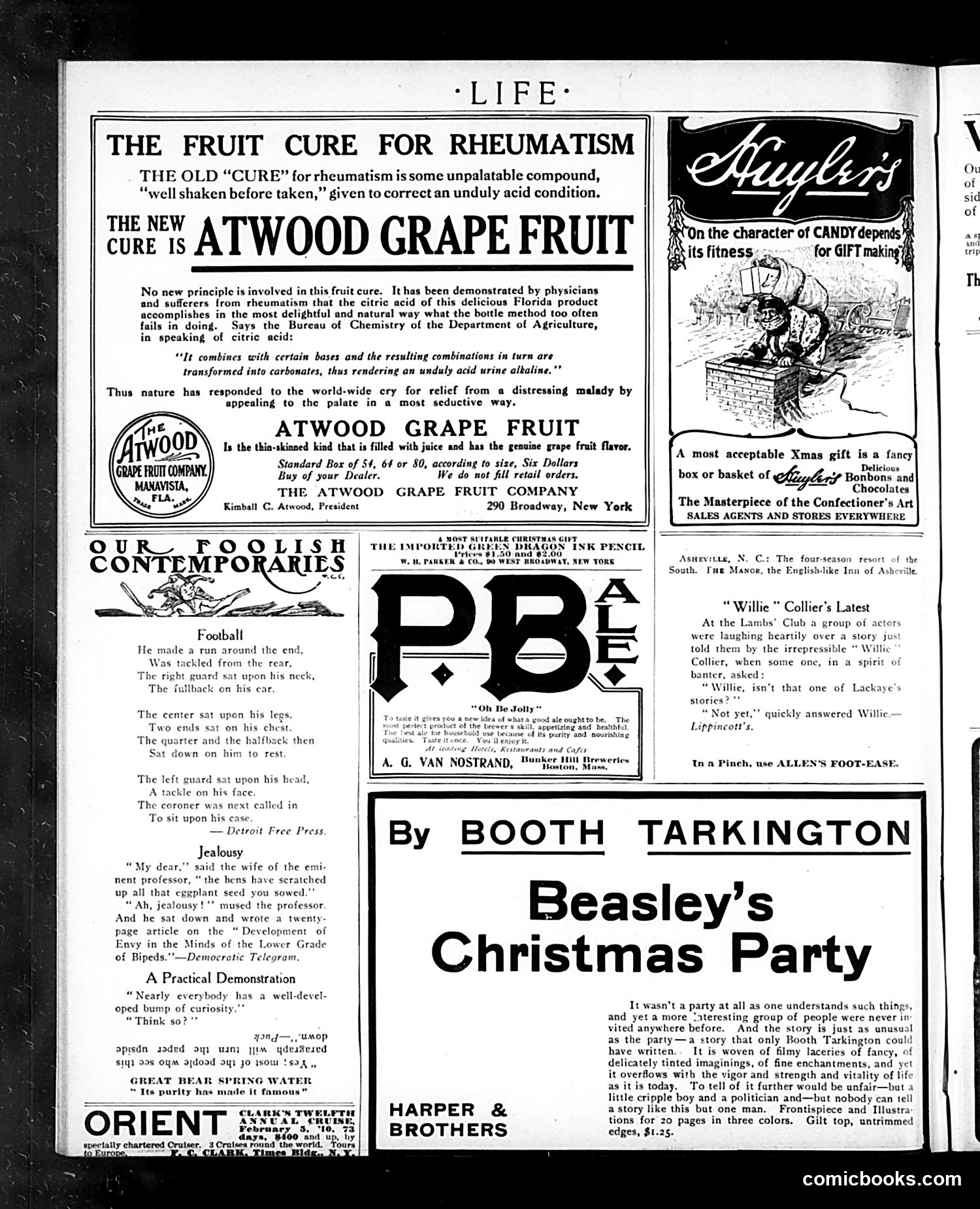
This page is primarily **advertising and literary promotion**, not political satire. The main content includes: **Atwood Grape Fruit advertisement** (top): Promotes grapefruit as a natural cure for rheumatism, claiming citric acid converts acidic urine to alkaline. This reflects early 20th-century patent medicine marketing—promoting fruit as medicinal without modern FDA oversight. **"Our Foolish Contemporaries" section** (left): Light humorous poems about everyday situations (football, jealousy, etc.)—gentle social humor rather than pointed satire. **Literary advertisements** (right side): Promotion for Booth Tarkington's *Beasley's Christmas Party* (Harper & Brothers) and mentions of Willie Collier's theatrical anecdote at the Lambs' Club. **Other ads**: Stuyler's chocolates, Allen's Foot-Ease, and various products typical of 1910s-era *Life* magazine. The page reflects early 1900s consumer culture and entertainment promotion rather than substantive political commentary.
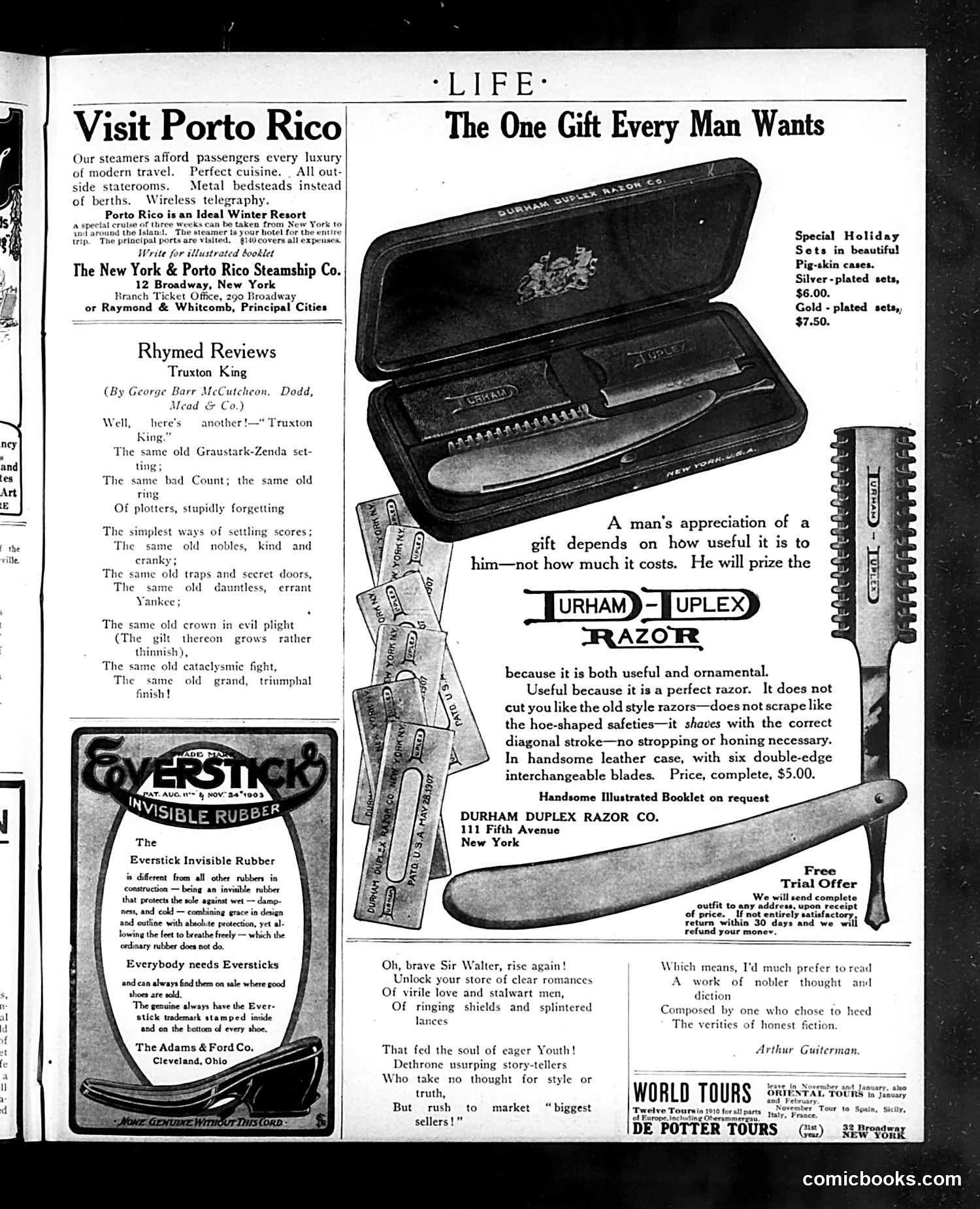
This page is **primarily advertisements**, not political satire. The main content includes: **Advertisements:** - Porto Rico steamship travel luxury cruise - Durham Duplex Razor (the featured "One Gift Every Man Wants")—marketed as superior to old-style razors for its diagonal-stroke shaving - Everstick Invisible Rubber overshoes - De Potter Tours travel packages **Editorial Content:** A "Rhymed Review" by George Barr McCutcheon critiques the novel *Truxton King*, sarcastically noting it repeats the same tired plot elements—evil counts, secret doors, dramatic battles—from the author's earlier work *Graustark*. The review mocks formulaic adventure fiction. Below, poet Arthur Guiterman laments that commercial publishers chase bestsellers over quality literature, appealing for writers of "honest fiction" with "nobler thought." **No political cartoons appear.** This is a typical early-20th-century magazine page mixing consumer goods advertising with book reviews and light verse commentary on popular culture's commercial demands.
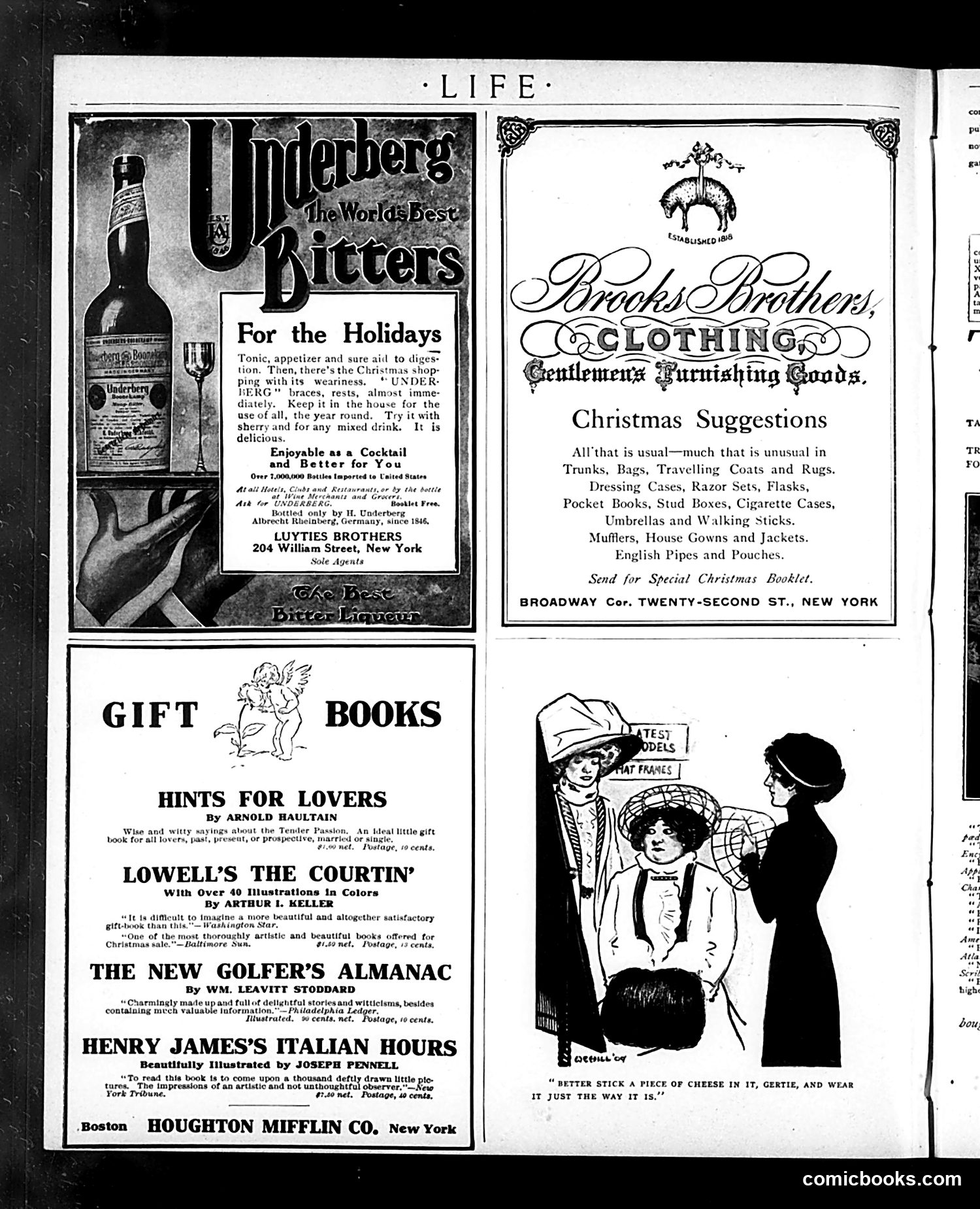
This page is primarily **Christmas advertising** from an early 1900s Life magazine, featuring luxury gift suggestions and holiday products. The small cartoon at bottom-right depicts a humorous domestic scene: three fashionably dressed women discussing a hat. One advises another ("Gertie") to stuff cheese in her hat and wear it as-is—an absurd suggestion playing on two period concerns: the elaborate, impractical nature of women's fashion hats of that era, and the smell-masking properties of cheese (possibly a crude joke about odor). The joke targets the **pretentiousness of high fashion**: women's hats were notoriously oversized, ornate, and sometimes ridiculous by modern standards. The cartoon mocks both the fashion itself and the casual way women discussed such impracticalities. The remainder of the page advertises Underberg Bitters (a digestif liqueur), Brooks Brothers clothing, gift books, and other upscale holiday merchandise—typical of Life's affluent readership during the Gilded Age.
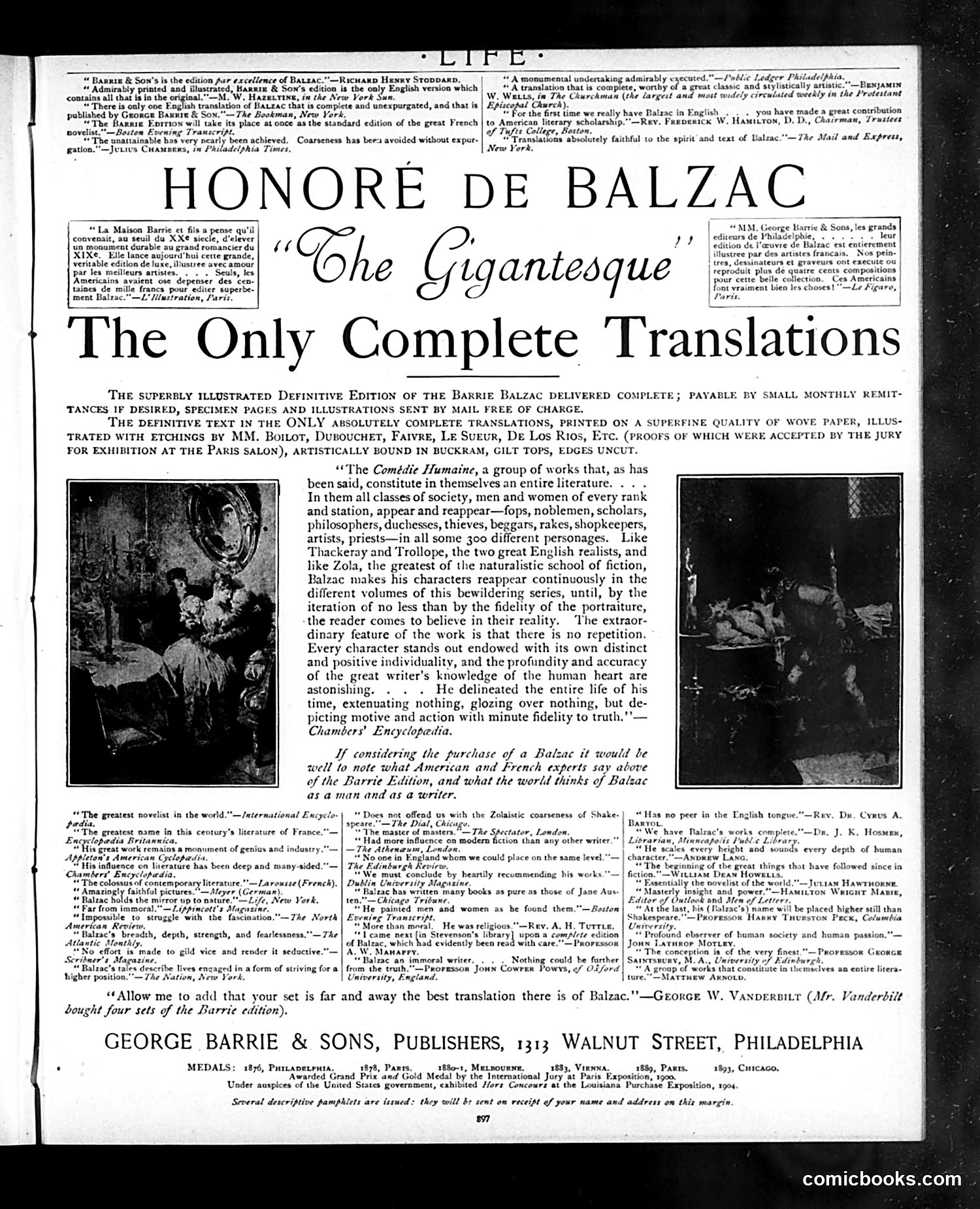
This is primarily a **title page advertisement**, not a political cartoon. It promotes George Barrie & Sons' complete English translation of Honoré de Balzac's works (1829-1850), a major French novelist. The page showcases endorsements from prominent American literary figures and publications praising this as the first "complete and unexpurgated" English translation. References to Thackeray, Trollope, and Zola position Balzac within the realist literary tradition. The two illustrated panels on the sides appear to be engravings from Balzac's works, showing dramatic scenes typical of his social novels depicting various classes of 19th-century French society. The advertisement emphasizes scholarly value ("definitive text," "superfine quality wove paper") and artistic merit (etchings by named French artists accepted at the Paris Salon). It's marketing an expensive, serialized luxury edition available through monthly installments—targeting educated, affluent American readers interested in continental literature. There is no satire or political commentary present on this page.
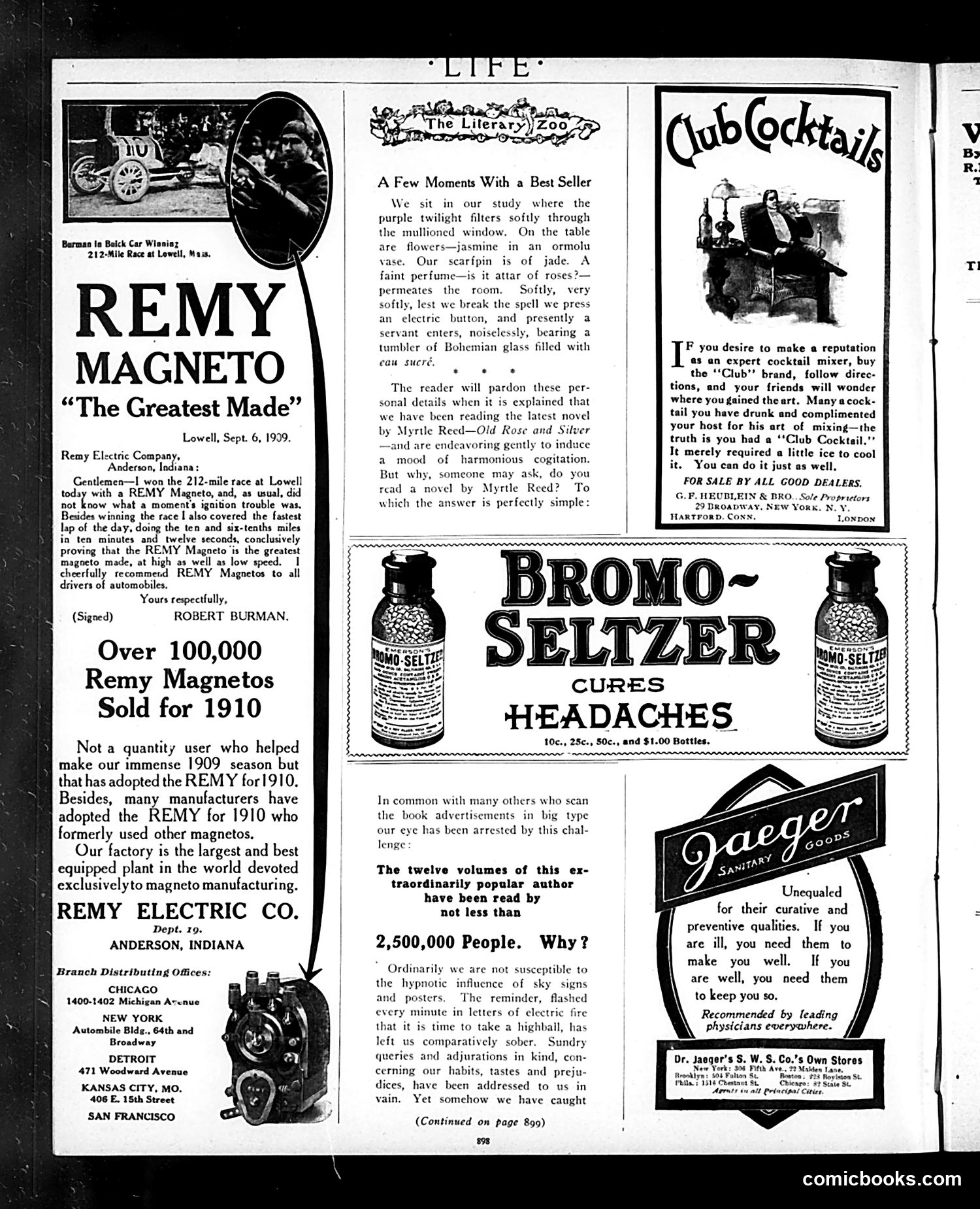
This page is primarily **advertising**, not satire or political commentary. It features four unrelated product advertisements typical of early 1900s magazines: 1. **Remy Magneto** (left): An automotive ignition system advertised via a signed testimonial from race driver Robert Burman, who won a 212-mile race at Lowell. The ad claims over 100,000 units sold in 1910. 2. **"The Literary Zoo"** (center): A satirical column mocking pretentious literary culture. It ridicules the affected atmosphere surrounding reading Myrtle Reed's novel *Old Rose and Silver*—purple twilight, jasmine flowers, jade scarfpins—claiming her twelve volumes have been read by 2.5 million people for unclear reasons. 3. **Club Cocktails** (right): An advertisement suggesting readers can appear skilled at cocktail mixing by buying pre-made "Club" brand cocktails. 4. **Bromo-Seltzer and Dr. Jaeger's** (bottom): Patent medicine advertisements for headache relief and general health. The page reflects early 20th-century consumer culture and advertising strategies rather than political satire.
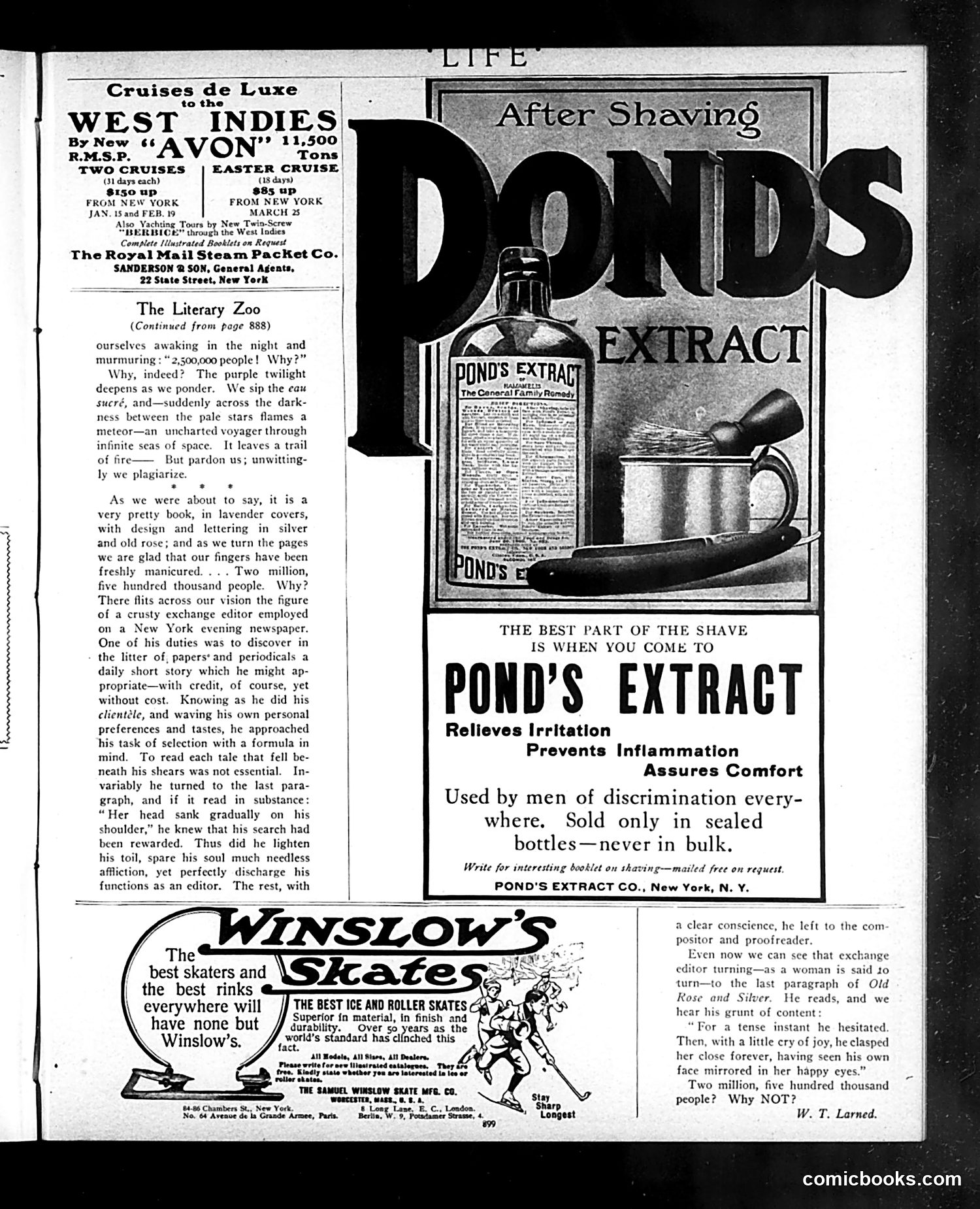
This page is primarily **advertisements** interspersed with a literary commentary titled "The Literary Zoo." The main content is a satirical piece mocking an exchange editor at a New York newspaper who lazily discovers publishable short stories by skipping to the final paragraph. The joke: if the last line reads "Her head sank gradually on his shoulder," he knows it's sentimental enough for his readers and claims it without payment. The editor then encounters a story ending "face mirrored in her happy eyes"—a similar emotional climax—and ironically becomes moved by it himself, experiencing the very sentimentality he cynically exploits professionally. The piece critiques both editorial dishonesty and the predictability of mass-market romance fiction of the era. The byline credits W.T. Larned. Advertisements include luxury cruise lines, Pond's Extract aftershave (claiming to prevent irritation), and Winslow's ice skates. These ads are typical early-20th-century product placement in the magazine.
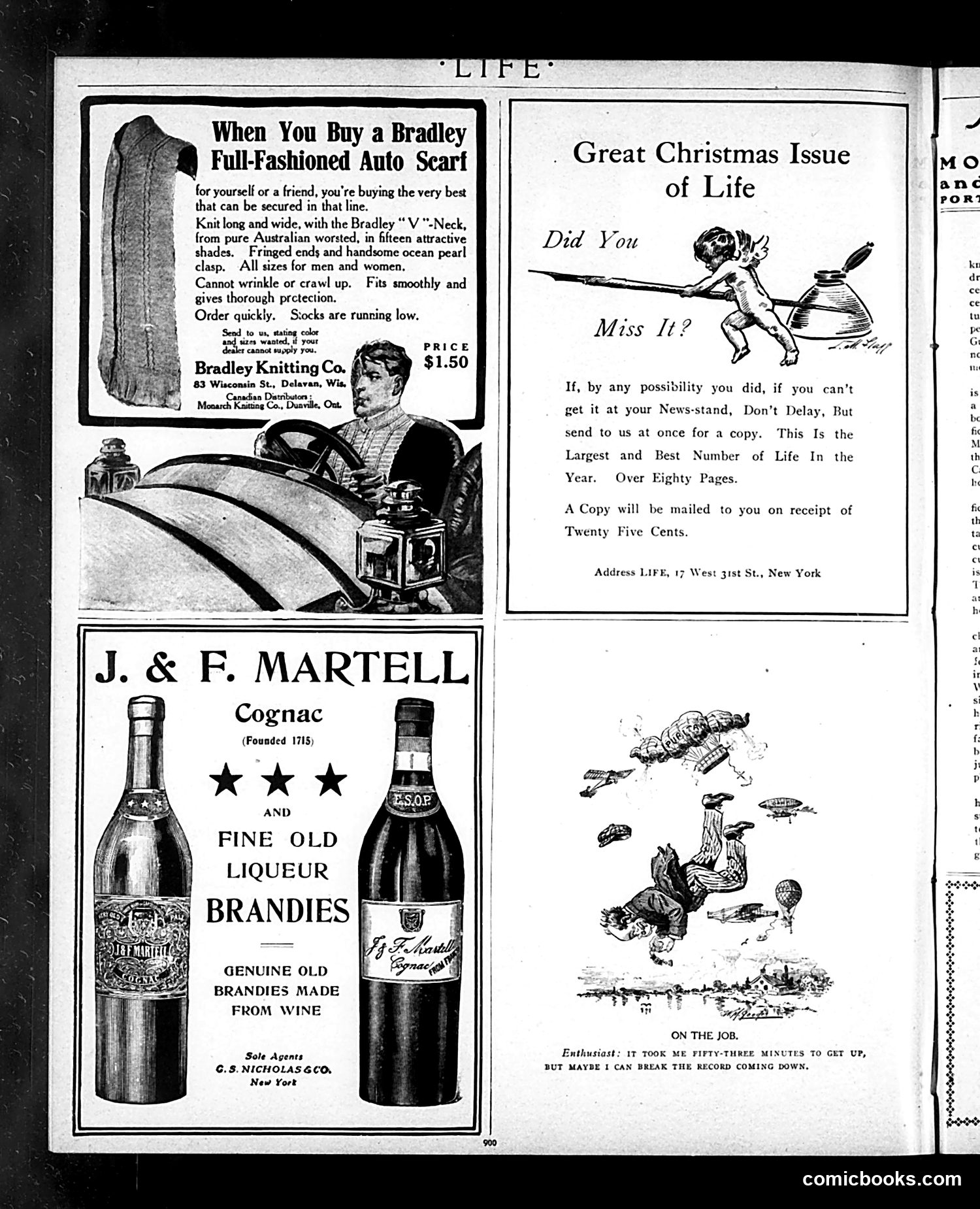
This page is primarily **advertising**, not satire or political commentary. It contains three commercial ads: 1. **Bradley Auto Scarf** (top left): A knitted accessory for automobile drivers, pitched as practical and fashionable for men and women. 2. **J. & F. Martell Cognac** (bottom left): A spirits advertisement highlighting French brandy, established 1715, sold through G.S. Nicholas & Co. in New York. 3. **Life Magazine's Christmas Issue promotion** (right): An advertisement encouraging readers to purchase the "Great Christmas Issue" for 25 cents, promoting it as the year's largest edition with 80+ pages. There is one small **cartoon** (bottom right) showing a figure on skis or a sled claiming they took 53 minutes to climb up but hopes to break that record coming down—a simple joke about gravity and sledding speed, unrelated to politics or social issues.
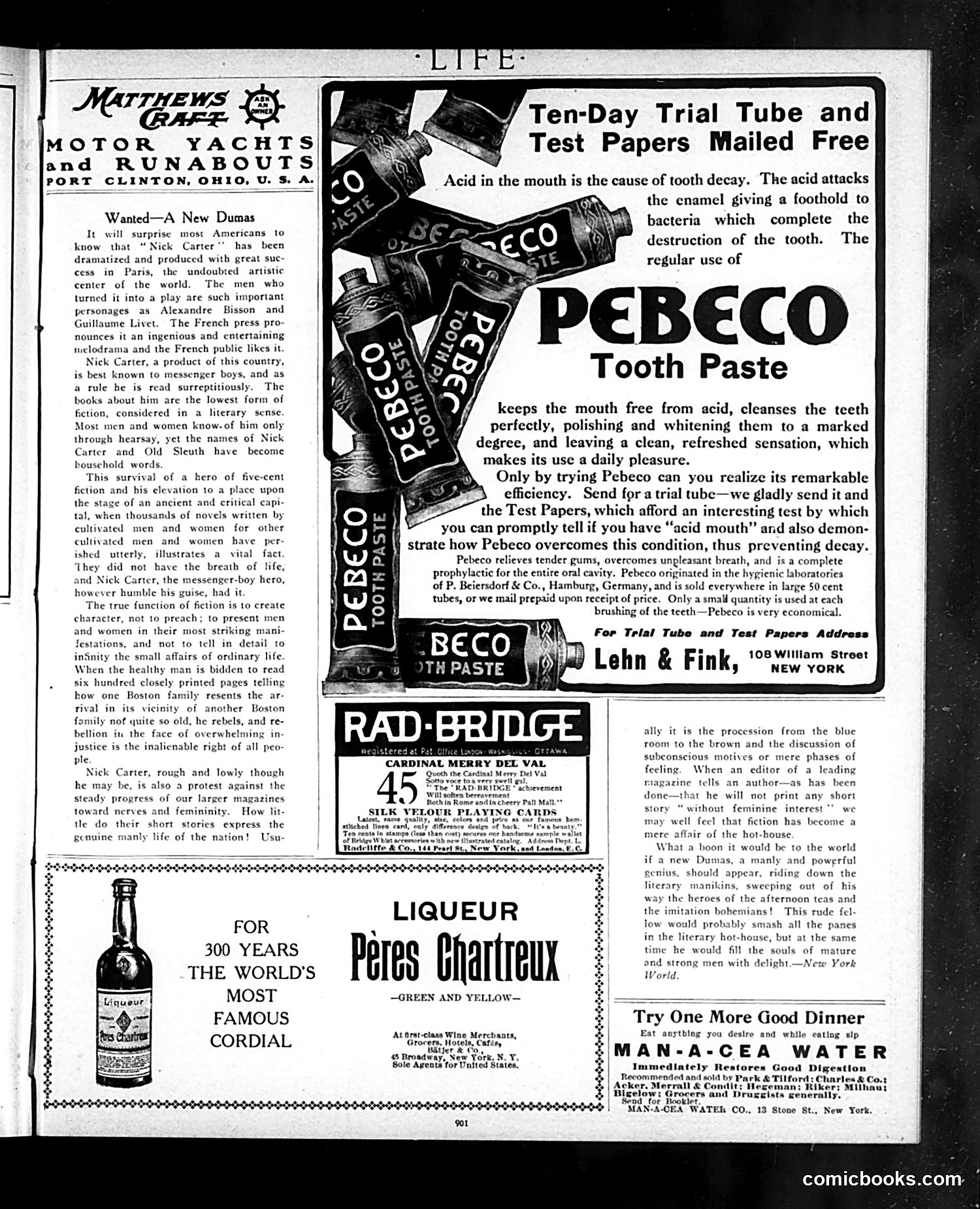
This page is primarily **advertising**, not political satire. The dominant content features three product advertisements: **Pebeco Tooth Paste**, **Rad-Bridge playing cards**, and **Père Chartreux liqueur**. However, the left column contains a **literary essay titled "Wanted—A New Dumas,"** which critiques American fiction. The piece argues that popular "five-cent" pulp novels like the **Nick Carter series** (cheap dime-novel detective stories read by messenger boys) have paradoxically gained respectability—even being dramatized in Paris by prestigious French playwrights. The author laments this as a symptom of declining literary standards in America. While Nick Carter represents "rough and lowly" entertainment, the essay protests that serious American fiction has become overly refined and detached from "genuine manly life." The piece concludes by wishing for a new Dumas—implying America needs a great novelist who can capture authentic human experience, not merely upper-class drawing-room minutiae or formulaic pulp. This reflects early 20th-century anxieties about American culture and literary quality.
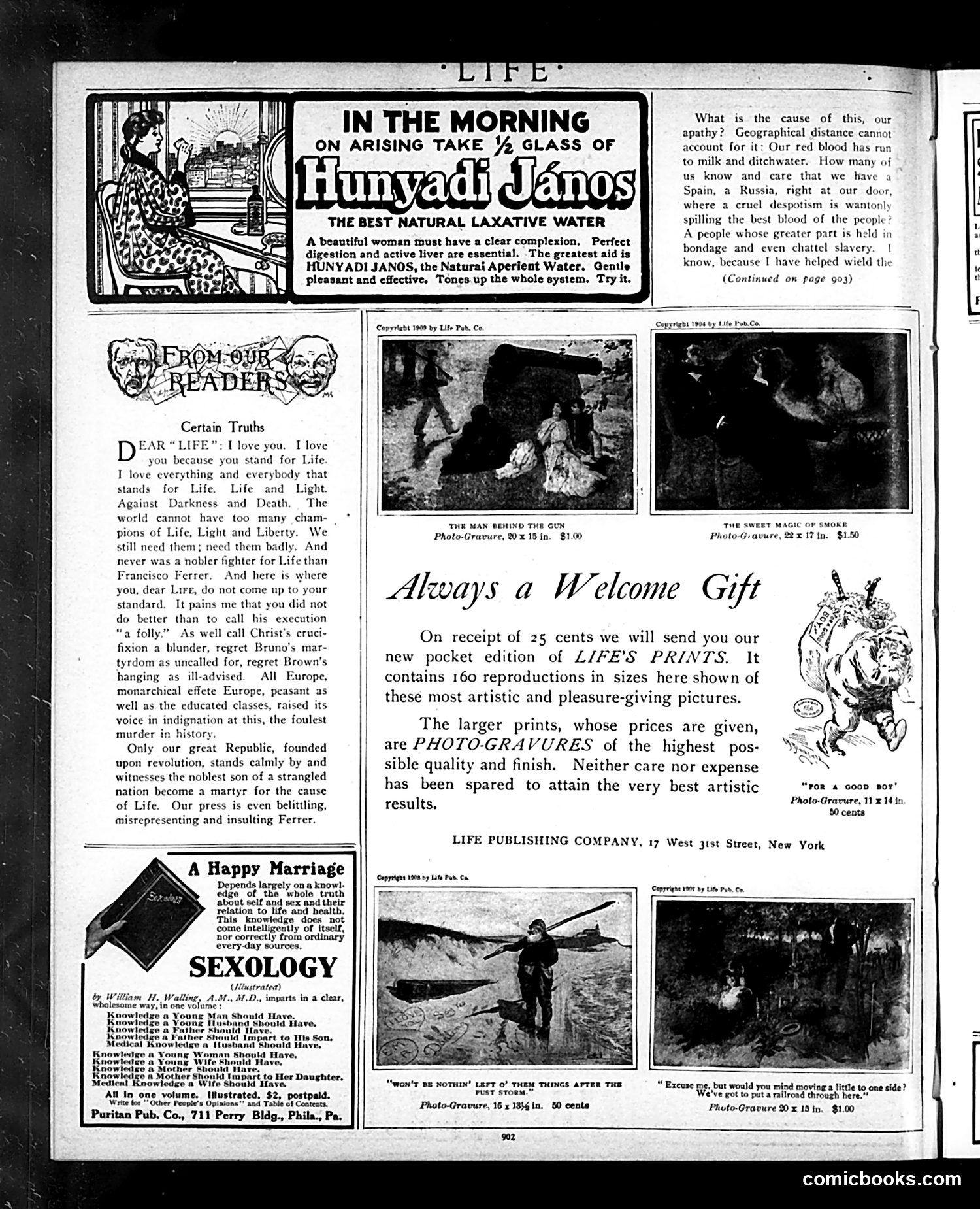
This page mixes advertisements with social commentary typical of early 1900s Life magazine. **Main Editorial Content:** A letter titled "Certain Truths" defends **Francisco Ferrer**, a Spanish educator executed in 1909 for alleged involvement in anarchist activities. The writer criticizes American apathy toward European despotism, specifically Spain and Russia, and contrasts the U.S. republic's "calm" response to Ferrer's execution with Europe's outrage. The letter suggests America should champion liberty more forcefully. **Cartoons/Photos:** Two photo-gravures ("The Man Behind the Gun" and "The Sweet Magic of Smoke") appear to be artistic/scenic images rather than political cartoons. **Advertisements:** The page features typical period ads: Hunyadi János laxative water, Life's Prints collection, and a Sexology book promising marital happiness through sexual knowledge—reflecting early 20th-century American publishing concerns. The Ferrer reference provides the page's political edge, criticizing American indifference to international injustice.
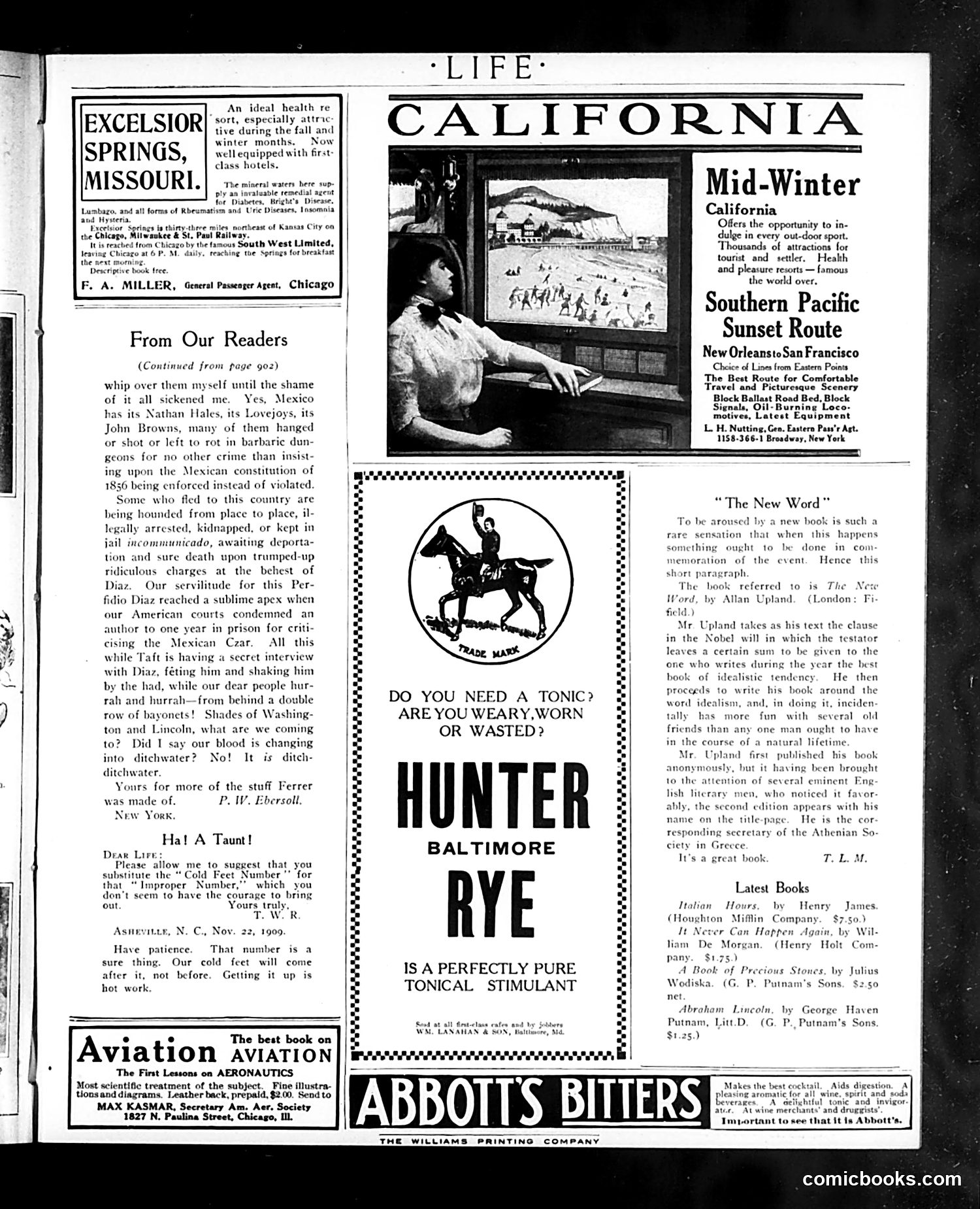
This page is primarily advertising, with some reader letters and book reviews. The main visual interest is an advertisement for **Hunter Baltimore Rye whiskey**, featuring a trade mark circular image of a figure on horseback. The ad claims the product is "a perfectly pure tonical stimulant"—an appeal common to the era when alcohol was openly marketed for medicinal purposes. The reader letters reference Mexican political turmoil (likely referring to **Porfirio Díaz's dictatorship** and American diplomatic support for it) and debate regarding freedom of the press. The book review discusses Allan Upland's *The New Word*, examining idealism versus political reality. The page also advertises travel destinations (California, Excelsior Springs), aviation books, and Abbott's Bitters. Most content reflects early-1900s concerns: health remedies, Mexican politics, and literary criticism.
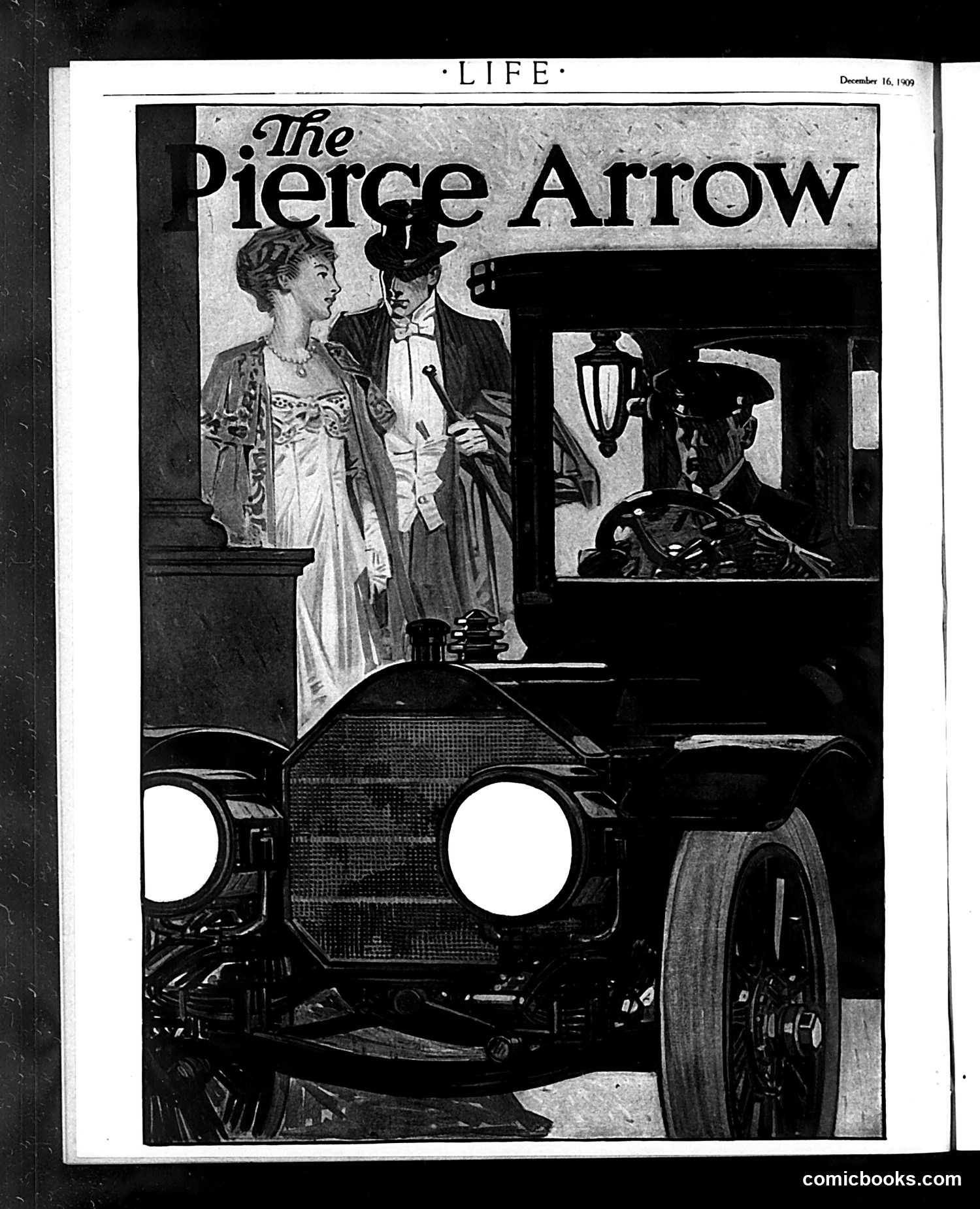
This is a LIFE magazine cover from December 16, 1909, advertising Pierce-Arrow automobiles through narrative illustration. The image depicts a wealthy couple—a woman in an elegant evening gown and a man in formal attire with top hat—preparing to depart in a Pierce-Arrow motorcar. A uniformed chauffeur is visible in the vehicle. The satire targets the emerging automotive luxury market and the social pretensions of the wealthy. The "pierce arrow" title puns on the car brand while suggesting the vehicle's power and prestige. The formal dress and servant indicate this is aspirational material aimed at affluent readers, satirizing how automobiles had become status symbols among the upper class by 1909.