
Life, 1909-12-16 · page 18 of 32
Life — December 16, 1909 — page 18: what you’re looking at
What you’re looking at
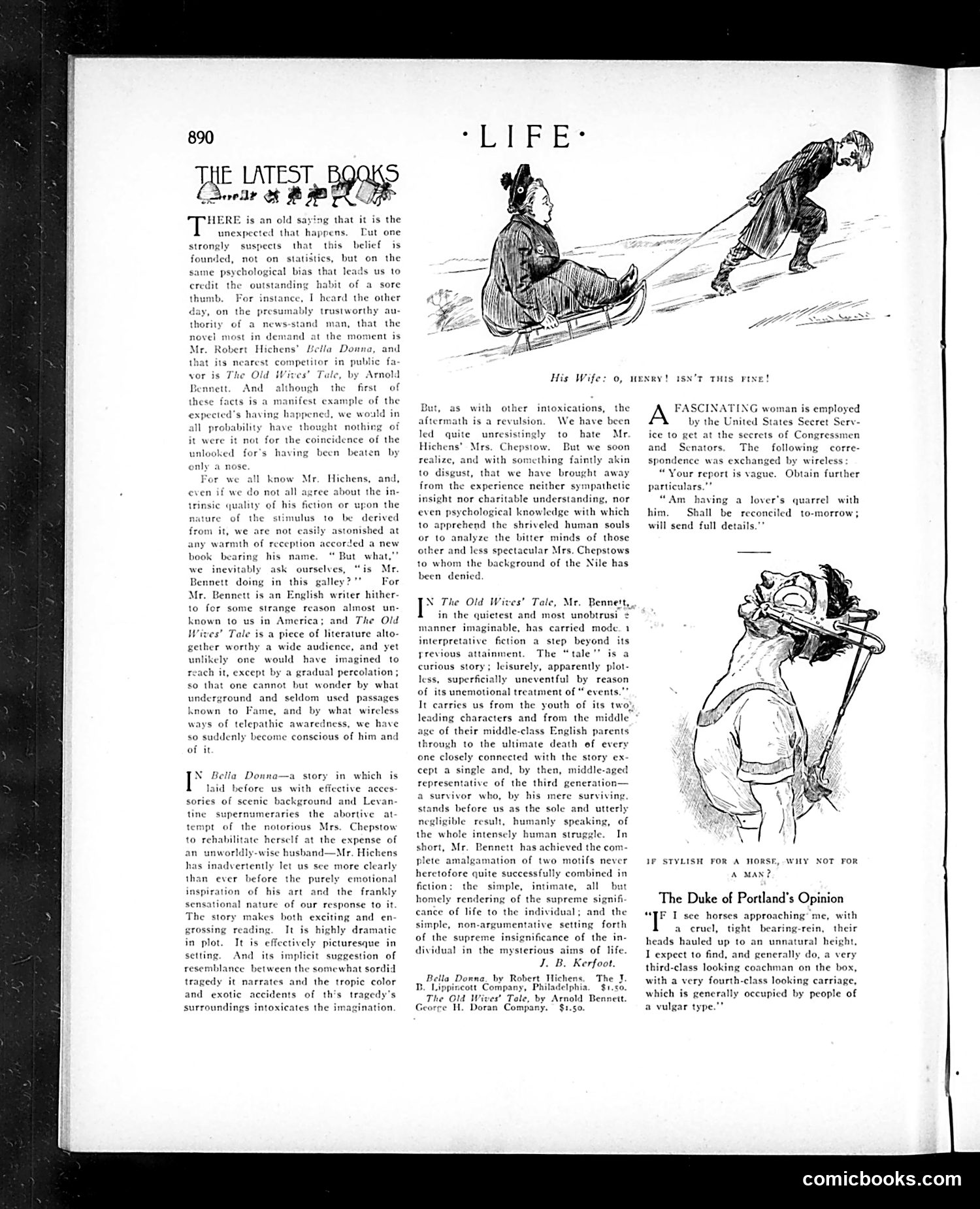
This page reviews three recent novels, with two accompanying illustrations satirizing literary and social pretension. The **top cartoon** shows a couple sledding: the wife sits contentedly on the sled while the husband strains to pull it, captioned "His Wife: O, Henry! Isn't This Fine!" The satire mocks gender dynamics and male effort—the husband labors while the wife enjoys leisure, inverting traditional expectations. The **bottom illustration** labeled "If Stylish for a Horse, Why Not for a Man?" depicts someone in an exaggerated riding outfit, ridiculing fashionable affectation and perhaps gender-nonconforming dress. The text reviews novels by Robert Hichens (*Bella Donna*) and Arnold Bennett (*The Old Wives' Tale*), debating their literary merit and unexpected popularity. The reviewer notes Bennett's work, though initially overlooked, has unexpectedly succeeded—illustrating the page's opening theme that "the unexpected happens" in publishing, defying statistical predictions about literary success.
📄 Transcribed text from this page (OCR, searchable)
Machine-transcribed from the original scan — historical spelling and the odd misread are preserved.
890 THE LATEST. S HERE is an old saying that it is the unexpected that happens. Tut one pects that this statistics, but on the strongly belief is not on : pgical bias that leads us to credit the habit of a sore For instance, I heard th csumably trustworthy au- that the founded, e psych outstand other on the | a news-stand man, at the moment is Donna, nid nearest competitor in public fa Arnold first of nost in demand Hichens’ Bella vor is The Old Wives’ Tale, by Bennett. And these facts is a manifest example of the |, we would in although — the ving happene thought xpected’s h I probability have t were it not for the coincidence of the been beaten by nothing of looked for's having only For we all know Mr. Hichens, and, even if we do not all agree about the i fiction or upon the a nose trinsic quality of mulus to be derived astonished at nature of the from it, we are not casily orded “ But ourselves, “is new what, Mr. For any warmth of receptio book bearing his nam we inevitably ask Bennett doing in this galley Mr. Bennett is an English writer hither- to for some strange reason almost un- known to us in America; and The Old Wives’ Tale is a piece of literature alto- gether worthy a wide audience, and yet unlikely one would have imagined to reach it, except by a gradual percolation ; so that one cannot but wonder by what underground and seldom used passages what e, and by wireless hic awaredness, we have hnown to F. ways of telep so suddenly become conscious of him and of it ip Bella Donna—a story in which is laid before us with effective acces sories of scenic background and Levan tine the abortive tempt of the Mrs. to rehabilitate herself at the expense of supernumeraries notorious Chepstow an unworldly-wise busband—Mr. Hichens has inadvertently let us see more clearly purely emotional and the frankly sensational nature of our response to it The akes both exciting and en. grossing reading. It is highly dramatic in plot. It ctively picturesque in setting. And its implicit suggestion of rese! between the somewhat sordid tragedy it narrates and the tropic color and exotic accidents of th’s tragedy’s ever before the of his art than inspiration story is eff ablance surroundings intoxicates the ima His Wife: 0, wexry! isn’t tTHIs Fixe! intoxications, the We have been hate Mr. we soon as with other rmath is a revulsion. led quite unresistingly to Hichens’ Mrs realize, and with something fa brought away from the experience neither sympathetic insight nor charitable understanding, nor even psychological kn ge with which to apprehend the shriveled human souls or to analyze the bitter minds of those Chepstow. But y akin to disgust, that we have other and less spectacular Mrs, Chepstows to whom the background of the Nile has been denied N The Old Wives’ Tale, Mr. Bennett, in the quietest and most unobtrusi manner imaginable, has carried mode. 1 interpretative fiction a step beyond its Trevious attainment. The “tale” is a curious story; leisurely, apparently plot- less, superficially uneventful by reason of its unemotional treatment of “ events."” It carries us from the youth of its two leading characters and from the middle : of their middle-class English parents through to the ultimate death ef every one closely connected with the story ex cept a singh representative of the third generation— surviving and, by then, middle-aged a survivor who, by his mere stands before us as the sole and utterly negligible result, humanly speaking, of the whole intensely human struggle. In short, Mr. Bennett has achieved the com- plete mation of two motifs never heretofore quite successfully combined in fiction: the simple, intimate, all but mely rendering of the supreme si cance of life to the individual; and the non-argumentative setting forth ne insignificance of the in- simple, of the supre dividual in the mysterious aims of life. J. B. Kerfoot. Bella Donna. by Robert Hichens. The J Lippincott Company, Philadelphia. $1.80. The Old Wives’ Tole, by Arnold Bennett. Georre H. Doran Company. §1.59. FASCINATING woman is employed by the United at the sccrets of Congressmen following corre- States Secret ice to and spondence was exchanged by wireless “Your report is vague. Obtain further particulars.”” Am having a him. Shall be reconciled will send full details."” Senators. he with to-morrow ; lover's quarrel we i i oN IP STYLISH FOR A WHY NOT FoR A MAN? The Duke of Portland's Opinion ‘I I sce horses approaching’ me, with crucl, tight bearing-rein, their heads hauled up to an unnatural height, I expect to find, and generally do, a very third-class looking coachr with a very fourth-class looking carriage, which is generally occupied by people of a vulgar type."’ worse, on the box, comicbooks.com