
Life, 1909-12-16 · page 9 of 32
Life — December 16, 1909 — page 9: what you’re looking at
What you’re looking at
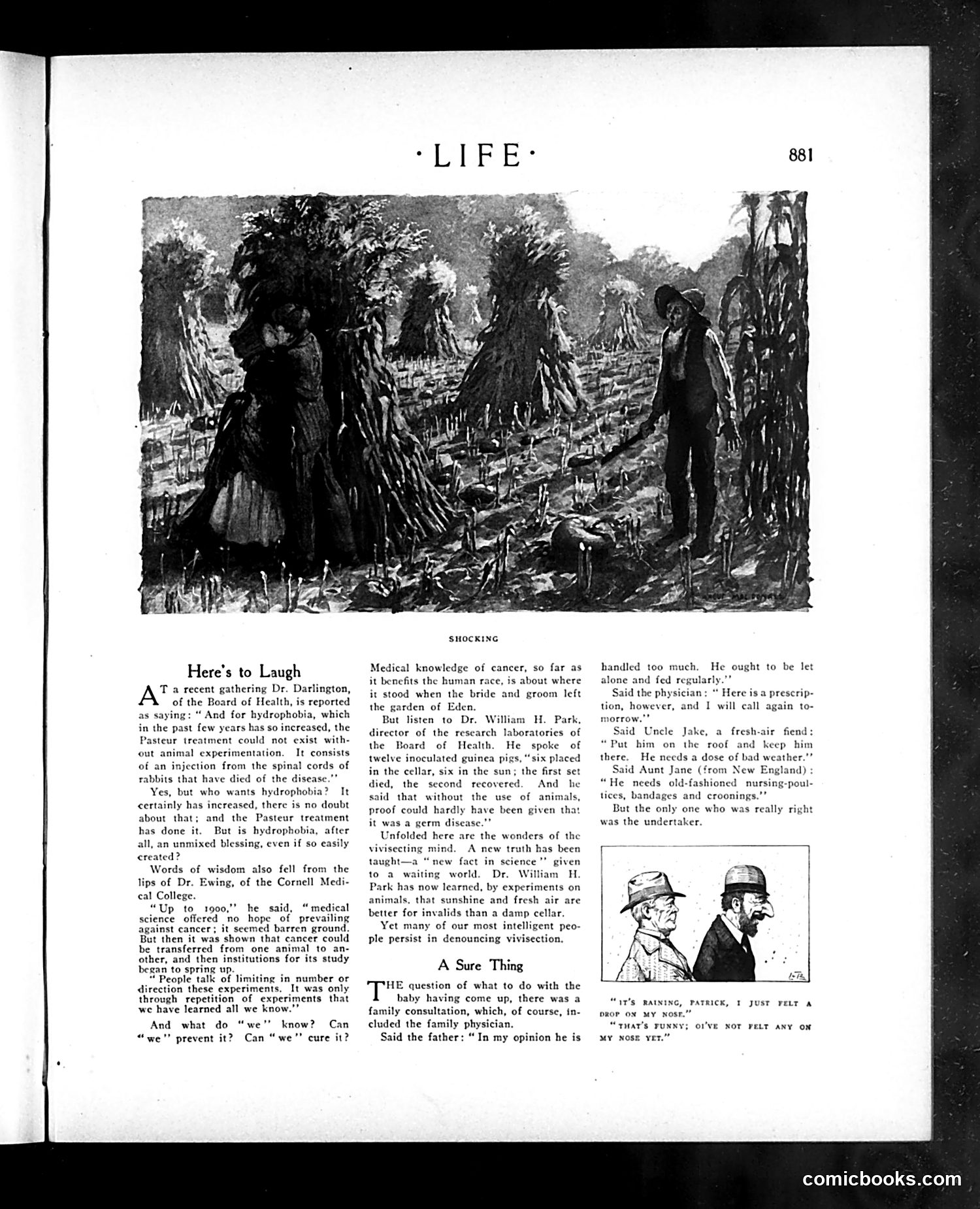
This page contains two satirical pieces about medical and scientific topics. **"Here's to Laugh"** mocks the anti-vivisection movement—opponents of animal testing. The article reports that the Pasteur treatment for rabies required guinea pig experiments, yet anti-vivisectionists opposed this life-saving research. The satire highlights the contradiction: people who denounce animal testing also benefit from medical advances that depend on it. **"A Sure Thing"** appears to be a brief comedic anecdote about parenting advice, shown in the small cartoon at bottom right. The main illustration depicts a cornfield scene, likely illustrating one of these narratives, though the specific connection isn't entirely clear from the text alone. The overall thrust criticizes what Life viewed as misguided moral absolutism that would prevent scientific progress.
📄 Transcribed text from this page (OCR, searchable)
Machine-transcribed from the original scan — historical spelling and the odd misread are preserved.
Here’s to Laugh T a recent gathering Dr. Darlington, of the Board of Health, is reported as saying: “And for hydrophobia, which in the past few years has so increased, the Pasteur treatment could not exist with- out animal experimentation. It consists of an injection from the spinal cords of rabbits that have died of the disease.” Yes, but who wants hydrophobia? It certainly has increased, there is no doubt about that; and the Pasteur treatment has done it. But is hydrophobia, after all, an unmixed blessing, even if so easily created? Words of wisdom also fell from the lips of Dr. Ewing, of the Cornell Medi- cal College. “Up to 1900,"" he said, “ medical science offered no hope of prevailing against cancer; it seemed barren ground. But then it was shown that cancer could be transferred from one animal to an- other, and then institutions for its study began to spring up. “People talk of limiting in number or rection these experiments. It was only through repetition of experiments that we have learned all we know.” And what do “we'? know? Can “we'? prevent it? Can “we cure it? SHOCKING Medical knowledge of cancer, so far as it benefits the human race, is about where it stood when the bride and groom left the garden of Eden, But listen to Dr, William H. Park, director of the research laboratories of the Board of Health. He spoke of twelve inoculated guinea pigs, “six placed in the cellar, six in the sun; the first set died, the second recovered. And he said that without the use of anima proof could hardly have been given tha it was a germ disease." Unfolded here are the wonders of the vivisecting mind. A new truth has been taught—a “new fact in science” given to a waiting world. Dr. William H Park has now learned, by experiments on animals, that sunshine and fresh air are better for invalids than a damp cellar, Yet many of our most intelligent peo- ple persist in denouncing vivisection, A Sure Thing HE question of what to do with the baby having come up, there was a family consultation, which, of course, in- cluded the family physician, Said the father: “In my opinion he is handled too much. He ought to be let alone and fed regularly.”’ Said the physician: “ Here is a prescrip- tion, however, and I will call again to- morrow d Uncle Jake, a fresh-air fiend: “Put him on the roof and keep him there, He needs a dose of bad weather.”” Said Aunt Jane (from New England) : “He needs old-fashioned nursing-poul- tices, bandages and croonings.’” But the only one who was really right was the undertaker. “ir's RAINING, PATRICK, 1 pRoP ON MY NosT. “IMAT'S FUNNY; MY Nose yer.” JUST veLT A Or'vE NOT FELT ANY OW comicbooks.com