
Life, 1909-12-16 · page 14 of 32
Life — December 16, 1909 — page 14: what you’re looking at
What you’re looking at
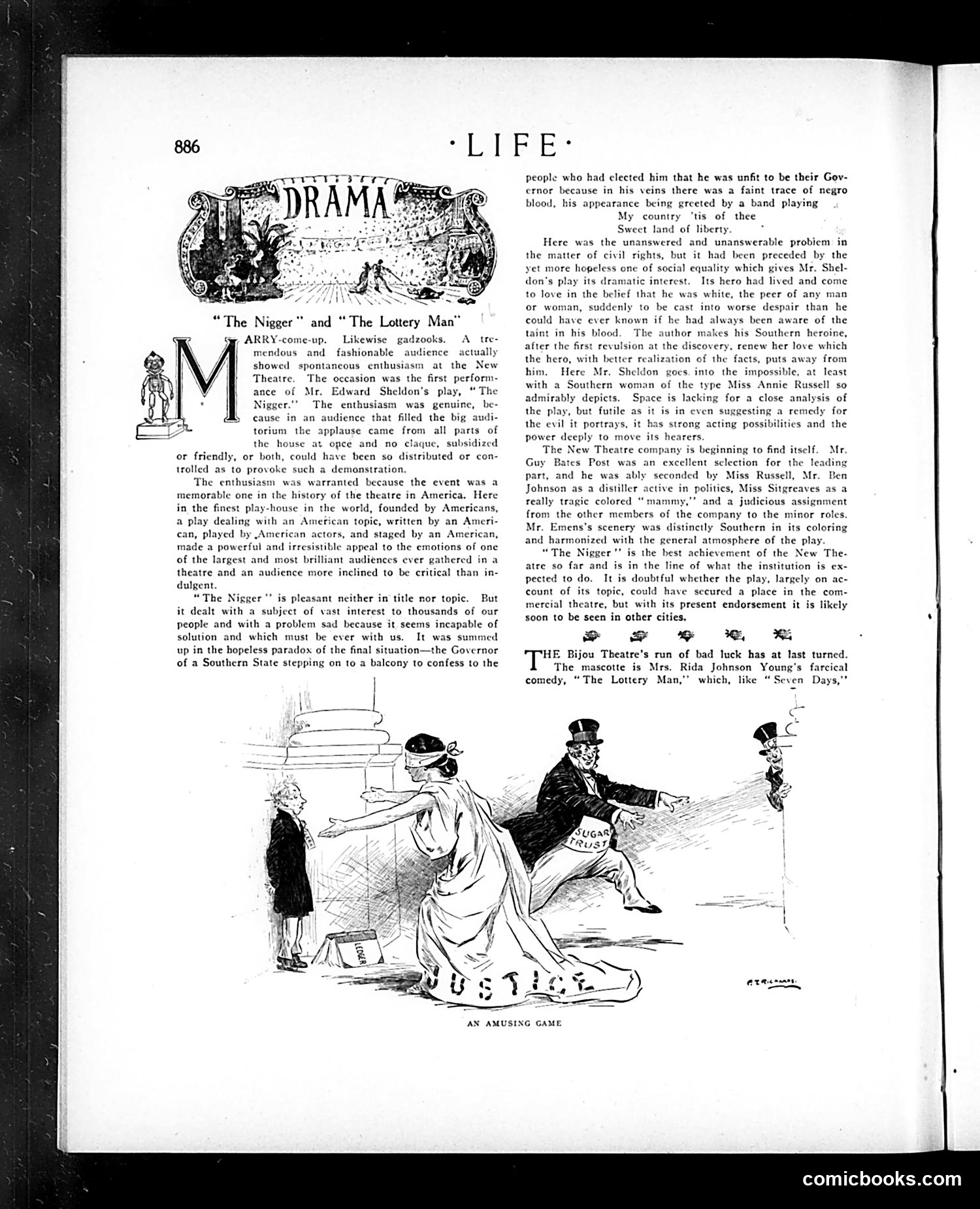
This page reviews Edward Sheldon's 1909 play *"The Nigger,"* which premiered at New York's New Theatre. The drama concerns a Southern governor who discovers he has Black ancestry and publicly confesses his "unfitness" to lead, revealing the paradox of American racial prejudice: a man deemed acceptable as governor becomes unacceptable upon learning of mixed ancestry. The text praises the play's serious treatment of an urgent social problem—civil rights and racial equality—while acknowledging it offers no solution. The reviewer highlights strong performances, particularly Annie Russell as a Southern woman who initially rejects the protagonist but later reconsiders. The bottom cartoon, titled "An Amusing Game," satirizes the legal system's treatment of racial justice. Lady Justice appears blindfolded and manipulated by politicians and men in top hats labeled "sugar trust," suggesting the judiciary is compromised and justice itself is merely a game controlled by corrupt interests rather than an impartial institution.
📄 Transcribed text from this page (OCR, searchable)
Machine-transcribed from the original scan — historical spelling and the odd misread are preserved.
aE ; SNe “The Nigger’ and “ The Lottery Mai ARRY-come-up. Likewise gadzooks, A tre- mendous and fashionable audience actually showed spontaneous enthusiasm at the New Theatre. The occasion was the first perform: ance of Mr. Edward Sheldon’s play, “The Nigger."” The enthusiasm was genuine, be- cause in an audience that filled the big audi- torium the applause came from all parts of the house at opce and no claque, subsidized or friendly, or both, could have been so distributed or con- trolled as to provoke such a demonstration. The enthusiasm was warranted because the event was a memorable one in the history of the theatre in America, Here the finest play-house in the world, founded by Americans, a play dealing with an Amefican topic, written by an Ameri- can, played by American actors, and staged by an American, made a powerful and irresistible appeal to the emotions of one of the largest and most brilliant audiences ever gathered in a theatre and an audience more inclined to be critical than in- dulgent. “The Nigger "' is pleasant neither in title nor topic. But it dealt with a subject of vast interest to thousands of our people and with a problem sad because it seems incapable of solution and which must be ever with us. It was summed up in the hopeless paradox of the final situation—the Governor of a Southern State stepping on to a balcony to confess to the people who had clected him that he was unfit to be their Gov- ernor because in his veins there was a faint trace of negro blood, his appearance being greeted by a band playing My country ‘tis of thee Sweet land of liberty. Here was the unanswered and unanswerable probiem in the matter of civil rights, but it had been preceded by the yet more hopeless one of social equality which gives Mr. Shel- don’s play its dramatic interest. Its hero had lived and come to love in the belief that he was white, the peer of any man or woman, suddenly to be cast into worse despair than he could have ever known if he had always been aware of the taint in his blood. The author makes his Southern heroine, after the first revulsion at the discovery, renew her love which the hero, with better realization of the facts, puts away from him. Here Mr. Sheldon goes. into the impossible, least with a Southern woman of the type Miss Annie Russell so admirably depicts. Space is lacking for a close analysis of the play, but futile as it is in even suggesting a remedy for the evil it portrays, it has strong acting possibilities and the power deeply to move its hearers. The New Theatre company is beginning to find itself. Mr. Guy Bates Post was an excellent sclection for the leadin: part, and he was ably seconded by Miss Russell, Mr. Ben Johnson as a distiller active in politics, Miss Sitgreaves as a really tragic colored “mammy,’’ and a judicious assignment from the other members of the company to the minor roles. Mr. Emens’s scenery was distinctly Southern in its coloring and harmonized with the general atmosphere of the play. “The Nigger'’ is the best achievement of the New The- atre so far and is in the line of what the institution is ex- pected to do. It is doubtful whether the play, largely on ac- count of its topic, could have secured a place in the com- mercial theatre, but with its present endorsement it is likely soon to be seen in other cities. HE Bijou Theatre's run of bad luck has at last turned. The mascotte is Mrs. Rida Johnson Young's farcical comedy, “The Lottery Man,’’ which, like “Seven Days,” AN AMUSING GAME comicbooks.com