
Life, 1909-12-16 · page 15 of 32
Life — December 16, 1909 — page 15: what you’re looking at
What you’re looking at
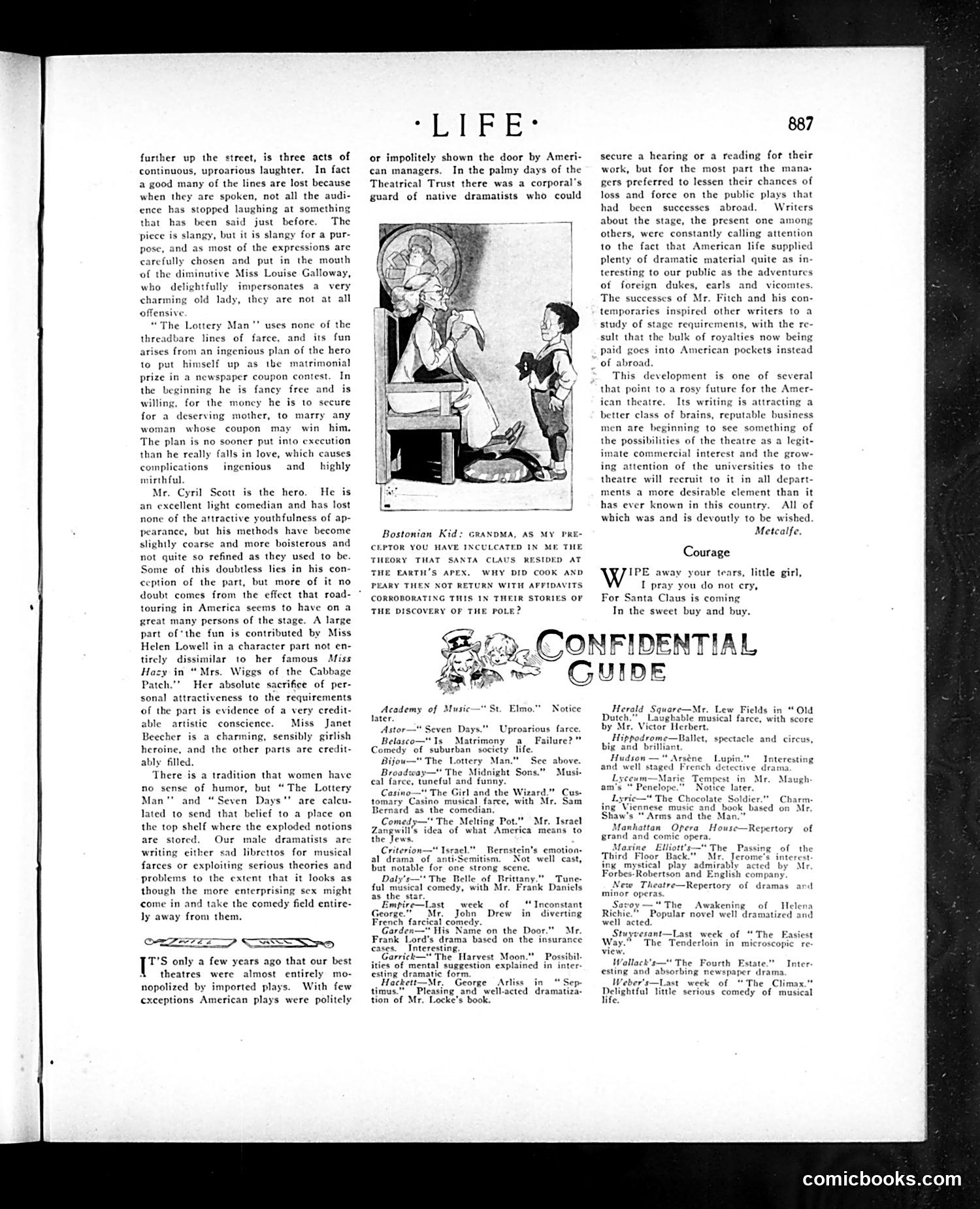
This page discusses American theatrical development, celebrating that native dramatists have finally gained respect after years of European plays dominating American stages. **The Main Cartoon** depicts "The Bostonian Kid," a child challenging his grandmother's claim that Santa Claus lives at the Earth's Apex. The boy references explorers Cook and Peary's recent Arctic expeditions, sarcastically asking why they didn't return with "affidavits corroborating" Santa's polar residence. This is **satire on pseudo-intellectual Boston children**—the joke mocks overly precocious youngsters who weaponize recent news events to deconstruct childhood myths with absurd logical "evidence." The surrounding text praises American plays like "The Lottery Man" and "Seven Days," noting that American dramatists are finally creating comedy rivaling imported European works. The passage expresses optimism that American theatre is maturing as a commercial and artistic enterprise worthy of university study.
📄 Transcribed text from this page (OCR, searchable)
Machine-transcribed from the original scan — historical spelling and the odd misread are preserved.
further up the street, is three acts of continuous, uproarious laughter. In fact a good many of the lines are lost because when they are spoken, not all the audi- ence has stopped laughing at something t has been said just before. The piece is slangy, but it is slangy for a pur- pose, and as most of the expressions are carefully chosen and put in the mouth of the diminutive Miss Louise Galloway, delightfully impersonates a very old lady, are not at all who charm| they uses none of the its fun The Lottery Man cadbare lines of es from an ingenious plan of the hero to put himself up as tbe matrimonial prize in a newspaper coup the beginning he is fancy free willing, for the moncy he is to for a deserving mother, to marry any woman whose coupon may him. The plan is no sooner put into execution than he really falls in love, which causes complications ingenious highly mirthful Mr. Cyril Scott is the hero. He is an excellent light comedian and has lost none of the attractive youthfulness of ap- pearance, but his methods have become slightly coarse and more boisterous and not quite so refined as they used to be Some of this doubtless lies in his con- ception of the part, but more of it no doubt comes from the effect that road- touring in America seems to have on a great many persons of the stage. A large part of‘the fun is contributed by Miss Helen Lowell in a character part not en- tirely dissimilar to her famous Miss Hazy in “Mrs. Wiggs of the Cabbage Patch."’ Her absolute sacrifice of per- sonal attractiveness to the requirements of the part is evidence of a very credit- able artistic conscience. Miss Janet Beecher is a charming, sensibly girlish heroine, and the other parts are credit- ably filled. There is a tradition that women have no sense of humor, but “The Lottery Man" and “Seven Days’ are calcu- lated to send that belief to a place on the top shelf where the exploded notions are stored. Our male dramatists are her sad librettos for musical farce, and n contest. In and is secure win and writing ¢ farces or exploiting serious theories and problems to the extent that it looks as though the more enterprising sex might come in and take the comedy field entire- ly away from them. ZED TESS T’S only a few years ago that our best theatres were almost entirely mo- nopolized by imported plays. With few exceptions American plays were politely PRE or impolitely shown the door by Ameri- can managers. In the palmy days of the Theatrical Trust there was a corporal’s guard of native dramatists who could a] Bostonian Kid: GRANDMA, AS MY PRE- CEPTOR YOU HAVE INCULCATED IN ME THE THEORY THAT SANTA CLAUS RESIDED AT THE EARTH'S APEX. WHY DID COOK AND PEARY THEN NOT RETURN WITH AFFIDAVITS CORROBORATING THIS IN THEIR STORIES OF THE DISCOVERY OF THE POLE? Pui, CO y) te Academy of Music: t. Elmo.” Notice later. Astor—" Seven Days." Uproarious farce. Belasco—“*1s Matrimony a Failure? Comedy of suburban society. life. Bijou—" The Lottery Man."* Broadway—" The Midnight Sons.’ cal farce, tuneful and funny. " The Girl and the Wizar ree, with 3 Bei cu Ae ‘as the prerali op bomede—' The Melting Pot.” Mr. Teract {what America means to See above. Musi- Cus. ir. Sam Bernstein's emotion: mitism. Not well cast, but notable for one strong scene. Daly’s—"' The Belle of Brittany.” Tune- ful musical comedy, with Mr. Frank Daniels as the star. Empire—Last. week of" Inconstant George.” Mr. John Drew in French farcical comedy. Garden—" His Name on the Door.” Mr. Frank Lord's drama based on the insurance cases. _ Interesting. | Garrick—" The Harvest Moon." Possibil. ities of mental suggestion explained in inter esting dramatic form. Hackett—Mr. George Arliss ‘ timus.” Pleasing and well-acted dramatiza- tion of Mr. Locke's book. 887 secure a hearing or a reading fof their work, but for the most part the mana- gers preferred to lessen their chances of loss and force on the public plays that had been successes abroad. Writers about the stage, the present one among others, were constantly calling attention to the fact that American life supplied plenty of dramatic material quite as in- teresting to our public as the adventures of foreign dukes, earls and The successes of Mr. Fitch and his con- temporaries inspired other writers to a study of stage requirements, with the re sult that the bulk of royalties now being paid goes into American pockets instead of abroad. This development is one of several that point to a rosy future for the Amer- ican th vicomtes Its writing is attracting a better class of brains, reputable business inning to see something of 's of the theatre as a legit- nercial interest and the grow- ing attention of the universities to the theatre will recruit to it in all depart- ments a more desirable element than it has ever known in this country. All of which was and is devoutly to be wished Metcalfe. catre. men are be the possibilit imate com Courage IPE away your tears, little girl, I pray you do not ery, For Santa Claus is coming In the sweet buy and buy. NFIDENTIAL UIDE Herald Square—Mr Dutch.” 1 by Mr. V Hippodrome big and brilliant Hudson —" Arséne and well staged Frene m—Marie Tempe Penelope.” Notice later. The Chocolate Soldier." Charm- nese music and book based on Mr. “Arms and the Man,” ttan Opera House grand and comic opera. Maxine Elliott’s—" The Third Floor Back.” Mr. Jer ing mystical play admirably acted by Mr Forbes-Robertson and English company Theatre—Repertory of oF operas Savoy —“ The Richie.” well acted. Stuyvesant—Last week of Way.” The Tenderloin in mi view. Wallack's—" The Fourth Estate. and absorbing newspaper dram Weber's—Last_ week of “The Climax Delightful little serious comedy of musical life. Lew Fields in “Old gbable musical farce, with score tor Herbert. Ballet, spectacle and circus, Lupin.” Interest Mr. Maugh Awakening of Helena Popular novel well dramatized and The Easiest Inter comicbooks.com