
Life, 1909-12-16 · page 6 of 32
Life — December 16, 1909 — page 6: what you’re looking at
What you’re looking at
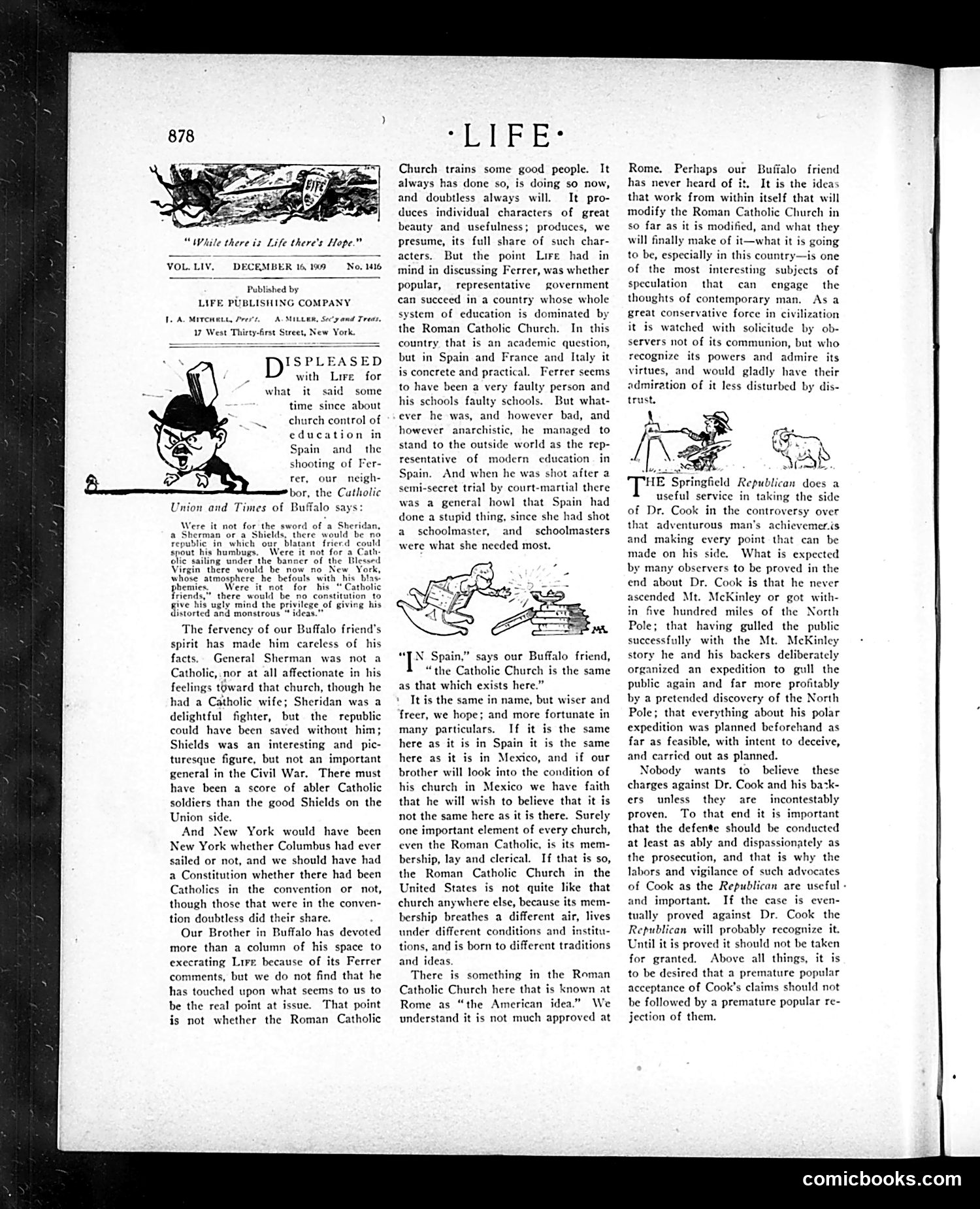
The page contains a political cartoon titled "Wait there is Life there's Hope" depicting a figure labeled "DISPLEASED" with church control of education in Spain and the shooting of Ferrer—likely referring to Francisco Ferrer Guardia, an anarchist educator executed by Spain in 1909. The cartoon satirizes the tension between progressive education reformers and Catholic Church dominance over Spanish schools. The text discusses whether the Roman Catholic Church should control education systems, using Ferrer's execution and controversial legacy as a focal point. The page also critiques Dr. Cook's Arctic expedition claims and discusses the Springfield *Republican* newspaper's coverage of these controversies. The overall tone is anti-authoritarian and skeptical of both religious institutional power and sensationalist exploration narratives.
📄 Transcribed text from this page (OCR, searchable)
Machine-transcribed from the original scan — historical spelling and the odd misread are preserved.
VOL.LIV, DECEMBER 16199 No. 416 Published by LIFE PUBLISHING COMPANY 1. A. Mrrenmnt, Press A. MILLER, Sec'y and Treat, New York. ISPLEASED with Lire for what it id some time since about church control of education in Spain and the shooting of Fer- rer, our neigh- bor, the Catholic Union and Times of Buffalo says: Were it not for the sword of a § ne a Sherman ora Shields, there would be no republic in which our blatant frierd could spout his humbugs. Were it not for a Cath: olic sailing under the banner of the Blessed Virgin there would be now no New York, whose atmosphere he befouls with his bias. phemies. Were it not for his “ Catholic friends,” there would be no constitution to give his ugly mind the privilege ng his distorted and monstrous “ ideas.’ The fervency of our Buffalo friend's spirit has made him careless of his facts. General Sherman was not a Catholic, nor at all affectionate in his feelings toward that church, though he had a Catholic wife; Sheridan was a delightful fighter, but the republic could have been saved without him; Shields was an interesting and pic- turesque figure, but not an important general in the Civil War. There must have been a score of abler Catholic soldiers than the good Shields on the Union side. And New York would have been New York whether Columbus had ever sailed or not, and we should have had a Constitution whether there had been Catholics in the convention or not, though those that were in the conven- tion doubtless did their share. Our Brother in Buffalo has devoted more than a column of his space to execrating Lire because of its Ferrer comments, but we do not find that he has touched upon what seems to us to be the real point at issue. That point is not whether the Roman Catholic be ee Church trains some good people. It always has done so, is doing so now, and doubtless always will. It pro- duces individual characters of great beauty and usefulness; produces, we presume, its full share of such char- acters. But the point Lire had in mind in discussing Ferrer, was whether popular, representative government can succeed in a country whose whole system of education is dominated by the Roman Catholic Church. In this country that is an academic question, but in Spain and France and Italy it is concrete and practical. Ferrer seems to have been a very faulty person and his schools faulty schools. But what- ever he was, and however bad, and however anarchistic, he managed to stand to the outside world as the rep- resentative of modern education. in Spain. And when he was shot after a emi-secret trial by court-martial there was a general howl that Spain had done a stupid thing, since she had shot a schoolmaster, and schoolmasters were what she needed most. “TN Spain,” says our Buffalo friend, “the Catholic Church is the same as that which exists here.” It is the same in name, but wiser and freer, we hope; and more fortunate in many particulars. If it is the same here as it is in Spain it is the same here as it is in Mexico, and if our brother will look into the condition of his church in Mexico we have faith that he will wish to believe that it is not the same here as it is there. Surely one important element of every church, even the Roman Catholic, is its mem- bership, lay and clerical. If that is so, the Roman Catholic Church in the United States is not quite like that church anywhere else, because its mem- bership breathes a different air, lives under different conditions and institu- tions, and is born to different traditions and ideas. There is something in the Roman Catholic Church here that is known at Rome as “the American idea.” We understand it is not much approved at Rome. Perhaps our Buffalo friend has never heard of it, It is the ideas that work from within itself that will modify the Roman Catholic Church in so far as it is modified, and what they will finally make of it—what it is going to be, especially in this country—is one of the most interesting subjects of speculation that can engage the thoughts of contemporary man. As a great conservative force in civilization it is watched with solicitude by ob- servers not of its communion, but who. recognize its powers and admire its virtues, and would gladly have their admiration of it less disturbed by dis- trust. TH Springfield Republican does a useful service in taking the side of Dr. Cook in the controversy over that adventurous man’s achievemer.is and making every point that can be made on his side, What is expected by many observers to be proved in the end about Dr. Cook is that he never ascended Mt. McKinley or got with- in five hundred miles of the North Pole; that having gulled the public successfully with the Mt. McKinle: story he and his backers deliberately organized an expedition to gull the public again and far more profitably by a pretended discovery of the North Pole; that everything about his polar expedition was planned beforehand as far as feasible, with intent to deceive, and carried out as planned. Nobody wants to believe these charges against Dr. Cook and his bazk- ers unless they are incontestably proven. To that end it is important that the defente should be conducted at least as ably and dispassionately as the prosecution, and that is why the labors and vigilance of such advocates of Cook as the Republican are useful - and important. If the case is even- tually proved against Dr. Cook the Republican will probably recognize it. Until it is proved it should not be taken for granted. Above all things, it is to be desired that a premature popular acceptance of Cook’s claims should not be followed by a premature popular re- jection of them. comicbooks.com