
A complete issue · 36 pages · 1909
Life — November 11, 1909
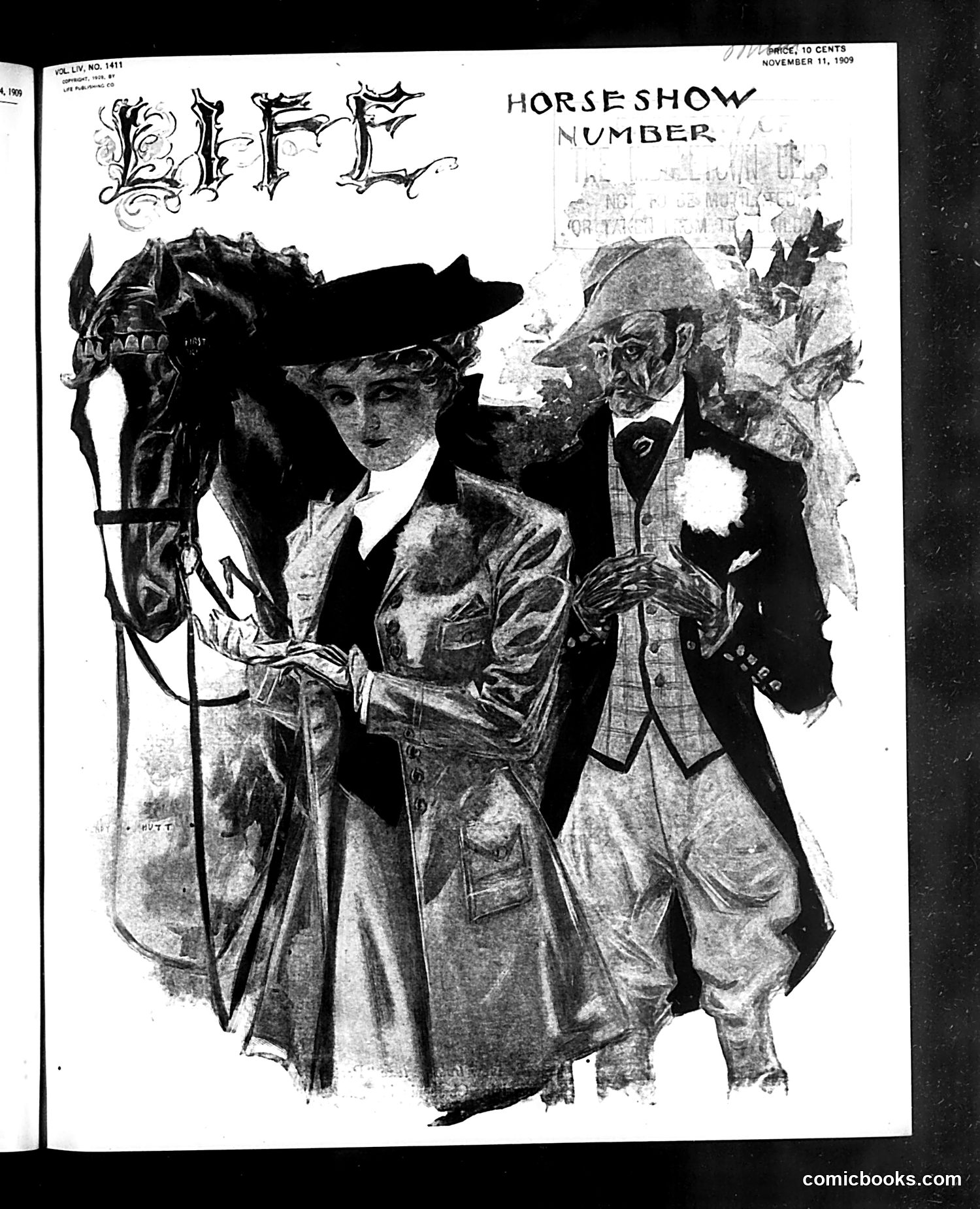
This is the cover of Life's special "Horseshow Number," featuring a satirical illustration of fashionable society attendees at a horse show. The image depicts elegantly dressed men and women in early 1900s attire (elaborate hats, formal jackets) parading with a decorated horse. The satire appears to target the vanity and self-importance of high society—the human figures are presented as theatrical and absurdly dressed as the horse itself. The joke likely mocks how wealthy New Yorkers used horse shows as venues for displaying their own fashionable appearance rather than appreciating the animals. This reflects a common early-20th-century Life magazine theme: ridiculing upper-class pretension and conspicuous consumption through exaggerated illustration.
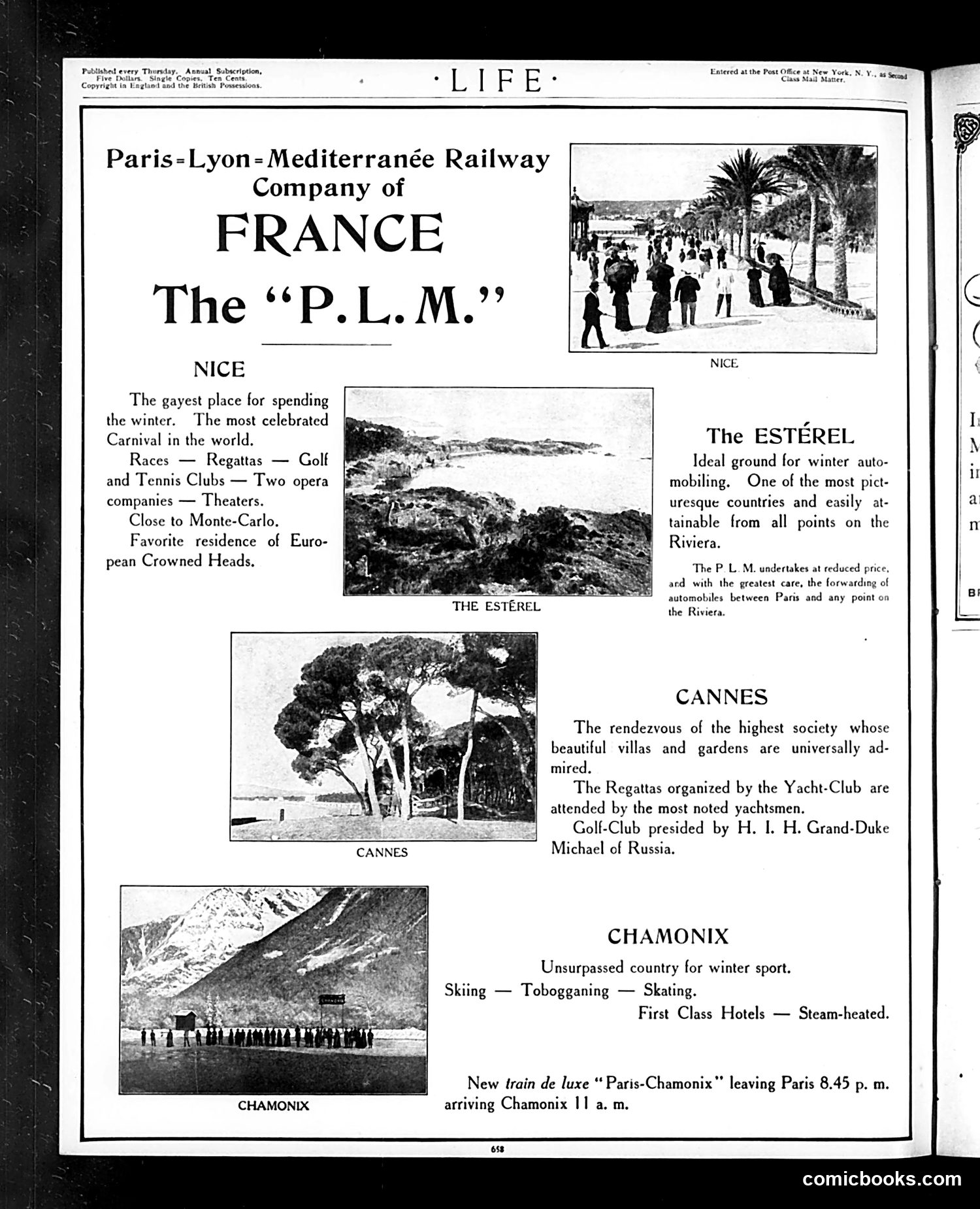
This page is **not a cartoon or satirical content**—it's a straightforward **travel advertisement** for the Paris-Lyon-Méditerranée (P.L.M.) Railway Company of France. The ad promotes four winter destination routes: Nice (described as ideal for carnival and social activities), the Estérel region (for automobiling), Cannes (for wealthy society with villas and gardens), and Chamonix (for winter sports like skiing). Each location includes photographs and promotional text. The Chamonix section highlights a luxury train service, the "Paris-Chamonix," departing Paris at 8:45 p.m. and arriving at 11 a.m. This represents early 20th-century **luxury travel marketing**, targeting wealthy European travelers seeking winter recreation and leisure destinations accessible by rail.
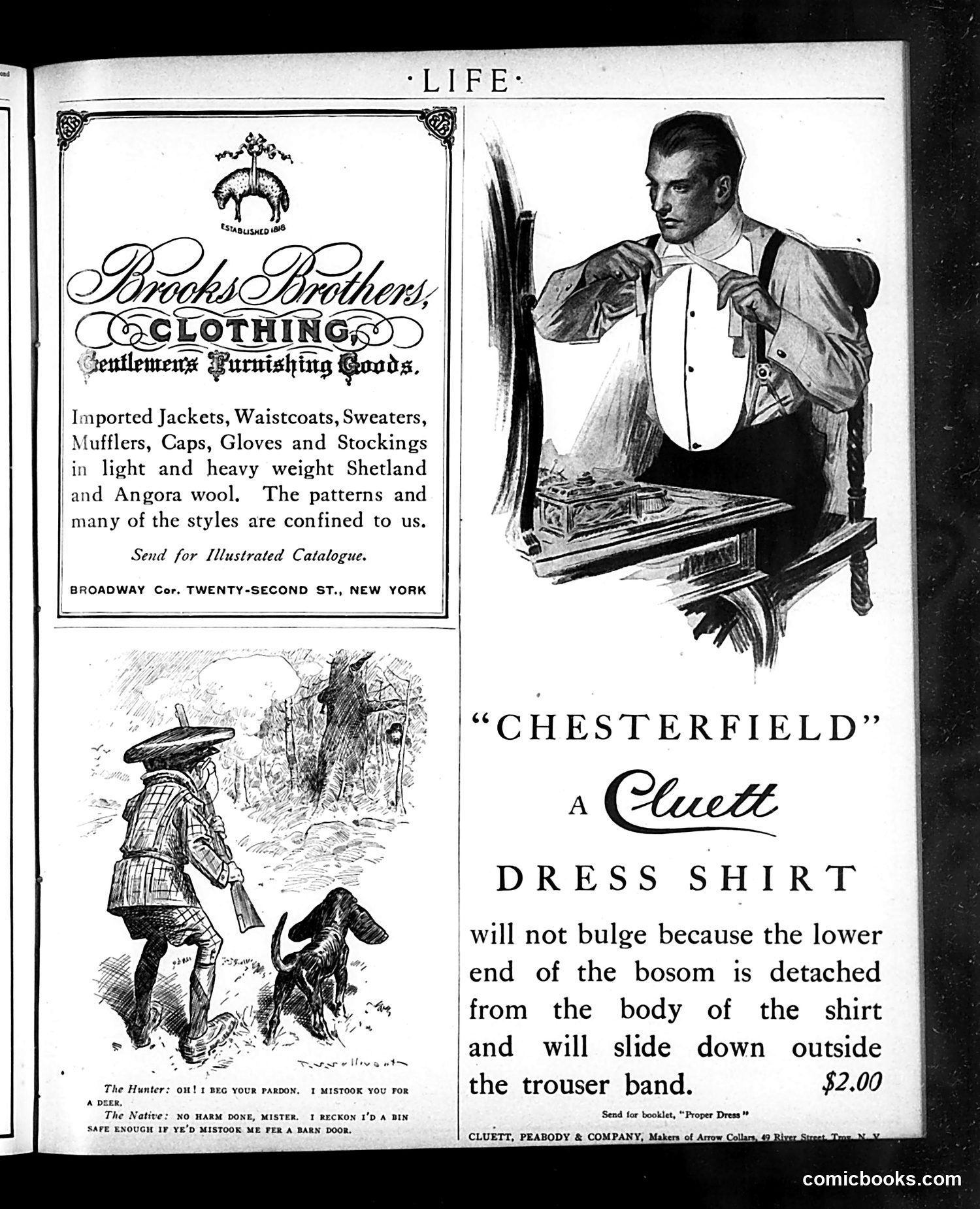
This page is primarily **advertising, not satire**. The top-left features a Brooks Brothers clothing advertisement for gentlemen's furnishings. The bottom-left contains a single-panel cartoon showing a hunter with a dog and the caption "The Hunter: 'Out! Beg your pardon. I mistook you for a deer'" with a note: "NO HARM DONE, MISTER. I RECKON I'D A BIN SAFE ENOUGH IF YE'D MISTOOK ME FEE A BARN DOOR." The joke is a simple visual gag: the hunter mistakes a person for a deer because the person is supposedly so large or wide they resemble a barn door. The right side features a Cluett dress shirt advertisement. This appears to be a typical early 20th-century magazine page mixing modest humor with product promotions.
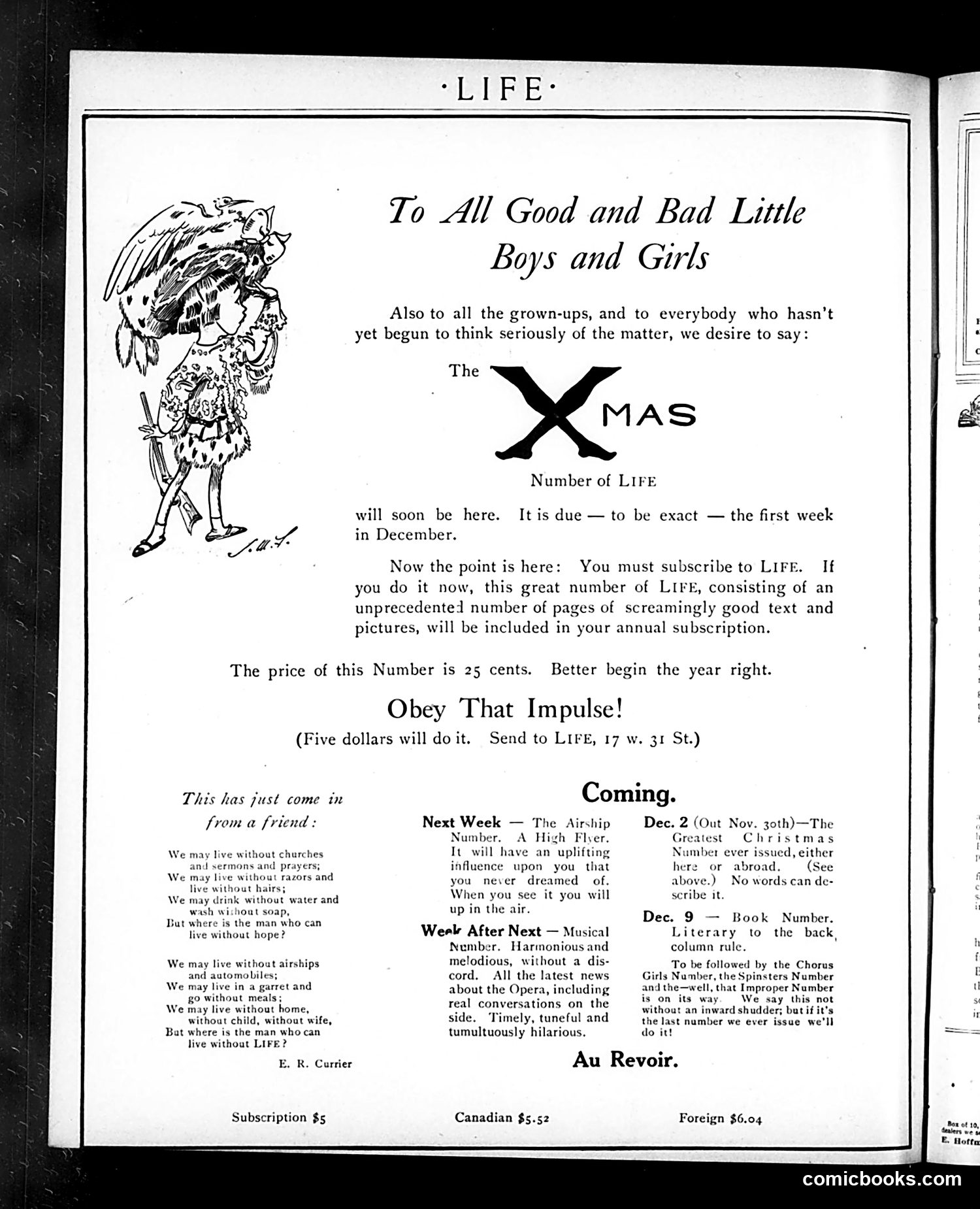
This page is primarily **advertising and promotional content** for Life magazine itself, not political satire. The main illustration shows a stylized figure in elaborate dress, but its specific meaning is unclear from the image alone. The page announces an upcoming **Christmas issue** (arriving early December) and urges readers to subscribe to Life at $5 annually to receive this special edition. It emphasizes the issue will contain "an unprecedented number of pages" and costs 25 cents. A poem by E.R. Currier titled "This has just come in from a friend" appears to make a philosophical point about what humans can live without, but its exact satirical target remains **unclear from the text provided**. The page functions as a subscription pitch rather than political commentary.
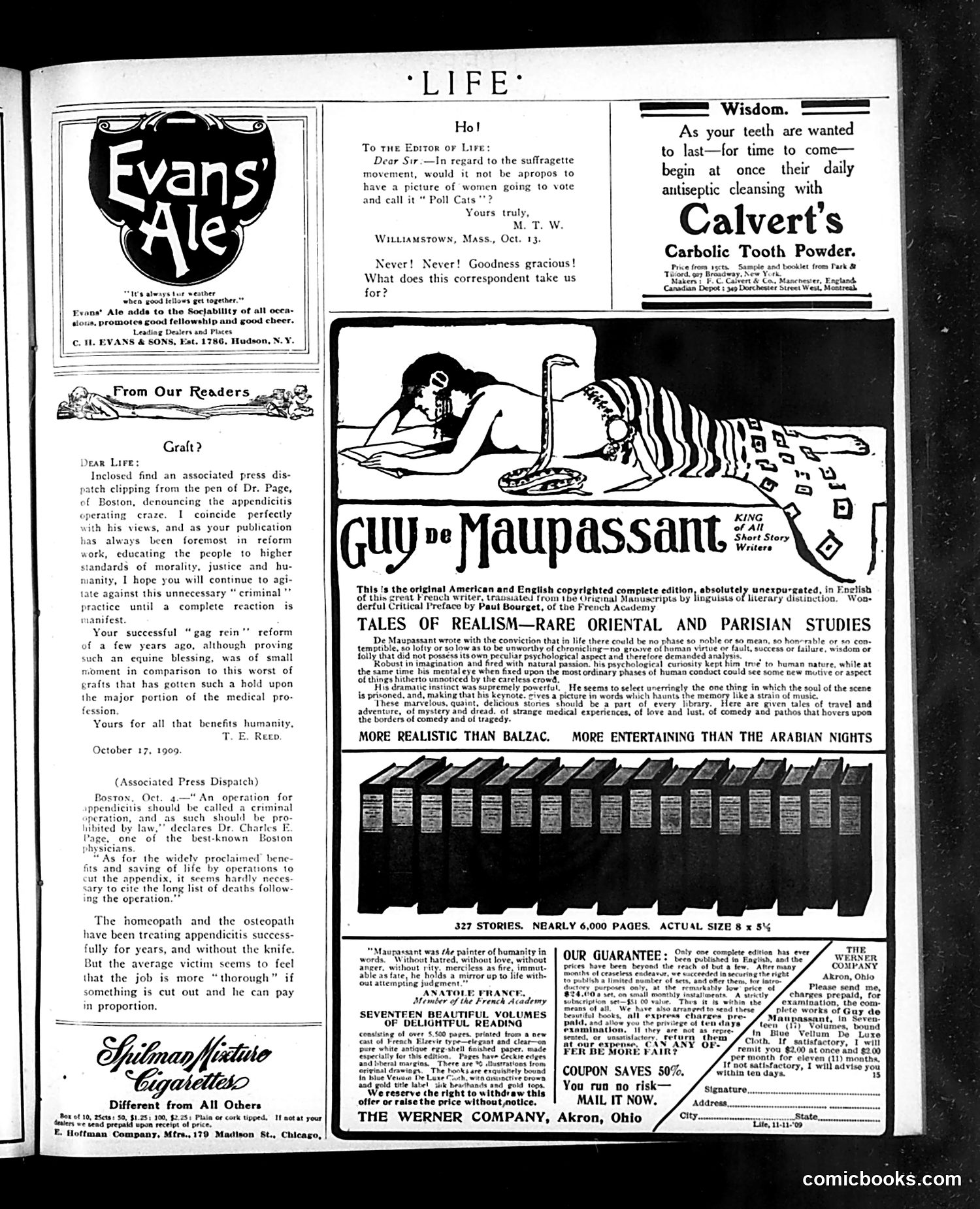
This page is primarily **advertising and reader letters**, not political satire. The main content includes: **Letters section ("From Our Readers"):** Correspondents debate suffrage ("Poll Cats"), medical ethics regarding appendicitis surgery, and criminal justice reform—typical Progressive Era concerns. **Advertisements:** Evans Ale, Calvert's Tooth Powder, and a large ad for Guy de Maupassant's complete works (327 stories, nearly 6,000 pages). **One illustration** accompanies the Maupassant ad showing a reclining figure, likely meant to evoke leisure reading. The page reflects early 20th-century middle-class preoccupations: women's voting rights, medical debates, and literary consumption. No identifiable political figures or sophisticated visual satire appear here—it's a typical period magazine page mixing reader engagement with commercial promotion.
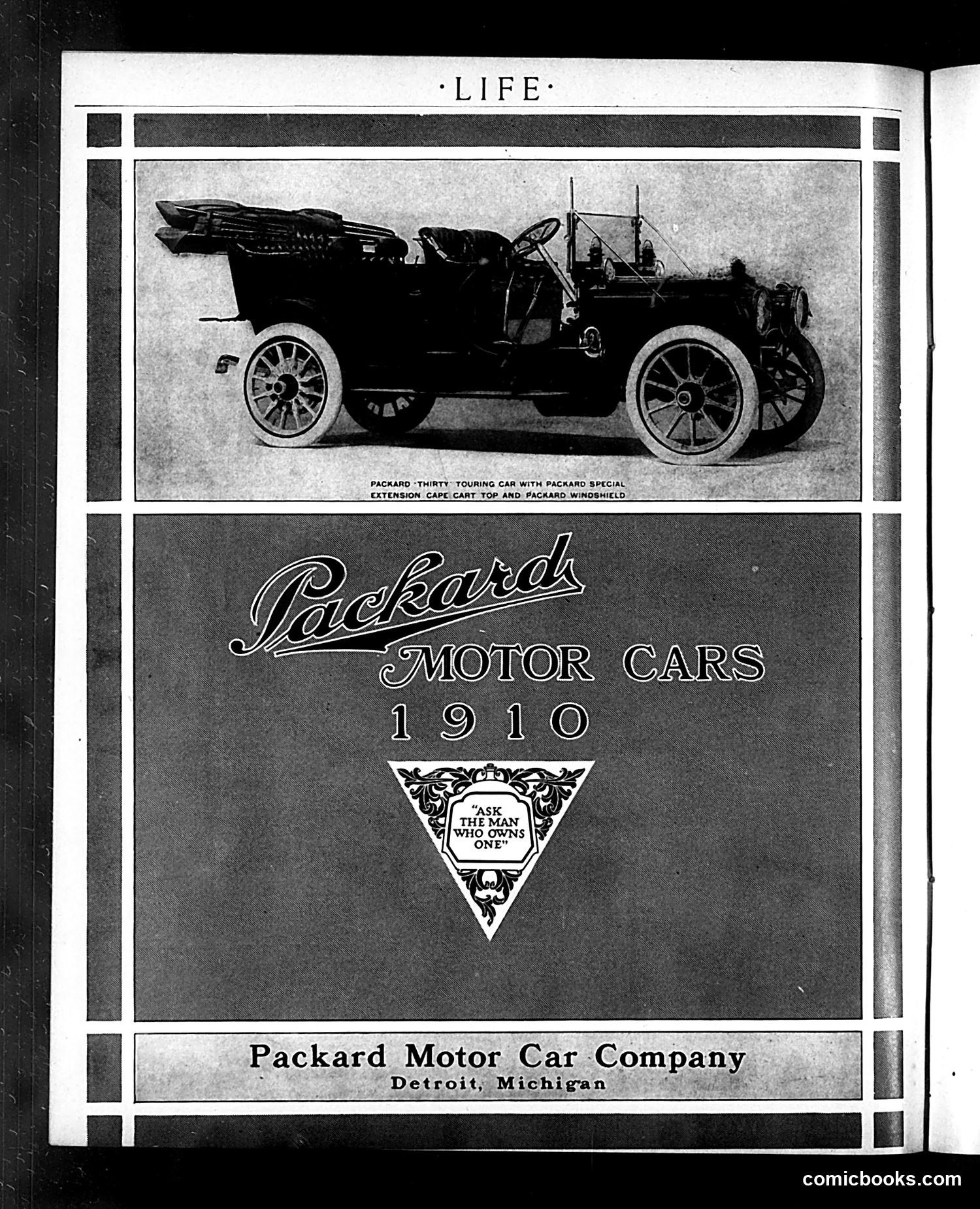
This is primarily **advertising, not editorial content**. The page features a 1910 Packard Motor Car Company advertisement from their Detroit, Michigan headquarters. The image shows a Packard "Thirty" touring car equipped with optional accessories (cape cart top and windshield). The tagline reads "Ask the man who owns one"—a famous Packard marketing slogan emphasizing owner satisfaction. There is **no political cartoon or satire** on this page. The decorative triangular emblem at bottom simply reinforces the brand messaging. This represents straightforward early automobile advertising aimed at affluent buyers, not social or political commentary. The "Life" magazine masthead indicates publication context, but the content itself is commercial rather than editorial.
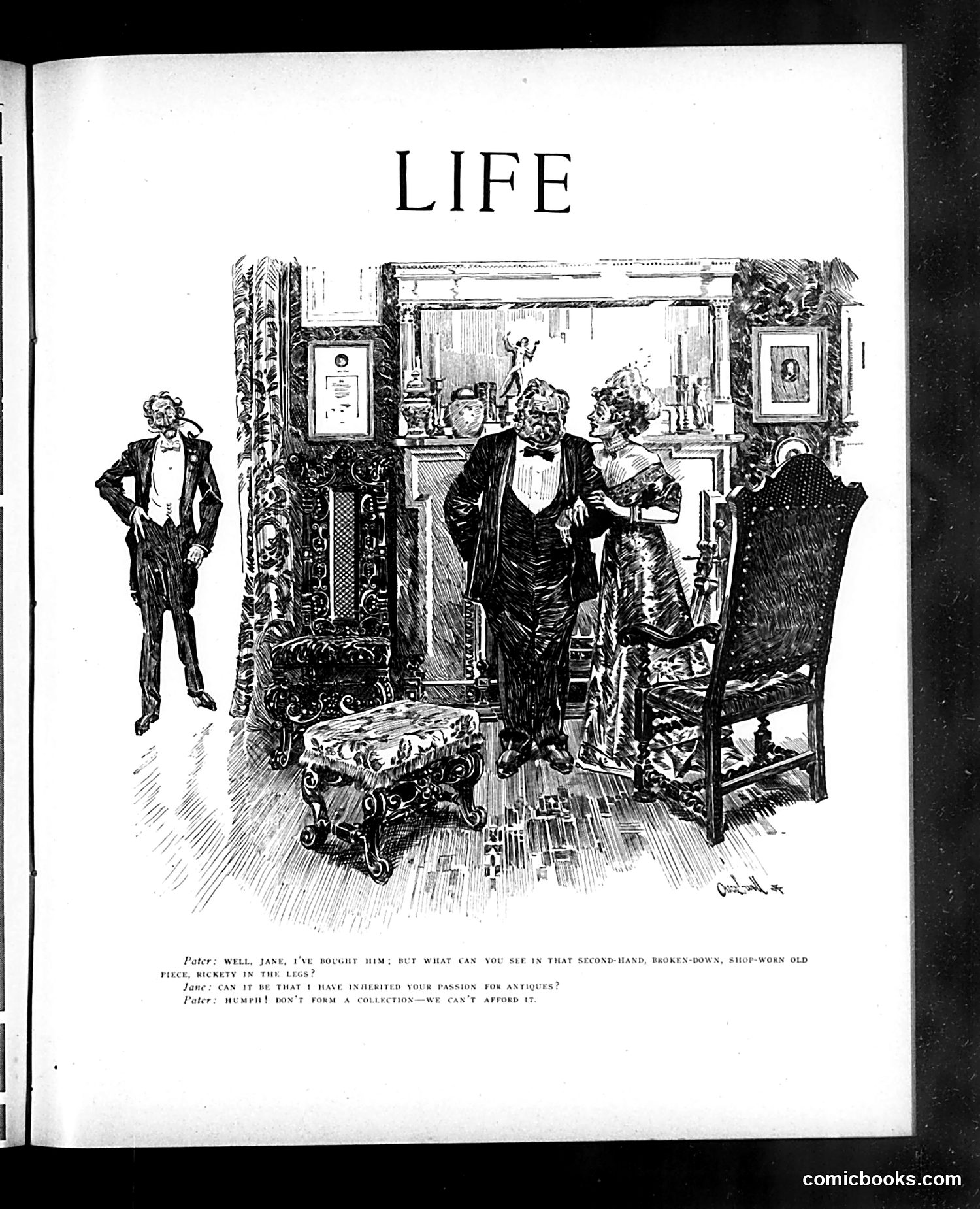
This is a satirical cartoon from *Life* magazine titled simply "LIFE." The sketch depicts an interior domestic scene with several well-dressed figures in what appears to be a Victorian or Edwardian parlor. The dialogue below reveals the satire's target: a husband (Father) has purchased a second-hand piece of furniture, which the wife (Jane) questions. She sarcastically asks if he's "inherited your passion for antiques," implying he's suddenly adopted pretentious collecting habits. The husband's response—"Humph! Don't form a collection—we can't afford it"—suggests the couple cannot sustain expensive hobbies despite social aspirations. The joke satirizes middle-class attempts at gentility and collecting antiques as status symbols, while financial constraints limit such aspirations. The worn furniture becomes a symbol of social pretension undermined by economic reality.
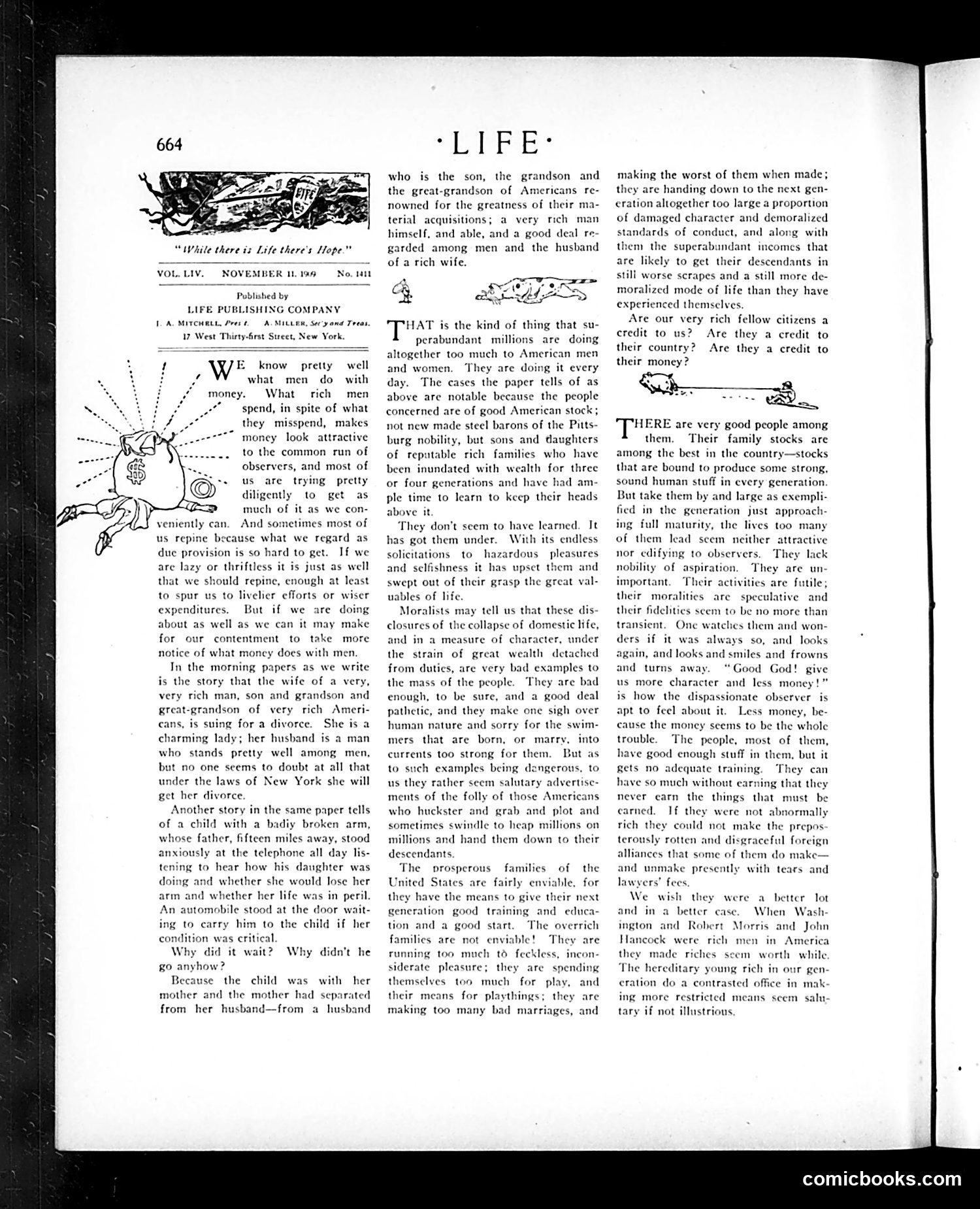
This page is primarily **text-based editorial content**, not a political cartoon. The left margin contains a small illustration of a money bag sprouting wings—a visual metaphor for wealth taking flight or dissipating. The article discusses **wealthy American families** and their moral failings. It criticizes rich citizens for failing to be proper "credit to their country," suggesting their inherited wealth has made them irresponsible. The piece expresses concern that the next generation of wealthy heirs will inherit both money and poor character, perpetuating cycles of "bad marriages" and moral dissolution. The satire targets **American aristocracy's hypocrisy**—their material success masks spiritual bankruptcy. This reflects Progressive Era anxieties (likely early 1900s) about whether concentrated wealth was corrupting American society.
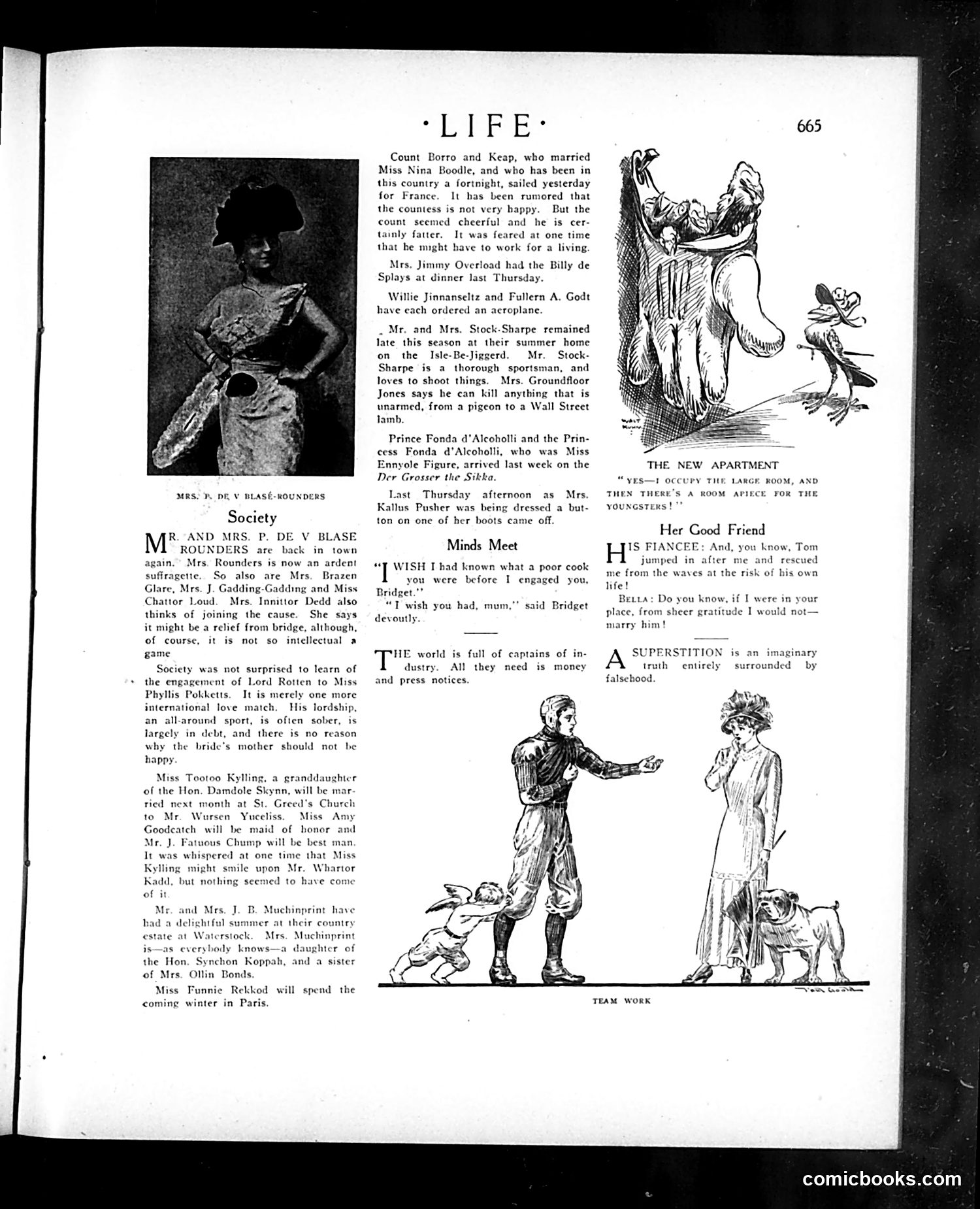
This page contains **society gossip and satirical illustrations** rather than political cartoons. The content includes: **"Society" section**: Announcements about engagements and social events among the wealthy, including Lord Rotten's engagement to Miss Phyllis Folkette, described as "largely in debt." **Illustrations**: - "The New Apartment" shows a woman triumphantly displaying a large room to younger women - "Team Work" depicts a man directing a small dog to pull a reluctant woman forward **"Her Good Friend"** and **"A Superstition"** appear to be humorous dialogue snippets about romantic situations and folk beliefs. The satire targets the leisure class—their financial irresponsibility, romantic entanglements, and domestic pretensions. The illustrations use physical comedy and exaggeration typical of early 20th-century magazine humor.
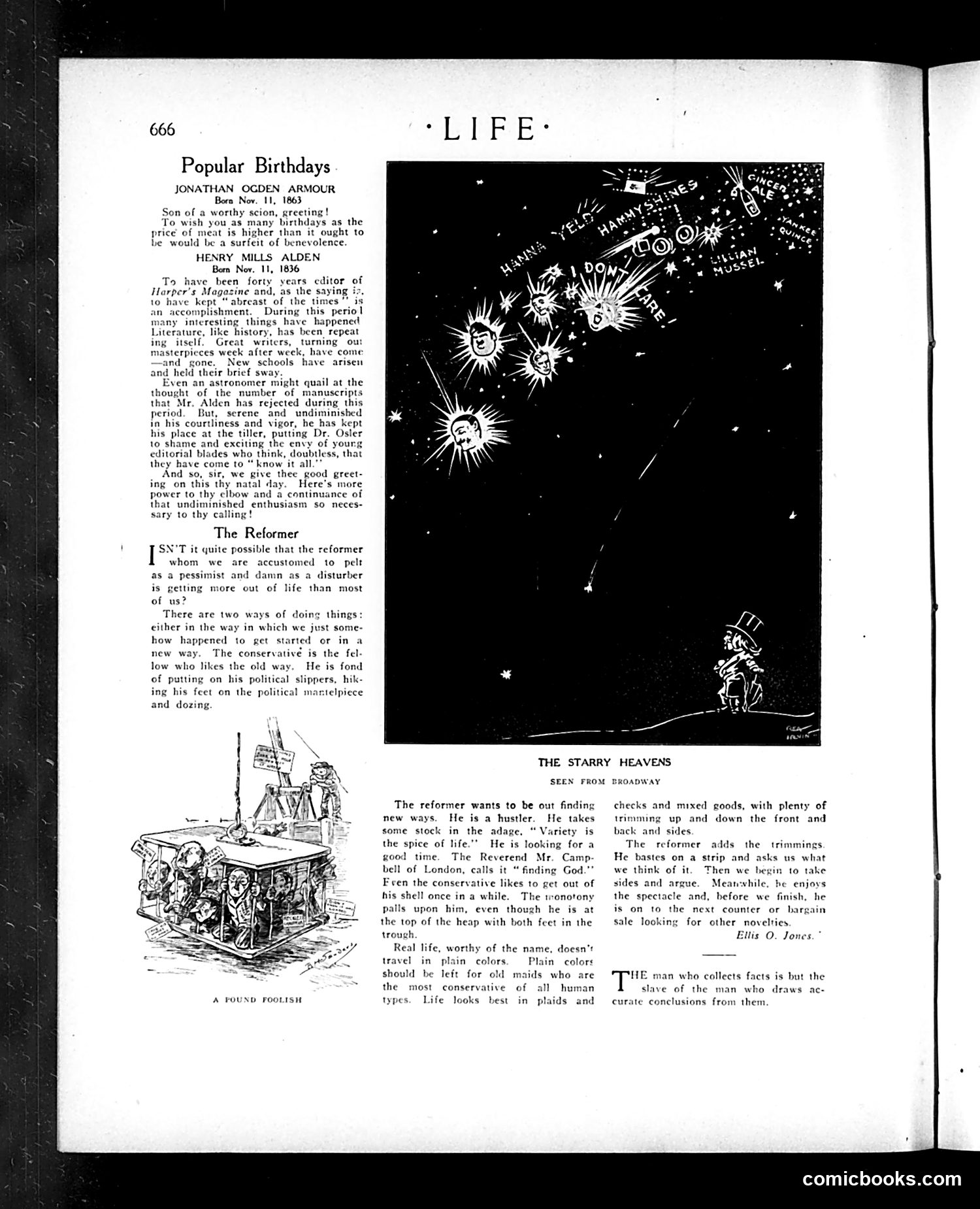
This page from *Life* magazine features a satirical cartoon titled "Ideas from Broadway" depicting fireworks exploding in the night sky with the caption "THE STARRY HEAVENS." The accompanying text, titled "The Reformer," discusses two contrasting political approaches: the reformer who seeks new ways and change, versus the conservative who prefers maintaining the status quo. The text uses the metaphor of traveling "in plain colors" and avoiding ostentatious display. The cartoon appears to satirize reformist ambitions or political upheaval—the explosive fireworks likely represent grandiose but ultimately ephemeral promises of change. A small figure at bottom observes the spectacle, suggesting the common person witnessing political theater. The satire critiques the theatrical, flashy nature of reform movements versus substantive political action.
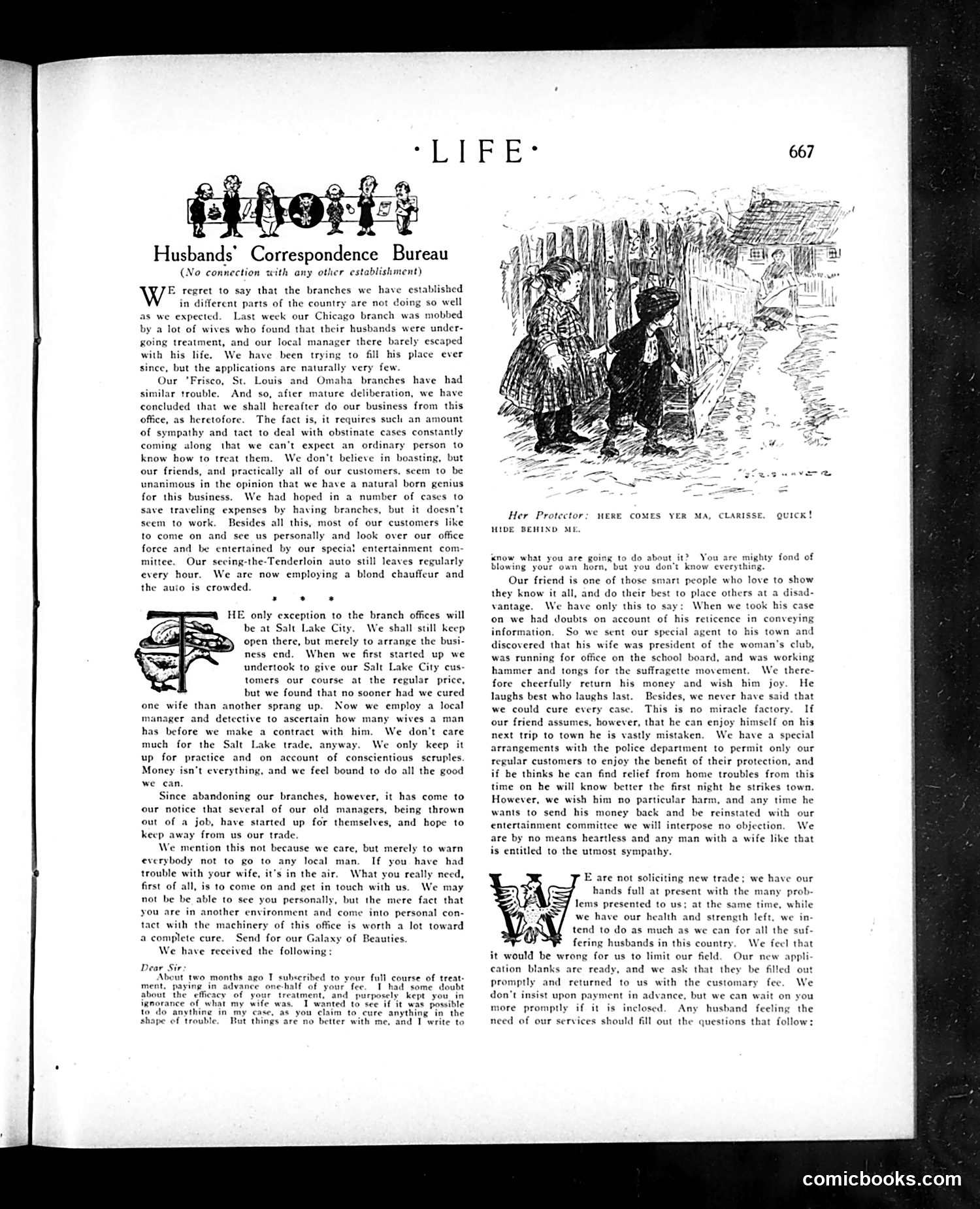
This satirical piece mocks a fake business service claiming to solve marital problems through correspondence. The humor targets husbands who neglect their wives or handle domestic disputes poorly. The illustrated vignette shows a woman standing alone while a man hides behind a fence—suggesting avoidance of confrontation. The accompanying text presents this "bureau" as offering to mediate husband-wife disagreements by mail, since husbands apparently can't communicate directly. The satire critiques early 20th-century masculine behavior: emotional distance, poor communication skills, and tendency to dodge marital responsibility. By presenting husband-management as a needed business service, Life ridicules both the incompetence of husbands and the desperation of wives forced to seek outside help for basic family problems. The tone is lighthearted but points to genuine frustrations with male emotional unavailability.
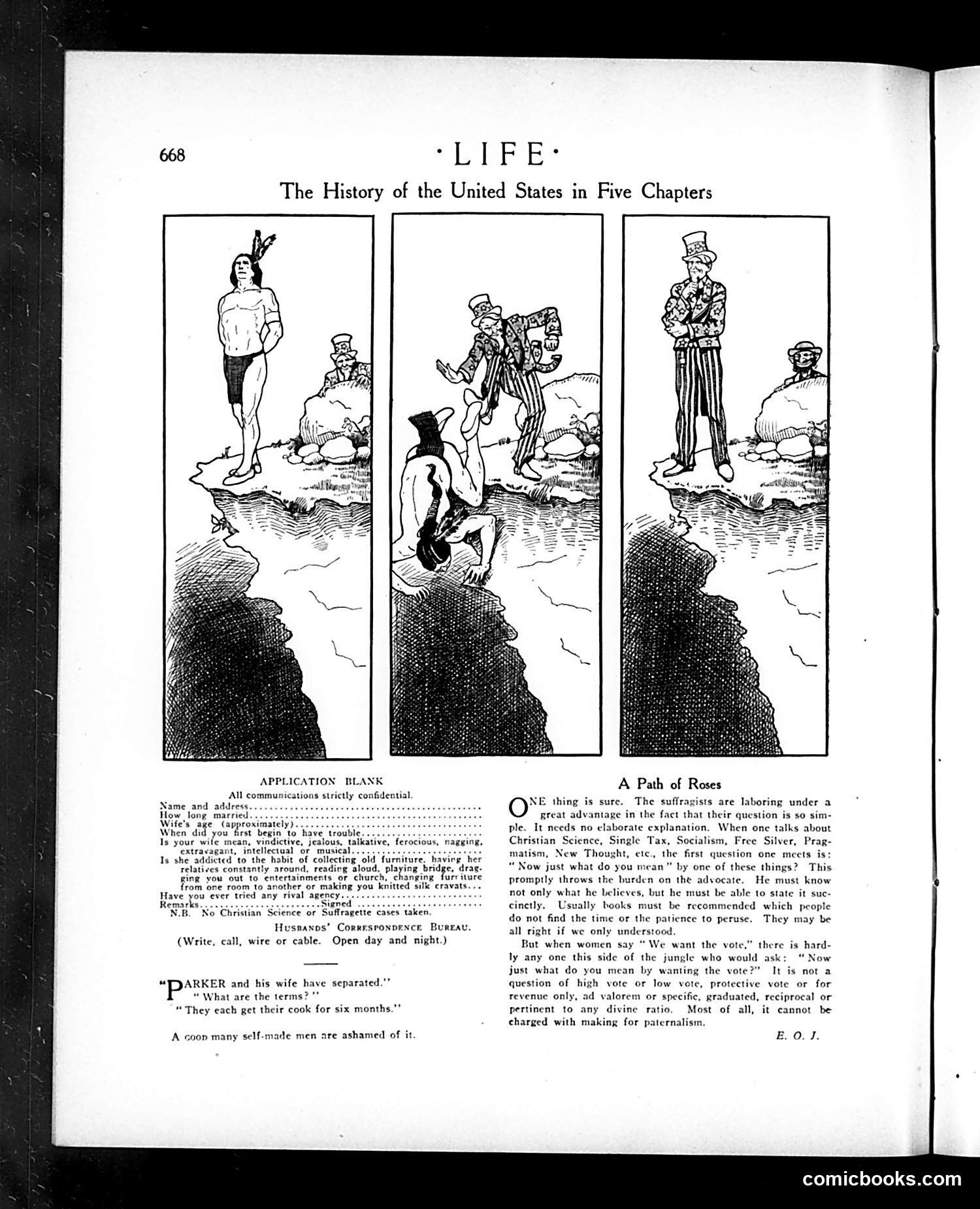
This three-panel satirical cartoon titled "The History of the United States in Five Chapters" depicts the progression of women's suffrage activism. **Panel 1**: A Native American woman stands while a suited man sits—representing pre-suffrage America. **Panel 2**: A woman in formal dress crouches or bows before a man in Uncle Sam attire, suggesting women petitioning for voting rights. **Panel 3**: The woman now stands prominently while the man appears diminished, suggesting achieved suffrage. The accompanying text "A Path of Roses" sarcastically dismisses suffragists' real struggles as easy. The editorial argues their cause is simple and needs no elaborate explanation—mocking the complexity of women's political advocacy while also trivializing the movement's actual obstacles and opposition.
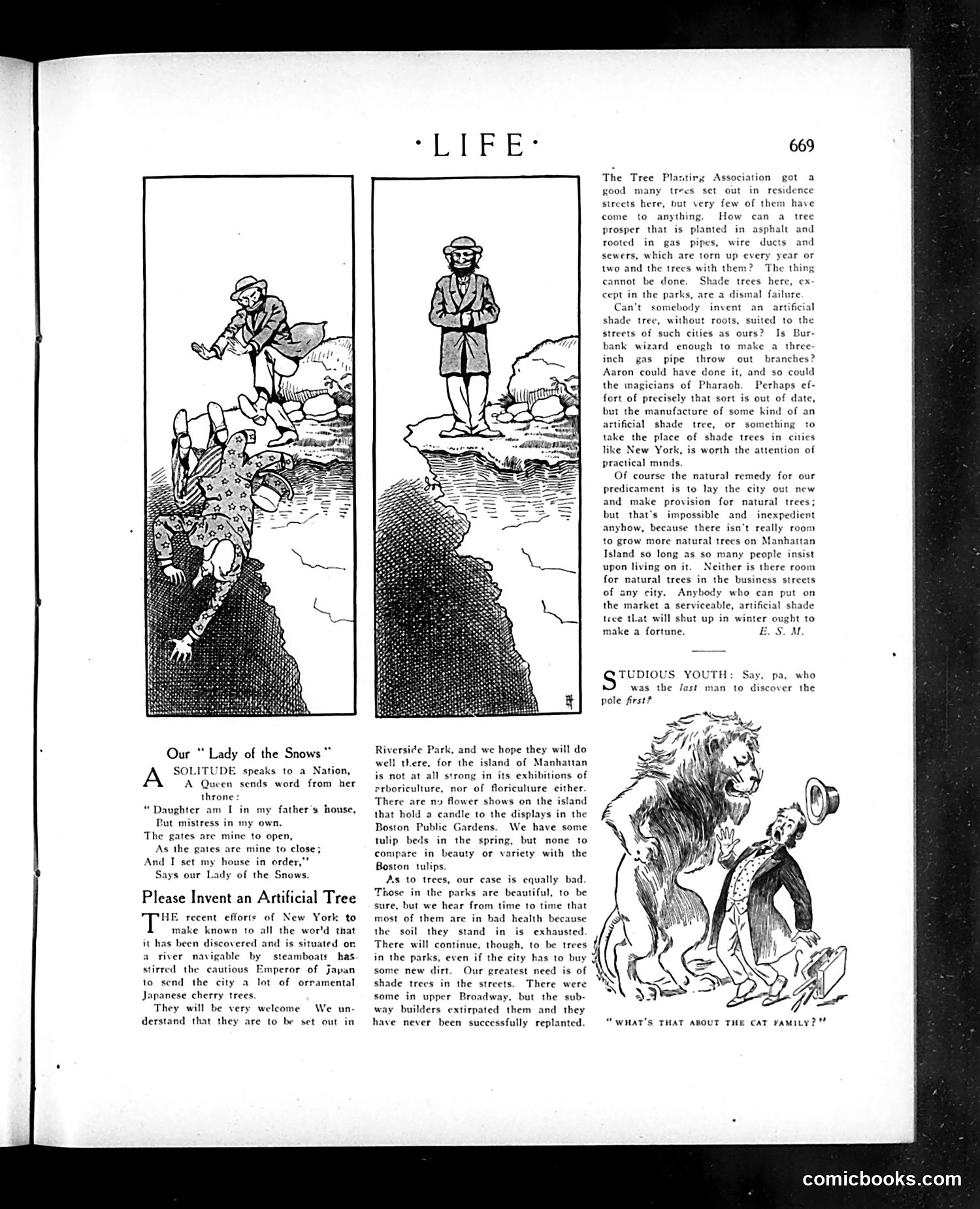
This page contains two distinct pieces: **Left Section**: A two-panel cartoon titled "Our 'Lady of the Snows'" shows a woman figure speaking poetically about her domain ("the gates are mine to open, to close"). This appears to be a personification of winter or snow, rendered in whimsical rather than political terms. **Right Section**: An article titled "Please Invent an Artificial Tree" critiques New York City's inability to maintain shade trees due to urban infrastructure (gas pipes, sewers, asphalt). The author (signed E.S.M.) argues that Manhattan needs artificial shade trees in streets since natural ones cannot survive the conditions. **Bottom Right**: An unrelated cartoon shows a child with animals, captioned "What's that about the cat family?" The satire targets urban planning failures rather than political figures.
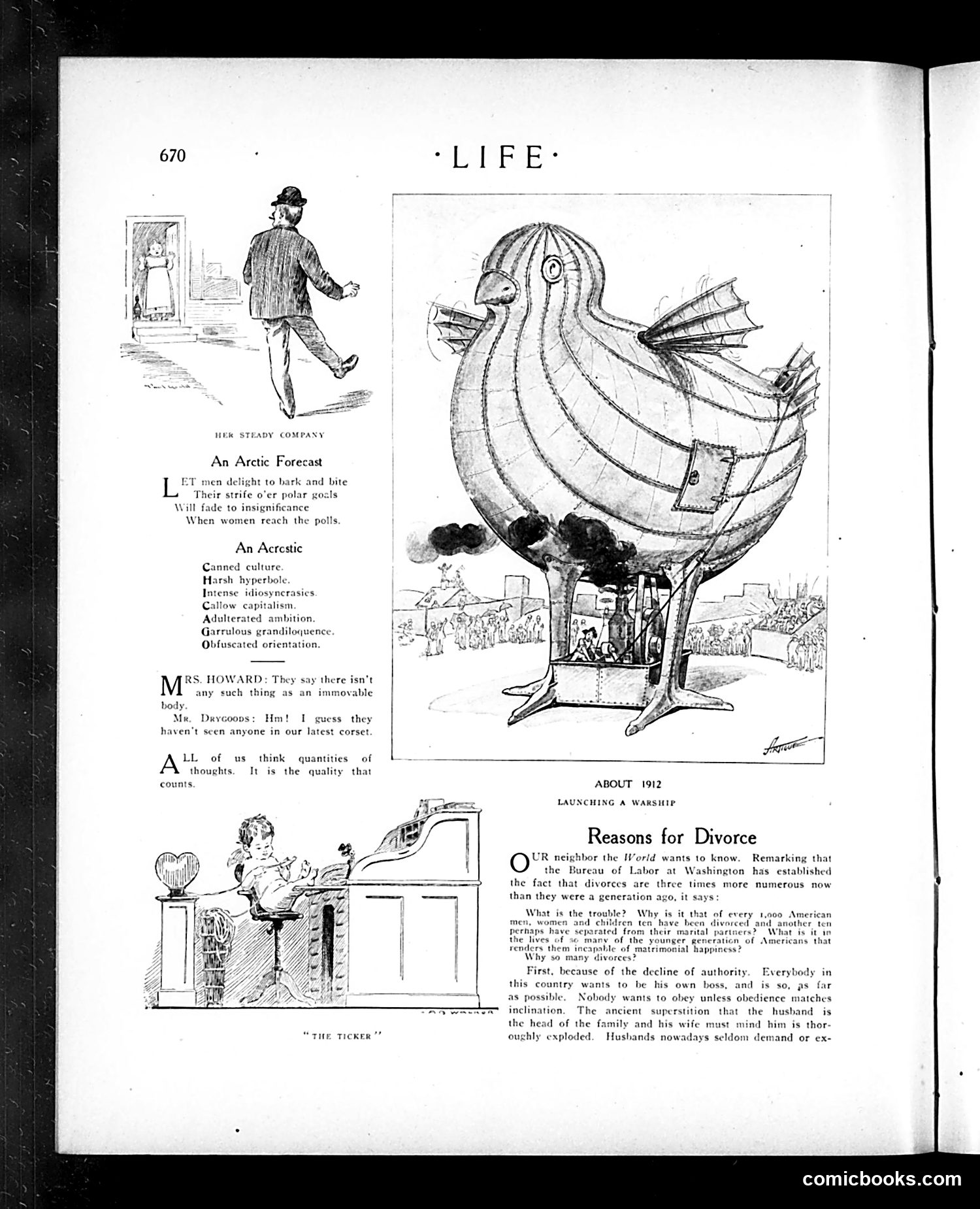
This satirical page from Life magazine contains several joke items reflecting early 1900s concerns: **"An Arctic Forecast"** mocks men's competitive polar exploration races by suggesting women's suffrage will make these efforts seem trivial—a contemporary dig at the women's voting rights movement. **The corset joke** between "Mrs. Howard" and "Mr. Daygoods" puns on fashion constraints: the "immovable body" references women's heavily corseted figures, suggesting corsets are so restrictive they create an "immovable object." **"Reasons for Divorce"** addresses rising divorce rates (reportedly triple a generation prior). The piece attributes this to declining patriarchal authority—men can no longer demand obedience from wives as they once did. This reflects anxiety about traditional family hierarchy weakening, presented as society's "decline" rather than women's emancipation. The giant duck-shaped airship cartoon's meaning is unclear from context alone. All content reflects upper-class anxieties about women's changing social roles and authority structures around 1912.
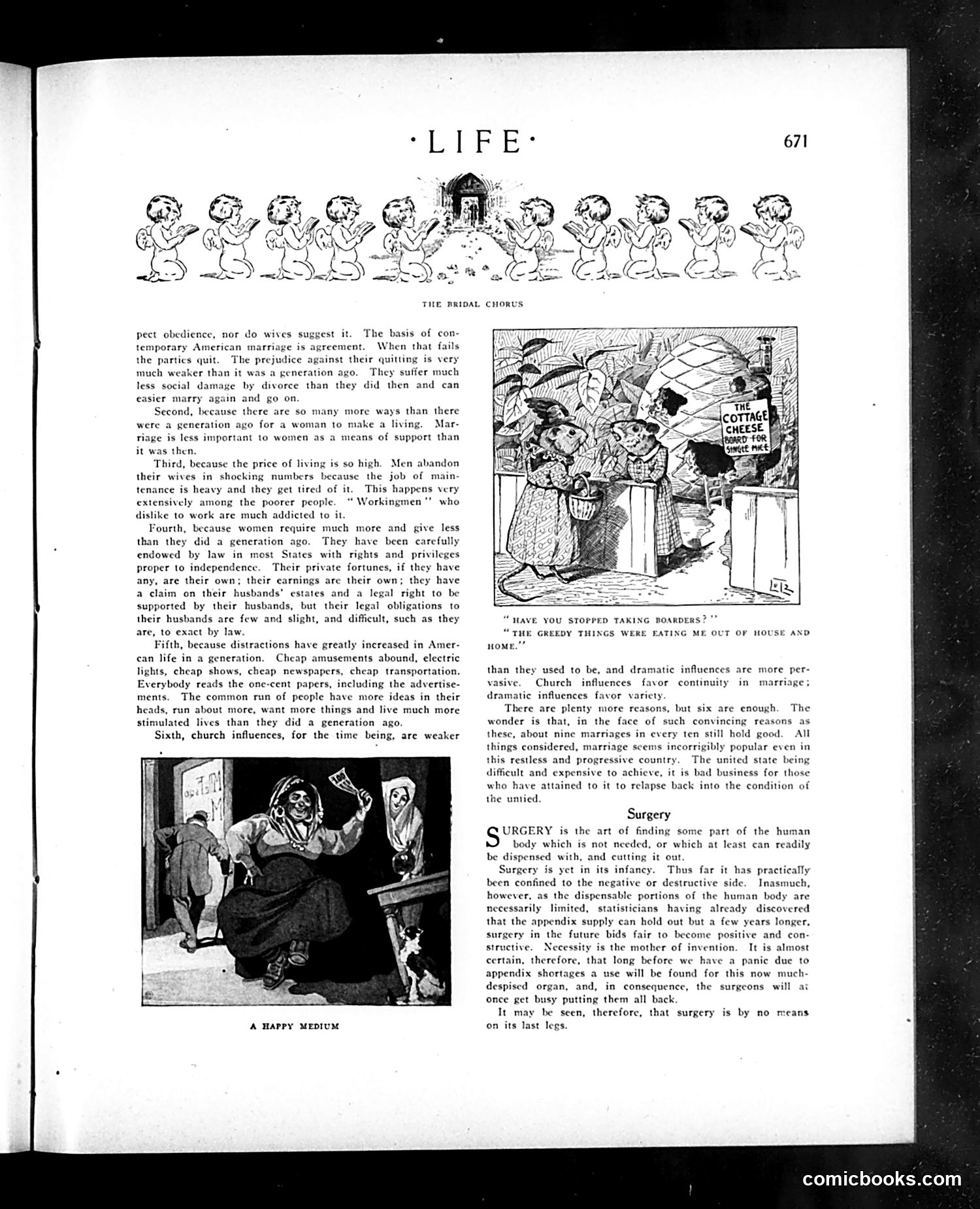
**The Cartoons:** The top illustration shows cherubs around a church, labeled "The Bridal Chorus"—a humorous reference to the famous wedding march. The main cartoon depicts a woman confronting what appears to be boarders or lodgers eating her food. The caption reads: "Have you stopped taking boarders?" / "The greedy things were eating me out of house and home." This satirizes the common practice of boarding house keeping—a way widows and working-class women supplemented income. The joke is that feeding boarders became economically unsustainable. **The Article Context:** The page discusses why American marriages increasingly fail. The text lists six reasons: marriage based on agreement (not obedience), women's economic independence, high living costs forcing abandonment, women's expanded legal rights, urban distractions (cheap entertainment, newspapers, transportation), and weakened church influence. The satire reflects early 20th-century anxieties about modernization—women's independence, economic strain, and secular entertainment threatening traditional marriage stability.
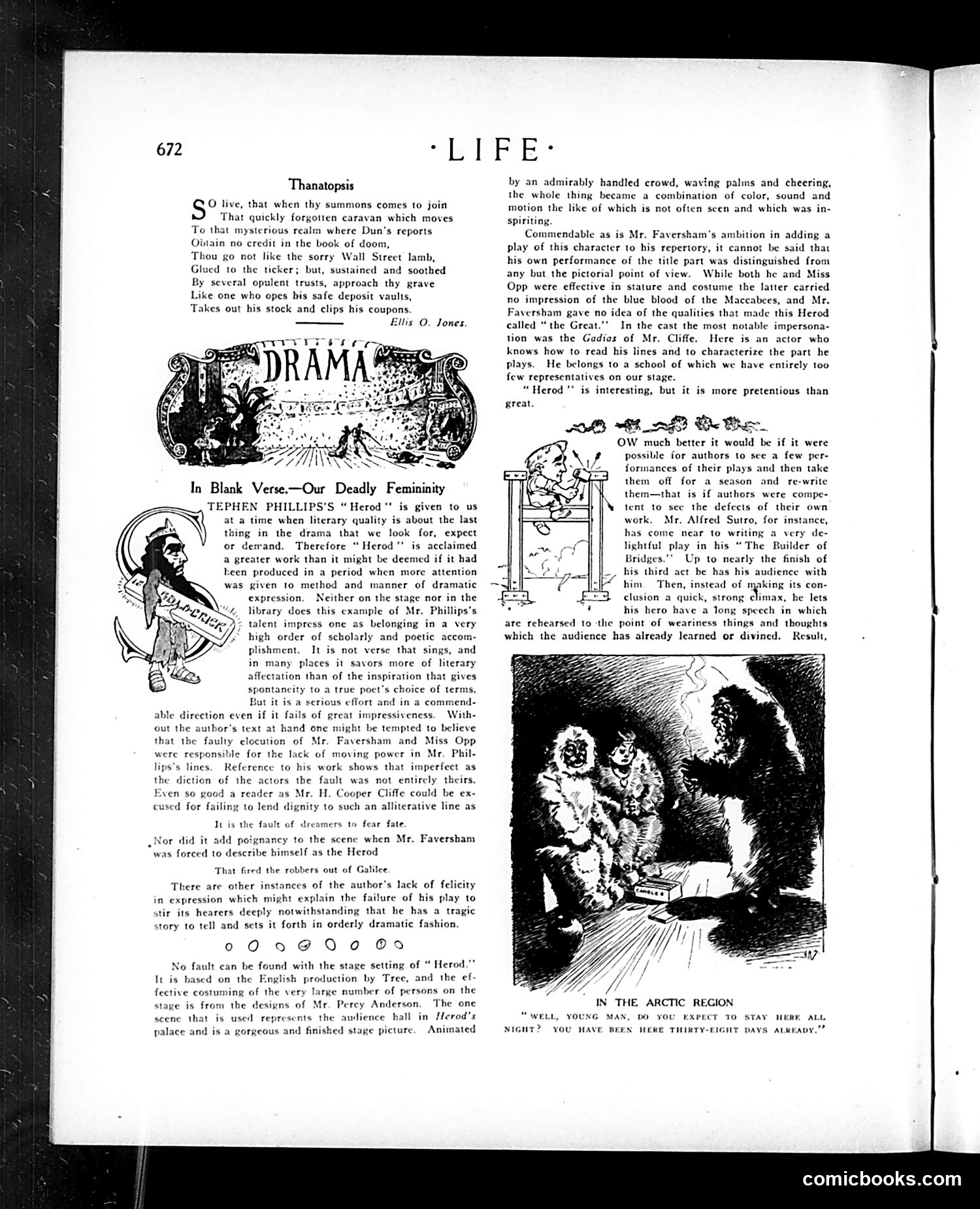
This page contains theater criticism of Stephen Phillips's play "Herod," starring actor William Faversham. The critic praises the production's staging, costumes, and crowd direction by Percy Anderson, calling it "gorgeous and finished." However, he judges the play itself as pretentious rather than great, criticizing Phillips's verse as affected rather than inspired. The main targets of satire are the lead actors' performances. Faversham's portrayal lacks the qualities that made the historical Herod "the Great," while Miss Opp fails to convey "the blue blood of the Maccabees" despite effective costuming. Only H. Cooper Cliffe, playing Godias, receives genuine praise for skilled line delivery and characterization. The opening poem "Thanatopsis" (by Ellis O. Jones) satirizes Wall Street greed during what appears to be the early 1900s financial era, mocking wealthy investors who approach death clutching stocks and safe deposit boxes rather than living meaningfully.
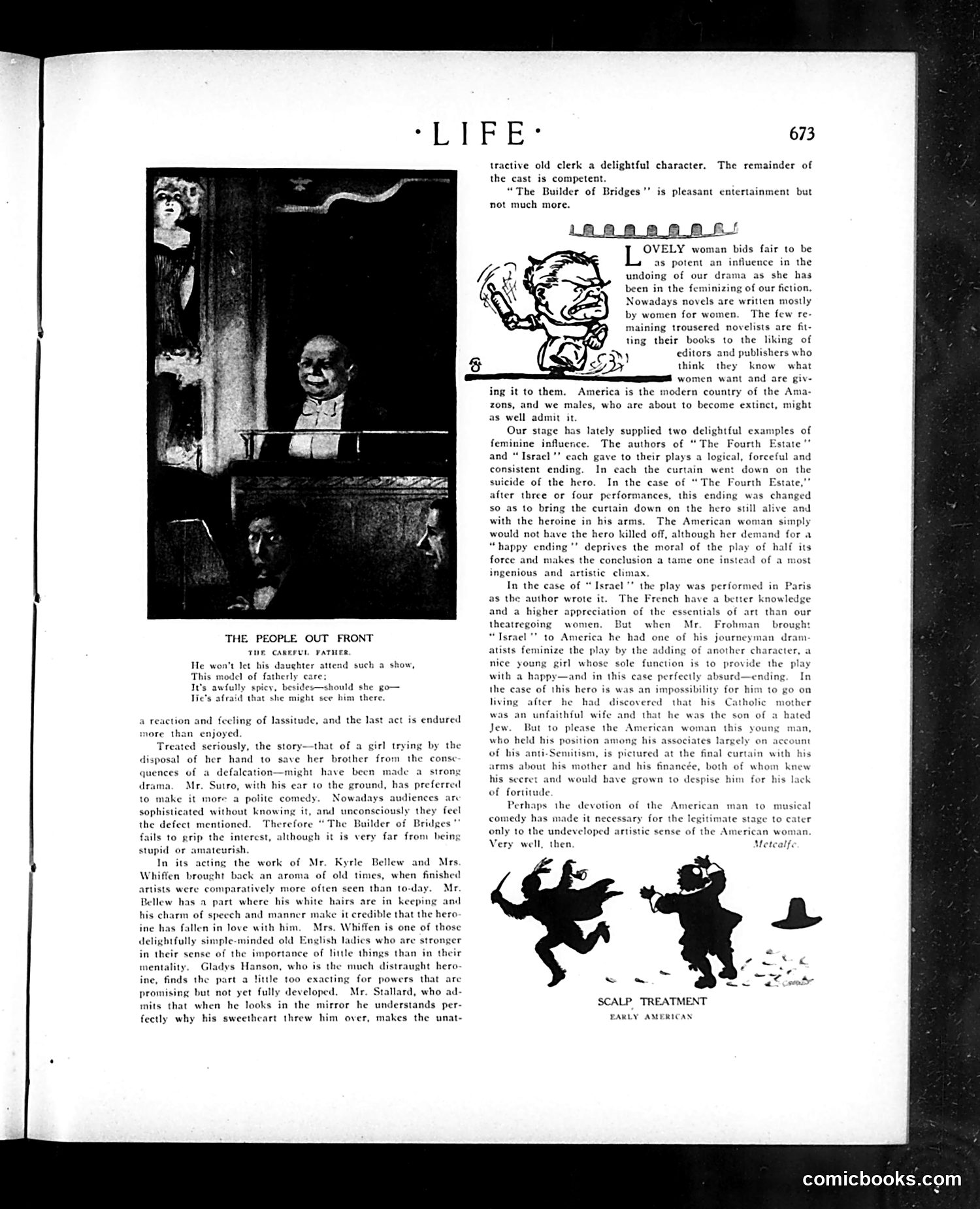
## "The People Out Front" (Top Cartoon) This joke satirizes Victorian hypocrisy about morality. A self-righteous father forbids his daughter from attending a risqué theatrical show—not from genuine moral concern, but because he fears she might spot *him* there enjoying it himself. The humor exposes the contradiction between public piety and private behavior common among respectable men of the era. ## Theater Criticism Section The text discusses how female influence is "feminizing" American drama and fiction. The author argues that women writers and female audiences now dominate, forcing male playwrights to provide sentimental "happy endings" rather than artistically authentic conclusions. Specific examples: plays like "The Fourth Estate" and "Israel" originally ended with the hero's suicide, but American producers altered them to show the hero surviving and reunited with the heroine—changes attributed to female audience demand for romance over artistic integrity. The French supposedly maintain better artistic standards. ## "Scalp Treatment" (Bottom Illustration) A crude cartoon depicting Native Americans, labeled "Early American," showing the historical practice of scalping. Its placement appears ironic given the surrounding text about American cultural taste.
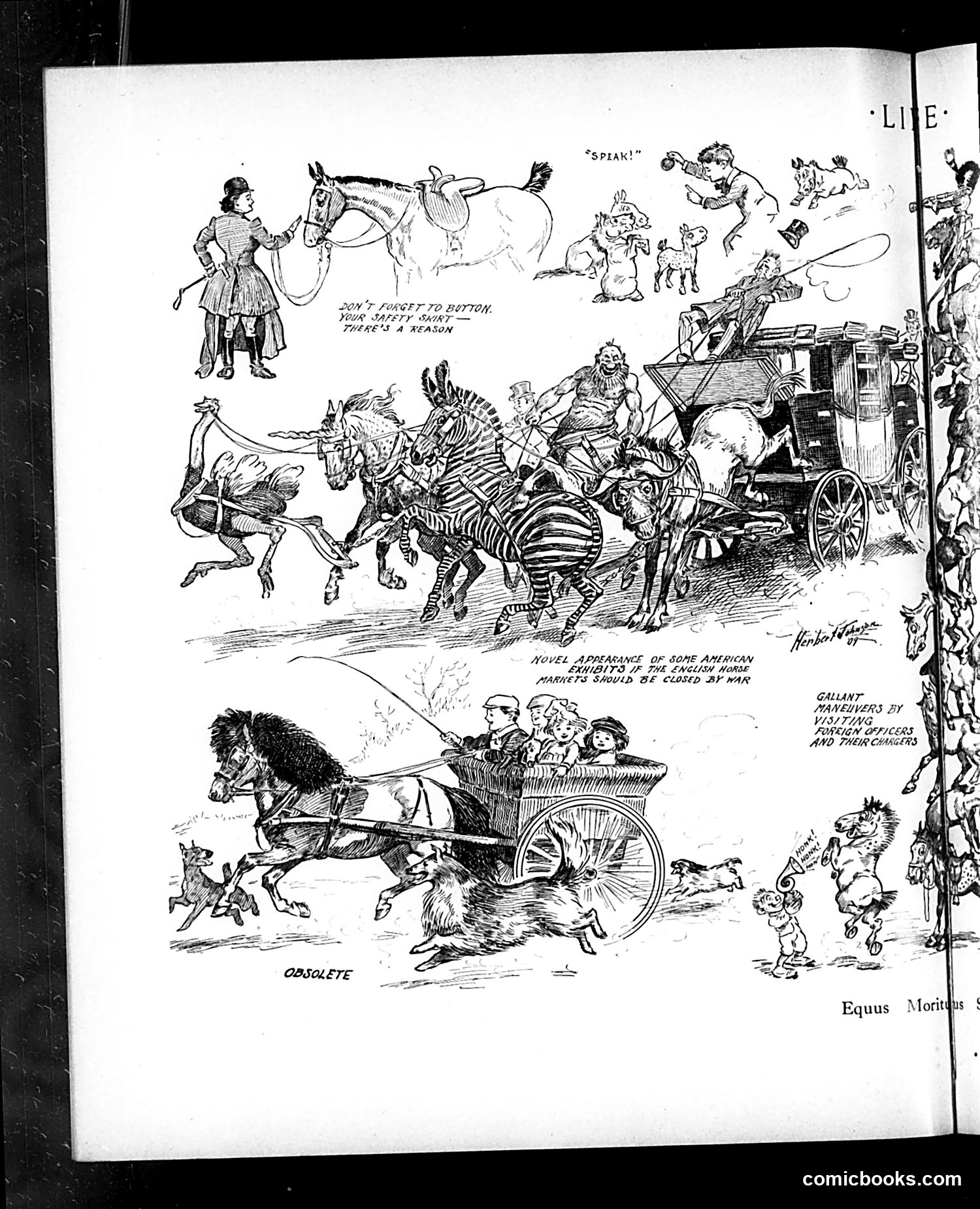
This satirical page mocks the potential impact of World War I on American trade and industry. The central cartoon depicts exotic zebras and fantastical creatures pulling carts—a visual metaphor suggesting that if war closes English horse markets, Americans would resort to absurd alternatives for transportation and commerce. The upper vignette shows a woman with a horse, referencing a "safety shirt" advertisement—likely satirizing wartime safety concerns or commercial opportunism during the conflict. The title "Equus Morityns" (dead horse) reinforces the joke: American businesses dependent on English horse imports would face obsolescence. The cartoon criticizes both American reliance on foreign trade and wartime market disruptions, using grotesque imagery to exaggerate economic anxiety. The tone is lighthearted mockery of commercial panic during the war period.
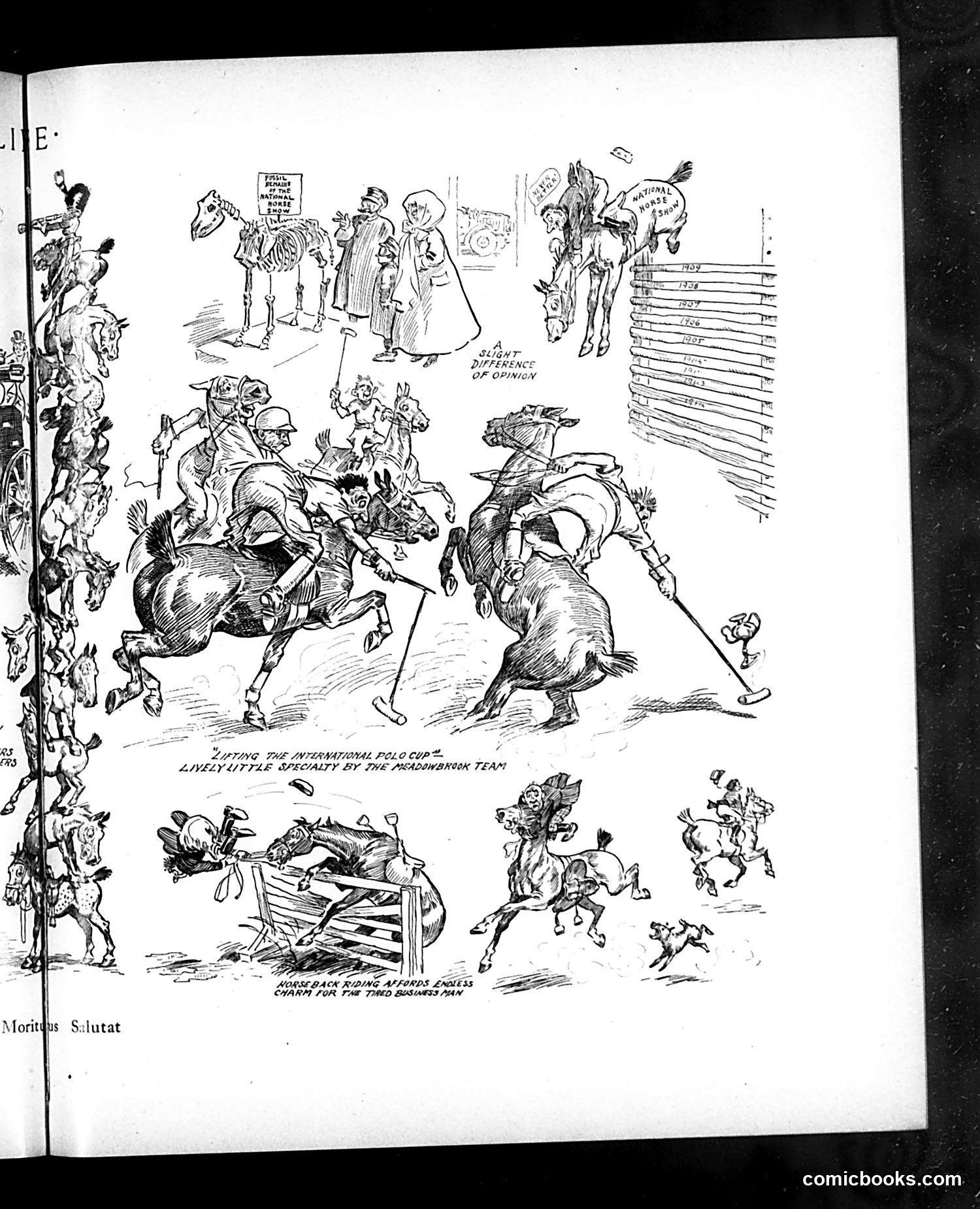
This page contains satirical sketches about polo and horseback riding, likely from the early 20th century. The upper cartoon depicts "Settling the International Polo Cup" with the Meadowbrook Team, showing mounted players in exaggerated, chaotic action—suggesting incompetence or comic ineptitude at this elite sport. The caption notes polo as "A Slight Difference of Opinion," implying disagreement or conflict among players. Below, "Horseback Riding Affords Endless Charm for the Tired Businessman" depicts riders tumbling and struggling, satirizing the notion that this supposedly genteel leisure activity is actually undignified and exhausting. The humor targets wealthy, urban businessmen who pursue polo and horseback riding as fashionable pastimes, mocking both the sport's complications and the participants' lack of actual skill despite their pretensions.
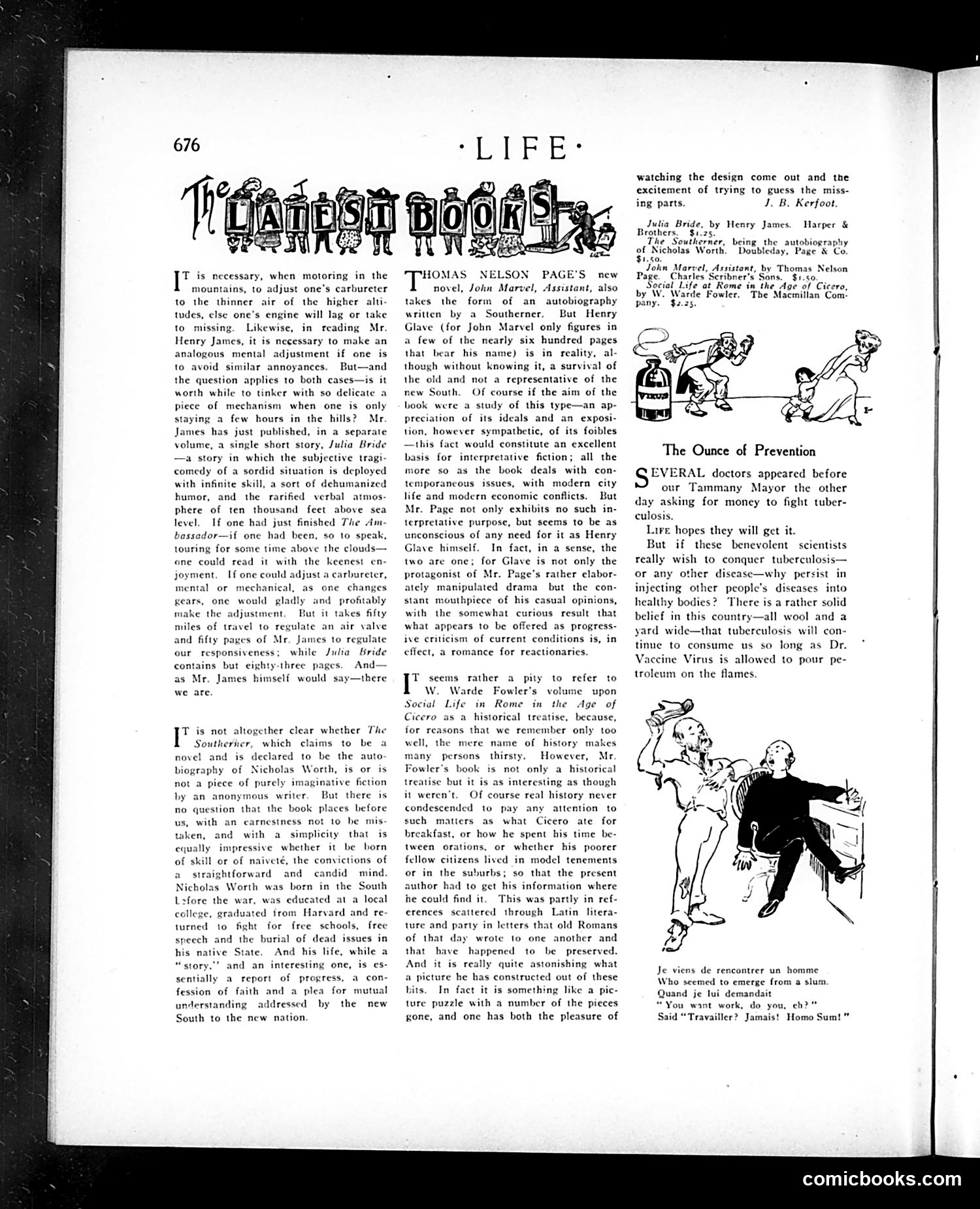
This page contains three literary reviews from what appears to be an early 20th-century issue of *Life* magazine. **The left column** critiques Henry James's short story collection *Julia Bride*, comparing reading James's dense prose to adjusting a car's carburetor for high altitude—you must mentally "adjust" to his rarified style, though the effort barely seems worth it for a short story. **The middle section** reviews Thomas Nelson Page's novel *John Marvel, Assistant*, criticizing it as unconsciously reactionary. The reviewer argues Page presents a pre-Civil War Southern character without ironic distance, making the book a "romance for reactionaries" rather than interpretive fiction about the modern South. **The right contains** two cartoons: "The Ounce of Prevention" (satirizing anti-tuberculosis public health campaigns) and a French caption about someone emerging from a slum, mocking social concern or tourism. The page exemplifies *Life*'s role as a literary and cultural arbiter with wit and satirical edge.
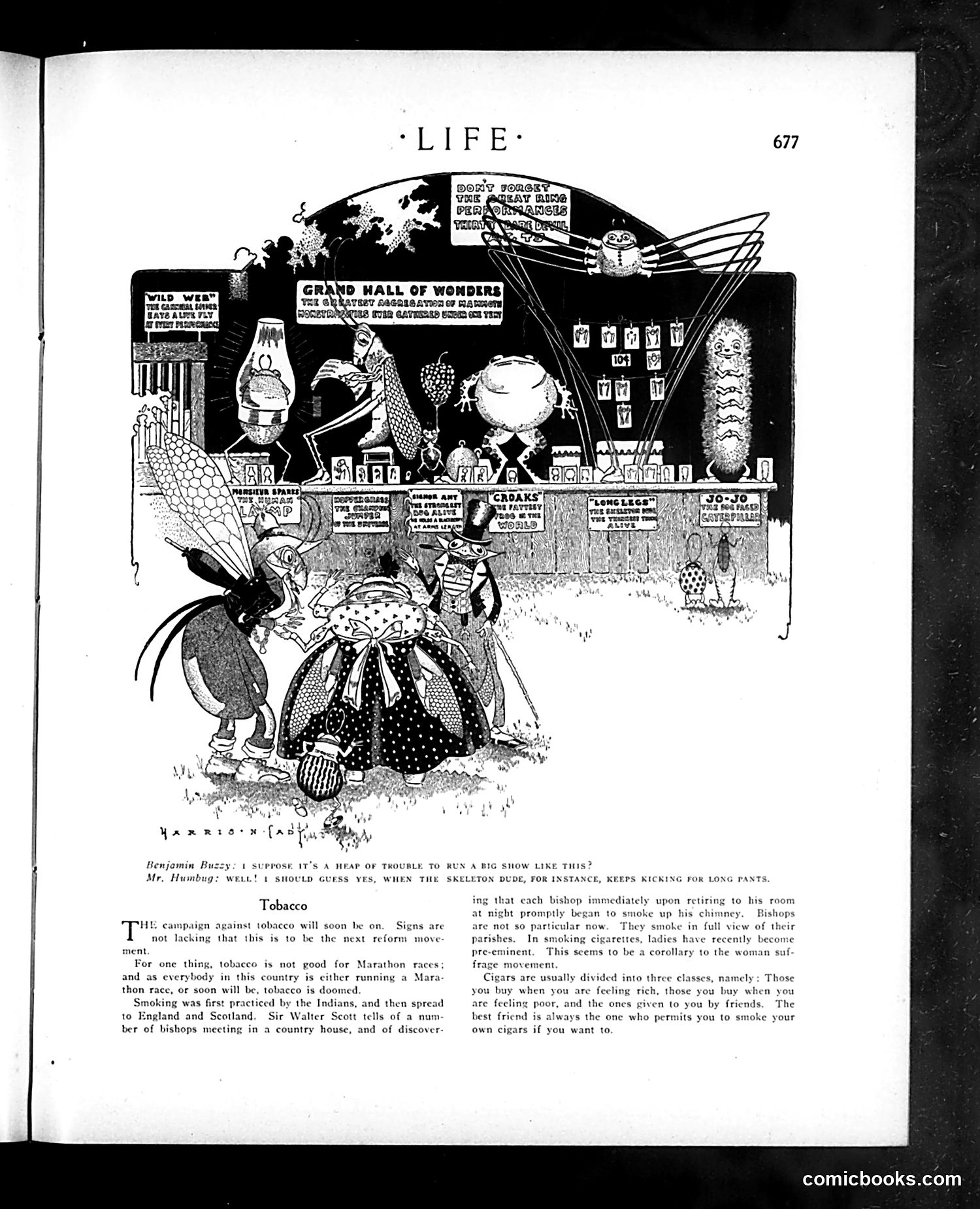
This page combines a whimsical carnival illustration with commentary on anti-tobacco campaigns. **The Cartoon:** Shows a "Grand Hall of Wonders" carnival midway with exaggerated characters—a large-headed figure, skeletal performer, and various attractions. The dialogue between "Benjamin Buzzy" and "Mr. Humbug" jokes that running such a show is troublesome because the "skeleton dude" keeps demanding long pants (suggesting the skeleton performer's physical deterioration or scandalous appearance). **The Article:** Discusses an upcoming anti-tobacco reform movement. It argues tobacco is "doomed" because Americans are obsessed with Marathon races (likely referring to the athletic craze of the era), and tobacco allegedly harms athletic performance. The piece humorously recounts how 19th-century bishops allegedly smoked in secret, while modern women now smoke cigarettes openly—implying this represents progress for women's suffrage. The satire mocks both anti-tobacco crusaders and changing social norms around smoking and gender, presenting tobacco reform as inevitable yet somewhat absurd.
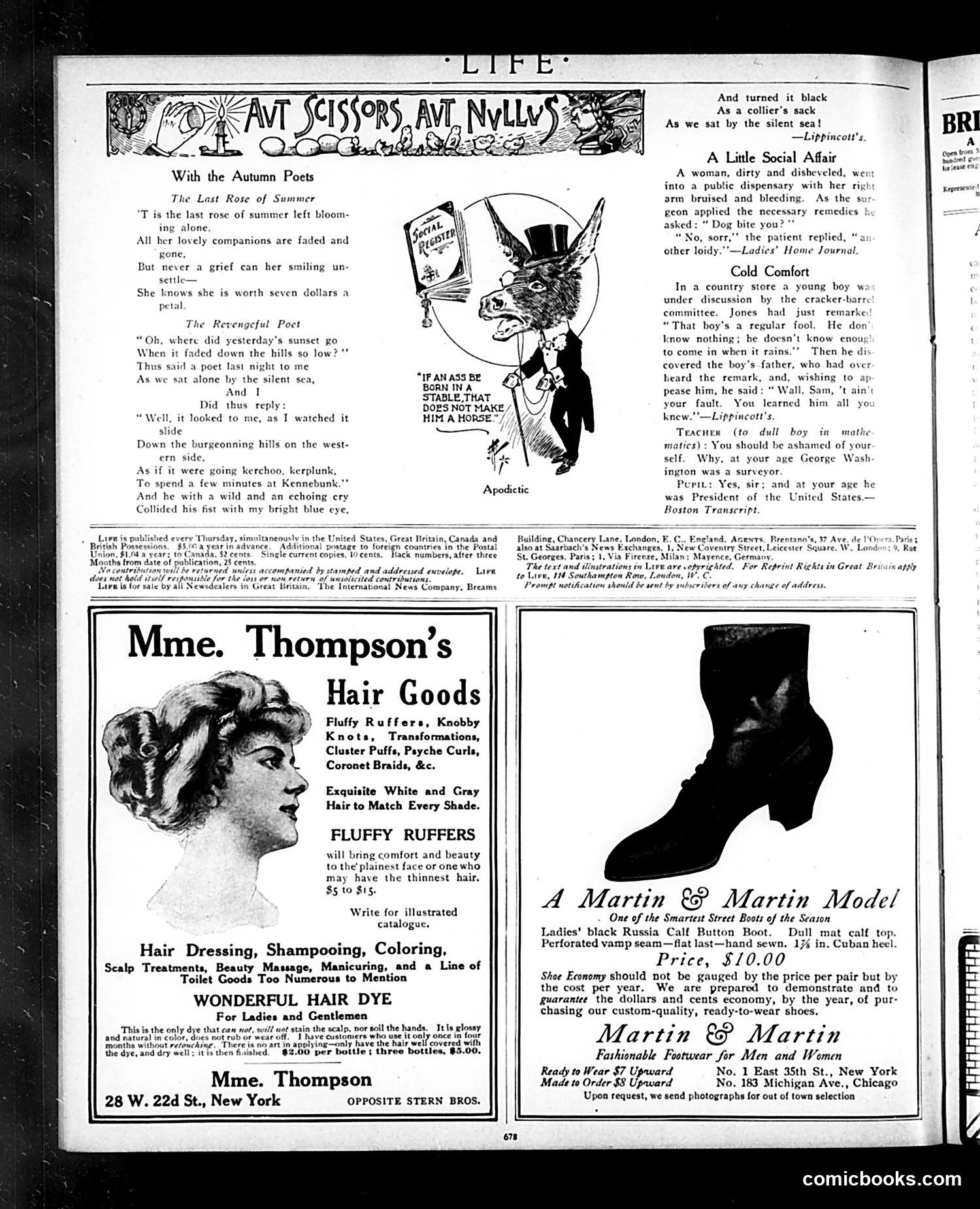
This page presents light satirical verse and jokes typical of Life's humor section. The central cartoon (marked "If an ass be born in a stable, that does not make him a horse") depicts a donkey-headed figure in formal dress—likely a visual pun on the proverb about breeding and nature. The accompanying poems mock romantic poets and their overwrought sentimentality. "The Last Rose of Summer" satirizes poets' tendency to romanticize nature while ignoring practical reality (a rose worth seven dollars). "The Revengeful Poet" humorously suggests that arguing about sunset observations leads to physical violence—mocking both poetic pretension and volatile temperament. The short humorous anecdotes below address working-class life: a woman in a public clinic admits to being beaten by "another lady," and a father defends his "fool" son by noting the boy learned his ignorance from his father's example—implying generational persistence of foolishness. The remainder is advertising for hair goods and footwear—typical of Life's revenue model.
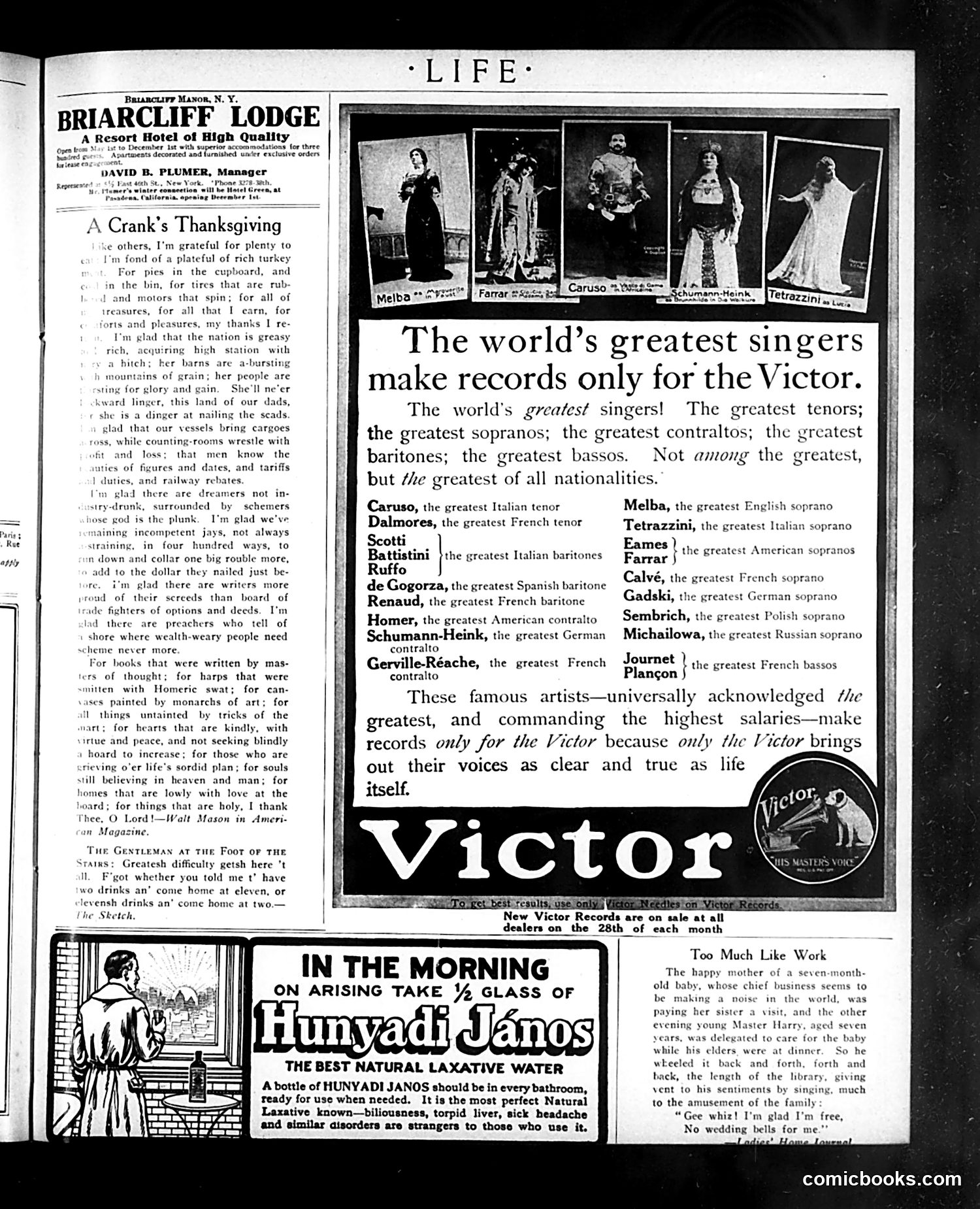
This page is primarily **advertising**, not political satire. The dominant content is a Victor Records advertisement featuring famous opera singers of the era—Caruso, Melba, Tetrazzini, and others—claiming Victor's superior recording quality. The left side contains "A Crank's Thanksgiving," a humorous poem by Walt Mason expressing gratitude for American abundance and values (ships, commerce, honest workers, free speech). It's gently satirical about American materialism and self-satisfaction, not biting political commentary. Below that is a brief joke from *The Sketch* about a drunk misunderstanding drinking advice—mild newspaper humor. The bottom advertises Humyadi János laxative water. **For modern readers:** This page reflects early 20th-century Life magazine's mix of light humor, celebrity endorsements, and patent medicine ads. There's no sharp political cartoon; the satire is gentle and lifestyle-focused rather than investigative.
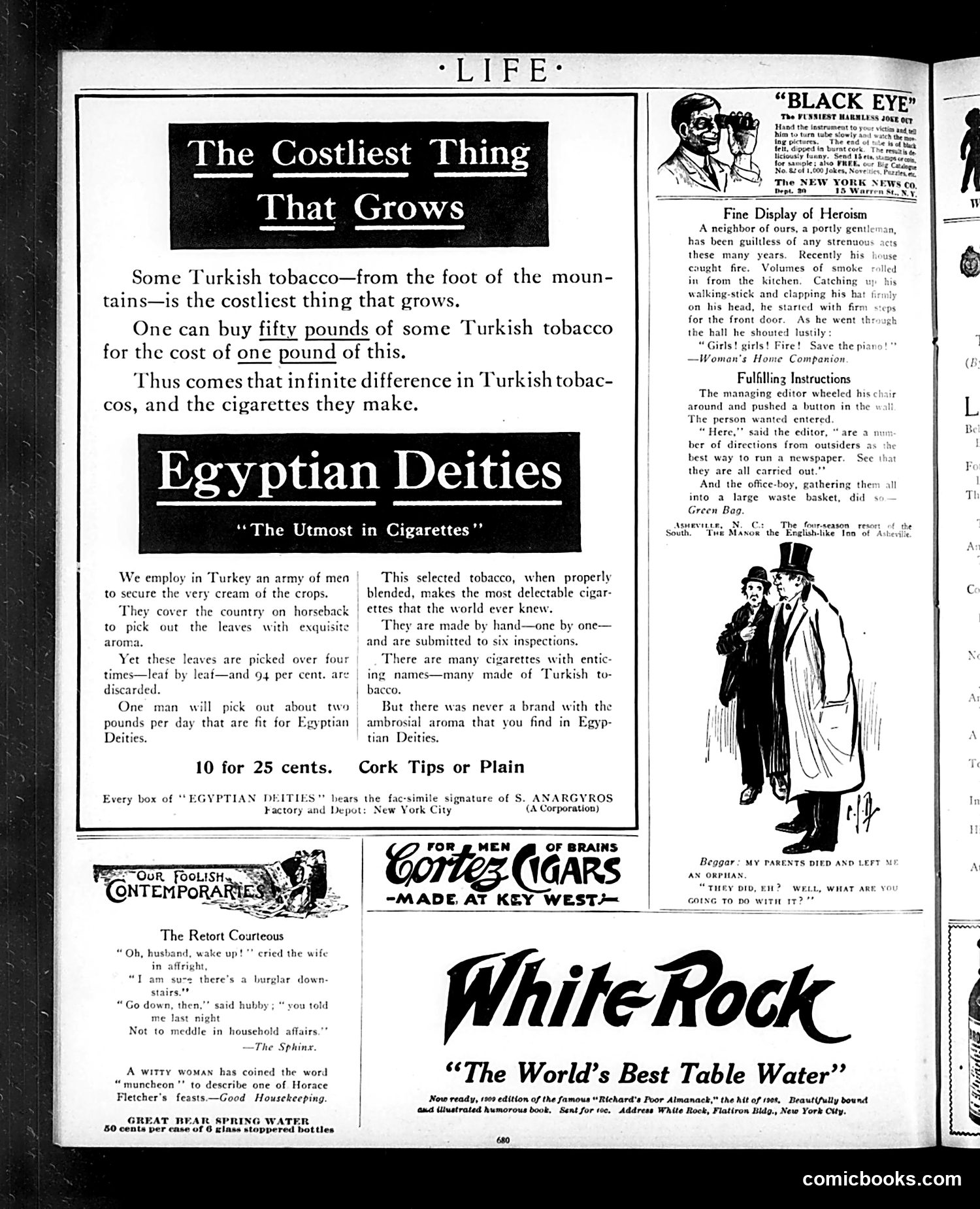
This page is **primarily advertising** for luxury cigarettes and other consumer products, with small satirical humor pieces interspersed. The main content advertises **Egyptian Deities cigarettes**, emphasizing their exclusivity and cost through claims about hand-selected Turkish tobacco and rigorous production standards. The copy targets affluent consumers seeking premium products. The small satirical pieces ("The Retort Courteous," "Fine Display of Heroism," "Fulfilling Instructions") are typical Life magazine humor—gentle domestic and workplace comedy with no political content. They mock husbands, editors, and social pretension through brief anecdotes. The **"Beggar" cartoon** (bottom right) shows a humorous misunderstanding: a beggar states "My parents died and left me an orphan," and someone responds with mock surprise, "What are you going to do with it?"—treating "orphan" as a possession rather than a condition. It's wordplay-based humor. Overall, this reflects **early 1900s consumer culture**, advertising luxury goods to middle/upper-class readers through satirical entertainment.
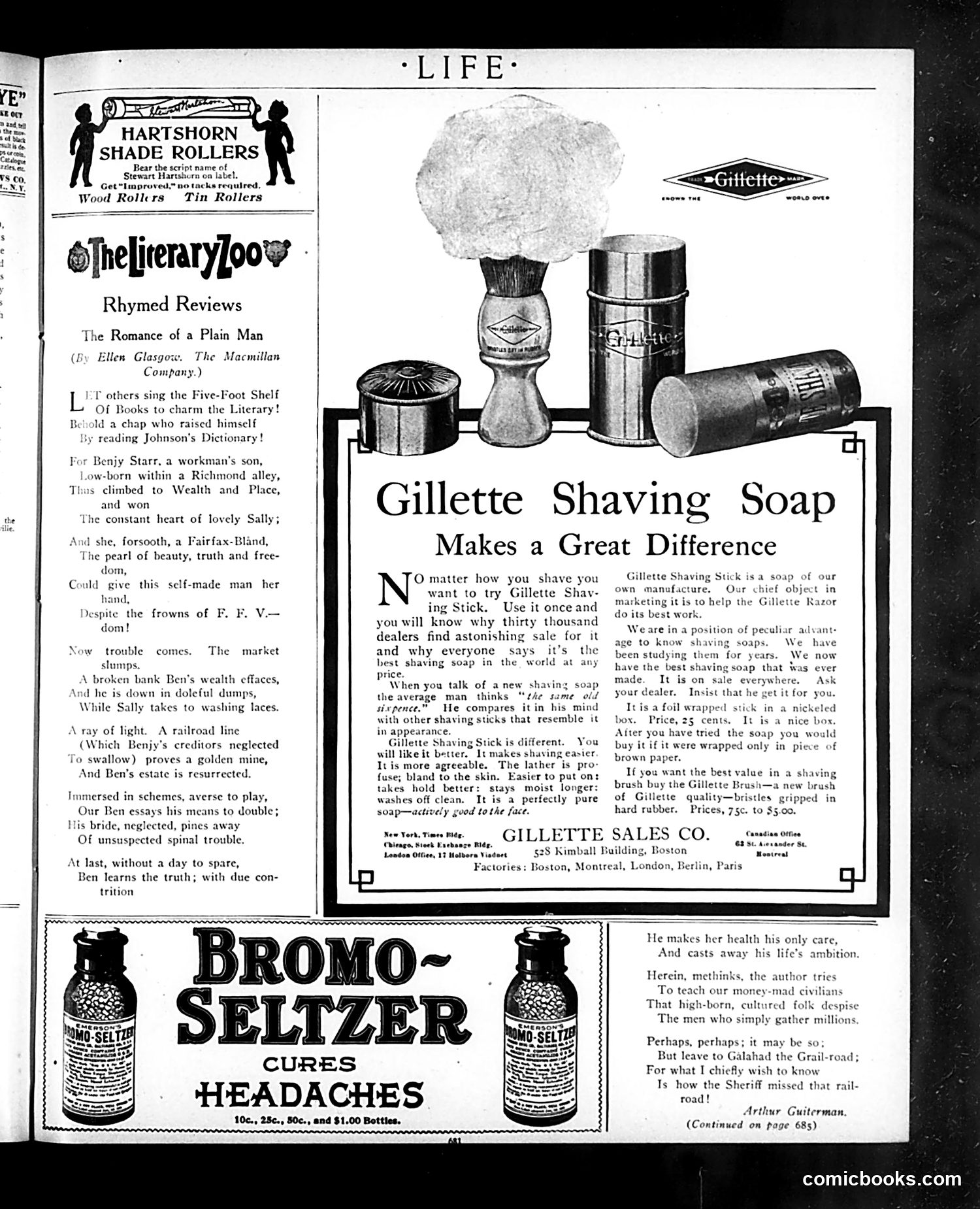
This page is primarily **advertising with literary content**, not political satire. The main feature is a **rhymed book review** by Arthur Guiterman of Ellen Glasgow's novel *The Romance of a Plain Man*. The poem summarizes the plot: Benjy Starr, a working-class man, rises through self-education and hard work, marries a woman from Virginia's aristocratic "First Families of Virginia" (F.F.V.), faces financial ruin, then recovers through an overlooked railroad investment. The poem's conclusion gently mocks the implausibility of this plot device—the Sheriff somehow missed seizing valuable railroad property. The satire is **literary, not political**: Guiterman affectionately ribbed Glasgow's melodramatic plot mechanics rather than critiquing social issues. The page is dominated by **three product advertisements**: Hartshorn Shade Rollers, Gillette Shaving Soap (with detailed product description), and Bromo-Seltzer headache remedy—typical early-20th-century magazine advertising. No political figures or contemporary events appear to be referenced.
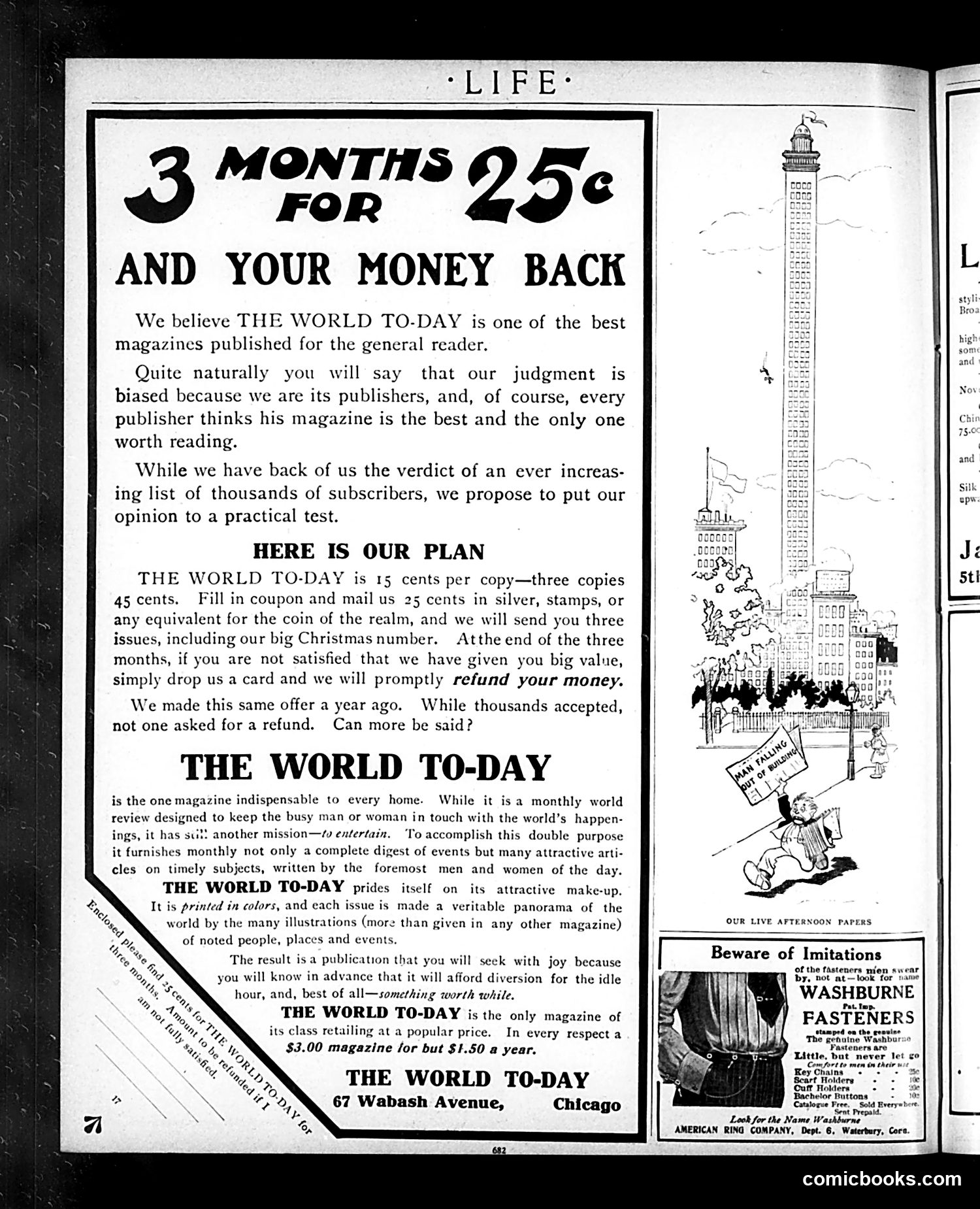
This page is primarily **advertising**, not satire or editorial content. The main advertisement promotes *The World To-Day* magazine with a money-back guarantee offer: three months for 25 cents, refundable if unsatisfied. The pitch is straightforward marketing, though it acknowledges bias humorously—the publishers admit their claim that their magazine is "the best" is naturally biased since all publishers think this. They propose a "practical test" to prove the claim, noting that a year prior, thousands accepted the offer but no one requested refunds. The subheading emphasizes the magazine's dual purpose: to inform readers about world events while providing entertainment. A secondary advertisement at bottom right warns consumers to look for the "Washburne" brand name on fasteners, cautioning against imitations—a typical early 20th-century anti-counterfeiting notice. The decorative illustration shows a tall building (likely Chicago's skyline, matching the publisher's address) with cityscape elements.
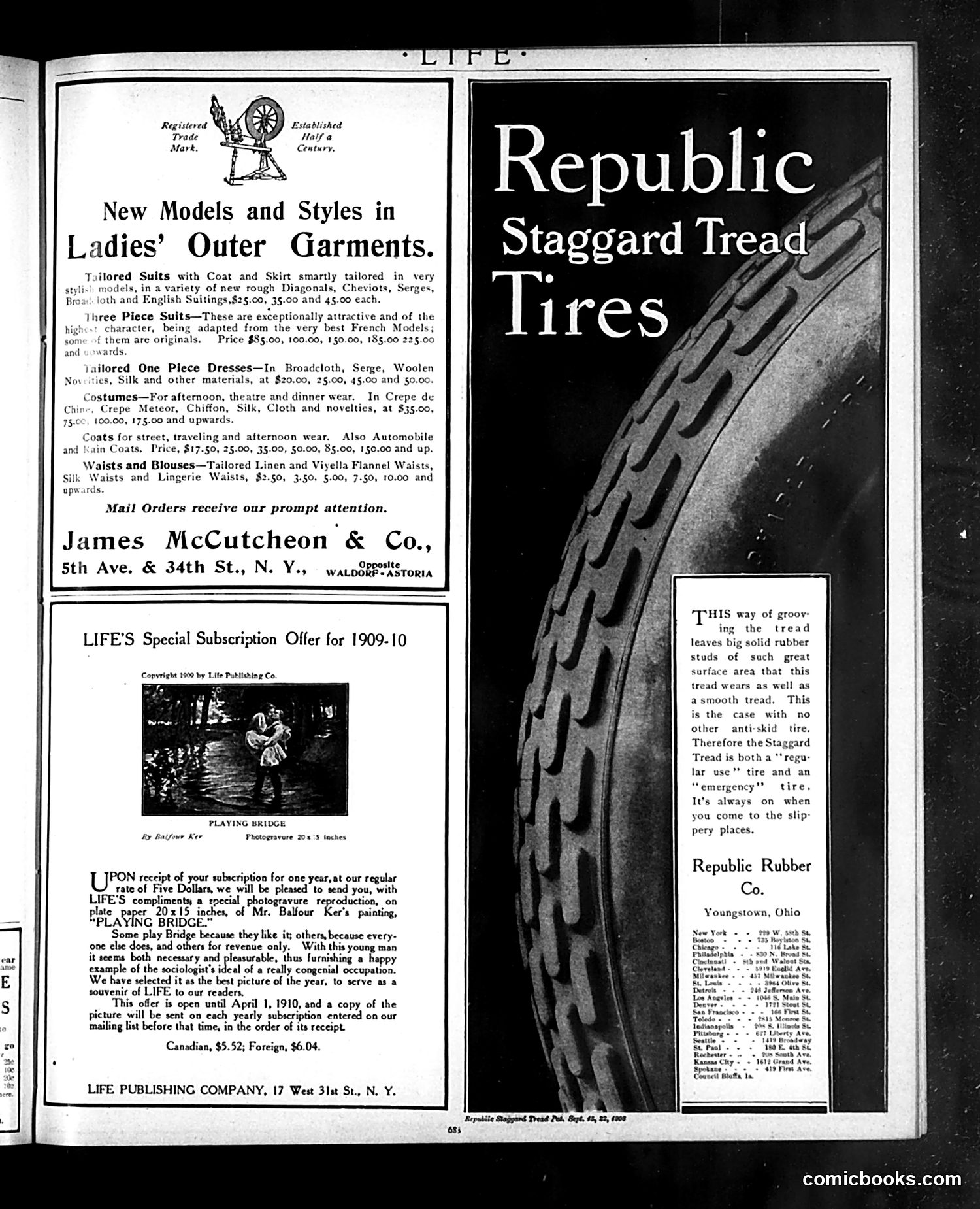
This page is primarily **advertising**, not satire or political commentary. It contains three distinct advertisements from 1909-10: 1. **James McCutcheon & Co.** (left): A department store ad for ladies' fashions—tailored suits, dresses, coats, and blouses with prices ranging from $2.50 to $225. 2. **Life's Subscription Offer** (center): Promotes a one-year subscription for five dollars, offering a complimentary photogravure reproduction of Balfour Ker's painting "Playing Bridge" (20×15 inches). The painting depicts a young man enjoying card games, described as embodying "a really congenial occupation." 3. **Republic Staggard Tread Tires** (right): An automobile tire advertisement emphasizing the tire's grooved tread design for anti-skid safety on slippery surfaces, marketed as both regular and emergency use. The page reflects early 20th-century consumer culture and leisure activities among the wealthy.
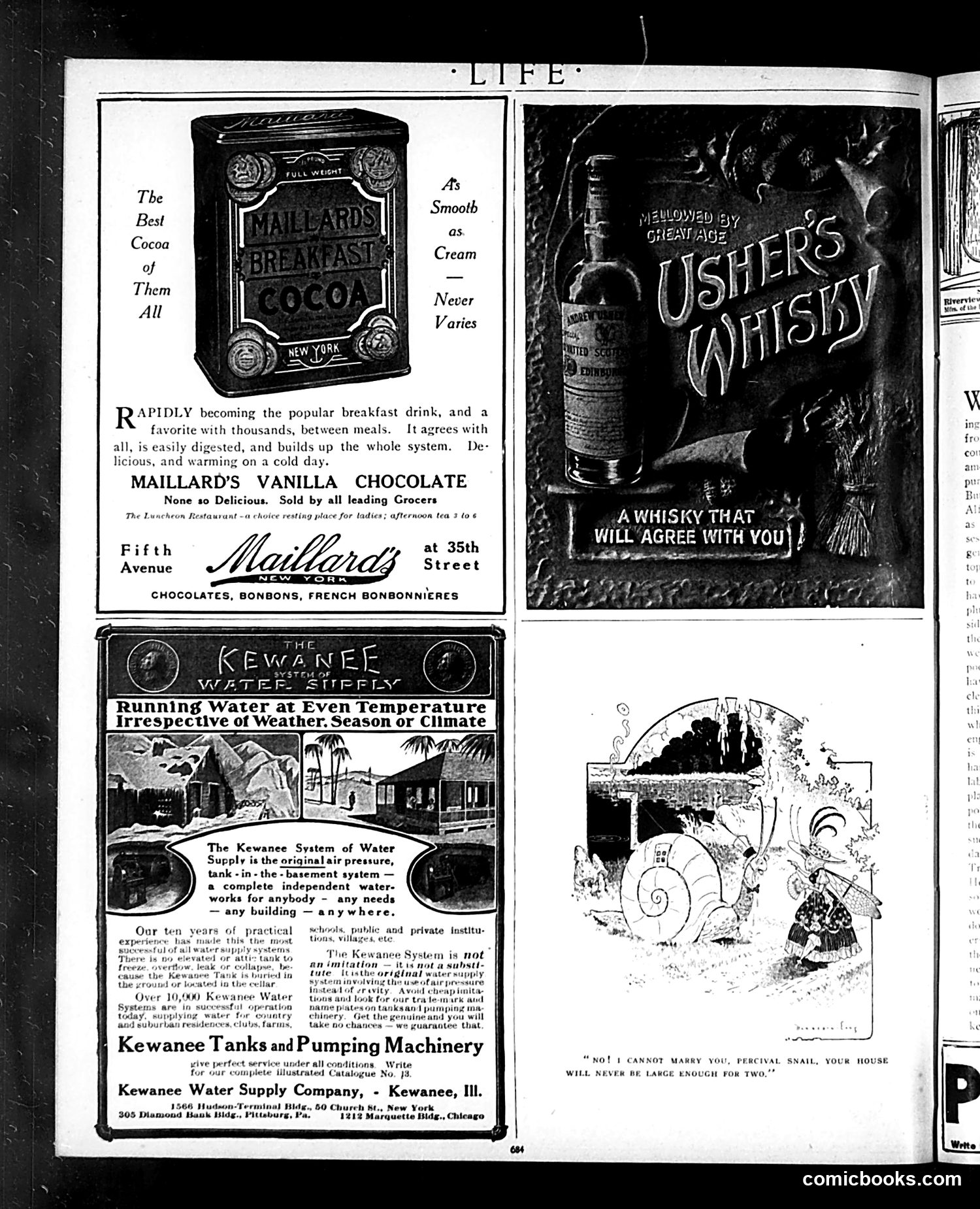
This page is primarily **advertising**, featuring four commercial products with minimal satirical content. **Advertisements shown:** - Maillard's Vanilla Chocolate (top left) - a breakfast cocoa - Usher's Whisky (top right) - promoting a Scotch whisky brand - Kewanee Water Supply system (bottom left) - indoor plumbing/water pressure tanks - A cartoon vignette (bottom right) **The cartoon** depicts a romantic rejection scene. A man proposes to a woman, who refuses him with the caption: "No! I cannot marry you, Percival. Your house will never be large enough for two." The joke appears to play on the absurdity of rejecting a suitor based on house size—likely satirizing materialistic marriage motivations or social status-consciousness among the wealthy. The page reflects early 20th-century consumer culture, mixing lifestyle products (chocolate, whisky, modern plumbing) with light domestic humor typical of *Life* magazine's format during this era.
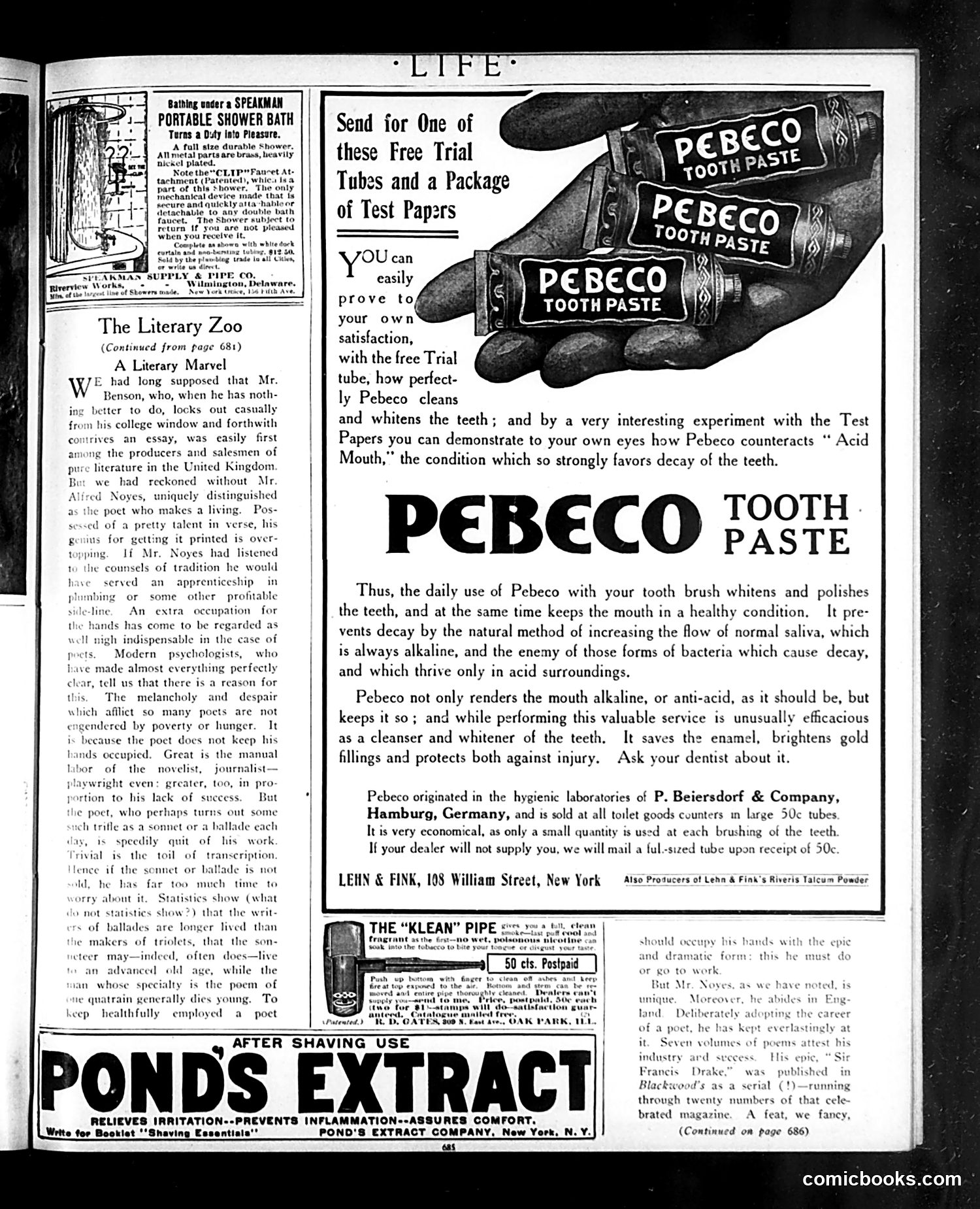
This page is primarily **advertising**, not political satire. It contains three main commercial advertisements: 1. **Speakman Portable Shower Bath** (top left): A practical product ad for a brass shower fixture with a patented clip faucet. 2. **Pebeco Toothpaste** (center/right): The dominant ad features a hand holding three toothpaste tubes. It promotes the product's ability to counteract "Acid Mouth" and prevent tooth decay by increasing saliva alkalinity—reflecting early 20th-century scientific claims about oral health. 3. **Pond's Extract** (bottom): An aftershave product advertisement. The page also contains "The Literary Zoo," a continuing essay (from page 681) discussing poet Alfred Noyes and theories about why poets live longer when employed—presented as humorous social commentary rather than political satire. The advertisements reflect period concerns: indoor plumbing accessibility, emerging consumer science around dental health, and grooming products for gentlemen.
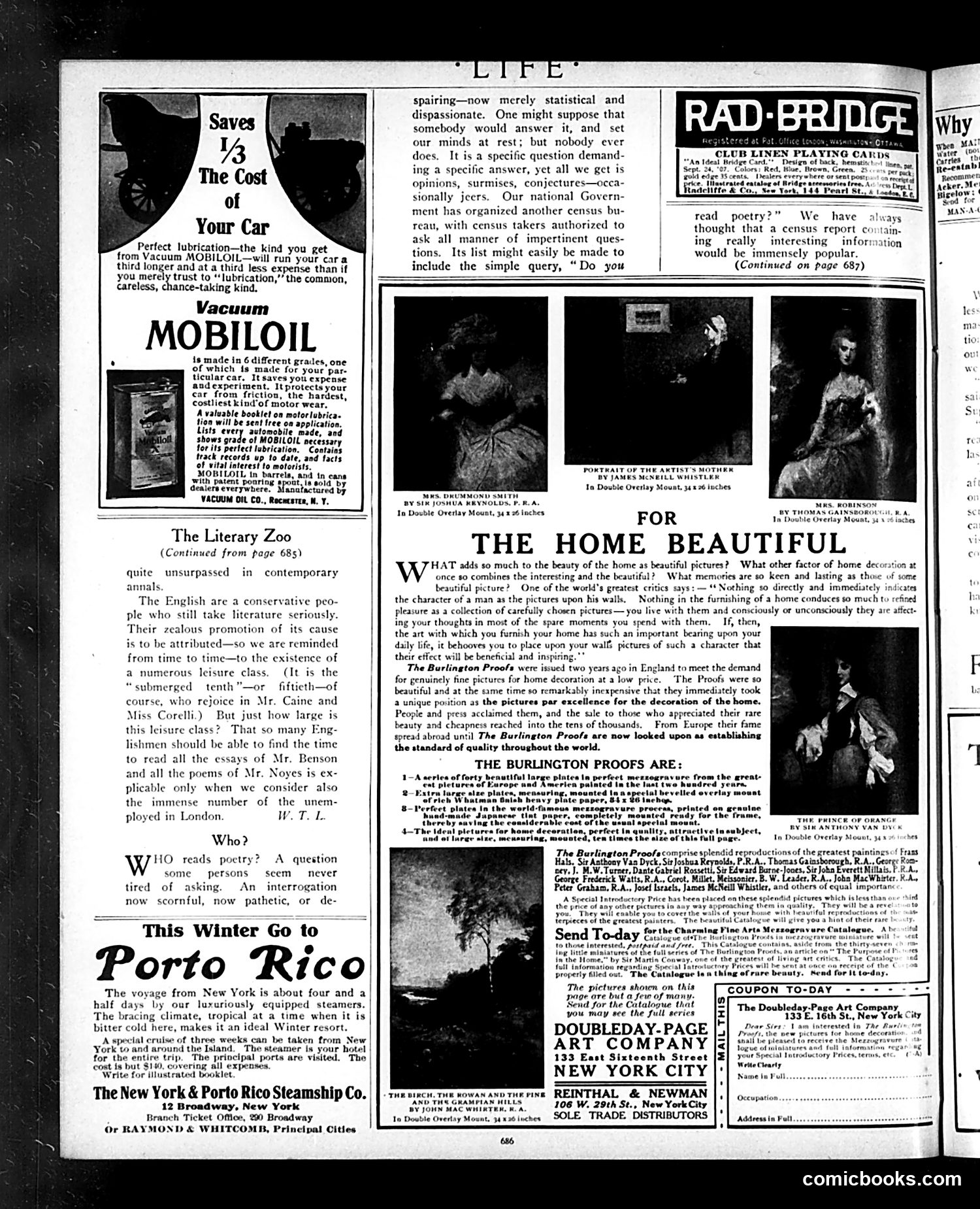
This page is primarily **advertising and promotional content** rather than political satire. The main elements are: **Advertisements:** - Vacuum Mobiloil motor oil (top left) - emphasizing car maintenance savings - New York & Porto Rico Steamship Company (bottom left) - promoting winter travel - The Burlington Proofs art company (center-right) - selling affordable fine art reproductions for home decoration **Editorial Content:** "The Literary Zoo" (left column) discusses British literary culture and leisure reading habits, continuing from a previous page. A separate brief note questions whether census data should include "Do you read poetry?" - satirizing how government bureaus ask impractical questions. **The Context:** This appears to be from an early 20th-century issue when *Life* magazine mixed humor, social commentary, and advertising. The page reflects period concerns: automobile ownership, leisure travel, and home beautification through art - markers of middle-class aspiration. There are no identifiable political cartoons or caricatures on this particular page.
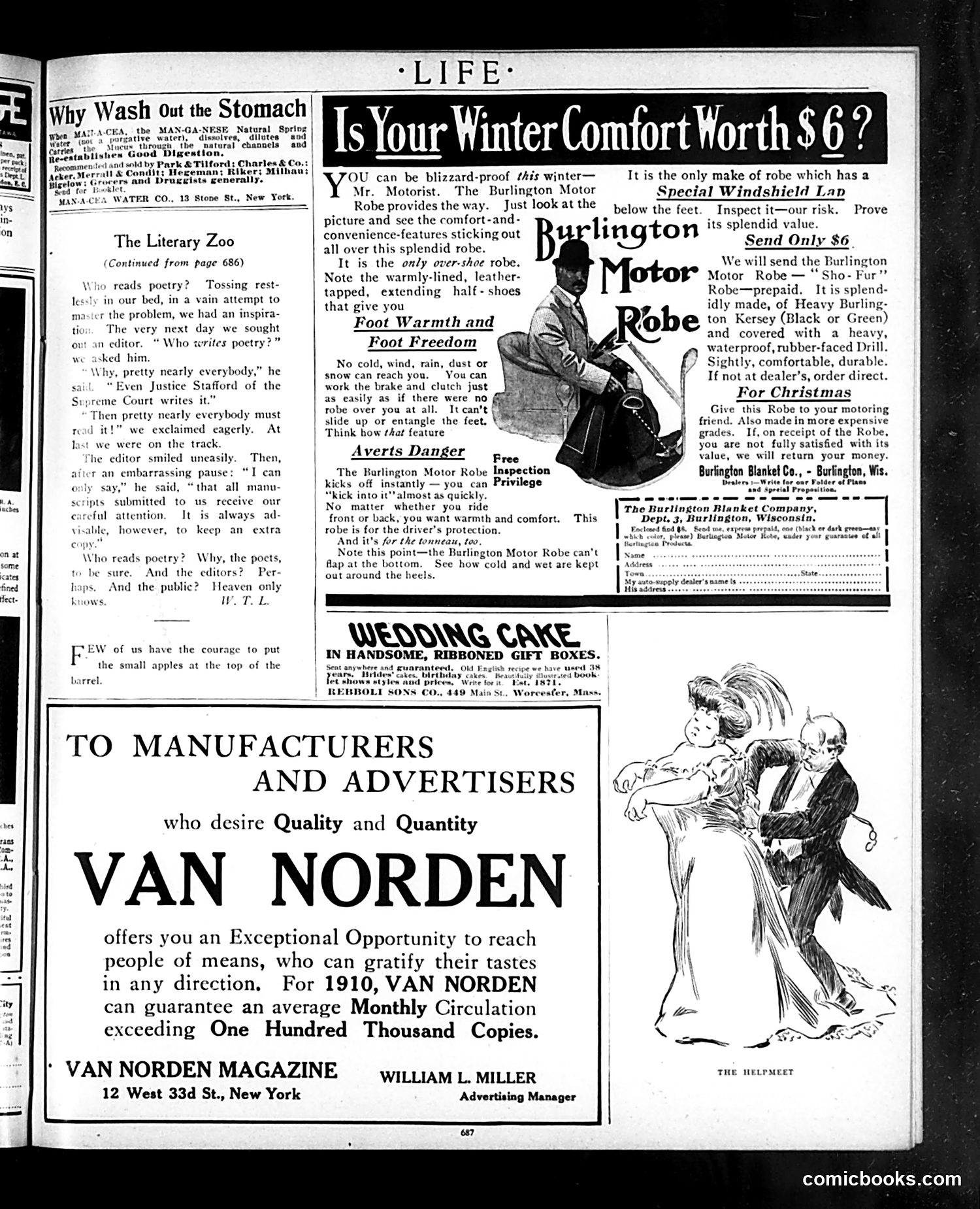
This page from *Life* magazine consists primarily of **advertisements and filler content** rather than satirical cartoons. The main content includes: **"The Literary Zoo"** — a humorous essay questioning who actually reads poetry. The joke: an editor admits that nearly everybody writes poetry (implying low quality), yet Heaven only knows who reads it. This satirizes both the proliferation of amateur poets and the pretension of literary culture. **Burlington Motor Robe Advertisement** — promotes a $6 winter driving robe with heated, leather-tapped foot coverings. The sales pitch emphasizes comfort and safety features for early motorists, reflecting the novelty of automobile travel circa 1910. **"The Helpmeet" cartoon** (bottom right) — appears to show a figure struggling with heavy laundry or domestic work, likely satirizing women's domestic labor, though details are unclear from the image. The page also contains ads for Van Norden Magazine and wedding cake, representing typical early-1900s magazine filler and revenue sources.
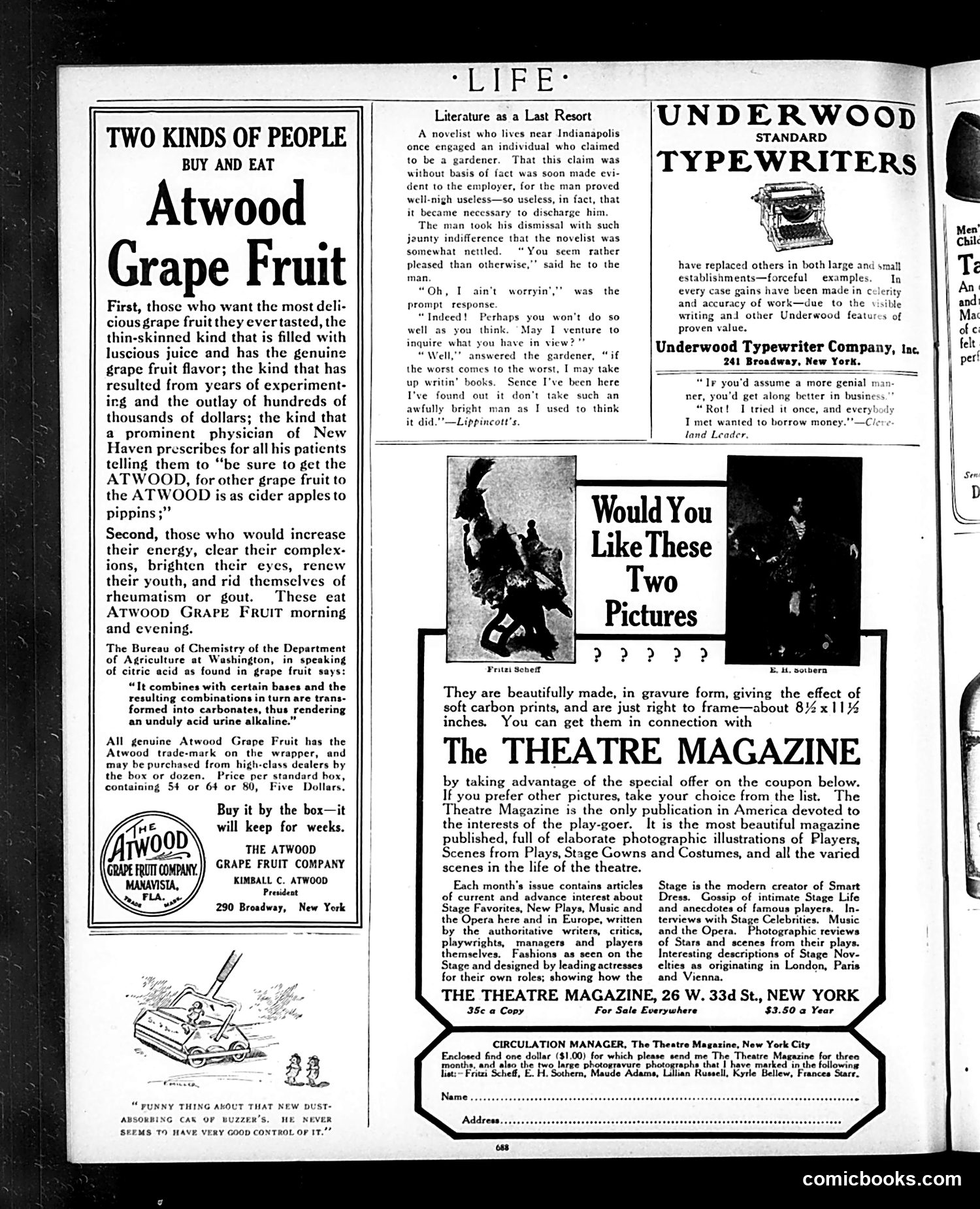
This page is primarily **advertising**, not political satire. The dominant content includes: **Main Advertisement (Left):** Atwood Grape Fruit promotes health benefits by dividing consumers into "two kinds of people"—those seeking superior flavor versus those seeking medicinal benefits (energy, clear complexion, relief from rheumatism). The embedded anecdote about a dismissed gardener who claims he'll "take up writin' books" satirizes literary pretension, not politics. **Other Advertisements:** - Underwood Typewriters (right column) - Theatre Magazine (center-bottom), offering two gravure prints of theatrical subjects **The Cartoon:** At page bottom, a small cartoon references "that new dust-absorbing cake of Buzzer's," joking that a dog has good control of it—a humorous product endorsement. **Context for Modern Readers:** This reflects early 20th-century magazine culture where satirical commentary shared pages with extensive advertising. The "two kinds of people" framing was a common marketing device of the era.
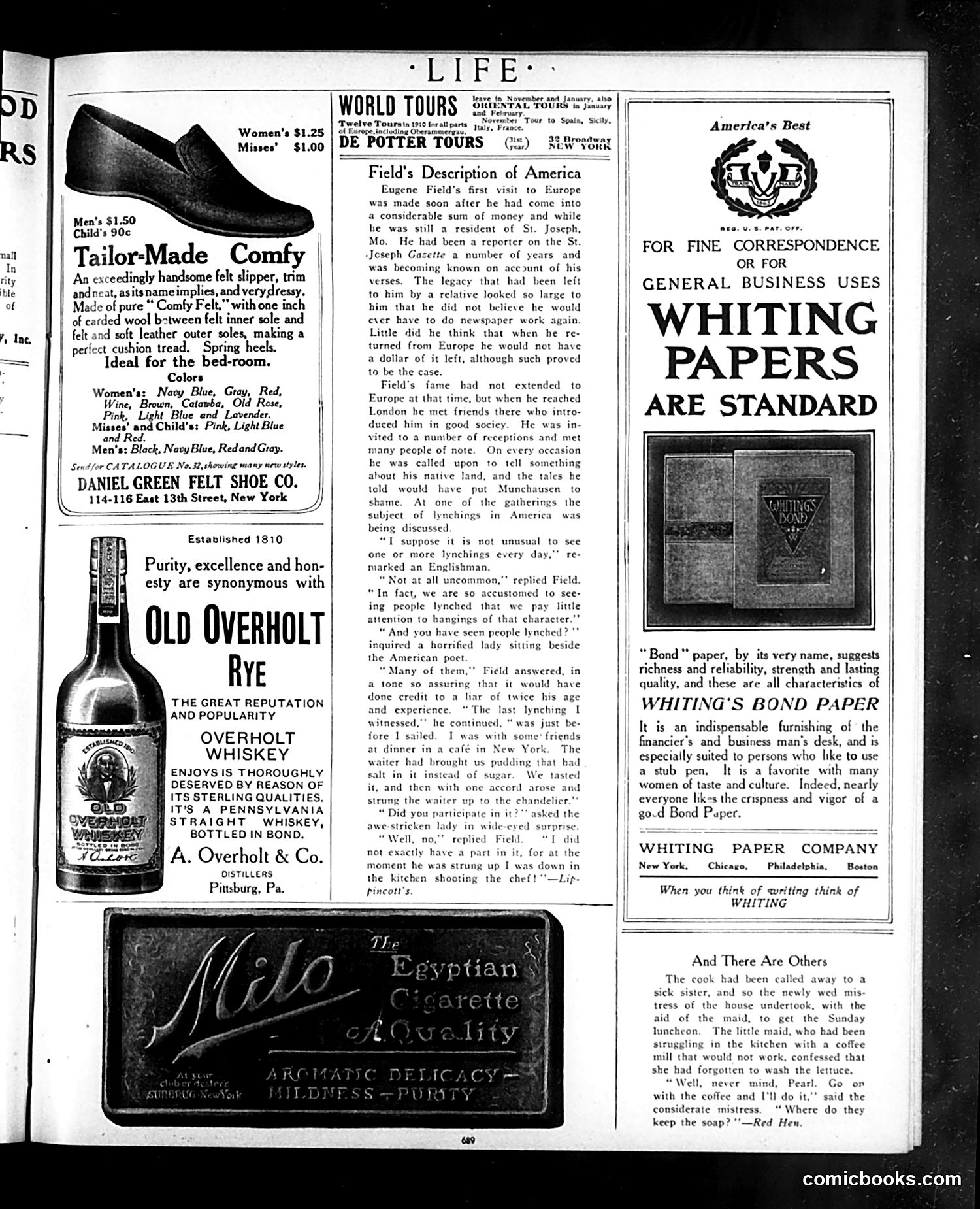
This page is primarily **advertising and light literary content**, not political satire. The main items are: **Advertisements:** Tailor-Made Comfy felt slippers, Old Overholt rye whiskey, De Potter Tours, and Whiting Bond Papers dominate the page. **Literary Content:** The central piece is Eugene Field's "Description of America"—a humorous travel narrative where Field, an American poet visiting London after inheriting money, deliberately exaggerates American violence to shock English dinner guests. When asked about witnessing lynchings, he fabricates an absurd story about lynching a waiter for serving pudding instead of sugar, claiming he was "downstairs shooting the chef." **The Joke:** This appears to be gentle satire of American frontier mythology and how Americans sometimes played up their country's rough reputation to foreign audiences—though the casual treatment of lynching reflects deeply troubling attitudes of the era. The page reflects early-20th-century Life magazine's mix of commercial content and literary humor.
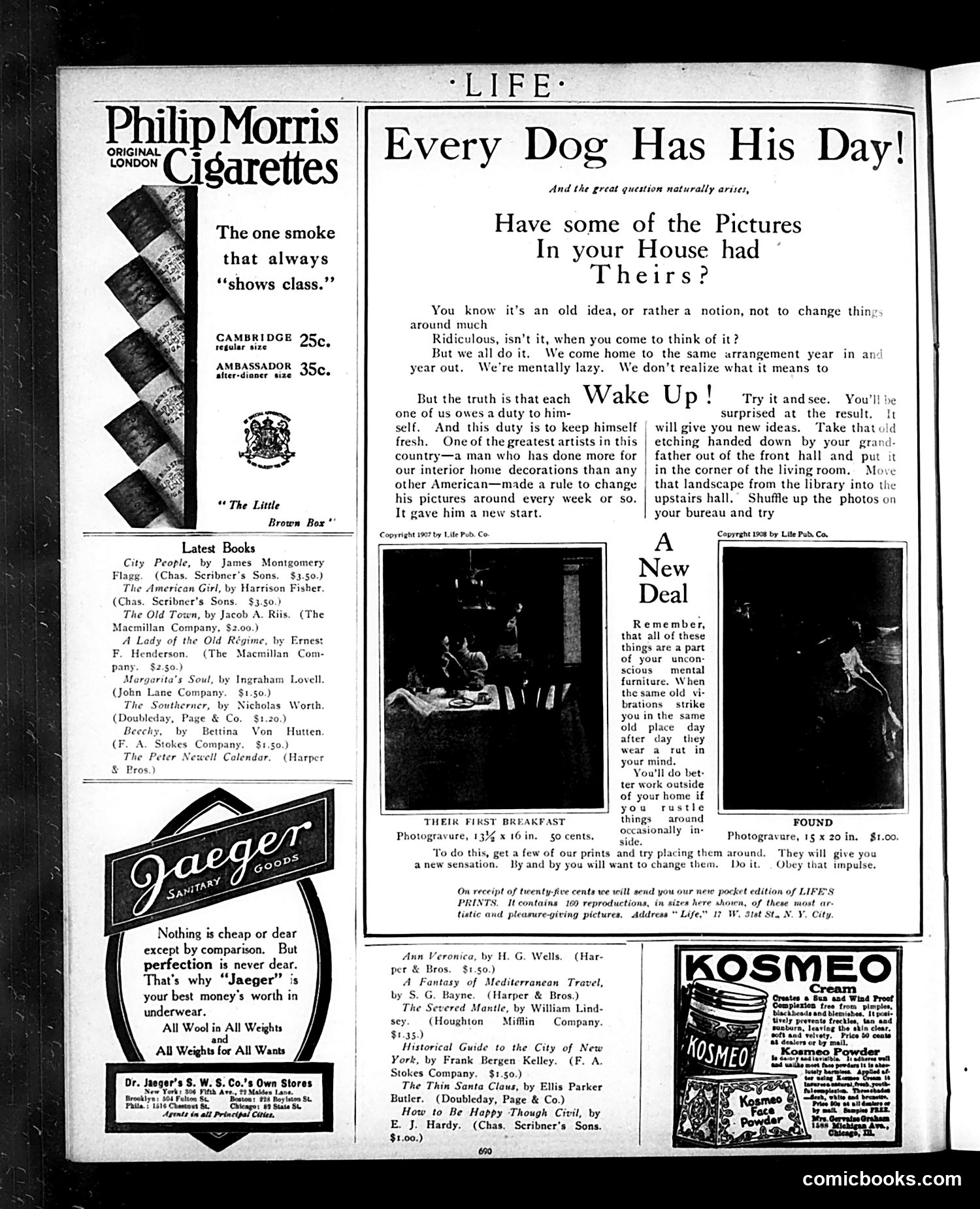
This page is primarily **advertising and book listings** rather than political satire. The main content is a feature titled "Every Dog Has His Day!" promoting decorative prints and photographs. The headline's metaphor ("every dog has his day") means even ordinary objects deserve attention. The article argues against mental laziness—the habit of leaving home décor unchanged year after year. It claims a famous (unnamed) American interior designer changed his pictures weekly for mental refreshment. The feature encourages readers to rearrange existing artwork: move old etchings, shift landscapes between rooms, shuffle bureau photographs. This supposedly provides "new ideas" and mental stimulation without expense. The accompanying photographs show domestic scenes with artwork. **Surrounding advertising** includes Philip Morris cigarettes ("shows class"), Dr. Jaeger underwear, and Kosmeo cosmetics—typical 1908 product placements. **Book listings** promote contemporary novels by James Montgomery Flagg and H.G. Wells, among others. There is **no political cartoon or satire** on this page—it's a lifestyle article framed as practical home advice.
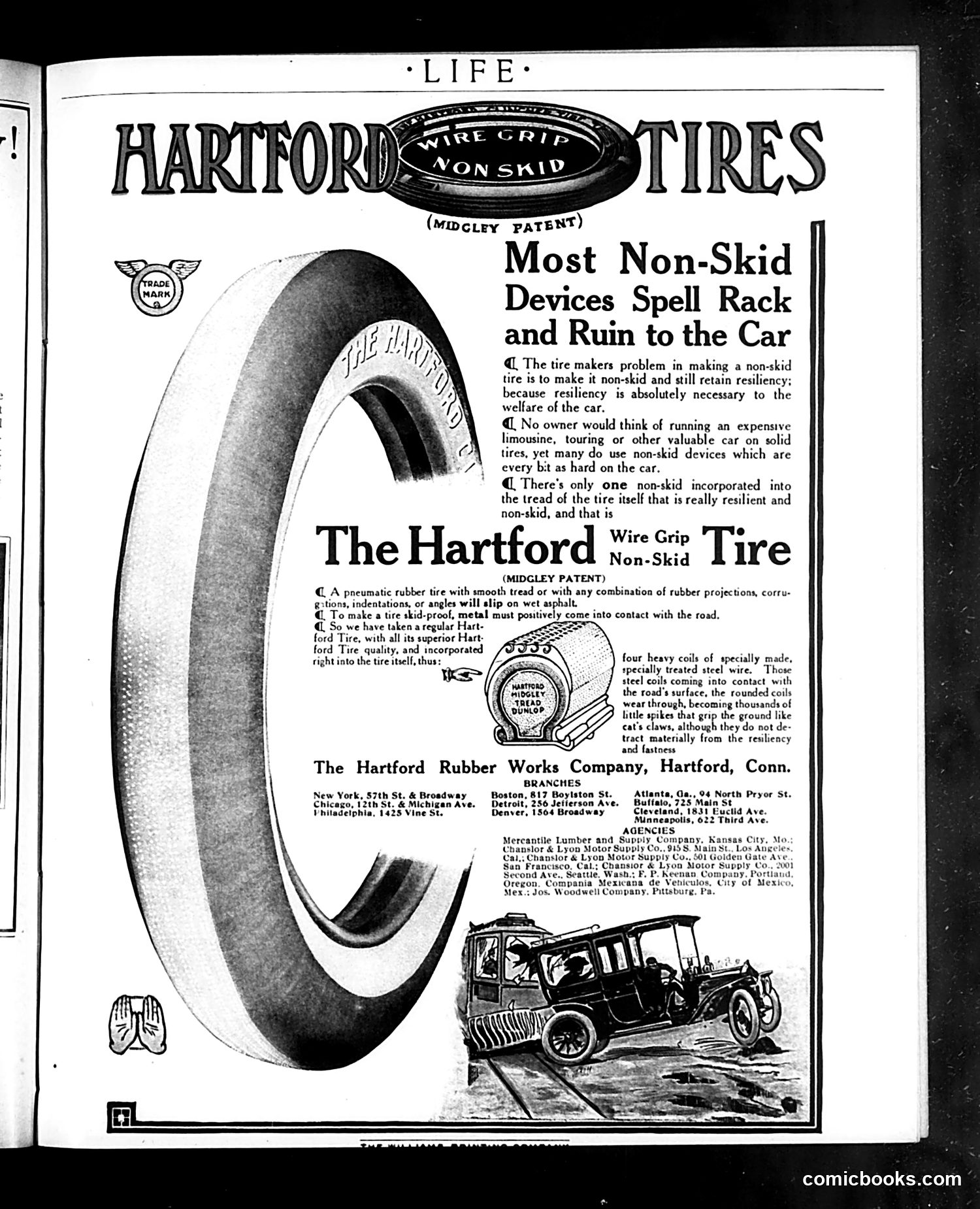
This is **not a cartoon or satire**—it's a straightforward **tire advertisement** from Life magazine. The page promotes Hartford's "Wire Grip Non-Skid" tire, emphasizing its superior safety features. The ad argues that most non-skid devices damage cars by being too rigid, lacking the necessary "resiliency." Hartford's solution: embedding steel wire coils directly into the tire tread itself. When worn, these coils create thousands of small spikes for traction—compared to "cat's claws"—without sacrificing tire flexibility. The image shows a large tire cross-section and a vintage automobile, illustrating the product's practical application. This reflects early automotive-era concerns about wet-road traction before modern rubber compounds were developed. The advertisement lists Hartford Rubber Works' Connecticut headquarters and numerous U.S. branch locations and agencies.
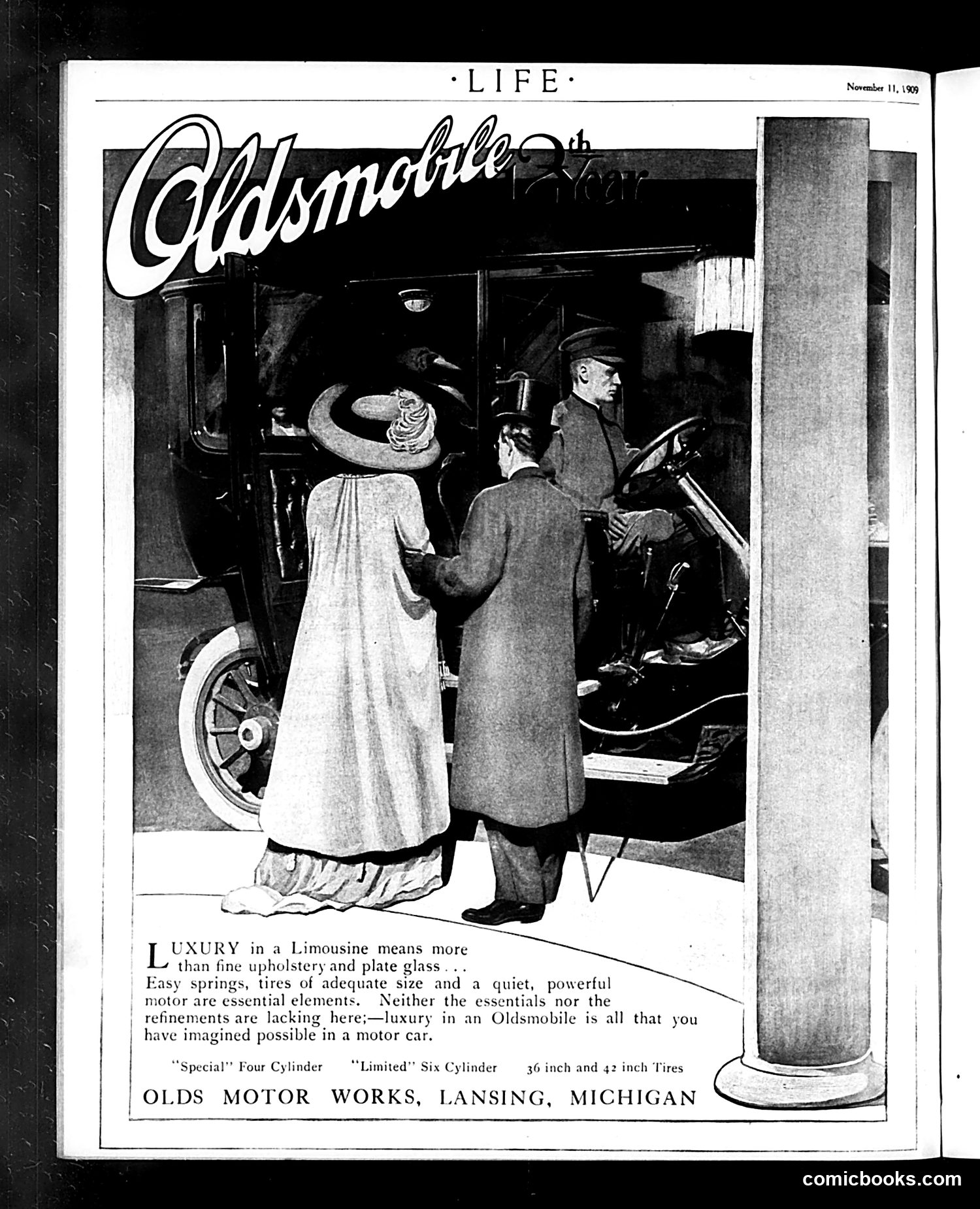
This is a **full-page automobile advertisement**, not a political cartoon. It promotes Oldsmobile luxury vehicles from Olds Motor Works in Lansing, Michigan (dated November 11, 1909). The image depicts an affluent couple—a woman in elegant dress with a large feathered hat and a man in formal attire—being assisted into a limousine by a chauffeur. The advertisement emphasizes that Oldsmobile luxury extends beyond mere decoration to include engineering essentials: quality springs, appropriately-sized tires, and a powerful, quiet motor. The copy argues that Oldsmobile offers everything a discerning buyer could imagine in a motor car. Two models are mentioned: "Special" Four Cylinder and "Limited" Six Cylinder, available with 36 or 42-inch tires. This reflects early 1900s automobile marketing targeting wealthy consumers for whom motorcar ownership represented status and refined taste.