
Life, 1909-11-11 · page 15 of 36
Life — November 11, 1909 — page 15: what you’re looking at
What you’re looking at
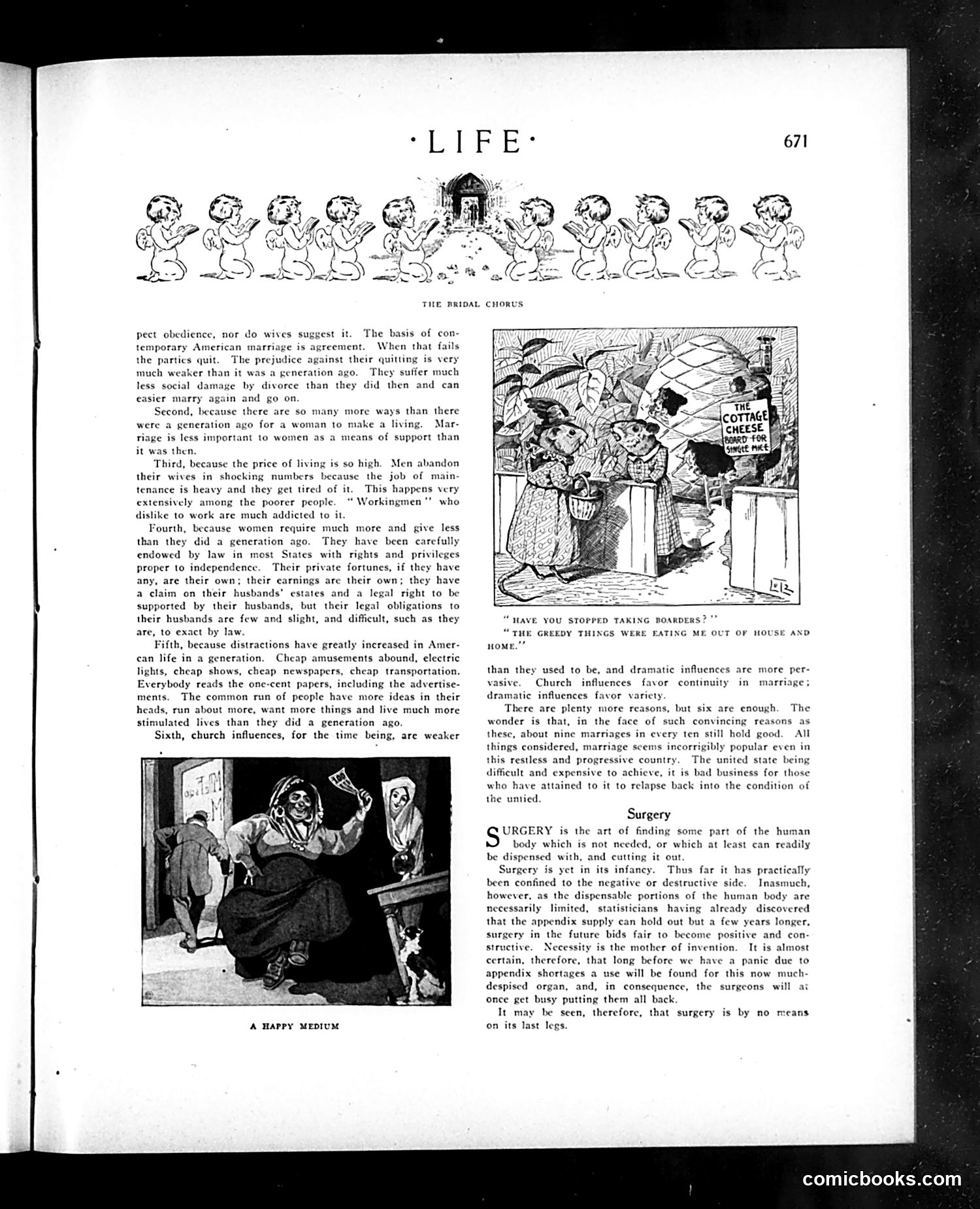
**The Cartoons:** The top illustration shows cherubs around a church, labeled "The Bridal Chorus"—a humorous reference to the famous wedding march. The main cartoon depicts a woman confronting what appears to be boarders or lodgers eating her food. The caption reads: "Have you stopped taking boarders?" / "The greedy things were eating me out of house and home." This satirizes the common practice of boarding house keeping—a way widows and working-class women supplemented income. The joke is that feeding boarders became economically unsustainable. **The Article Context:** The page discusses why American marriages increasingly fail. The text lists six reasons: marriage based on agreement (not obedience), women's economic independence, high living costs forcing abandonment, women's expanded legal rights, urban distractions (cheap entertainment, newspapers, transportation), and weakened church influence. The satire reflects early 20th-century anxieties about modernization—women's independence, economic strain, and secular entertainment threatening traditional marriage stability.
📄 Transcribed text from this page (OCR, searchable)
Machine-transcribed from the original scan — historical spelling and the odd misread are preserved.
THE BRIDAL pect obedience, nor do wives suggest it. The basis of con- temporary American marriage is agreement. When that fails the partics quit. The prejudice against their quitting is very much weaker than it was a generation ago. They suffer much less social damage by divorce than they did then and can easier marry again and go on. Second, because there are so many more ways than there were a generation ago for a woman to make a living. Mar- riage is less important to women as a means of support than it was then. Third, because the price of living is so high. Men abandon their wives in shocking numbers because the job of main tenance is heavy and they get tired of it. This happens very extensively among the poorer people.“ Workingmen"’ who dislike to work are much addicted to it Fourth, because women require much more and give less than they did a generation ago. They have been carefully endowed by law in most States with rights and privileges proper to independence. Their private fortunes, if they have any, are their own; their earnings are their own; they have a claim on their husbands’ estates and a legal right to be supported by their husbands, but their legal obligations to their husbands are few and slight, and difficult, such as they are, to exact by law. Fifth, because distractions have greatly increased in Amer- can life in a generation. Cheap amusements abound, electric lights, cheap shows, cheap newspapers, cheap transportation. Everybody reads the one-cent papers, including the advertise- ments. The common run of people have more ideas in their heads, run about more, want more things and live much more stimulated lives than they did a generation ago. Sixth, church influences, for the time being, are weaker A HAPPY MEDIUM cnorvs “MAVE YOU STOPPED TAKING BOARDERS? '* “THE GREEDY THINGS WERE EATING ME OUT OF HOUSE AND than they used to be, and dramatic influences are more per- vasive. Church influences favor continuity in marriage: dramatic influences favor variety There are plenty more reasons, but six are enough. The wonder is that, in the face of such convincing reasons as these, about nine marriages in every ten still hold good. All things considered, marriage scems incorrigibly popular even in this restless and progressive country. The united state being difficult and expensive to achieve, it is bad business for those who have attained to it to relapse back into the condition of the untied. Surgery URGERY is the art of body which is not needed, or which at least can readily be dispensed with, and cutting it out Surgery is yet in its infancy. Thus far it has practically been confined to the negative or destructive side. Inasmuch, however, as the dispensable portions of the human body are necessarily limited, statisticians having already discovered that the appendix supply can hold out but a few years longer, surgery in the future bids fair to become positive and con structive. Necessity is the mother of invention. It is almost certain, therefore, that long before we have a panic due to appendix shortages a use will be found for this now much- despised organ, and, in consequence, the surgeons will at once get busy putting them all back It may be seen, therefore, that surgery is by no means on its last legs. nding some part of the human comicbooks.com