
Life, 1909-11-11 · page 16 of 36
Life — November 11, 1909 — page 16: what you’re looking at
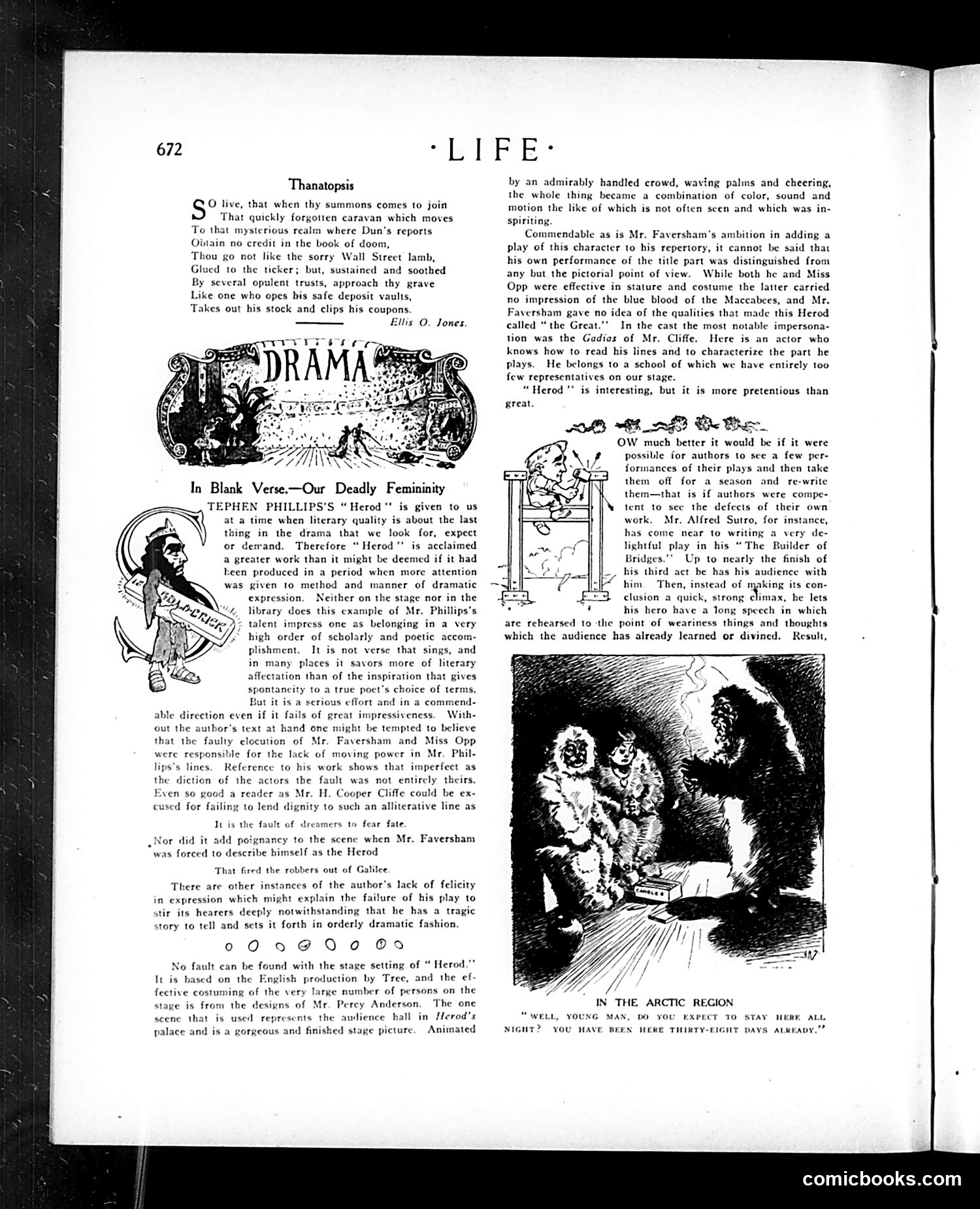
What you’re looking at
This page contains theater criticism of Stephen Phillips's play "Herod," starring actor William Faversham. The critic praises the production's staging, costumes, and crowd direction by Percy Anderson, calling it "gorgeous and finished." However, he judges the play itself as pretentious rather than great, criticizing Phillips's verse as affected rather than inspired. The main targets of satire are the lead actors' performances. Faversham's portrayal lacks the qualities that made the historical Herod "the Great," while Miss Opp fails to convey "the blue blood of the Maccabees" despite effective costuming. Only H. Cooper Cliffe, playing Godias, receives genuine praise for skilled line delivery and characterization. The opening poem "Thanatopsis" (by Ellis O. Jones) satirizes Wall Street greed during what appears to be the early 1900s financial era, mocking wealthy investors who approach death clutching stocks and safe deposit boxes rather than living meaningfully.
📄 Transcribed text from this page (OCR, searchable)
Machine-transcribed from the original scan — historical spelling and the odd misread are preserved.
“LIFE: Thanatopsis O live, that when thy summons comes to join That quickly forgotten caravan which moves To that mysterious realm where Dun’s reports Obtain no credit in the book of doom, Thou go not like the sorry Wall Street lamb, Glued to the ticker; but, sustained and soothed By several opulent trusts, approach thy grave Like one who opes his safe deposit vaults, Takes out his stock and clips his coupons. Ellis O. Jones. In Blank Verse——Our Deadly Femininity TEPHEN PHILLIPS'S “Herod” is given to us at a time when literary quality is about the last thing in the drama that we look for, expect or derand. Therefore “ Herod" is acclaimed a greater work than it might be deemed if it had been produced in a period when more attention was given to method and manner of dramatic expression. Neither on the stage nor in the library does this example of Mr. Phillips's alent impress one as belonging in a very high order of scholarly and poetic accom- plishment. It is not verse that sings, and in many places it savors more of literary affectation than of the inspiration that gives spontaneity to a true poet’s choice of terms. But it is a serious effort and in a commend- able direction even if it fails of great impressiveness. With- out the author’s text at hand one might be tempted to believe that the faulty eclocution of Mr. Faversham and Miss Opp were responsib for the lack of moving power in Mr. Phil- lips's lines. Reference to his work shows that imperfect as the diction of the actors the fault was not entirely theirs. Mr. H. Cooper Cliffe could be ex- dignity to such an alliterative line as Even so good a reader a cused for failing to } Jt is the fault of dreamers to fear fate. Nor did it add poignancy to the scene when Mr. Faversham “was forced to describe himself as the Herod ‘That fired the robbers out of Galilee. There are other instances of the author's lack of felicity in expression which might explain the failure of his play to ir its hearers deeply notwithstanding that he has a tragic story to tell and sets it forth in orderly dramatic fashion 0090900 00 No fault can be found with the stage setting of “ Herod.”" It is based on the English production by Tree, and the ef he very large number of persons on the The one fective costuming of stage is from the designs of Mr. Percy Anderson. scene that is used represents the audience hall in Herod's palace and is a gorgeous and finished stage picture. Animated by an admirably handled crowd, waving palms and cheering, the whole thing became a combination of color, sound and motion the like of which is not often scen and which was in- spiriting. Commendable as is Mr. Faversham’s ambition in adding a play of this character to his repertory, it cannot be said that his own performance of the title part was distinguished from any but the pictorial point of view. While both he and Miss Opp were effective in stature and costume the latter carried no impression of the blue blood of the Maccabees, and Mr. Faversham gave no idea of the qualities that made this Herod called “the Great."” In the cast the most notable impersona- tion was the Godios of Mr. Cliffe. Here is an actor who knows how to read his lines and to characterize the part he plays. He belongs to a school of which we have entirely too few representatives on our stage. “Herod "’ is interesting, but it is more pretentious than great. OW much better it would be if it were possible for authors to see a few per- formances of their plays and then take them off for a season and re-write them—that is if authors were compe- tent to see the defects of their own work. Mr. Alfred Sutro, for instance, has come near to writing a very de- lightful play in his “The Builder of Bridges."’ Up to nearly the finish of his third act be has his audience with him Then, instead of making its con- clusion a quick, strong Seas he lets his hero have a long specch in which ind thoughts Result, are rehearsed to the point of weariness things which the audience has already learned or divined. IN THE ARCTIC REGION WELL, YOUNG MAN, DO YOU EXPECT TO STAY HERR ALL NIGHT? YOU MAVE BEEN MERE THIRTY-FIGHT DAYS ALREADY.’? comicbooks.com