
Life, 1909-11-11 · page 20 of 36
Life — November 11, 1909 — page 20: what you’re looking at
What you’re looking at
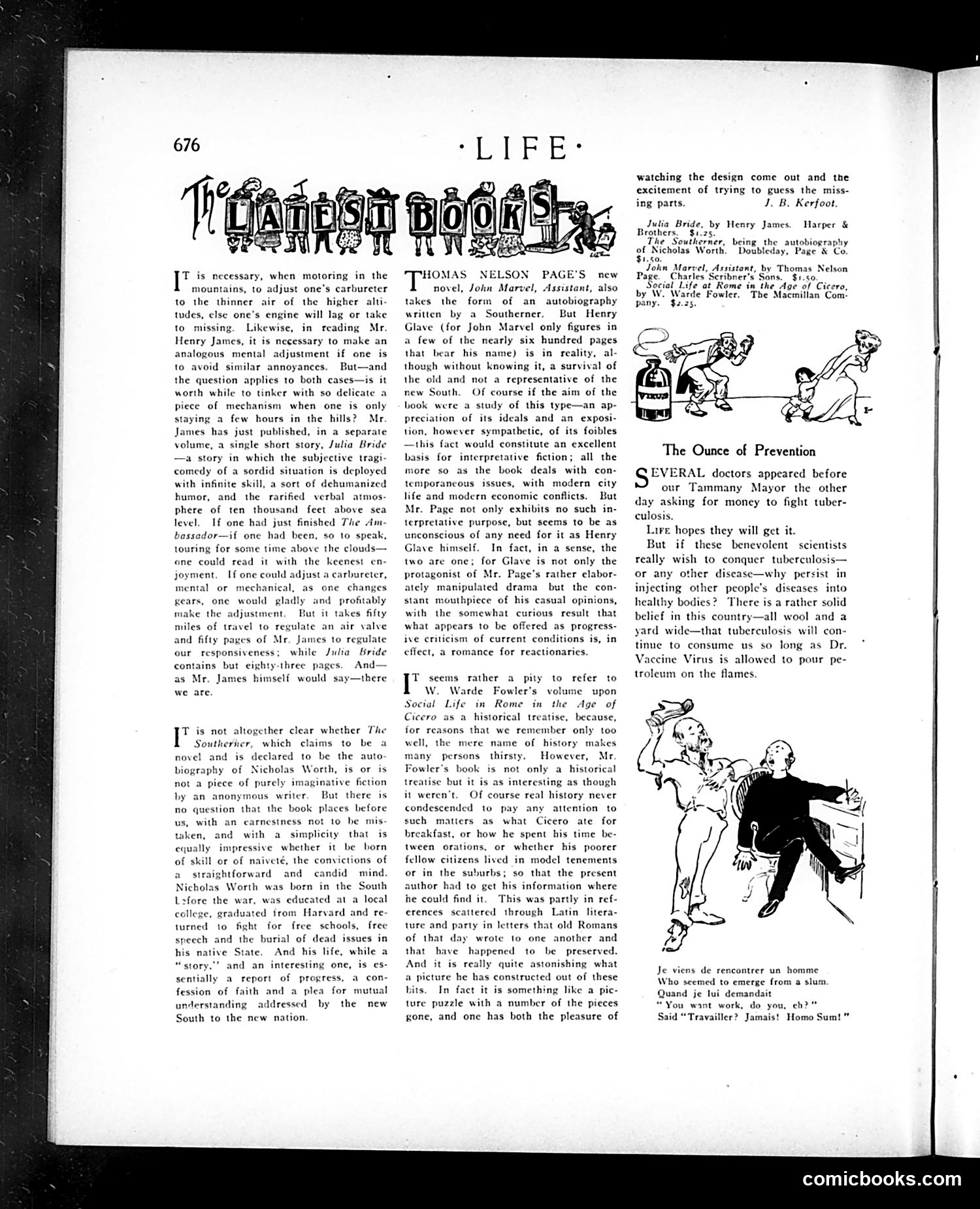
This page contains three literary reviews from what appears to be an early 20th-century issue of *Life* magazine. **The left column** critiques Henry James's short story collection *Julia Bride*, comparing reading James's dense prose to adjusting a car's carburetor for high altitude—you must mentally "adjust" to his rarified style, though the effort barely seems worth it for a short story. **The middle section** reviews Thomas Nelson Page's novel *John Marvel, Assistant*, criticizing it as unconsciously reactionary. The reviewer argues Page presents a pre-Civil War Southern character without ironic distance, making the book a "romance for reactionaries" rather than interpretive fiction about the modern South. **The right contains** two cartoons: "The Ounce of Prevention" (satirizing anti-tuberculosis public health campaigns) and a French caption about someone emerging from a slum, mocking social concern or tourism. The page exemplifies *Life*'s role as a literary and cultural arbiter with wit and satirical edge.
📄 Transcribed text from this page (OCR, searchable)
Machine-transcribed from the original scan — historical spelling and the odd misread are preserved.
is necessary, when motoring in the ins, to adjust one’s carbureter to the thinner air of the higher alti- tudes, else one’s engine will lag or take to missing. Likewise, in reading Mr Henry James, it is necessary to make an analogous mental adjustment if one is to avoid similar annoyances. But—and the question applies to both cases—is it worth while to tinker with so delicate a piece of mechanism when one is only ying a few hours in the hills? Mr James has just published, in a separate volume, a single short story, Julia Bride —a story in which the subjective tragi comedy of a sordid situation is deployed with infinite skill, a sort of dehumanized humor, and the rarified verbal atmos- phere of ten thousand feet above sea level. If one had just finished The Am bassador—if one had been, so to speak, touring for some time above the one could read it with the keenest en- joyment, If one could adjust a carbureter, mechanical, as one changes would gladly and_ profitably But it takes fifty miles of travel to regulate an air valve and fifty pages of Mr. James to regulate while Julia Bride pages. And— as Mr. James himself would say—there we are jouds— mental or gears, one make the adjustment our responsiveness ; contains but eighty-three altogether clear whether The which claims to be a novel and is declared to be the auto. biography of Nicholas Worth, is or is ietion T is not Southerner, not a piece of purely imaginative by an anonymous writer, But there is no question that the book places before us, with an carnestness not and simplicity impressive whether it be born of skill or of naiveté, the convictions of a straightforward and candid mind Nicholas Worth was born in the South Lefore the war, was educated at a local Harvard and re free schools, free of dead issues in his native State. And his life, while a an interesting one, is es- of progress, a con- mutual new to be mis- taken, with a that is equally college, graduated fron turned to fight for speech and the bu: “ story.” and sentially a report fession of faith and a plea for understanding addressed by the South to the new nation HHOMAS NELSON PAGE novel, John Marvel, Assistant, also takes the form of an autobiography written by a Southerner. But Henry Glave (for John Marvel only figures in a few of the nearly six hundred pages that bear his name) is in reality, al- though without knowing it, a survival of the old and not a representative of the new South. Of course if the aim of the book were a study of this type—an ap- preciation of its ideals and an exposi- lion, however sympathetic, of its foibles —this fact would constitute an excellent basis for interpretative fiction; all the more so as the book deals with con- temporancous issues, with modern city life and modern economic conflicts. But Mr. Page not only exhibits no such in- terpretative purpose, but seems to be as unconscious of any need for it as Henry Glave himself. In fact, in a sense, the two are one; for Glave is not only the protagonist of Mr. Page's rather elabor- ately manipulated drama but the stant mouthpiece of his casual opi with the somewhat curious result what appears to be offered as progress- ive criticism of current conditions is, in effect, a romance for reactionaries. con- ons, that iv seems rather a pity to refer to W. Warde Fowler's volume upon Life in Rome in the Age of Cicero as a historical because, for reasons that we remember only too well, the mere name of history makes many persons thirsty. However, Mr. Fowler's book is not only treatise but it is as interesting as though it weren't. Of course real history never condescended 10 pay any attention to such matters as what Cicero ate for breakfast, or how he spent his time be- Social treatise, a historical tween orations, or whether his poorer fellow citizens lived in model tenements or in the suburbs; so that the present author had to get his information where he could find it. This was partly in ref- erences scattered through Latin litera- ture and party in letters that old Romans of that day that have wrote to one another and happened to be preserved. And it is really quite astonishing what picture he has constructed out of these bits. In fact it is something like a pic- ture puzzle with a number of the pieces gone, and one has both the pleasure of watching the design come out and the excitement of trying to guess the miss- ing parts. J. B. Kerfoot Julia Bride, by Henry James Brothers, $1.25. sa The Southerner, being the autobiography gf Nicholas Worth. “Doubleday, Page & Co. 260. Jokn Marvel, Assistant, by Thomas Nelson Page. Charles’Scribner’s Sons. $1.50. Social Life at Rome in the Age of Cicero, by W. Warde Fowler, The Macmillan Com: Harper & The Ounce of Prevention EVERAL doctors appeared before our Tammany Mayor the other day asking for money to fight tuber- culosi: Lire hopes they will get it. But if these benevolent scientists really wish to conquer tuberculosis— or any other disease—why persist in injecting other people’s diseases into healthy bodies? There is a rather solid belief in this country—all wool and a yard wide—that tuberculosis will con- tinue to consume us so long as Dr. Vaccine Virus is allowed to pour pe- troleum on the flames. Je viens de rencontrer un homme Who seemed to emerge from a slum. Quand je lui demandait “You want work, do you, eh aid “Travailler? Jamais! Homo Sum!” comicbooks.com