
Life, 1909-11-11 · page 17 of 36
Life — November 11, 1909 — page 17: what you’re looking at
What you’re looking at
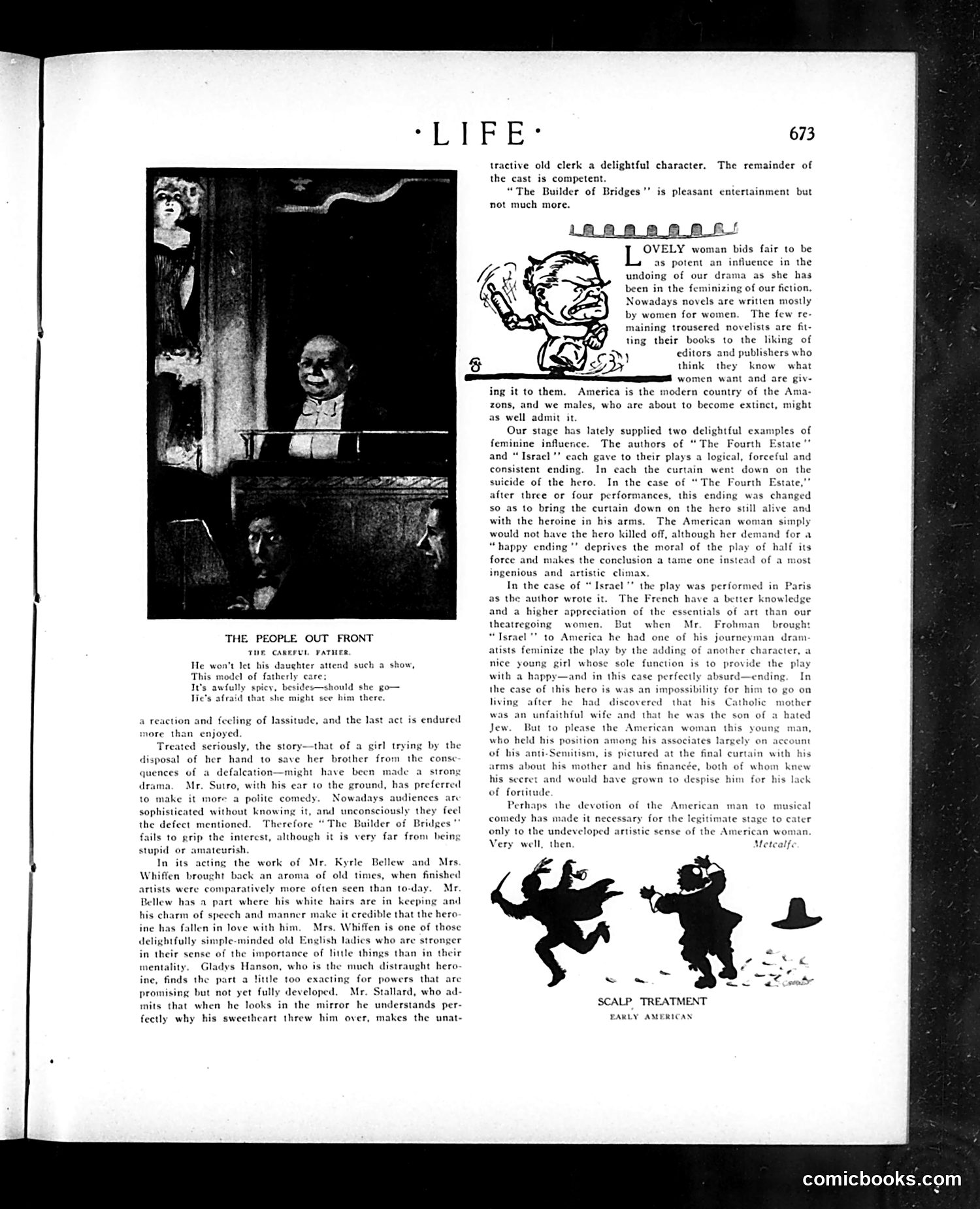
## "The People Out Front" (Top Cartoon) This joke satirizes Victorian hypocrisy about morality. A self-righteous father forbids his daughter from attending a risqué theatrical show—not from genuine moral concern, but because he fears she might spot *him* there enjoying it himself. The humor exposes the contradiction between public piety and private behavior common among respectable men of the era. ## Theater Criticism Section The text discusses how female influence is "feminizing" American drama and fiction. The author argues that women writers and female audiences now dominate, forcing male playwrights to provide sentimental "happy endings" rather than artistically authentic conclusions. Specific examples: plays like "The Fourth Estate" and "Israel" originally ended with the hero's suicide, but American producers altered them to show the hero surviving and reunited with the heroine—changes attributed to female audience demand for romance over artistic integrity. The French supposedly maintain better artistic standards. ## "Scalp Treatment" (Bottom Illustration) A crude cartoon depicting Native Americans, labeled "Early American," showing the historical practice of scalping. Its placement appears ironic given the surrounding text about American cultural taste.
📄 Transcribed text from this page (OCR, searchable)
Machine-transcribed from the original scan — historical spelling and the odd misread are preserved.
THE PEOPLE OUT FRONT TUE CAREFUL FATHER He won't let his daughter attend such a show, This model of fatherly care: It’s awfully spicy, besides—should she go— Hie’s afraid that she might sce him there. 1 reaction and feeling of lassitude, and the last act is endured more than enjoyed Treated seriously, the story—that of a girl trying by the the conse disposal of her hand to save her brother fro! might have been nd, has preferred le a strong quences of a defaleation dra Mr. Sutro, with his ear to the gro to make it more a polite comedy. Nowadays audiences are sophisticated without knowing it, and w the defect mentioned. Therefore “The Builder of fails to grip the interest, although it is very far from being consciously they feel Bridges" stupid or amateurish In its acting the work of Mr. Kyrle Bellew and Mrs Whiffen brought back an aroma of old times, when finished artists were comparatively more often seen than to-day. Mr Bellew has a part where his white hairs are in keeping and his charm of speech and manner make it credible that the hero: ine has fallen in love with him. Mrs, Whiffen is one of those delightfully simple-minded old English ladies who are stronger in their sense of the importance of little things than in their dvs Hanson, who is the much distraught hero. mentality. ine, finds the part a little too exacting for powers that are promising but not yet fully developed. Mr. Hard, who ad- mits that when he looks in the mirror he understands per- fectly why his sweetheart threw him over, makes the unat- “LIFE: 673 tractive old clerk a delightful character. The remainder of the cast is competent. “The Builder of Bridges ’ not much more. LAA 6 8 8 A RS OVELY woman bids fair to be as potent an influence in the undoing of our drama as she has been in the feminizing of our fiction. Nowadays novels are written mostly by women for women. The few re- maining trousered novelists are fit- ting their books to the liking of ditors and publishers who cp) e 153, think they know what women want and are gi ing it to them. America is the modern country of the A\ zons, and we males, who are about to become extinct, might as well admit it. Our stage has lately supplied two de feminine influence. The authors of “The Fourth Estate" and “ Israel" each gave to their plays a logical, forceful and consistent ending. In each the curtain went down on the suicide of the hero. In the case of Fourth Estate,”’ after three or four performances, this ending was changed 30 as to bring the curtain down on the hero still alive and with the heroine in his arms, The American woman simply would not have the hero killed off, although her demand for a “happy ending" deprives the moral of the play of half its kes the conclusion a tame one instead of a most is pleasant entertainment but mas tful examples of force and ¢ climax. ingenious and art! In the case of “ Israel"? the play was perio as the author wrote it. The French have a better knowledge in Paris and a higher appreciation of the essentials of art than our theatregoing women, But when Mr. Frohman ti “Israel "’ to America he had one of his journeyma by the her char, nize the p sts fi a ing of a nic sole function is to provide the with a happy—and in this case perfectly absurd. the living after he had discovered that his Cal thful wife and that he was the son of a young girl whose ending ase of this hero is was an impossibility for him to go lic mother was an un! Jew. But to pl se the Amer an woman this young jon amor argel who held his pos: 1g his associates on account of his anti-Semitis final curtain with his . is pictured at arms about his mother and his financée . both of whom knew and would bave grown to despise him for his lack ade. Perhaps the devotion of the American man to musical comedy has made it necessary for the legitimate stage to cater only to the undeveloped artistic sense of the American woman: well, then, Metea ce SCALP TREATMENT EARLY AMERICAN comicbooks.com