
Life, 1909-11-11 · page 8 of 36
Life — November 11, 1909 — page 8: what you’re looking at
What you’re looking at
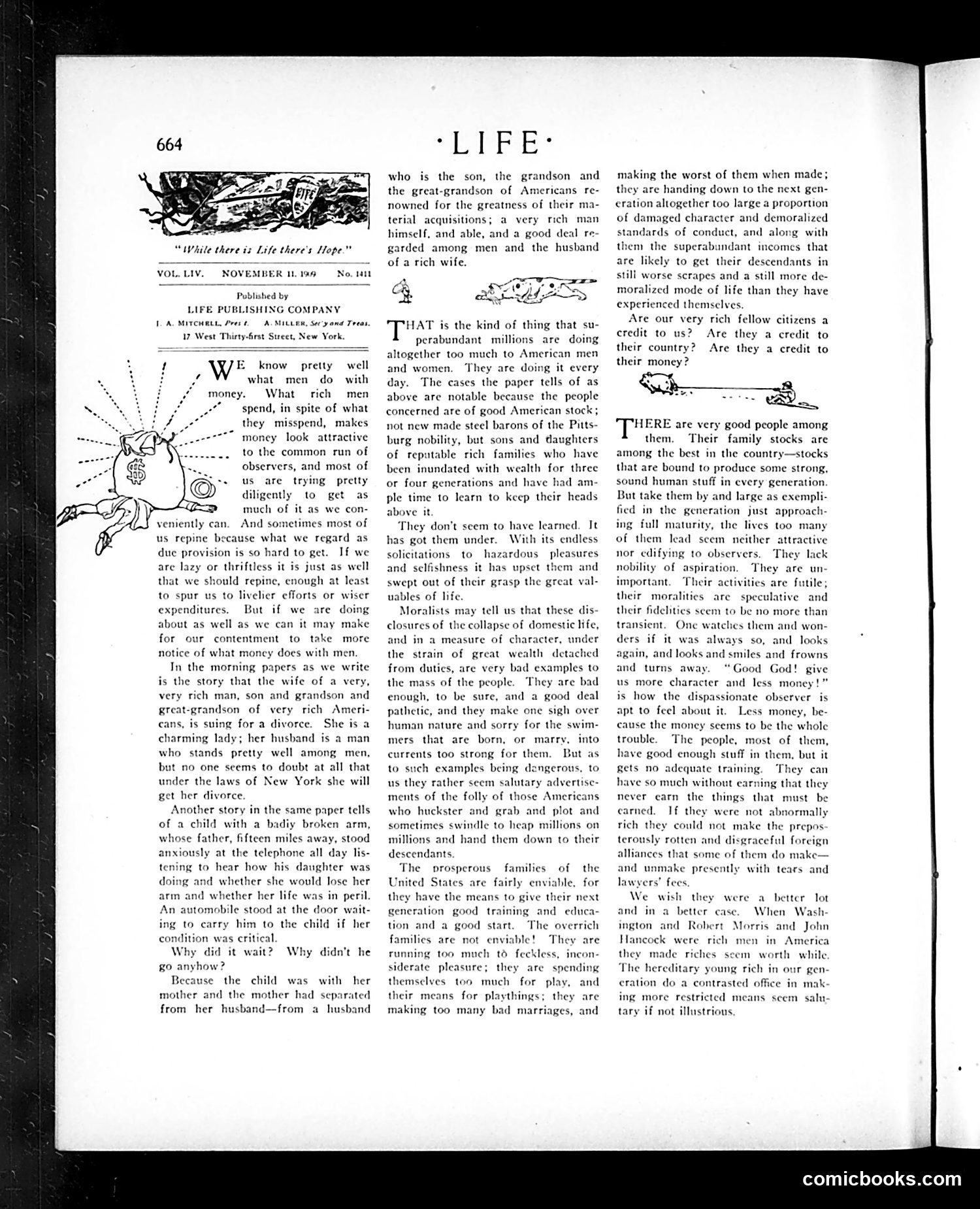
This page is primarily **text-based editorial content**, not a political cartoon. The left margin contains a small illustration of a money bag sprouting wings—a visual metaphor for wealth taking flight or dissipating. The article discusses **wealthy American families** and their moral failings. It criticizes rich citizens for failing to be proper "credit to their country," suggesting their inherited wealth has made them irresponsible. The piece expresses concern that the next generation of wealthy heirs will inherit both money and poor character, perpetuating cycles of "bad marriages" and moral dissolution. The satire targets **American aristocracy's hypocrisy**—their material success masks spiritual bankruptcy. This reflects Progressive Era anxieties (likely early 1900s) about whether concentrated wealth was corrupting American society.
📄 Transcribed text from this page (OCR, searchable)
Machine-transcribed from the original scan — historical spelling and the odd misread are preserved.
“While there iz Life there's Hope.” No. uit VOL. LIV, NOVEMBER 11. 199 Published by LIFE PUBLISHING COMPANY FA MITCHRLL, Prete AL MILLRR, Seep ond hirty-Grst Street, New Vork. = know pretty well what men do with money. What rich men spend, in spite of what they misspend, makes money look attractive to the common run of observers, and most of us are trying pretty diligently to get as much of it as we con- And sometimes most of us repine because what we regard as due provision is so hard to get. If we are lazy or thriftless it is just as well that we should repine, enough at least to spur us to livelier efforts or wiser expenditures. But if we are doing out as well as we can it may make for our contentment to take more notice of what moncy does with men. In the morning papers as we write is the story that the wife of a ver very rich man, son and grandson and great-grandson of very rich Ameri- cans, is suing for a divorce. She is a charming lady; her husband is a man who stands pretty well among men, but no one seems to doubt at all that under the laws of New York she will get her divorce. Another story in the same paper tells of a child with a badiy broken arm, whose father, fifteen miles away, stood anxiously at the telephone all day lis- tening to hear how his daughter was doing and whether she would lose her arm and whether her life was in peril. An automobile stood at the door wa @ to carry him to the child if her lition was criti Why did it wait? go anyhow? Because the child with her mother and the mother had separated from her husband—from a husband veniently can. Why didn't he was ele le who is the son, the grandson and the great-grandson of Americans re- nowned for the greatness of their ma- terial acquisitions; a very rich himself, and able, and a good deal re- garded among men and the husband of a rich wife. 4 "past is the kind of thing that su- perabundant millions are doing altogether too much to American men and women. They are doing it every day. The cases the paper tells of as above are notable because the people concerned are of good American stock ; not new made steel barons of the Pitts- burg nobility, but sons and daughters of reputable rich families who have been inundated with wealth for three or four generations and have had am- ple time to learn to keep their heads above it They don’t seem to have learned. It has got them under. With its endless solicitations to hazardous pleasures and selfishness it has upset them and swept out of their grasp the great val- man uables of life. Moralists may tell us that these dis- closures of the collapse of domestic life, and in a measure of character, under the strain of great wealth detached from duties, are very bad examples to the mass of the people. They are bad enough, to be sure, and good deal pathetic, and they make one sigh over human nature and sorry for the swim- mers that are born, or marry, into currents too strong for them. But as to such examples being dangerous, to us they rather seem salutary advertise- ments of the folly of those Americans who huckster and grab and plot and sometimes swindle to heap millions on millions and hand them down to their descendants, The prosperous families of the United States are fairly enviable, for they have the means to give their next generation good training and educa- tion and a good start. The overrich families are not ! They are running too much to feckless, incon- siderate they are spending much for play, and their means for playthings; they are making too many bad marriages, and enviable pleasur themselves too making the worst of them when made; they are handing down to the next gen- eration altogether too large a proportion of damaged character and demoralized standards of conduct, and along with them the superabundant incomes that are likely to get their descendants in still worse scrapes and a still more de moralized mode of life than they have experienced themselves. Are our very rich fellow citizens a credit to us? Are they a credit to their country? Are they a credit to their money? a HERE are very good people among them. Their family stocks are among the best in the country—stocks that are bound to produce some strong, sound human stuff in every generation But take them by and large as exempli- fied in the generation just approach- ing full maturity, the lives too many of them lead scem neither nor edifying to observers. nobility of aspiration important their tractive They lack They are un- Their activities are futile; moralities are speculative and their fidelities seem to be no more than transient. One w ders if it was always so, and looks again, and looks and smiles and frowns and turns away. “Good God! give us more character and less money!” is how the dispassionate observer is apt to feel about it. Less money, be- cause the money seems to be the whole trouble. The people, most of them, have good enough stuff in them, but it gets no adequate training. They can have so much without earning that they never carn the things that must be earned. If they were not abnormally could not make the prepos terously rotten and disgraceful foreign alli ches them and won- t some of them do make— 1 unmake presently with tears and lawyers’ fees We wish the in a better case, ington and R Hancock were they better lot When Wash- vert’ Morris and John rich America riches worth while The hereditary young rich in our gen- eration do a contrasted office in mak ing more restricted means scem salu- tary if not illustrious, were men in made seem comicbooks.com