
A complete issue · 32 pages · 1909
Life — September 9, 1909
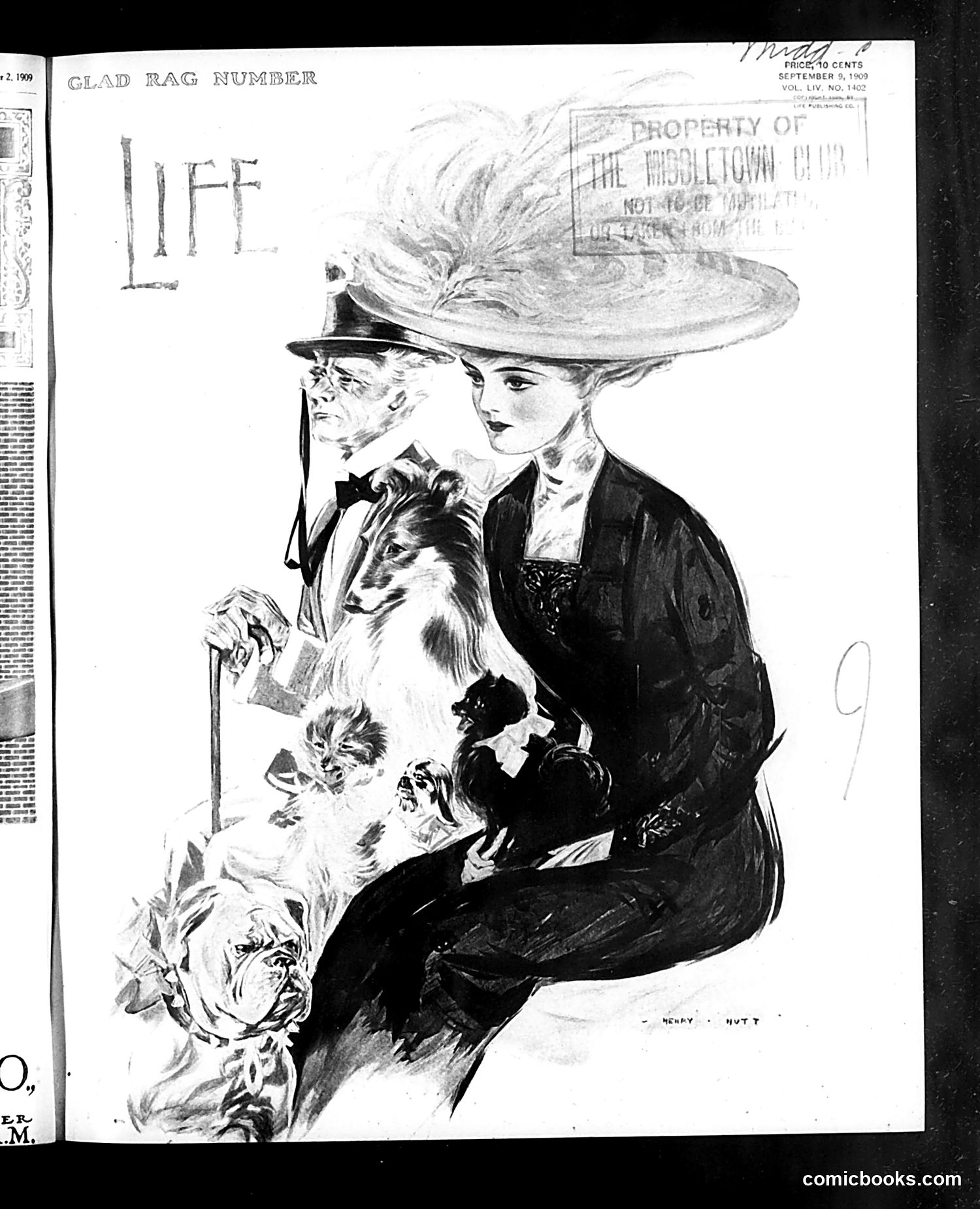
This appears to be a cover illustration from *Life* magazine (Vol. LIV, No. 1402), priced at 10 cents. The artwork, signed by Henry Hutt, depicts an elegantly dressed woman wearing an enormous, fashionable wide-brimmed hat adorned with feathers—a style characteristic of early 20th-century high society. She is accompanied by an older gentleman in formal attire and holds multiple small dogs. The single-word title "LIFE" suggests this is satirizing the lifestyle and preoccupations of wealthy society figures. The exaggerated hat, multiple lap dogs, and formal presentation mock the vanity and frivolous concerns of the upper class. The composition emphasizes material excess and social pretension typical of *Life* magazine's satirical commentary on American society during this era.
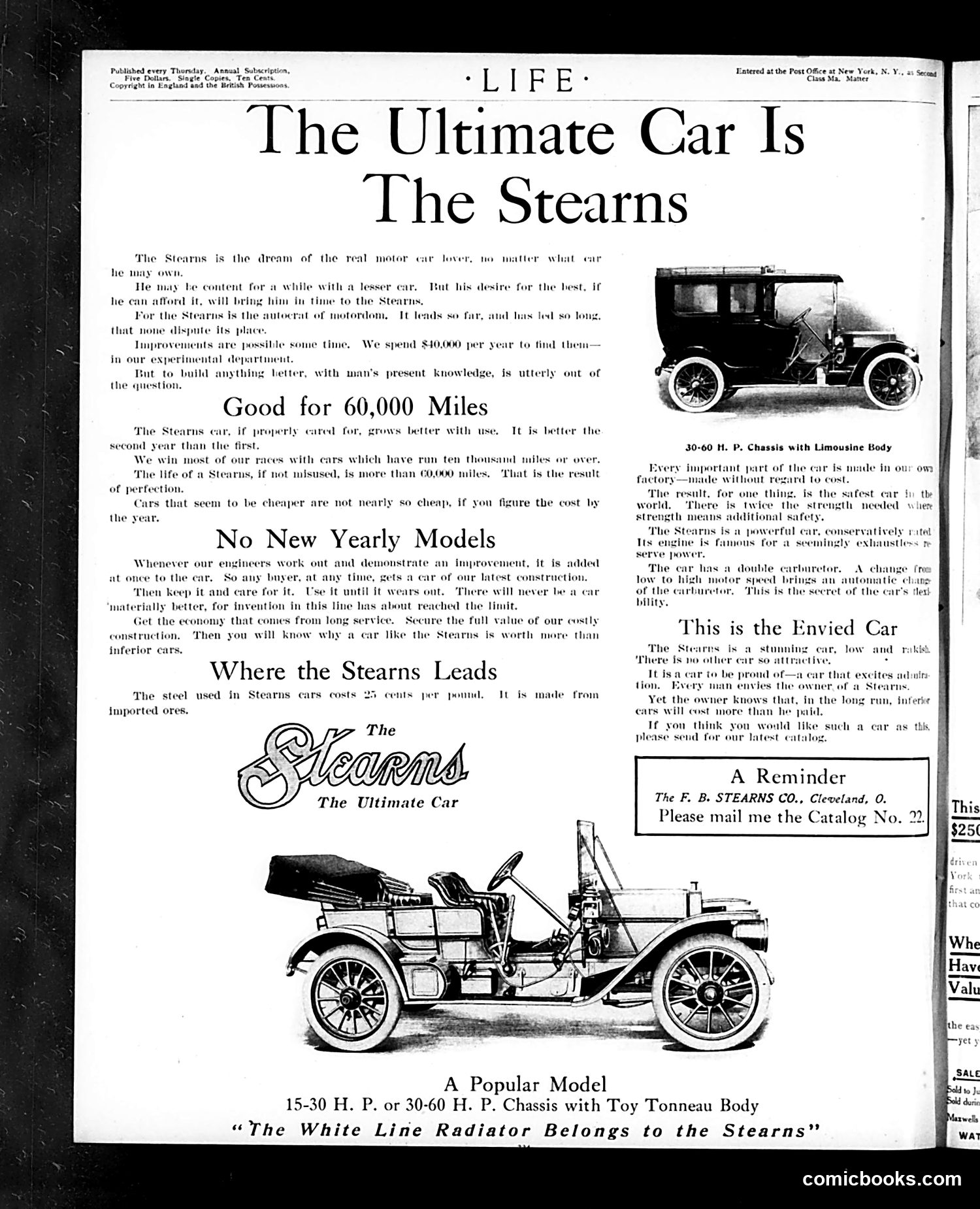
This is **not satire or political commentary**—it's a straightforward advertisement for the Stearns automobile, published in *Life* magazine. The page promotes the Stearns as "The Ultimate Car," emphasizing durability (good for 60,000 miles), reliability, and conservative design philosophy. Key selling points include: no yearly model changes (owners keep cars longer), low steel content reducing costs, and a powerful double-carburetor engine. Two vehicle illustrations show the car's design: a limousine version (top) and a chassis with toy tonneau body (bottom). The "White Line Radiator" is highlighted as a Stearns feature. The ad includes a call-to-action ("Please mail me the Catalog No. 22") from the F.B. Stearns Co., Cleveland, Ohio—typical early-1900s automotive marketing targeting affluent buyers seeking practical luxury vehicles.
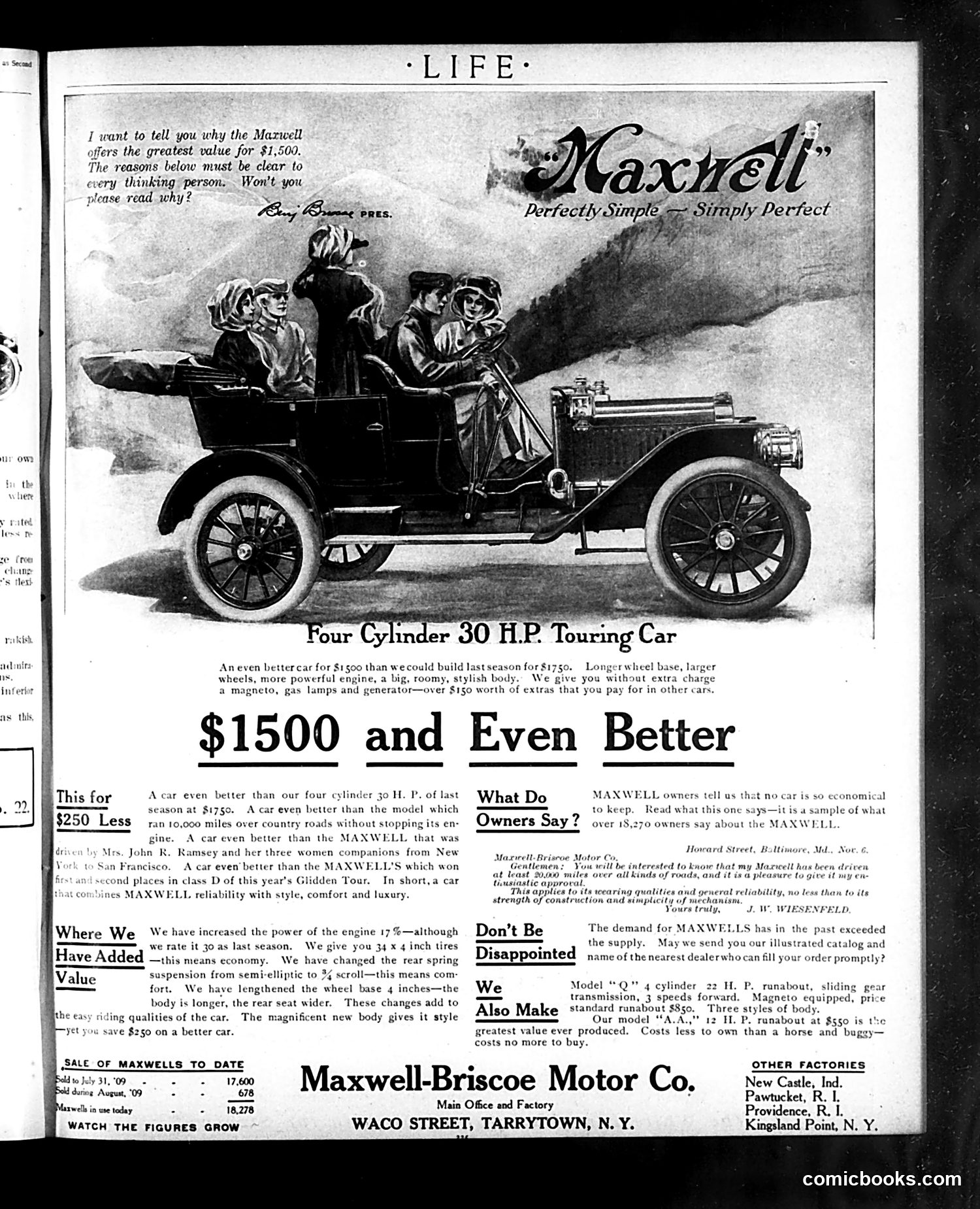
This is **not a political cartoon or satire page**—it's a straightforward automobile advertisement. The page features a Maxwell automobile advertisement from Maxwell-Briscoe Motor Co. (located in Tarrytown, N.Y.). The illustration shows a touring car carrying well-dressed passengers, presented as a practical family vehicle. The ad emphasizes value, claiming the Maxwell offers "greatest value for $1,500" with features like a four-cylinder 30 HP engine, longer wheelbase, and larger wheels compared to competitors. The marketing strategy highlights price advantage ("$250 Less"), reliability testimonials from owners, and lists of added features. This represents typical early-1900s automotive advertising targeting middle-class buyers seeking affordable automobiles. There is no political or satirical content present.
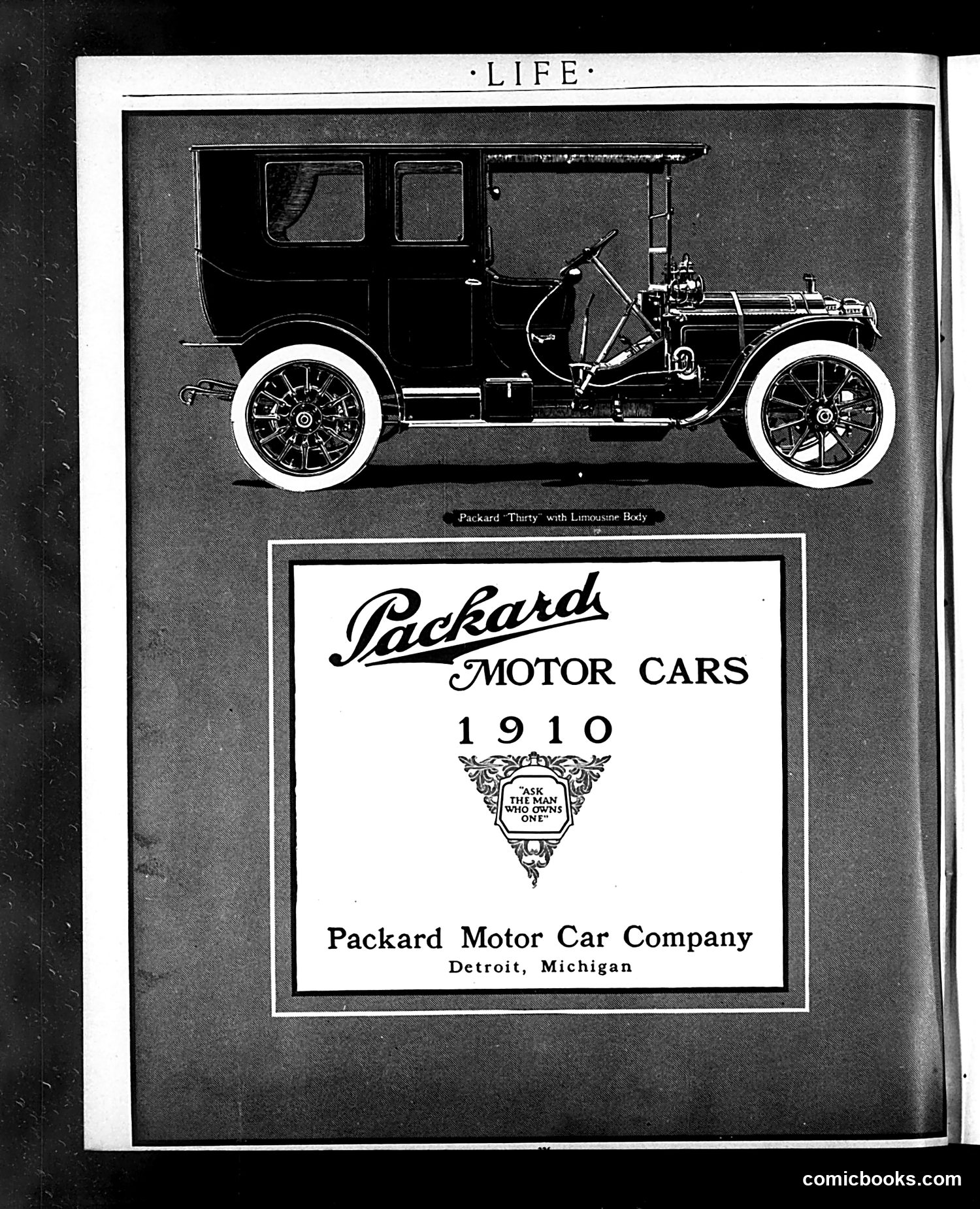
This page from *Life* magazine is primarily **advertising content**, not political satire or commentary. It features a 1910 Packard automobile advertisement showcasing a "Packard Thirty with Limousine Body." The image displays a detailed technical illustration of the luxury car in profile, emphasizing its engineering and stylish design. The Packard Motor Car Company, based in Detroit, Michigan, uses the tagline "Ask the man who owns one"—a famous advertising slogan from that era meant to suggest satisfied customer testimonials. There is **no cartoon, caricature, or political satire present**. This is straightforward luxury automobile marketing from the early 20th century, targeting affluent readers of *Life* magazine.
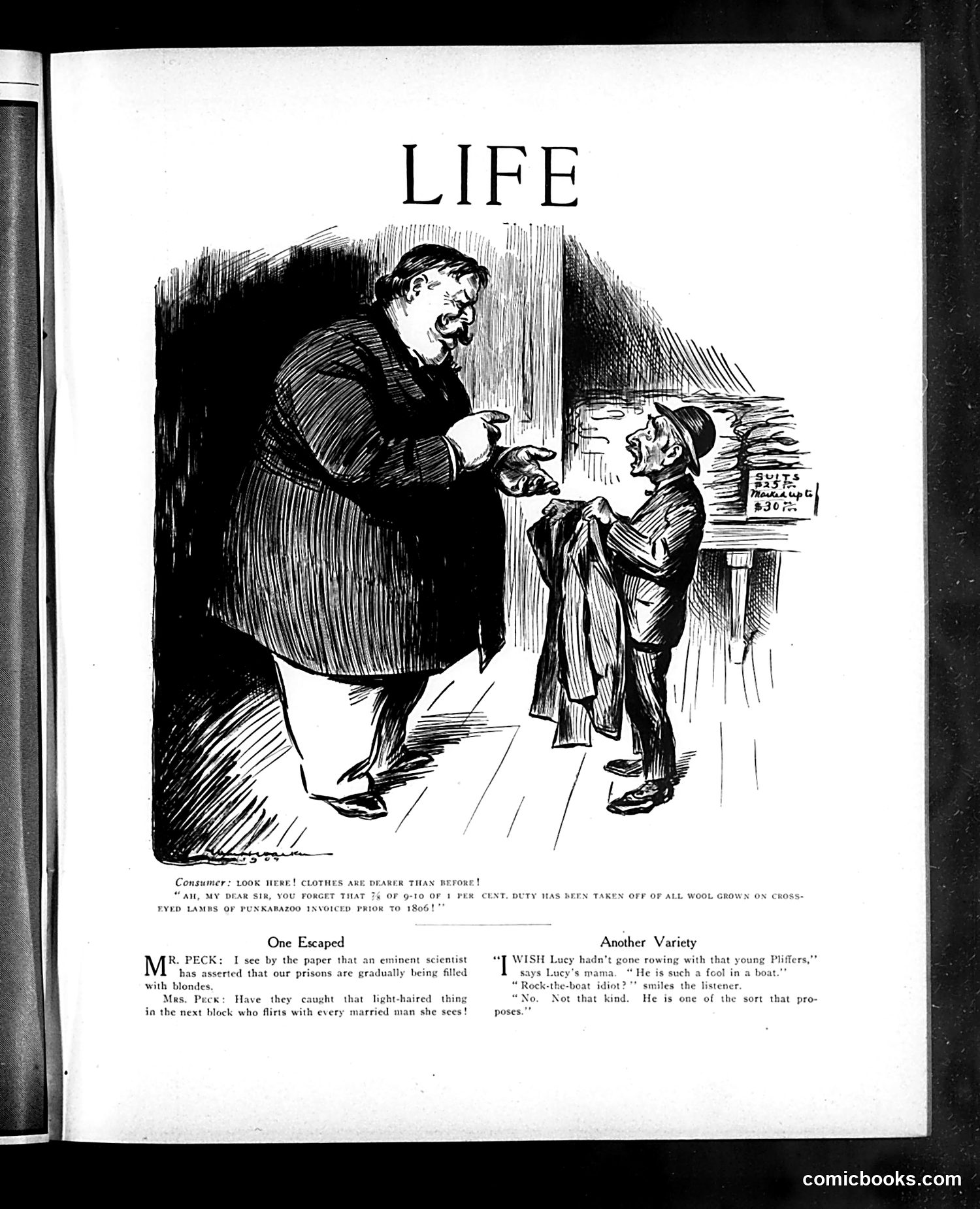
This *Life* magazine page satirizes **tariff policy and consumer prices**, likely from the early 20th century. The main cartoon shows a large man (representing a tariff-supporting politician or businessman) confronting a smaller consumer about clothing prices. The caption reveals the joke: wool tariffs have been removed from "cross-typed lambs of Punckaroob" (fictional), yet prices remain high—the consumer is being blamed for supposedly "forgetting" that duty removal should lower costs. The two brief anecdotes below continue mocking consumer complaints. "One Escaped" ridicules a scientist claiming prisons are filling with blondes. "Another Variety" jokes about a foolish young man courting. The overall message: **tariff reductions don't benefit consumers as promised**—retailers keep prices artificially high while blaming the public's ignorance.
This page features an article about **Professor Hugo Münsterberg**, a German-American psychologist and Harvard professor. The accompanying illustration (left) depicts him as a somewhat portly figure, characteristic of Life's satirical style. The article discusses Münsterberg's observations of American nervousness and his belief that Americans waste nervous energy through poor self-discipline. Life's satire targets his German perspective on American society—positioning him as an outsider making judgmental observations about American habits. The small cartoon (center) appears to illustrate the concept of "nervousness" through a simple figure, though details are unclear. The piece satirizes both Münsterberg's foreign critique of Americans and contemporary anxieties about modern life's psychological toll—a common theme in early 20th-century journalism.
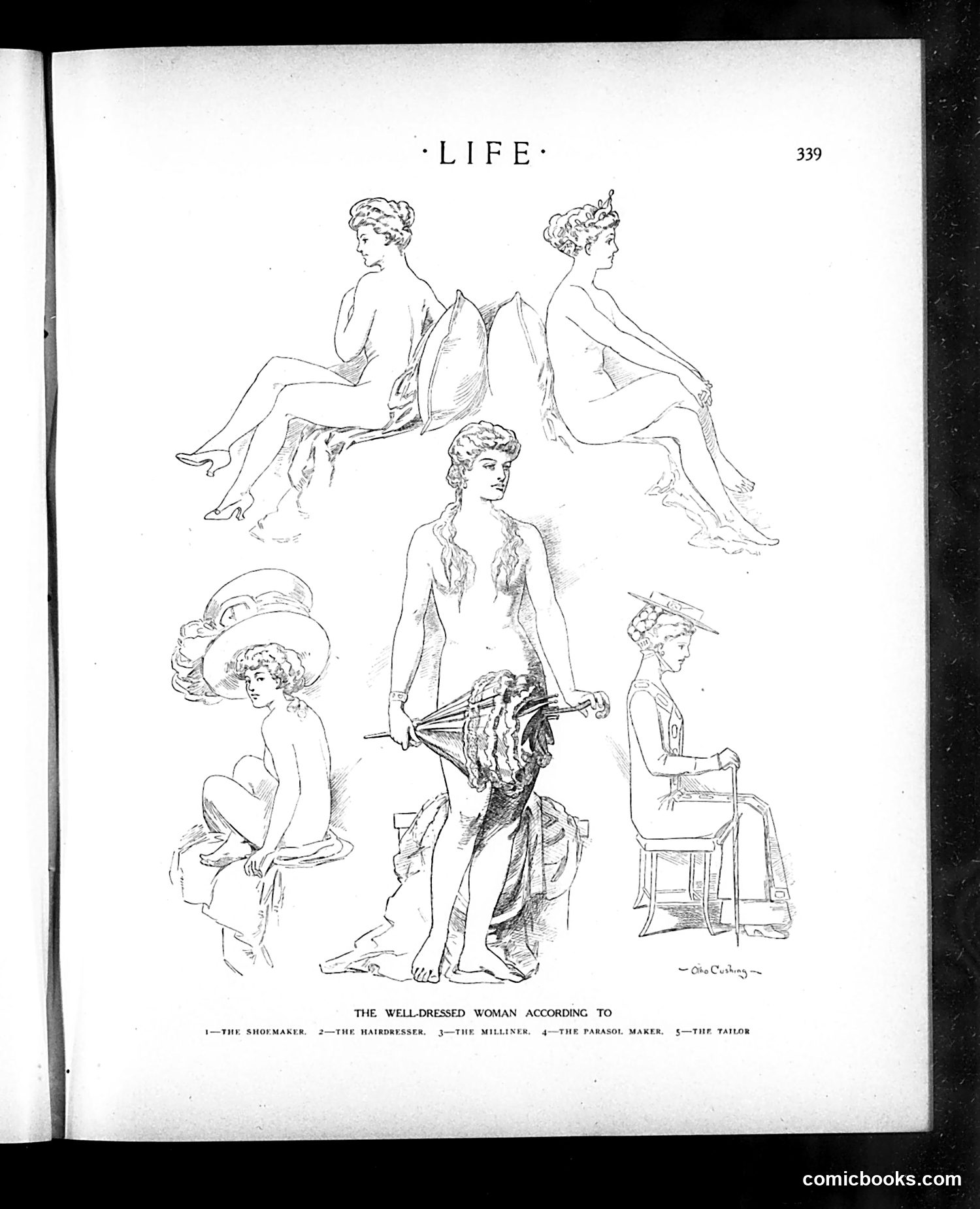
This satirical illustration from *Life* magazine presents five different professional women's perspectives on ideal female fashion and appearance. Each figure represents a tradesperson who profits from women's clothing and grooming: 1. **The Shoemaker** - depicts a woman in a large hat 2. **The Hairdresser** - shows elaborate upswept hair 3. **The Milliner** - features an oversized decorative hat 4. **The Parasol Maker** - emphasizes parasol accessories 5. **The Tailor** - displays a fully clothed, modest figure The satire mocks how each tradesperson's vision of a "well-dressed woman" conveniently showcases their own products and services, suggesting they prioritize profit over genuine female aesthetics or comfort. It critiques commercial interests shaping women's fashion standards rather than women's actual preferences.
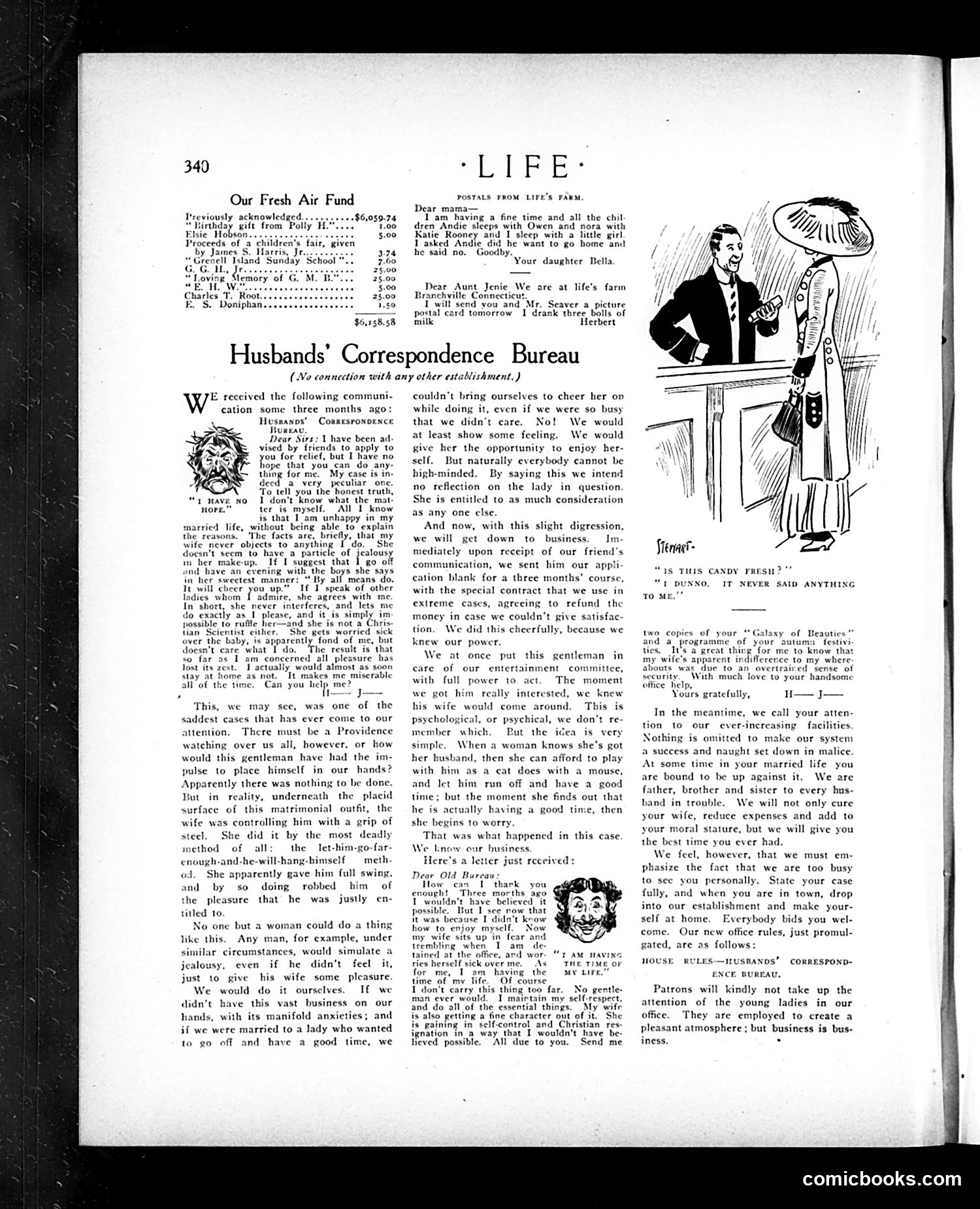
This page contains the "Husbands' Correspondence Bureau," a satirical advice column addressing marital problems. The main illustrated cartoon shows a well-dressed man speaking with a woman wearing a large, fashionable hat—typical of early 20th-century style. The satirical premise mocks the era's gender dynamics: the column presents itself as helping husbands manage difficult wives. One letter describes a husband whose wife nags constantly, suggesting she needs "entertainment" and distraction to improve her mood—reflecting period attitudes that women's happiness required male management. The satire critiques both husbands' inability to understand their wives and the underlying assumption that wives are problems to be solved rather than people deserving genuine consideration. The column's tongue-in-cheek "business" framing underscores how transactional some viewed marriage.
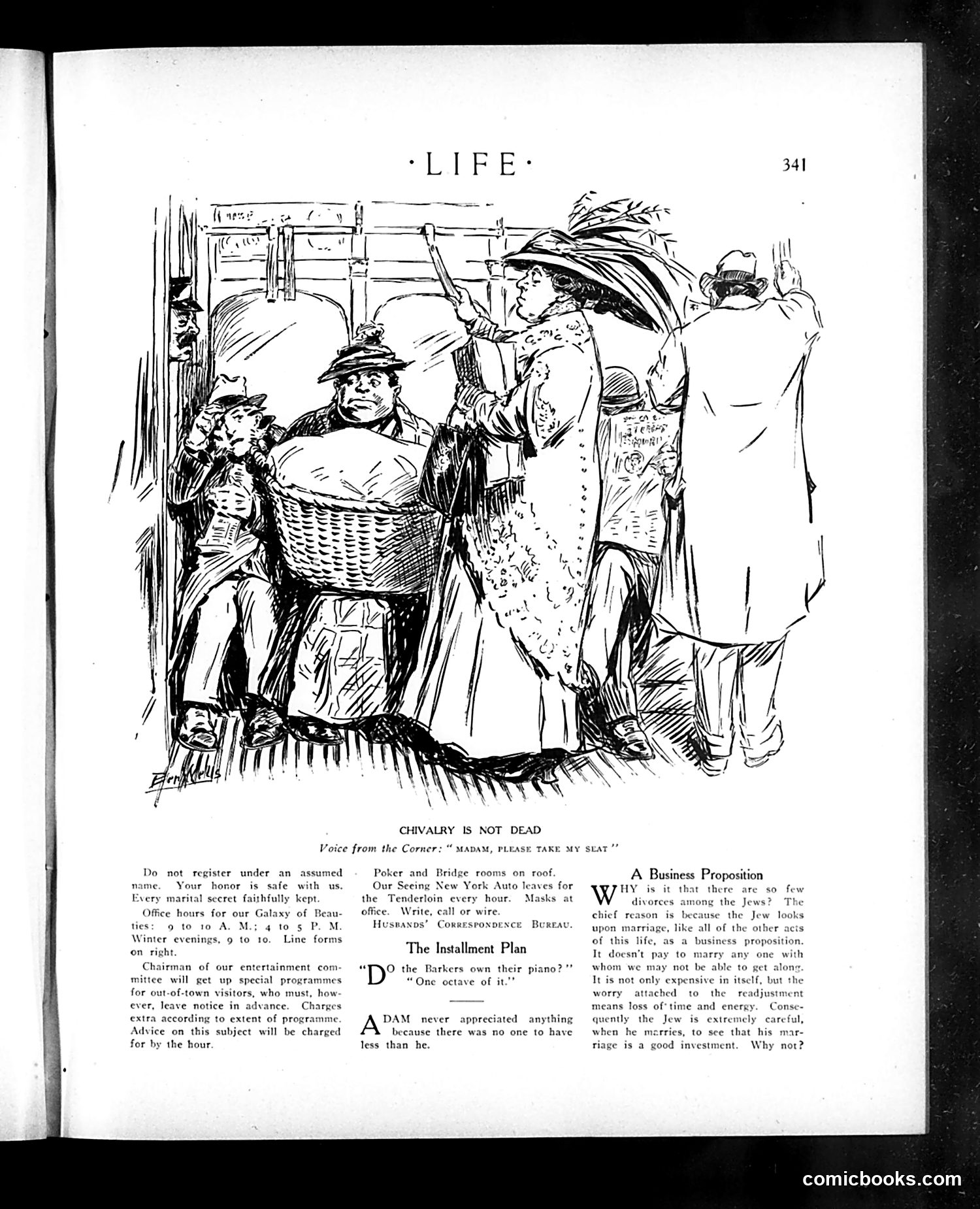
The main cartoon depicts a crowded streetcar or trolley where a man in a bowler hat holds a large basket, while a woman stands nearby. The caption quotes "Madam, please take my seat," suggesting old-fashioned gentlemanly behavior. The satire appears to mock the contradiction between outdated courtesies and modern realities. The accompanying text discusses Jewish marriage customs and business practices regarding intermarriage, framed as a pragmatic "business proposition." The cartoon likely critiques how superficial gestures of chivalry persist while deeper social prejudices remain intact—men may offer seats on streetcars but harbor discriminatory attitudes about interfaith marriage. The title's irony suggests chivalry is selectively applied based on social convenience rather than genuine principle.
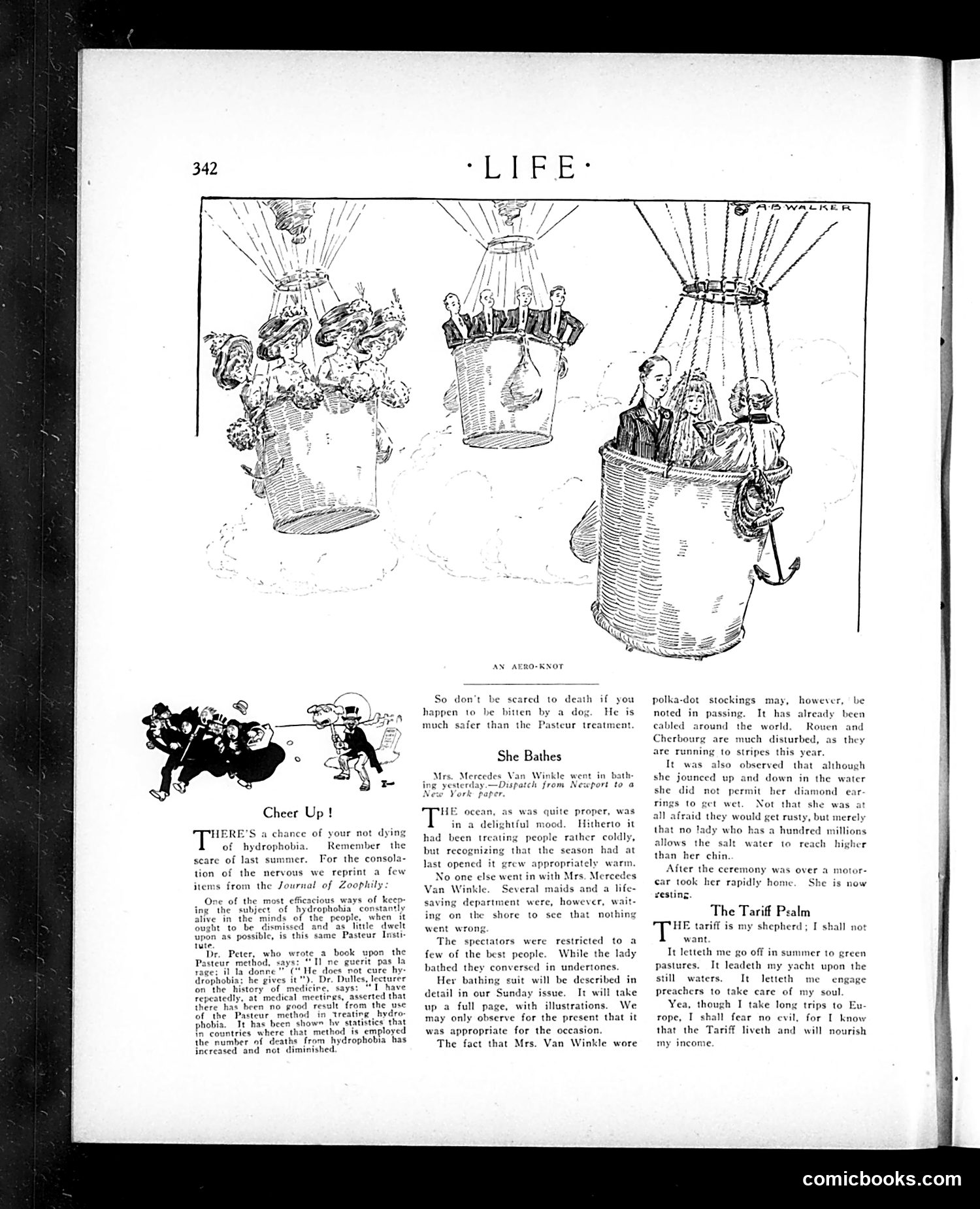
This satirical cartoon depicts three hot air balloons carrying passengers, illustrating the early aviation craze. The "aero-knot" title plays on the double meaning of "knot" (a nautical speed unit and a tangled predicament). The cartoon mocks wealthy socialites experiencing the then-novel thrill of balloon rides. The accompanying text discusses hydrophobia treatments and references "Mrs. Mercedes Van Winkle," a society figure who bathed in the ocean. The satire targets upper-class leisure activities and their perceived absurdities—here, the fashionable new pursuit of aerial recreation. The tangled, knotted appearance of the balloons suggests both the novelty's chaos and the social entanglement of those participating in this exclusive pastime during aviation's early days.
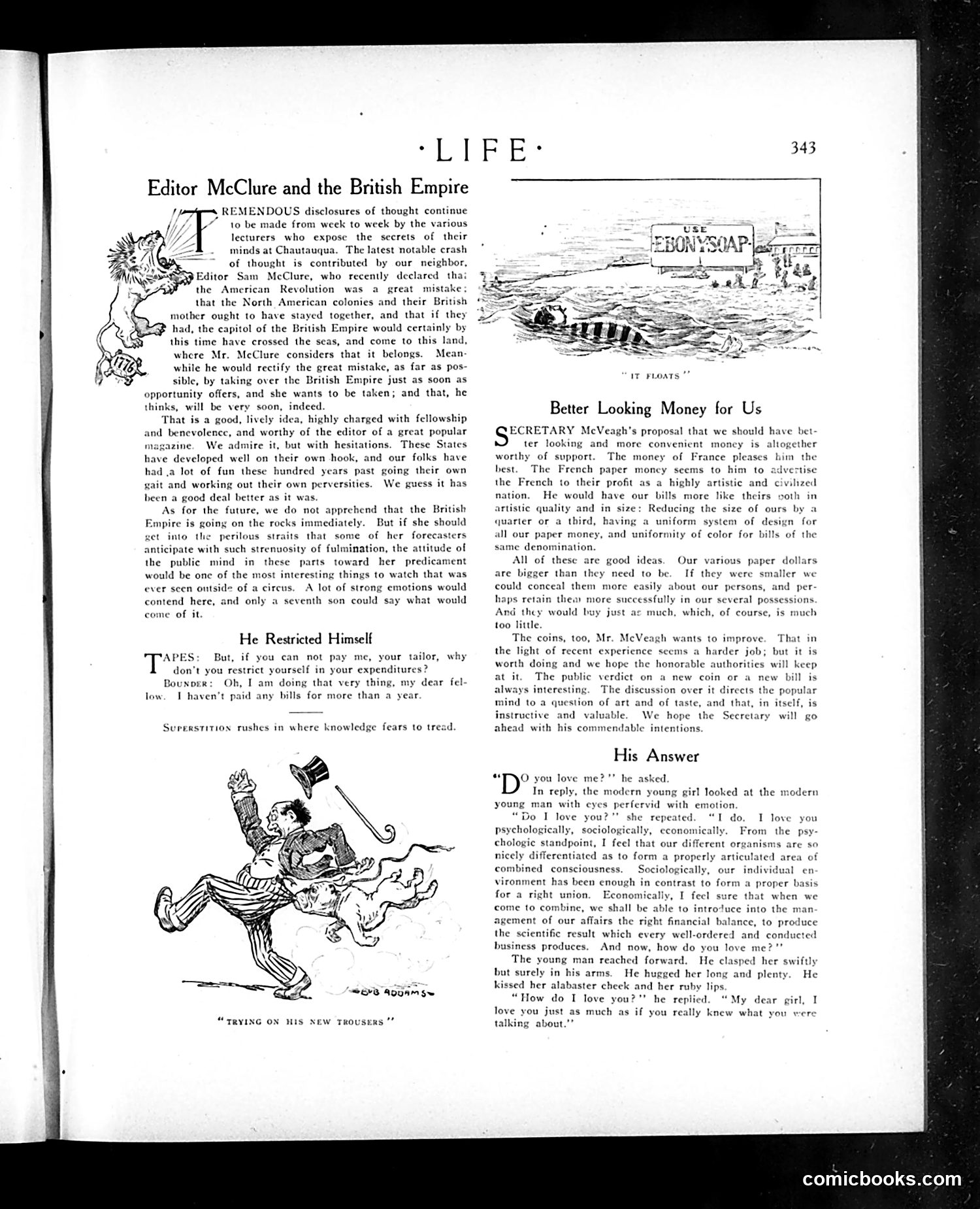
**Top Section:** "Editor McClure and the British Empire" discusses Editor S.S. McClure's controversial claim that the American Revolution was a mistake and that the colonies should have remained British. The text sarcastically suggests McClure wants to "rectify" this error by returning America to British control—a jab at what the author considers absurd Anglophilia. **Bottom Cartoon:** "Trying on His New Trousers" depicts a man struggling comically with oversized pants, likely satirizing someone (possibly McClure or a related political figure) attempting to assume an inappropriate role or adopt foreign customs awkwardly. **Right Section:** "Better Looking Money for Us" and "His Answer" discuss currency reform proposals by Secretary McVeagh, debating artistic improvements to American bills and coins versus practical concerns—relatively apolitical content contrasting with the editorial satire above.
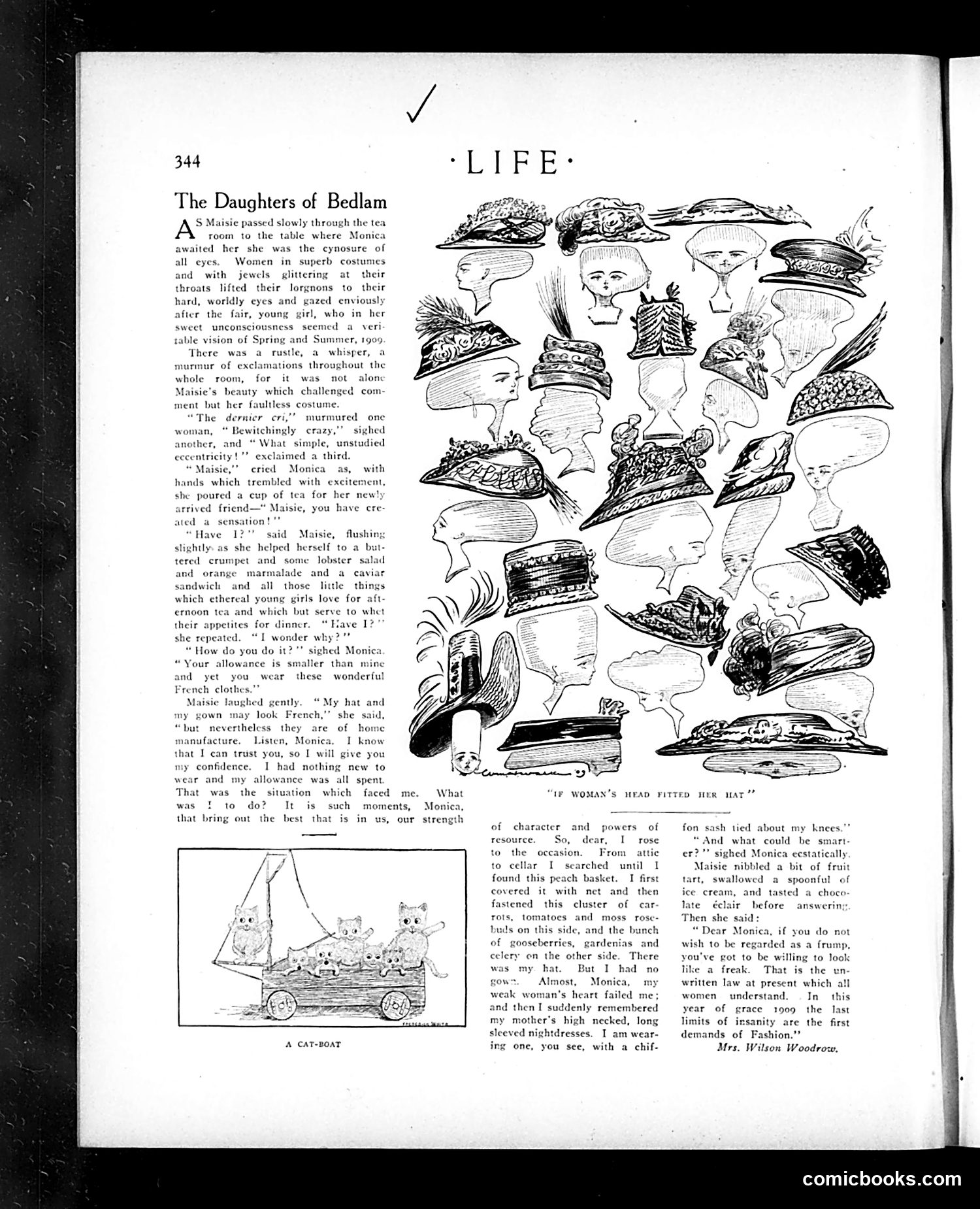
This page contains a satirical story about women's fashionable hats, illustrated with a humorous drawing of exaggerated women's heads wearing elaborate, stacked millinery creations. **The Satire:** The piece mocks the extravagance and absurdity of early 1900s women's fashion, particularly oversized decorated hats laden with feathers, fruit, vegetables, and ornamental materials. The title references "Bedlam" (a famous asylum), suggesting such fashion choices reflect madness. **The Joke:** The story follows women at a tea where Maisie's hat creation—containing lobster salad, caviar, and other delicacies—causes scandal. The accompanying illustration shows heads progressively burdened with ridiculous hat constructions, emphasizing the physical strain and social competition driving these fashion choices. **Context:** This reflects genuine turn-of-century concern about impractical, dangerous women's fashions and the conspicuous consumption they represented.
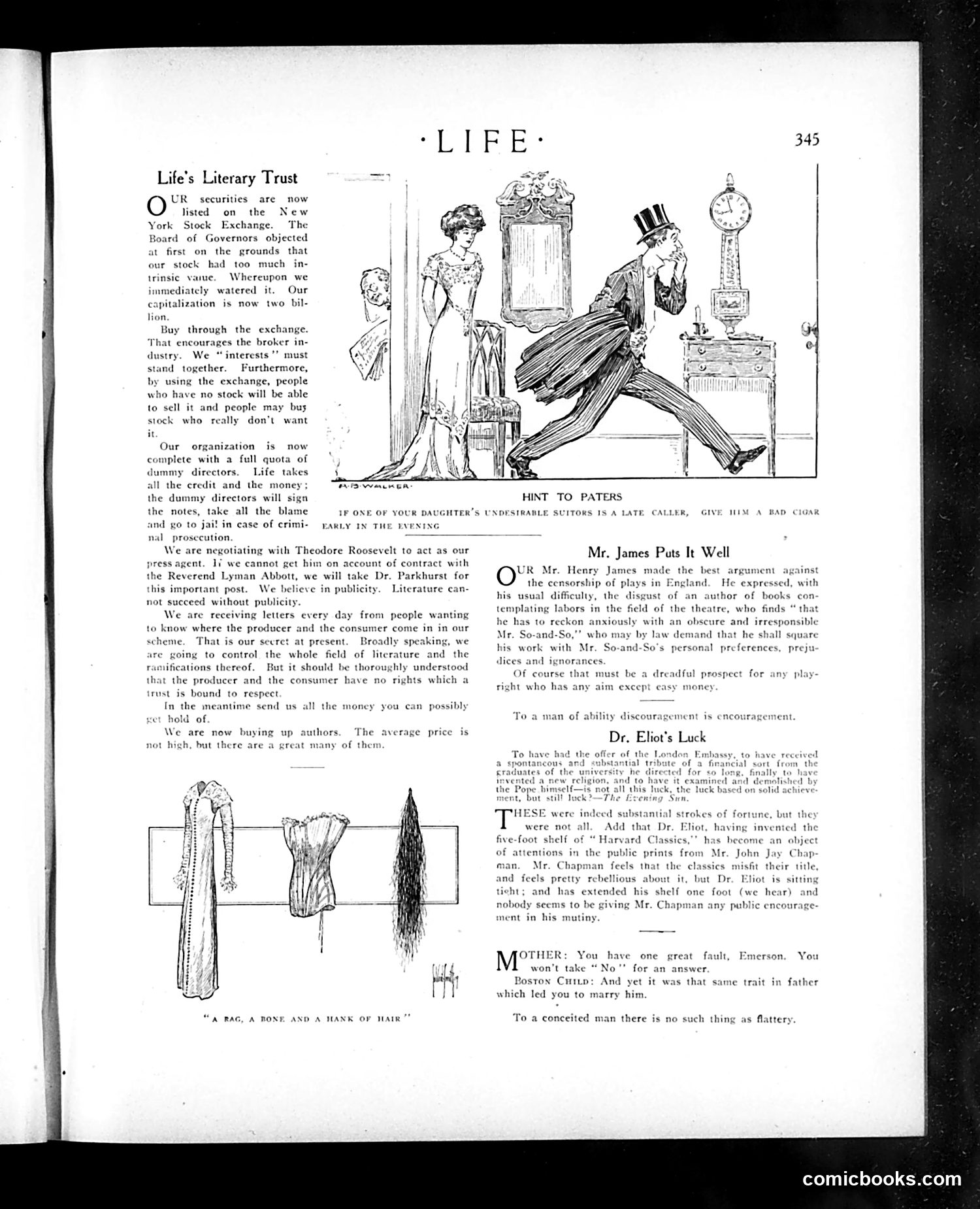
This page contains three distinct sections: **"Life's Literary Trust"** (left column): An editorial discussing Life magazine's new listing on the New York Stock Exchange. It addresses concerns about editorial independence, arguing that public ownership won't compromise their literary judgment. **"Hint to Paters"** (top right): A cartoon satirizing late-night callers visiting a young woman. The wealthy gentleman depicted appears to be a social climber or unsuitable suitor—the humor derives from the father's disapproval of unwanted evening visitors courting his daughter. **"A Rag, a Rose and a Hank of Hair"** (bottom): Illustration of three items, likely representing fashion or domestic life. The remaining articles discuss theater censorship and Dr. Eliot's academic achievements, typical early-20th-century Life content blending social commentary with humor.
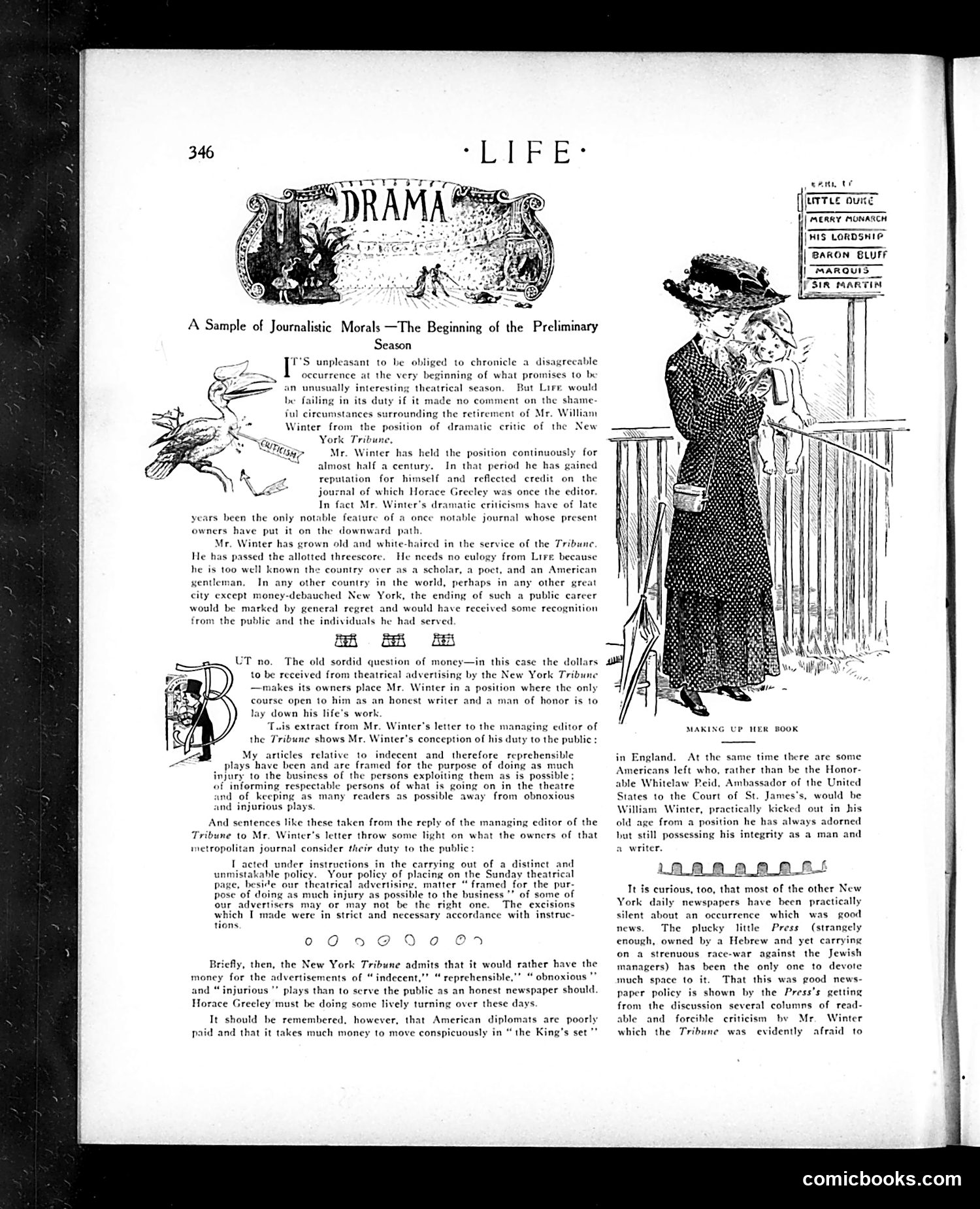
This page satirizes the New York *Tribune*'s decision to force out veteran drama critic William Winter (who served nearly 50 years) to appease theatrical advertisers. Winter had written scathing reviews of "indecent" plays, damaging those producers' business. The *Tribune's* management chose advertising revenue over editorial integrity, instructing editors to soften criticism of paying advertisers. Life argues this shameful treatment of an elderly, respected scholar—who sacrificed his career to moral principle—reflects the corruption of once-noble journalism. The sidebar cartoon mocks society's misplaced values: Americans would rather become wealthy but morally compromised diplomats like Whitelaw Reid (U.S. Ambassador to Britain) than principled writers like Winter. The satire targets both corporate greed and America's reverence for money over honor and public service.
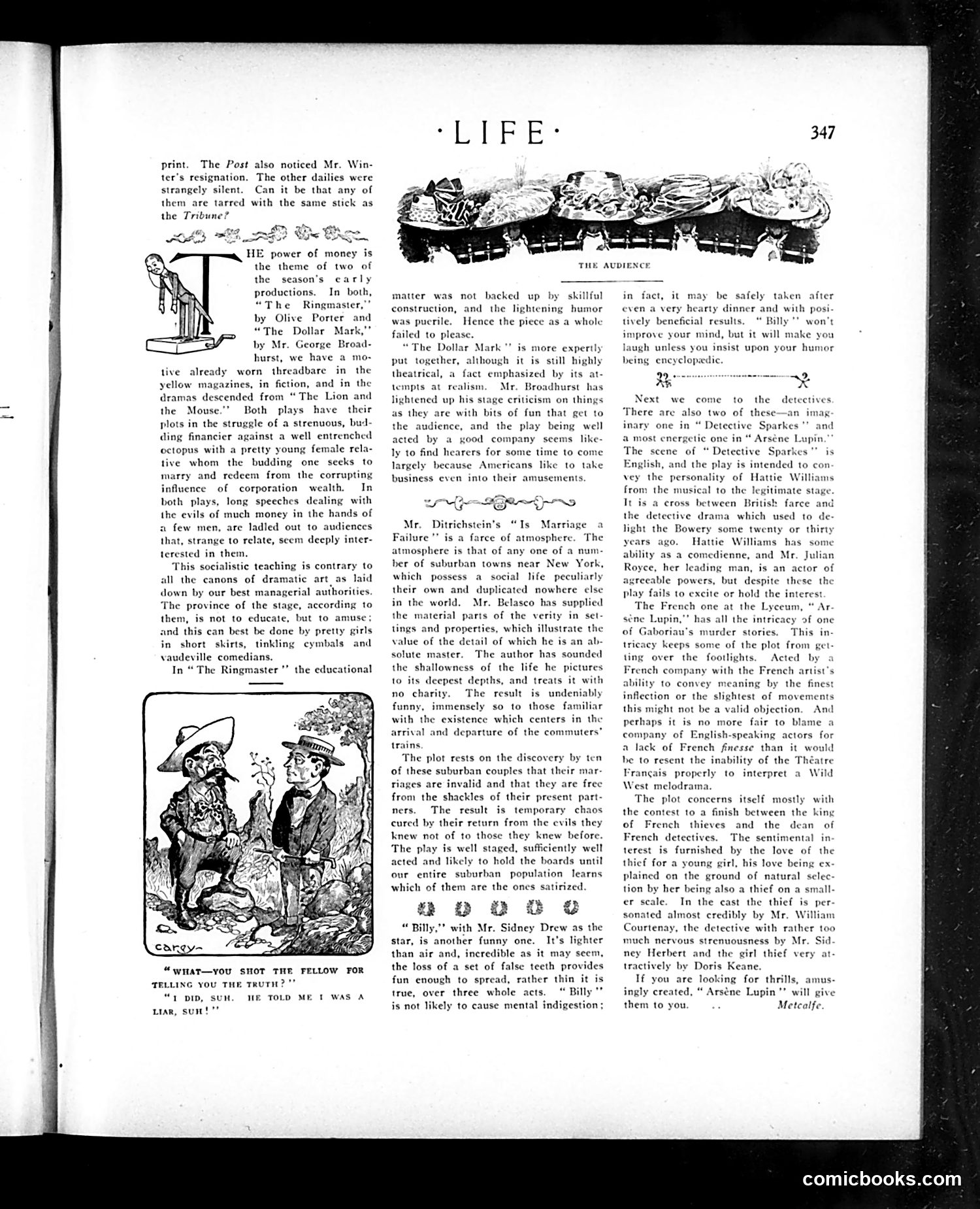
This page reviews Broadway theatrical productions, focusing on plays about wealth and financial power—"The Ringmaster," "The Dollar Mark," and "Is Marriage a Failure?" **The Main Cartoon** (lower left) depicts a confrontation between two men. The caption reads: "What—you shot the fellow for telling you the truth?" / "I did, sir. He told me I was a liar, sir!" The joke satirizes thin-skinned defensiveness: a man shoots someone not for the insult itself ("liar"), but for being *exposed as one*—suggesting the truth hurts more than the accusation. **The Broader Critique**: The article notes these plays teach "socialistic" lessons about the evils of concentrated wealth, which contradicts theatrical conventions favoring entertainment over education. The reviewer finds the moralizing heavy-handed but notes audiences remain interested in anti-corporate themes—suggesting early 20th-century anxieties about monopolies and financial inequality resonated with theatergoers despite artistic conventions.
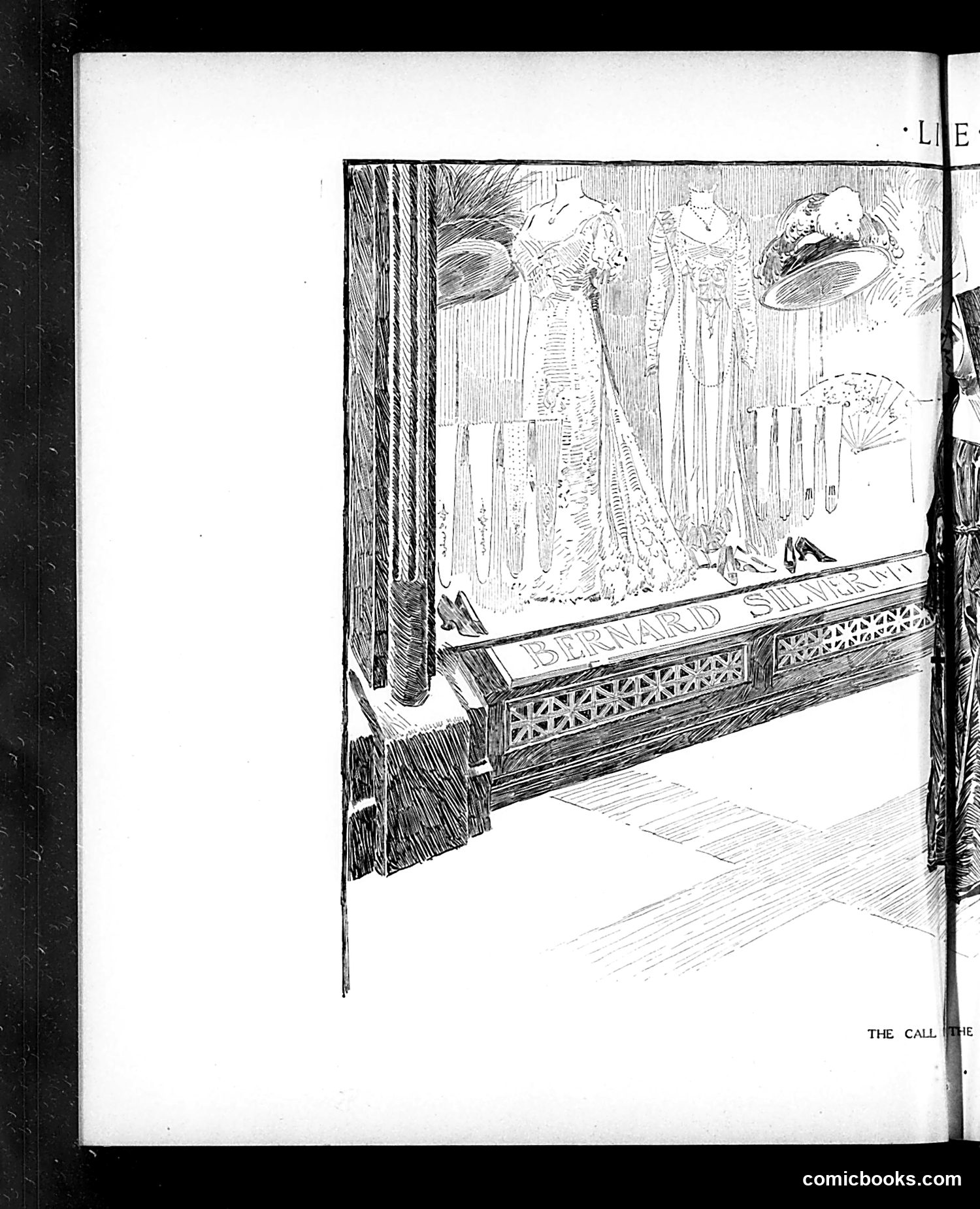
This page appears to be primarily illustrative rather than textual content. The main image is an ink sketch depicting an elegant window display or shop window, likely from a high-end department store or fashion boutique. The window features: - Mannequins displaying fashionable women's clothing and accessories - Elaborate hats and fans displayed above - A decorative border labeled "BERNARD SILVER" (likely the store or designer name) - Fine architectural detailing with geometric patterns The sketch style and composition suggest this is a fashion illustration or advertisement from *Life* magazine. Without clear satirical elements, caricatures, or readable text identifying specific political figures or social commentary, this appears to be a straightforward fashion-related illustration rather than political satire. The quality of the artwork emphasizes the luxury and refinement of the displayed merchandise.
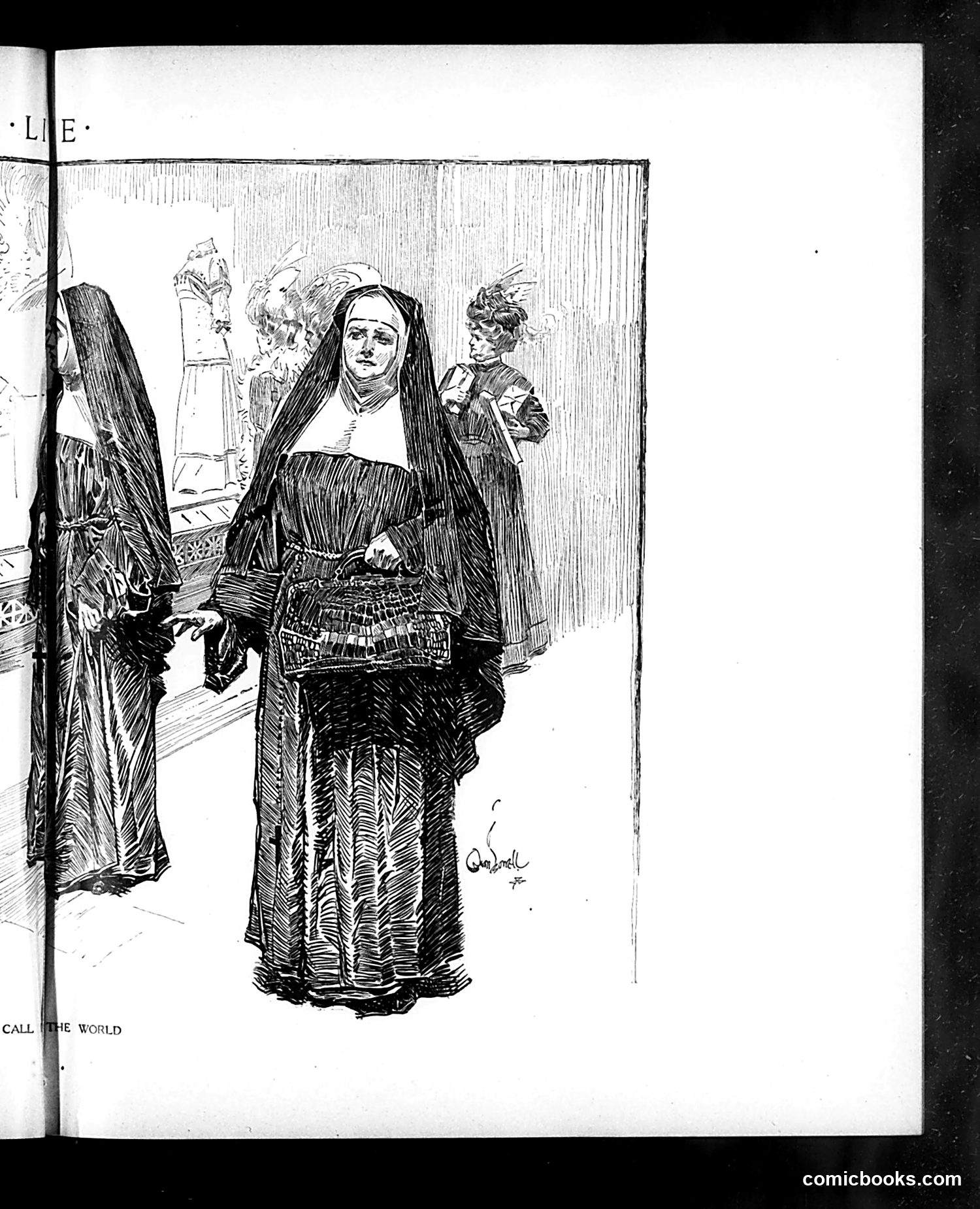
This appears to be a pen-and-ink illustration from *Life* magazine depicting a nun in religious habit standing in what seems to be an interior space. Other figures are visible in the background. The drawing style is detailed cross-hatching characteristic of early 20th-century satirical illustration. However, the OCR text is fragmentary ("E WORLD" / "CALL THE WORLD"), making it difficult to identify the specific cartoon's point or any particular political/social satire. Without the complete caption or article text, I cannot reliably explain what commentary this illustration was making or which specific events or figures it referenced. To properly analyze this cartoon's satirical intent and historical context, the full accompanying text would be necessary.
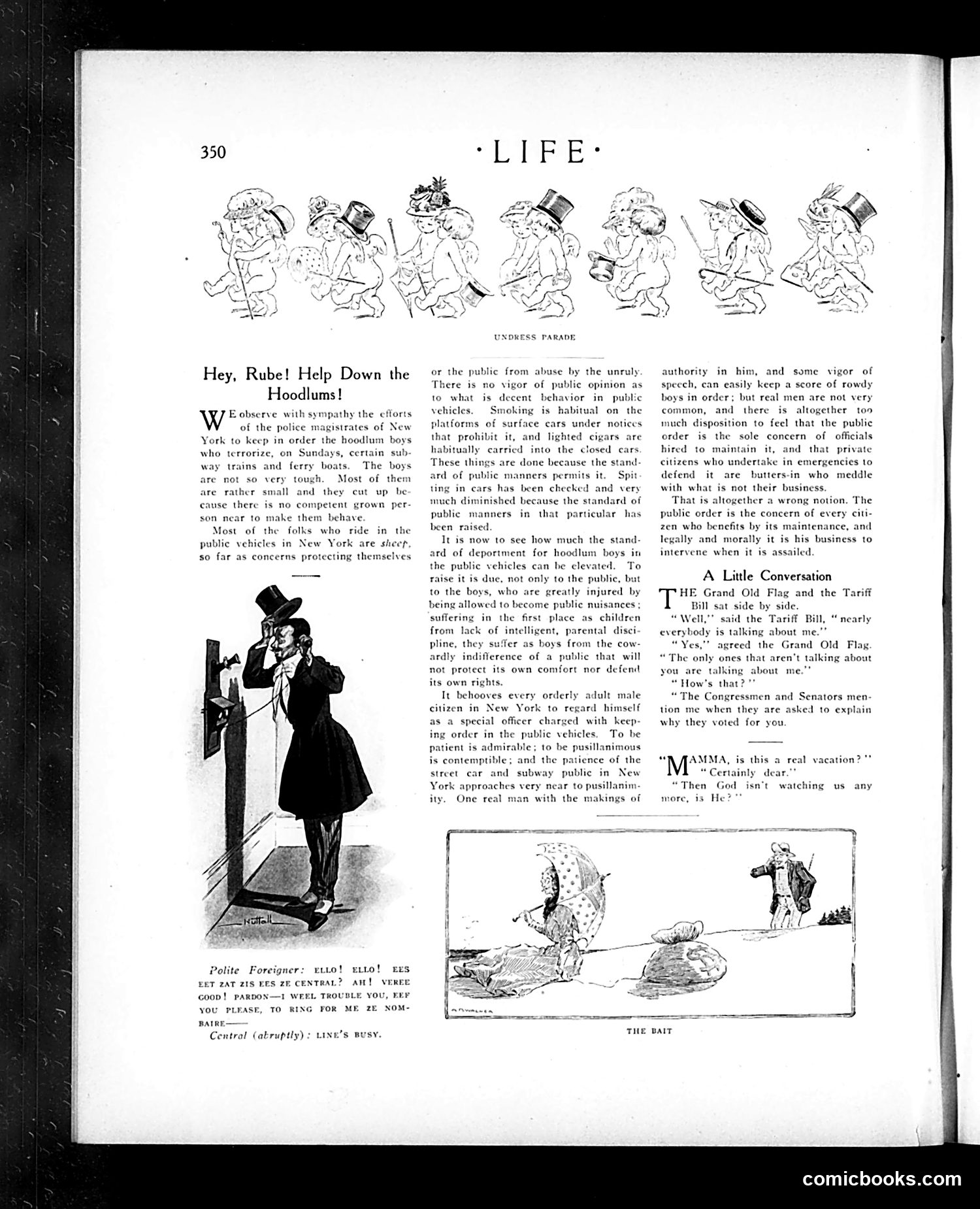
This page contains three distinct satirical pieces addressing public behavior and civics in early 20th-century New York: **"Hey, Rube! Help Down the Hoodlums!"** critiques public apathy toward rowdy youth terrorizing Sunday ferry and train riders. The article argues that ordinary citizens—not just police—bear responsibility for maintaining order, accusing the public of being "sheep" who passively tolerate misbehavior rather than intervening. **"Petite Foreigner"** cartoon mocks a confused foreign visitor unable to reach the telephone operator at "Central," satirizing New York's reputation for inefficiency and rudeness. **"A Little Conversation"** depicts the Grand Old Flag (representing America) and the Tariff Bill as characters complaining that only politicians discuss them when defending their votes—a jab at politicians using nationalist rhetoric and trade policy as convenient talking points without genuine engagement. The decorative header shows an "Undress Parade" of figures in various states of disarray, likely commenting on social disorder or impropriety generally.
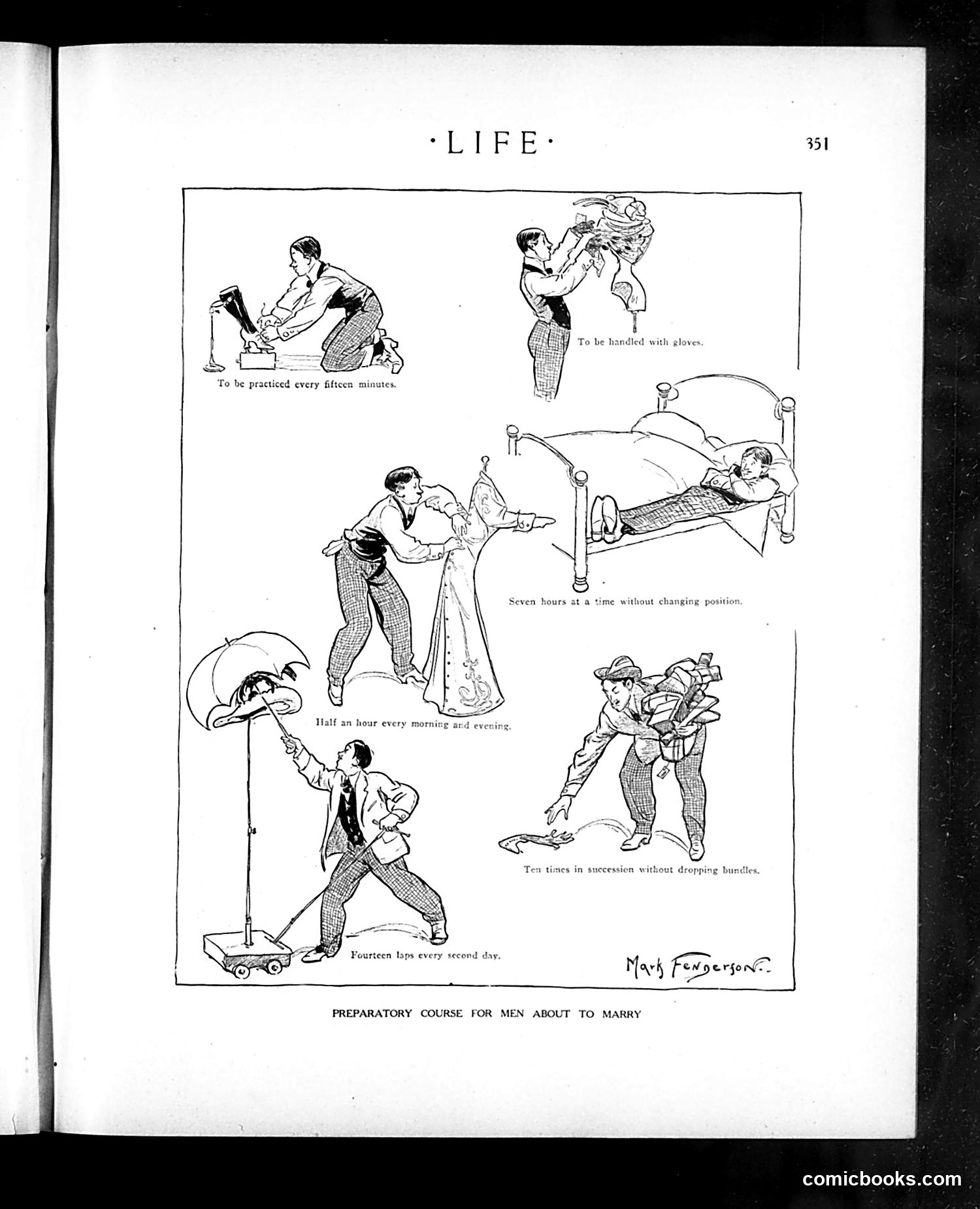
This satirical comic by Mark Fenderson presents humorous "training exercises" for unmarried men, humorously suggesting marriage requires physical conditioning. The panels depict: - **Diaper handling** (with gloves, implying unpleasantness) - **Holding an infant** aloft - **Lying in bed motionless** for seven hours - **Standing under an umbrella** during morning and evening—likely representing wives' complaints or nagging - **Umbrella practice** with increasing weight - **Repeatedly catching falling bundles** without dropping them The joke satirizes marriage as physically demanding and exhausting work, not romantic partnership. It reflects early 20th-century attitudes portraying domestic life—childcare, sleep deprivation, and wives' constant demands—as burdensome trials requiring athletic preparation. The tone is cynically humorous about matrimony's practical realities versus romantic expectations.
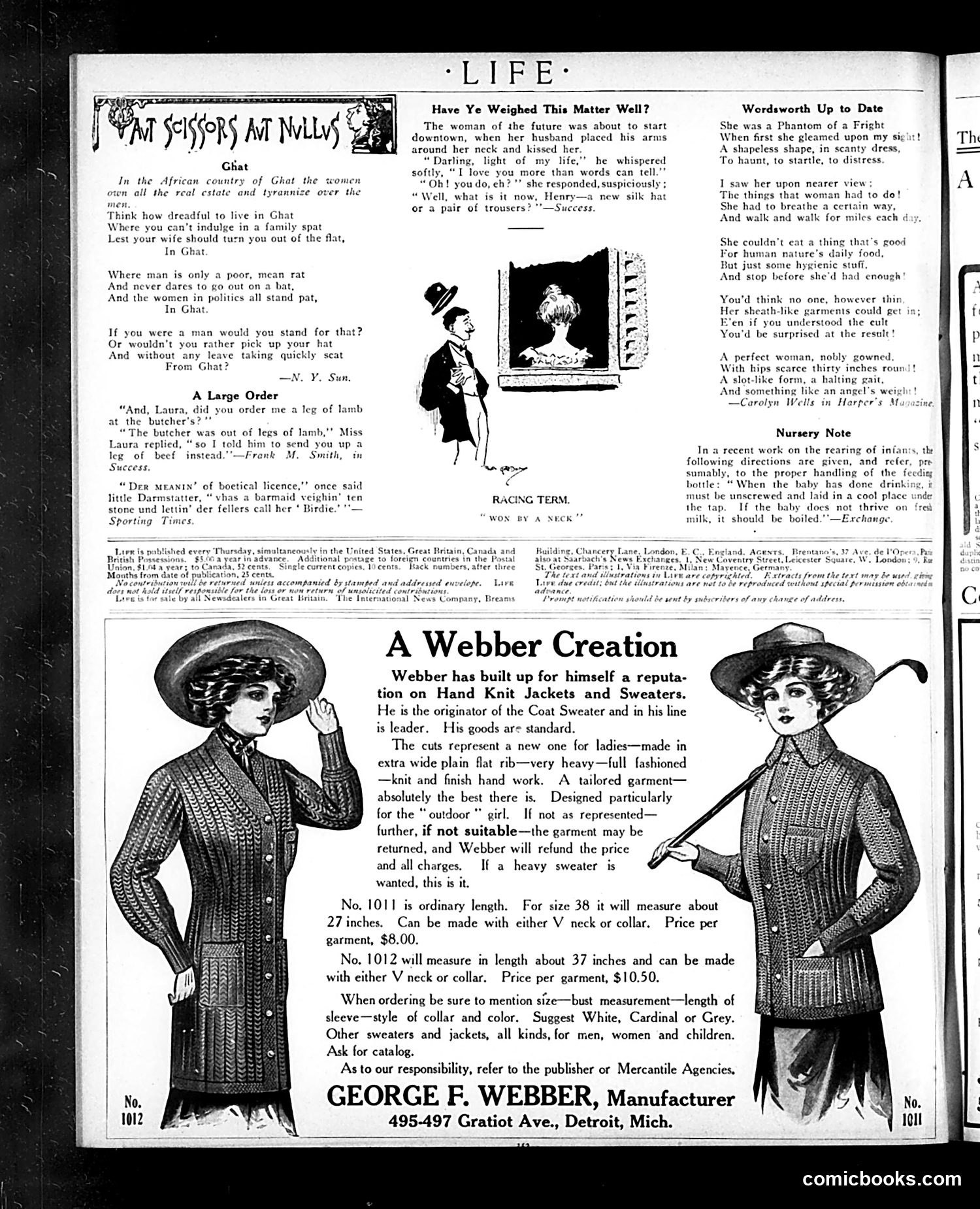
This page contains several satirical pieces mocking early 20th-century gender relations and fashion: **"Ghat" poems**: Satirize an imaginary African country where wives control husbands—inverting contemporary gender hierarchies to mock women's limited freedoms in actual Western society. **"Wordsworth Up to Date"**: A parody mocking the "New Woman"—likely referencing corsets, restrictive clothing, and beauty standards that confined women's bodies and movement. The poem criticizes the physical toll of fashionable femininity. **Small jokes**: Include puns on marriage, shopping incompetence, and child-rearing—typical period humor targeting domestic life. **"A Webber Creation"**: The majority is advertising for women's hand-knit sweaters—notably marketed as practical wear for the "outdoor girl," reflecting emerging athleticism and less restrictive fashion for women. The page juxtaposes satirical critiques of women's restrictions with advertisements for more functional clothing, capturing the cultural tension between Victorian constraints and emerging modern femininity.
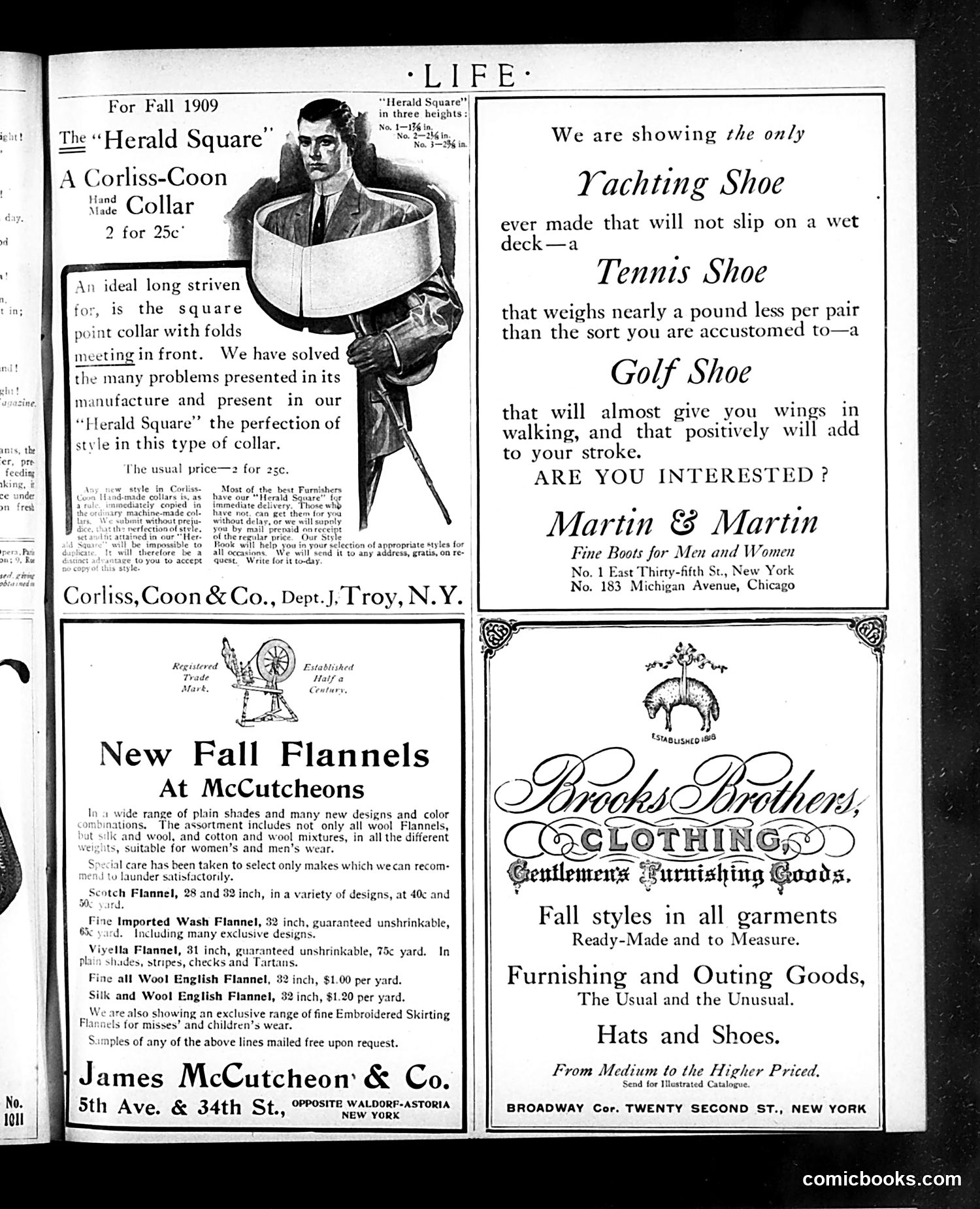
This page is primarily **advertising**, not political satire. It contains four commercial advertisements typical of the era: 1. **Corliss-Coon Collar** — A men's shirt collar marketed as the ideal "Herald Square" style, solving manufacturing problems. The small illustration shows a man modeling the collar. 2. **Martin & Martin Shoes** — Premium footwear claiming superiority in specialized sports (yachting, tennis, golf), emphasizing lighter weight and performance benefits. 3. **McCutcheon Flannels** — A textile merchant advertising fall fabrics in various materials and prices, targeting both men and women. 4. **Brooks Brothers** — High-end clothing retailer offering ready-made and custom garments, furnishings, hats, and shoes at varied price points. The page reflects early 1900s consumer culture, targeting affluent urban audiences in New York. There is no evident political commentary or satire—it's a straightforward commercial section of *Life* magazine designed to generate revenue through advertising.
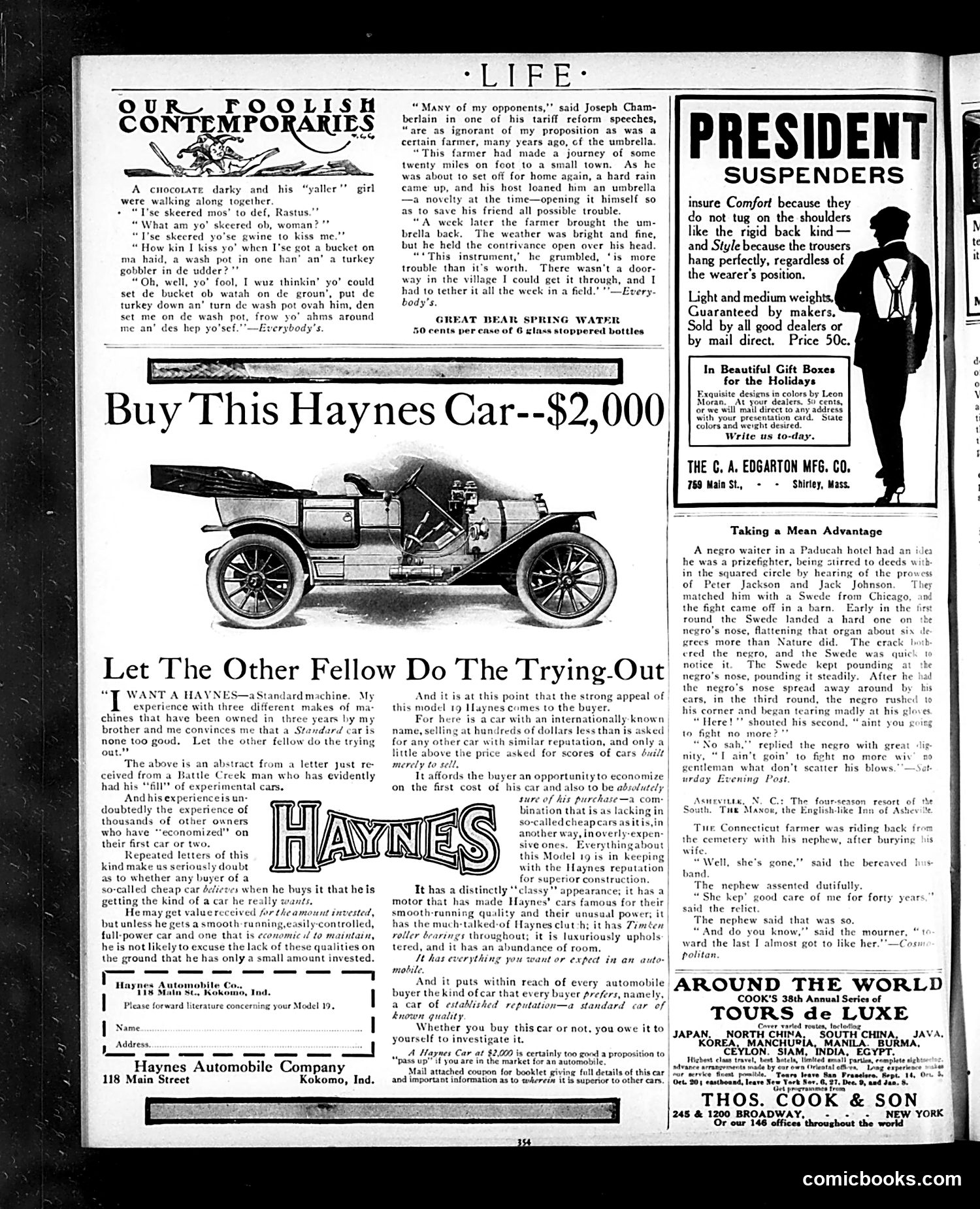
This page is primarily **advertising and humor content**, not political satire in the modern sense. **The cartoons/humor pieces:** 1. **"Our Foolish Contemporaries"** - A racist dialect joke about a Black couple (using period slurs and stereotypical speech patterns) where the woman suggests creative positions for kissing while holding objects. This reflects the deeply offensive racial humor common in early 1900s American magazines. 2. **"Taking a Mean Advantage"** - Another racist anecdote about a Black waiter who fancies himself a boxer and is tricked into fighting a Swedish opponent, presented as humorous. These pieces exemplify the casual, dehumanizing racism embedded in mainstream American periodicals of this era. The "humor" relies entirely on ethnic/racial stereotypes. **The advertisements** promote a Haynes automobile ($2,000), President Suspenders (50¢), and Cook & Son travel tours—typical commercial content. **For modern readers:** Understanding this requires recognizing this represents the normalized racism of early 20th-century American culture, which shaped public discourse and reflected deeply entrenched discrimination.
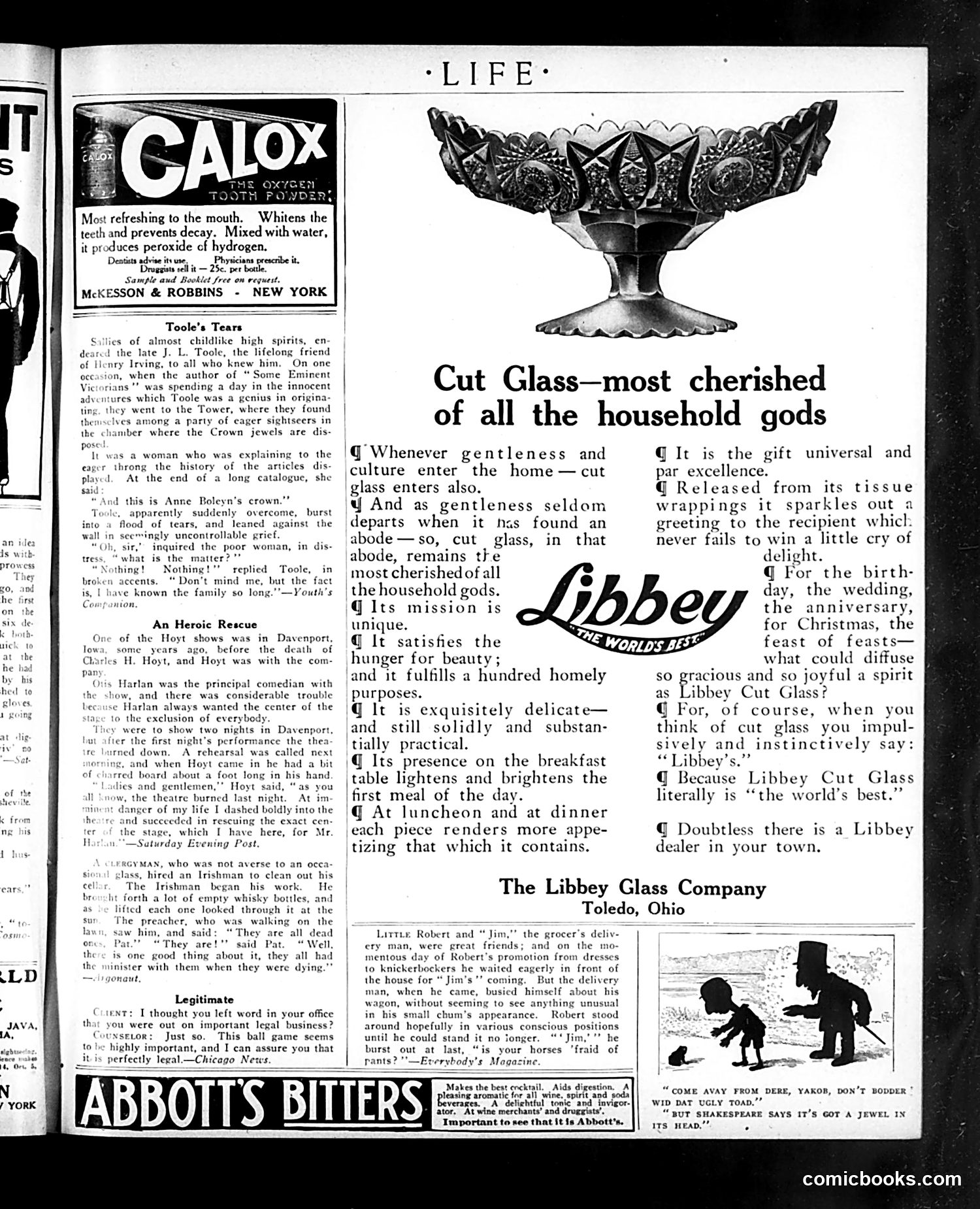
This page is **primarily advertising**, not political satire. It contains: **Main Content:** A full-page ad for Libbey Cut Glass, using flowery language to position cut glass as an essential luxury item for genteel households. The ad emphasizes cut glass as a gift for all occasions (birthdays, weddings, Christmas) and claims it represents sophistication and culture. **Left Column:** Three humorous anecdotes about theatrical figures (J.L. Toole, Charles Hoyt) and a brief joke about a clergyman and Irish laborer—standard early-20th-century humor. **Small Ads:** Include Calox toothpaste and Abbott's Bitters (a patent medicine). **Social Context:** The cut glass ad reflects 1920s consumer culture aspirations, where middle-class Americans were encouraged to buy decorative goods as markers of refinement and good taste. The repeated phrase "household gods" suggests these items were nearly sacred status symbols. There is no political cartoon or satire on this page—it's a straightforward (if ornate) product advertisement mixed with light entertainment content.
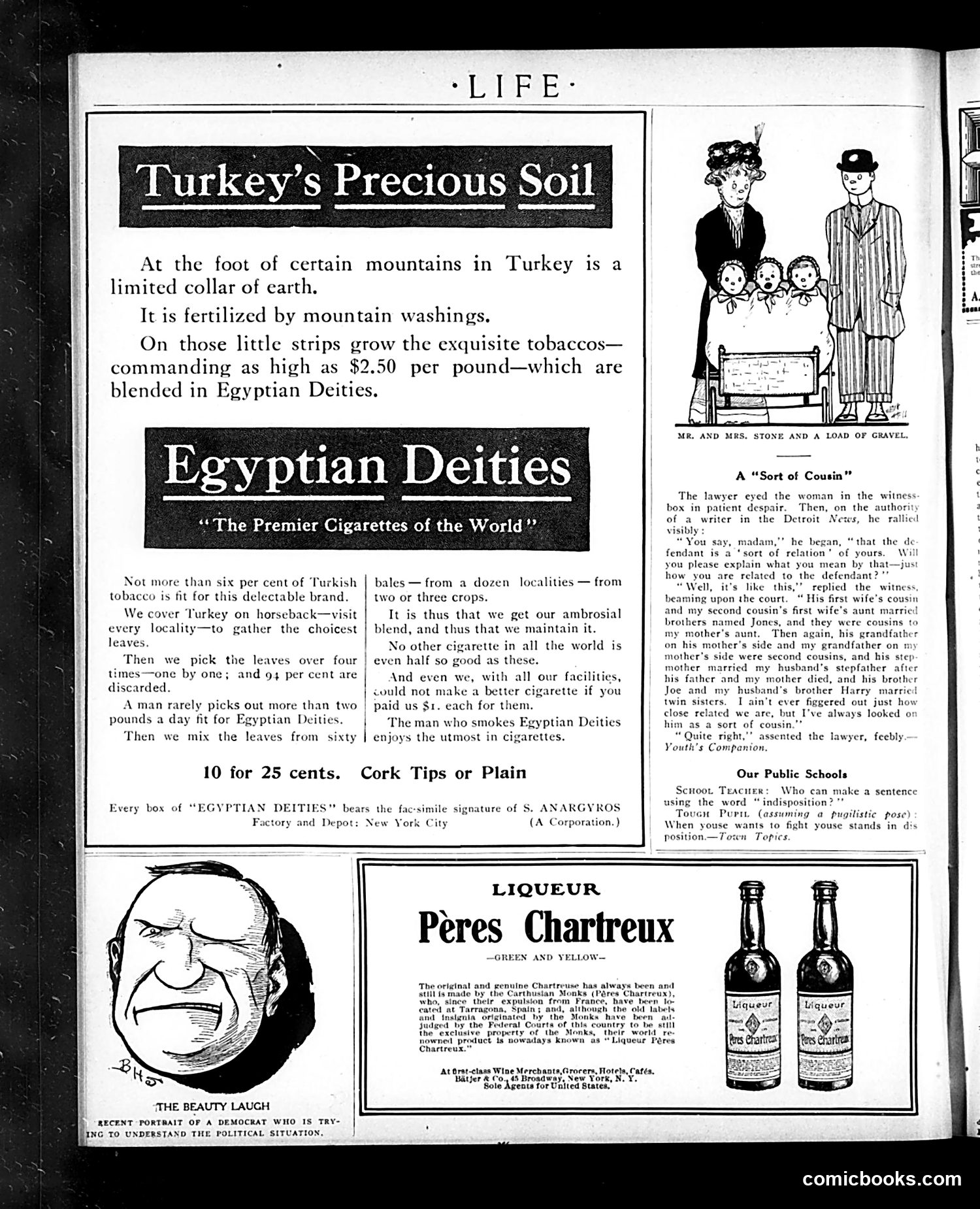
This page primarily features **advertisements** for luxury goods (Egyptian Deities cigarettes, Pérès Chartreux liqueur) alongside three brief humorous pieces. **The cartoons/jokes:** 1. **"A Sort of Cousin"** — A witness testifies about her relation to a defendant by describing an absurdly convoluted family connection (step-relations, cousins-in-law, etc.). The joke satirizes how people stretch definitions of kinship through remarriage and distant connections. 2. **"Our Public Schools"** — A teacher asks a student to use "indisposition" in a sentence; the student (drawn in crude dialect) interprets it as a fighting stance. This mocks either poor education or working-class speech patterns. 3. **"The Beauty Laugh"** — A caricatured face labeled as "a Democrat trying to understand the political situation." This is partisan satire suggesting Democrats were confused about current politics (likely early 20th century, but specific context is unclear). The page is primarily **commercial**, with advertisements occupying roughly half the space.
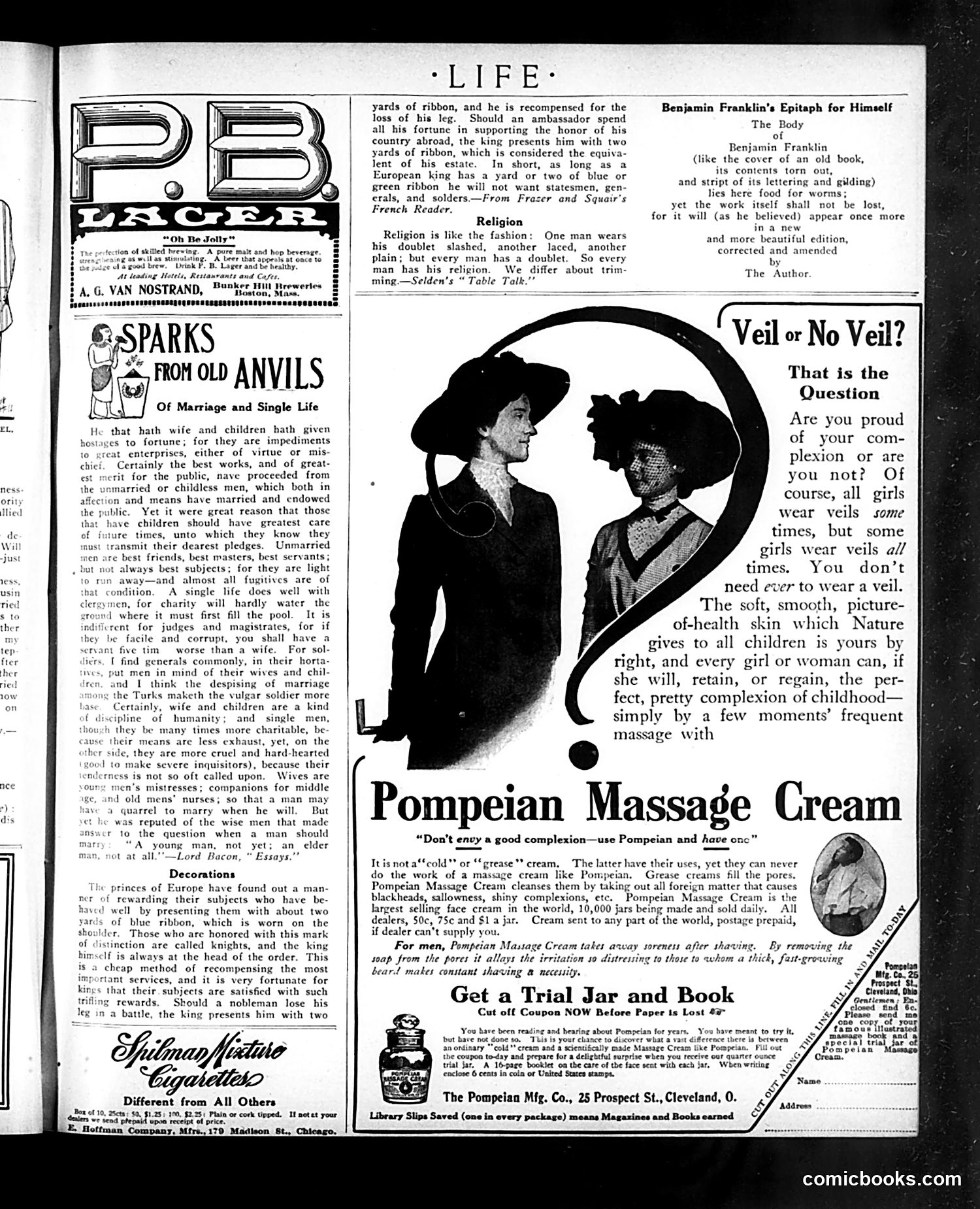
This page contains primarily **advertisements and literary excerpts** rather than political satire. The main content includes: 1. **"Sparks from Old Anvils"** — A philosophical column quoting Francis Bacon's essays on marriage versus single life, discussing whether unmarried men or fathers make better citizens and servants. 2. **Religious and diplomatic quotes** — Including observations on religion as fashion and the absurdity of rewarding ambassadors with mere ribbon rather than actual compensation. 3. **Benjamin Franklin's Epitaph** — A self-written epitaph presenting himself as a worn book awaiting correction and republication. 4. **Pompeian Massage Cream advertisement** — A prominent ad using silhouettes of fashionable women debating whether to wear veils, then pitching the cream as a path to perfect childhood complexion. The page reflects early 20th-century Life magazine's format: mixing literary reprints, social commentary, and beauty product advertising aimed at maintaining feminine appearance standards.
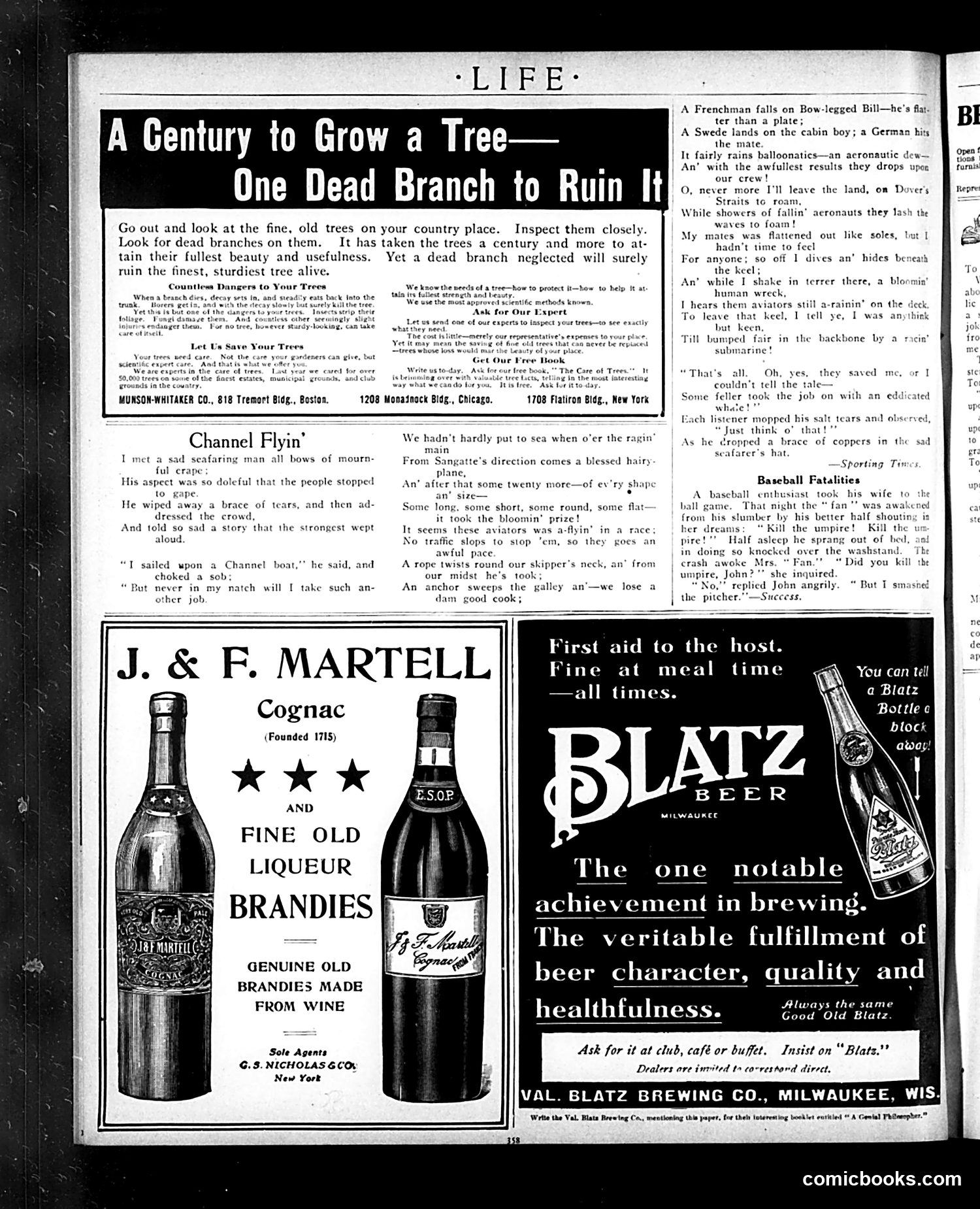
This page contains three unrelated pieces typical of early 20th-century Life magazine: **"A Century to Grow a Tree"** is a practical article advising readers to inspect and remove dead branches from trees, with endorsements from a tree-care company. **"Channel Flyin'"** is a humorous poem-story about a seafarer whose Channel crossing is disrupted by aviators racing overhead. Multiple aircraft crash into his ship, killing crew members in increasingly absurd ways (flattening sailors "like soles," tangling in ropes). The joke plays on the novelty and danger of early aviation—airplanes were new, unregulated, and apparently menacing enough to collision with ships. The sailor's traumatic tale earns sympathetic donations from listeners. **"Baseball Fatalities"** is a brief comic anecdote where a man, half-asleep, misunderstands his wife's question about killing a "fan" at a baseball game and smashes the pitcher instead—a play on words exploiting the double meaning of "fan." The page is otherwise filled with period advertisements for Martell Cognac and Blatz Beer, typical of Life's revenue model.
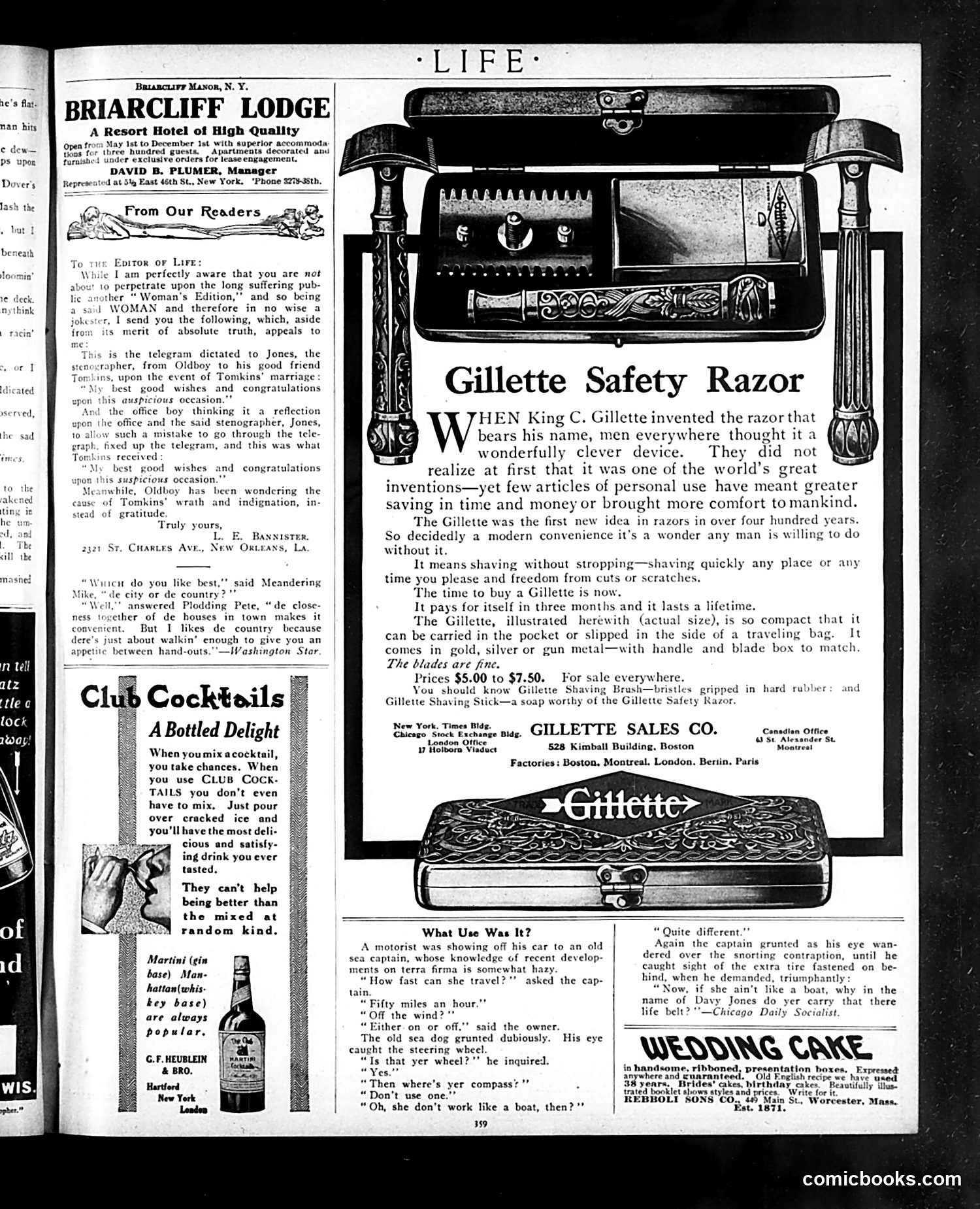
This page is primarily **advertising and reader correspondence**, not political satire. The dominant content is a full-page Gillette Safety Razor advertisement featuring product imagery and marketing copy emphasizing the razor's modernity and convenience—it requires no stropping, works anywhere, and "pays for itself in three months." The page also contains: - **"From Our Readers"**: Humorous anecdotes from readers, including a joke about a stenographer correcting "auspicious" to "suspicious" in a telegram, and dialogue between two working-class characters about city versus country life. - **Club Cocktails advertisement**: Promoting pre-mixed cocktails as superior to homemade versions. - **Briarcliff Lodge advertisement**: A resort hotel announcement. The humor is mild, genteel comedy typical of Life's era—workplace mishaps and working-class dialect humor—rather than political commentary. This appears to be a standard early-20th-century magazine page blending advertising with light entertainment content.
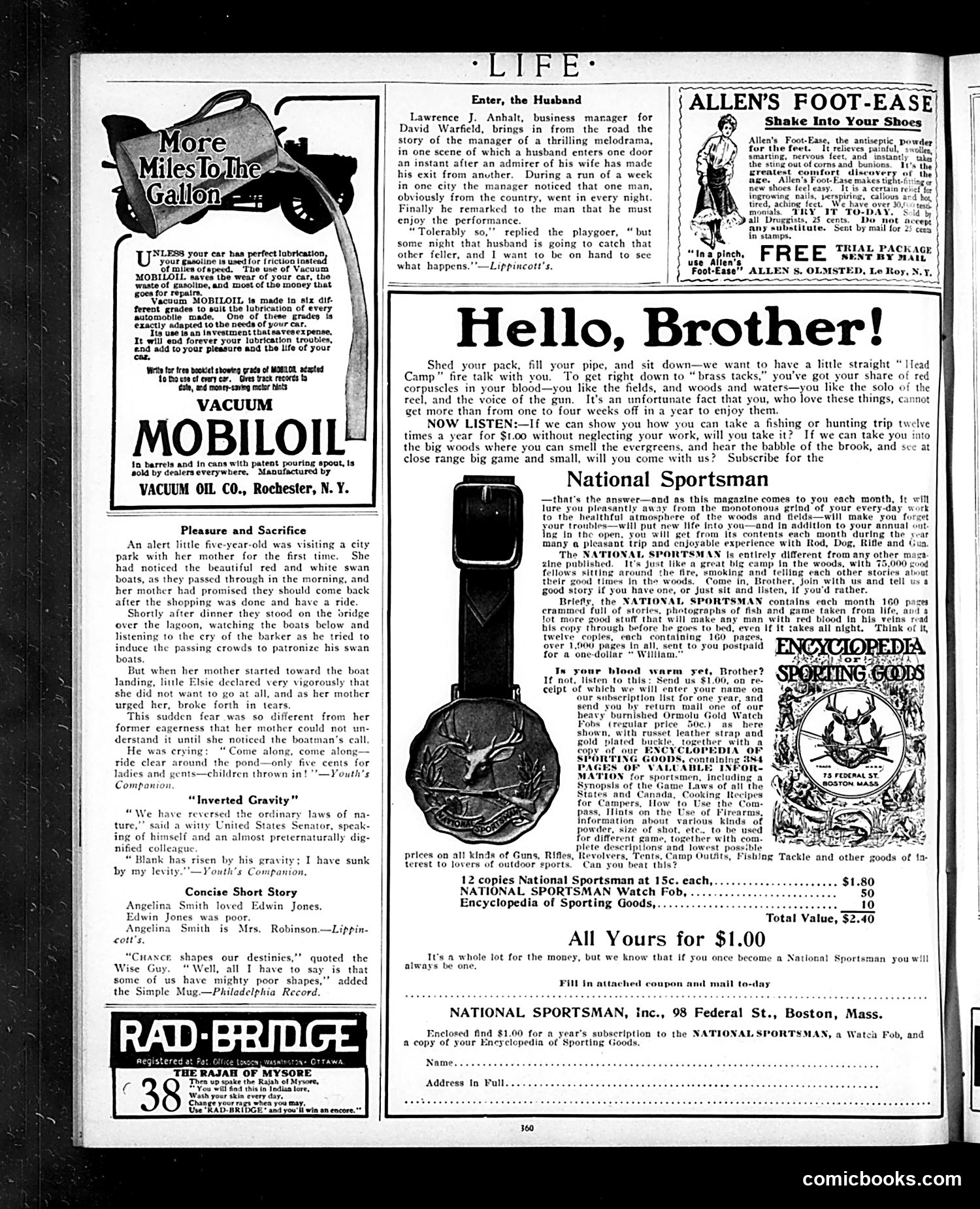
This is primarily an **advertising and humor page** from Life magazine (early 20th century). The content includes: **Main Advertisements:** - Vacuum Mobiloil (car lubricant) — emphasizing fuel efficiency and reduced wear - Allen's Foot-Ease (foot powder) — for comfort and foot ailments - National Sportsman magazine subscription offer - Rad-Bridge film advertisement **Humor Sections:** Short anecdotes and jokes typical of Life's satirical format: - "Pleasure and Sacrifice": A child refuses a swan boat ride after overhearing the barker say "children thrown in!"—she misunderstands the phrase as literal. - "Inverted Gravity": A pun about a senator rising through gravity while another sinks through "levity" (frivolity). - Brief comedic observations about romance, chance, and theater-going. **The "Enter, the Husband" piece** mocks melodramatic theater—a country patron attends nightly, hoping to finally witness the climactic moment when the husband catches his wife's admirer. The page reflects early 20th-century concerns (car maintenance, foot comfort) and entertainment tastes (melodrama, puns, observational humor).
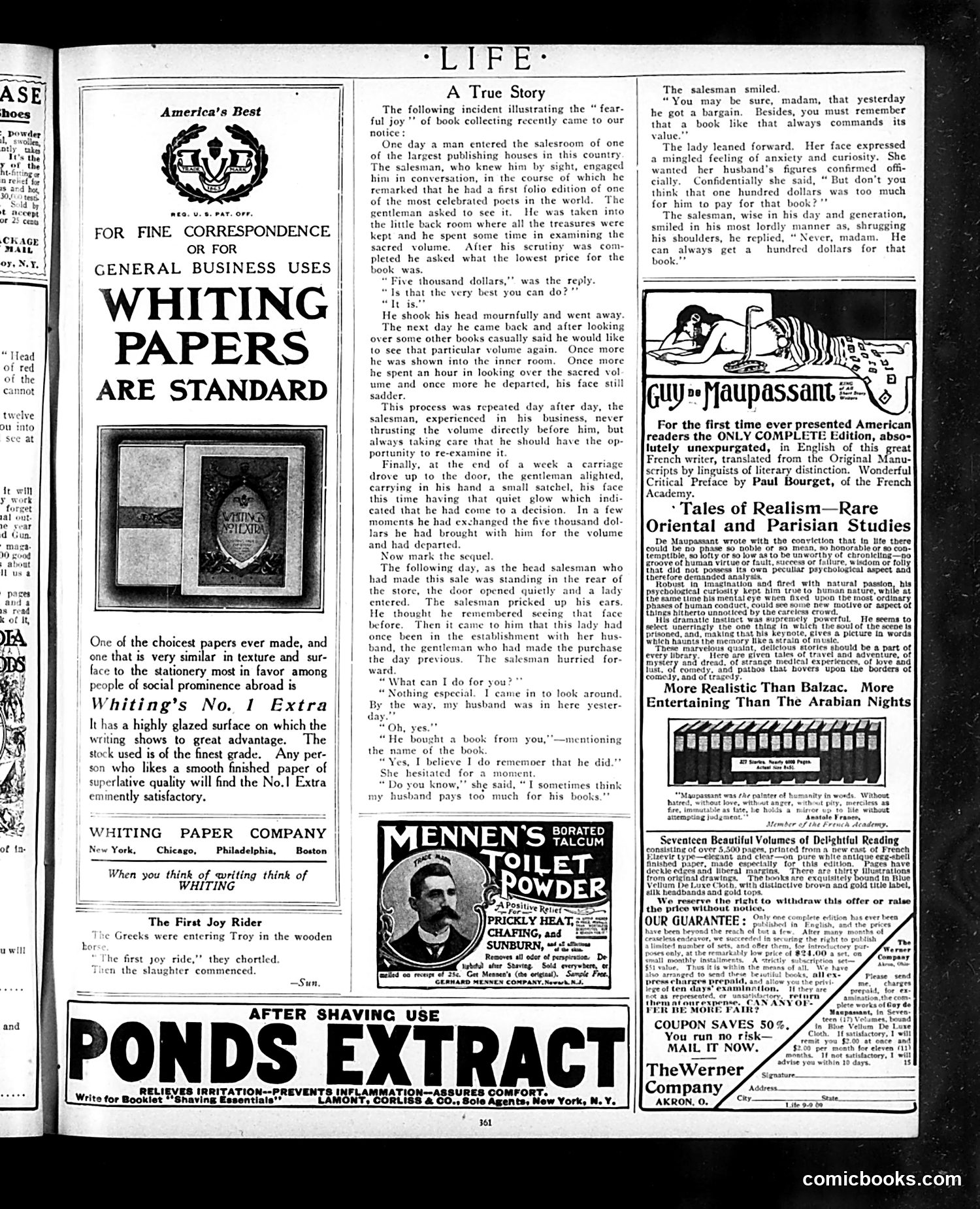
This page is primarily **advertising**, featuring multiple product promotions (Whiting Papers, Mennen's Talcum Powder, Pond's Extract) alongside two short humorous stories. **"The First Joy Rider"** is a brief classical reference joke: Greeks entering Troy in the wooden horse called it "the first joy ride"—dark humor about the subsequent massacre that followed. **"A True Story"** satirizes **book collecting obsession**. A wealthy gentleman becomes irrationally fixated on a rare first edition, repeatedly visiting over a week to examine it at $5,000 (enormous sum for the era). He finally purchases it in an almost fevered state. The punchline: his wife later visits the bookseller, confessing her husband "pays too much for his books." The salesman's defensive response—that rare books "always command their value"—is the joke's target: the gentleman has been manipulated by expert salesmanship into an irrational purchase, and even his spouse recognizes the absurdity. The satire mocks both wealthy collectors' susceptibility to desire and salesmen's psychological manipulation tactics.
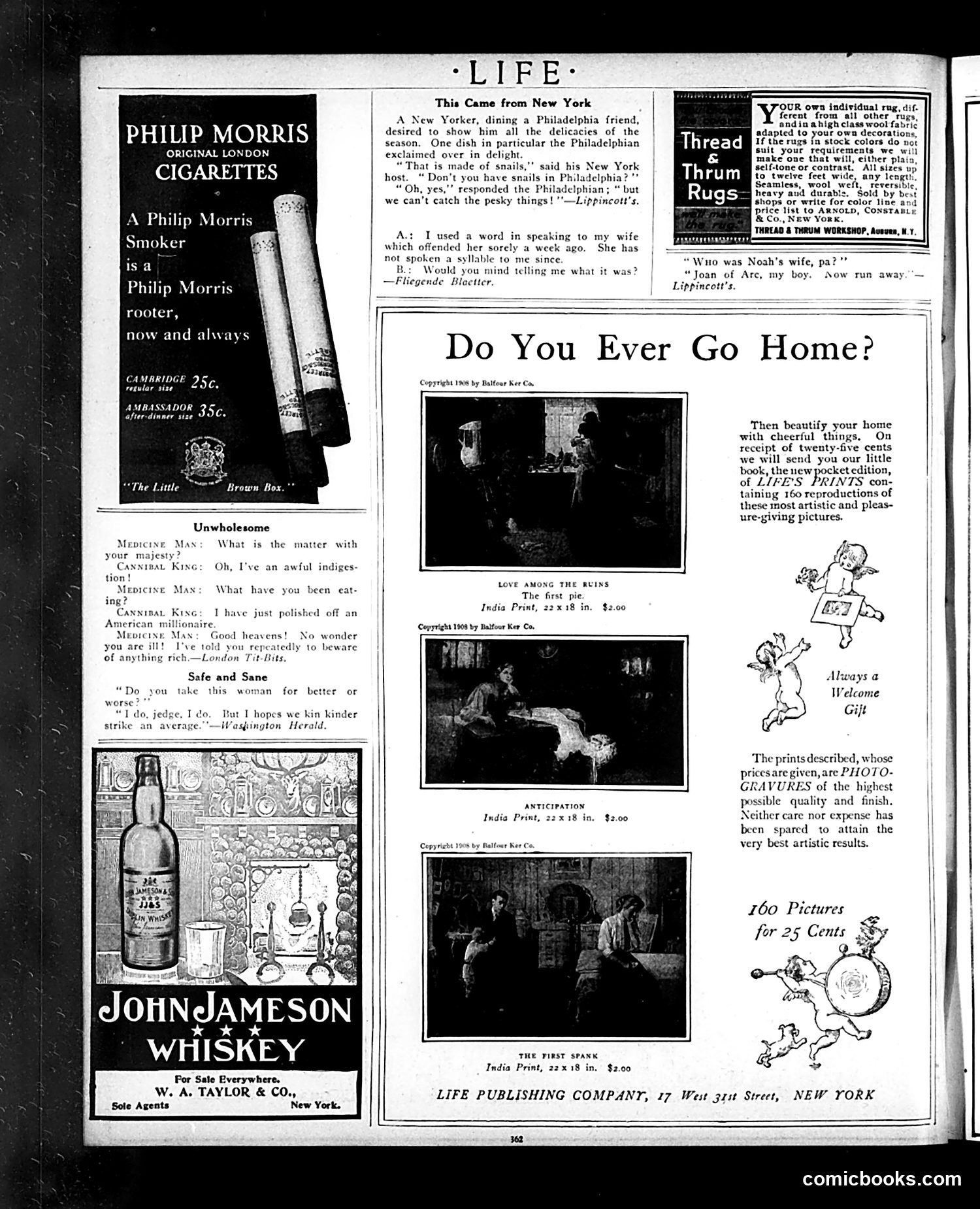
This page is primarily **advertisements and humor columns** rather than political cartoons. The satirical content consists of brief jokes: **"This Came from New York"** jokes about regional differences. A New York host serves snails to a Philadelphia guest, who admits Philadelphians can't catch snails—a light gibe at Philadelphia's less cosmopolitan reputation. **"Unwholesome"** depicts a comic dialogue where a "Medicine Man" treats a "Cannibal King" suffering from indigestion caused by eating an American millionaire. This is racial/ethnic humor typical of 1908, mocking both indigenous peoples and American wealth. **"Safe and Sane"** is a marriage joke about accepting a spouse "for better or worse." The page also advertises **Philip Morris cigarettes, John Jameson whiskey, Thread and Thrum rugs**, and **Life's Prints**—artistic reproductions for home decoration. The humor reflects early 1900s attitudes toward social hierarchy, regional stereotypes, and ethnic caricature now considered offensive.
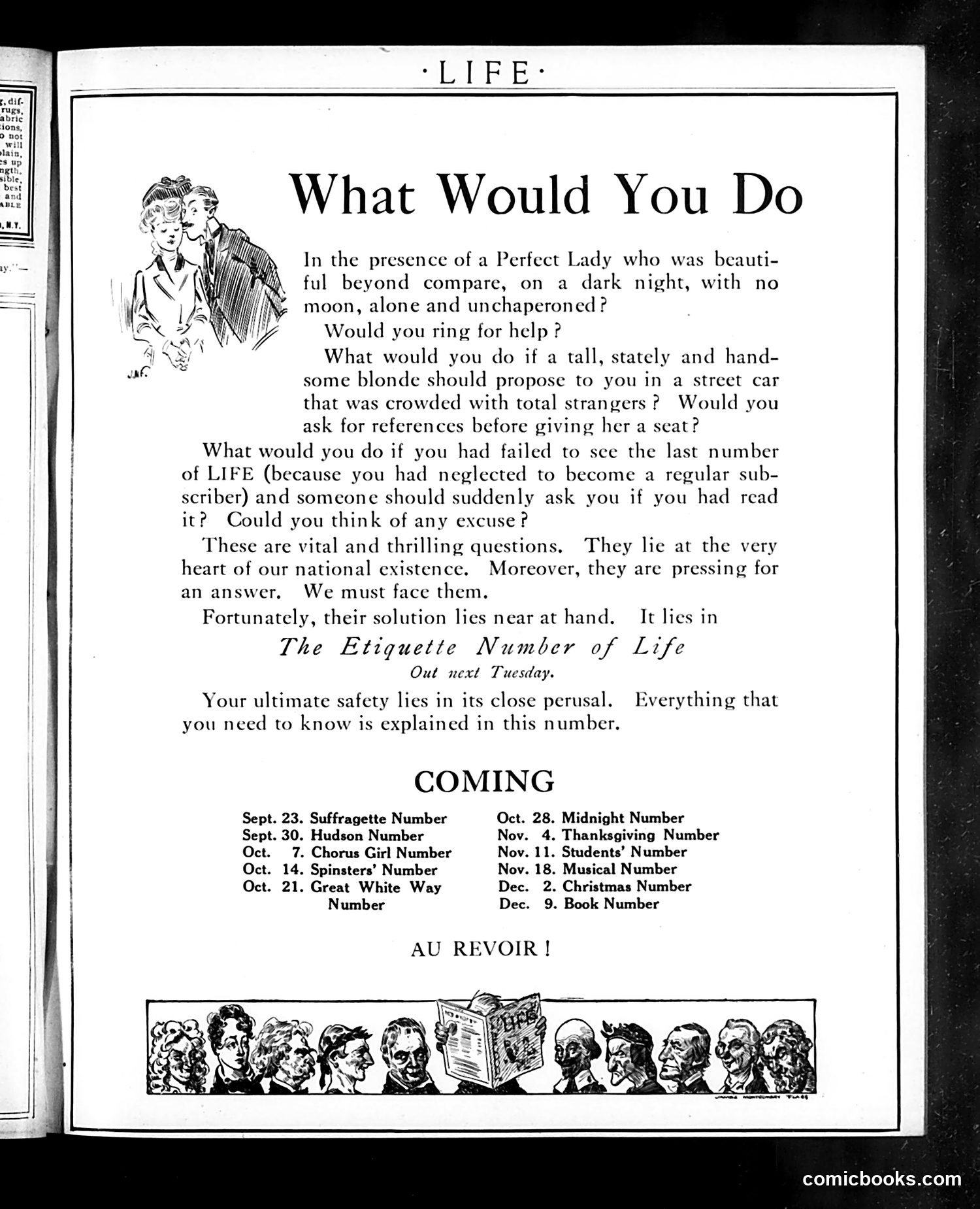
This is a self-promotional advertisement for *Life* magazine's upcoming "Etiquette Number," disguised as satirical social commentary. The page mocks contemporary anxieties about proper behavior through absurdist scenarios: How should a gentleman behave alone with an attractive woman? Should he demand references from a stranger in a streetcar? Most pointedly, it suggests that *not* being a regular subscriber to *Life* is itself a social catastrophe requiring excuse-making. The humor lies in treating etiquette questions with mock-seriousness ("vital and thrilling questions...at the very heart of our national existence"), while ultimately pitching the magazine as the solution to all social uncertainty. The bottom illustration shows diverse male faces reading *Life*, positioning the magazine as essential reading. The list of upcoming themed issues (Suffragette, Chorus Girl, Spinsters, etc.) indicates *Life*'s typical focus on contemporary social topics and gender relations of the early 20th century.
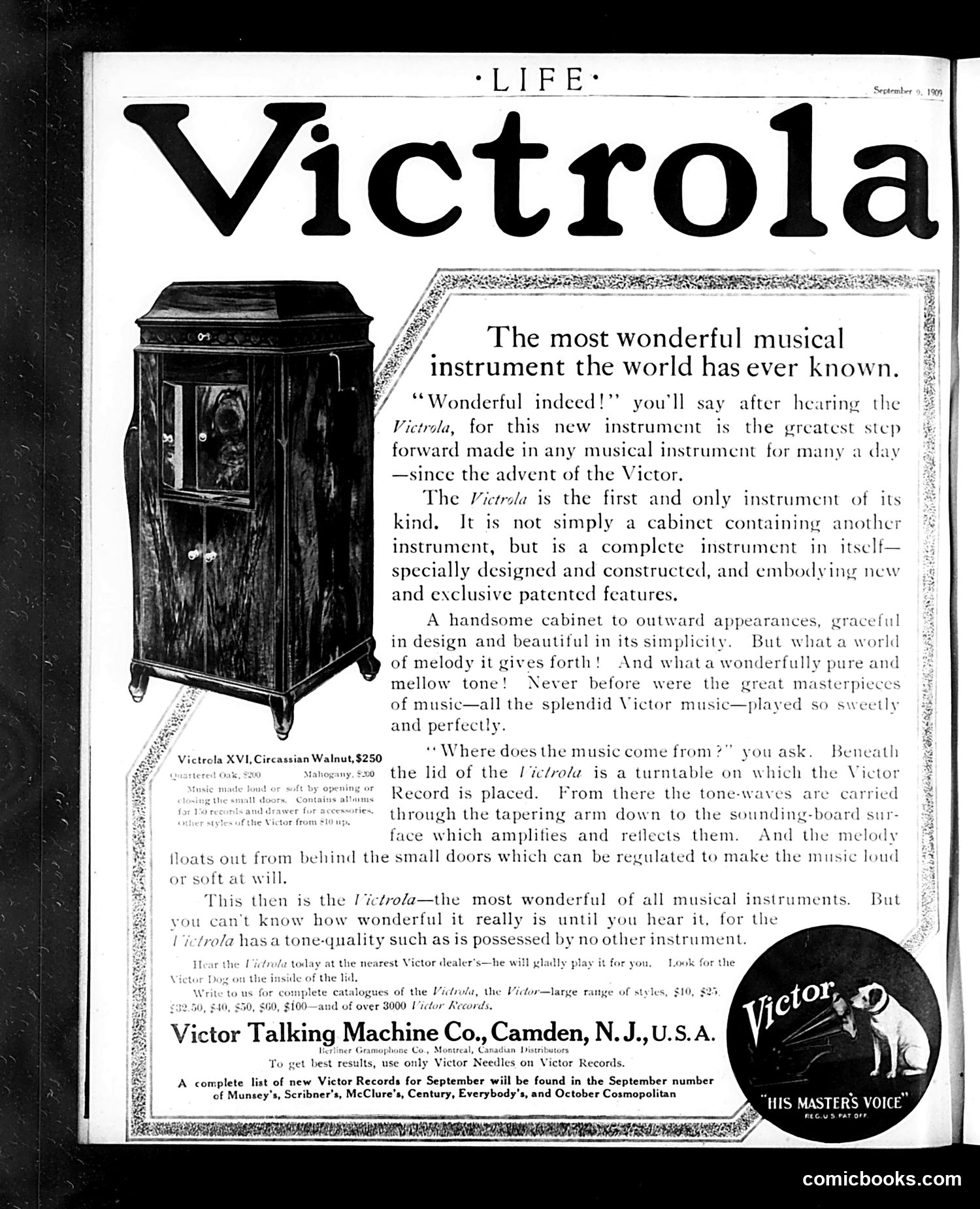
This is primarily a **product advertisement**, not a political cartoon. It promotes the Victrola, a phonograph/record player manufactured by Victor Talking Machine Co. The page announces the Victrola as revolutionary technology—a cabinet-style phonograph that plays Victor Records with claimed superior sound quality. The advertisement emphasizes its innovative design: music is reproduced through a turntable, tonearm, and sounding board that amplifies and projects sound through adjustable doors. The only visual element approaching satire is the famous "His Master's Voice" logo (lower right)—depicting a dog listening to a phonograph—which was Victor's actual trademark and advertising mascot. For modern readers: this represents early 20th-century consumer enthusiasm for emerging audio technology. The breathless marketing language ("most wonderful musical instrument the world has ever known") reflects how transformative recorded music technology was to contemporary audiences. There's no actual satire or political commentary present—it's straightforward vintage advertising.