
Life, 1909-09-09 · page 14 of 32
Life — September 9, 1909 — page 14: what you’re looking at
What you’re looking at
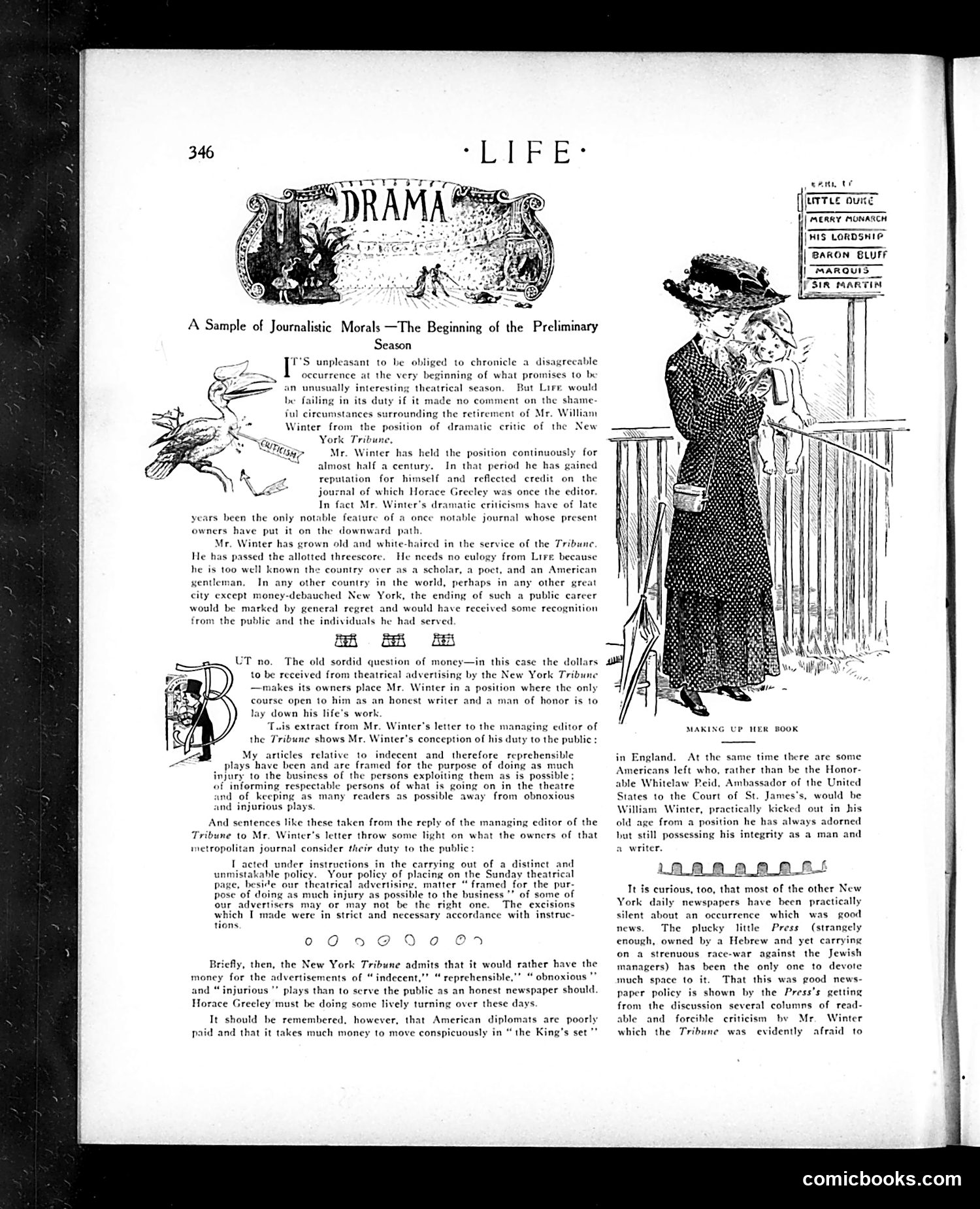
This page satirizes the New York *Tribune*'s decision to force out veteran drama critic William Winter (who served nearly 50 years) to appease theatrical advertisers. Winter had written scathing reviews of "indecent" plays, damaging those producers' business. The *Tribune's* management chose advertising revenue over editorial integrity, instructing editors to soften criticism of paying advertisers. Life argues this shameful treatment of an elderly, respected scholar—who sacrificed his career to moral principle—reflects the corruption of once-noble journalism. The sidebar cartoon mocks society's misplaced values: Americans would rather become wealthy but morally compromised diplomats like Whitelaw Reid (U.S. Ambassador to Britain) than principled writers like Winter. The satire targets both corporate greed and America's reverence for money over honor and public service.
📄 Transcribed text from this page (OCR, searchable)
Machine-transcribed from the original scan — historical spelling and the odd misread are preserved.
A Sample of Journalistic Morals —The Beginning of the Preliminary Season T'S unpleasant to be obliged to chronicle a disagrecable occurrence at the very beginning of what promises to be 1 unusually interesting theatrical season, But Lire. would e failing in its duty if it made no comment on the shame- jul circumstances surrounding the retirement of Mr. William Winter from the position of dramatic critic of the New York Mr. Winter has held the position continuously for almost half a century. In that period he has gained station for himself and reflected credit on the journal of which Horace Grecley was once the editor. In fact Mr. Winter's dramatic criticisms have of late years been the only notable feature of a once notable journal whose present Tribune, owners have put it on the downward path Mr. Winter has grown old and white-haired in the service of the Tribunc. He has passed the allotted threescore. He needs no culogy from Lire because he is 100 well known the country over as a scholar, a poet, and an American gentle In any other country in the world, perhaps in any other great city except money-debauched New York, the ending of such a public carcer would be marked by general regret and would have received some recognition from the public and the individuals he had served Bi GA AA UT no. The old sordid question of money—in this case the dollars to be received from theatrical advertising by the New York Tribune —makes its owners place Mr. Winter in a position where the only course open to him as an honest writer and a man of honor is to lay down his life's Tais extract from Mr. Winter's letter to the ging editor of the Tribune shows Mr. Winter's conception of his duty to the public : My articles relative to indecent and therefore reprehensible plays have been and are framed for the purpose of doing as much injury to the business of the persons exploiting them as is possible; of informing respectable persons of what is going on in the theatre ind of keeping as many readers as possible away from obnoxious and injurious plays. And sentences like these taken from the reply of the managing editor of the Tribune to Mr. Winter's letter throw some light on what the owners of that metropolitan journal consider their duty to the public: I acted under instructions in the carrying out of a distinct and Kk Your policy of placing on the Sunday theatrical unmistakable policy. page, besi¢e our theatrical advertising, matter “ framed for the pur- of some of pose of doing as much injury as possible to the business"? our advertisers may or may not be the right one. The excisions which I made were in strict and necessary accordance with instruc- tions ) O 00900 ole) Briefly, then, the New York Tribune admits that it would rather have the money for the advertisements of “indecent,’’ “ reprehensible,"’ “ obnoxious "" and “injurious "’ plays than to serve the public as an honest newspaper should Horace Greeley must be doing some lively turning over these days. It should be remembered, however, that American diplomats are poorly paid and that it takes much money to move conspicuously in “the King’s set "* | AERRY MONARCH [WIS LoRDSHIe | BARON BLUFF i] MAKING UP HER 800K in England. At the same time there are some Americans left who, rather than be the Honor- able Whitelaw Peid, Ambassador of the United States to the Court of St. James's, would be William Winter, practically kicked out in his old age from a position he has always adorned but still possessing his integrity as a man and a writer. It is curious, too, that most of the other New York daily newspapers have been practically silent about an occurrence which was good The plucky little Press (strangely enough, owned by a Hebrew and yet carrying on a strenuous race-war against the Jewish managers) has been the only one to devote That this was good news- paper policy is shown by the Press’s getting from the discussion several columns of read- able and forcible criticism by Mr. Winter which the Tribune was evidently afraid to news. much space to comicbooks.com