
Life, 1909-09-09 · page 15 of 32
Life — September 9, 1909 — page 15: what you’re looking at
What you’re looking at
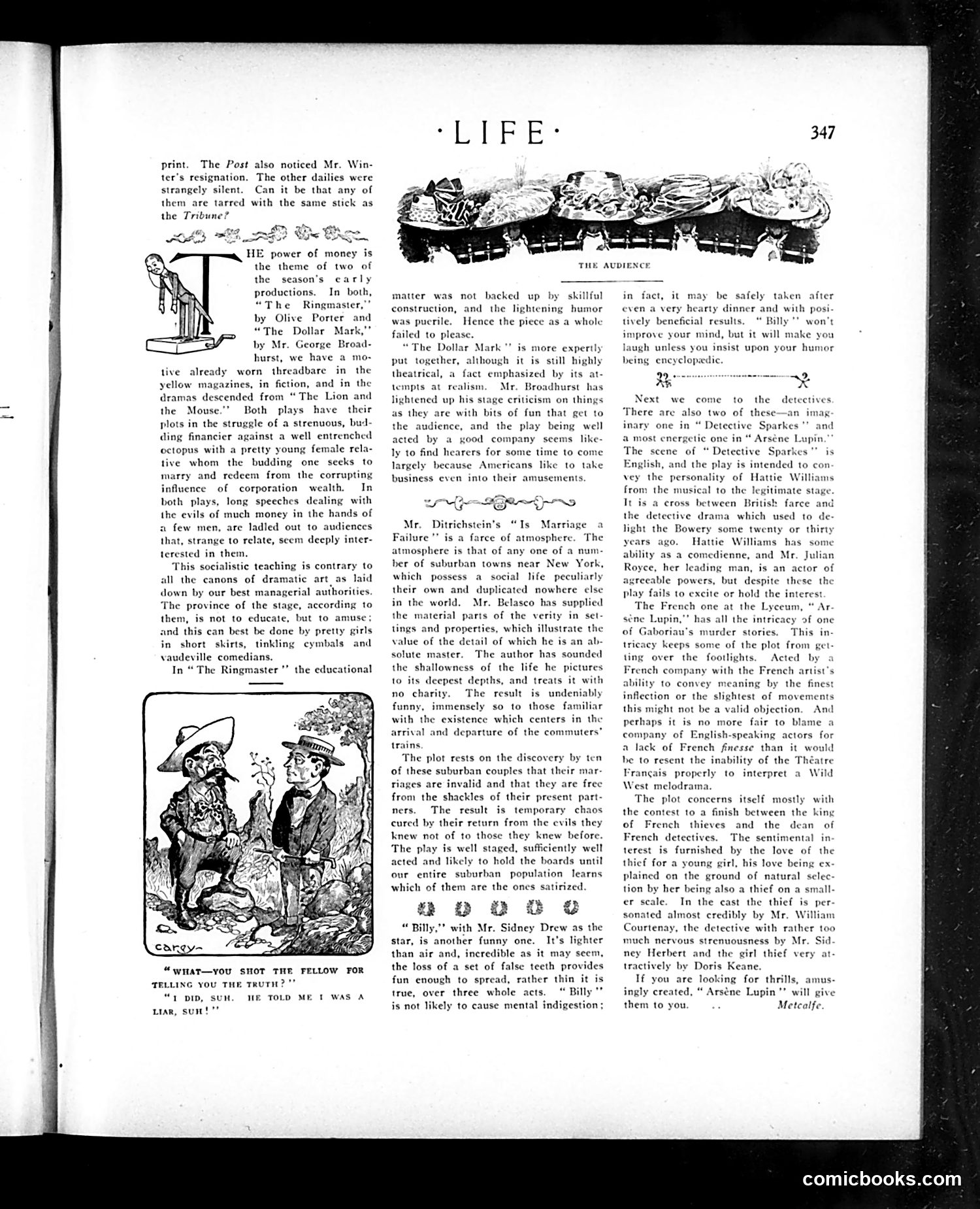
This page reviews Broadway theatrical productions, focusing on plays about wealth and financial power—"The Ringmaster," "The Dollar Mark," and "Is Marriage a Failure?" **The Main Cartoon** (lower left) depicts a confrontation between two men. The caption reads: "What—you shot the fellow for telling you the truth?" / "I did, sir. He told me I was a liar, sir!" The joke satirizes thin-skinned defensiveness: a man shoots someone not for the insult itself ("liar"), but for being *exposed as one*—suggesting the truth hurts more than the accusation. **The Broader Critique**: The article notes these plays teach "socialistic" lessons about the evils of concentrated wealth, which contradicts theatrical conventions favoring entertainment over education. The reviewer finds the moralizing heavy-handed but notes audiences remain interested in anti-corporate themes—suggesting early 20th-century anxieties about monopolies and financial inequality resonated with theatergoers despite artistic conventions.
📄 Transcribed text from this page (OCR, searchable)
Machine-transcribed from the original scan — historical spelling and the odd misread are preserved.
print. The Post also noticed Mr. Win- ter’s resignation, The other dailies were strangely silent. Can it be that any of them are tarred with the same stick as the Tribune? an Re. HE power of money is the theme of two of the season’s carly productions. In both, “The Ringmaster,” by Olive Porter and “The Dollar Mark," by Mr. George Broad- hurst, we have a mo- tive already worn threadbare in the yellow magazines, in fiction, and in the dramas descended from “The Lion and the Mouse."? Both plays have their plots in the struggle of a strenuous, bu:- ding financier against a well entrenched octopus with a prett female rela- tive whom the budding one seeks to marry and redeem from the corrupting influence of corporation wealth, In both plays, long speeches dealing with the evils of much money in the hands of a few men, are ladled out to audiences that, strange to relate, seem deeply inter- terested in them. This socialistic teaching is contrary to all the canons of dramatic art as laid down by our best managerial authorities. The province of the stage, according to them, is not to educate, but to amuse and this can best be done by pretty girls in short skirts, tinkling cymbals and vaudeville comedians. In “ The Ringmaster"? the educational “wiat—you SHOT THE FELLOW FOR TELLING You THE TRUTH?" “1 pip, sun Liar, sunt! "" NE TOLD ME f WAS A THE AUDIENCE matter was construction, was pucrile, not backed up by skillful nd the lightening humor Hence the piece as a whole failed to ple: The Dollar Mark "’ is more expertly put together, although it is still highly theatrical, a fact emphasized by its at- Mr ightened up his stage criticism on things tempts at realism. Broadhurst has as they are with bits of fun that get to audience, and the play being well acted by a good company seems like- ly to find hearers for some time to co like to take pusements, because Americans into their a largely business eve Ditrichstein’s “Is Marris * is a farce of atmosphere. The atmosphere is that of any one of a num ber of suburban towns near New York, which possess social life peculiarly their own and duplicated nowhere else in the world. Mr. Belasco has supplied the material parts of the verity in set- tings and properties, which illustrate the of which he is an ab- The author has sounded value of the de solute maste! the shallowness of the life he pictures to its deepest depths, and treats it with no charity. The result is undeniably funny, immensely so to those fam! with the existence which centers in th arrival and departure of the commuters’ trains The plot rests on the discovery by ten of these suburban couples that their mar- riages are invalid and that they are free from the shackles of their present part- ners. The result is temporary chaos cured by their return from the evils they knew not of to those they knew before. The play is well staged, sufficiently well acted and likely to hold the boards until our entire suburban population learns which of them are the ones satirized apo. o “ Billy,” with Mr, Sidney Drew as the star, is another funny one. It’s lighter than air and, incredible as it may seem, the loss of a set of false teeth provides fun enough to spread, rather thin it true, over three whole acts. “ Billy is not likely to cause mental indigestion ; in fact, it may be safely taken after even a very hearty dinner and with posi- tively beneficial results,“ Billy"? won't improve your mind, but it will make you laugh unless you insist upon your humor being encyclo} xt we vedic. come to the detectives ‘There are also two inary c of these—an “Detective Sparkes’ one in “ Arséne Lupin The scene of “Detective Sparkes English, and the play is intended to vey the personality of Hattie Williams from the musi It is a cross between farce the detective drama which used to de light the Bowery some twenty or thirty years ago. Hattie Williams has some ability as a comedienne, and Mr. Julian Royce, her leading man, is an actor of agreeable powers, but despite these the imag. one in and A most energet legitimate st British al to the fails to excite or hold the interest The French one at the Lyceum, “ Ar séne Lupin,”’ has all the intricacy of one of Gaboriau’s murder stories tricacy keeps som ting over This in- of the plot from get the footlights. Acted by French company with the French artist’s ability to convey meaning by the finest nflection or the slightest of movements And perhaps it is no more fair to blame a company of English-speaking actors for a lack of French finesse than it would he to resent the inability of the Théatre interpreta Wild this might not be a valid objection. Francais properly to West melodrama. The plot concerns itself mostly with the contest to a finish between the king of French thieves and the dean of French detectives. The sentimental in terest is furnished by the love of the thief for a young girl, his love being ex- plained on the ground of natural selec- tion by her being also a thief on a small- er scale. In the cast the thief is per- sonated almost credibly by Mr, William Courtenay, the detective with rather too much nervous strenuousness by Mr. Sid ney Herbert and the girl thief very at- tractively by Doris Keane. If you are looking for thrills, amus- ingly created, “ Arséne Lupin"? will them to you Metcalfe comicbooks.com