
Life, 1909-09-09 · page 6 of 32
Life — September 9, 1909 — page 6: what you’re looking at
What you’re looking at
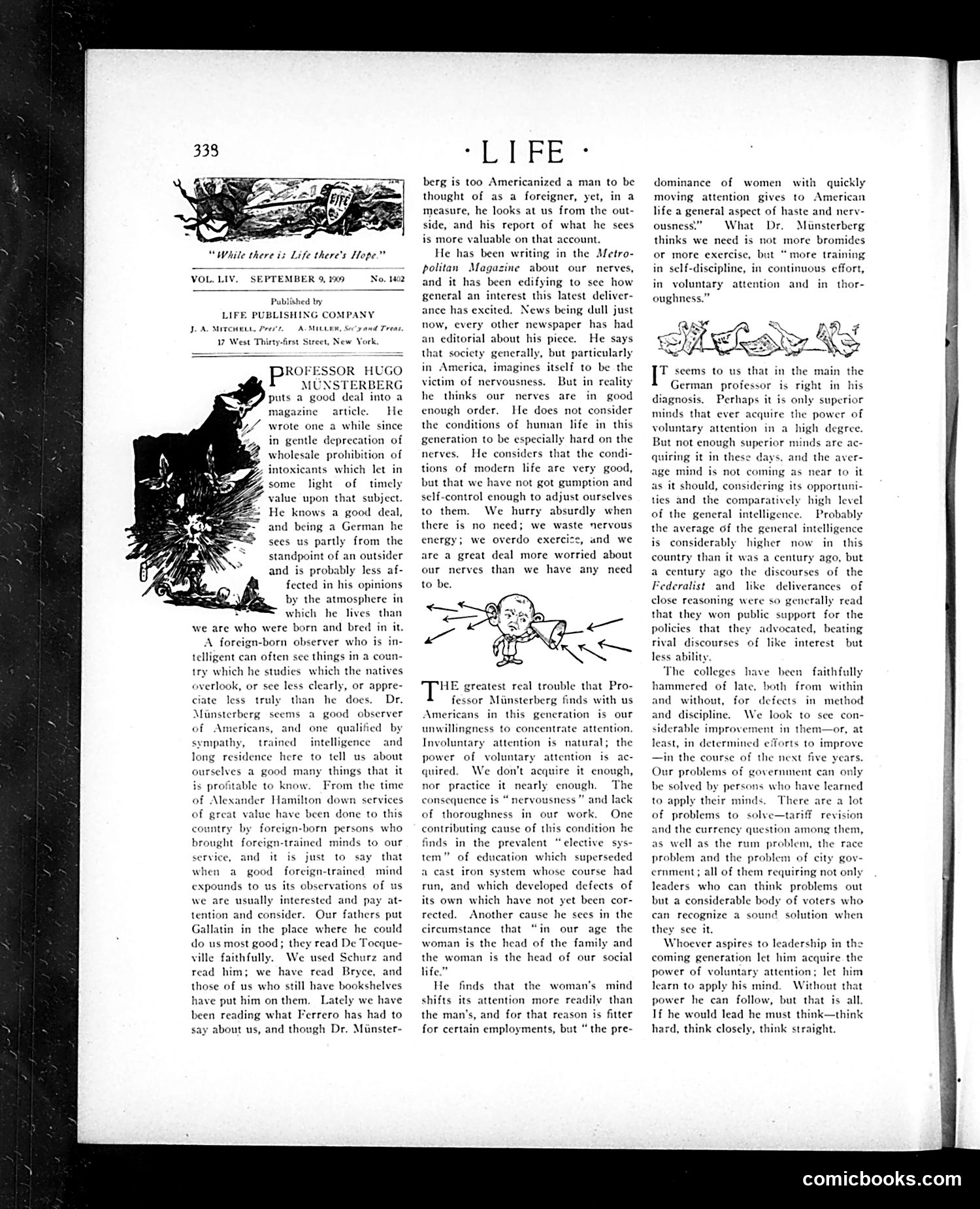
This page features an article about **Professor Hugo Münsterberg**, a German-American psychologist and Harvard professor. The accompanying illustration (left) depicts him as a somewhat portly figure, characteristic of Life's satirical style. The article discusses Münsterberg's observations of American nervousness and his belief that Americans waste nervous energy through poor self-discipline. Life's satire targets his German perspective on American society—positioning him as an outsider making judgmental observations about American habits. The small cartoon (center) appears to illustrate the concept of "nervousness" through a simple figure, though details are unclear. The piece satirizes both Münsterberg's foreign critique of Americans and contemporary anxieties about modern life's psychological toll—a common theme in early 20th-century journalism.
📄 Transcribed text from this page (OCR, searchable)
Machine-transcribed from the original scan — historical spelling and the odd misread are preserved.
9, 1909 lished by LIFE PUBLISHING COMPANY JA. Mirren AL MILLER, Sec’y ane Treas v7 West Thi first Street, New York, ROFESSOR HUGO MUNSTERBERG puts a good deal into a magazine article. He wrote one a while since in gentle deprecation of wholesale prohibition of intoxicants which let in some light of timely value upon that subject. He knows a good deal, and being a German he sees us partly from the standpoint of an outsider and is probably less af- fected in his opinions by the atmosphere in which he than we are who were born and bred in it. ‘A foreign-born observer who is in- lives telligent can often see things in a coun- try which he studies which the natives overlook, or see less clearly, or appre- less truly than he does, Dr. Miinsterberg seems a good observer ciate of Americans, and one qualified by sympathy, trained intelligence and long residence here to tell us about a good many things that it s profitable to know. From the time of Alexander Hamilton down services of great value have been done to this country by foreign-born persons who brought foreign-trained minds to our and it is just to say that good foreign-trained mind expounds to us its observations of us we are usually interested and pay tention and consider. Our fathers put Gallatin in the place where he could do us most good; they read De Tocque- ville faithfully. We used Schurz and read him; we have tread Bryce, and those of us who still have bookshelves have put him on them. Lately we have been reading what Ferrero has had to say about us, and though Dr. Miinster- ourselve servic when a “LABE* berg is too Americanized a man to be thought of as a foreigner, yet, in a measure, he looks at us from the out- side, and his report of what he sees is more valuable on that account. He has been writing in the Metro- politan Magazine about our nerves, and it has been edifying to see how general an interest this latest deliver- ance has excited. News being dull just now, every other newspaper has had an editorial about his piece. He says that society generally, but particularly in America, imagines itself to be the victim of nervousne But in reality he thinks our nerves are in good enough order. He does not consider the conditions of human life in this generation to be especially hard on the nerves. He considers that the condi- tions of modern life are very good, but that we have not got gumption and self-control enough to adjust ourselves to them. We hurry absurdly when there is no need; we waste nervous energy; we overdo exercise, and we ¢ a great deal more worried about our nerves than we have any need HE greatest real trouble that Pro- fessor Minsterberg finds with us Americans in this generation is our unwillingness to concentrate attention. Involuntary attention is natural; the power of voluntary attention is ac- quired. We don't acquire it enough, nor practice it nearly enough. The consequence is “nervousness” and lack of thoroughness in our work. One contributing cause of this condition he nds in the prevalent tem” of education which superseded a cast iron system whose course had run, and which developed defects of its own which have not yet been cor- rected. Another cause he sees in the circumstance that “in our age the woman is the head of the family and the woman is the head of our social life.” He finds that the mind shifts its attention more readily than the man’s, and for that reason is fitter for certain employments, but “ the pre- “elective sys- woman's dominance of with quickly moving attention gives to. American life a general aspect of haste and nerv- ousness.” What Dr. Miinsterberg thinks we need is not more bromides or more exercise, but “more training in self-discipline, in continuous effort, thor- women in voluntary attention and in oughness.” Se I" seems to us that in the main the German professor is right in his diagnosis. Perhaps it is only superior minds that ever acquire the power of voluntary attention in a high degree. But not enough superior minds are ac- quiring it in these days, and the aver- age mind is not coming as near to it as it should, considering its opportuni- ties and the comparatively high level of the general intelligence. Probably the average of the general intelligence is considerably higher now in this country than it was a century ago, but a century ago the discourses of the deralist’ and like deliverances of close reasoning were so generally read that they won public support for the policies that they advocated, beating rival discourses of like interest but less ability. The colleges have been faithfully hammered of late, both from within and without, for defects in method and discipline. We look to see con- siderable improvement in them—or, at least, in determined efforts to improve —in the course of the nest five year: Our problems of government can be solved by persons who have learned to apply their minds. There are a lot of problems to solve—tariff revision and the currency question among them, as well as the rum problem, the rac problem and the problem of city gov- ernment; all of them requiring not only leaders who can think problems out but a considerable body of voters who can recognize a sound solution when they see it. Whoever aspires to leadership in th coming generation let him acquire the power of voluntary attention; let him learn to apply his mind. Without that power he can follow, but that is all. If he would lead he must think—think hard, think closely, think straight. comicbooks.com