
A complete issue · 36 pages · 1909
Life — May 20, 1909
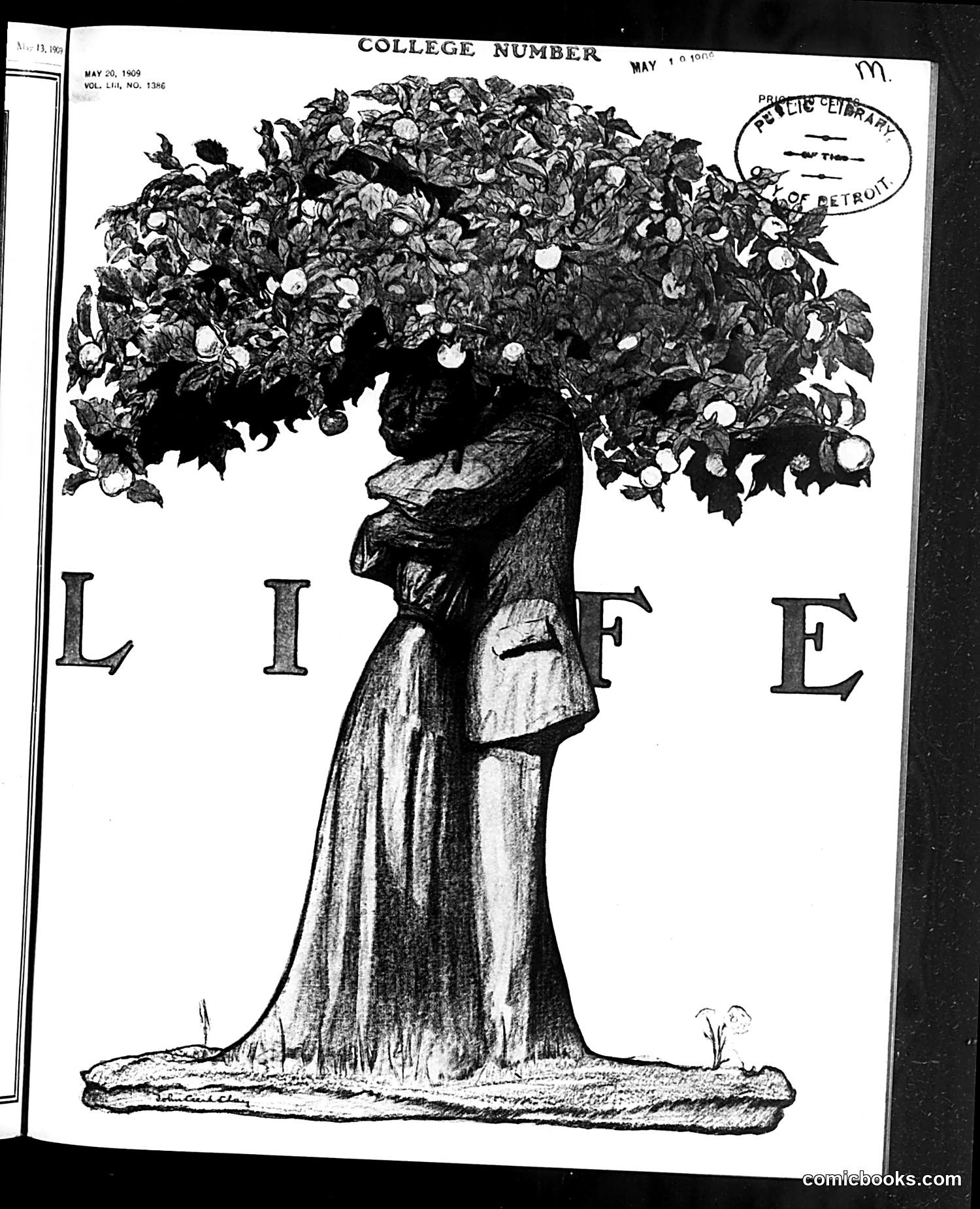
This is the cover of *Life* magazine from May 20, 1909. The central image shows a stylized tree with a human head/bust as its trunk, bearing fruit (apples or similar round fruits) in its canopy. The single word "LIFE" appears vertically beside the figure. The symbolism appears to represent growth, vitality, and natural flourishing—common themes in early 20th-century American culture emphasizing vigor and productivity. The anthropomorphic tree suggests human potential bearing fruit, likely reflecting contemporary progressive ideals about personal development and societal advancement. Without additional text from the magazine's interior, the specific satirical target remains unclear, though the image celebrates life's generative power rather than critiquing a particular political figure or event.
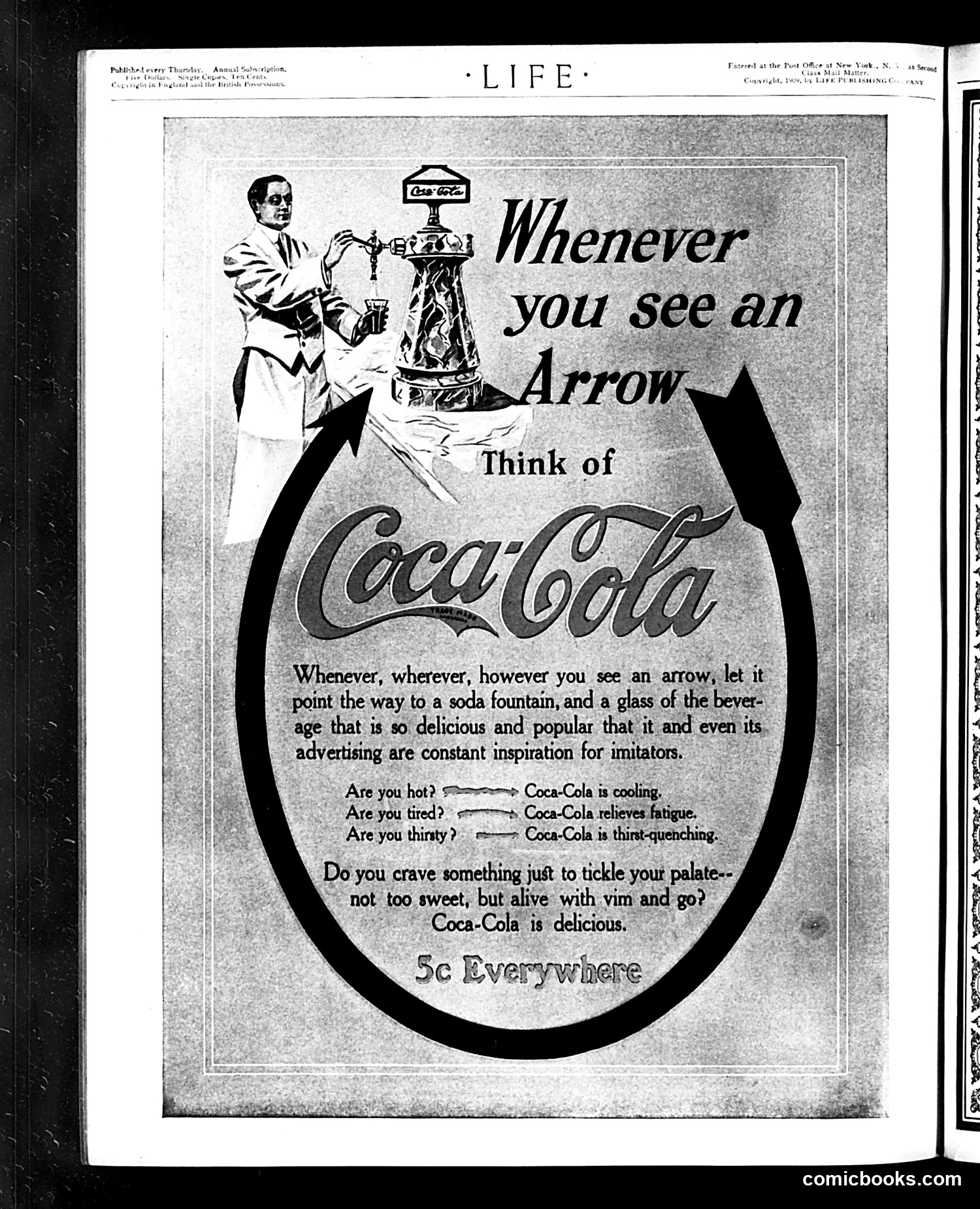
This is a **Coca-Cola advertisement**, not satirical content. The page shows a man at a soda fountain operating a Coca-Cola dispenser beneath an arrow sign. The ad's central message uses arrows as a marketing device: "Whenever you see an Arrow, Think of Coca-Cola." The copy claims that arrows should redirect people to Coca-Cola fountains, establishing the brand as synonymous with refreshment. The advertisement lists practical benefits (cooling when hot, relieving fatigue, quenching thirst) and emphasizes taste ("delicious"), positioning Coca-Cola as an essential everyday beverage available "5c Everywhere." This represents early 20th-century brand-building through pervasive marketing symbolism—attempting to make the arrow an involuntary mental trigger for the product.
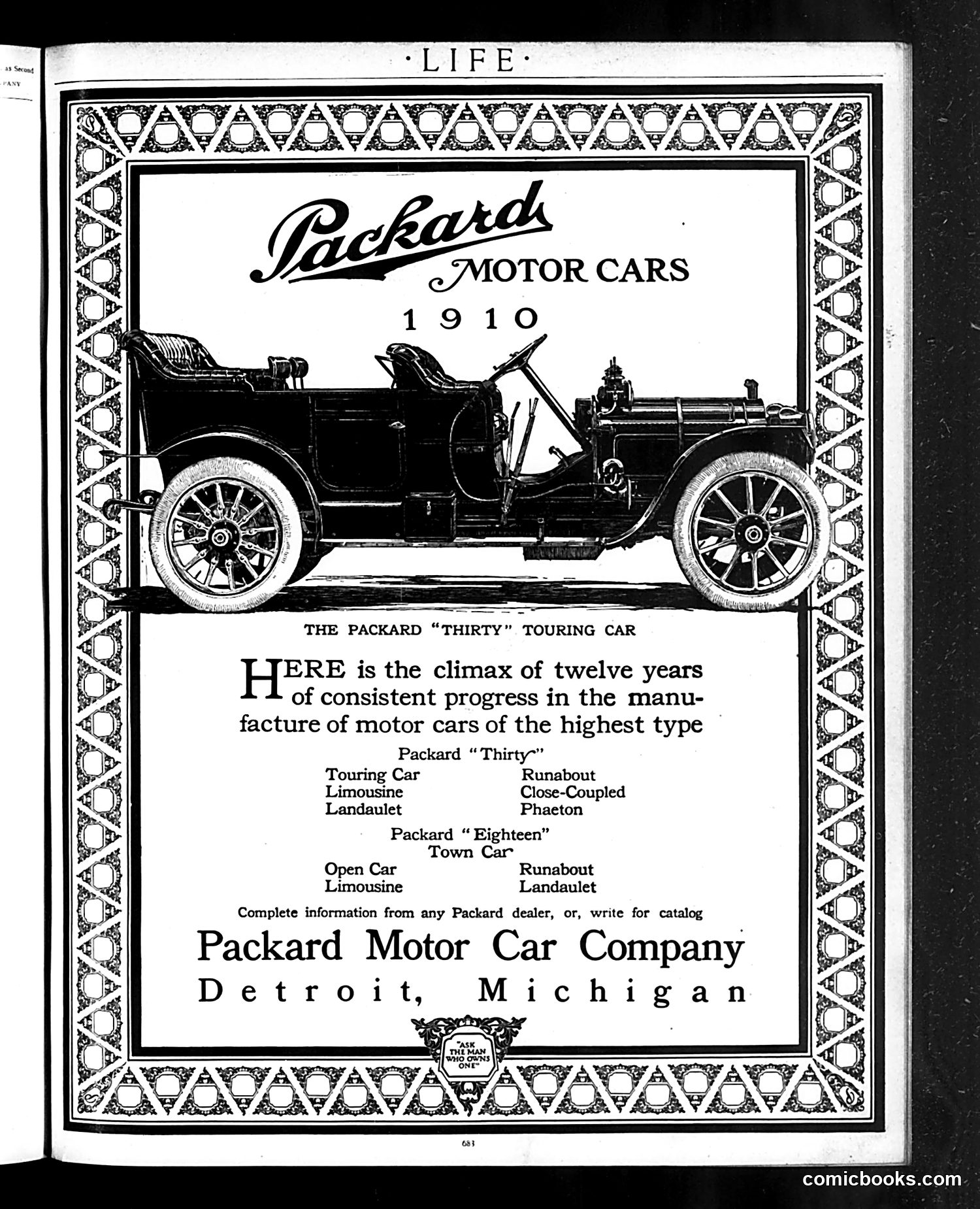
This page is **not a cartoon or satire—it is a straightforward advertisement** for Packard Motor Cars from 1910. The image shows a side-view technical illustration of the Packard "Thirty" touring car, a luxury automobile of that era. The ad emphasizes twelve years of manufacturing progress and lists various Packard models: the "Thirty" (Touring Car, Limousine, Landaulet, Runabout, Close-Coupled, Phaeton) and the "Eighteen" (Town Car, Open Car, Limousine, Runabout, Landaulet). The Packard Motor Car Company, based in Detroit, Michigan, positioned itself as producing "motor cars of the highest type." This represents early-1900s automotive advertising targeting wealthy consumers.
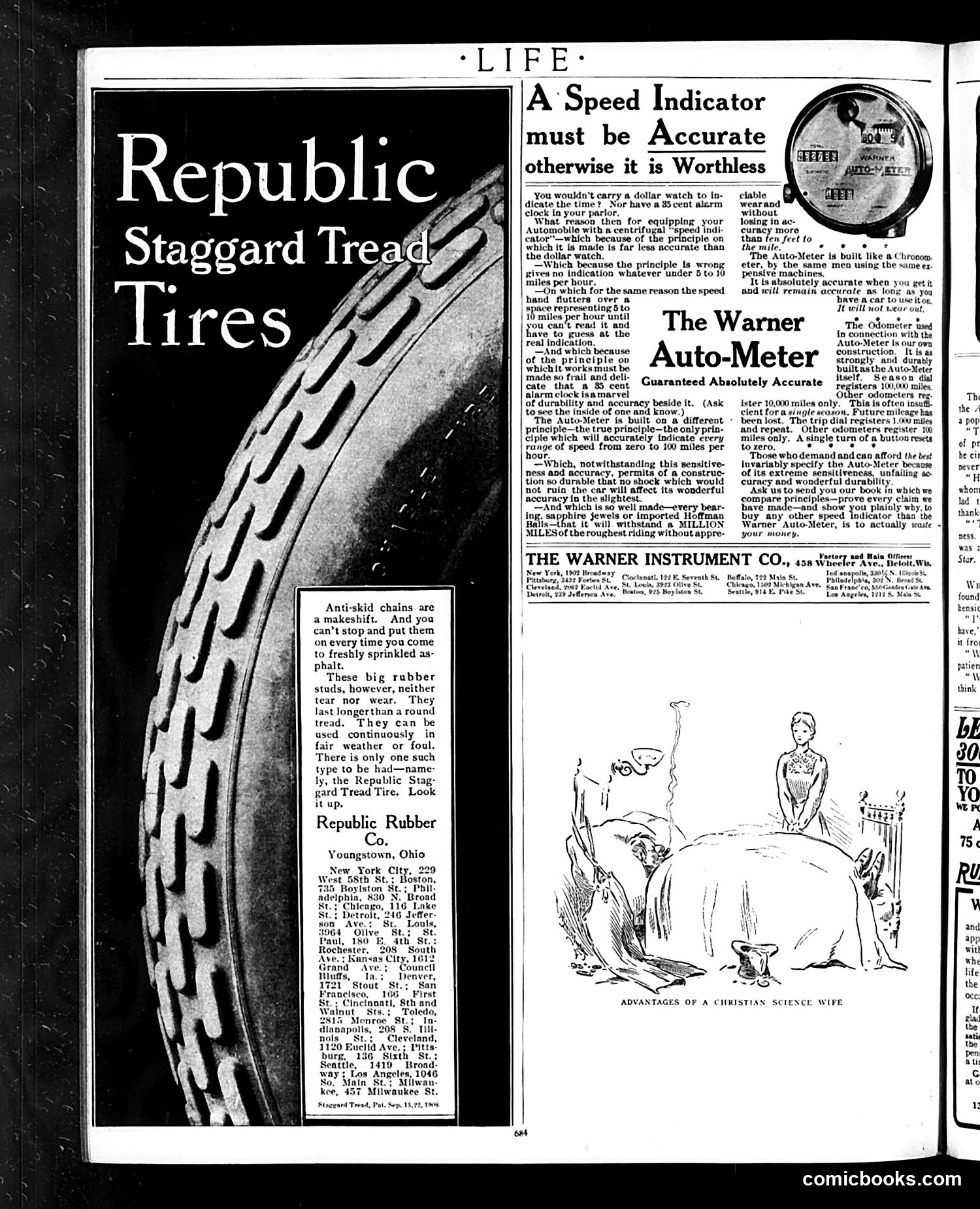
This page is primarily **advertising**, not political satire. The left side features a Republic Rubber Company advertisement for "Staggered Tread Tires," emphasizing the tire's durability and traction through detailed product description and listings of multiple company locations. The right side contains two separate advertisements: one for the Warner Auto-Meter (a speed indicator device), and below it, a small illustration labeled "Advantages of a Christian Science Wife" showing a woman tending to a sick man. The "Christian Science" cartoon appears to be gentle satire about faith healing—suggesting a wife's Christian Science beliefs might be preferable to other medical approaches—though the joke's specific point is unclear without broader context about 1920s attitudes toward Christian Science. The page reflects typical early-20th-century *Life* magazine content: commercial advertisements interspersed with light social humor.
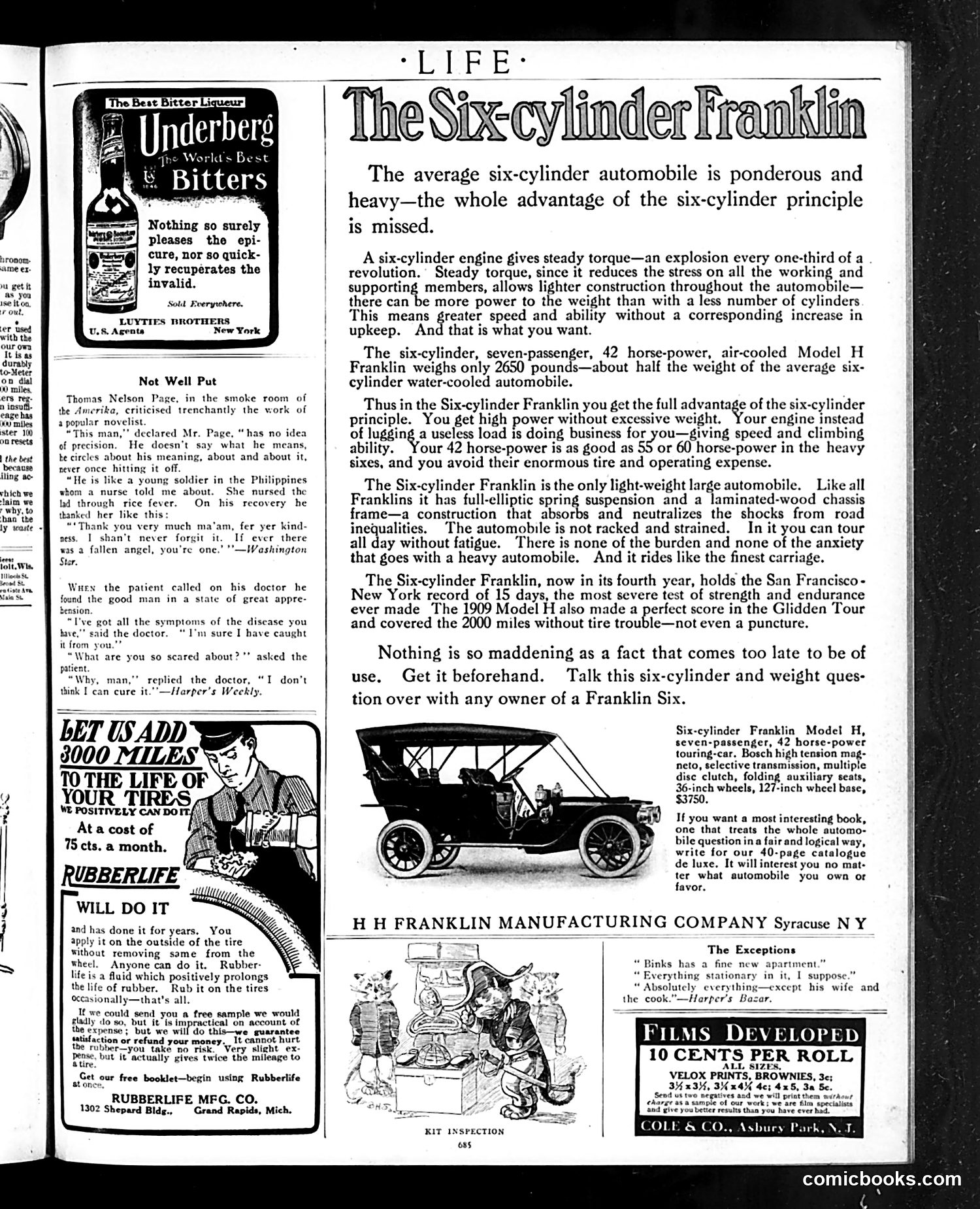
This page is **primarily advertising with minimal satirical content**. The dominant feature is a large advertisement for the **Six-cylinder Franklin automobile**, emphasizing its lightweight design and fuel efficiency compared to heavier six-cylinder competitors. The left side contains two smaller items: an **Underberg Bitters liquor ad** and a **Rubberlife tire advertisement** promoting tire longevity ("Bet us add 3000 miles to the life of your tires"). Between these sits a brief humorous anecdote titled "Not Well Put"—a doctor-patient joke about misunderstanding medical language, with no political significance. The page reflects **early 1900s consumer culture**, showcasing period automobiles and related products aimed at middle-class readers. There is no discernible political satire or social commentary.
This is **not a cartoon or satirical content** — it's a straightforward advertisement for Martin & Martin, a New York bootmaker. The page header reads "LIFE," but this is paid advertising copy, not editorial content. The ad argues that the company's "ready-to-wear" boots offer advantages over custom-made boots: they're faster to obtain, less expensive, and nearly as customizable. The pitch claims their ready-made service provides "custom service in every particular except time and expense." This reflects early 20th-century consumer economics, when mass-produced goods were gaining respectability against handmade alternatives. The ad targets customers seeking quality boots without the wait and cost of full customization.
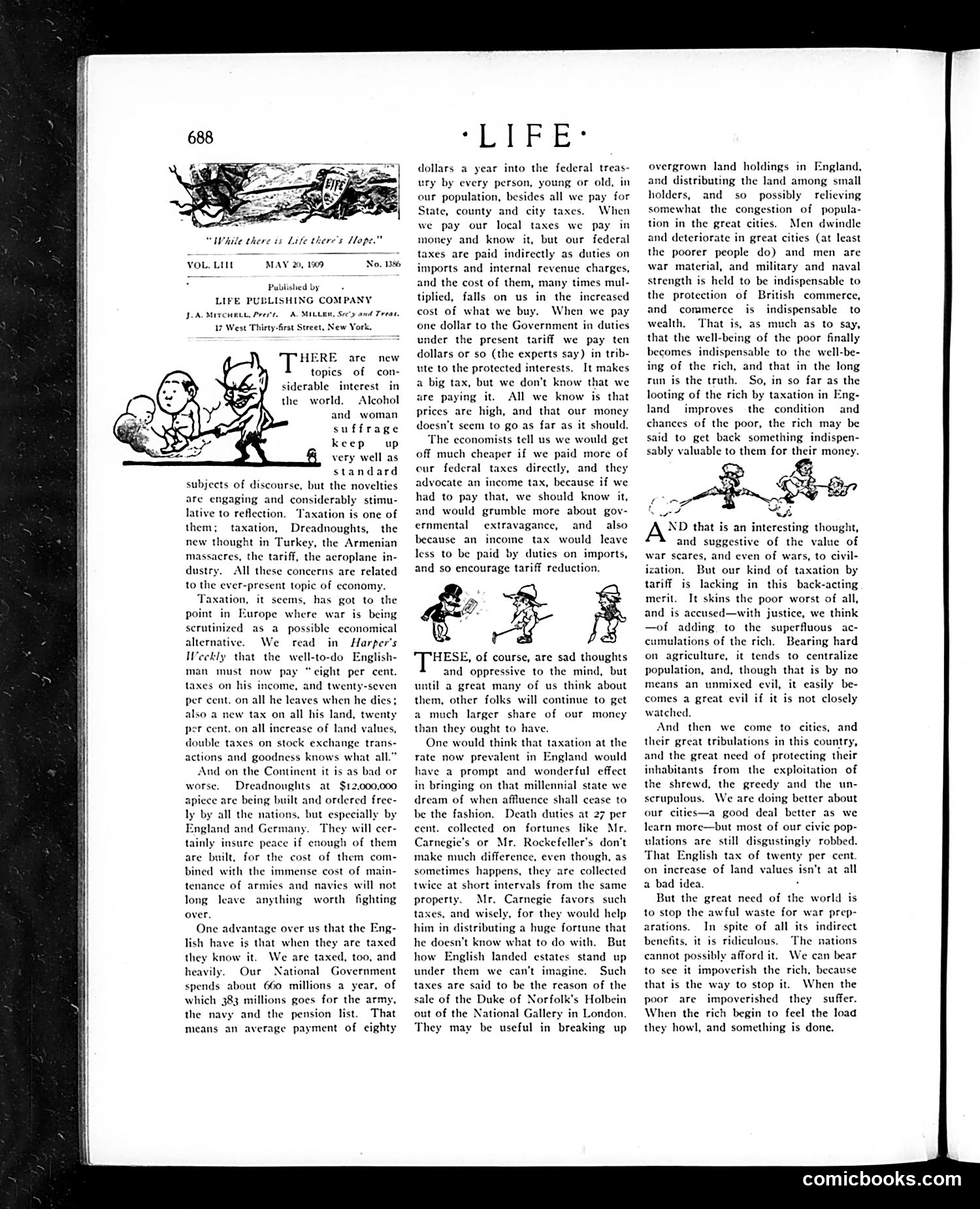
This *Life* magazine page (May 29, 1909) satirizes taxation and wealth inequality during wartime. The text discusses how ordinary citizens pay indirect federal taxes through tariffs and duties without knowing it, while the wealthy escape similar burden. The cartoon illustrations (though small) appear to depict working-class figures contrasted with wealthy ones—a common *Life* visual motif mocking class disparity. The article critiques tariff policy, suggesting the poor bear disproportionate tax burden while the rich benefit from protective trade policies. References to Carnegie and Rockefeller—America's wealthiest industrialists—highlight the tension: their fortunes accumulate while ordinary workers struggle. The satire argues taxation should be transparent and equitable, not hidden in consumer prices.
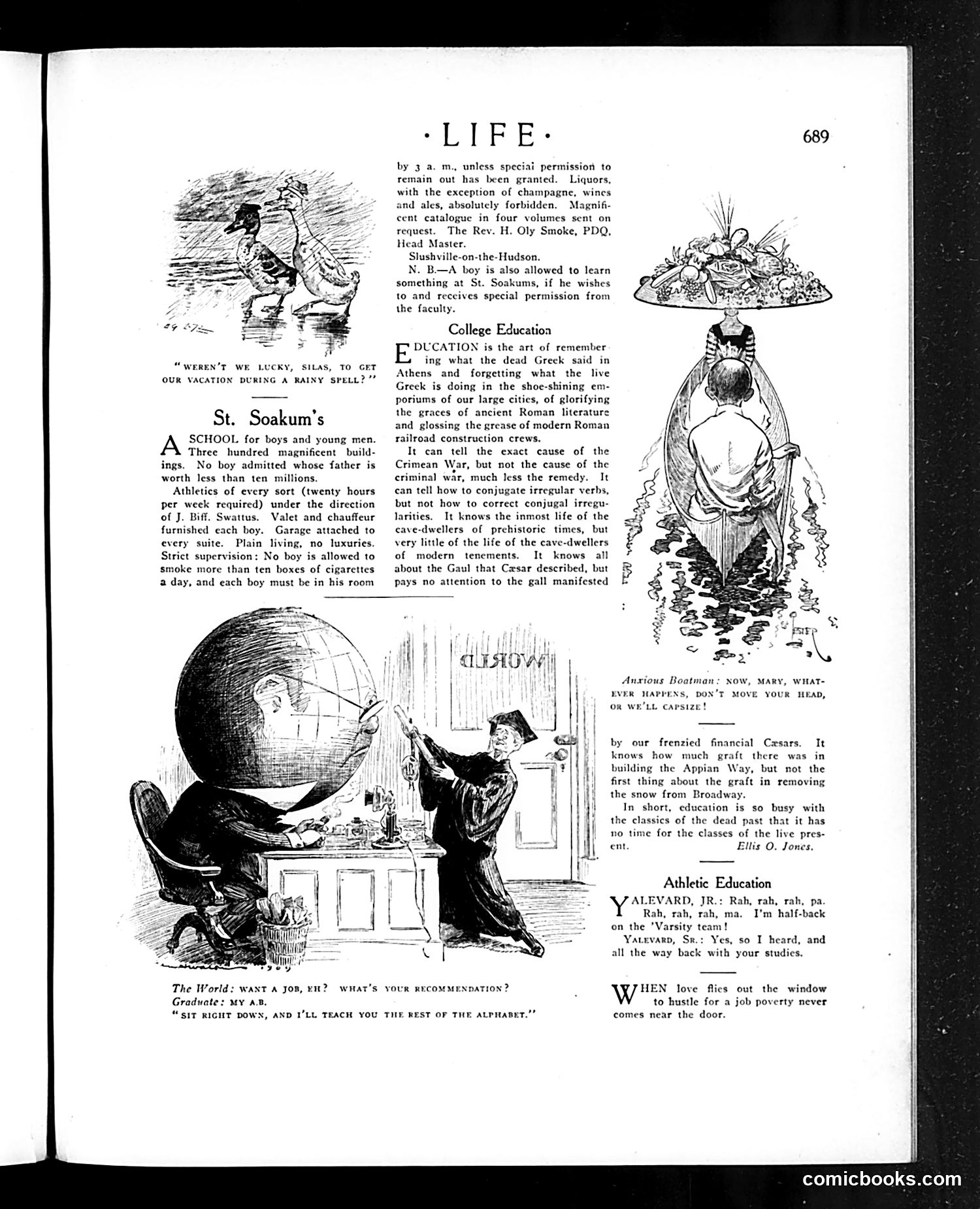
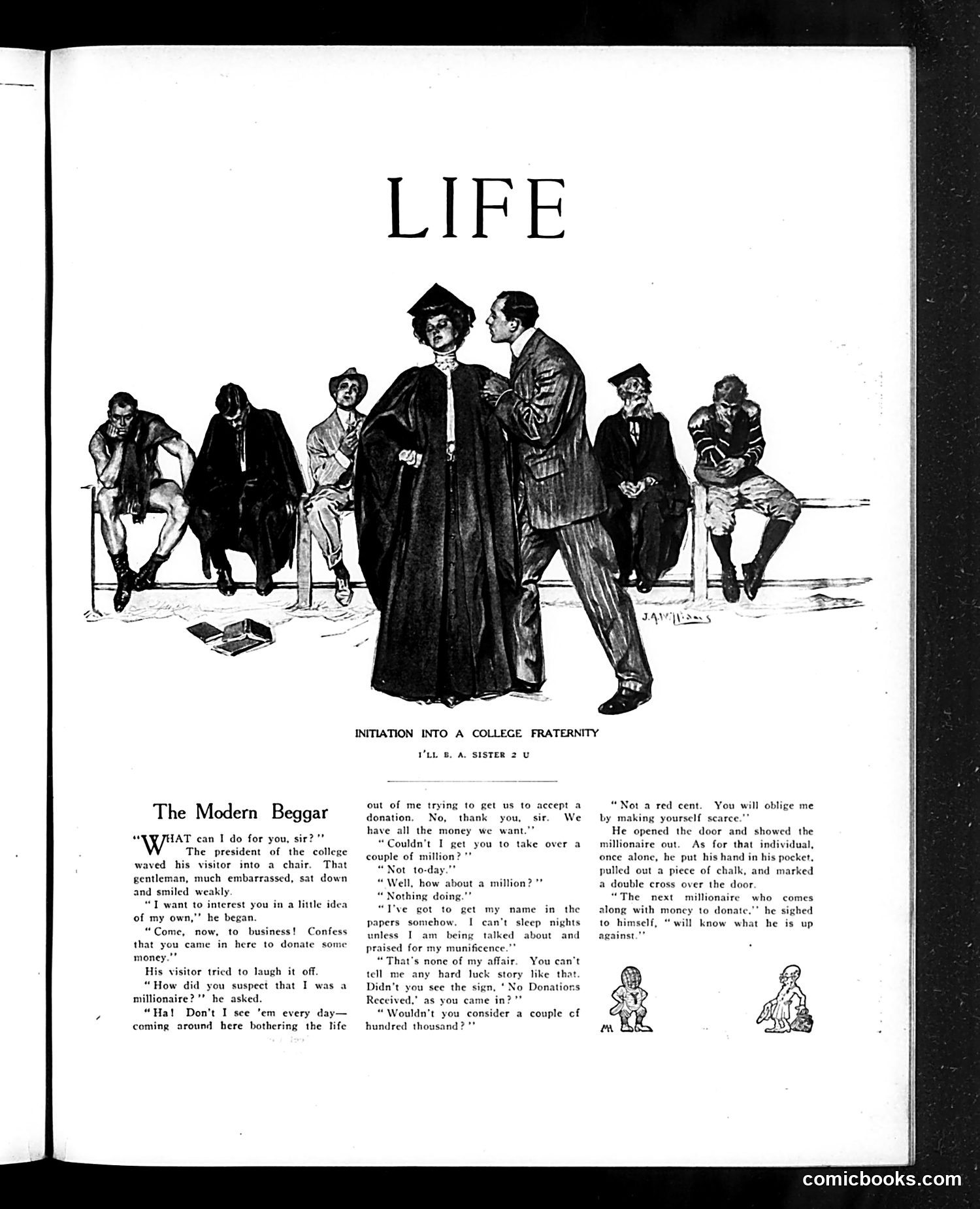
This page combines educational satire with humor about schools and work. **St. Soakum's School** mocks elite boarding schools, describing three hundred "magnificent buildings" where boys learn "plain living, no luxuries" while actually smoking heavily and living lavishly—a clear satire on hypocrisy in expensive institutions that claim to build character through austerity. **The World cartoon** shows a graduate being told "I'll teach you the best of the alphabet"—satirizing how unprepared graduates are for actual employment despite their expensive education. **College Education section** critiques education as merely memorizing dead classical knowledge while ignoring modern life and contemporary social problems. **Athletic Education** mocks how sports distract students from academics. The overall theme: American education systems fail to prepare students for real life.
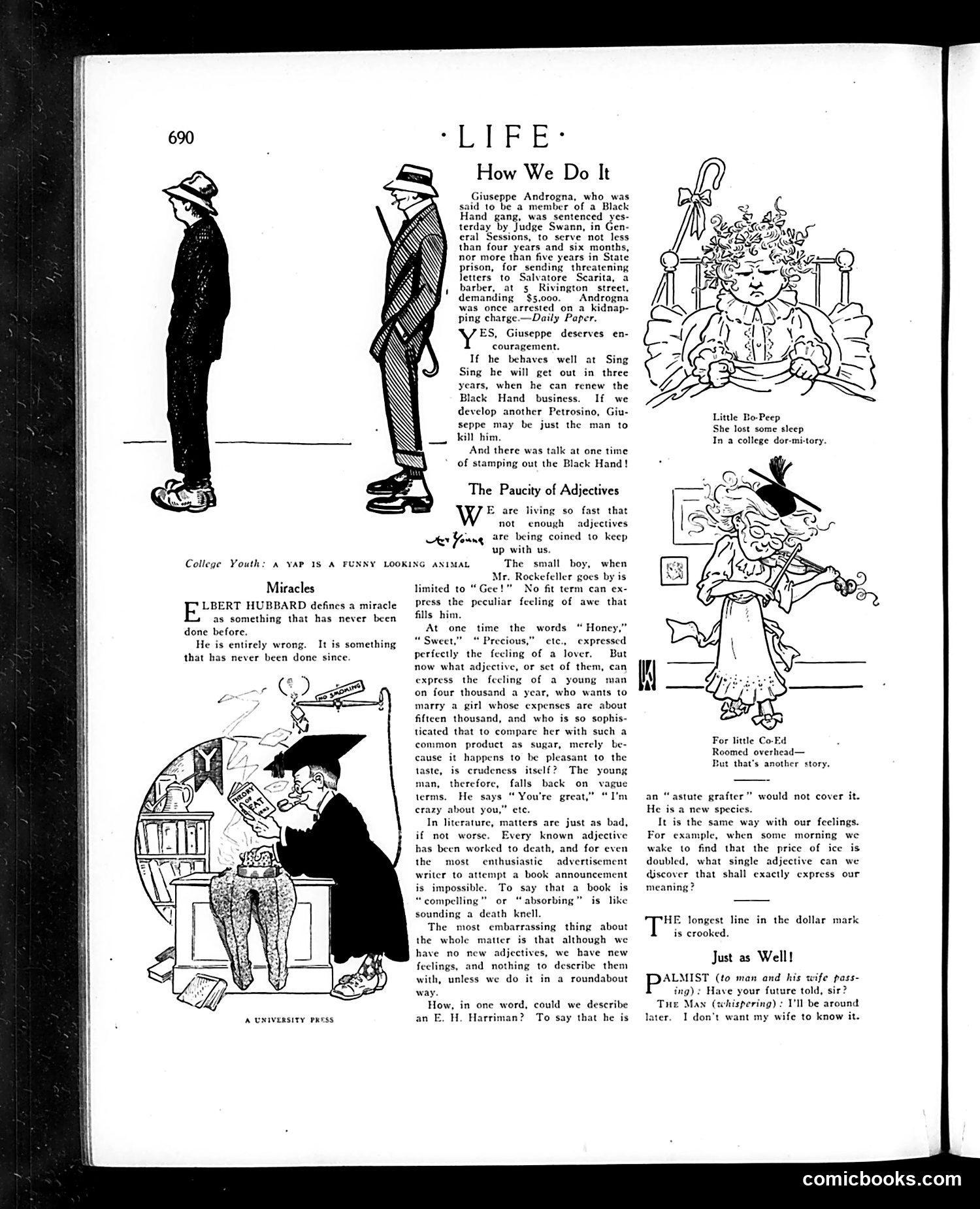
This page contains three distinct pieces: 1. **"College Youth"** - A sketch labeled "A YAF IS A FUNNY LOOKING ANIMAL" shows two tall, thin young men in hats and coats, satirizing the physical appearance of college students of the era. 2. **"Miracles"** - A humorous piece about an inventor named Elbert Hubbard, accompanied by an illustration of a scholarly figure surrounded by books and papers. The text discusses Hubbard's philosophy. 3. **"The Paucity of Adjectives"** - An essay satirizing how modern language lacks sufficient descriptive words to capture human emotions and experiences. It critiques both everyday speech and literature for relying on overused, vague adjectives. The page also includes whimsical cartoon illustrations of children and light-hearted domestic humor pieces like "Just as Well," demonstrating Life magazine's blend of social commentary, literary criticism, and family-oriented comedy.
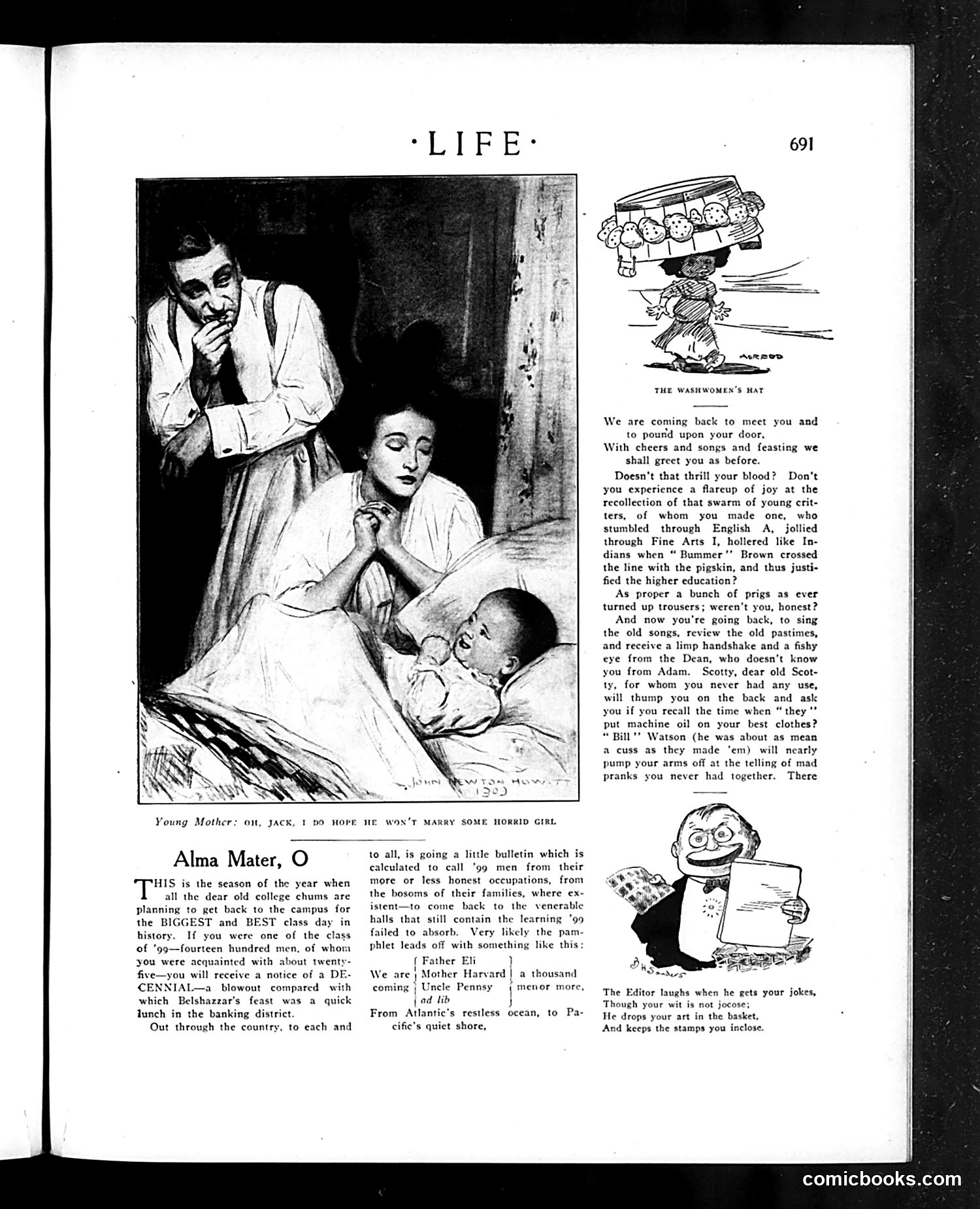
The main illustration depicts a domestic scene with a young mother and father anxiously watching over an infant, captioned "Young Mother: Oh, Jack, I do hope he won't marry some horrid girl." The satire targets parental anxiety about their children's future marriages. This reflects early 20th-century social concerns about class and suitable matches. The accompanying article, "Alma Mater, O," is a humorous poem about college reunion season. It mocks the nostalgia of returning alumni reminiscing about their college days while exaggerating the gap between youthful wildness and present respectability. The small cartoons on the right satirize an overly sentimental editor who collects reader jokes and contributions—poking fun at magazine culture itself. The overall tone is gentle social satire about American domesticity, education, and print media conventions of the era.
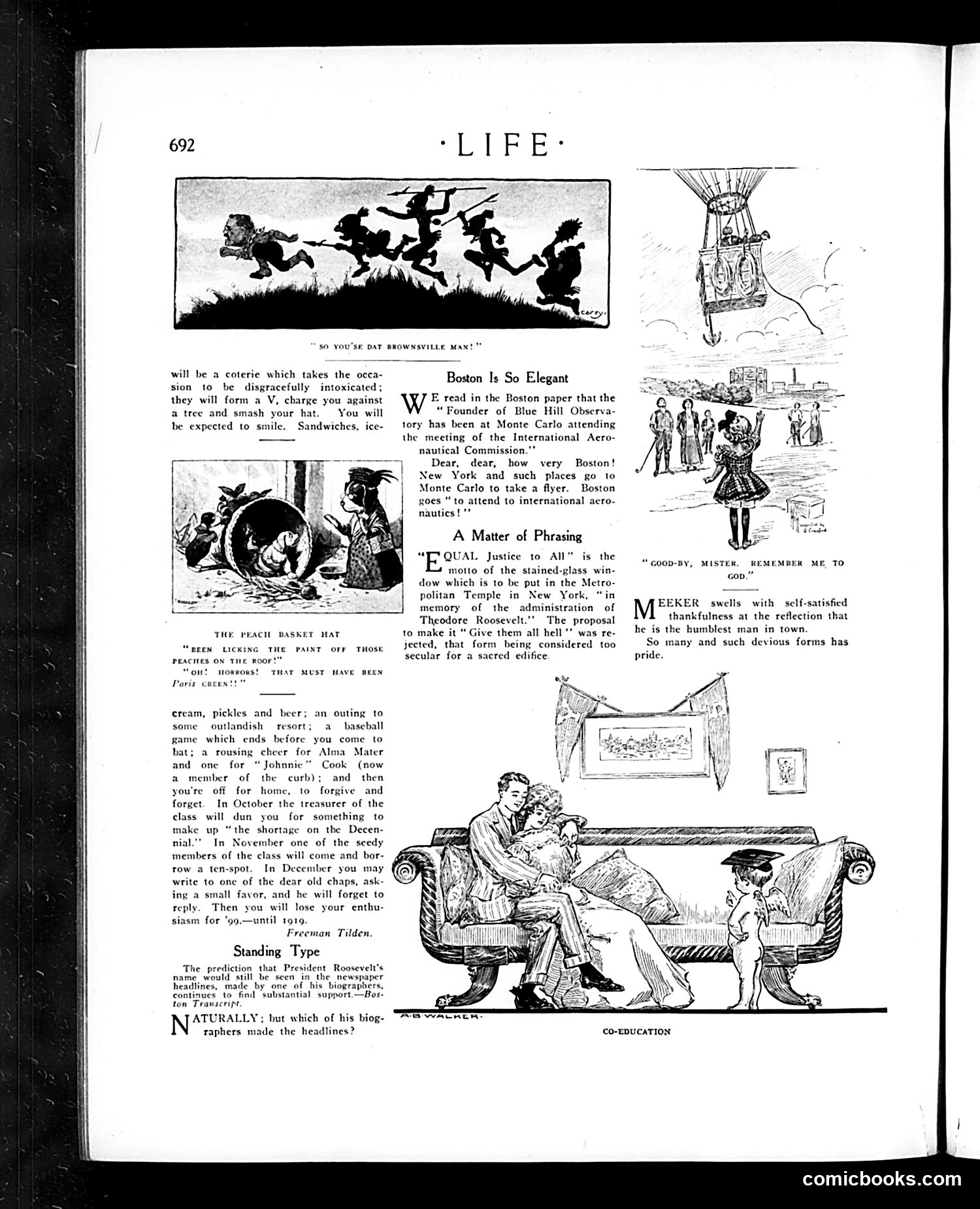
This page contains humorous social commentary rather than political cartoons. The top silhouette depicts children playing roughly outdoors, captioned "So You're Dat Brownsville Man!"—likely referencing a local ethnic stereotype. "Boston Is So Elegant" satirizes Boston's pretentious attitudes, mocking how Bostonians attend international events like aeronautical conferences while dismissing other American cities. "A Master of Phrasing" jokes about proposed stained-glass window honoring Theodore Roosevelt with the phrase "Give them all hell," deemed too crude for a sacred space—humor about Roosevelt's rough speaking style conflicting with religious decorum. The bottom illustration titled "Co-Education" shows a couple studying together on a sofa, with the humor implying the ambiguous educational value of such arrangements. The page represents Life's satirical commentary on American manners, regional pretension, and social behavior of the era.
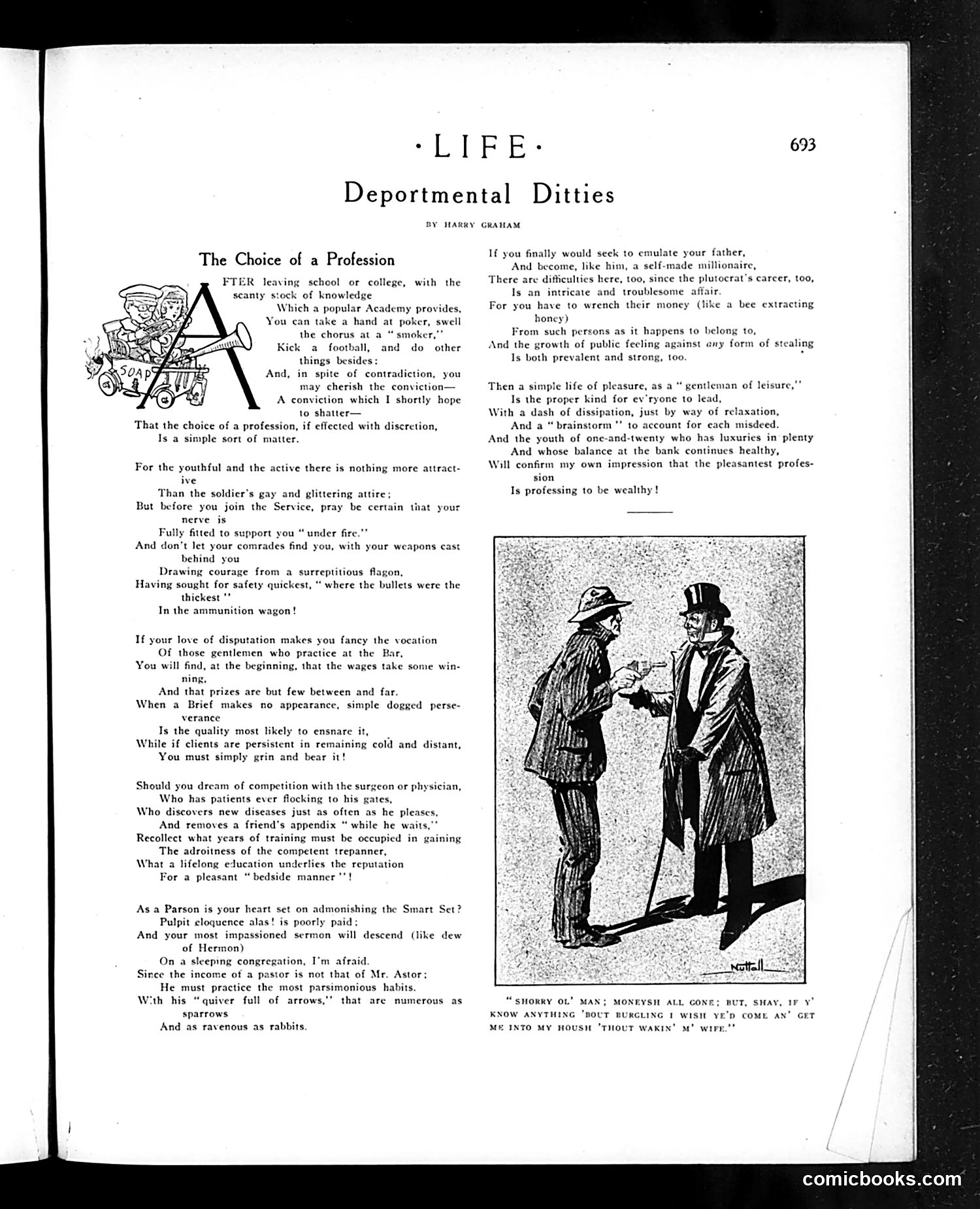
This page satirizes professional career choices through humorous verse. The illustrated cartoon shows two men in conversation—one wearing a bowler hat and cape, the other in top hat and formal dress—appearing to discuss employment prospects or social standing. The poem mocks various professions: soldiers (unreliable pay), lawyers (few win cases), surgeons (practice on patients), and parsons (must be frugal and pious). The satire targets the gap between professional prestige and actual financial rewards or job security. The cartoon's caption contains working-class dialect humor about a man worried his wife will lose money to burglary, suggesting anxiety about maintaining respectability and wealth among ordinary people aspiring to middle-class status—the core subject of this "departmental ditties" section.
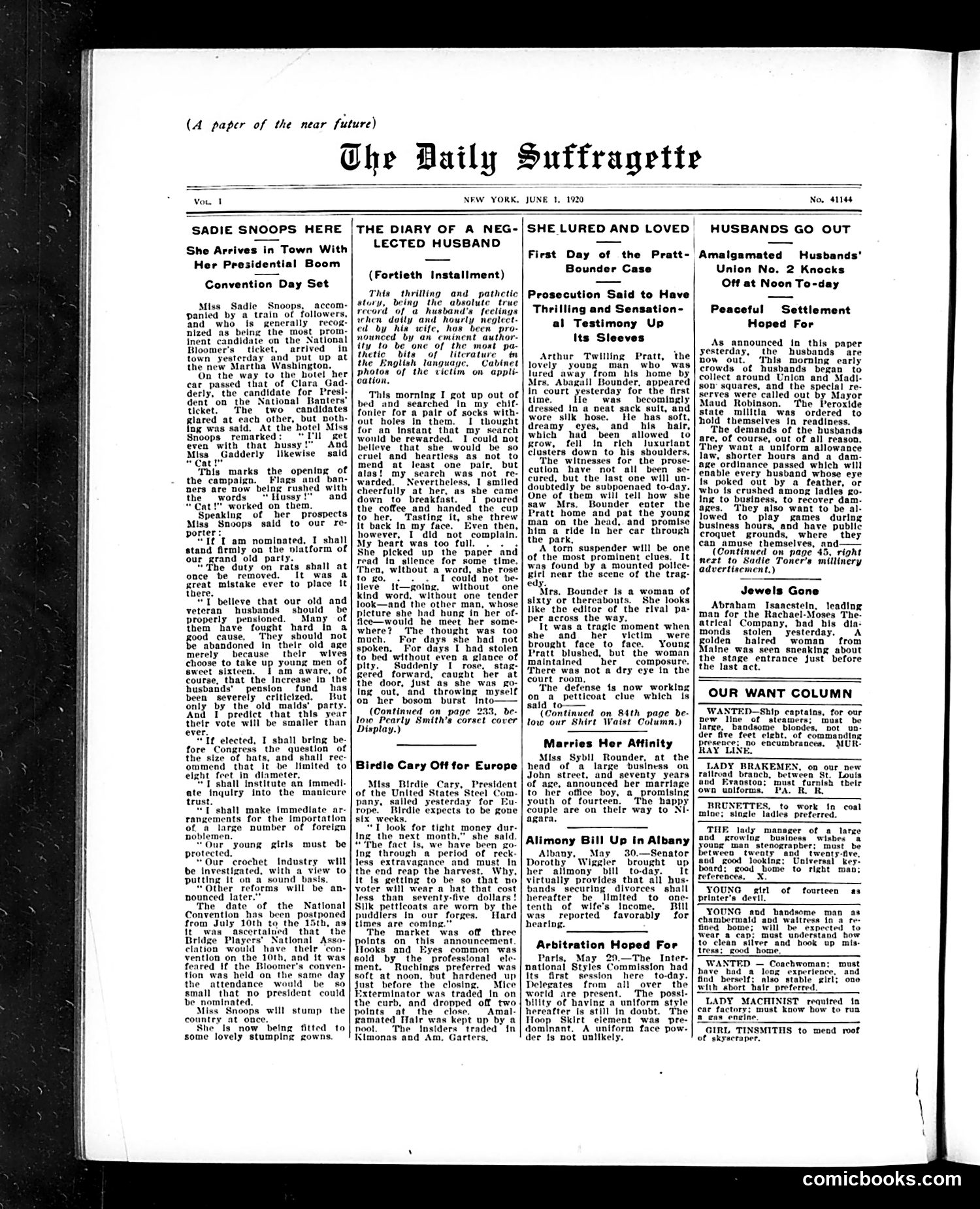
This is a satirical newspaper from *Life* magazine depicting a fictional future where women hold political power. The main story mocks women's suffrage by imagining a "National Bloomer's ticket" with female presidential candidate Sadie Snoops competing against Clara Gadderly on the "National Banters' ticket." The satire ridicules women voters through absurd platform promises: removing tariffs on rats, limiting hat sizes to eight feet, investigating manicure trusts, and importing "foreign noblemen" to protect young girls. The accompanying "Diary of a Neglected Husband" continues a running satirical series depicting men as helpless victims of female indifference. The humor relies on period stereotypes: women as frivolous, competitive, and unfit for governance. Published just before the 19th Amendment's ratification (August 1920), this represents anti-suffrage propaganda dressed as comedy—mocking the idea that women's political participation would be anything but chaotic and trivial.
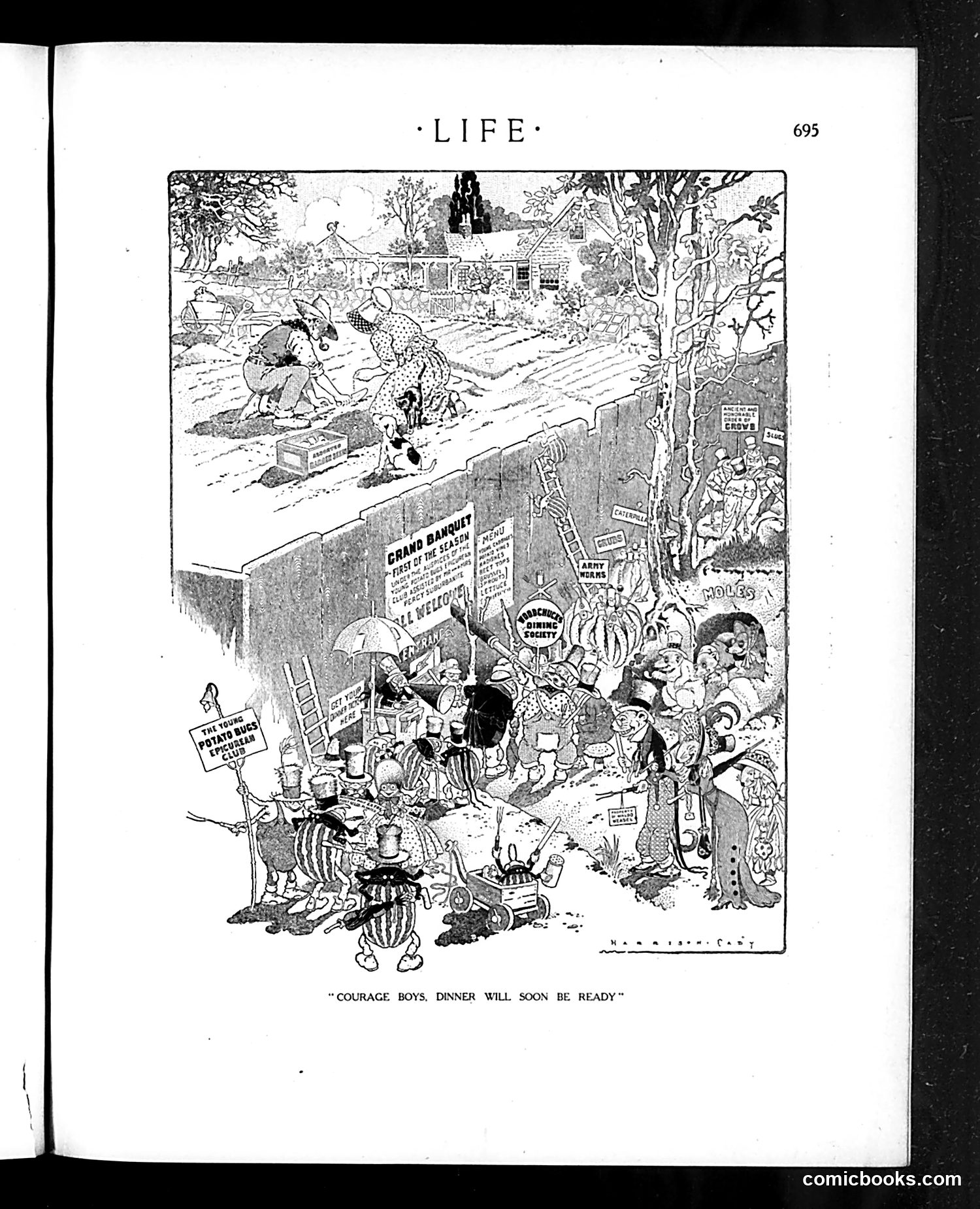
This satirical cartoon depicts a "Grand Banquet" held partially underground—suggesting a secretive or illicit gathering. The upper ground level shows a respectable domestic scene with a house and garden; below, numerous figures in period dress (appearing to be late 19th or early 20th century) crowd beneath a banner labeled "Grand Banquet," with visible signs referencing organizations like "Army" and what appears to be "Dining Society." The cartoon likely satirizes a hidden or hypocritical gathering of a specific group—possibly a fraternal organization, political faction, or exclusive society operating under a veneer of respectability. The juxtaposition of the innocent domestic scene above with the crowded, conspiratorial gathering below suggests the satire mocks the contrast between public propriety and private behavior, or the secretive nature of the group's activities. The caption "Courage Boys, Dinner Will Soon Be Ready" adds ironic encouragement to this underground assemblage.
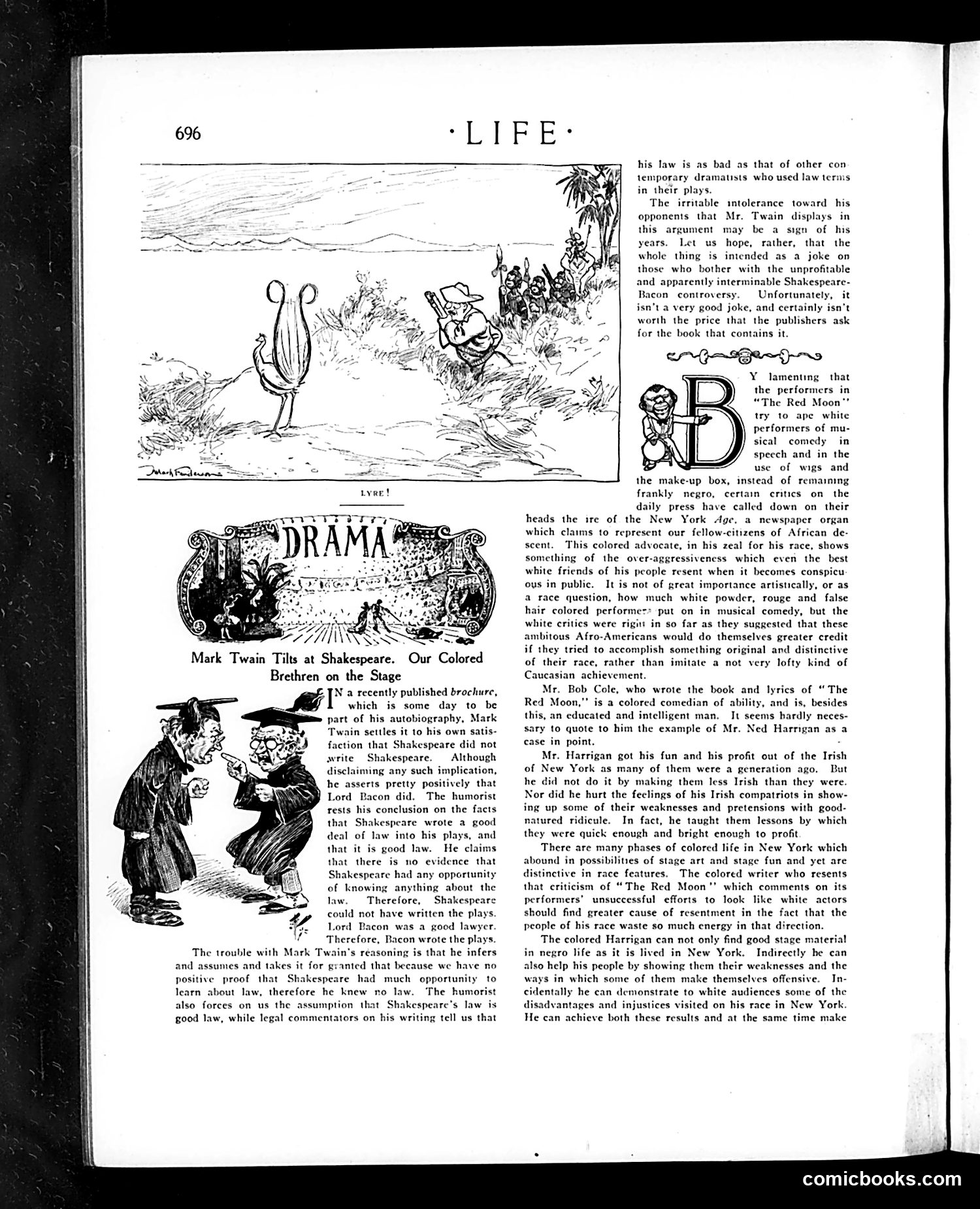
This page contains two distinct critiques: **1. Mark Twain and Shakespeare (top cartoon):** Twain recently published an argument claiming Lord Bacon—not Shakespeare—wrote Shakespeare's plays, because the plays contain good legal knowledge and Shakespeare had no law training. Life's editor ridicules this logic as circular reasoning and suggests Twain is joking about the tedious "Shakespeare-Bacon controversy," though unsuccessfully. **2. "The Red Moon" musical (main article):** Black performers in this musical comedy are criticized for imitating white performers' makeup and style rather than developing distinctly African-American theatrical art. The *New York Age* (a Black newspaper) defended the performers, but Life's editor argues they should follow the example of Irish-American dramatist Ned Harrigan, who authentically portrayed Irish characters and comedy without abandoning their identity—suggesting Black artists would gain more respect creating original race-specific content rather than imitation.
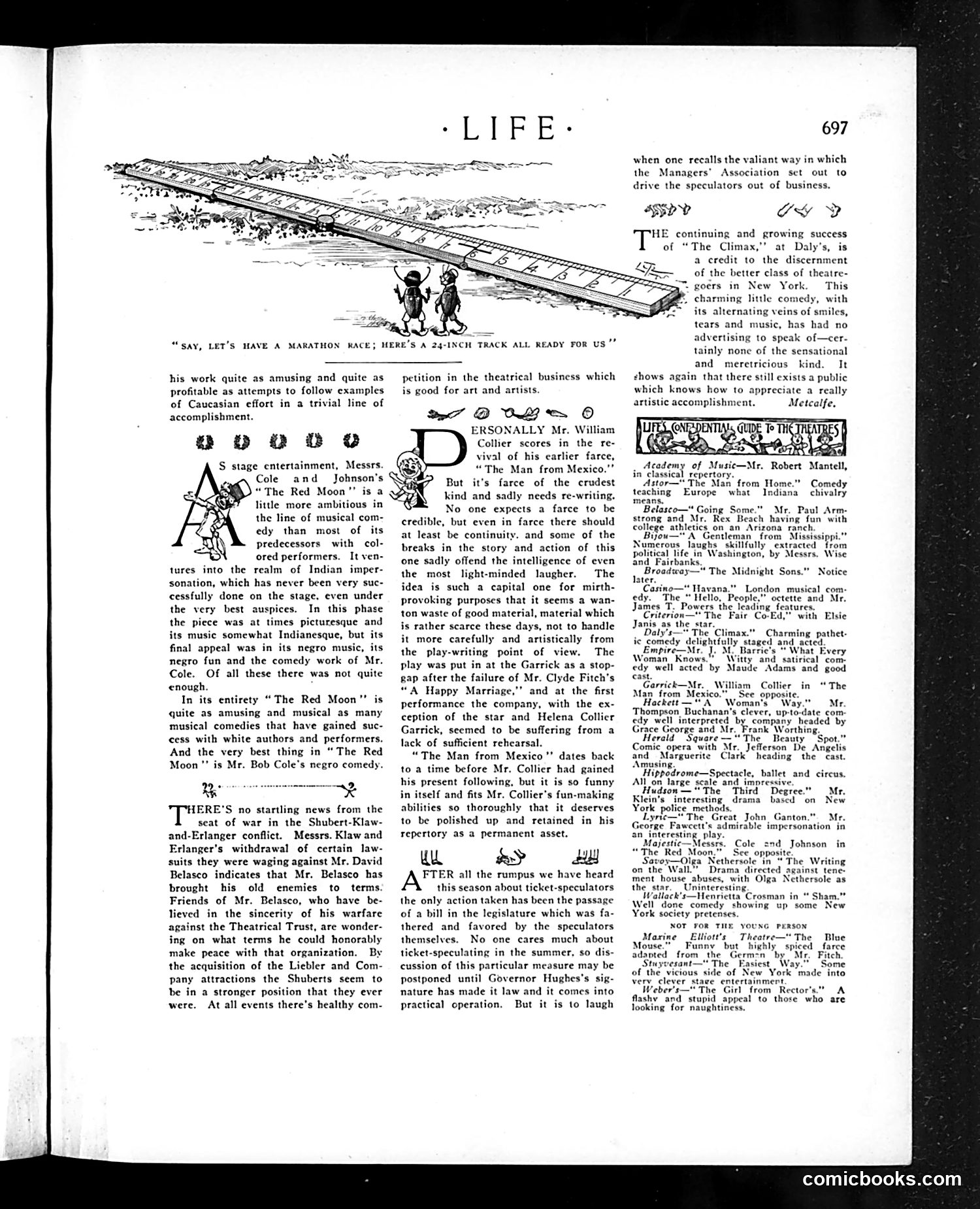
This page from *Life* magazine contains theatrical reviews rather than political cartoons. The main illustration shows two figures examining a 24-inch railroad track, captioned "Say, let's have a marathon race; here's a 24-inch track all ready for us"—likely satirizing the era's fascination with marathon competitions and miniaturized novelties. The text reviews Broadway productions, including Cole and Johnson's "The Red Moon," a musical comedy featuring Black performers and Indian impersonation themes. The reviewer notes the show's "negro music" and "negro fun," using period-appropriate (though offensive) terminology standard to 1906 theater criticism. Other reviews discuss William Collier's farce "The Man from Mexico" and the ongoing theatrical competition between the Shubert-Klaw-Erlanger syndicate and David Belasco—industry conflicts reflecting early 20th-century theatrical business tensions. The page also comments on recently-passed anti-scalping legislation, dismissing it as ineffective and ironically favoring the speculators it supposedly opposed.
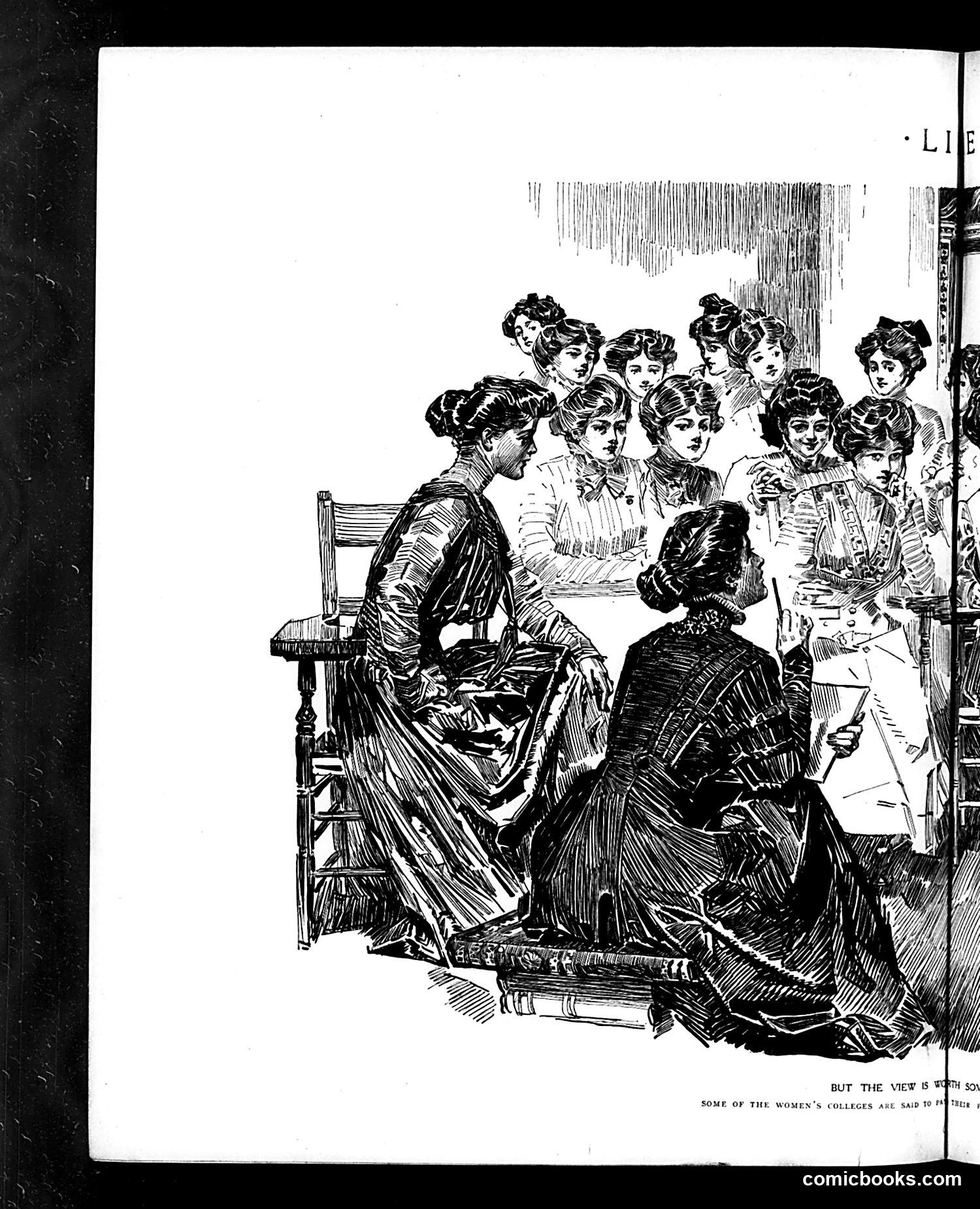
This is a sketch depicting a social gathering of women, likely from the early 1900s based on the clothing and hairstyles. The partial caption reads: "BUT THE VIEW IS WITH SOME OF THE WOMEN'S COLLEGES ARE SAID TO THEIR..." The incomplete text suggests satire about women's colleges and their perceived views on something (the full critique is cut off). The illustration shows well-dressed women in an interior setting, with two women seated prominently in the foreground while others stand in the background observing. Without the complete caption, the specific satirical target is unclear, but Life magazine frequently mocked educational trends and women's institutions of the era. The scene appears to critique either the pretentiousness of women's college culture or their social attitudes, though the exact point remains obscured by the truncated text.
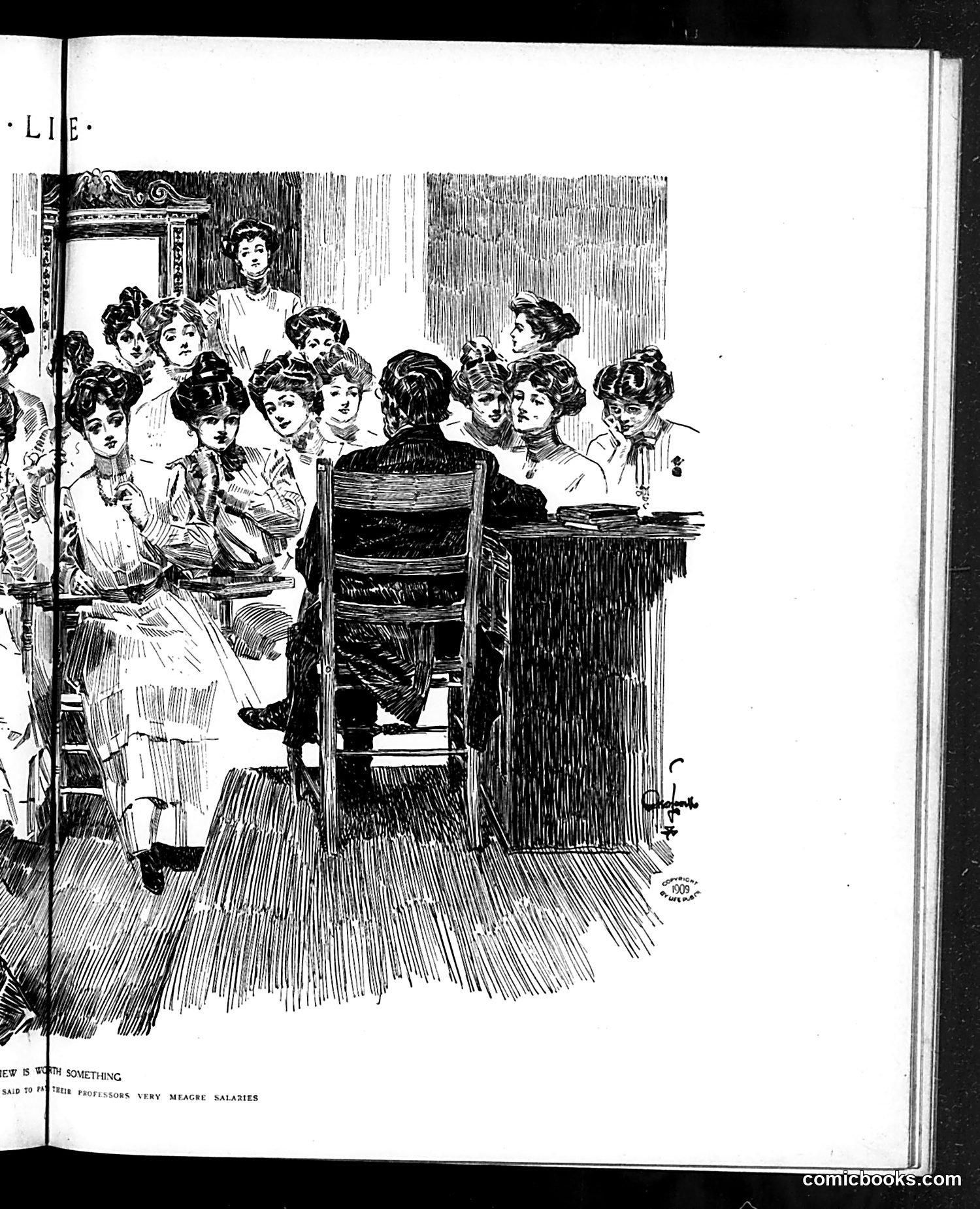
This illustration depicts a classroom scene where a male teacher (seated, viewed from behind) addresses a group of female students. The OCR text fragment mentions "PROFESSORS VERY MEAGRE SALARIES," suggesting the cartoon satirizes academic compensation. The joke likely critiques the irony of educators earning low wages while teaching privileged young women—possibly implying the contrast between the professor's financial struggle and his students' apparent affluence (evident in their fashionable dress and grooming). The composition emphasizes the gender dynamics of early 20th-century education, where women were increasingly entering higher education. Without the complete caption, the precise satirical target remains partially unclear, but it appears to mock either academic economics or social pretensions in educational institutions.
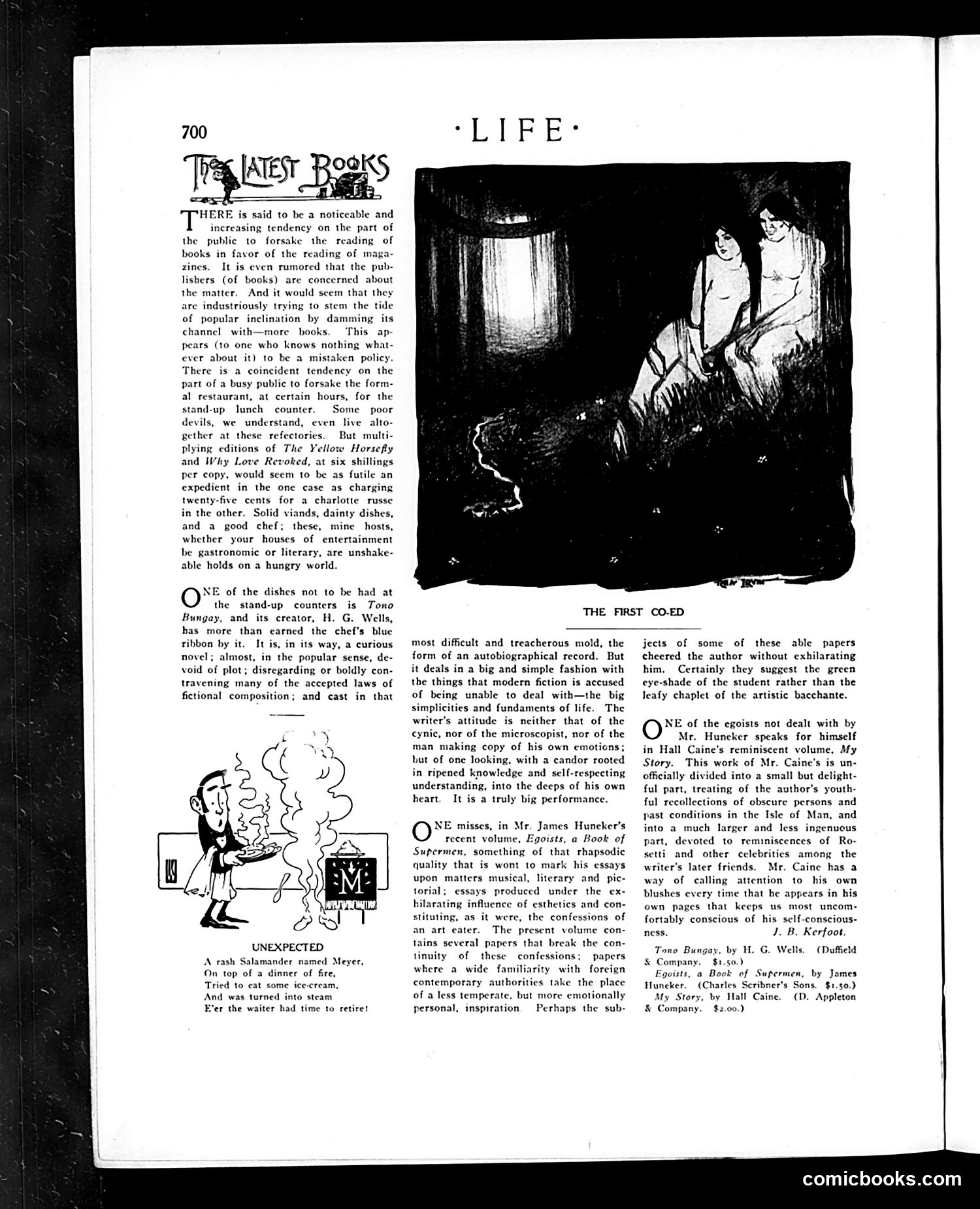
This *Life* magazine page critiques early-20th-century publishing and cultural trends. The main article argues that publishers are losing readers to magazines but respond counterproductively by flooding the market with more books—a strategy the author likens to a restaurant combating fast-casual dining by raising prices on desserts. The page reviews H.G. Wells's *Tono-Bungay*, praising its ambitious scope and honest introspection. It also discusses James Huneker's essay collection *Egoists*, noting that some pieces lack his usual passionate engagement with aesthetic subjects—they read like academic scholarship rather than inspired criticism. The small cartoon labeled "Unexpected" is a light joke: a salamander named Meyer eats ice cream atop flaming food and turns to steam—a pun on thermodynamics for gentle humor. The title "The First Co-ed" likely references an accompanying illustration about women in higher education.
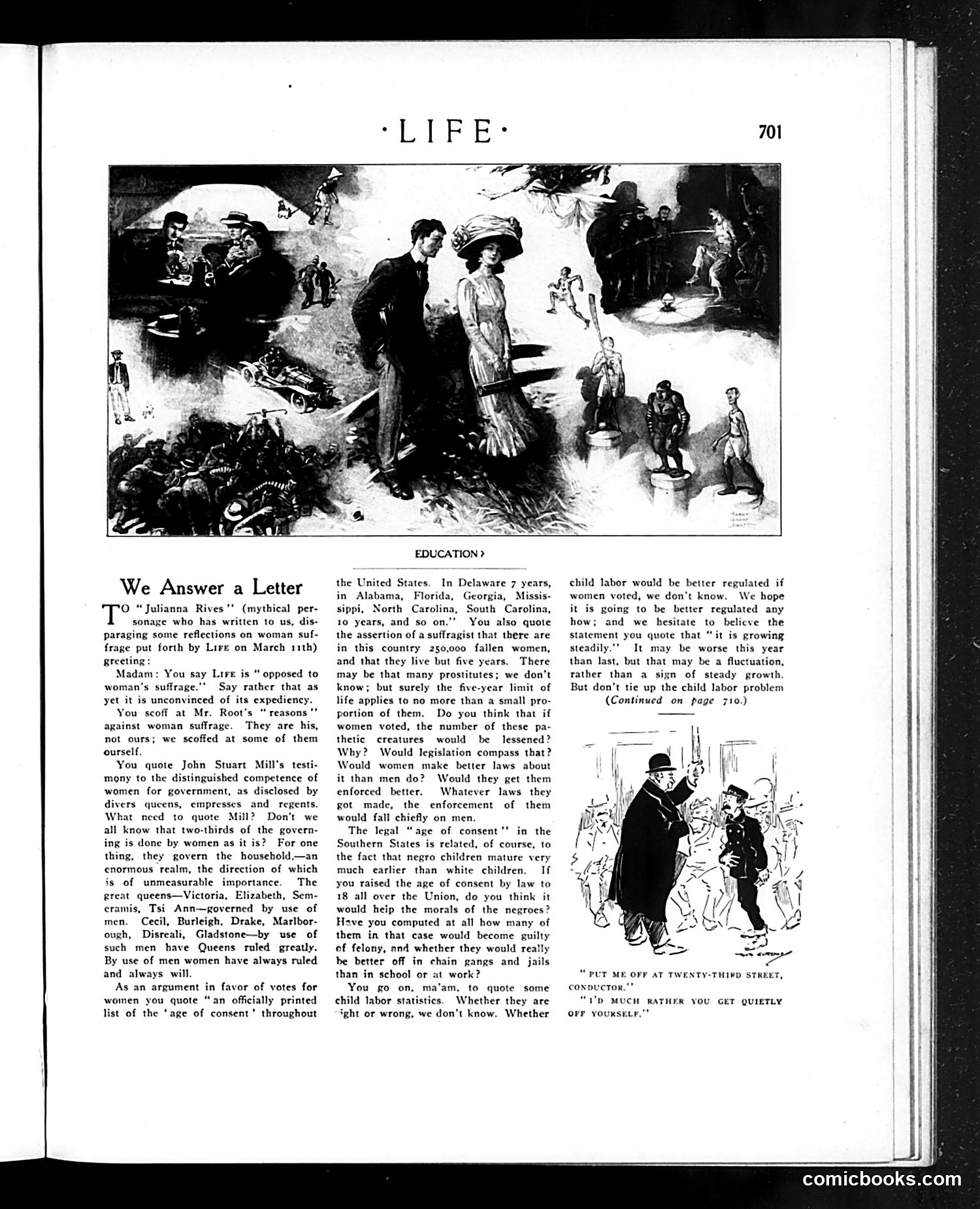
This page presents *Life* magazine's response to a letter from "Julianna Rives" defending women's suffrage. The publication argues *against* giving women the vote by dismantling suffragist arguments: **The satire's strategy:** Life admits women already govern households and have historically influenced kings through male advisors—therefore, voting is unnecessary. The magazine dismisses claims that female voters would reduce prostitution, improve child labor laws, or address racial consent age disparities, arguing enforcement would still fall to men. **The cartoon** (bottom right) shows a woman instructing a conductor to "put me off" at Twenty-Third Street, only to be told she should "get quietly off yourself"—a crude visual metaphor suggesting women should handle their own problems rather than demand political power. The underlying argument: women already possess informal power and don't need formal voting rights to accomplish social reform. This represents mainstream anti-suffrage rhetoric from the early 1910s.
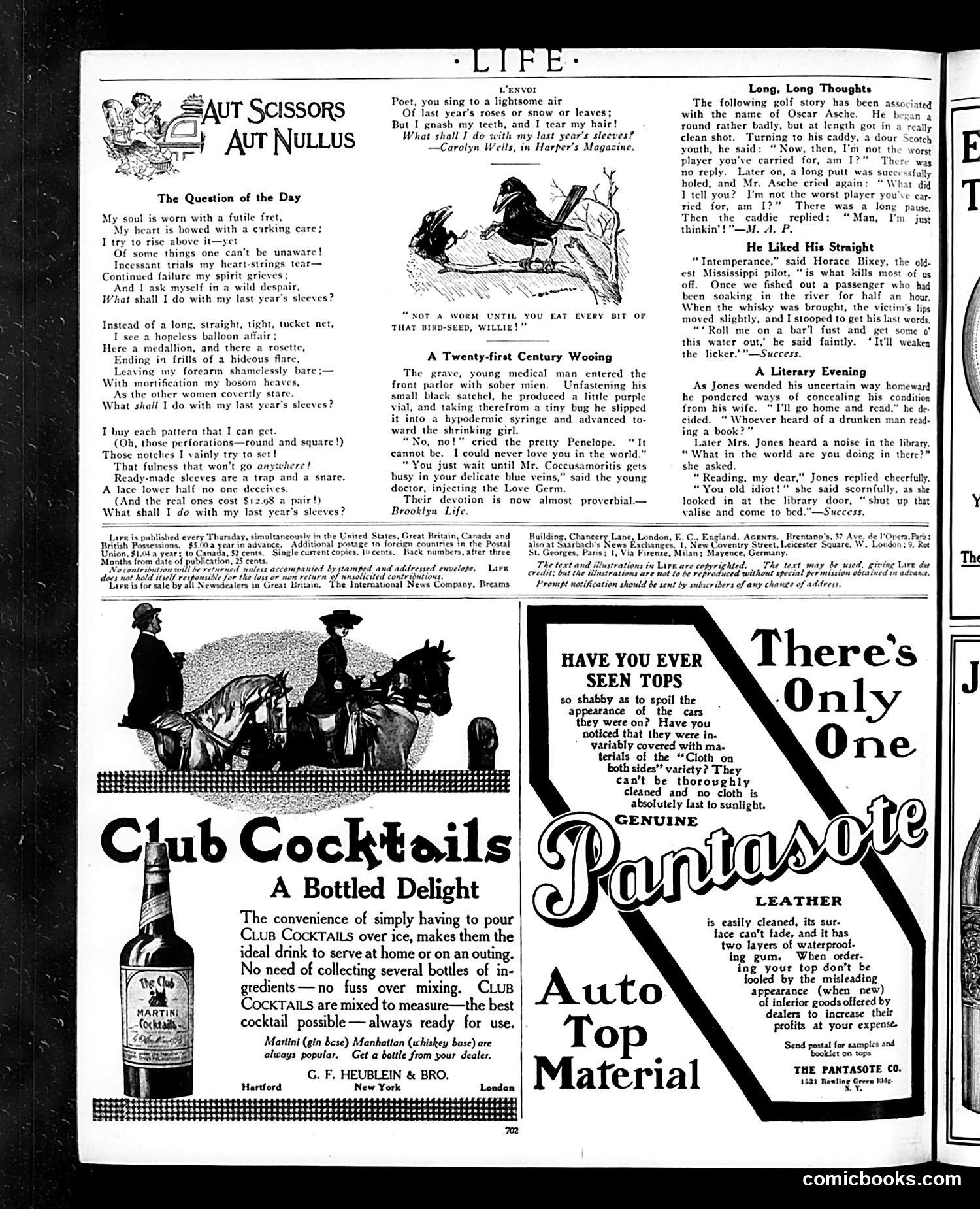
This Life magazine page (circa 1910s-1920s) contains three humorous pieces satirizing everyday frustrations: **"The Question of the Day"** is a comic poem about fashion anxiety—a woman agonizing over outdated sleeves from last year's dresses. The satire mocks the relentless cycle of women's fashion, where garments become unwearable almost immediately due to changing sleeve styles (from tight to puffy and decorated). It's social commentary on how fashion tyranny creates genuine distress for women over "trivial" matters. **"A Twenty-first Century Wooing"** satirizes modern medicine and romance by imagining a doctor injecting a literal "Love Germ" into a woman to make her fall for him—absurdist humor mocking both scientific overconfidence and courtship conventions. **The anecdotes** (Oscar Asche's golf story, the riverboat pilot) are genteel humor about male understatement and wordplay. The advertisements for cocktails and auto-top leather are period products now obsolete. Overall, the page reflects early-20th-century concerns: women's fashion constraints, technological optimism, and masculine bravado.
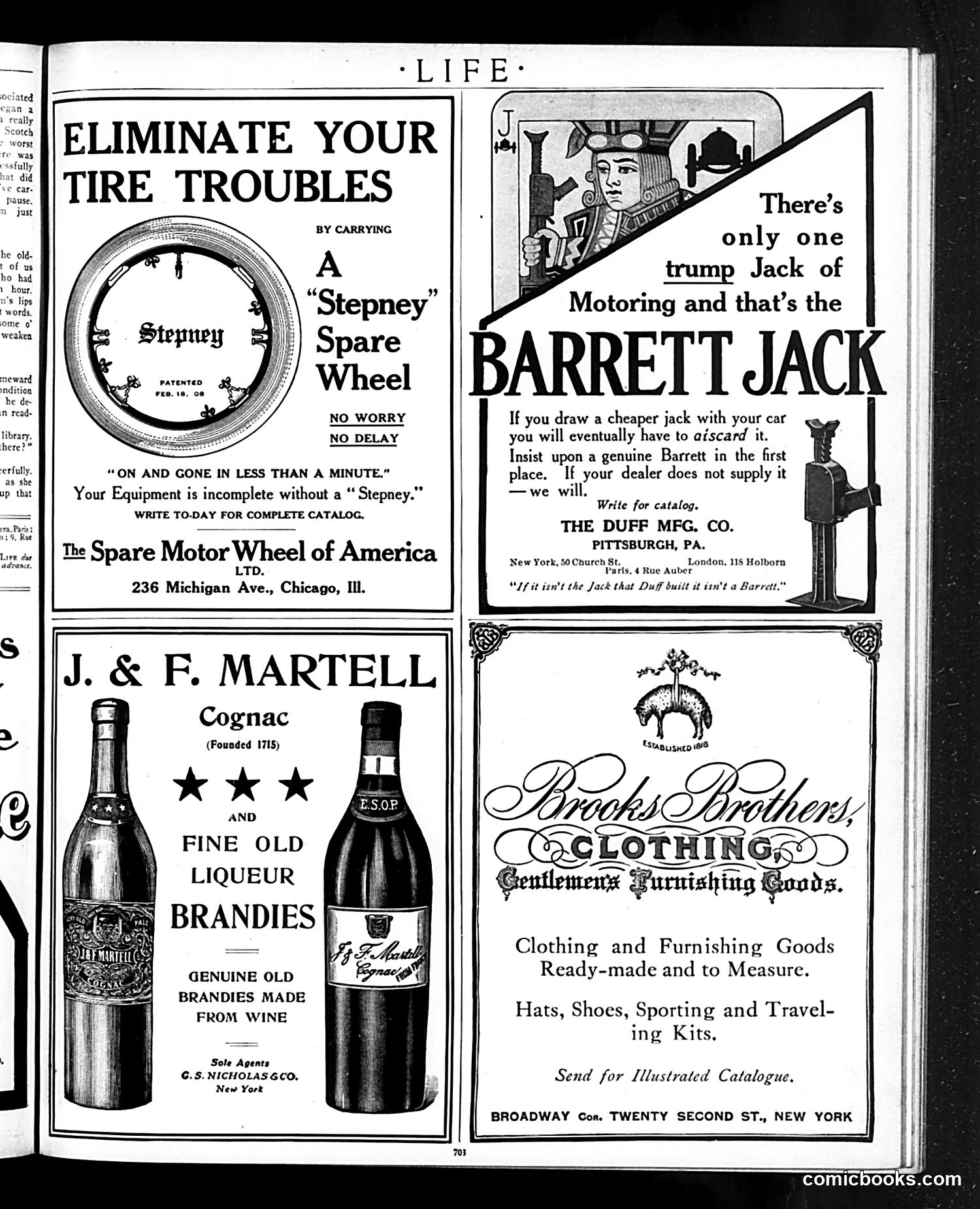
This page is **primarily advertising**, not satire or political commentary. It contains four product advertisements targeting early motorists and gentlemen: 1. **Stepney Spare Wheel** — promotes a quick-change spare tire system for automobiles, emphasizing speed ("on and gone in less than a minute") 2. **Barrett Jack** — advertises a car jack, using competitive messaging that cheaper alternatives are unreliable; includes a slogan implying Barrett is the only trustworthy option 3. **J. & F. Martell Cognac** — sells brandy (founded 1715), marketed as "genuine old" spirits 4. **Brooks Brothers** — clothing retailer offering gentlemen's ready-made and custom garments, hats, and travel kits The page reflects early automotive culture (when spare wheels and jacks were novelties requiring advertising) and targets affluent male consumers through traditional product endorsements. There is **no cartoon satire or political commentary** visible—it's a straightforward commercial page from what appears to be a Life magazine issue from approximately 1910-1920.
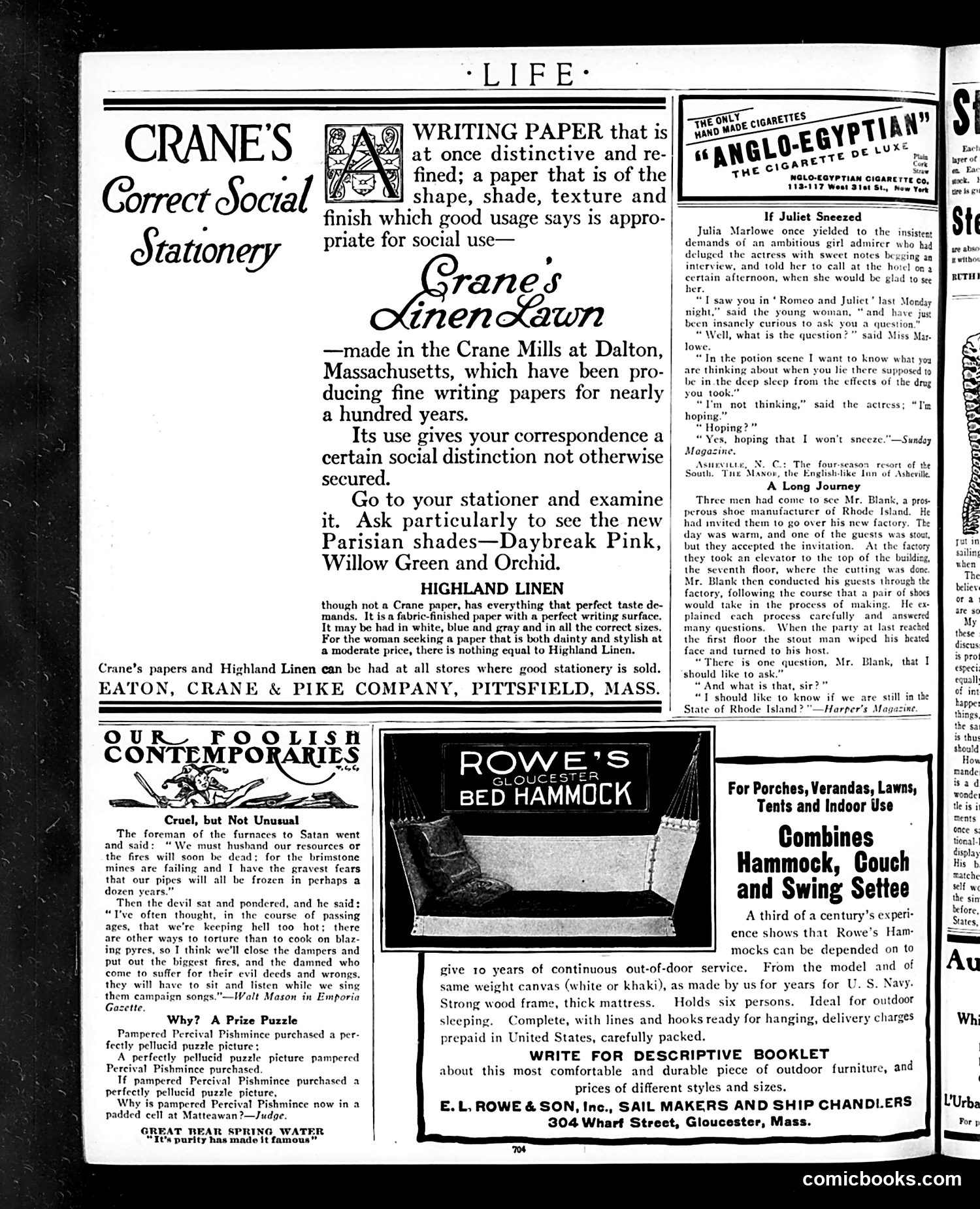
This satirical cartoon presents a dialogue between the Devil and a furnace foreman in Hell. The Devil proposes closing Hell's fires to conserve brimstone resources, arguing that torture need not rely solely on heat—there are other methods of suffering available. The satire targets contemporary waste and resource mismanagement during what appears to be wartime (likely WWI, given the scarcity concerns). By literalizing Hell's resource crisis, the cartoonist mocks public figures or leaders who waste resources or prioritize comfort over necessity. The punchline—that closing the fires would achieve torture through alternative means—cynically suggests that human suffering will continue regardless, perhaps critiquing either the futility of conservation efforts or the inherent cruelty of those in power. The surrounding page content (stationery and hammock advertisements) contrasts sharply with this dark humor, typical of *Life* magazine's editorial approach mixing social commentary with commercial notices.
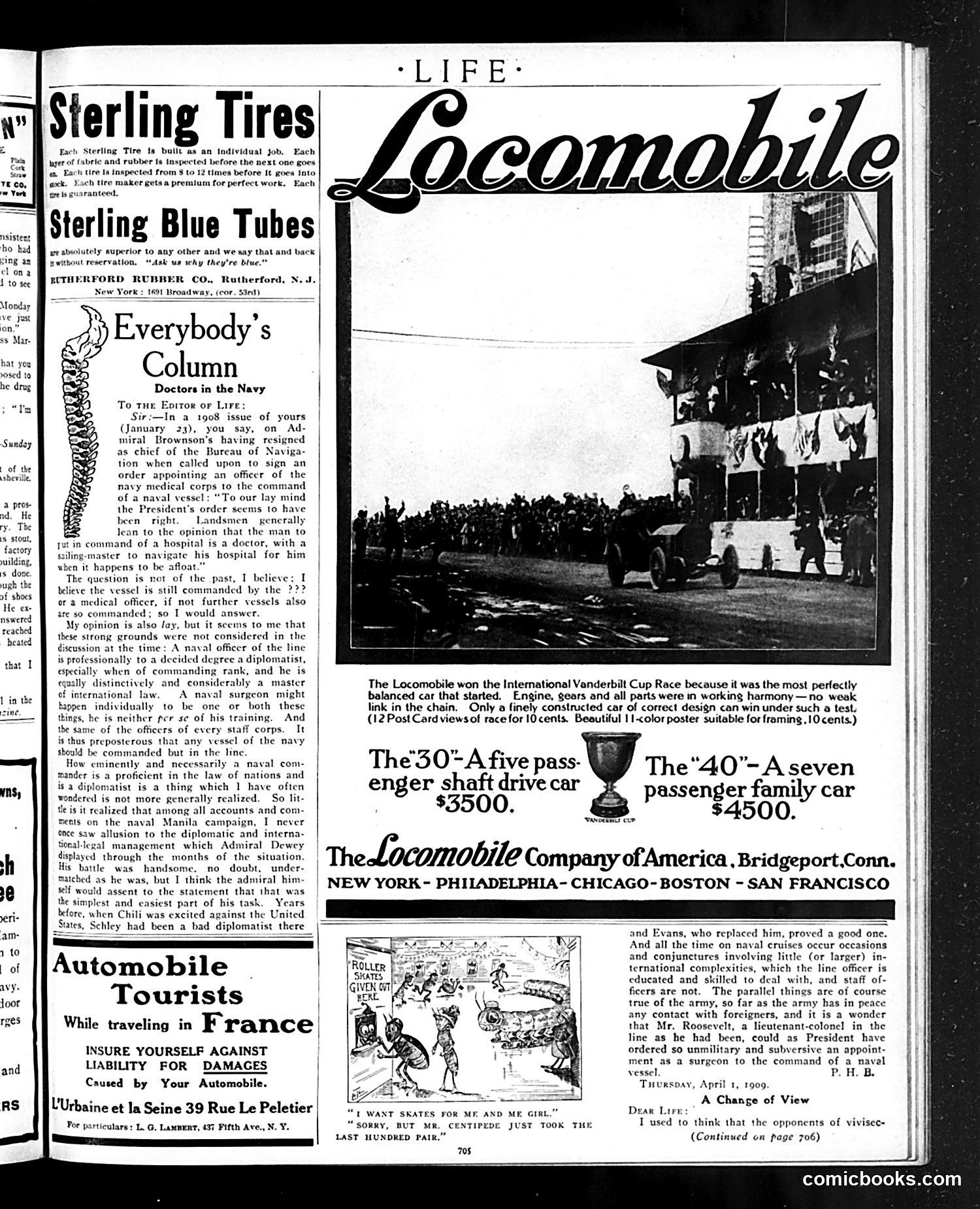
This page from Life magazine (appears to be early 1900s based on references) mixes advertising with editorial content. The main cartoon depicts a centipede on roller skates with the caption "I want skates for me and me girl... sorry, but Mr. Centipede just took the last hundred pair." The joke's humor relies on the absurdity of a centipede—with numerous legs—wanting roller skates, which would be comically impractical. It's a nonsensical visual gag typical of early Life's satirical humor. The page otherwise features advertisements for Sterling tires and tubes, and prominently advertises the Locomobile automobile, highlighting its Vanderbilt Cup Race victory. The "Everybody's Column" discusses naval command structure, debating whether medical officers should command naval vessels—a serious policy question of the era, likely stemming from recent administrative disputes.
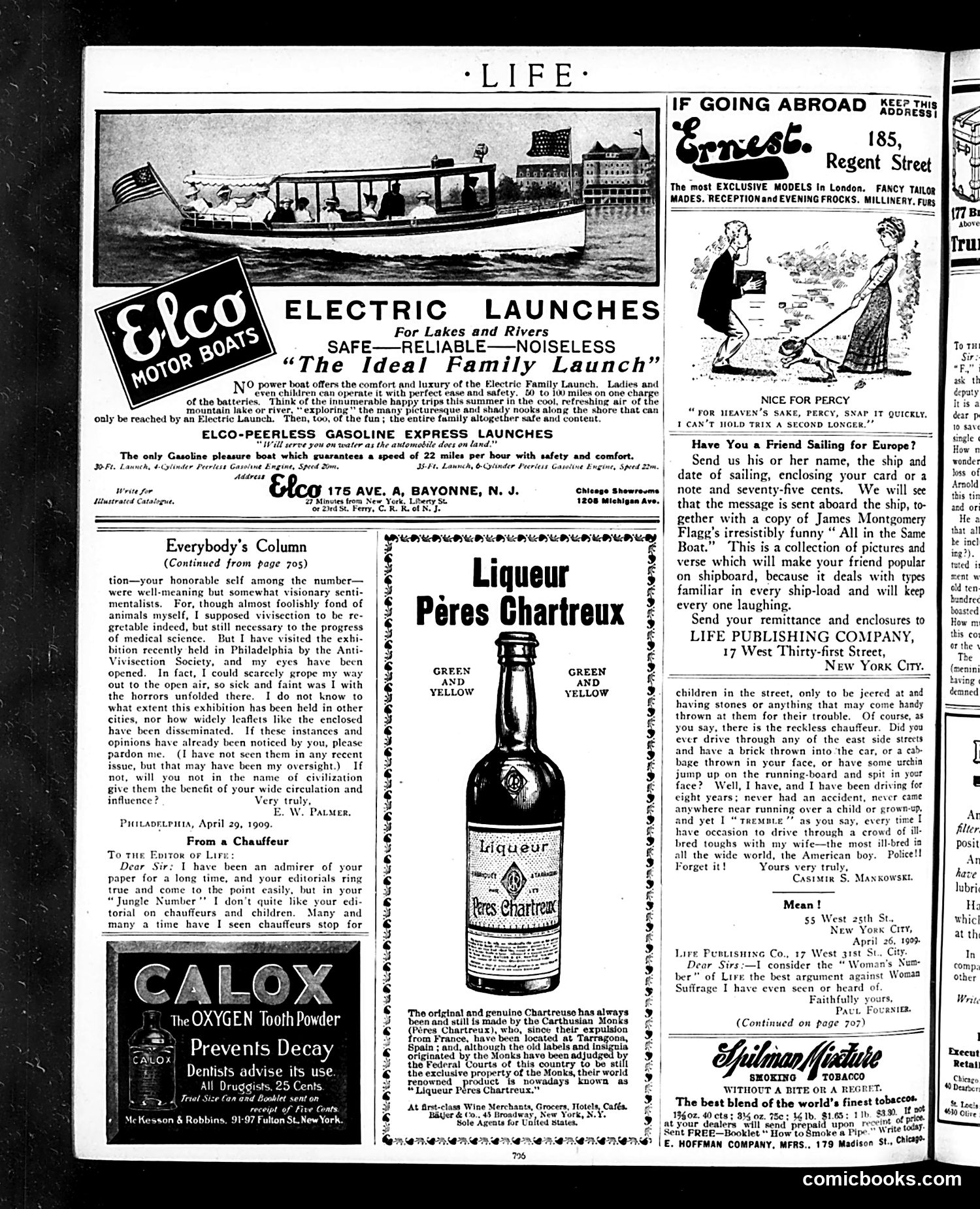
This page is primarily **advertising**, with supplementary reader correspondence sections. The main advertisements promote: - **Elco Electric Launches**: Motor boats marketed as safe, quiet, family-friendly alternatives to gasoline launches for recreational boating on lakes and rivers - **Liqueur Pères Chartreux**: A French liqueur (the text notes the monks who originally made it were expelled from France and relocated to Spain) - **Calox Tooth Powder**: An oxygen-based dental product - **Ernest fashion house** in London The "Everybody's Column" section contains letters from readers: one criticizing vivisection (animal experimentation) following an anti-vivisection exhibition in Philadelphia; another from a chauffeur defending chauffeurs' treatment of children on streets. A small cartoon titled "Nice for Percy" shows two figures with the caption "For Heaven's sake, Percy, say it quickly—I can't hold this a second longer," appearing to be a domestic humor sketch (the reference is unclear without more context). The page reflects early 1900s leisure culture, consumer products, and reader engagement typical of *Life* magazine's format.
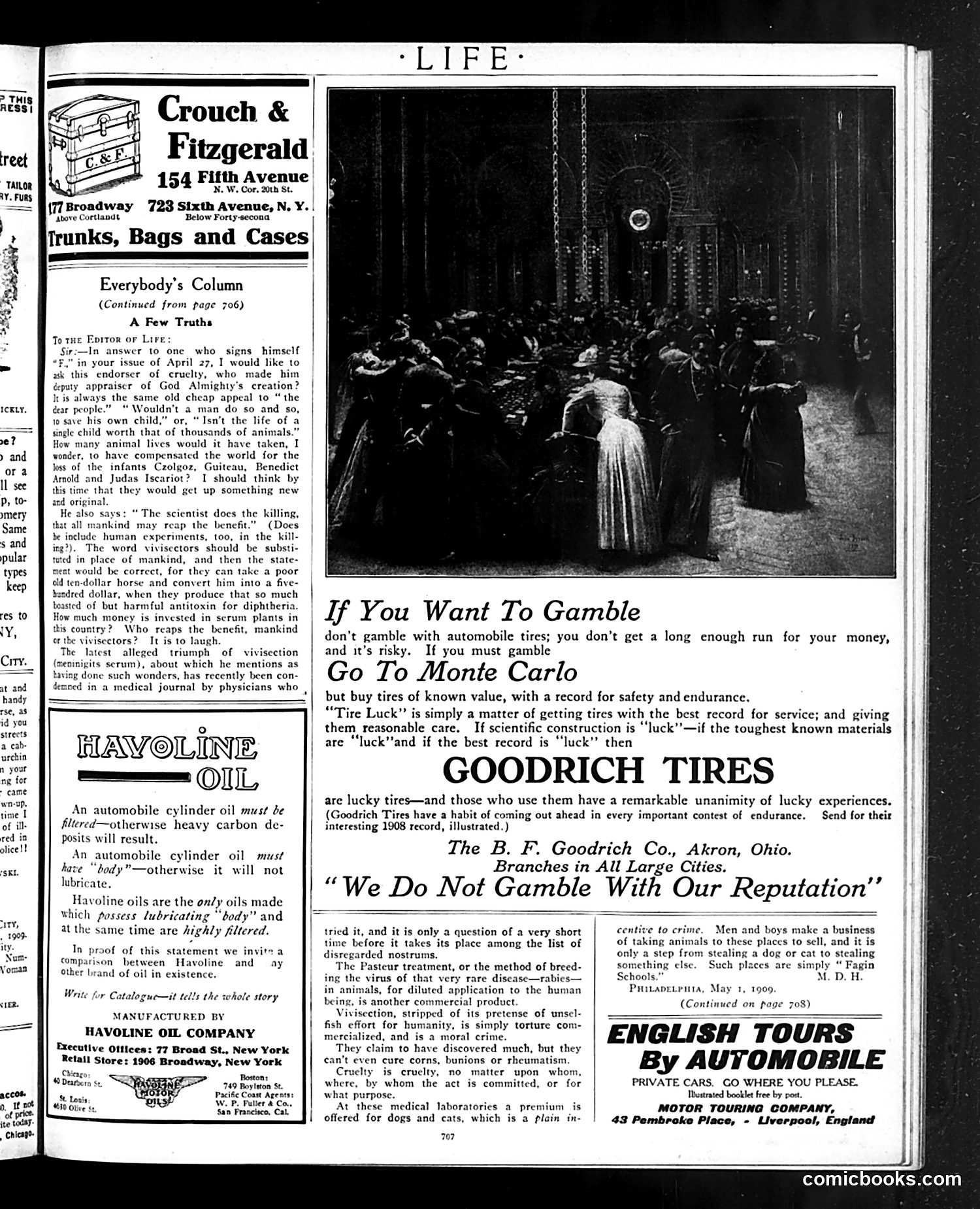
This page is primarily **advertising and editorial content** rather than political cartooning. The main image shows what appears to be a formal gathering or ceremony in a grand interior space, but lacks identifying captions that would clarify its specific reference. The notable editorial content is "A Few Truths," a letter to the editor debating **animal vivisection** (live animal testing). The writer argues against vivisection for medical research, sarcastically questioning whether animal experiments justify themselves by listing infamous historical figures (Czolgosz, Guiteau, Benedict Arnold, Judas) whose deaths might have been "worth" animal lives. The writer also critiques the meningitis serum and Pasteur's rabies treatment as unproven remedies. The page is otherwise filled with advertisements for luggage, motor oil, and tires, employing period marketing rhetoric about reliability and "luck." The overall content reflects early 20th-century debates over scientific ethics and animal rights.
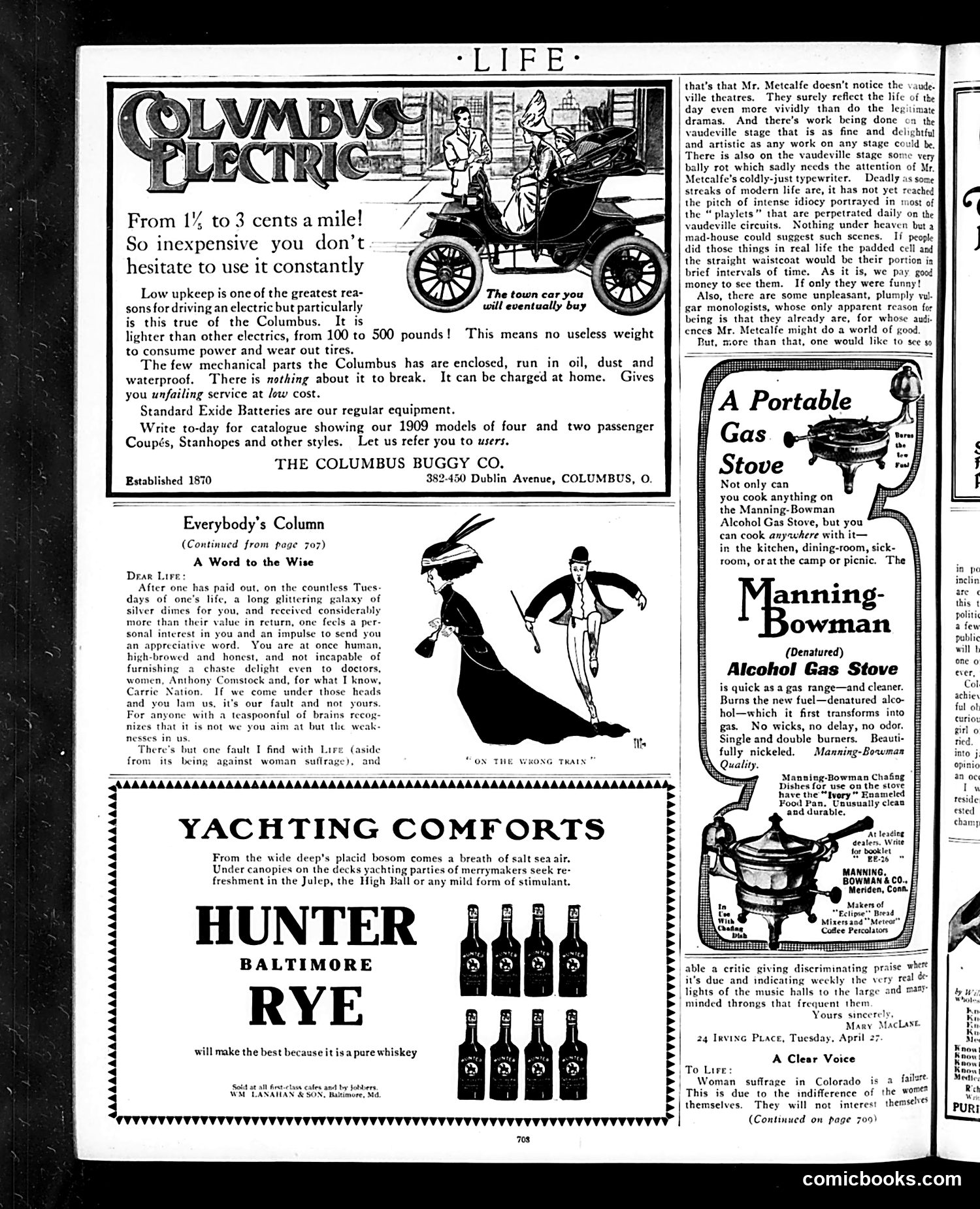
This page is primarily **advertisements and reader letters**, not political satire. The main content includes: **Columbus Electric Car ad** (top): Markets electric automobiles as affordable (1½-3¢/mile) and reliable, targeting the 1909 market when electric vehicles competed with gasoline cars. **"Everybody's Column"**: Reader letters praising Life magazine itself and commenting on vaudeville theater quality—one correspondent criticizes the low artistic standards of popular vaudeville "playlets." **"On the Wrong Train"** cartoon (center): A small illustration showing figures on a train, labeled as being "on the wrong train"—likely a generic visual joke unrelated to political content. **Hunter Baltimore Rye whiskey ad** (bottom left): Advertises whiskey for yachting. **Manning-Bowman Alcohol Gas Stove ad** (right): Promotes a portable cooking device using denatured alcohol fuel. The page reflects early 1900s consumer culture and leisure activities rather than containing political commentary or social satire.
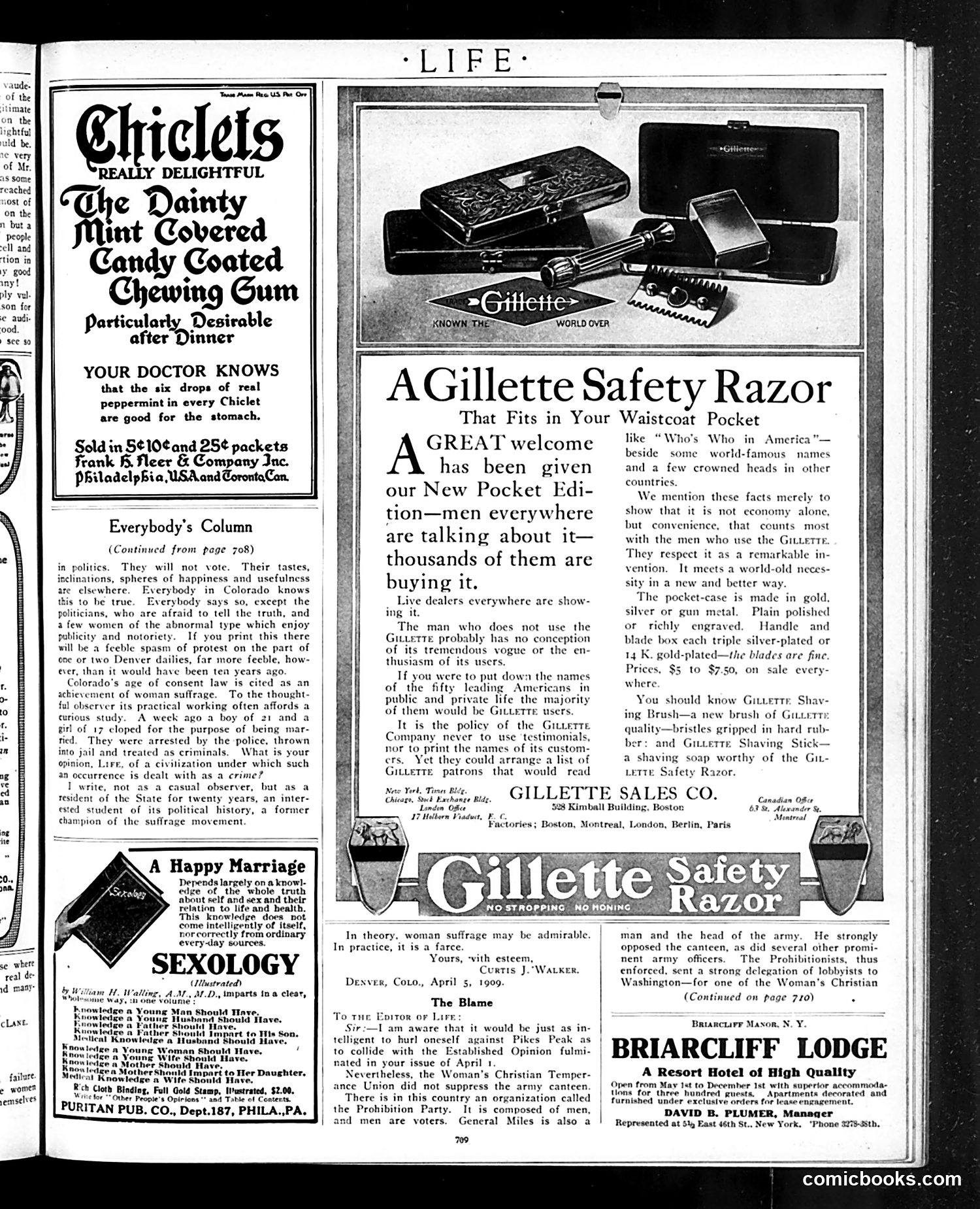
This is primarily an **advertising page** from Life magazine (circa 1909), with some reader letters mixed in. The main content includes ads for **Chiclets gum** (emphasizing digestive benefits), **Gillette Safety Razors** (promoting a new pocket-sized model), and **Briarcliff Lodge** hotel. The "Everybody's Column" section contains **letters to the editor debating women's suffrage**. One Colorado resident argues sarcastically that despite voting rights, women lack real political power and influence—their suffrage is "a farce." Another writer defends women's Christian temperance activism against army opposition to temperance. The **"Sexology" book advertisement** (bottom left) promises sex education for married couples, reflecting early 20th-century anxieties about marital knowledge. The page captures 1909 concerns: **emerging consumer products marketed as modern conveniences, contentious women's rights debates, and shifting attitudes toward discussing sexuality openly**—all positioned alongside commercial appeals.
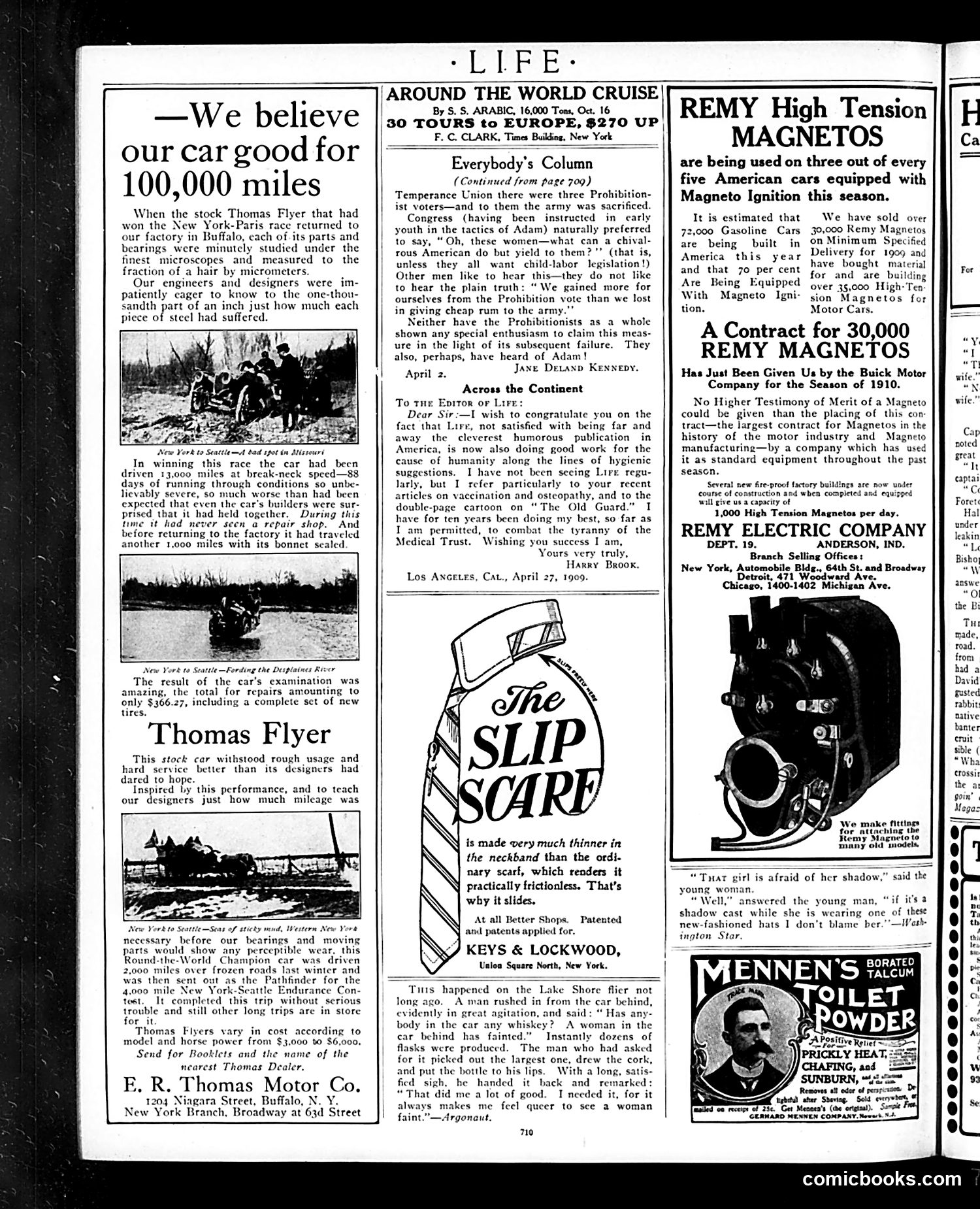
This page is primarily **automobile advertising**, specifically promoting the Thomas Flyer car. The main content celebrates the vehicle's durability by describing how a stock model completed a grueling New York-to-Seattle race (13,000 miles in 83 days) requiring only $366.27 in repairs. The accompanying photographs show the car fording rivers and traversing difficult terrain to visually demonstrate its ruggedness. The implicit message: buy this car because it withstands extreme conditions better than competitors. The right side contains **unrelated advertisements** for Remy magnetos (electrical car components), a "slip scarf" novelty item, and Mennen's talcum powder. The "Everybody's Column" section contains reader letters on various topics—temperance legislation, women's rights, and medical freedom—representing typical public discourse of 1909. **This is not political satire**, but rather a showcase of early automotive engineering claims used to drive consumer sales.
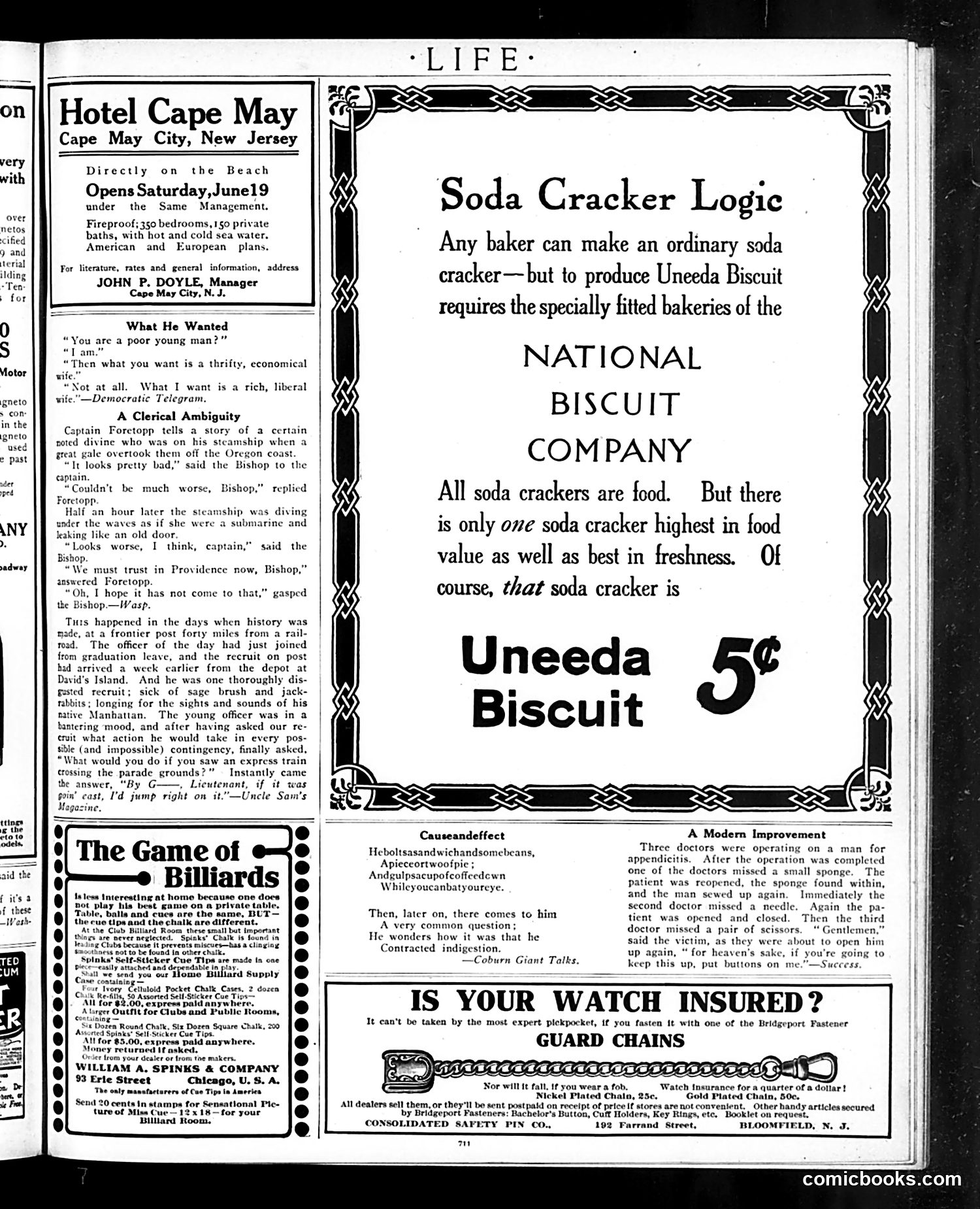
This page is primarily **advertising**, not satirical content. The dominant feature is a National Biscuit Company advertisement for Uneeda Biscuits (5¢), claiming superiority over generic soda crackers based on specialized bakery production. The page includes several brief humorous anecdotes in the margins: - **"What He Wanted"**: A poor man seeks wealth, not economy - **"A Clerical Ambiguity"**: A bishop on a sinking ship trusts Providence; when the ship sinks further, he quips it "couldn't be much worse"—the joke being clergy's supposed naive faith - **"Cause and Effect"**: A satirical hospital story where three doctors sequentially lose surgical instruments (sponge, needle, scissors), with the patient sarcastically suggesting they "put buttons on me" for efficiency These are light, non-political humor pieces typical of *Life* magazine's format. The page also advertises billiards equipment, a Cape May hotel, and watch chains—standard early-20th-century commercial content.
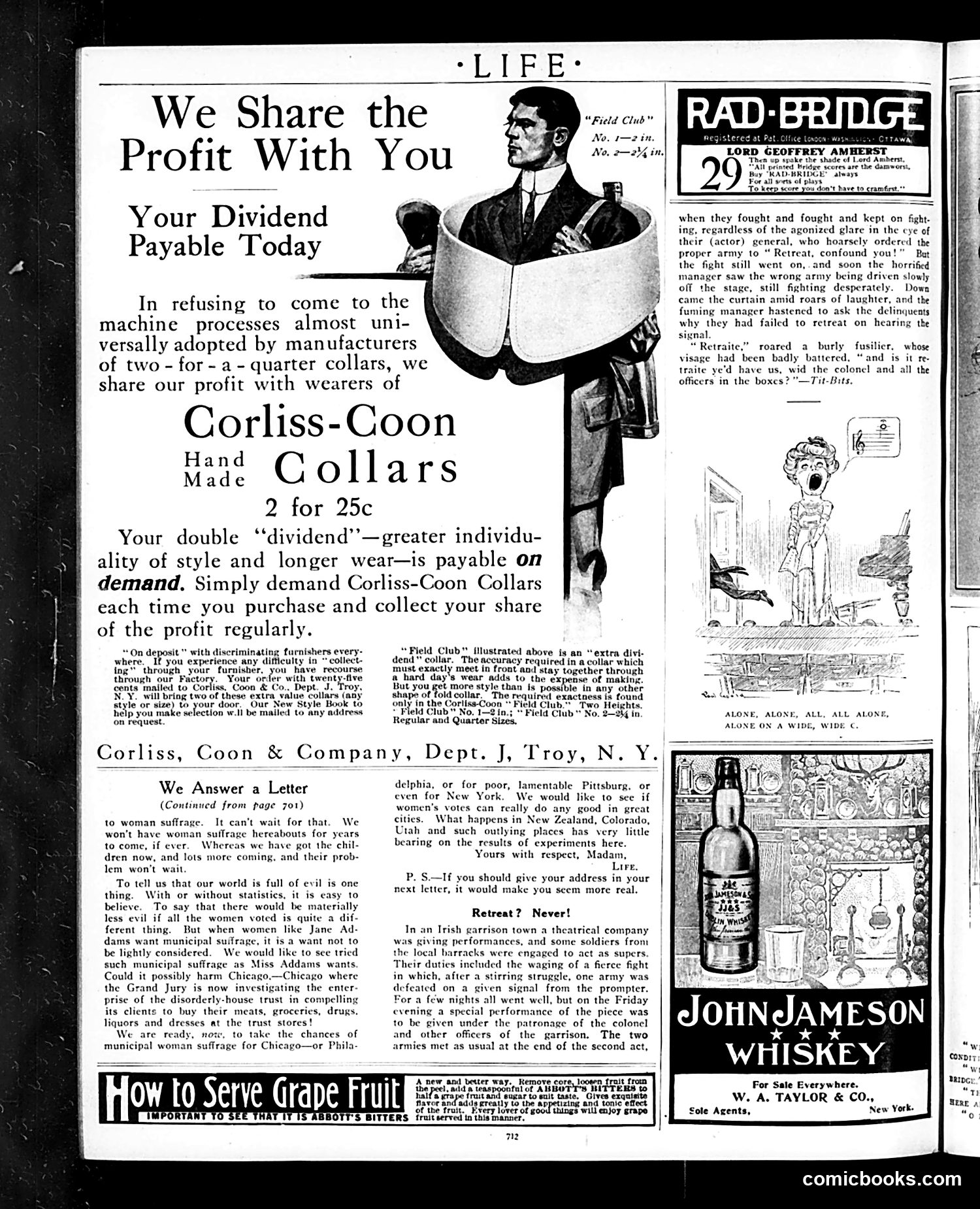
This page contains primarily **advertising** interspersed with editorial content. The main advertisements are for **Corliss-Coon Hand Made Collars** (promoting profit-sharing with consumers) and **John Jameson Whiskey**. The editorial content includes: - **"We Answer a Letter"**: A response to a female reader about women's suffrage, arguing against immediate voting rights for women while acknowledging Jane Addams's reasonable request for municipal (local) suffrage in cities like Chicago - **A humorous anecdote** about Irish soldiers in a theatrical performance who refuse to "retreat" on cue during a staged battle - **A recipe section** for serving grapefruit The page reflects early 20th-century attitudes: skepticism toward women's political participation (despite acknowledging urban reform needs), and light satirical humor about military discipline. No specific political cartoon appears on this page—the humor is contained in the brief anecdotes rather than visual caricature.
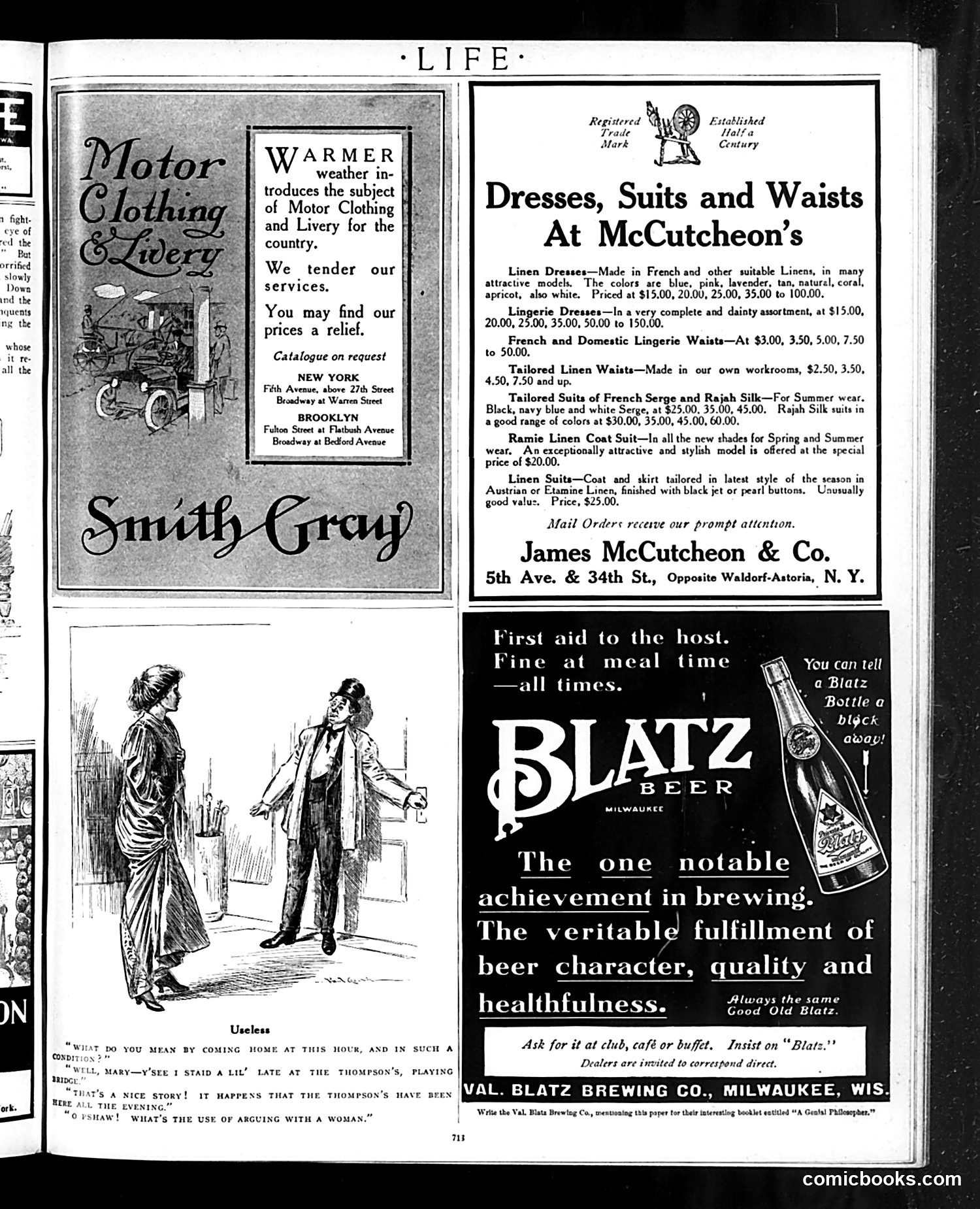
This cartoon satirizes marital discord through a domestic dispute. A man arrives home late, attempting to explain his absence by claiming he stayed at "the Thompson's, playing." His wife confronts him skeptically, suggesting his excuse is unconvincing or dishonest. The caption "Useless" implies the man's explanation is futile—that arguing with his wife about his whereabouts is pointless. The humor derives from the era's common trope of husbands fabricating excuses for late nights out (likely at bars or social venues), while wives remain justifiably suspicious. The cartoon mocks both the husband's transparent deception and the futility of conjugal argument, suggesting that wives simply won't accept such flimsy alibis regardless of persuasive effort. This reflects early 20th-century gender dynamics, portraying women as shrewd domestic gatekeepers skeptical of male behavior.
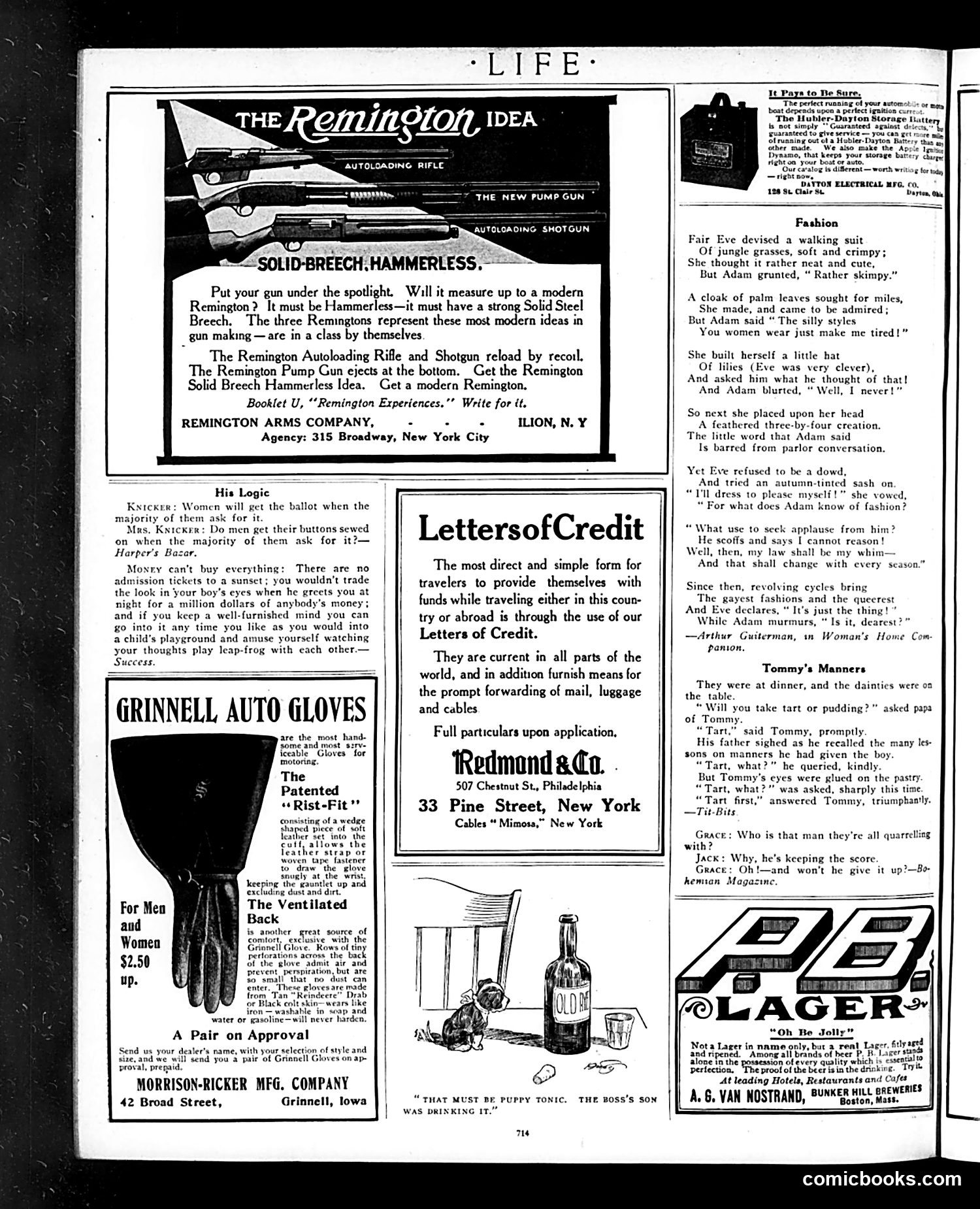
This page is primarily **advertising and humorous fiction**, not political satire. The main content includes: **"Fashion" poem**: A satirical piece about Eve (Adam's wife) repeatedly changing her outfit styles, with Adam constantly complaining they're either too skimpy or ridiculous. The joke is that women's fashion is inherently illogical and cyclical—Eve adopts whatever is trendy to spite Adam's criticism, proving his dismissal of women's reasoning wrong. This reflects early 20th-century gender tensions around women's suffrage and autonomy. **"His Logic" dialogue**: A brief exchange mocking the argument that women don't deserve voting rights until they request it en masse—pointing out men don't earn buttons sewn on by popular demand either. It's pro-women's suffrage satire. **Advertisements** dominate the page: Remington firearms, auto gloves, letters of credit, and lager beer. These are standard period product promotions with no satirical intent. The humor assumes a reader familiar with contemporary debates over women's rights and fashion's rapid, seemingly arbitrary changes.
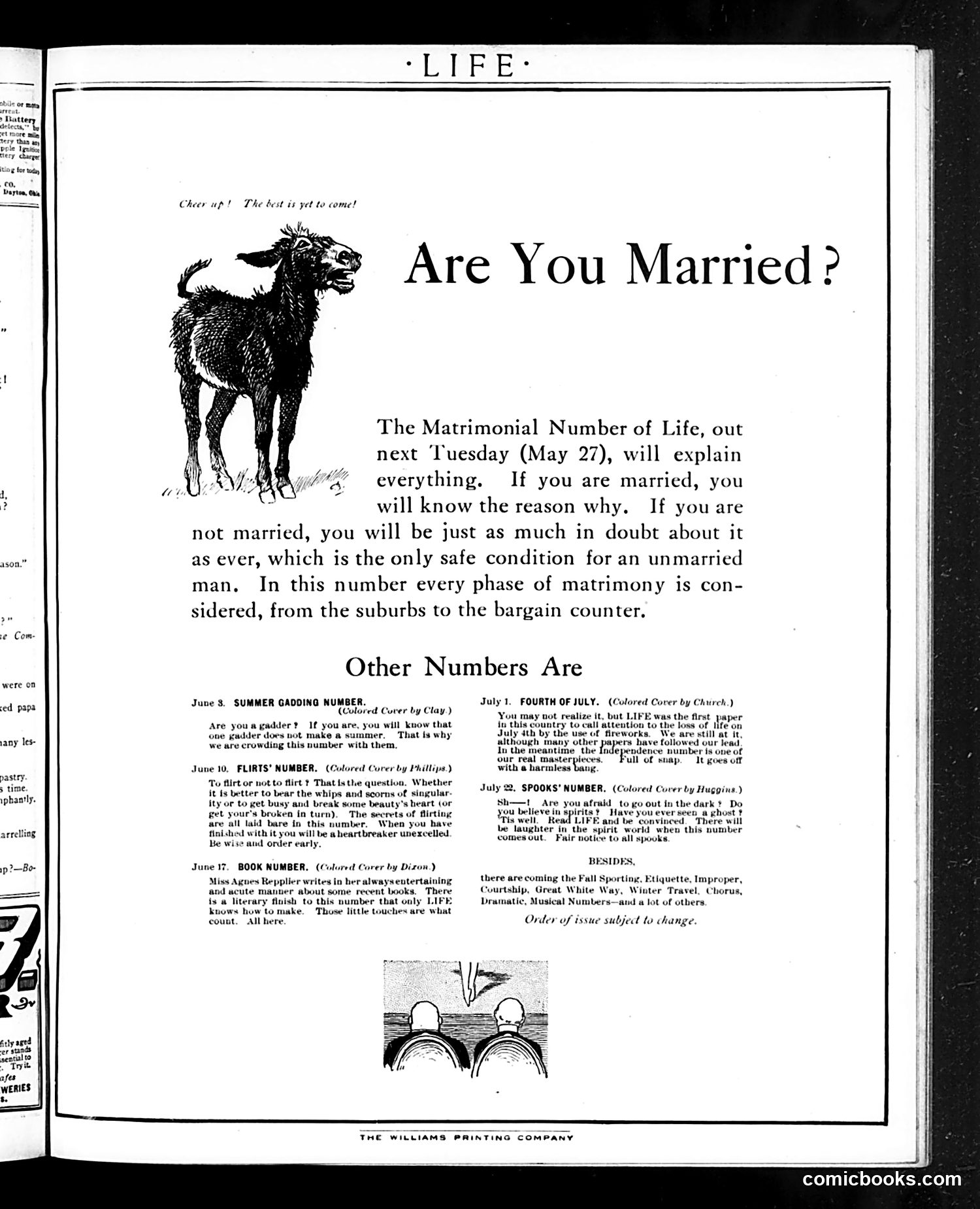
This is a promotional page for *Life* magazine's upcoming "Matrimonial Number" (May 27), employing light satirical humor typical of early 20th-century American magazines. The goat illustration and opening line ("Cheer up! The best is yet to come!") humorously suggest marriage as an inevitable, somewhat dubious fate. The text jokes that married readers will understand matrimony's complexities while unmarried men will remain equally confused—describing ignorance as "the only safe condition" for bachelors. The page advertises future special issues with colored covers by named illustrators, each targeting specific themes: summer travel ("gadding"), flirtation, books, the Fourth of July, and Halloween ("spooks"). The tone throughout is gently mocking of both marriage and modern life's fads, characteristic of *Life*'s satirical approach to American social customs and leisure activities in this era.
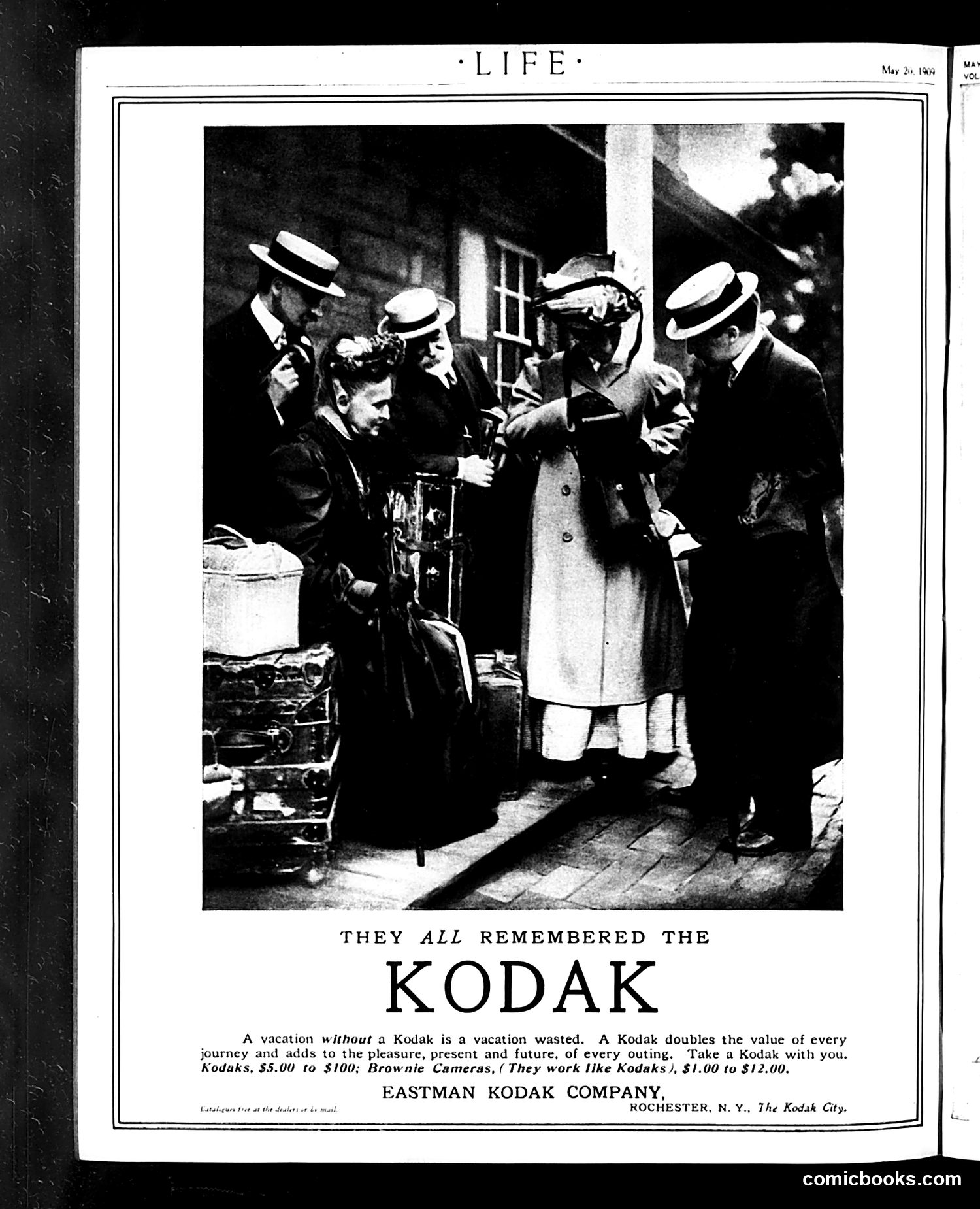
This is a **Kodak camera advertisement**, not political satire. The image shows a group of well-dressed people (men in straw hats, women in fashionable coats) gathered together, apparently sharing vacation memories. The advertisement's message is straightforward: cameras preserve memories and enhance vacations. The tagline "They All Remembered the Kodak" suggests that people recall their trips better when they've documented them photographically. The ad emphasizes Kodak's product range—from expensive models ($5–$100) down to affordable Brownie cameras ($1–$12)—making photography accessible across economic classes. This reflects early 20th-century marketing positioning photography as an essential vacation activity for middle and upper-class Americans. No political figures or satire are present; this is purely commercial promotion.