
Life, 1909-05-20 · page 8 of 36
Life — May 20, 1909 — page 8: what you’re looking at
What you’re looking at
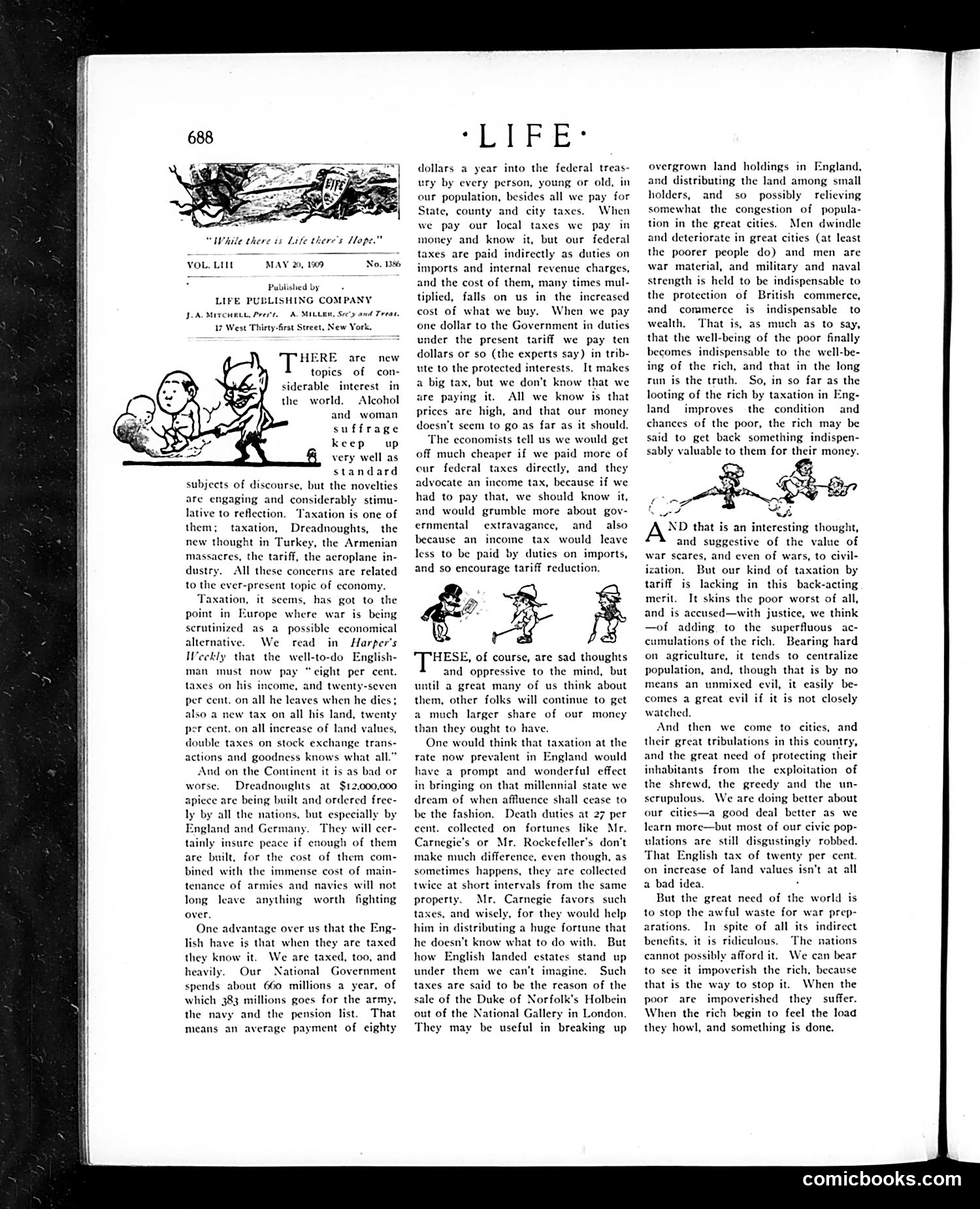
This *Life* magazine page (May 29, 1909) satirizes taxation and wealth inequality during wartime. The text discusses how ordinary citizens pay indirect federal taxes through tariffs and duties without knowing it, while the wealthy escape similar burden. The cartoon illustrations (though small) appear to depict working-class figures contrasted with wealthy ones—a common *Life* visual motif mocking class disparity. The article critiques tariff policy, suggesting the poor bear disproportionate tax burden while the rich benefit from protective trade policies. References to Carnegie and Rockefeller—America's wealthiest industrialists—highlight the tension: their fortunes accumulate while ordinary workers struggle. The satire argues taxation should be transparent and equitable, not hidden in consumer prices.
📄 Transcribed text from this page (OCR, searchable)
Machine-transcribed from the original scan — historical spelling and the odd misread are preserved.
“While there is Life there's Hope. VOL. LIL No. 13% MAY 20, 1909 Published by LIFE PUBLISHING COMPANY JAA MITCHELL, Prost, A MILLER, See'y and Treas, 7 West Thirty-first Street, New York, HERE are new topics of con- siderable interest in the world. Alcohol and woman suffrage keep up very well as standard subjects of discourse, but the novelties are engaging and considerably. stimu- lative to reflection. ‘Taxation is one of them; taxation, Dreadnoughts, the new thought in Turkey, the Armenian massacres, the tariff, the acroplane in- dustry. All these concerns are related to the ever-present topic of economy. Taxation, it seems, got to the point in Europe where war is being scrutinized as a possible economical alternative. We read in) Harper's Weekly that the well-to-do English- man must now pay “eight per cent. taxes on his income, and twenty-seven per cent, on all he leaves when he dies; also a new tax on all his land, twenty per cent. on all increase of land values, double taxes on stock exchange trans- actions and goodness knows what all.” And on the Continent it is as bad or wors Dreadnoughts at $12,000,000 apiece are being built and ordered free- ly by all the nations, but especially by England and Germany. They will cer- tainly insure peace if enough of them are built, for the cost of them com- bined with the immense cost of main- tenance of armies and navies will not long leave anything worth fighting over. One advantage over us that the Eng- lish have is that when they are taxed they know it. We are taxed, too, and heavily. Our National Government spends about 660 millions a year, of which 383 millions goes for the army, the navy and the pension list. That means an average payment of eighty 2) 0 dollars a year into the federal treas- ury by every person, young or old, in our population, besides all we pay for State, county and city taxes. When we pay our local taxes we pay in money and know it, but our federal taxes are paid indirectly as duties on imports and internal revenue charges, and the cost of them, many times mul- tiplied, falls on us in the increased cost of what we buy. When we pay one dollar to the Government in duties under the present tariff we pay ten dollars or so (the experts say) in trib- ute to the protected interests. It makes a big tax, but we don't know that we are paying it. All we know is that prices are high, and that our money doesn’t seem to go as far as it should. The economists tell us we would get off much cheaper if we paid more of cur federal taxes directly, and they advocate an income tax, because if we ad to pay that, we should know it, and would grumble more about gov- ernmental extravagance, and also because an income tax would leave less to be paid by duties on imports, and so encourage tariff reduction. iD 'HESE, of course, are sad thoughts and oppressive to the mind, but until a great many of us think about them, other folks will continue to get a much larger share of our money than they ought to have. One would think that taxation at the rate now prevalent in England would have a prompt and wonderful effect in bringing on that millennial state we dream of when affluence shall cease to be the fashion. Death duties at 27 per cent. collected on fortunes like Mr. Carnegie’s or Mr. Rockefeller’s don't make much difference, even though, as sometimes happens, they are collected twice at short intervals from the same property. Mr. Carnegie favors such taxes, and wisely, for they would help him in distributing a huge fortune that he doesn’t know what to do with. But how English landed estates stand up under them we can’t imagine. Such taxes are said to be the reason of the sale of the Duke of Norfolk's Holbein out of the National Gallery in London. They may be useful in breaking up overgrown land holdings in England, and distributing the land among small holders, and so. possibly relieving somewhat the congestion of popula- tion in the great cities. Men dwindle and deteriorate in great cities (at least the poorer people do) and men are war material, and military and naval strength is held to be indispensable to the protection of British commerce, and commerce is indispensable to wealth, That is, as much as to say, that the well-being of the poor finally becomes indispensable to the well-be- ing of the rich, and that in the long run is the truth. So, in so far as the looting of the rich by taxation in Eng- land improves the condition and chances of the poor, the rich may be said to get back something indispen- sably valuable to them for their money. D that is an interesting thought, and suggestive of the value of war scares, and even of wars, to civil- zation. But our kind of taxation by tariff is lacking in this back-acting merit. It skins the poor worst of all, and is accused—with justice, we think —of adding to the superfluous ac- cumulations of the rich. Bearing hard on agriculture, it tends to centralize population, and, though that is by no means an unmixed evil, it easily be- comes a great evil if it is not closely watched. And then we come to cities, and their great tribulations in this country, and the great need of protecting their inhabitants from the exploitation of the shrewd, the greedy and the un- scrupulous. We are doing better about our cities—a good deal better as we learn more—but most of our civie pop- ulations are still disgustingiy robbed. That English tax of twenty per cent. on increase of land values isn’t at all a bad idea : But the great need of the world is to stop the awful waste for war prep- arations. In spite of all its indirect benefits, it is ridiculous. The nations cannot possibly afford it. We can bear to see it impoverish the rich, because that is the way to stop it. When the poor are impoverished they suffer. When the rich begin to feel the load they howl, and something is done. comicbooks.com