
Life, 1909-05-20 · page 21 of 36
Life — May 20, 1909 — page 21: what you’re looking at
What you’re looking at
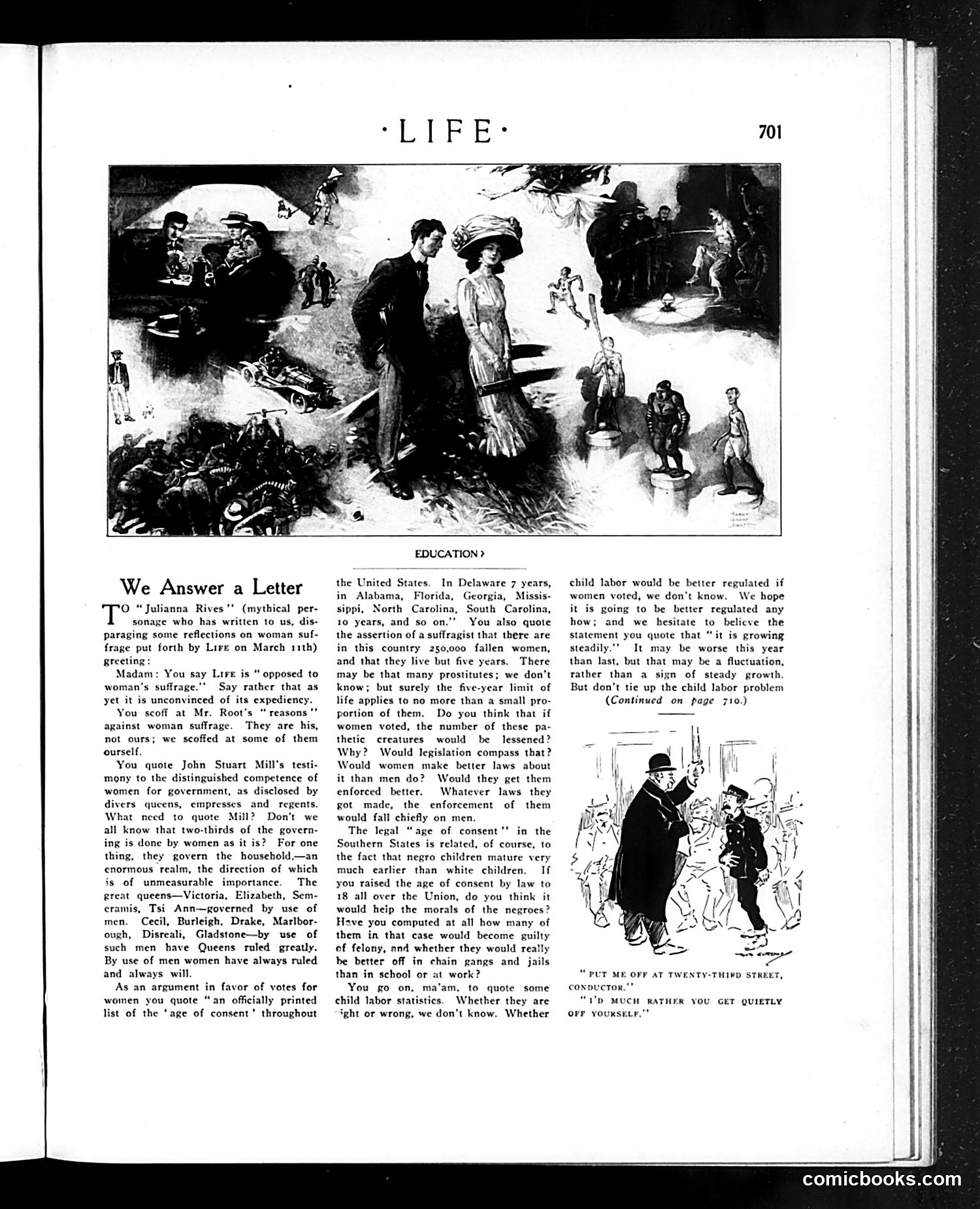
This page presents *Life* magazine's response to a letter from "Julianna Rives" defending women's suffrage. The publication argues *against* giving women the vote by dismantling suffragist arguments: **The satire's strategy:** Life admits women already govern households and have historically influenced kings through male advisors—therefore, voting is unnecessary. The magazine dismisses claims that female voters would reduce prostitution, improve child labor laws, or address racial consent age disparities, arguing enforcement would still fall to men. **The cartoon** (bottom right) shows a woman instructing a conductor to "put me off" at Twenty-Third Street, only to be told she should "get quietly off yourself"—a crude visual metaphor suggesting women should handle their own problems rather than demand political power. The underlying argument: women already possess informal power and don't need formal voting rights to accomplish social reform. This represents mainstream anti-suffrage rhetoric from the early 1910s.
📄 Transcribed text from this page (OCR, searchable)
Machine-transcribed from the original scan — historical spelling and the odd misread are preserved.
We Answer a Letter ‘© “Julianna Rives" (mythical per- sonage who has written to us, dis- paraging some reflections on woman suf- frage put forth by Lire on March 11th) greeting : Madam: You say Lire is “ opposed to woman's suffrage."” Say rather that as yet it is unconvinced of its expediency. You scoff at Mr. Root’s “reasons? against woman suffrage. They are his, not ours; we scoffed at some of them ourself. You quote John Stuart Mill's testi- mony to the distinguished competence of women for government, as disclosed by divers queens, empresses and regents. What need to quote Mill? Don't we all know that two-thirds of the govern- ing is done by women as it is? For one thing, they govern the household—an enormous realm, the direction of which is of unmeasurable importance. The great queens—Victoria, Elizabeth, Sem- cramis, Tsi Ann—governed by use of men. Cecil, Burleigh, Drake, Marlbor- ough, Disreali, Gladstone—by use of such men have Queens ruled greatly. By use of men women have always ruled and always will As an argument in favor of votes for women you quote “an officially printed list of the ‘age of consent’ throughout EDUCATION > the United States. In Delaware 7 years, in Alabama, Florida, Georgia, Missis- sippi, North Carolina, South Carolina, 10 years, and so on."’ You also quote the assertion of a suffragist that there are in this country 250,000 fallen women, and that they live but five years. There may be that many prostitutes; we don’t know; but surely the five-year limit of life applies to no more than a small pro- portion of them. Do you think that if women voted, the number of these pa- thetic creatures would be lessened? Why? Would legislation compass that? Would women make better laws about it than men do? Would they get them enforced better. Whatever laws they got made, the enforcement of them would fall chiefly on men. The legal “age of consent’? in the Southern States is related, of course, to the fact that negro children mature very much earlier than white children. If you raised the age of consent by law to 18 all over the Union, do you think it would heip the morals of the negroes? Have you computed at all how many of them in that case would become guilty of felony, nd whether they would really be better off in chain gangs and jails than in school or at work? You go on, ma'am, to quote some child labor statistics. Whether they are ight or wrong, we don't know. Whether child labor would be better regulated if women voted, we don’t know. We hope it is going to be better regulated any how; and we hesitate to believe the statement you quote that “it is growing steadily.” It may be worse this year than last, but that may be a fluctuation, rather than a sign of steady growth. But don’t tie up the child labor problem (Continued on page 710.) “PUT ME OFF AT TWENTY-THIRD STREET, conpuctor."* “I'D MUCH RATHER YOU GET QUIETLY OFF youxsELr.”” comicbooks.com