
Life, 1909-05-20 · page 20 of 36
Life — May 20, 1909 — page 20: what you’re looking at
What you’re looking at
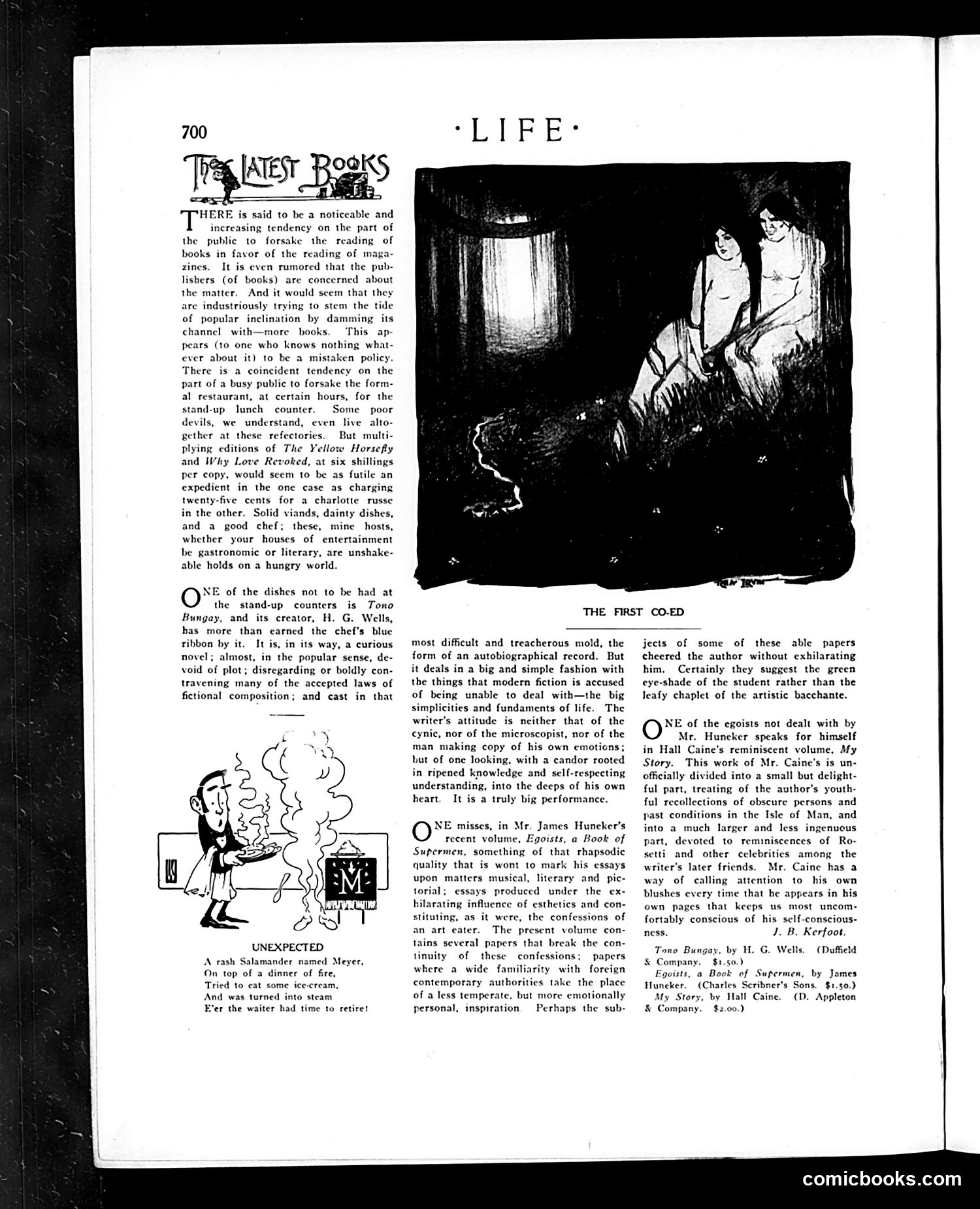
This *Life* magazine page critiques early-20th-century publishing and cultural trends. The main article argues that publishers are losing readers to magazines but respond counterproductively by flooding the market with more books—a strategy the author likens to a restaurant combating fast-casual dining by raising prices on desserts. The page reviews H.G. Wells's *Tono-Bungay*, praising its ambitious scope and honest introspection. It also discusses James Huneker's essay collection *Egoists*, noting that some pieces lack his usual passionate engagement with aesthetic subjects—they read like academic scholarship rather than inspired criticism. The small cartoon labeled "Unexpected" is a light joke: a salamander named Meyer eats ice cream atop flaming food and turns to steam—a pun on thermodynamics for gentle humor. The title "The First Co-ed" likely references an accompanying illustration about women in higher education.
📄 Transcribed text from this page (OCR, searchable)
Machine-transcribed from the original scan — historical spelling and the odd misread are preserved.
[AEST Bosks HERE is said to be a noticeable and increasing tendency on the part of the public to forsake the reading of books in favor of the reading of 1 zines. It is even rumored that the pub- lishers (of books) are concerned about the matter. And it would seem that they are industriously trying to stem the tide of popular inclination by damming its channel _with—more books. ‘This ap- pears (10 one who knows nothing what- ever about it) 10 be a mistaken policy. There is a coincident tendency on the part of a busy public to forsake the form- al restaurant, at certain hours, for the stand-up lunch counter. Some poor devils, we understand, even live alto- gether at these refectories. But multi- plying editions of The Yellow Horsefly and Why Love Revoked, at six shillings per copy, would seem to be as futile an expedient in the one case as charging twenty-five cents for a charlotte russe in the other. Solid viands, dainty dishes, and a good chef; these, mine hosts, whether your houses of entertainment be gastronomic or literary, are unshake- able holds on a hungry world. SE of the dishes not to be had at the stand-up counters is Tono Bungay, and its creator, H. G. Wells, bas more than earned the chef's blue ribbon by it. It is, in its way, a curious novel; almost, in the popular sense, de- void of plot; disregarding or boldly con- travening many of the accepted laws of fictional composition; and cast in that i" ow UNEXPECTED A rash Salamander named Meyer, On top of a dinner of fire, Tried to cat some ice-cream, And was turned into steam E’er the waiter had time to retiret THE FIRST CO-ED most difficult and treacherous mold, the form of an autobiographical record. But it deals in a big and simple fashion with the things that modern fiction is accused of being unable to deal with—the big simplicities and fundaments of life. The writer's attitude is neither that of the cynic, nor of the microscopist, nor of the man making copy of his own emotions; but of one looking, with a candor rooted in ripened knowledge and self-respecting understanding, into the deeps of his own heart. It is a truly big performance. O° misses, in Mr. James Huneker’s recent volume, Egoists, a Book of Supermen, something of that rhapsodic quality that is wont to mark his essays upon matters musical, literary and_pic- torial; essays produced under the ex- hilarating influence of esthetics and con- stituting, as it were, the confessions of an art eater. The present volume con- tains several papers that break the con- tinuity of these confessions; papers where a wide familiarity with foreign authorities take the place of a less temperate, but more emotionally Personal, inspiration. Perhaps the sub- contemporary, jects of some of these able papers cheered the author without exhilarating him. Certainly they suggest the green eye-shade of the student rather than the leafy chaplet of the artistic bacchante. NE of the egoists not dealt with by Mr. Huncker speaks for himself in Hall Caine’s reminiscent volume, My Story. This work of Mr. Caine’s is un- officially divided into a small but delight- ful part, treating of the author's youth- ful recollections of obscure persons and past conditions in the Isle of Man, and into a much larger and less ingenuous part, devoted to reminiscences of Ro- setti_ and other celebrities among the writer's later friends. Mr. Caine has a way of calling attention to his own blushes every time that he appears in his own pages that keeps us most uncom: fortably conscious of his sclf-conscious- J. B. Kerfoot. H. G. Wells. (Duffield ness. Tono Bungay. by & Company. $1.50.) Egoists, a Book of Supermen, by James Huneker. (Charles Scribner's Sons. $1.50.) My Story, by Hall Caine. (D. Appleton & Company. $2.00.) comicbooks.com