
Life, 1909-05-20 · page 16 of 36
Life — May 20, 1909 — page 16: what you’re looking at
What you’re looking at
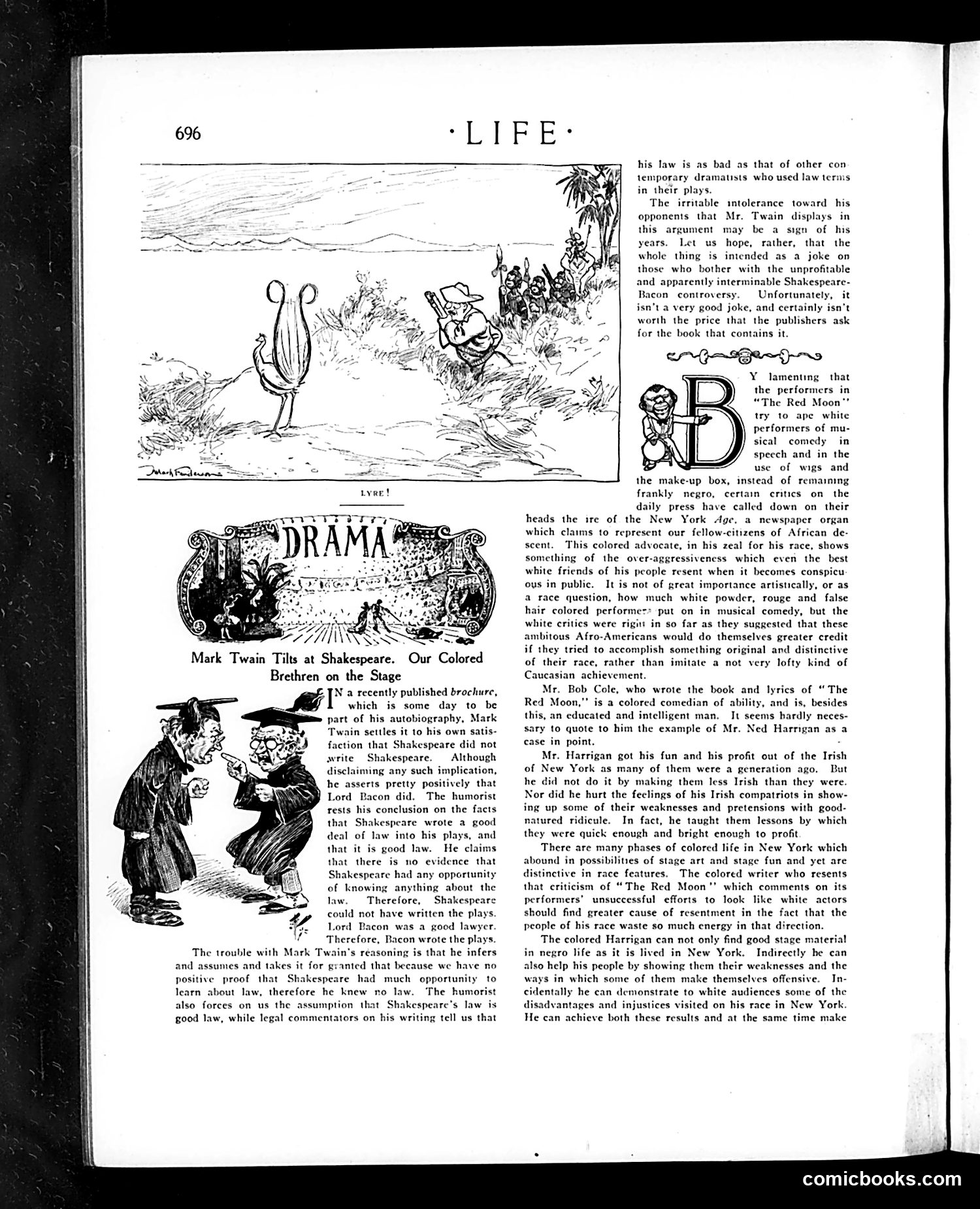
This page contains two distinct critiques: **1. Mark Twain and Shakespeare (top cartoon):** Twain recently published an argument claiming Lord Bacon—not Shakespeare—wrote Shakespeare's plays, because the plays contain good legal knowledge and Shakespeare had no law training. Life's editor ridicules this logic as circular reasoning and suggests Twain is joking about the tedious "Shakespeare-Bacon controversy," though unsuccessfully. **2. "The Red Moon" musical (main article):** Black performers in this musical comedy are criticized for imitating white performers' makeup and style rather than developing distinctly African-American theatrical art. The *New York Age* (a Black newspaper) defended the performers, but Life's editor argues they should follow the example of Irish-American dramatist Ned Harrigan, who authentically portrayed Irish characters and comedy without abandoning their identity—suggesting Black artists would gain more respect creating original race-specific content rather than imitation.
📄 Transcribed text from this page (OCR, searchable)
Machine-transcribed from the original scan — historical spelling and the odd misread are preserved.
his law is as bad as that of other con temporary dramatists who used law terms in their plays. The irritable intolerance toward his opponents that Mr. Twain displays in this argument may be a sign of his years, Let us hope, rather, that the whole thing is intended as a joke on those who bother with the unprofitable and apparently interminable Shakespeare- Bacon controversy. Unfortunately, it isn’t a very good joke, and certainly isn’t worth the price that the publishers ask for the book that contains it. EMG SGR— 9 Y lamenting that the performers in “The Red Moon” try to ape white performers of mu- sical comedy in specch and in the use of wigs and SS re. Our Colored Brethren on the Stage N a recently published brochure, which is some day to be part of his autobiography, Mark Twain settles it to his own sat faction that Shakespeare did not write Shakespeare. Although disclaiming any such implication, he asserts pretty positively that Lord Bacon did. The humorist rests his conclusion on the facts that Shakespeare wrote a good deal of law into his plays, and that it is good law. He claims that there is no evidence that Shakespeare had any opportunity of knowing anything about the law. Therefore, Shakespeare could not have written the pla Lord Bacon was a good lawyer. Therefore, Bacon wrote the plays. The trouble with Mark Twain's reasoning is that he infers and assumes and takes it for granted that because we have no positive proof that Shakespeare had much opportunity to learn about law, therefore he knew no law. The humori also forces on us the assumption that Shakespeare's law is good law, while legal commentators on his writing tell us that the make-up box, instead of remaining frankly negro, certain critics on the daily press have called down on their heads the ire of the New York Age, a newspaper organ which claims to represent our fellow-citizens of African de- scent. This colored advocate, in his zeal for his race, shows something of the over-aggressiveness which even the best white friends of his people resent when it becomes conspicu ous in public. It is not of great importance artistically, or as a race question, how much white powder, rouge and false hair colored performe:> put on in musical comedy, but the white critics were rigit in so far as they suggested that these ambitous Afro-Americans would do themselves greater credit if they tried to accomplish something original and distinctive of their race, rather than imitate a not very lofty kind of Caucasian achievement Mr. Bob Cole, who wrote the book and lyrics of “The Red Moon,” is a colored comedian of ability, and is, besides this, an educated and intelligent man. It seems hardly neces- sary to quote to him the example of Mr. Ned Harrigan as a case in point. Mr. Harrigan got his fun and his profit out of the Irish of New York as many of them were a generation ago. But he did not do it by making them less Irish than they were. Nor did he hurt the feclings of his Irish compatriots in show- ing up some of their weaknesses and pretensions with good- natured ridicule. In fact, he taught them lessons by which they were quick enough and bright enough to profit There are many phases of colored life in New York which abound in possibilities of stage art and stage fun and yet are inctive in race features. The colored writer who resents that criticism of “The Red Moon"? which comments on its performers’ unsuccessful efforts to look like white actors should find greater cause of resentment in the fact that the people of his race waste so much energy in that direction. The colored Harrigan can not only find good stage material in negro life as it is lived in New York. Indirectly he can also help his people by showing them their weaknesses and the ways in which some of them make themselves offensive. In- cidentally he can demonstrate to white audiences some of the disadvantages and injustices visited on his race in New York. He can achieve both these results and at the same time make comicbooks.com