
A complete issue · 32 pages · 1909
Life — May 13, 1909
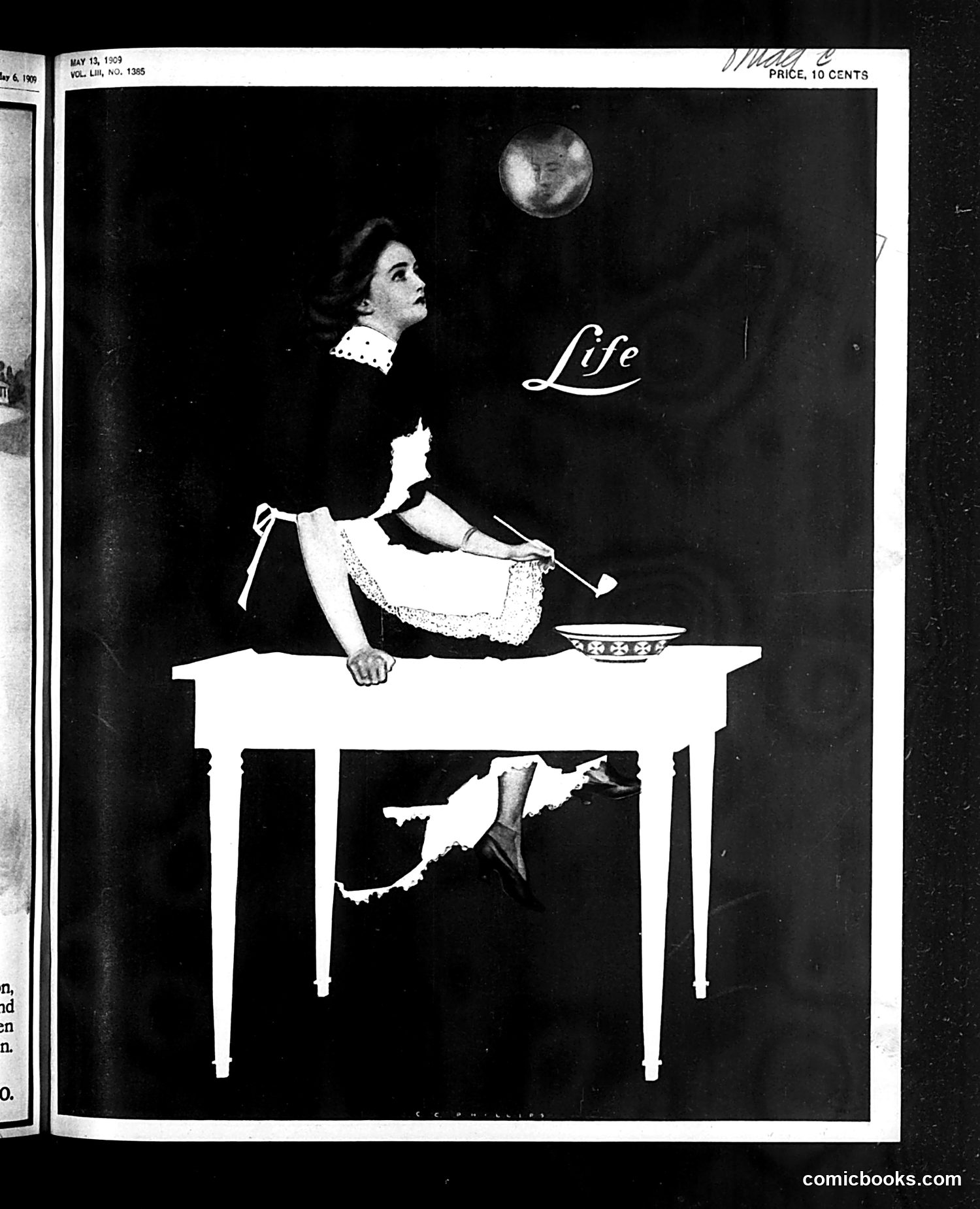
This appears to be a cover or advertisement from *Life* magazine (dated May 13, 1909, priced 10 cents). The image depicts a woman in Edwardian dress seated at a table, gazing upward at the moon. She holds what appears to be a pipe and a decorative bowl sits nearby. The single word "Life" is prominently displayed, suggesting this is the magazine's masthead or thematic cover art rather than a political cartoon. The composition—romantic, contemplative, domestic—appears to be artistic rather than satirical. Without accompanying OCR text or context, the specific social commentary or satirical intent remains unclear. It may relate to contemporary debates about women's roles or leisure, but this cannot be confirmed from the image alone.
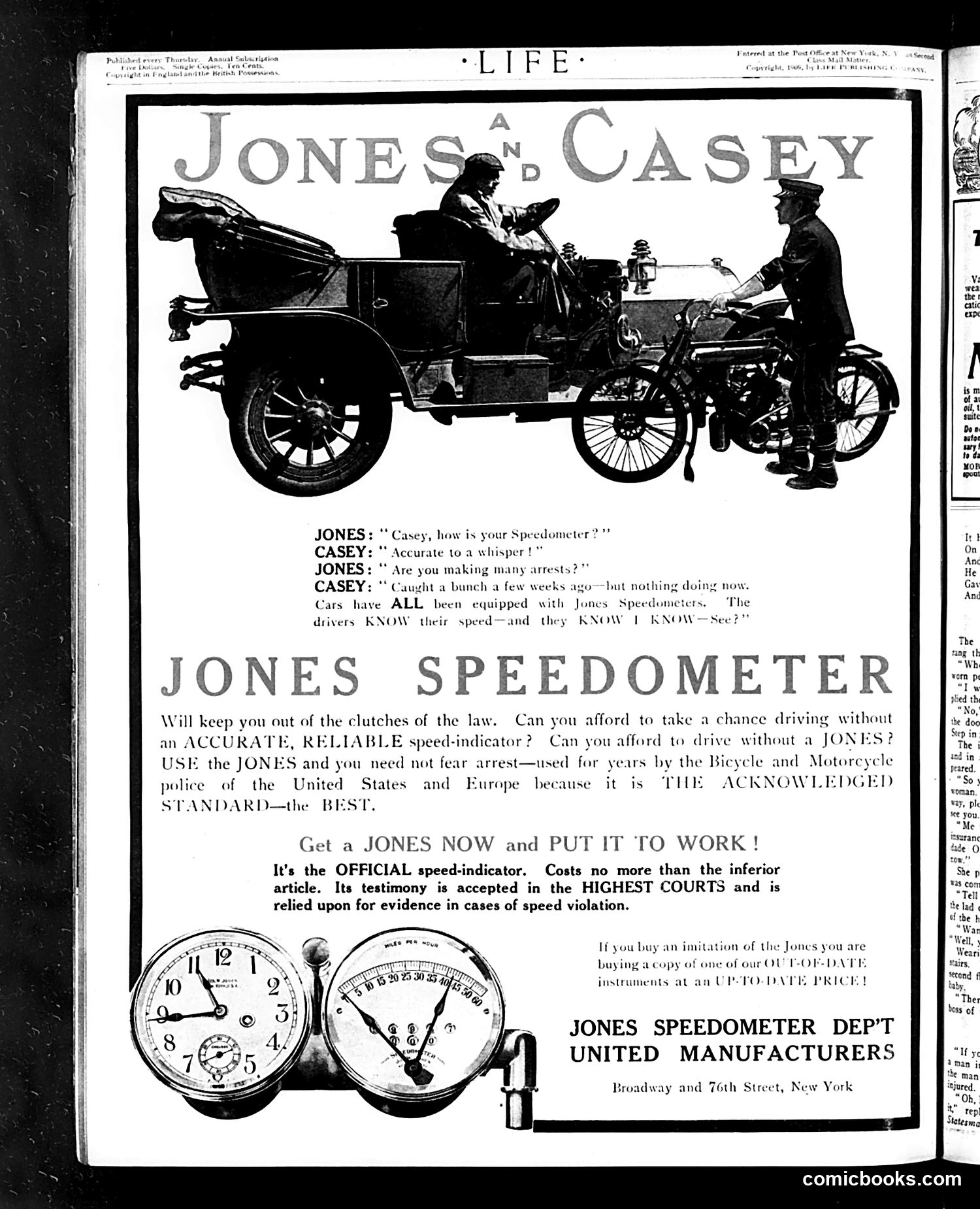
This page is primarily an advertisement rather than political satire. It promotes the Jones Speedometer, a device that measures vehicle speed. The top illustration shows a humorous dialogue between Jones (a driver) and Casey (appearing to be a police officer on motorcycle), where Jones claims his speedometer helps him avoid speeding violations. The ad's appeal is safety-conscious: it positions the speedometer as protection against legal trouble, claiming it's used as evidence in courts and trusted by law enforcement across the US and Europe. The bottom shows two circular instrument gauges. The humor relies on the implicit premise that drivers naturally want to exceed speed limits—the speedometer supposedly keeps them "out of the clutches of the law" by helping them stay within legal limits while maintaining plausible deniability.
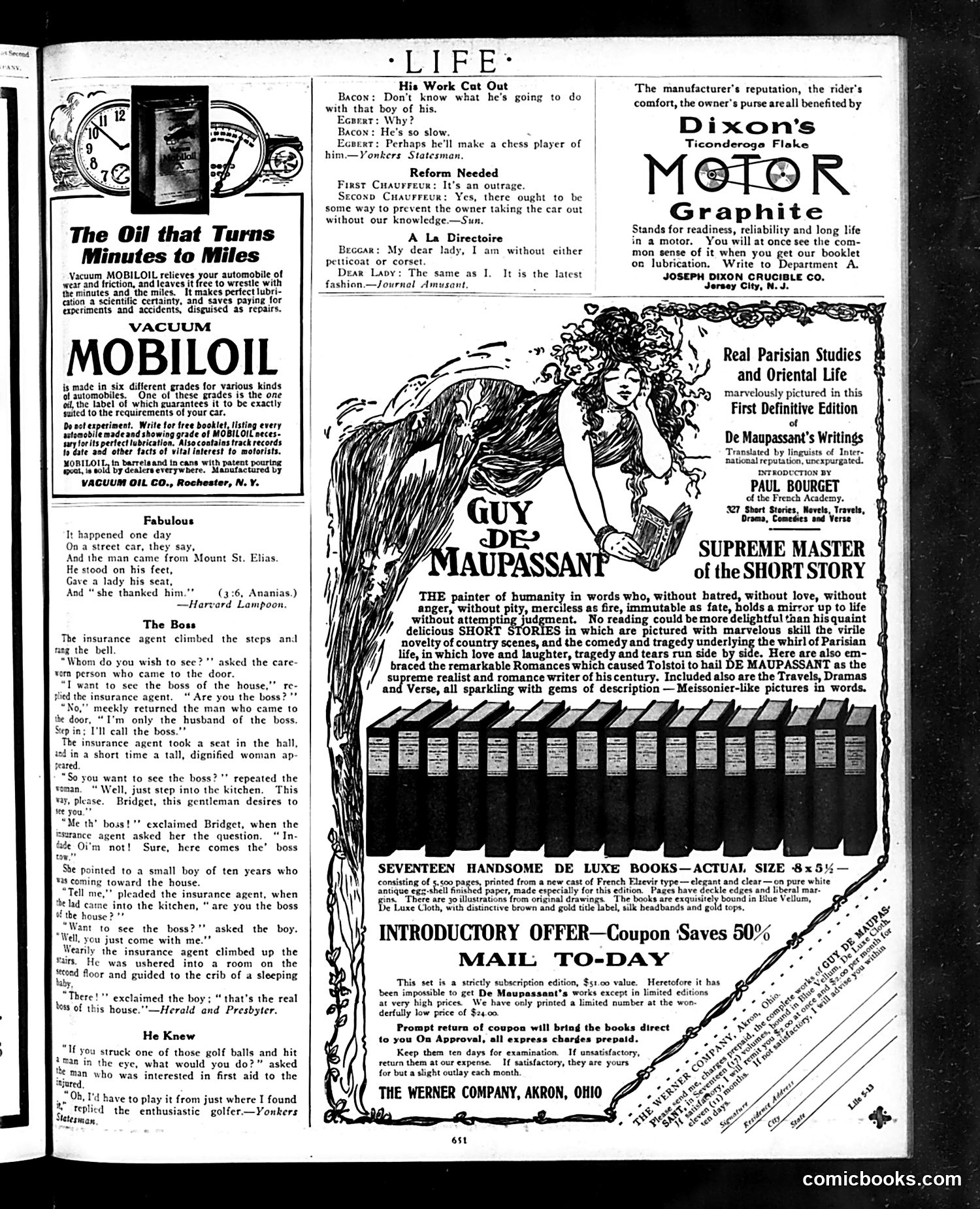
This page is primarily **advertising with minimal editorial content**. The dominant feature is a large advertisement for Guy de Maupassant's collected short stories, marketed as "Supreme Master of the Short Story." The illustration shows a dramatic caricatured face, likely representing Maupassant himself. The page includes several small humor pieces ("His Work Cut Out," "Reform Needed," "A La Directoire," "Fabulous," "The Boss," "He Knew") typical of Life's satirical style—brief anecdotes poking fun at everyday situations and character types. These are generic social commentary rather than political satire. The remaining advertisements promote Mobiloil motor oil and Dixon's Motor Graphite—typical early 20th-century automotive products. The page represents Life's mixed editorial-advertising model rather than focused political commentary.
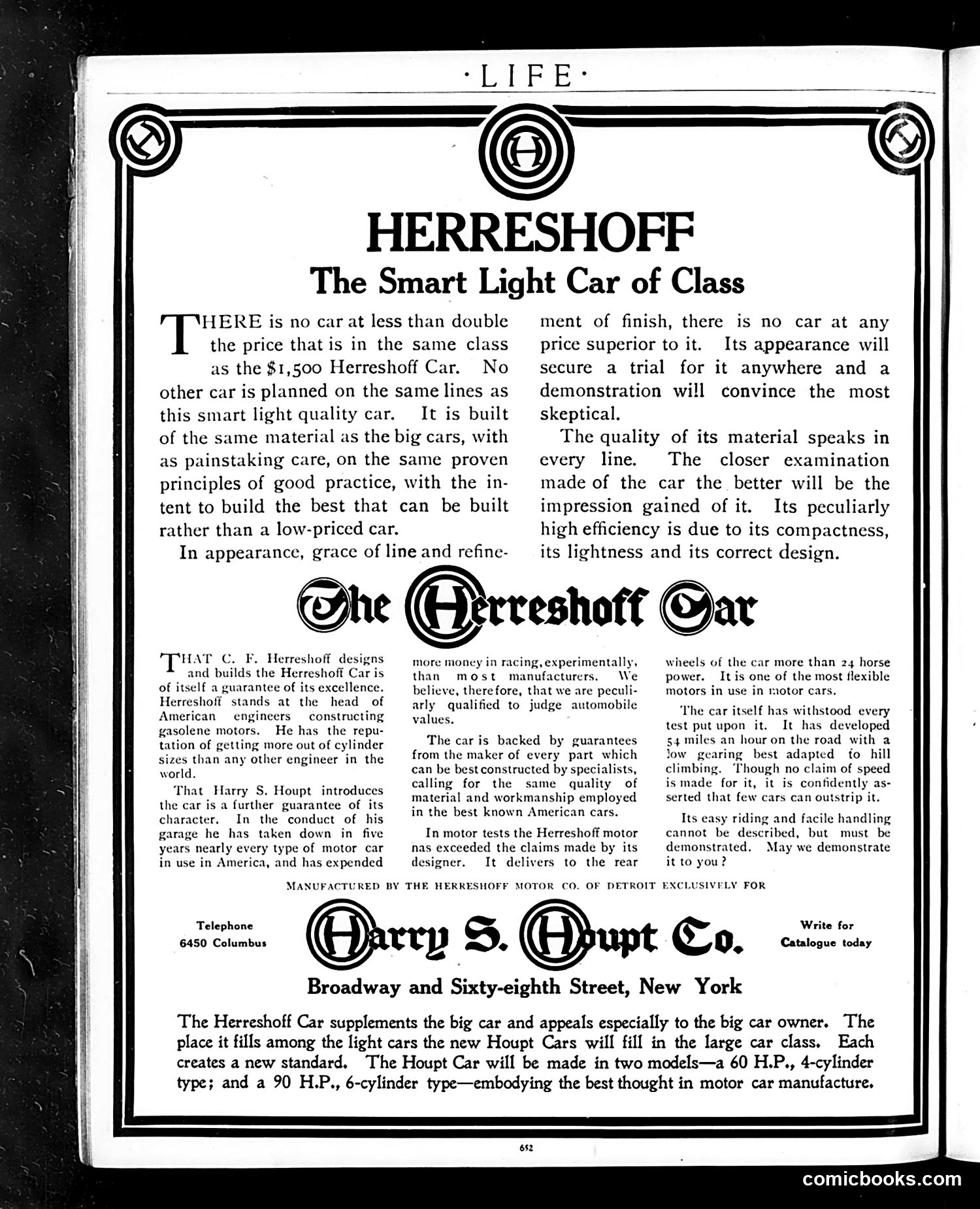
This is not a cartoon or satirical piece, but rather a **straightforward automobile advertisement** from Life magazine's early 20th century period. The page advertises the Herreshoff Car, described as "The Smart Light Car of Class"—a $1,500 vehicle manufactured by the Herreshoff Motor Company of Detroit and distributed by Harry S. Houpt Co. in New York. The ad emphasizes the car's quality construction, efficiency, and design rather than satirizing anything. It targets affluent buyers seeking a lighter alternative to larger automobiles while maintaining premium craftsmanship. The text highlights the designer C.F. Herreshoff's engineering reputation and the car's proven performance in motor tests. There is **no political content, caricature, or satire** on this page—it is purely commercial advertising.
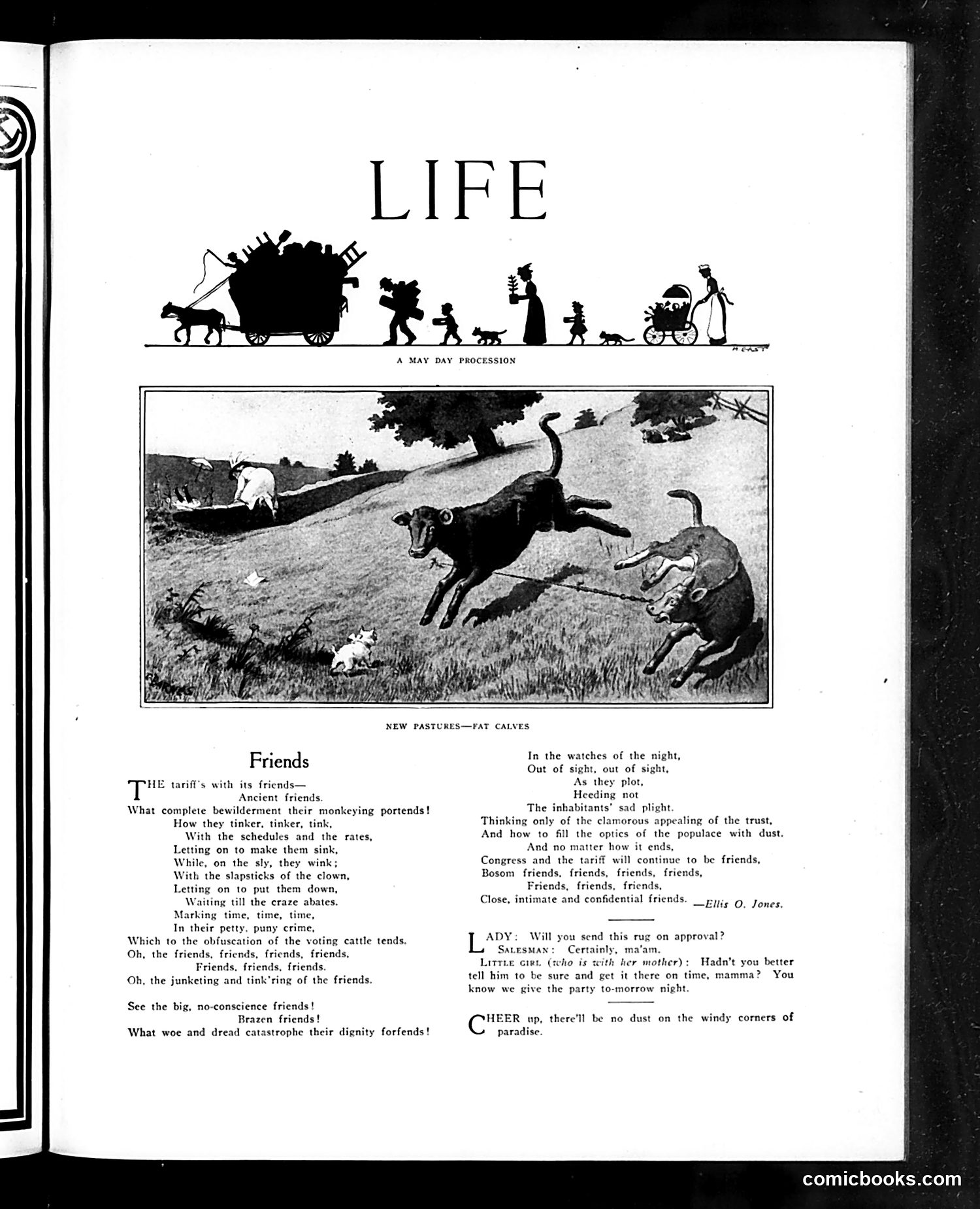
This page from *Life* magazine features a poem titled "Friends" by Ellis O. Jones alongside an illustration labeled "New Pastures—Fat Calves." The poem satirizes political alliances and friendships, using metaphors of the tariff and Congress. It mocks how politicians maintain friendships based on mutual benefit rather than principle, describing them as "monkeying," "tinkering," and ultimately "catastrophic" to dignity. The illustration shows cattle in a pastoral setting, likely representing the political figures being satirized as livestock—a common rhetorical device suggesting they are stupid or being herded. "Fat calves" may reference politicians fattening themselves on government largesse or tariff benefits. Without a specific date visible, the exact political controversy remains unclear, but the content targets corrupt political alliances and self-serving legislative behavior.
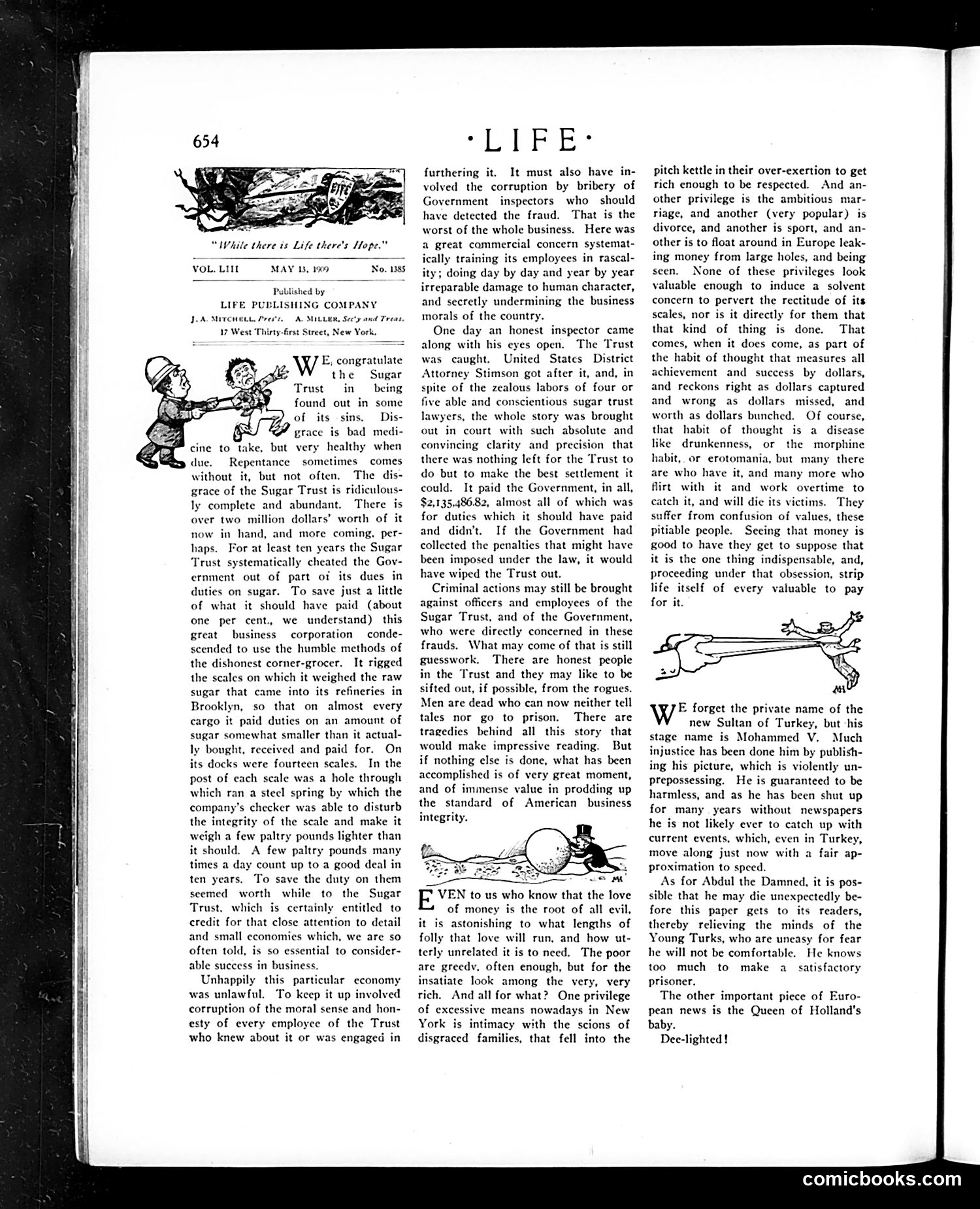
This page satirizes the **Sugar Trust fraud case**. The text describes how the Trust systematically cheated the U.S. Government on sugar duties through rigged scales—fraudulently underpaying tariffs for years. A honest inspector eventually caught them, leading to court action where the Trust paid massive penalties ($213,480.82). The small cartoons illustrate the deception: one shows a child and figure with a sugar kettle, representing innocent victims; another depicts a figure being weighed on corrupt scales. The satire criticizes both corporate corruption and moral decay: the Trust trained employees in "rascality," bribing inspectors while undermining national business integrity. The piece calls for accountability and warns that such "love of money" drives destructive social consequences.
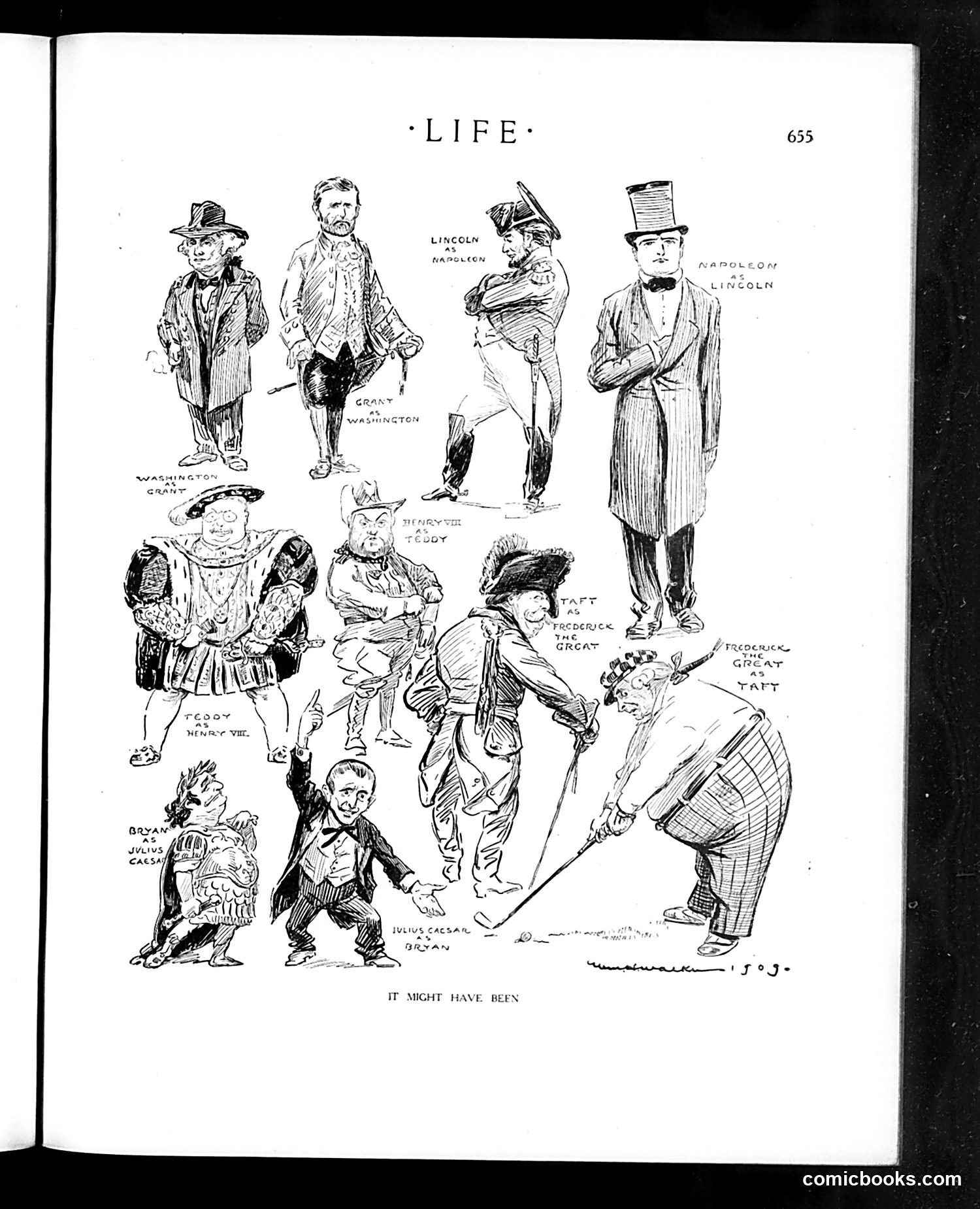
This is a satirical cartoon comparing historical figures to contemporary American politicians, likely from the early 20th century. The top row shows Lincoln and Napoleon alongside figures labeled "Lincoln" and "Napoleon" paired with modern leaders. The bottom section depicts smaller caricatured figures identified as Grant, Henry VIII, Teddy Roosevelt, Frederick the Great, Julius Caesar, and Bryan, arranged as if in conversation or confrontation. The cartoon's title, "It Might Have Been," suggests a counterfactual comparison—implying that contemporary American political figures could have been great historical leaders, or conversely, that history's titans resemble modern politicians. The mixing of historical and contemporary figures appears to mock pretensions or draw satirical parallels between current events and past epochs.
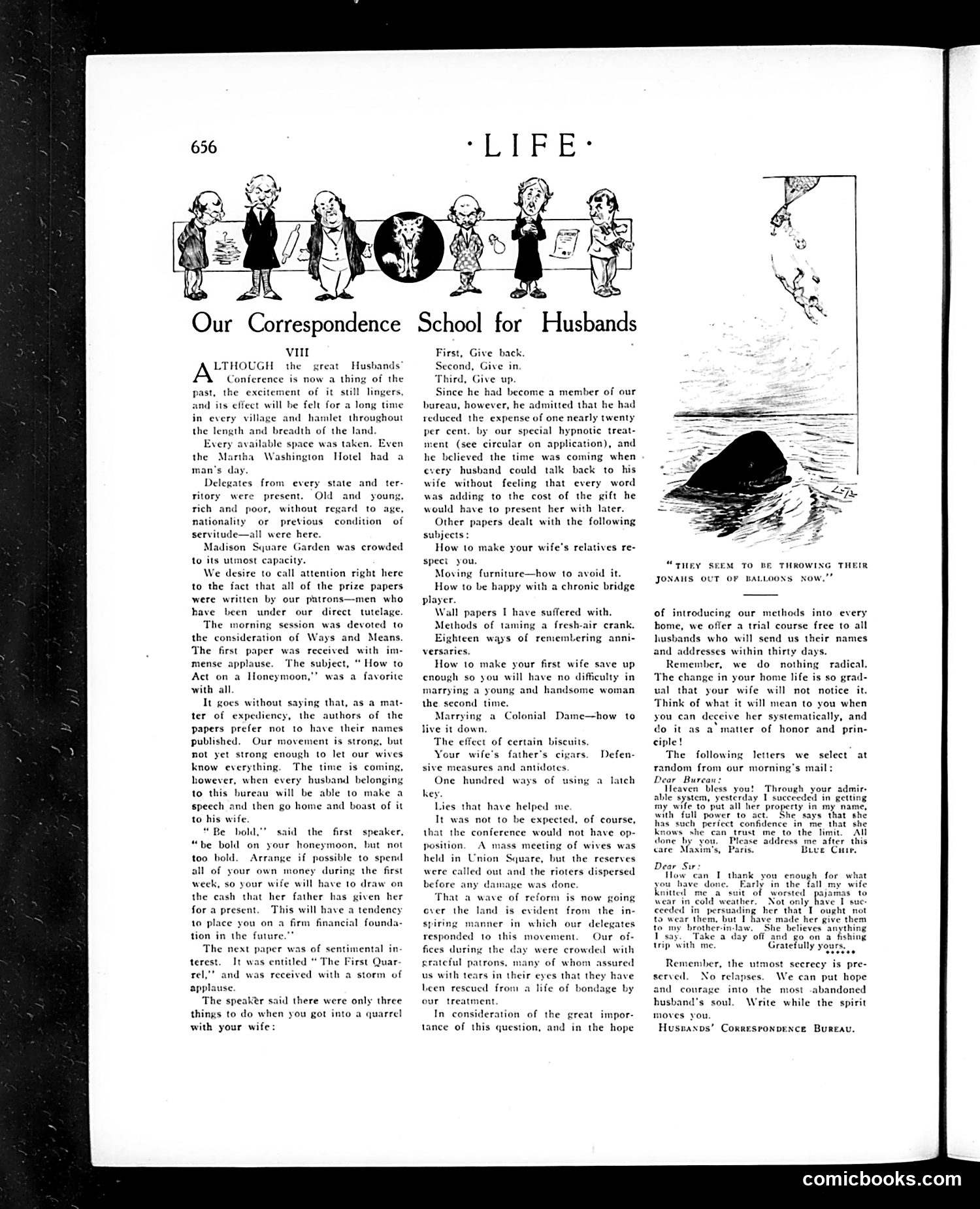
This satirical piece mocks a purported "bureau" offering marital advice to husbands. The seven caricatured figures at the top represent different husband "types"—likely stereotypes of the era (the wealthy man, the poor man, etc.). The text humorously describes a conference at the Martha Washington Hotel where wives submitted complaints about husbands, compiled into a correspondence course. Topics include "How to Act on a Honeymoon," managing finances, and handling domestic disputes. The satire targets two things: (1) the era's male arrogance and domestic incompetence, and (2) the proliferation of dubious mail-order "correspondence schools" claiming to teach any skill. By framing husbands as students requiring systematic retraining, the piece mocks both marital discord and the gullibility of those seeking quick-fix solutions through commercial schemes.
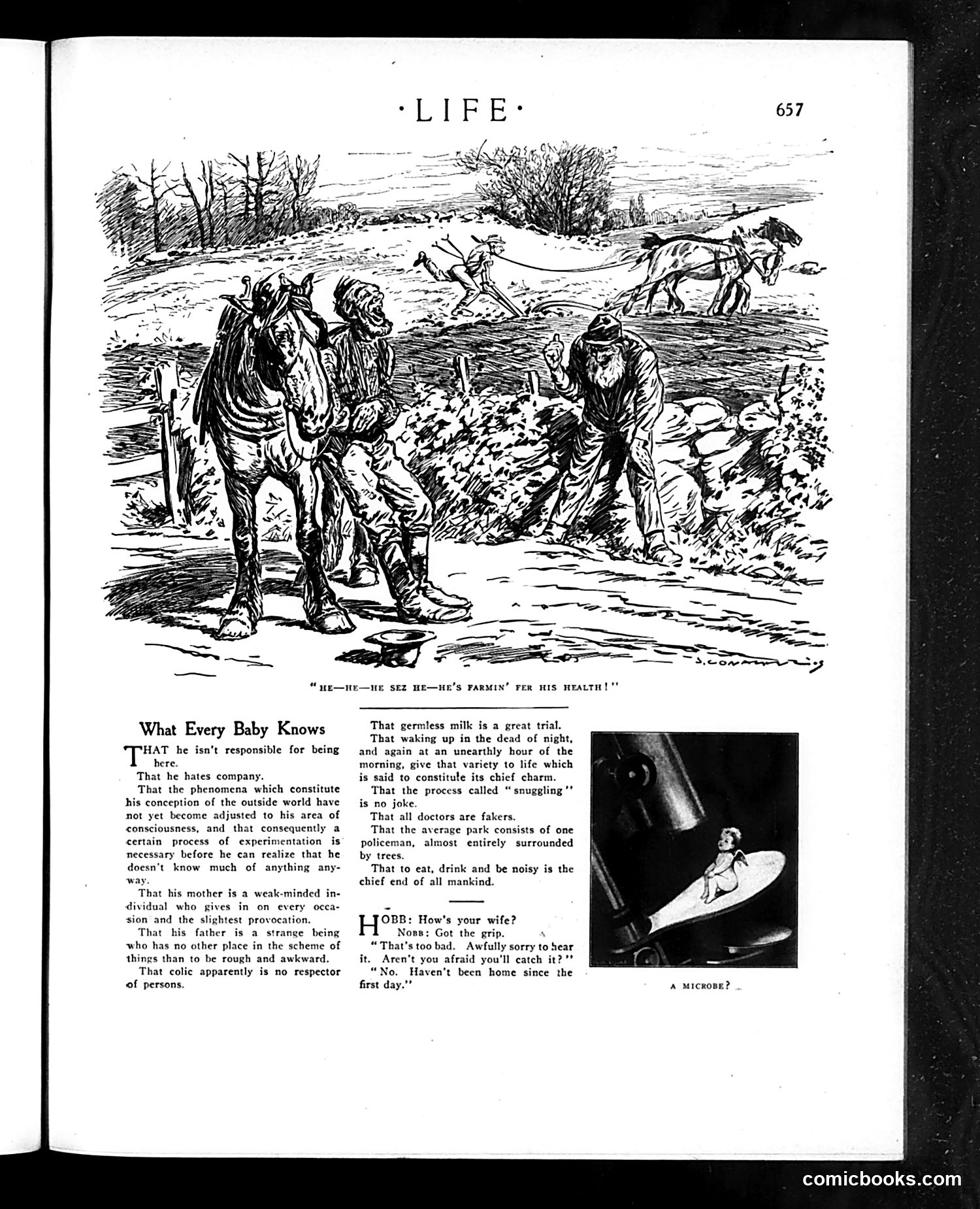
**Main Cartoon:** Shows rural laborers and farmers at work. The caption "HE—HE—HE SEZ HE'S FARMIN' FER HIS HEALTH!" satirizes the common excuse wealthy or idle people gave for farming as a hobby or health pursuit, rather than genuine agricultural work. The sketch mocks this pretense by contrasting it with actual manual laborers genuinely toiling in the fields. **"What Every Baby Knows" Section:** A humorous list of observations about infants and life, written in mock-serious style. It includes absurdist claims ("all doctors are fakers," "the average park consists of one policeman") and observations about babies' experiences. **"Hobb" Dialogue:** A brief comic exchange between two men about one's wife, ending with the punchline that he hasn't been home since their first day together—suggesting marital discord played for laughs.
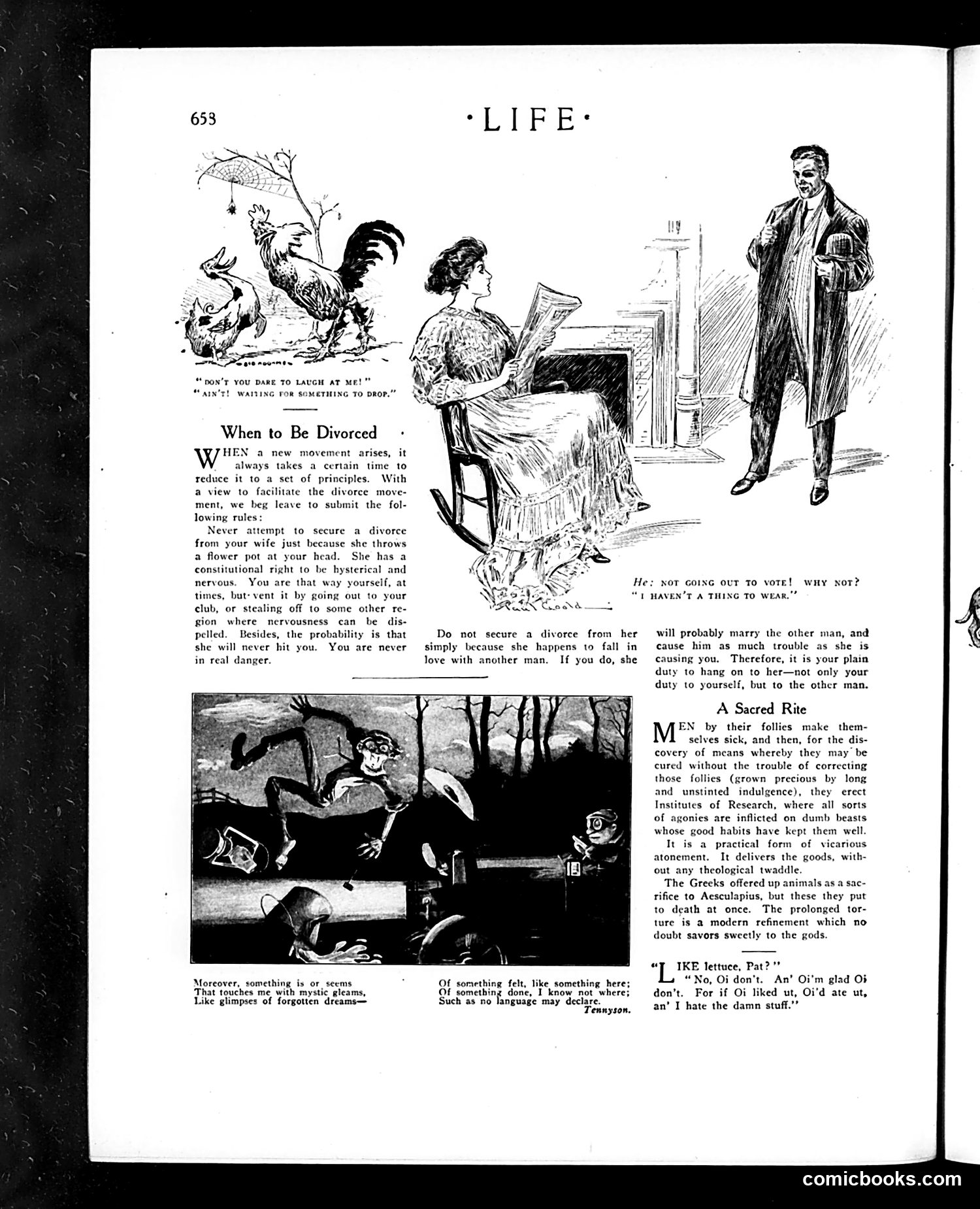
This page satirizes divorce and women's independence in early 20th-century America. The main article "When to Be Divorced" advises against divorcing merely because a wife falls for another man—doing so would only cause trouble for everyone involved, including the new man. The cartoons mock both female infidelity and male anxieties about women's changing roles. One illustration shows a woman reading while her husband departs, with her claiming she has "nothing to wear"—satirizing women's supposed materialism. Another depicts men in what appears to be a club setting, with accompanying verse about mystic dreams and fate. The overall tone suggests anxious humor about shifting gender dynamics and marriage instability among the educated classes during the era of emerging feminism and women's suffrage movements.
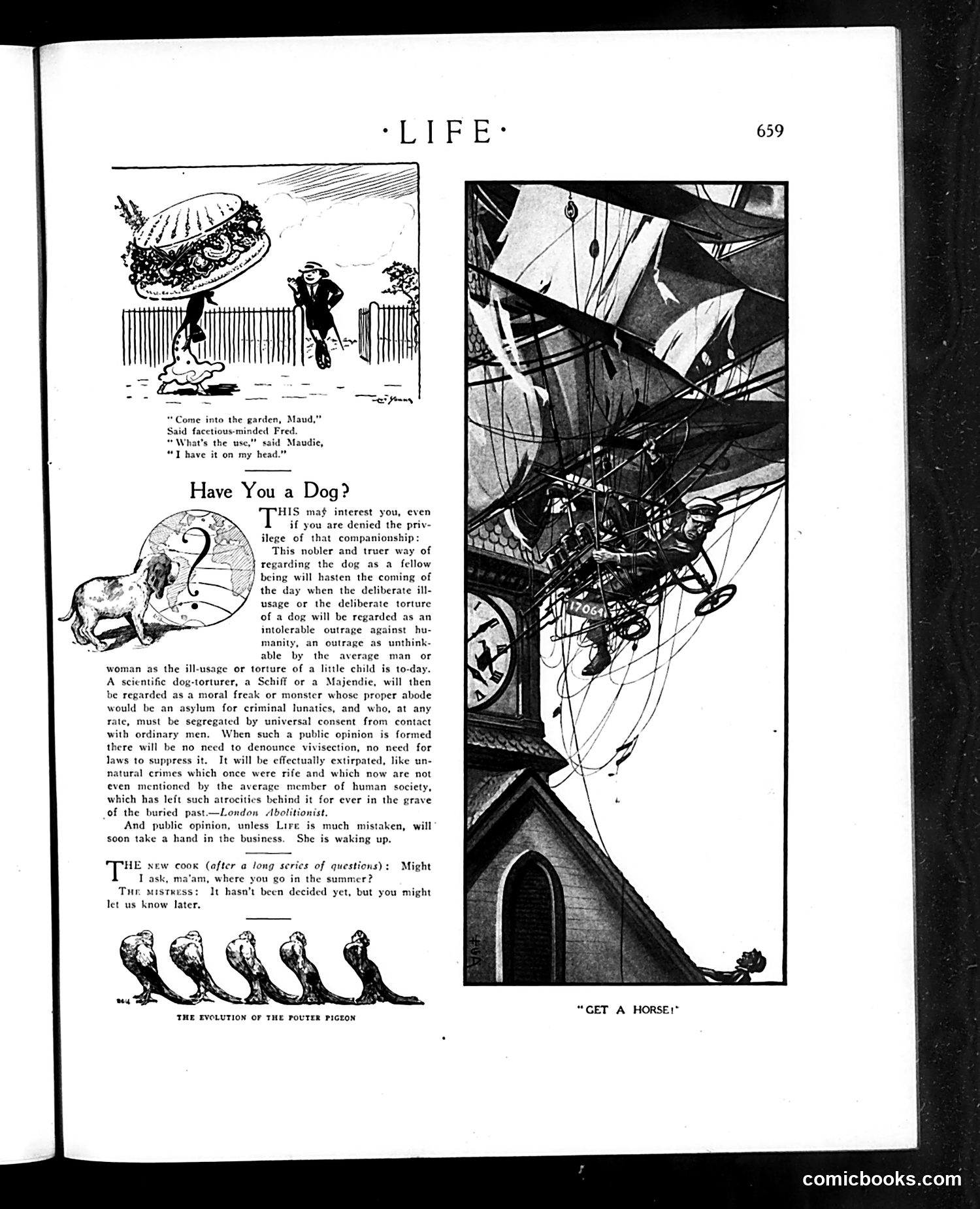
**Top Cartoon:** Shows two men arguing over a large sandwich. One says "I had it first," the other responds "Said friction-minded Fred. 'What's she up to?' said Maggie. 'I have it on my head.'" The joke appears to be about marital discord and domestic disagreement. **Main Article:** "Have You a Dog?" argues that society should recognize animal cruelty as morally outrageous. It predicts that future generations will view dog torture as we view grave atrocities—something unthinkable. The piece cites the *London Abolitionist* and suggests public opinion against animal cruelty is growing. **Bottom Image:** "Evolution of the Porter Pigeon" shows five similar bird silhouettes in sequence, likely satirizing pseudo-scientific evolutionary claims popular in the era. **Right Image:** "Get a Horse!" depicts a vintage automobile, captioned with dialogue about summer travel plans.
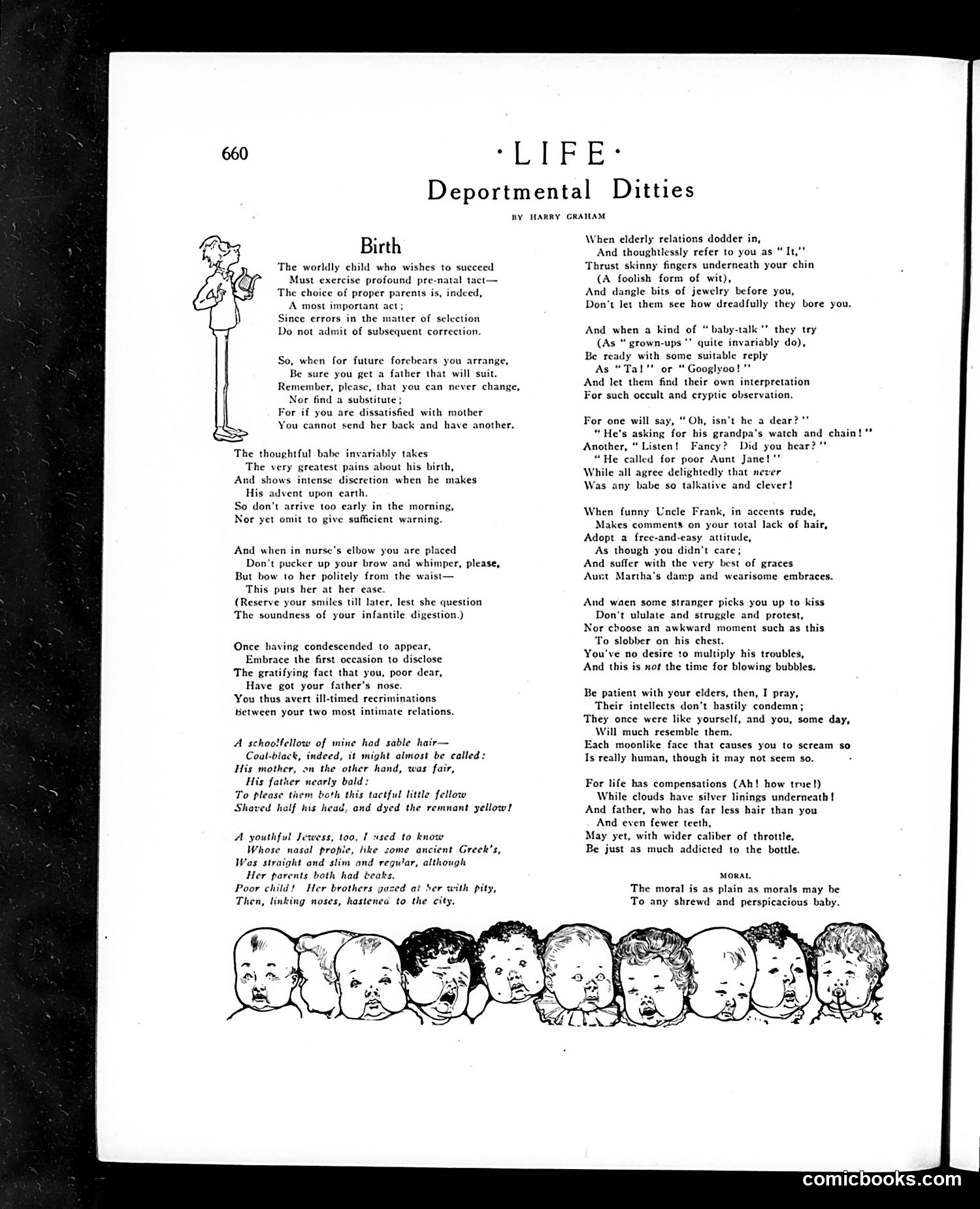
This page by Harry Graham presents humorous advice for new parents, sarcastically titled "Departmental Duties." The poem mocks the prevailing attitudes of upper-class parenting in the early 20th century, when children were often raised by nursemaids rather than parents. The satire targets the emotional distance between parents and infants, advising against showing affection, maintaining composure during the baby's distress, and tolerating relatives' intrusive comments about the child. Graham ridicules the era's rigid child-rearing conventions—the expectation that proper parents remain aloof and detached. The footer illustration shows nine baby heads displaying varied expressions, humorously emphasizing the range of infant emotions parents were expected to ignore.
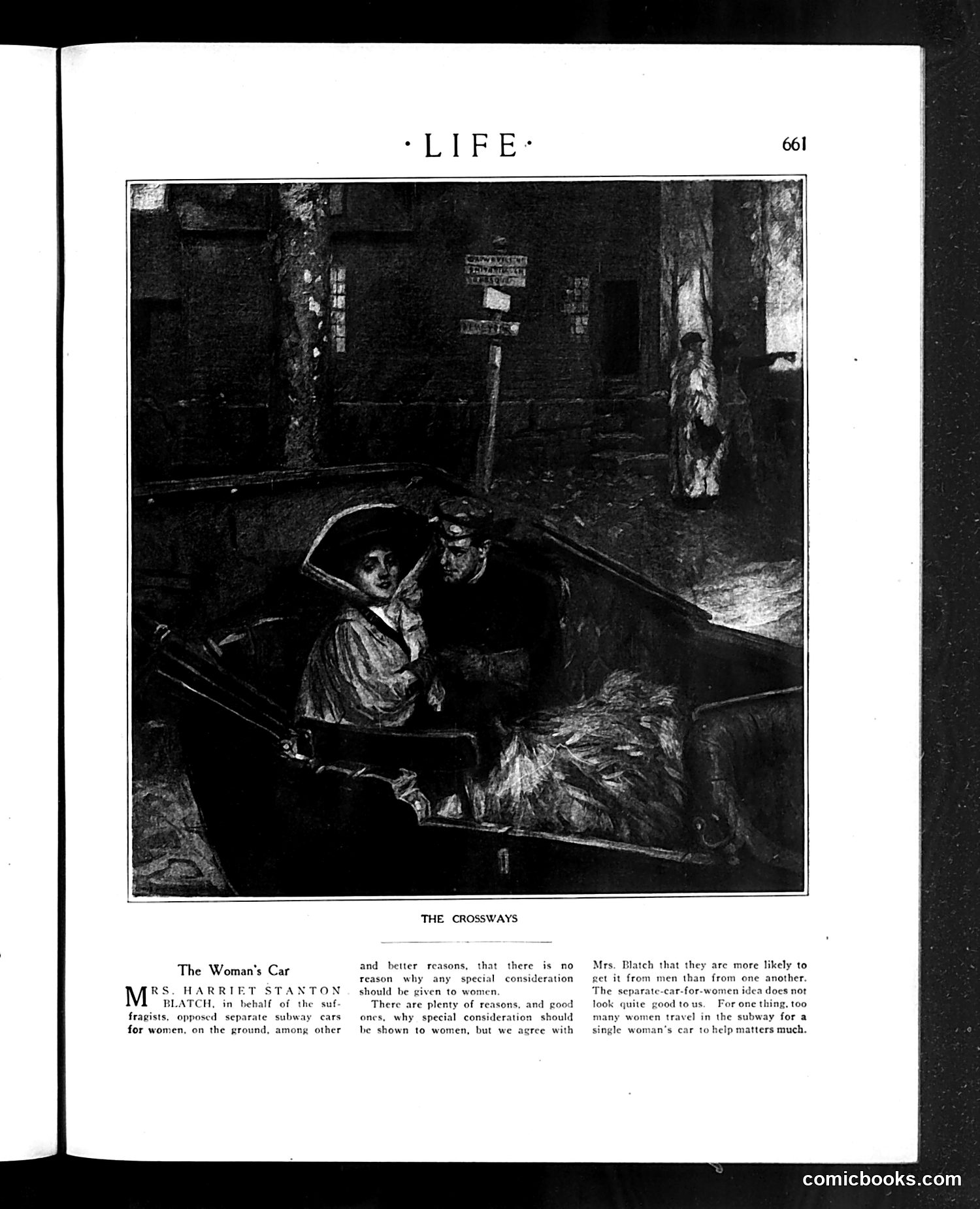
This page features a political cartoon titled "The Crossways" depicting a scene in what appears to be a subway car. The accompanying article by Mrs. Harriet Stanton Blatch argues **for** separate subway cars designated for women, contrary to suffragist opposition to such segregation. The cartoon illustrates the crowded, uncomfortable conditions women faced in mixed subway cars, showing a woman squeezed uncomfortably among other passengers. Blatch's commentary contends that separate women-only cars would provide better conditions and protection for female riders, framing this as a practical safety and comfort issue rather than a segregationist one. This reflects early 20th-century debates about women's public mobility and the various approaches—sometimes contradictory—within feminist movements regarding women's protection versus equality.
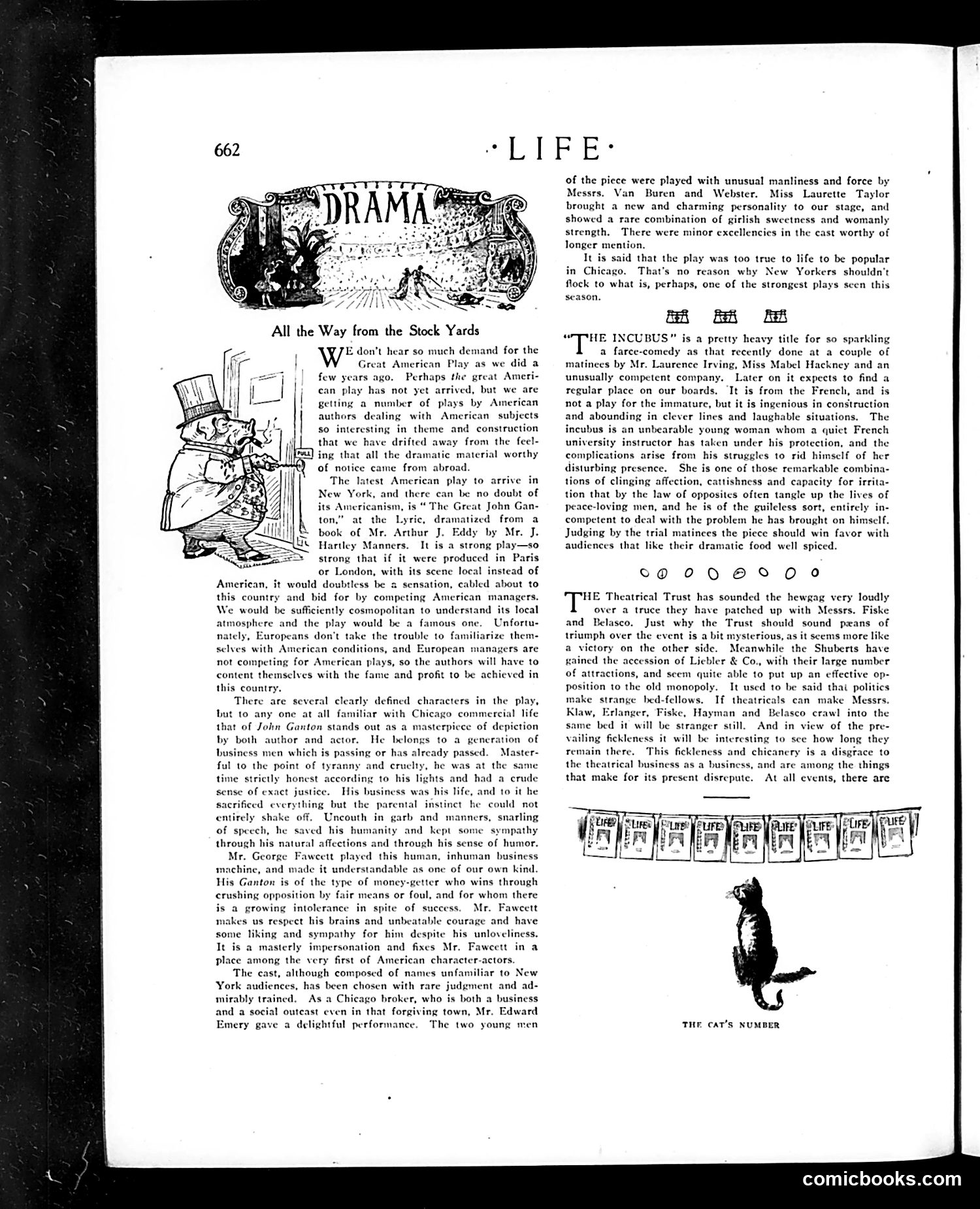
This page reviews "The Great John Ganton," a new American play adapted from Arthur J. Eddy's book. The critic argues that American dramatic works deserve equal respect to European imports. The play depicts a Chicago businessman—John Ganton—a ruthless, honest money-maker representing a "passing generation" of robber-baron capitalists. Actor George Fawcett's portrayal is praised as masterful character work showing this "human, inhuman business machine" with crude integrity but also tyranny. The review's satire is implicit: Americans shouldn't need a European production stamp to validate homegrown plays. The stockyard reference in the title suggests Chicago's industrial brutality parallels Ganton's business methods. The article also briefly mentions another play, "The Incubus," calling it misleadingly heavy-titled for a light farce-comedy.
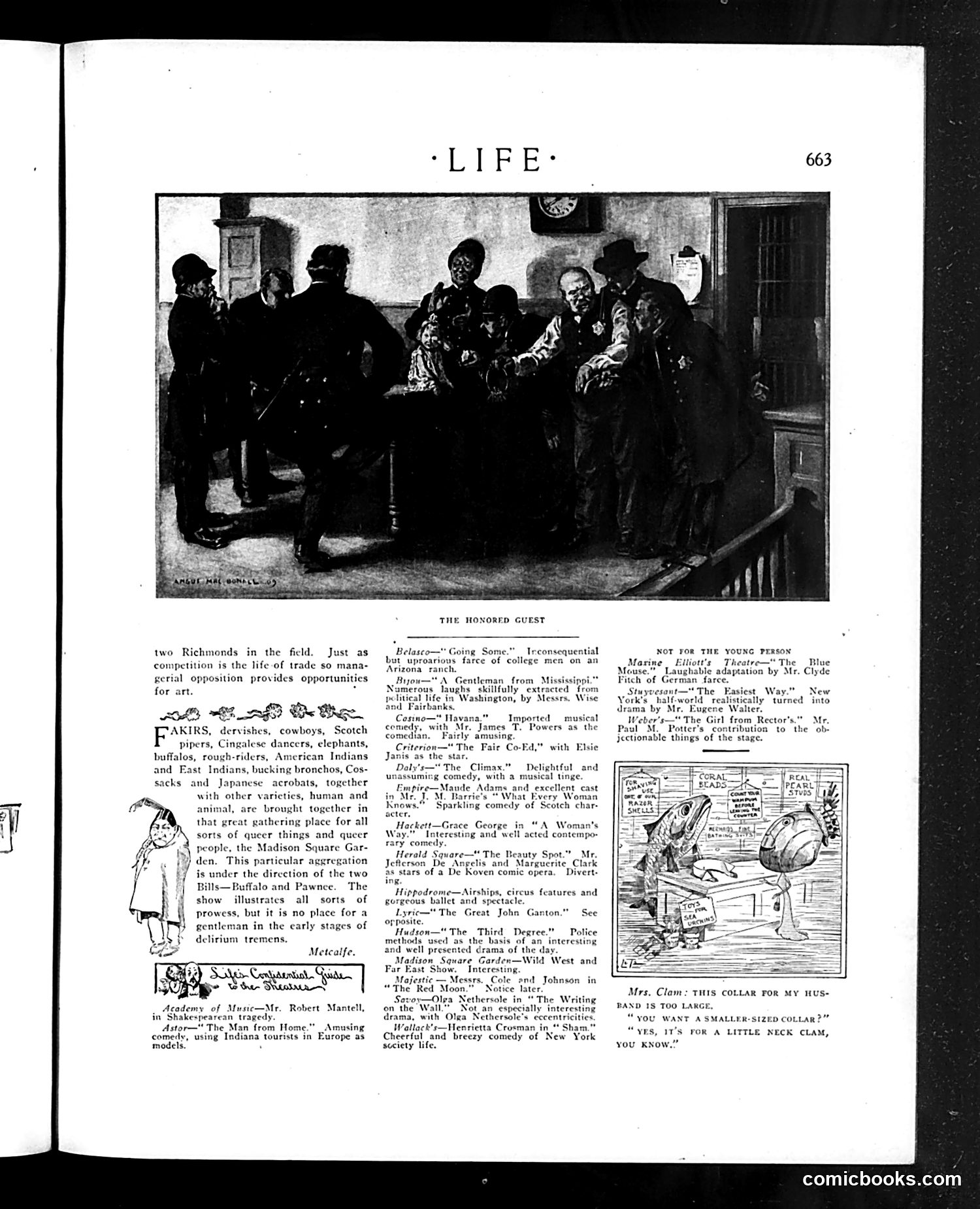
This page from *Life* magazine contains theater reviews and a small visual gag. The main photograph shows "The Honored Guest"—appears to be a scene from a theatrical production with multiple figures in period costume gathered indoors. The bulk of the page lists New York City theater offerings with brief, witty reviews of current productions. The satire targets both theatrical quality and social pretension: comedies are praised for being "amusing," while dramas involving police brutality ("The Third Degree") and morally questionable content (productions marked "Not for the Young Person") are noted with knowing cynicism. At bottom right is a simple visual pun: a woman requests a smaller collar for her "little neck clam"—wordplay on the size distinction between full-sized and littleneck clams, typical of *Life*'s light humor. The overall tone is sophisticated mockery of Manhattan's entertainment scene and its audiences.
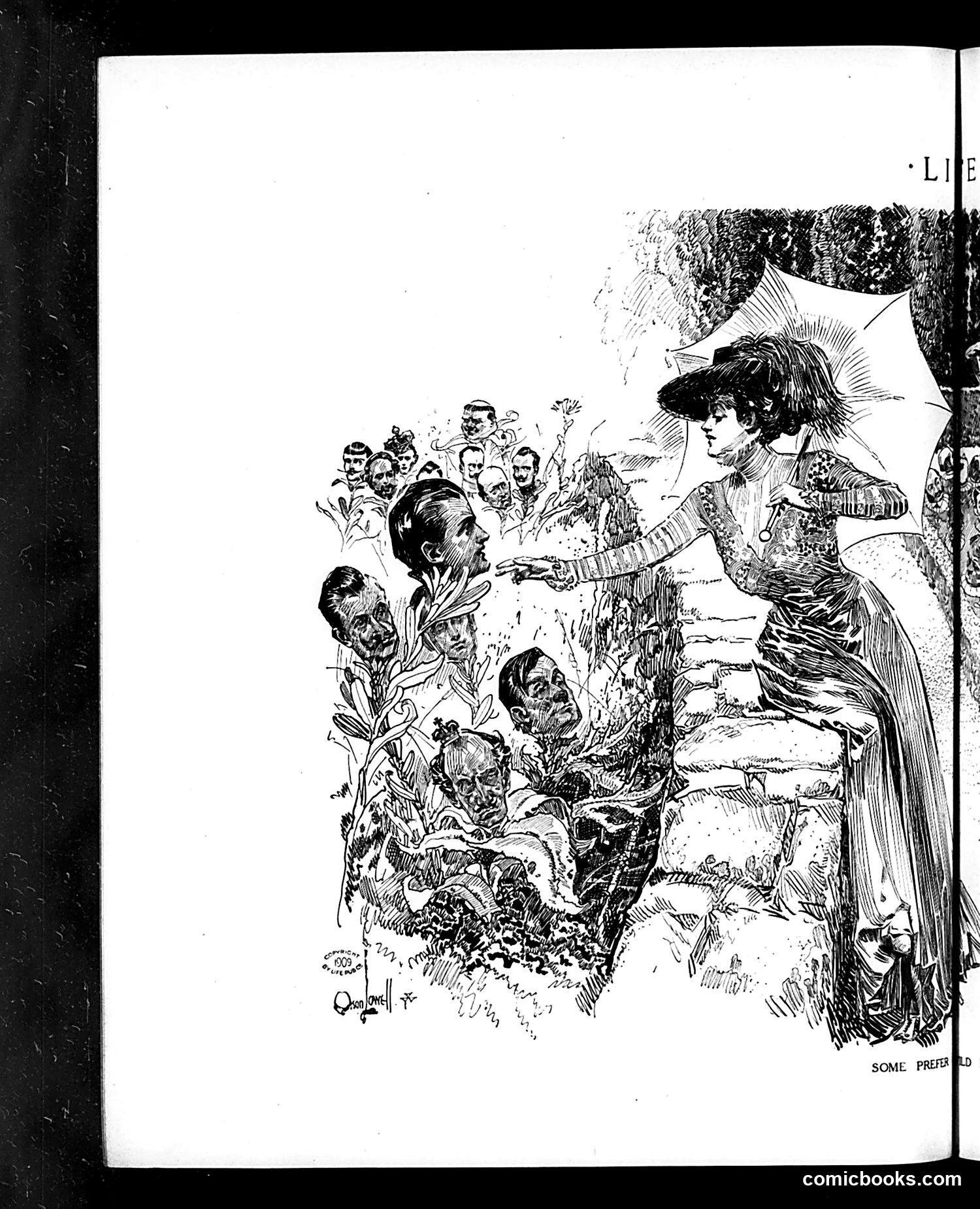
This appears to be a political cartoon from *Life* magazine showing a elegantly dressed woman with a parasol confronting figures emerging from or rooted in soil/vegetation. The caption reads "SOME PREFER'D" (likely "SOME PREFERRED"). The cartoon likely satirizes early 20th-century social or political preferences—possibly commenting on courtship, class distinctions, or romantic choices. The woman's refined appearance contrasts sharply with the rough, earthy nature of the figures she faces, suggesting satire about social aspirations or the gap between idealized romantic partners and reality. The artist's signature appears lower left, though it's not clearly legible in this image. Without the full caption or publication date visible, the specific political or social reference remains unclear, though the style suggests pre-1920s American satirical commentary.
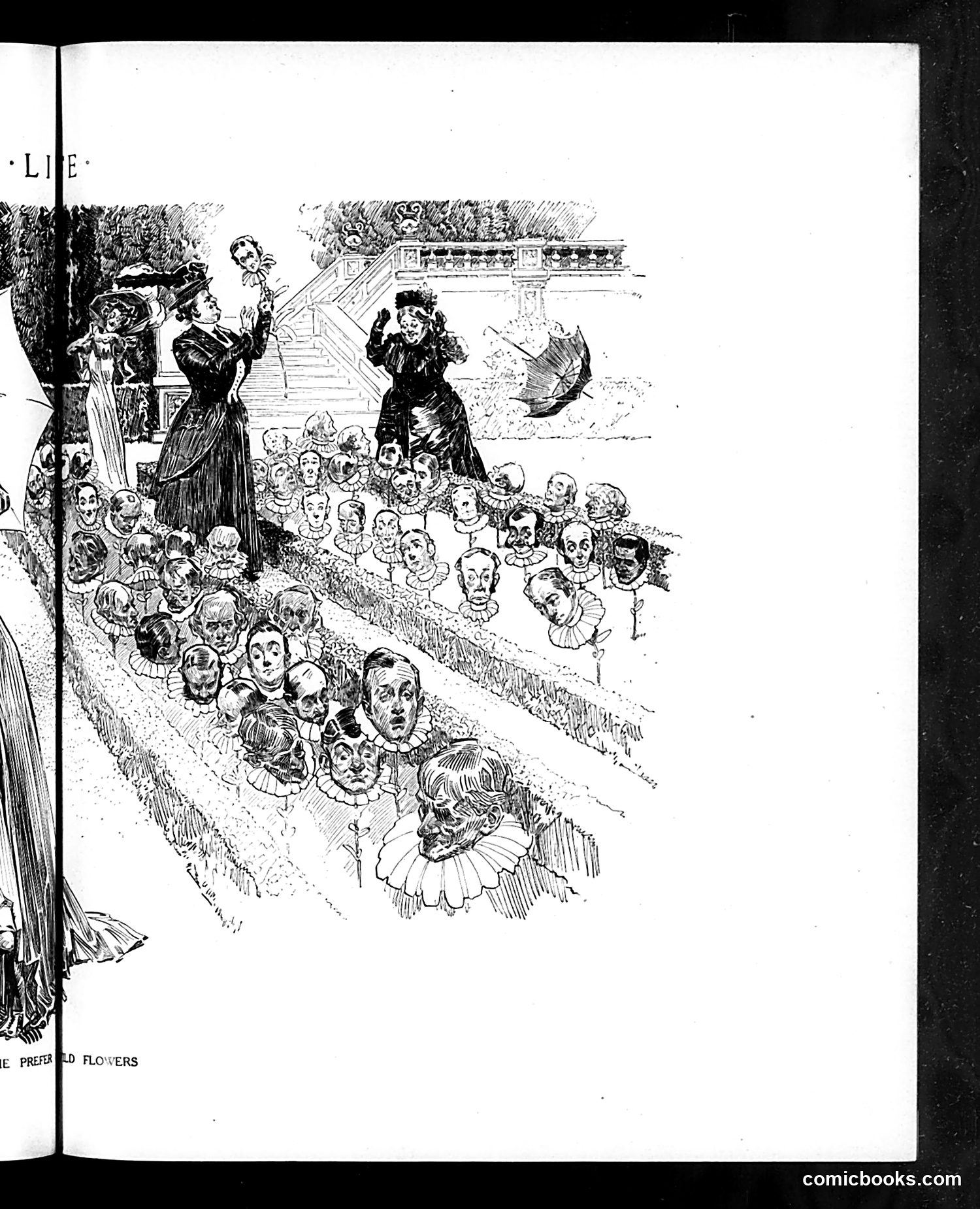
This illustration depicts a large crowd of people arranged in a garden setting, with three elegantly dressed women standing elevated above them. The figures appear to be caricatured with exaggerated facial features typical of late 19th/early 20th-century satirical art. The title "The Preferred Flowers" suggests social satire—likely contrasting "flowers" (the three refined women) with the "garden" of common people below. The composition implies commentary on class distinction and social hierarchy. The elevated positioning of the fashionable women and the crowded, undifferentiated masses beneath them emphasizes social stratification. Without additional context or visible captions identifying specific individuals, the exact political targets remain unclear, though the work appears to satirize either aristocratic pretension or contemporary social attitudes toward class and refinement.
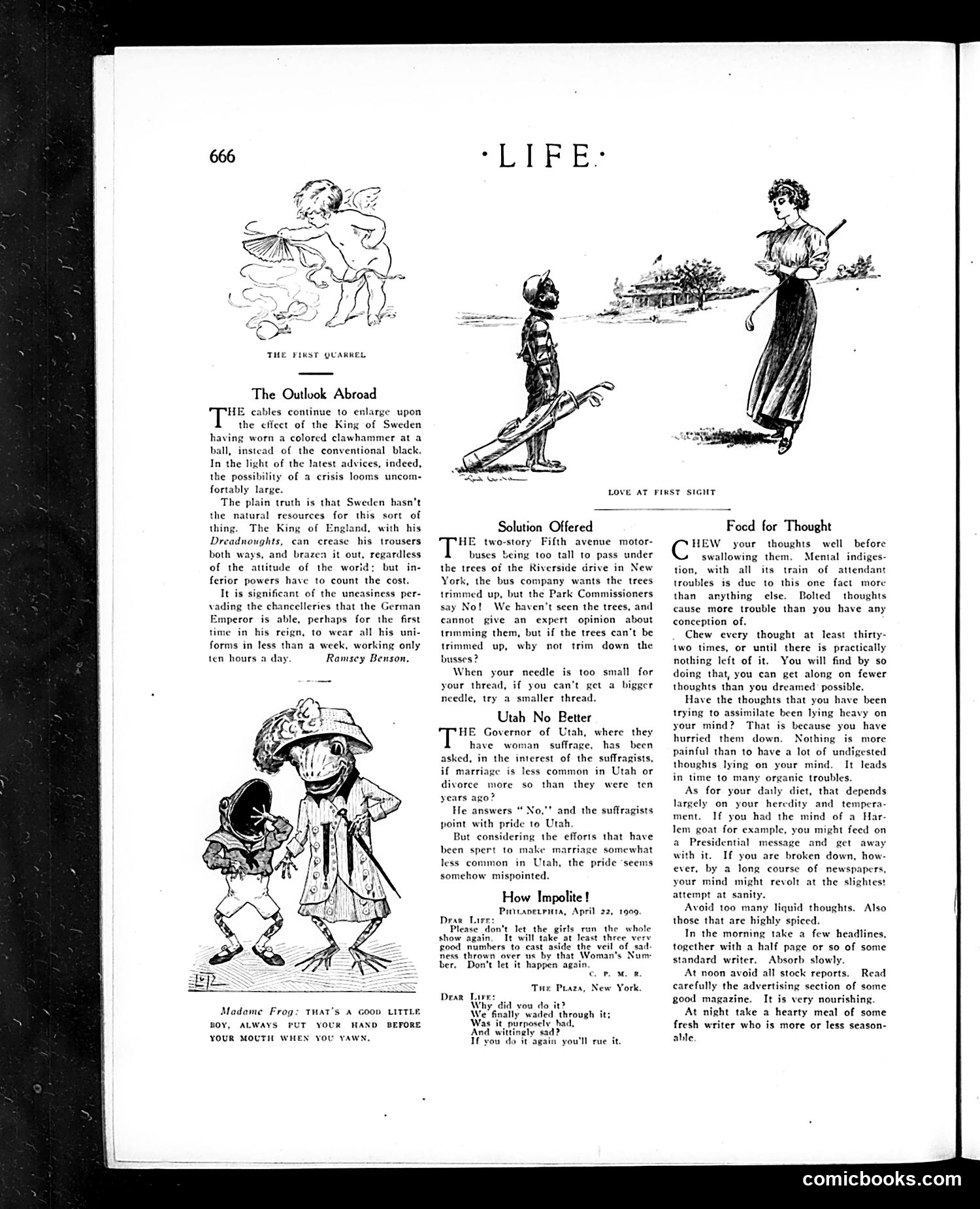
This satirical page from Life magazine (dated April 22, 1909) contains several political and social commentary pieces: **"The Outlook Abroad"** mocks European power dynamics through absurdist logic. It treats the Swedish King's choice of a colored dinner jacket as a potential international crisis, arguing that only powerful nations like England (with its Dreadnoughts warships) can afford such fashion risks. Weaker powers must "count the cost." The joke satirizes the pretentious fragility of diplomatic relations. **"Solution Offered"** presents practical absurdist advice: if Fifth Avenue buses are too tall for Riverside Drive trees, trim the buses instead of the trees—inverting the obvious solution to mock bureaucratic obstinacy. **"Utah No Better"** criticizes women's suffrage advocates in Utah, suggesting their claims that suffrage improved marriage rates are "mispointed" given actual divorce statistics. The cartoon of "Madame Frog" teaches etiquette to a child—likely satirizing overly refined social rules. Multiple reader letters complain about Life's recent "Woman's Number" issue, finding it depressing—suggesting contemporary gender debates were contentious even among readers.
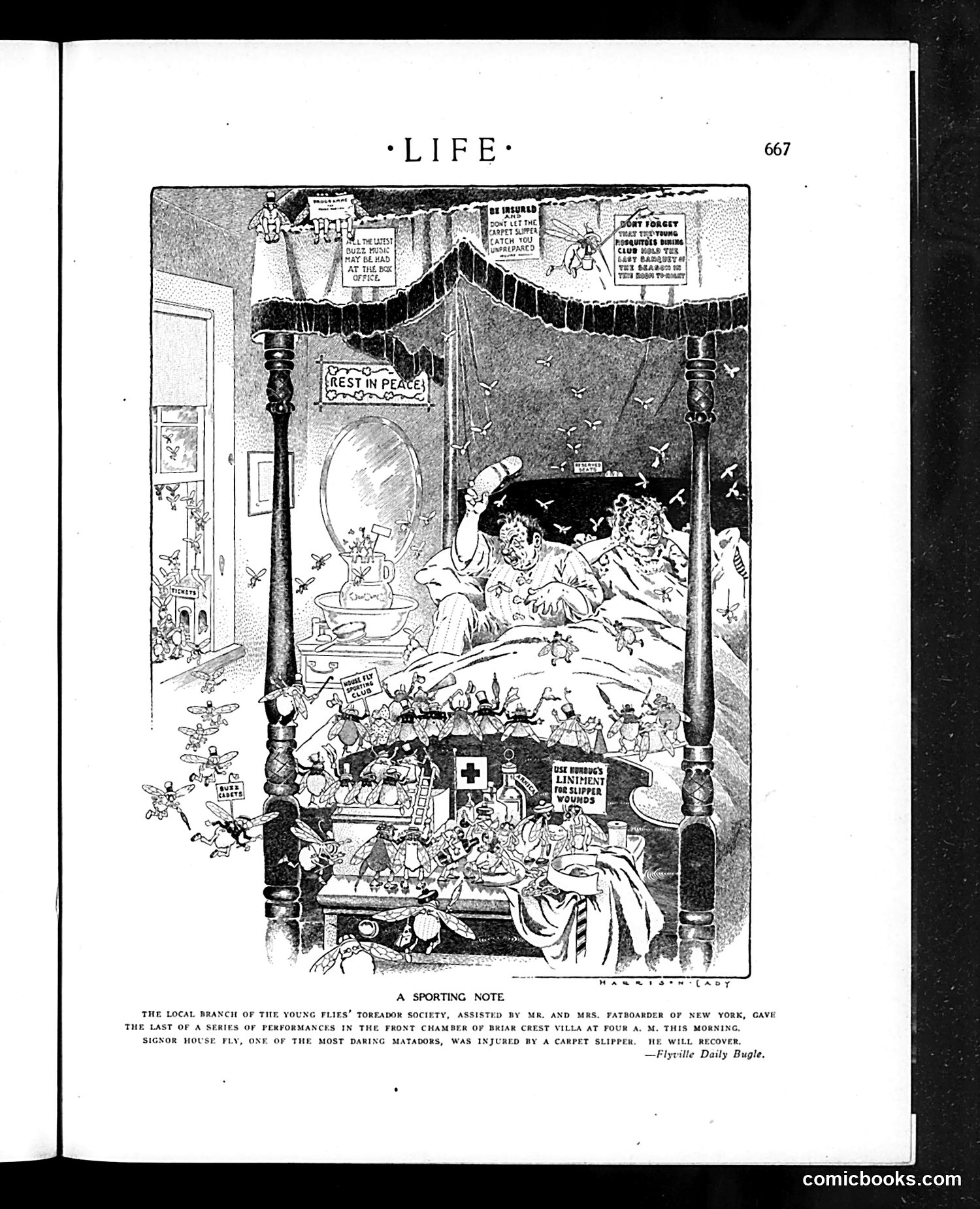
This is a humorous anthropomorphic satire depicting a bullfighting spectacle staged by flies in a bedroom. The cartoon shows: **The Setup**: A mock "Young Flies' Toreador Society" performance at "Briar Crest Villa" at 4 A.M., suggesting an absurd nighttime intrusion into human domestic space. **The Joke**: The caption, written as a faux newspaper report from the "Flyville Daily Bugle," treats a mundane household incident—a fly being swatted with a carpet slipper—as a dramatic bullfighting injury. The fly "Signor House Fly" is presented as a daring matador who "will recover." **The Satire**: Life magazine is mocking both the pretentious nature of high society ("assisted by Mr. and Mrs. Fatboarder of New York") and the absurdity of treating pests as noble creatures worthy of sporting events. The elaborate bedroom staging with decorations parodies grand theatrical productions. The humor relies on the incongruity between the grandiose framing and the mundane reality of household pest control.
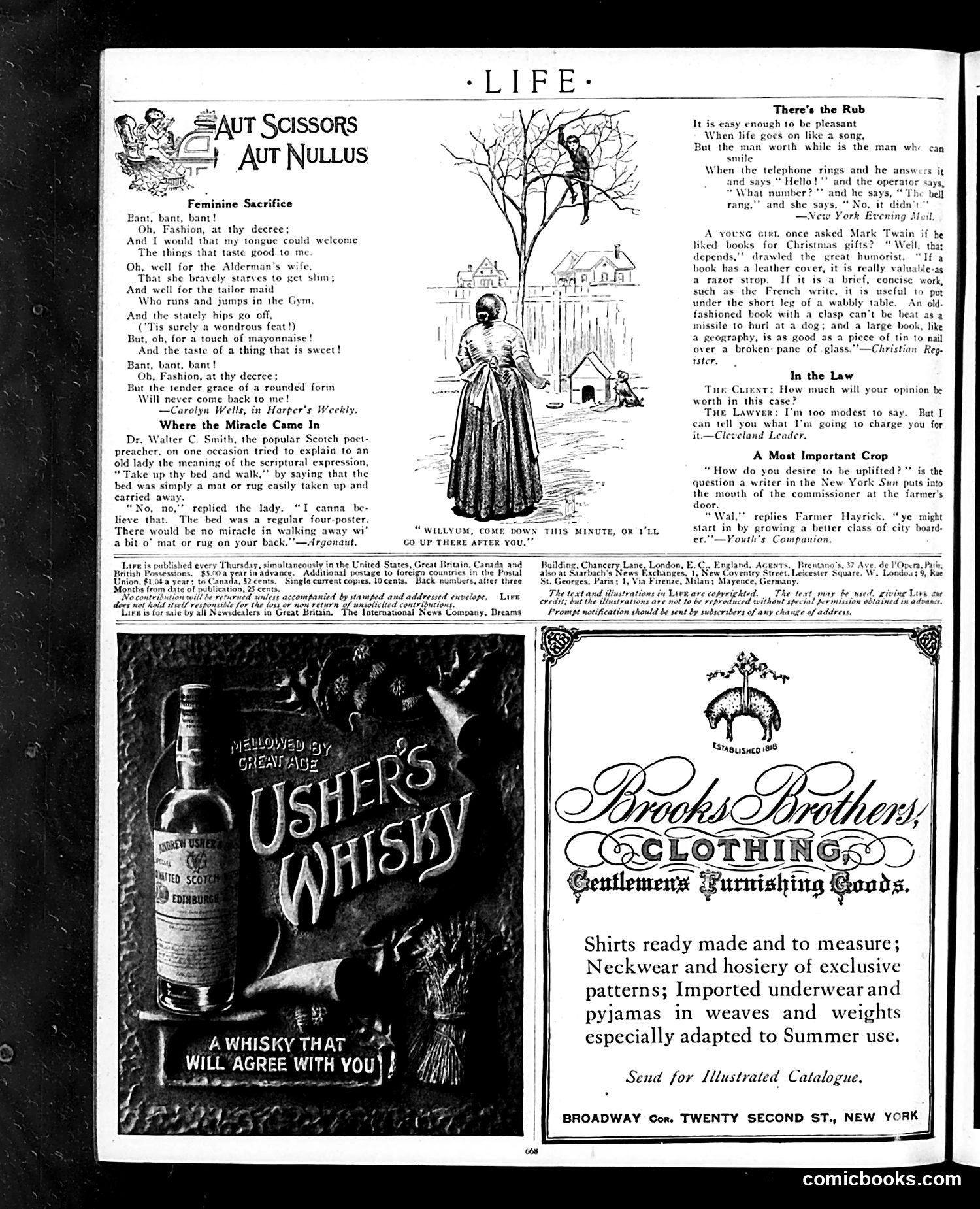
This page from *Life* magazine contains several satirical pieces and advertisements typical of early 20th-century American humor: **"Feminine Sacrifice"** mocks the fashion industry's demands on women, particularly the "banting" (dieting) craze. The poem expresses frustration that women must starve themselves thin to meet fashion standards, sacrificing pleasure (mayonnaise, sweetness) for appearance. **"Where the Miracle Came In"** is a brief anecdote poking fun at literal biblical interpretation—an old Scottish woman insists Jesus's "bed" must have been a large four-poster, not a mat, making the miracle less impressive. **"There's the Rub"** and other short items are observational humor about everyday annoyances and absurdities in modern life. The page also features period advertisements for **Usher's Whisky** and **Brooks Brothers clothing**, reflecting the magazine's commercial support. Overall, this is typical *Life* content: light satirical verse and anecdotes critiquing fashion obsession, social pretension, and modern inconveniences, aimed at educated middle-class readers.
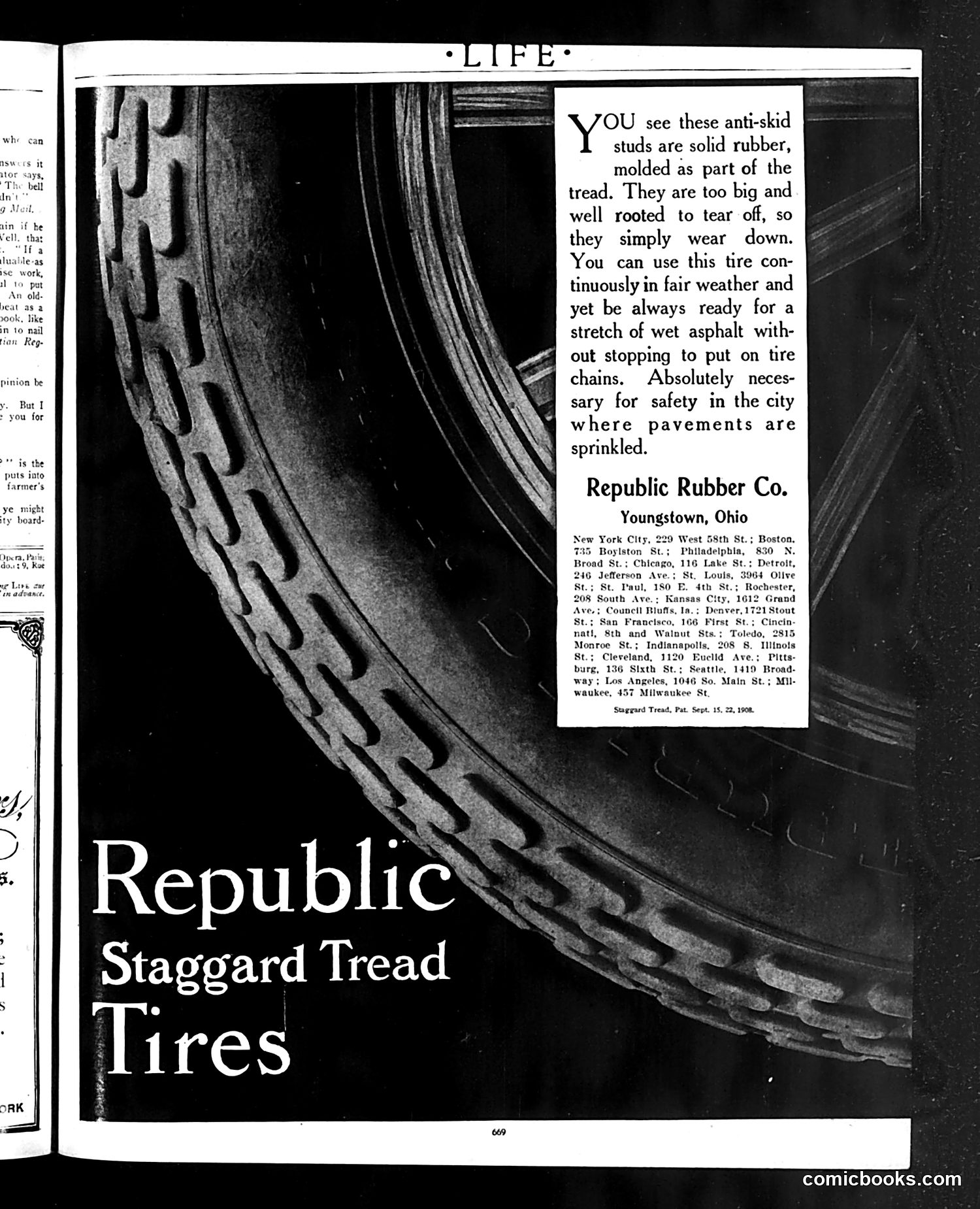
This is primarily a **tire advertisement**, not a political cartoon. The page promotes Republic Rubber Co.'s "Staggard Tread" tires, featuring a close-up photograph of the tire's tread pattern with prominent anti-skid studs. The ad's sales pitch emphasizes practicality for early 1900s urban driving: the solid rubber studs won't tear off but gradually wear down, and the tire performs adequately in fair weather while remaining ready for wet conditions without requiring tire chains—a significant convenience claim for the era. The text explicitly targets city drivers where "pavements are sprinkled" (likely referring to water-sprayed streets to control dust), positioning safety as the primary selling point. The publication date (Sept. 15, 1908) and multiple office locations listed indicate this was a national advertisement in *Life* magazine's pages.
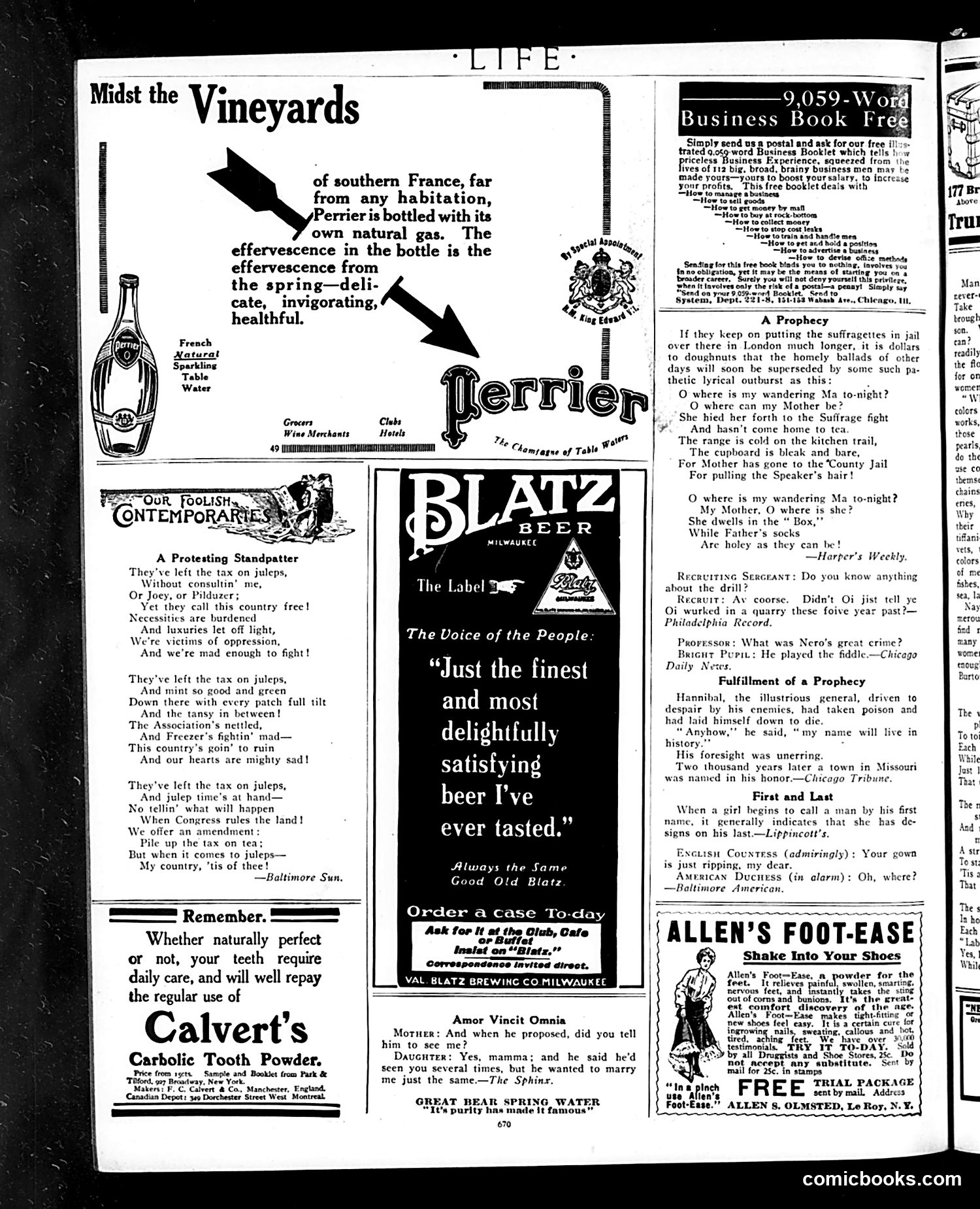
This page from *Life* magazine contains primarily **advertisements and light humor** rather than political cartoons. The main satirical piece is **"A Protesting Standpatter,"** a poem from the *Baltimore Sun* mocking opposition to tax policy. It protests that excise taxes were placed on "necessities" (like juleps and mint) while luxuries were left untaxed—presented as absurd and un-American. The humor targets conservative complainers who invoke patriotic rhetoric ("My country, 'tis of thee!") while complaining about alcohol taxes. **"A Prophecy"** references the **British suffragette movement**, which involved jailed activists. The satire imagines a mother imprisoned for "pulling the Speaker's hair," creating a domestic disruption narrative—the joke being that suffragette activism would leave homes in disarray and fathers with unwashed socks. This reflects contemporary anxiety about women's rights activism. The remaining content consists of advertisements (Perrier water, Blatz beer, Calvert's tooth powder, Allen's Foot-Ease) and miscellaneous jokes about courtship, military recruits, and classical history—typical *Life* magazine filler material from the early 20th century.
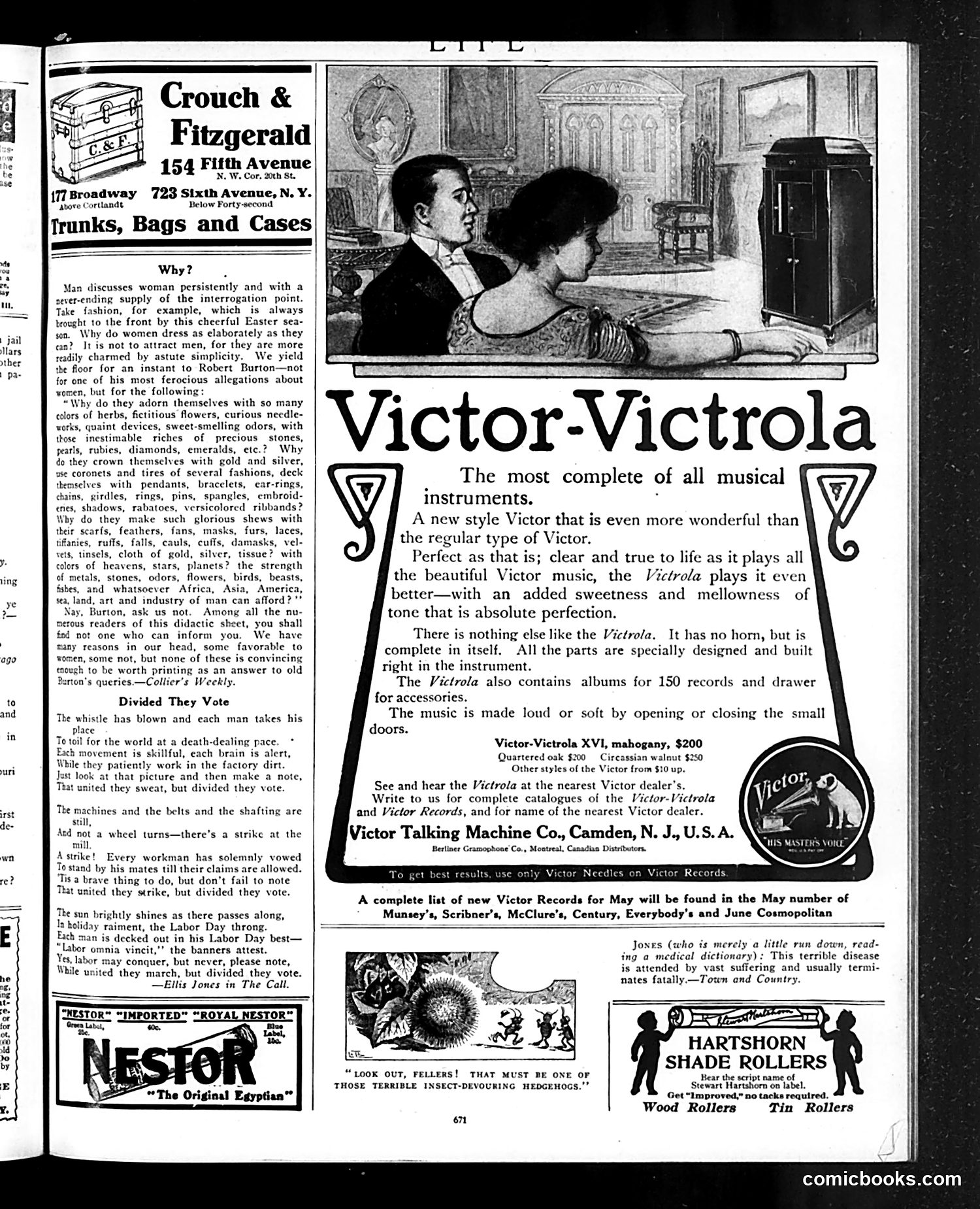
This page combines **advertising with social commentary**. The main content is a Victor Victrola phonograph advertisement—a luxury musical device priced at $200 (substantial money in this era). The accompanying editorial text, titled "Why?" satirizes women's elaborate fashion and ornamentation, quoting the 17th-century writer Robert Burton's lengthy catalog of female adornments (jewels, fabrics, cosmetics, etc.) while claiming the magazine cannot explain women's motivations. This reflects early 20th-century gender attitudes treating women's self-presentation as frivolous and inexplicable. The "Divided They Vote" poem by Ellis Jones critiques workers' political disunity: laborers unite for strikes and marches but fail to coordinate their voting power. The satire suggests organized labor's weakness stems from fragmented political action despite workplace solidarity. The advertisements (Crouch & Fitzgerald luggage, Nestor film, Hartshorn Shade Rollers) are period products typical of Life's commercial content.
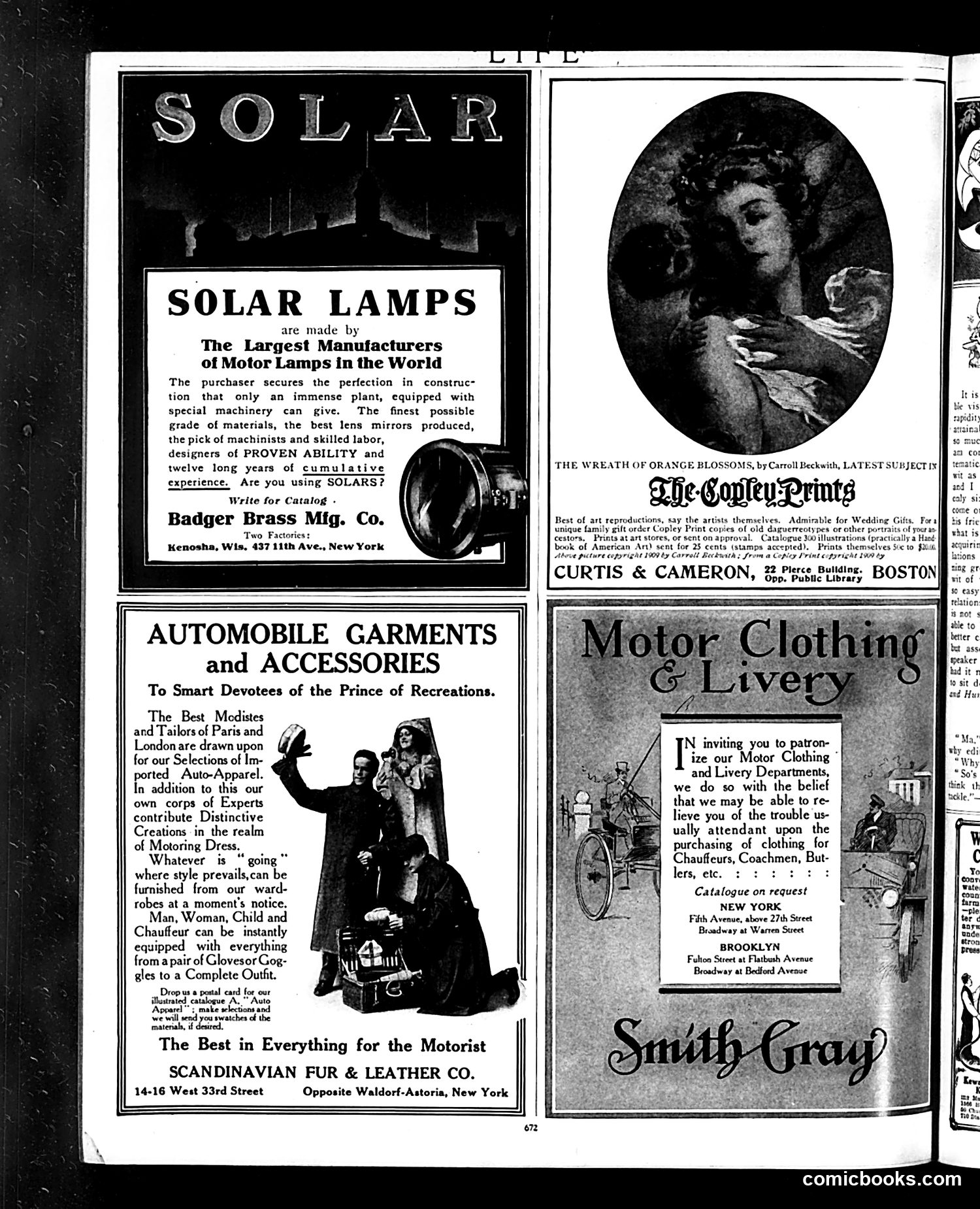
This is **not a cartoon or satirical content** — it's a page of advertisements from an early 1900s issue of Life magazine, page 672. The ads reflect the era's automobile boom and emerging motorist culture: - **Solar Lamps**: Automotive lighting manufactured by Badger Brass, targeting car owners concerned with quality engineering - **Copley Prints**: Art reproductions advertised alongside a painting titled "The Wreath of Orange Blossoms" - **Automobile Garments**: Specialized motoring clothing from Scandinavian Fur & Leather Co., emphasizing European fashion imported for wealthy "devotees" of automobiles - **Motor Clothing & Livery**: Curtis & Cameron's services for outfitting chauffeurs, coachmen, and servants — reflecting the class structure where wealthy owners employed uniformed drivers The consistent theme shows automobiles as luxury items for the affluent, with an entire consumer ecosystem developing around them — from technical equipment to fashionable attire to servant uniforms. This represents early-20th-century aspirational marketing to the wealthy.
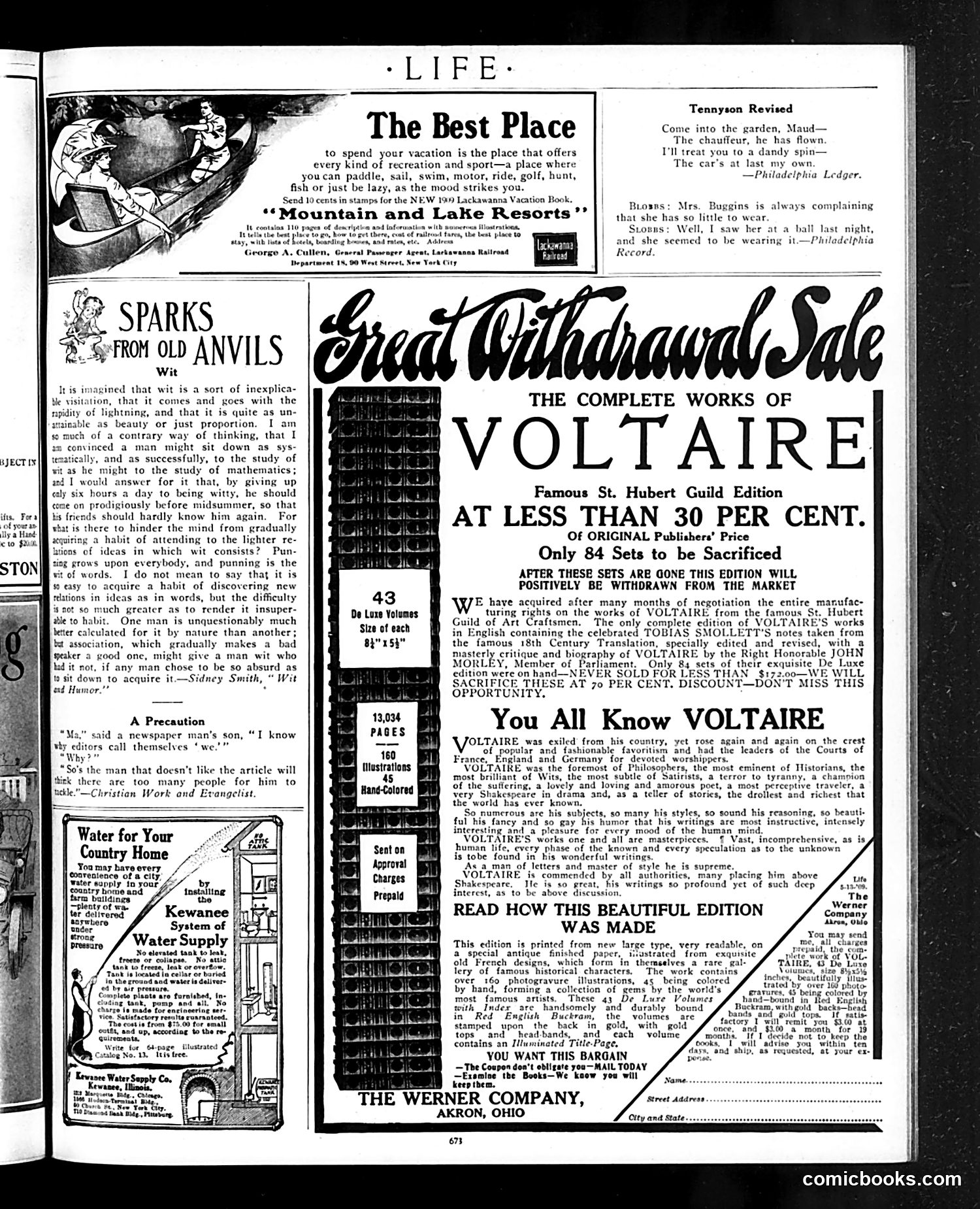
This page mixes advertisements with light satirical content typical of Life magazine's format. **"Tennyson Revised"** is a humorous parody of Alfred Tennyson's famous poem "Come into the Garden, Maud." The satire updates the romantic Victorian poem to the modern automobile age—the speaker now offers the lady a "dandy spin" in his motorcar instead of poetic garden romance. This reflects early 20th-century anxiety about technology replacing traditional romance. **"Sparks from Old Anvils"** is a humor column discussing wit and puns, presenting philosophical observations about humor as learned skill rather than innate talent. **Other brief jokes** mock Mrs. Buggins' constant clothing complaints and marital banter about appearances. The page is dominated by a **major advertisement for a complete Voltaire edition** at discount pricing from The Werner Company. The dominant advertising reflects Life's business model of mixing editorial content with substantial paid promotions.
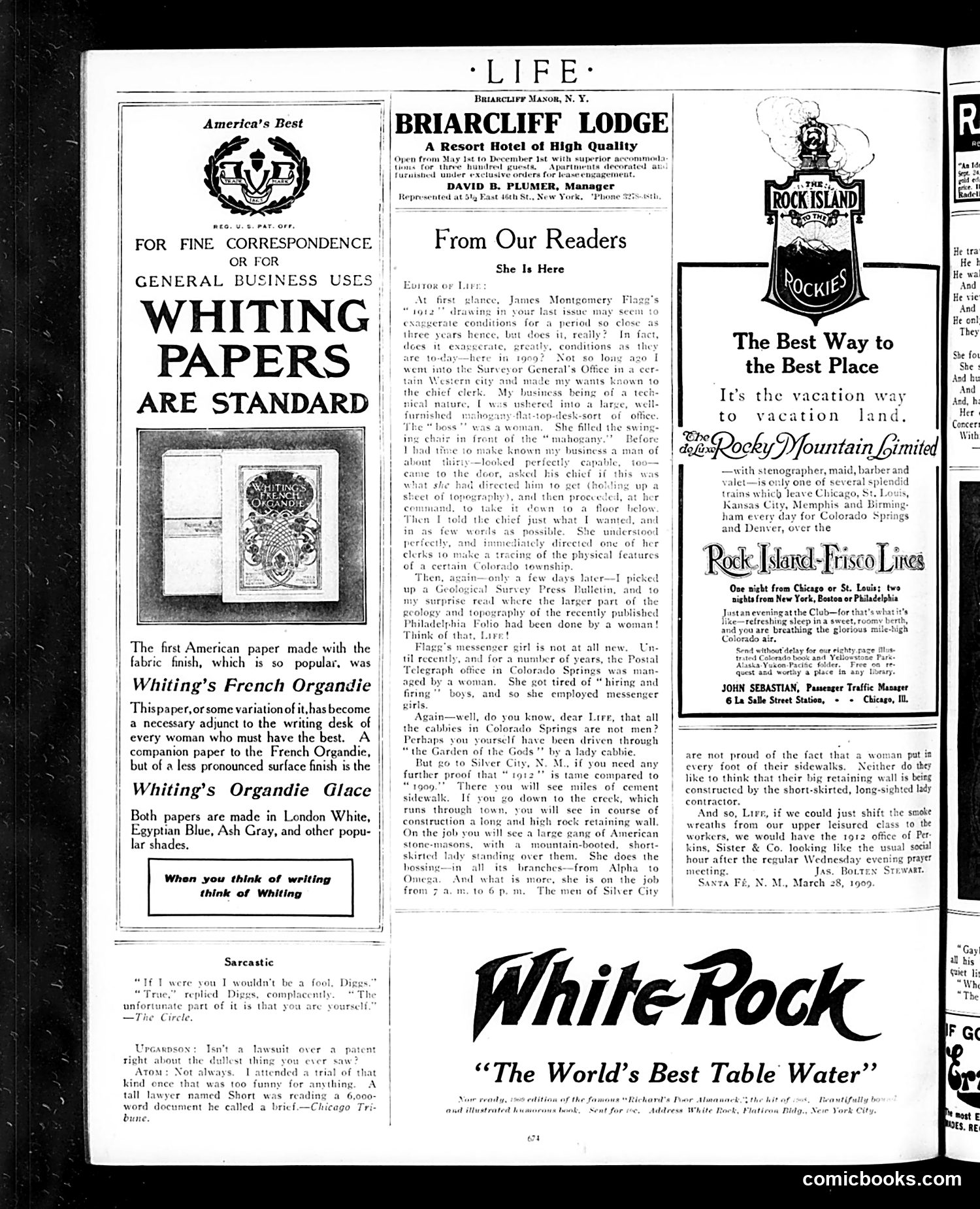
This page is primarily **advertising** rather than political cartoon content. It features: **Main advertisements:** - Whiting Papers (writing stationery), emphasizing that their French Organdie brand is "standard" for women's correspondence - Briarcliff Lodge (resort hotel in upstate New York) - Rock Island-Frisco railway lines promoting Colorado tourism - White Rock table water **Editorial content:** The "From Our Readers" section contains a letter from James Montgomery Flagg describing a woman working as a surveyor/draftsperson in Colorado Springs around 1909. The letter celebrates her professional competence while noting surprise that a woman performs technical work typically done by men—remarking on female surveyors, draftspeople, and even a female taxi driver. **Historical context:** This reflects early 1900s attitudes where women in professional/technical roles were noteworthy curiosities rather than commonplace, despite their clear capability. The satirical section ("Sarcastic") contains a brief legal joke unrelated to the page's main content.
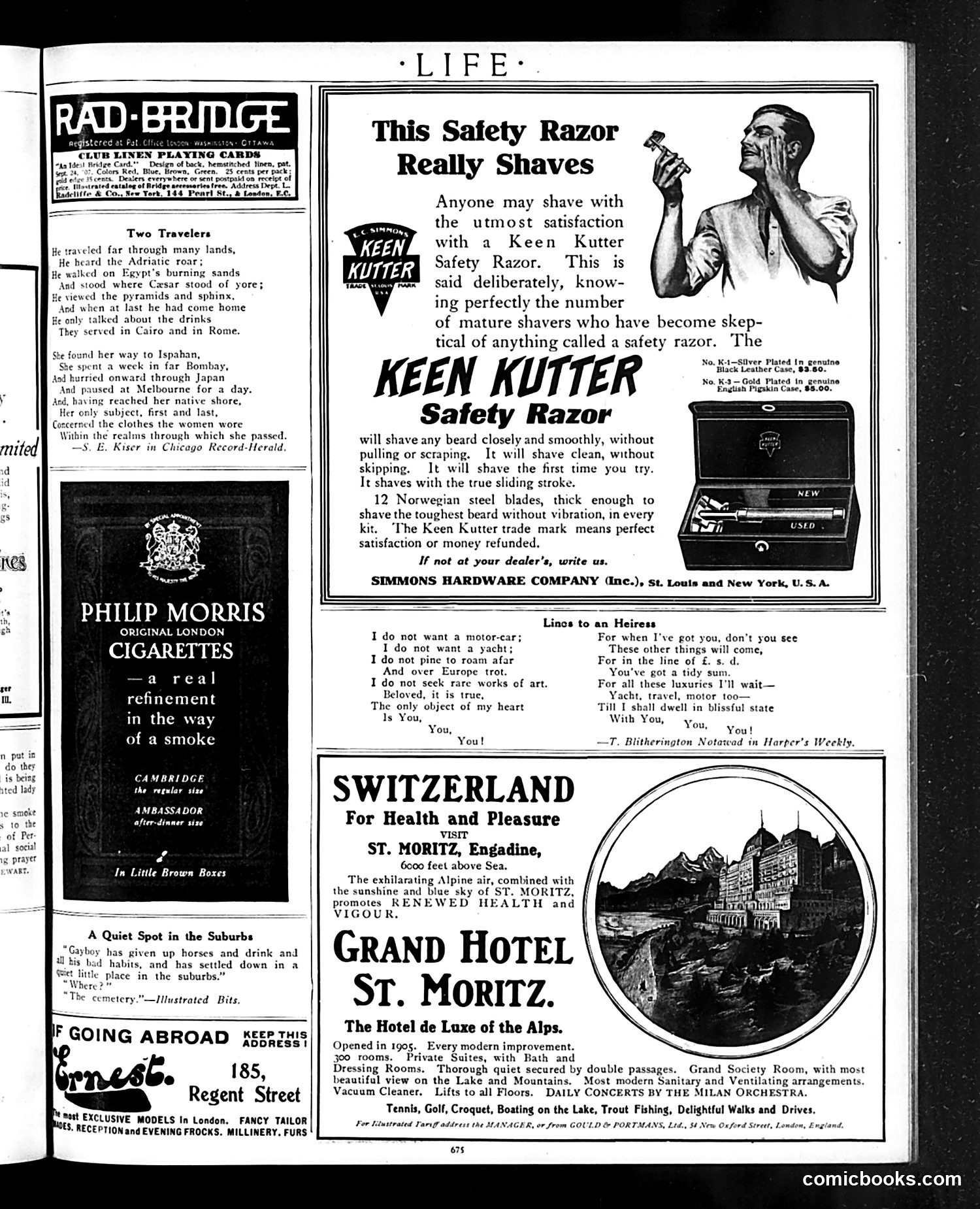
This page is primarily **advertising**, not political satire. It contains: **Main Content:** - A **Keen Kutter Safety Razor** advertisement featuring a man shaving, targeting skeptics of safety razors by emphasizing quality ("12 Norwegian steel blades") - **Philip Morris cigarettes** ad promoting "refinement" - Travel advertisements for **Switzerland's St. Moritz** and the **Grand Hotel** - A travel agency ad ("Ernest") for those going abroad **Lighter Editorial Content:** Two brief poems appear: "Two Travelers" (contrasting a man and woman's travel experiences) and "Lines to an Heiress" (a suitor declaring he wants only the woman, not material luxuries—though the punchline reveals he'll wait for wealth once married). A brief joke about suburban life rounds out the page. **Historical Context:** This reflects early-1900s concerns: safety razors were still novel enough to require reassurance advertising, and luxury Alpine travel represented aspirational leisure for the wealthy. The page contains **no political cartoons or significant satire**—it's a commercial advertising section typical of *Life* magazine's revenue model.
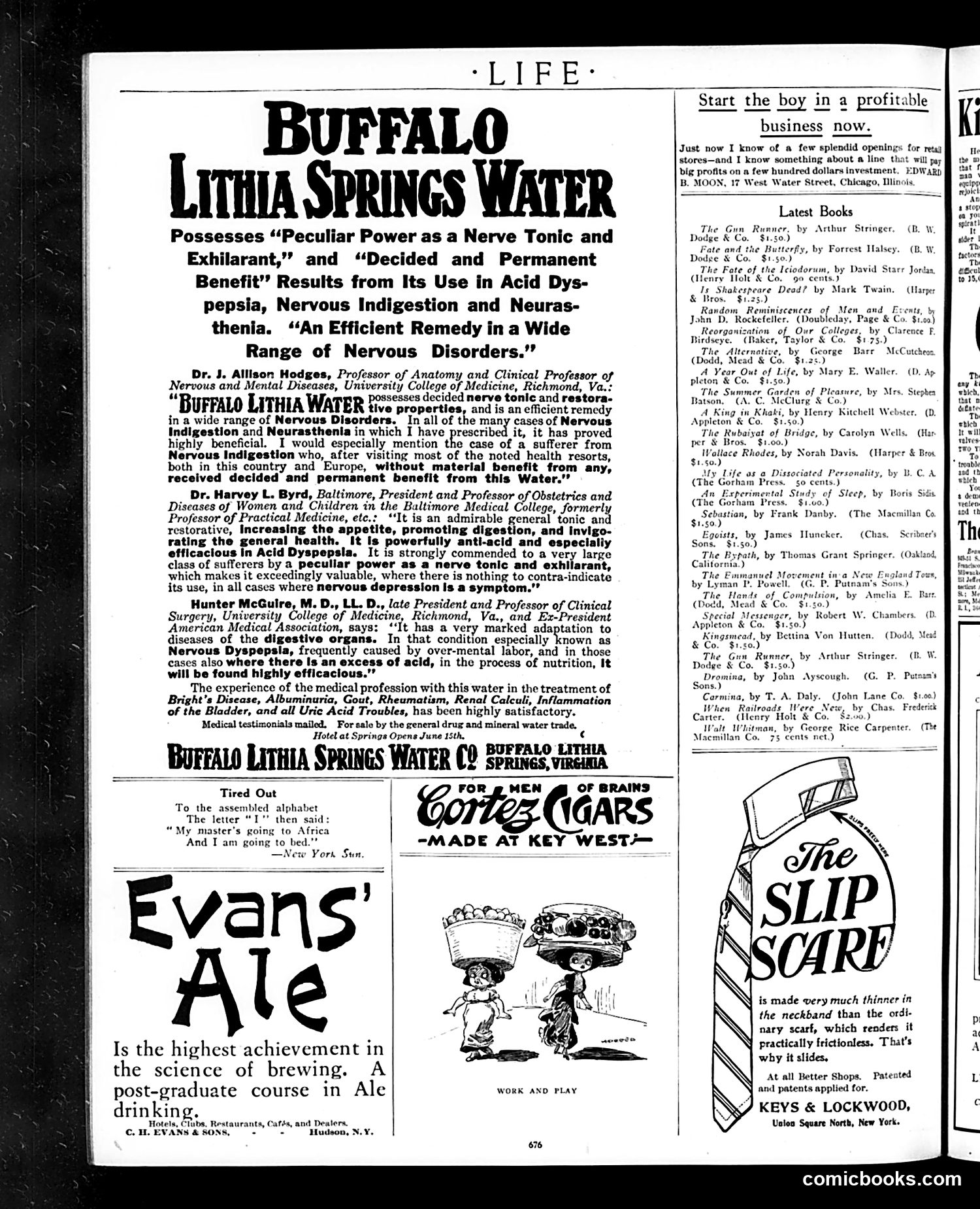
This page is primarily **advertising** rather than satire or political commentary. It features several mineral water and consumer product advertisements from the early 1900s. The dominant advertisement promotes **Buffalo Lithia Springs Water** from Virginia, claiming it cures "nervous disorders," indigestion, and neurasthenia. It includes quotes from medical professors endorsing its supposed curative powers—a common marketing tactic of the era. Modern readers should note that such "patent medicines" were largely unregulated snake oil, and conditions like "neurasthenia" (nervous exhaustion) were pseudoscientific diagnoses often applied to stressed, overworked people. The page also advertises **Evans' Ale** (claiming superiority in brewing science) and **Cortez Cigars** (marketed "for men of brains"), along with a brief joke about the letter "I" going to bed. A small section mentions book recommendations and business opportunities. These ads reflect early 20th-century marketing before food and drug regulation, when extravagant health claims were commonplace.
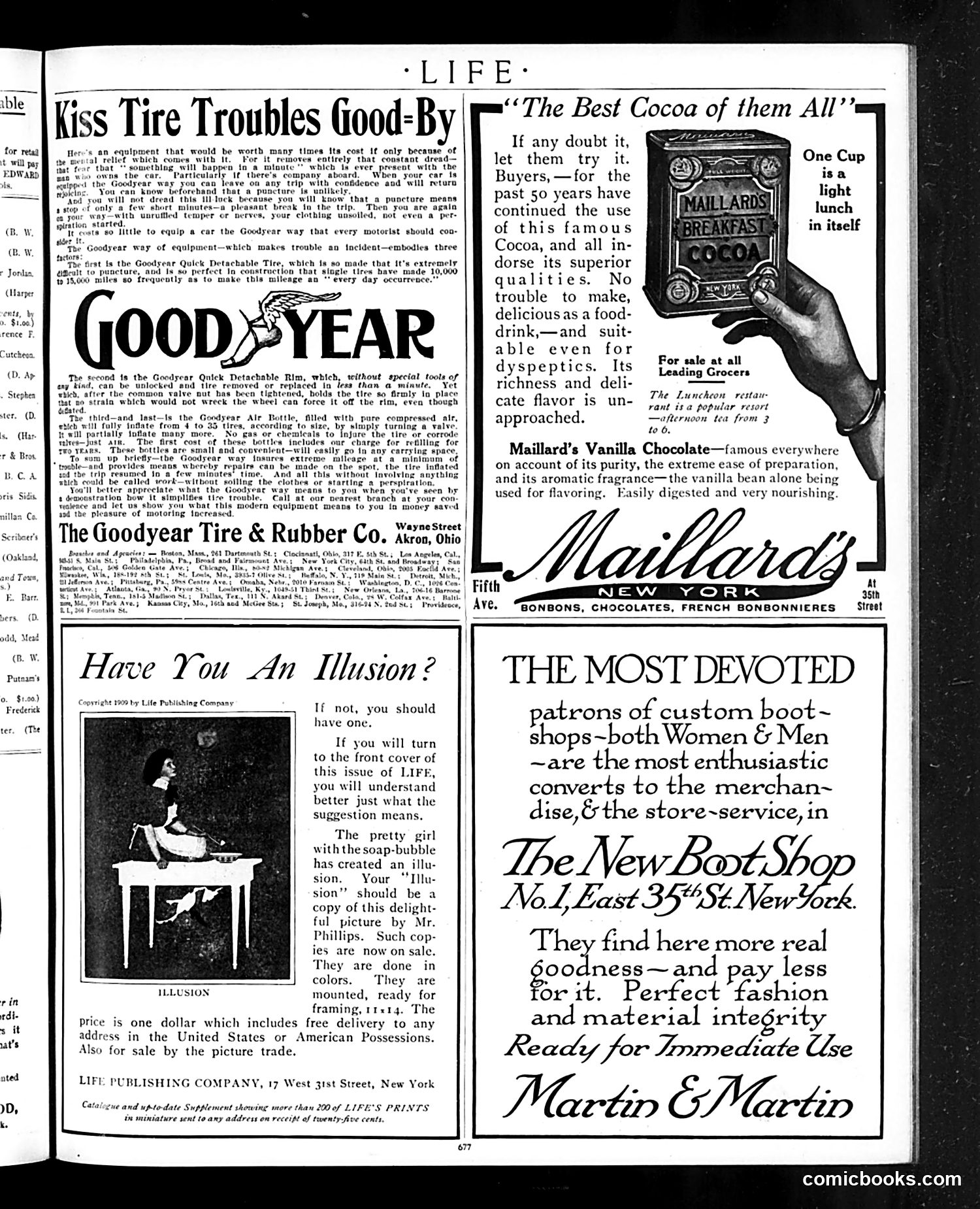
This page is primarily **advertising** rather than satirical content. The main elements are: **Left side:** A Goodyear Tire advertisement claiming their new "Quick Detachable Rim" eliminates tire troubles—a sales pitch for motorists concerned about punctures and breakdowns, common problems in the early automobile era. **Center:** A Maillard's Cocoa advertisement emphasizing purity and digestibility, marketing chocolate as a healthful beverage suitable even for people with weak stomachs. **Bottom left:** A small feature titled "Have You An Illusion?" advertising art prints by Life Publishing—offering framed soap-bubble artwork for sale. **Right side:** Advertisements for The New Boot Shop and Martin & Martin, promoting custom-made footwear. The page reflects **early 1900s consumer culture**: automobiles were still novel enough that tire reliability was a major selling point, cocoa was marketed as medicinal/nourishing rather than purely recreational, and custom retail services were emphasized as signs of quality and integrity.
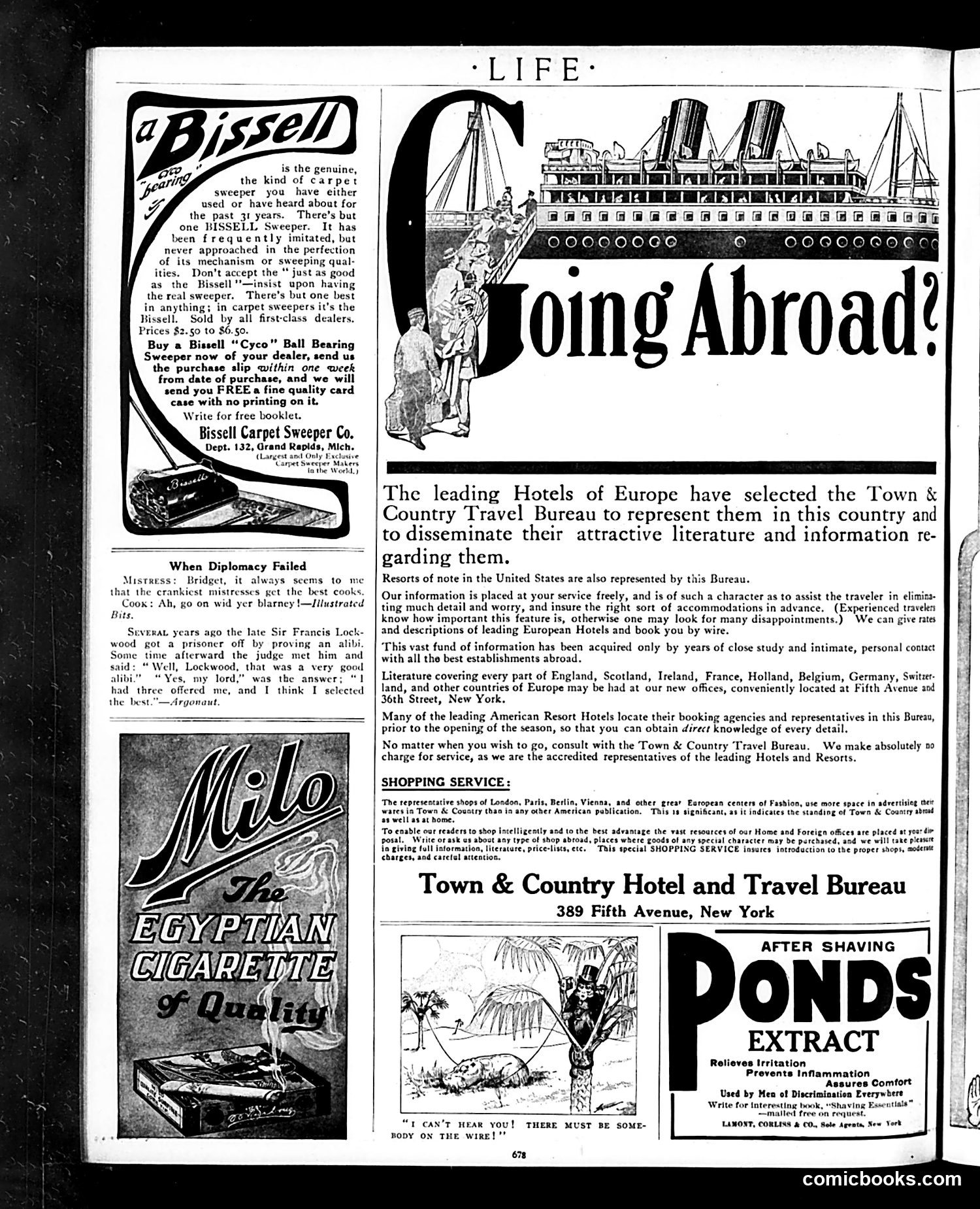
This page is primarily **advertising and service announcements** rather than political satire. The main content includes: **Advertisements:** - Bissell carpet sweeper (emphasizing it's the original, imitated but never matched) - Milo Egyptian cigarettes - Ponds After Shaving Extract **Service Announcements:** - Town & Country Travel Bureau promoting European hotel bookings and shopping services for wealthy American travelers **Minor Humor Sections:** - Two brief jokes: one about a cranky mistress and her cook (Irish servant stereotype), and another about Sir Francis Lockwood selecting the best of three alibis offered by a judge The page reflects **early 20th-century consumer culture** targeting affluent readers—promoting luxury travel, branded consumer goods, and servant-household dynamics. The humor relies on class and ethnic stereotypes typical of the era. There is no significant political cartoon or satire present.
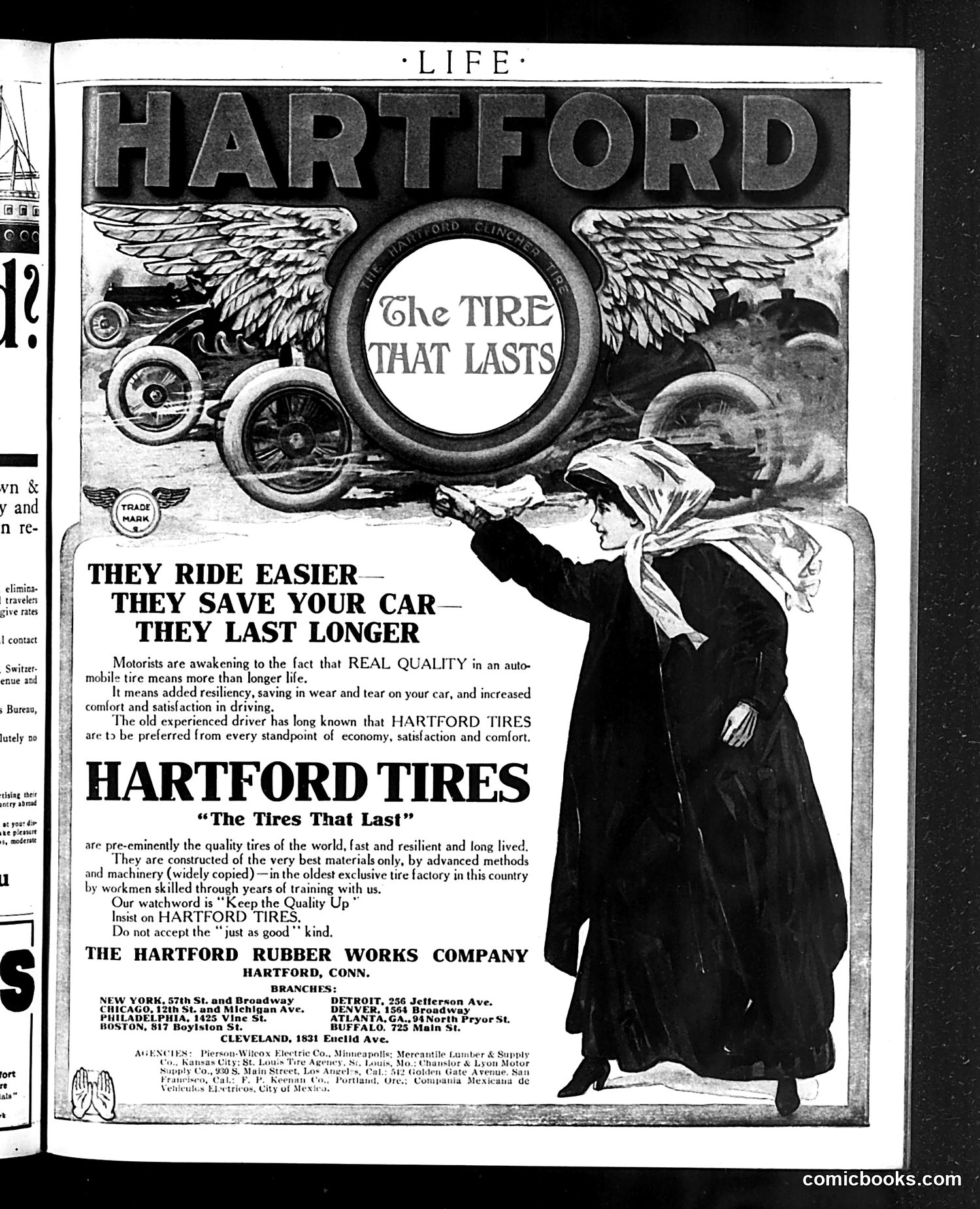
This is a **full-page tire advertisement**, not political satire. The image shows a woman in early 20th-century dress (long coat, headscarf) pointing admiringly at a large Hartford tire, with a vintage automobile and winged imagery in the background. The ad's message is straightforward commercial: Hartford Tires offer superior quality, durability, comfort, and economy compared to competitors. The tagline "The Tires That Last" emphasizes longevity. The text appeals to "experienced drivers" and warns against accepting inferior "just as good" alternatives. The winged imagery suggests speed and progress—common Art Deco marketing conventions of the era. The female figure represents the modern motorist. There is no satirical content here; this is genuine period advertising claiming Hartford as the premium tire choice through quality construction and skilled American manufacturing.
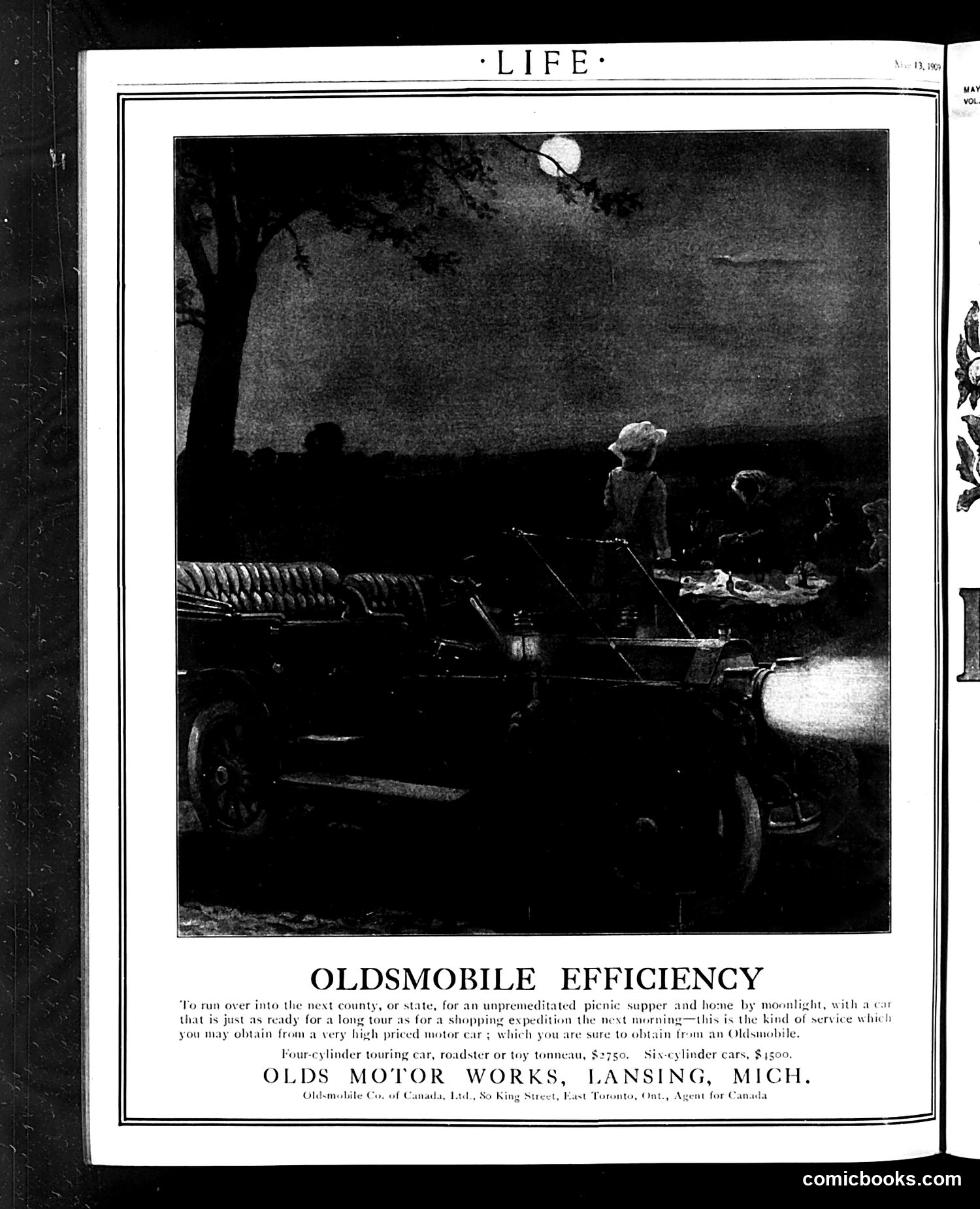
This page is **purely advertising**, not satire or editorial content. It's a full-page Oldsmobile motor car advertisement from Life magazine. The image shows a nighttime scene: a couple in an early automobile preparing for or returning from a moonlit excursion, with another vehicle visible. The ad copy emphasizes the car's reliability and versatility—suitable for both spontaneous romantic trips and practical shopping errands. The pitch targets affluent buyers by claiming Oldsmobile offers the service quality of expensive cars at better value. Prices listed ($2,750 for four-cylinder, $4,300 for six-cylinder) indicate luxury vehicles. The "efficiency" angle reflects early-1900s marketing language emphasizing automobiles as practical, dependable machines rather than mere novelties. The moonlit picnic imagery appeals to leisure and romance—social aspirations of the car-owning class.