
Life, 1909-05-13 · page 12 of 32
Life — May 13, 1909 — page 12: what you’re looking at
What you’re looking at
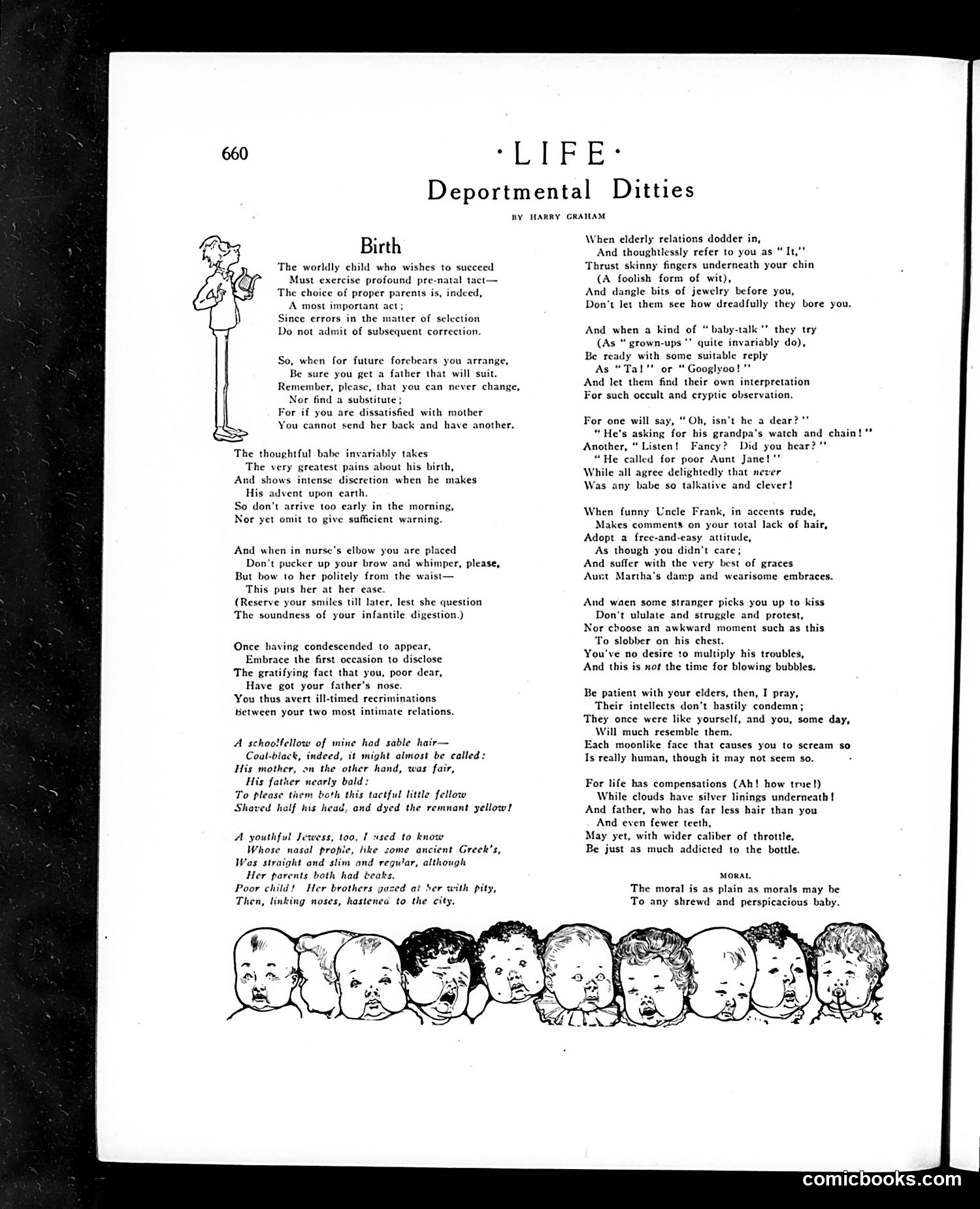
This page by Harry Graham presents humorous advice for new parents, sarcastically titled "Departmental Duties." The poem mocks the prevailing attitudes of upper-class parenting in the early 20th century, when children were often raised by nursemaids rather than parents. The satire targets the emotional distance between parents and infants, advising against showing affection, maintaining composure during the baby's distress, and tolerating relatives' intrusive comments about the child. Graham ridicules the era's rigid child-rearing conventions—the expectation that proper parents remain aloof and detached. The footer illustration shows nine baby heads displaying varied expressions, humorously emphasizing the range of infant emotions parents were expected to ignore.
📄 Transcribed text from this page (OCR, searchable)
Machine-transcribed from the original scan — historical spelling and the odd misread are preserved.
"LIF E* Deportmental Ditties BY HARRY GRATIAM Birth The worldly child who wishes to succeed Must exercise profound pre-natal tact— The choice of proper parents is, indeed, A most important act ce errors in the matter of selection Do not admit of subsequent correction. So, when for future forebears you arrange, Be sure you get a father that will suit. Remember, please, that you can never change, Nor find a substitute; For if you are dissatisfied with mother You cannot send her back and have another. The thoughtful babe invariably takes The very greatest pains about his birth, And shows intense discretion when he makes His advent upon earth So don't arrive too early in the morning, Nor yet omit to give sufficient warning. And when in nurse’s elbow you are placed Don’t pucker up your brow and whimper, please, But bow to her politely from the waist— This puts her at her ease. (Reserve your smiles till later, lest she question The soundness of your infantile digestion.) Once having condescended to appear, Embrace the first occasion to disclose The gratifying fact that you, poor dear, Have got your father’s ni You thus avert ill-timed recriminations Between your two most intimate relations. A schoo!fellow of mine had sable hair— Cout-black, indeed, it might almost be called: His mother, on the other hand, was fair, His father nearly bald: To please tiem both this tactful little fellow Shaved half his head, and dyed the remnant yellow! A youthful Jewess, too, | used to know Whose nasal propiie, like some ancient Greek’s, Was straight and slim and regular, although Her parents both had beaks, Poor child! Her brothers gazed at her with pity, Then, linking noses, hastened to the city. When elderly relations dodder in, And thoughtlessly refer to you as “It,” Thrust skinny fingers underneath your chin (A foolish form of wit), And dangle bits of jewelry before you, Don't let them sce how dreadfully they bore you. And when a kind of “baby-talk '’ they try (As “ grown-ups "" quite invariably do), Be ready with some suitable reply As “Tal” or “Googlyoo! '’ And let them find their own interpretation For such occult and cryptic observation. For one will say, “Oh, isn’t he a dear?" “He's asking for his grandpa’s watch and chain!"* Another, “Listen! Fancy? Did you hear?’* “He called for poor Aunt Jane!" While all agree delightedly that never Was any babe so talkative and clever! When funny Uncle Frank, in accents rude, Makes comments on your total lack of hair, Adopt a free-and-easy attitude, As though you didn’t care; And suffer with the very best of graces Aunt Martha’s damp and wearisome embraces. And waen some stranger picks you up to kiss Don’t ululate and struggle and protest, Nor choose an awkward moment such as this To slobber on his chest. You've no desire to multiply his troubles, And this is not the time for blowing bubbles. Be patient with your elders, then, I pray, Their intellects don’t hastily condemn; They once were like yourself, and you, some day, Will much resemble them. Each moonlike face that causes you to scream so Is really human, though it may not seem so. For life has compensations (Ah! how true!) While clouds have silver linings underneath! And father, who has far less hair than you And even fewer teeth, May yet, with wider caliber of throttle, Be just as much addicted to the bottle. MORAL. The moral is as plain as morals may be To any shrewd and perspicacious baby. comicbooks.com