
Life, 1909-05-13 · page 14 of 32
Life — May 13, 1909 — page 14: what you’re looking at
What you’re looking at
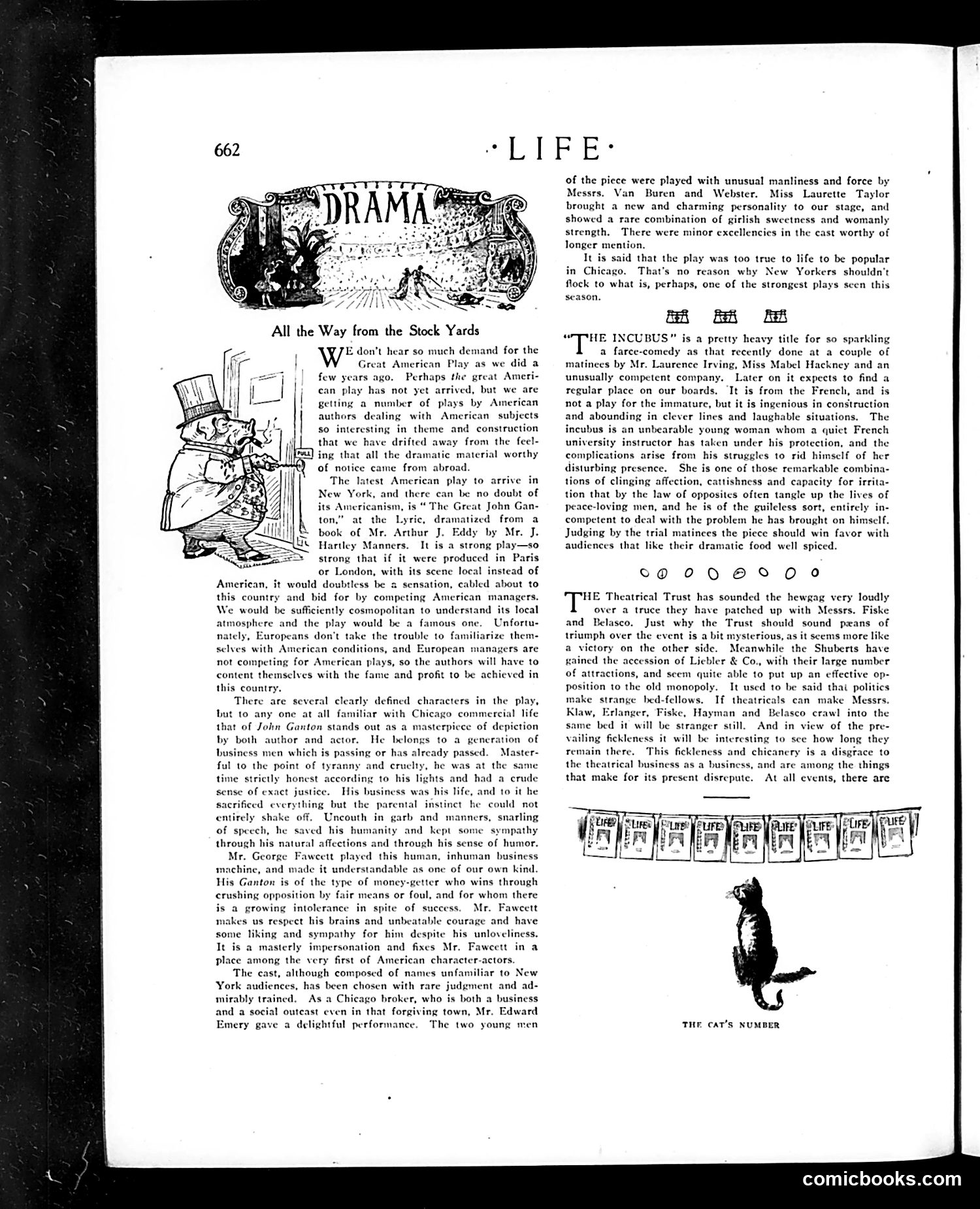
This page reviews "The Great John Ganton," a new American play adapted from Arthur J. Eddy's book. The critic argues that American dramatic works deserve equal respect to European imports. The play depicts a Chicago businessman—John Ganton—a ruthless, honest money-maker representing a "passing generation" of robber-baron capitalists. Actor George Fawcett's portrayal is praised as masterful character work showing this "human, inhuman business machine" with crude integrity but also tyranny. The review's satire is implicit: Americans shouldn't need a European production stamp to validate homegrown plays. The stockyard reference in the title suggests Chicago's industrial brutality parallels Ganton's business methods. The article also briefly mentions another play, "The Incubus," calling it misleadingly heavy-titled for a light farce-comedy.
📄 Transcribed text from this page (OCR, searchable)
Machine-transcribed from the original scan — historical spelling and the odd misread are preserved.
*LIFE* eee doe? ee All the Way from the Stock Yards E don’t hear so much demand for the Great American Play as we did a few years ago. Perhaps the great Ameri- can play has not yet arrived, but we are getting a number of plays by American authors dealing with American subjects so interesting in theme and construction that we have drifted away from the feel ing that all the dramatic material worthy of notice came from abroad. The latest American play to arrive in ew York, and there can be no doubt of its Americanism, is “The Great John Gan- ton,” at the Lyric, dramatized from a book of Mr. Arthur J. Eddy by Mr. J. Hartley Manners. It is a strong play—so strong that if it were produced in Paris or London, with its scene local instead of American, it would doubtless be & sensation, cabled about to this country and bid for by competing American managers. We would be sufficiently cosmopolitan to understand its local atmosphere and the play would be a famous one. Unfortu- nately, Europeans don't take the trouble to familiarize them- selves with American conditions, and European managers are not competing for American plays, so the authors will have to content themselves with the fame and profit to be achieved in this country, There are several clearly defined characters in the play, but to any one at all familiar with Chicago commercial life that of John Ganton stands out as a masterpiece of depiction by both author and actor. He belongs to a generation of business men which is passing or has already passed. Master- ful to the point of tyranny and eruchy, he was at the same time strictly honest according to his lights and had a crude sense of exact justice. His business was his life, and to it he sacrificed everything but the parental instinct he could not entirely shake off. Uncouth in garb and manners, snarling of speech, he saved his humanity and kept some sympathy through his natural affections and through his sense of humor. Mr. George Fawcett played this human, inhuman business machine, and made it understandable as one of our own kind. His Ganton is of the type of money-getter who wins through crushing opposition by fair means or foul, and for whom there is a growing intolerance in spite of success. Mr. Faweett makes us respect his brains and unbeatable courage and have some liking and sympathy for him despite his unloveliness. It is a masterly impersonation and fixes Mr. Fawcett in a place among the very first of American character-actors. The cast, although composed of names unfamiliar to New York audiences, has been chosen with rare judgment and ad- mirably trained. As a Chicago broker, who is both a business and a social outeast even in that forgiving town, Mr, Edward Emery gave a delightful performance. The two young men of the piece were played with unusual manliness and force by Messrs. Van Buren and Webster. Miss Laurette Taylor brought a new and charming personality to our stage, and showed a rare combination of girlish sweetness and womanly strength. There were minor exccllencies in the cast worthy of longer mention. It is said that the play was too true to life to be popular in Chicago. That’s no reason why New Yorkers shouldn't flock to what is, perhaps, one of the strongest plays scen this BA RMB HE INCUBUS" is a pretty heavy title for so sparkling a farce-comedy as that recently done at a couple of matinees by Mr. Laurence Irving, Miss Mabel Hackney and an unusually competent company. Later on it expects to find a regular place on our boards. ‘It is from the French, and is not a play for the immature, but it is ingenious in construction and abounding in clever lines and laughable situations, The incubus is an unbearable young woman whom a quict French university instructor has taken under his protection, and the complications arise from his struggles to rid himself of her disturbing presence. She is one of those remarkable combina- tions of clinging affection, cattishness and capacity for irrita- tion that by the law of opposites often tangle up the lives of peace-loving men, and he is of the guileless sort, entirely in- competent to deal with the problem he has brought on himself. Judging by the trial matinces the piece should win favor with audiences that like their dramatic food well spiced. ©0900 68900 HE Theatrical Trust has sounded the hewgag very loudly over a truce they have patched up with Messrs. Fiske and Belasco. Just why the Trust should sound pxans of triumph over the event is a bit mysterious, as it scems more like a victory on the other side. Meanwhile the Shuberts have gained the accession of Licbler & Co., wiih their large num of attractions, and scem quite able to put up an effecti Position to the old monopoly. It used to be said thai politics make strange bed-fellows. If theatricals can make Messrs. Klaw, Erlanger, Fiske, Hayman and Belasco crawl into the ame bed it will be stranger still. And in view of the pre- vailing fickleness it will be interesting to sce how long they remain there. This fickleness and chicanery is a di the theatrical business as a business, and are among the things that make for its present disrepute. At all events, there are THE CAT'S NUMBER comicbooks.com