
Life, 1909-05-13 · page 6 of 32
Life — May 13, 1909 — page 6: what you’re looking at
What you’re looking at
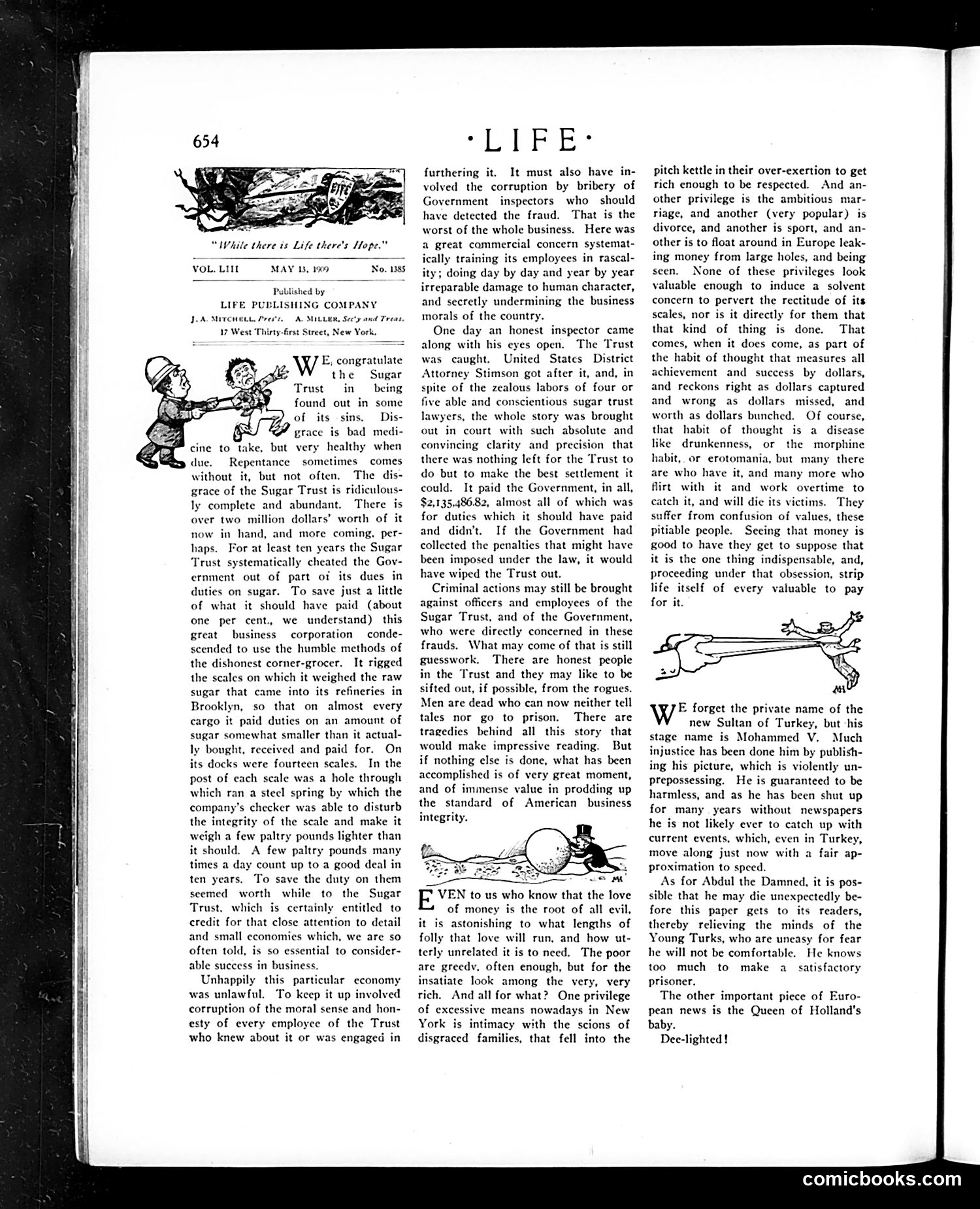
This page satirizes the **Sugar Trust fraud case**. The text describes how the Trust systematically cheated the U.S. Government on sugar duties through rigged scales—fraudulently underpaying tariffs for years. A honest inspector eventually caught them, leading to court action where the Trust paid massive penalties ($213,480.82). The small cartoons illustrate the deception: one shows a child and figure with a sugar kettle, representing innocent victims; another depicts a figure being weighed on corrupt scales. The satire criticizes both corporate corruption and moral decay: the Trust trained employees in "rascality," bribing inspectors while undermining national business integrity. The piece calls for accountability and warns that such "love of money" drives destructive social consequences.
📄 Transcribed text from this page (OCR, searchable)
Machine-transcribed from the original scan — historical spelling and the odd misread are preserved.
“While there is Life there's Hope.” VOL. LIL MAY 3, 1900 Published by LISHING COMPANY A. Mitta, Secty and Treat. LIFE PU SoA MITCHELL Pree. 17 West Thirty-first Street, New York. E, congratulate the Sugar Trust in being found out in some of its Dis- grace is bad medi- cine to take, but very healthy when due. Repentance sometimes comes without it, but not often. The dis- grace of the Sugar Trust is ridiculous- ly complete and abundant. There is over two million dollars’ worth of it now in hand, and more coming, per- haps. For at least ten years the Sugar Trust systematically cheated the Gov- ernment out of part of its dues in duties on sugar. To save just a little of what it should have paid (about one per cent., we understand) this great business corporation conde- scended to use the humble methods of the dishonest corner-grocer. It rigged the scales on which it weighed the raw sugar that came into its refineries in Brooklyn, so that on almost every cargo it paid duties on an amount of sugar somewhat smaller than it actual- ly bought, received and paid for. On its docks were fourteen scales. In the post of each scale was a hole through which ran a steel spring by which the company’s checker was able to disturb the integrity of the scale and make it weigh a few paltry pounds lighter than it should. A few paltry pounds many times a day count up to a good deal in ten years, To save the duty on them seemed worth while to the Sugar Trust, which is certainly entitled to credit for that close attention to detail and small economies which, we are so often told, is so essential to consider- able success in business. Unhappily this particular economy was unlawful. To keep it up involved corruption of the moral sense and hon- esty of every employee of the Trust who knew about it or was engaged in sins. *“LIFE* furthering it. It must also have in- volved the corruption by bribery of Government inspectors who should have detected the fraud. That is the worst of the whole business. Here was a great commercial concern systemat- ically training its employees in rascal- ity; doing day by day and year by year irreparable damage to human character, and secretly undermining the business morals of the country. One day an honest inspector came along with his eyes open. The Trust was caught. United States District Attorney Stimson got after it, and, in spite of the zealous labors of four or five able and conscientious sugar trust lawyers, the whole story was brought out in court with such absolute and convincing clarity and precision that there was nothing left for the Trust to do but to make the best settlement it could. It paid the Government, in all, $2,135.486.82, almost all of which was for duties which it should have paid and didn’t. If the Government had collected the penalties that might have been imposed under the law, it would have wiped the Trust out. Criminal actions may still be brought against officers and employees of the Sugar Trust, and of the Government, who were directly concerned in these frauds. What may come of that is still guesswork, There are honest people in the Trust and they may like to be sifted out, if possible, from the rogues. Men are dead who can now neither tell tales nor go to prison. There are tragedies behind all this story that would make impressive reading. But if nothing else is done, what has been accomplished is of very great moment, and of immense value in prodding up the standard of American business integrity. =—_ ~= Mt VEN to us who know that the love of money is the root of all evil, it is astonishing to what lengths of folly that love will run, and how ut- terly unrelated it is to need. The poor are greedy, often enough, but for the insatiate look among the very, very rich. And all for what? One privilege of excessive means nowadays in New York is intimacy with the scions of disgraced families, that fell into the pitch kettle in their over-exertion to get rich enough to be respected. And an- other privilege is the ambitious mar- riage, and another (very popular) is divorce, and another is sport, and an- other is to float around in Europe leak- ing money from large holes, and being seen. None of these privileges look valuable enough to induce a solvent concern to pervert the rectitude of its scales, nor is it directly for them that that kind of thing is done. That comes, when it does come, as part of the habit of thought that measures all achievement and success by dollars, and reckons right as dollars captured and wrong as dollars missed, and worth as dollars bunched. Of course, that habit of thought is a disease like drunkenness, or the morphine habit, or erotomania, but many there are who have it, and many more who flirt with it and work overtime to catch it, and will die its victims. They suffer from confusion of values, these pitiable people. Seeing that money is good to have they get to suppose that it is the one thing indispensable, and, proceeding under that obsession, strip life itself of every valuable to pay for it W* forget the private name of the new Sultan of Turkey, but his stage name is Mohammed V. Much injustice has been done him by publish- ing his picture, which is violently un- Prepossessing. He is guaranteed to be harmless, and as he has been shut up for many years without newspapers he is not likely ever to catch up with current events, which, even in Turkey, move along just now with a fair ap- proximation to speed. As for Abdul the Damned, it is pos- sible that he may die unexpectedly be- fore this paper gets to its readers, thereby relieving the minds of the Young Turks, who are uneasy for fear he will not be comfortable. He knows too much to make a_ satisfactory prisoner. The other important piece of Euro- pean news is the Queen of Holland's baby. Dee-lighted! comicbooks.com