
A complete issue · 32 pages · 1909
Life — February 18, 1909
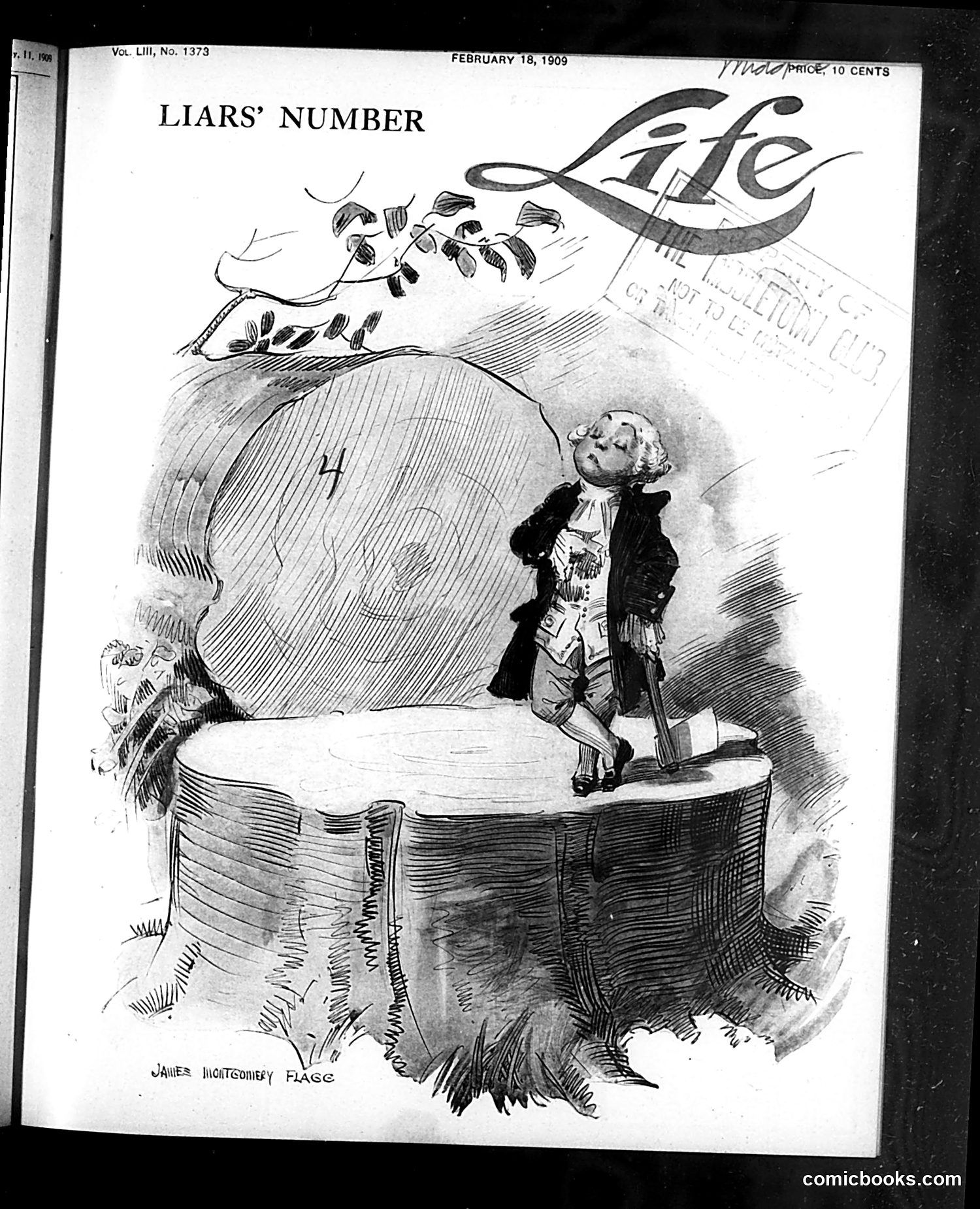
This political cartoon by James Montgomery Flagg depicts a rotund, well-dressed man standing on a tree stump, looking upward at birds perched on a branch above him. The title "Liars' Number" suggests the cartoon is satirizing dishonest statements or exaggeration. The man appears to be a politician or public figure telling tall tales, while the birds above—a traditional symbol of spreading rumors or "birdsong" gossip—mock him. The stump setting evokes the American tradition of politicians delivering speeches from improvised platforms. Without additional context about February 1909 political events, the specific identity of the figure remains unclear, but the cartoon likely critiques a contemporary politician's credibility or truthfulness during a particular scandal or controversial statement.
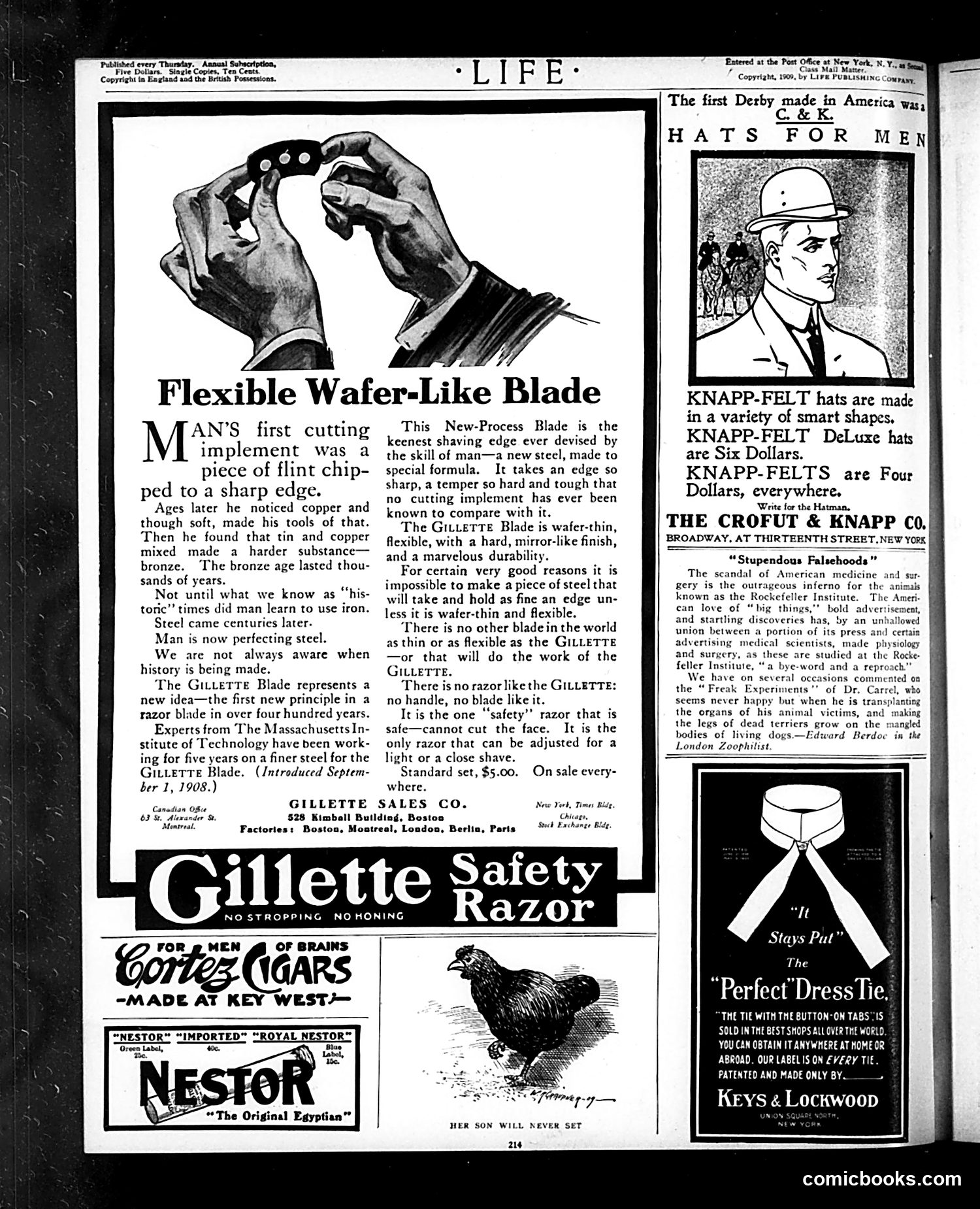
This page is **primarily advertising**, not satire or political commentary. The main content features three product ads: 1. **Gillette Safety Razor** (dominant): Emphasizes the razor's "flexible water-like blade" and superior cutting edge, comparing it favorably to competitors like the Gillette (the text seems self-referential). The ad highlights technological innovation in steel manufacturing. 2. **Cortez Cigars** and **Nestor Cigars**: Standard product advertisements. 3. **Knapp-Felt Hats**, **Perfect Dress Tie**, and other accessories: Minor sidebar ads. The only image with potential satirical intent is captioned "HER SON WILL NEVER SET"—a hen illustration—likely a pun on "setting" (brooding), though context is limited. Overall, this is a typical early-20th-century magazine page dominated by consumer product marketing rather than political or social satire.
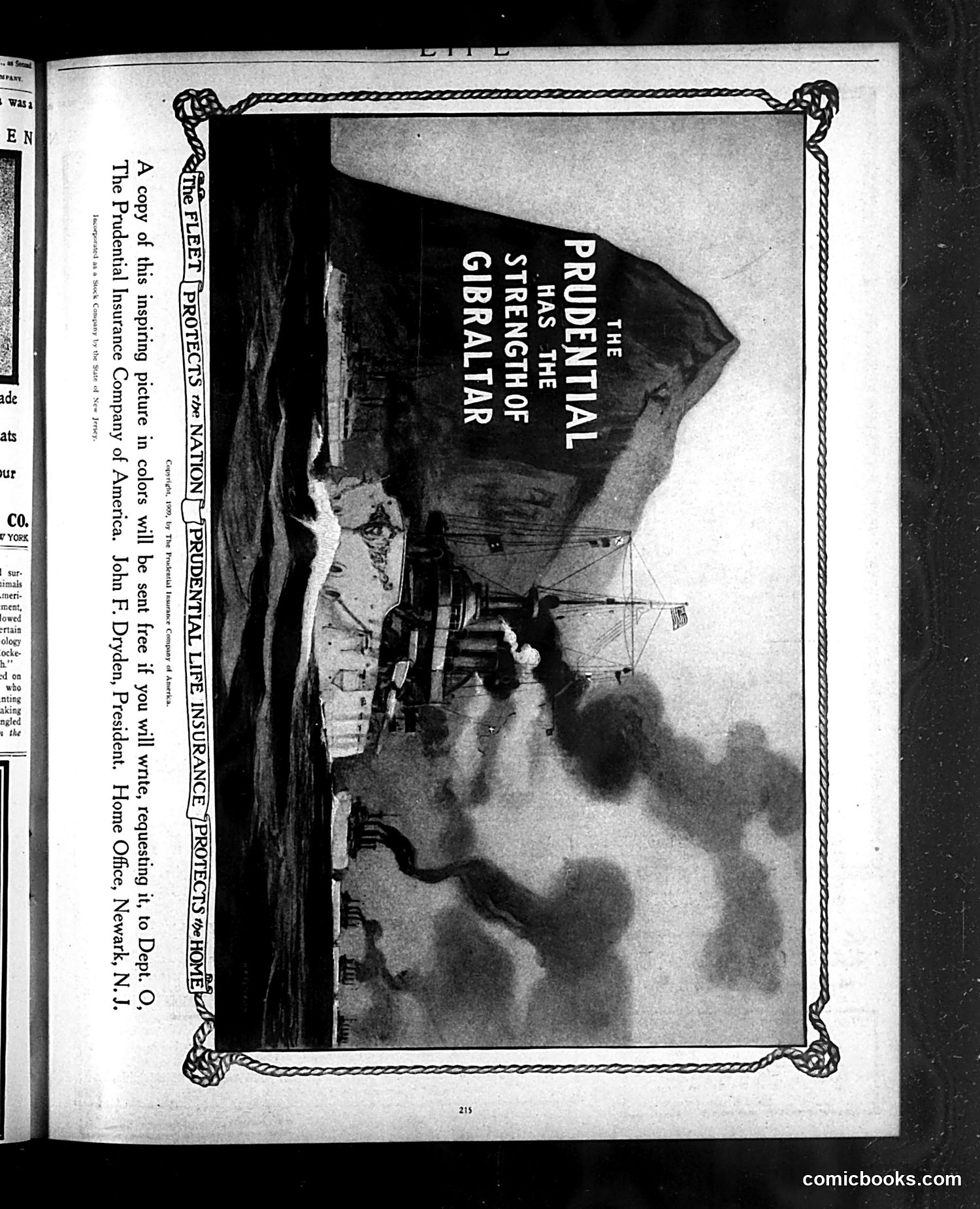
This page contains an advertisement for "The Prudential: It Has the Strength of Gibraltar," featuring an image of the Rock of Gibraltar. The advertisement uses the famous rock formation as a metaphor for financial stability and reliability. On the left side is text describing a copy of Prudential Insurance Company's pamphlet about Antarctica. The copy emphasizes that the company offers protection "to people willing to depend it to Depend On" and mentions "Home Office, Newark, N.J." The satire or commentary here is unclear from the image alone. This appears primarily to be a corporate advertisement leveraging Gibraltar's iconic strength as a symbol of trustworthiness for insurance purposes—a common marketing strategy of the era. Without additional context about the magazine's editorial stance toward insurance companies, the specific satirical intent cannot be determined.
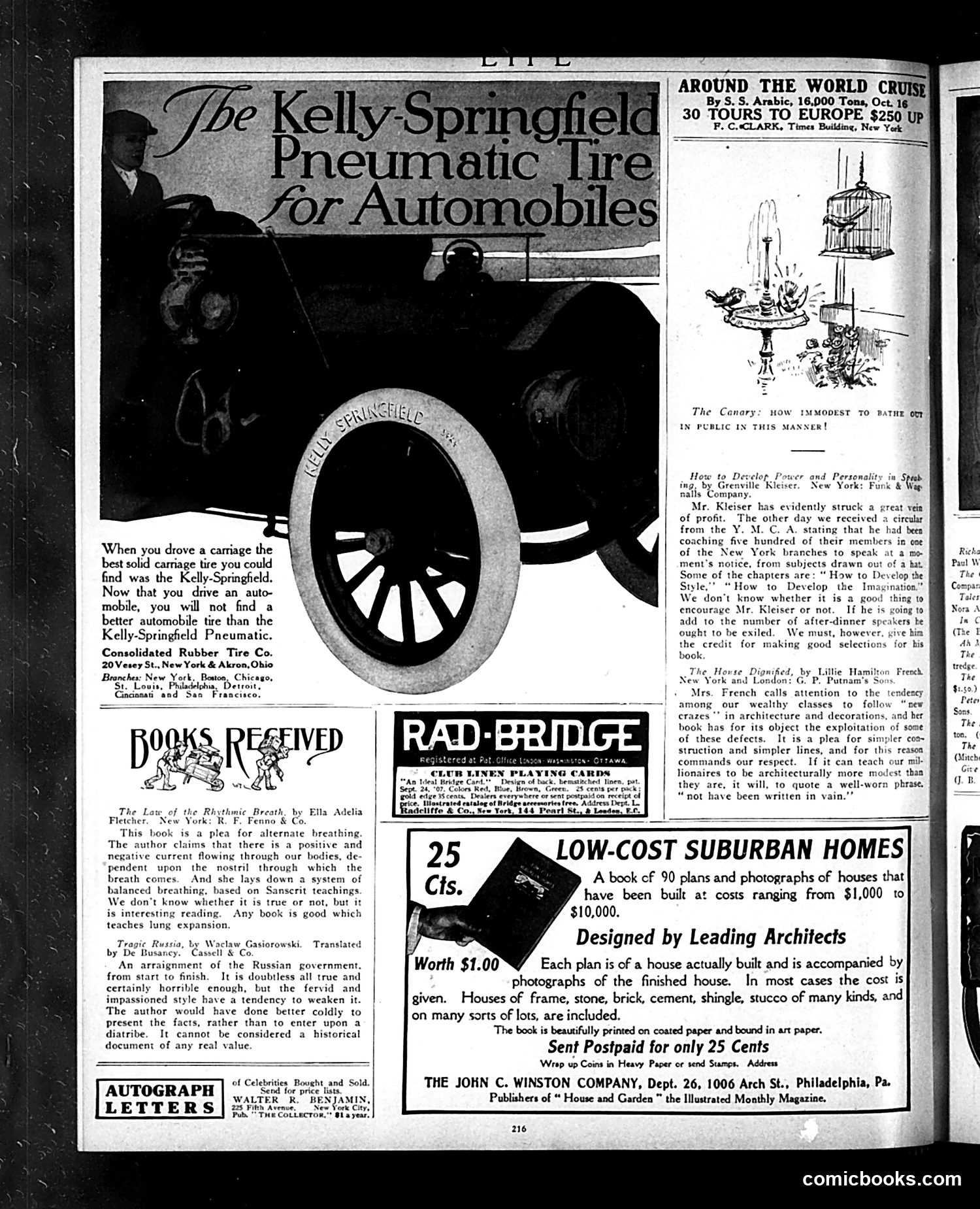
This page is primarily **advertising**, not satirical content. It features: 1. **Kelly-Springfield Pneumatic Tire ad** (top): Compares carriage tires to automobile tires, positioning Kelly-Springfield as superior for the new automobile age. 2. **Books Received** section: Brief reviews of recently published books on practical topics like breathing exercises and Russian history. 3. **Rad-Bridge** playing cards advertisement. 4. **Low-Cost Suburban Homes** promotion (bottom): A 25-cent book of 90 house plans priced $1,000-$10,000, designed by leading architects—appealing to early 20th-century suburban expansion. 5. **Autograph Letters** section: Mentions celebrity autographs. The page reflects early 1900s consumer culture: automobiles replacing carriages, suburban home-building boom, and affordable self-help publishing. No political satire is evident.
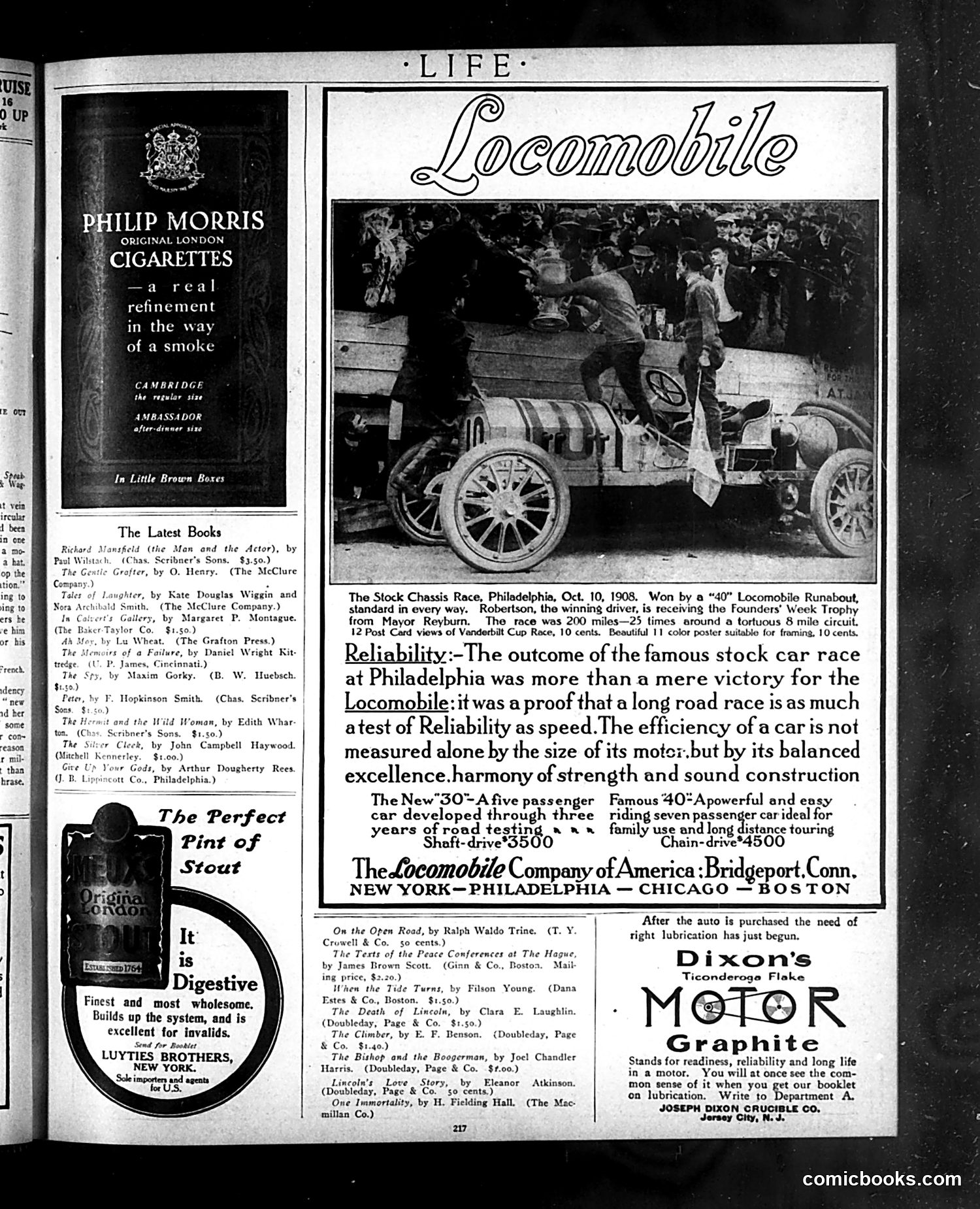
This page is primarily **advertising and automotive promotion**, not political satire. The dominant content is a Locomobile automobile advertisement celebrating a 1908 stock chassis race victory in Philadelphia. The ad emphasizes the car's "Reliability" as proof that long-distance racing tests engineering quality beyond mere speed. Secondary advertisements include Philip Morris cigarettes (promoting "refinement"), a Luyties Brothers stout drink (claiming digestive benefits), and Dixon's Motor Graphite lubricant. A "Latest Books" section lists contemporary publications. There is **no political cartoon** on this page. The only image is a photograph of the winning Locomobile race car. This appears to be a typical early 1900s magazine page mixing consumer advertising with book notices.
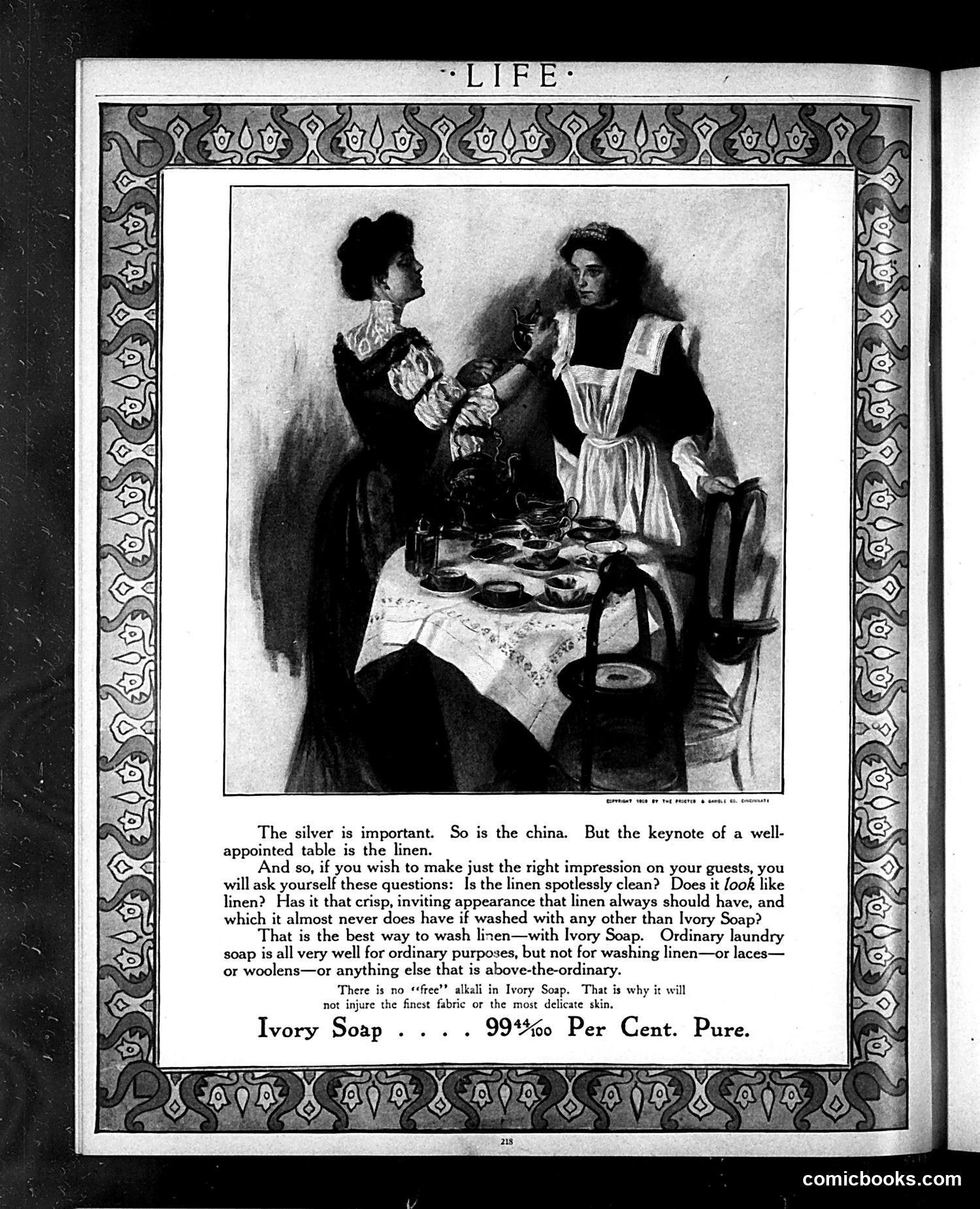
This page is primarily an **advertisement for Ivory Soap**, not political satire. The image shows two women examining table linens at a formally set dinner table, illustrating a domestic scene about household management. The accompanying text argues that fine linens are essential to making a proper impression on dinner guests—more important even than silver or china. It recommends using Ivory Soap specifically for washing delicate fabrics like linens and laces, claiming the soap won't damage fine materials. The ad emphasizes Ivory Soap's purity (99 44/100% pure) and gentle formula as superior to ordinary laundry soap for luxury textiles. This reflects early 20th-century middle-class domestic values and anxieties about maintaining proper social standing through household presentation.
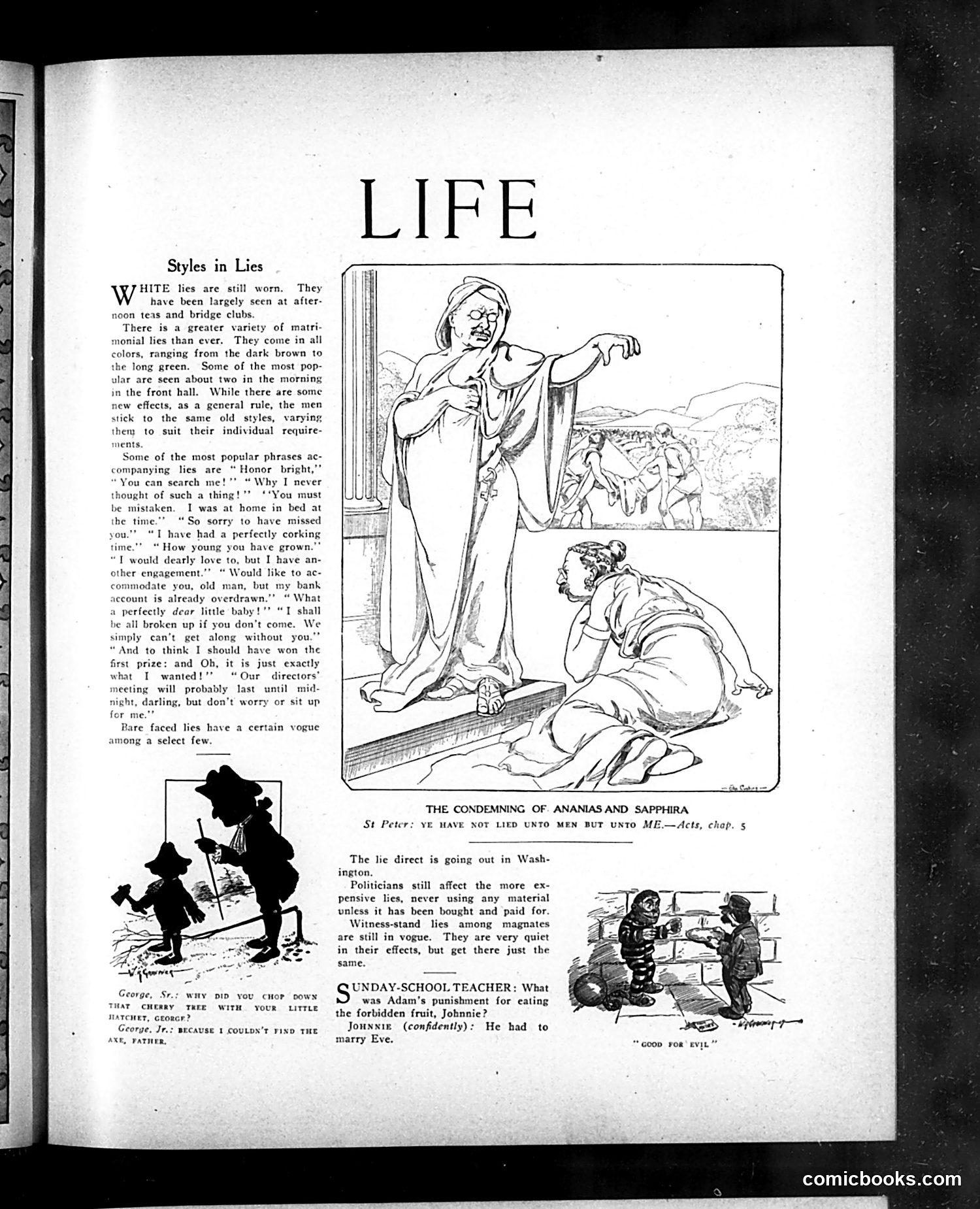
This page satirizes social lying and deception. The main cartoon depicts a biblical scene—"The Condemning of Ananias and Sapphira" (Acts 5)—where early Christians were struck dead for lying about charitable donations. The irony is stark: this ancient punishment for dishonesty contrasts with modern acceptance of lies. The article discusses prevalent social lies of the era—white lies at tea parties and bridge clubs, marital excuses ("You must be mistaken"), professional deceptions among politicians. A secondary cartoon jokes about politicians' expensive lies requiring "material" (money) versus cheaper social lies. The page mocks how lying has become normalized in society despite religious/moral condemnation, suggesting early 20th-century concerns about eroding honesty in social and political life.
This page addresses the contemporary debate over women's suffrage. The illustrated figures (appearing to be caricatured women) accompany an editorial discussing arguments both for and against voting rights for women. The text presents suffrage advocates' claims that women represent a "cause" worthy of support, while acknowledging opponents' arguments. The author argues that most anti-suffrage rhetoric operates "inversely to intention"—that opposition actually strengthens the movement. The piece also discusses broader geopolitical concerns, including tensions with Japan and naval military buildups, suggesting Life magazine addressed multiple political issues simultaneously. The satirical tone typical of Life's editorial approach is evident in how it presents these competing viewpoints on a contentious social issue of the Progressive Era.
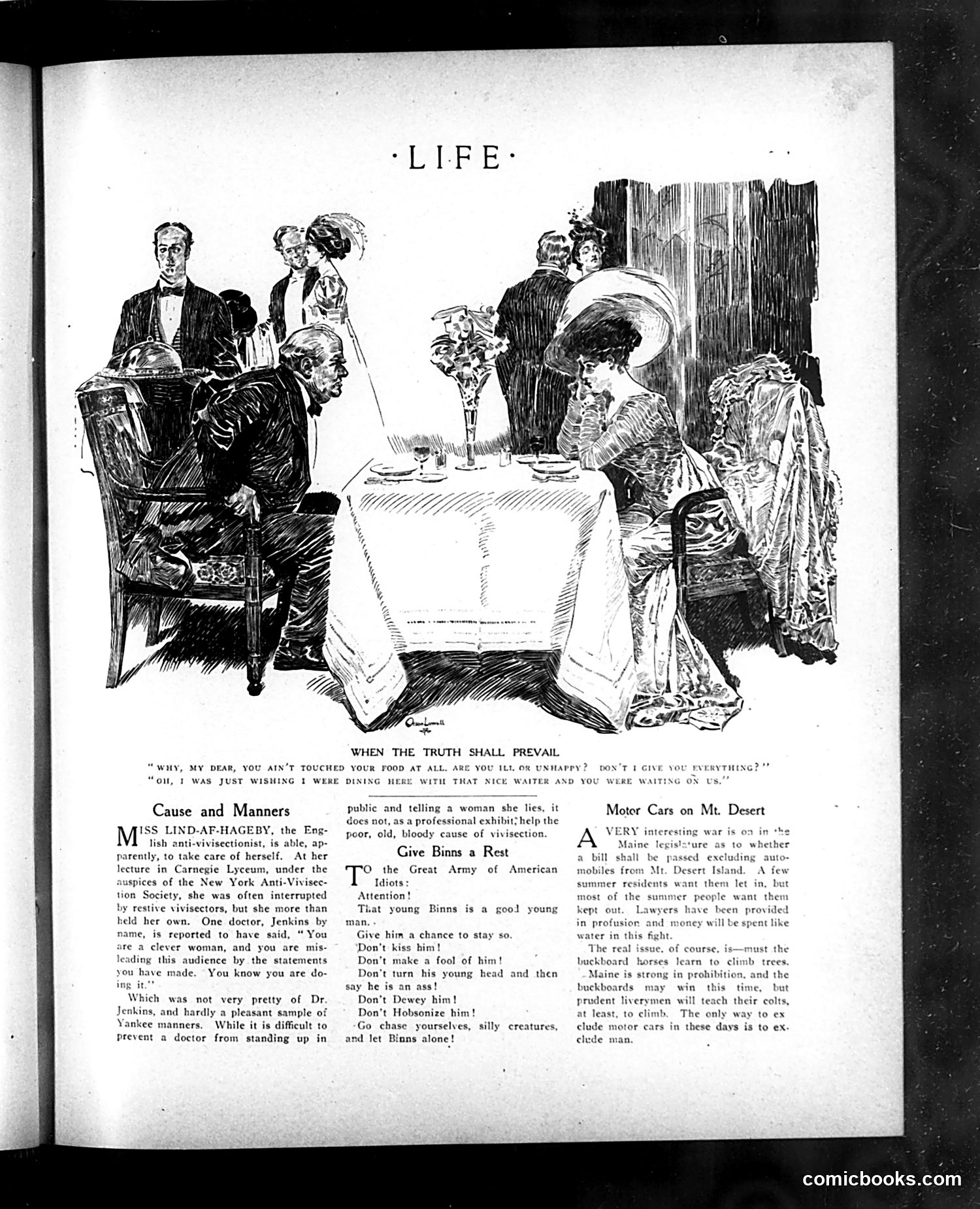
This page contains a social satire cartoon titled "When the Truth Shall Prevail" depicting a formal dinner scene. The caption suggests a guest confronting the host about untouched food and unhappiness, implying the host has misrepresented the gathering's quality. Below are two separate commentary pieces: "Cause and Manners" criticizes Dr. Merton Hardin-Harding, described as an "anti-vivissectionist," for using a lecture to interrupt speakers and disrupt audiences—satirizing self-righteous activism. "Give Binns a Rest" humorously urges readers to stop mocking a young man named Binns, using increasingly absurd exhortations ("Don't Dewey him! Don't Holsonize him!"). The references to "Dewey" and "Holsonize" suggest period-specific names for ridicule or mockery now unclear to modern readers.
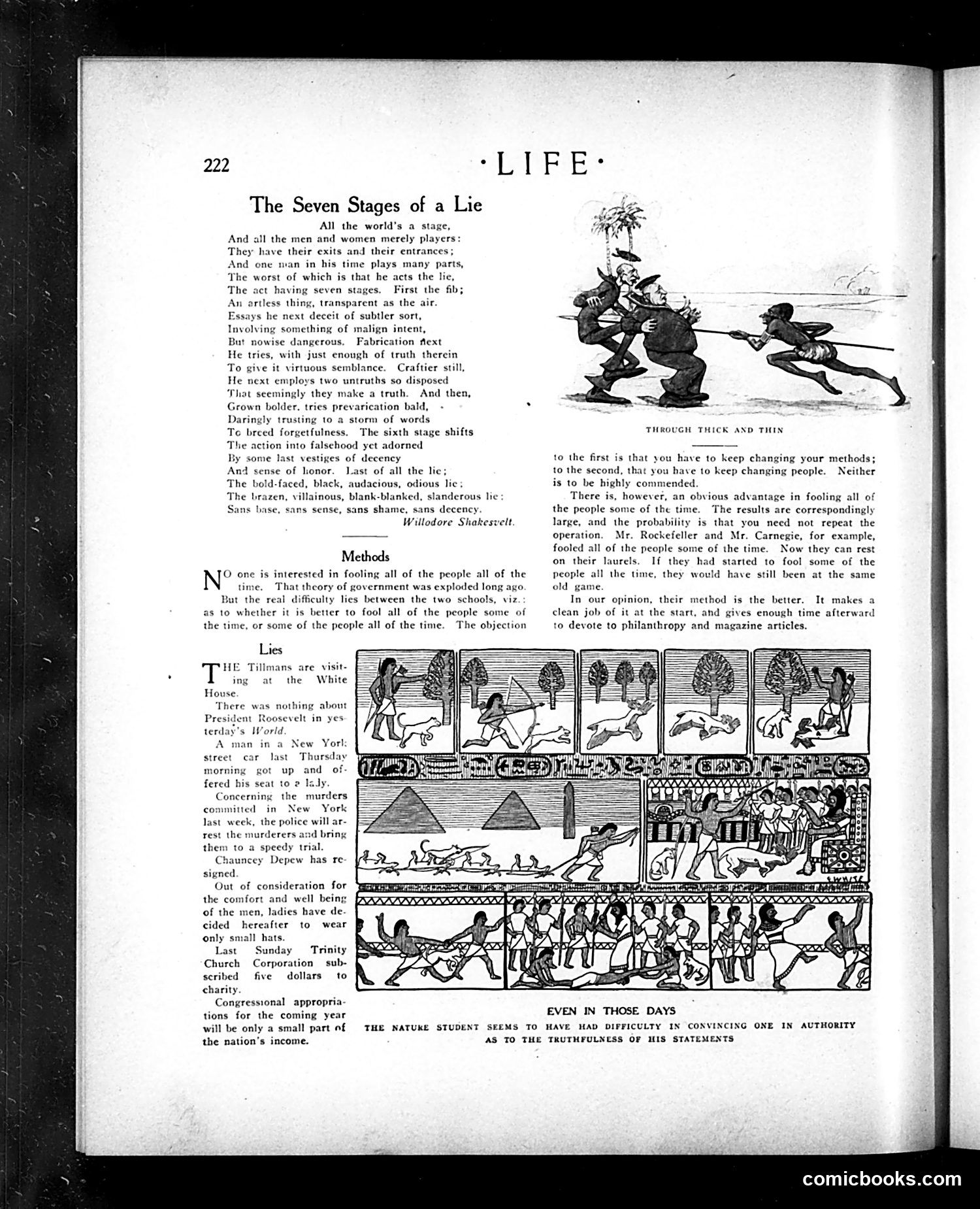
This satirical article uses a comic strip sequence to illustrate how lies escalate and spread. The text describes seven progressive stages: from an initial "fib" (transparent lie) through increasingly elaborate deceptions involving "subtler sort" fabrications, "untruth," and finally reaching complete "bold-faced, black, audacious, odious lie." The accompanying comic panels depict figures engaged in various deceptive scenarios. The article references specific examples—mentioning President Roosevelt's visit to the White House and police arresting murderers—to ground the satire in contemporary events. The bottom illustration labeled "Even in Those Days" suggests that dishonesty in authority was historically persistent. The piece critiques how liars continuously change methods while targeting different audiences, ultimately mocking institutional hypocrisy and the ease with which deceptions gain acceptance in society.
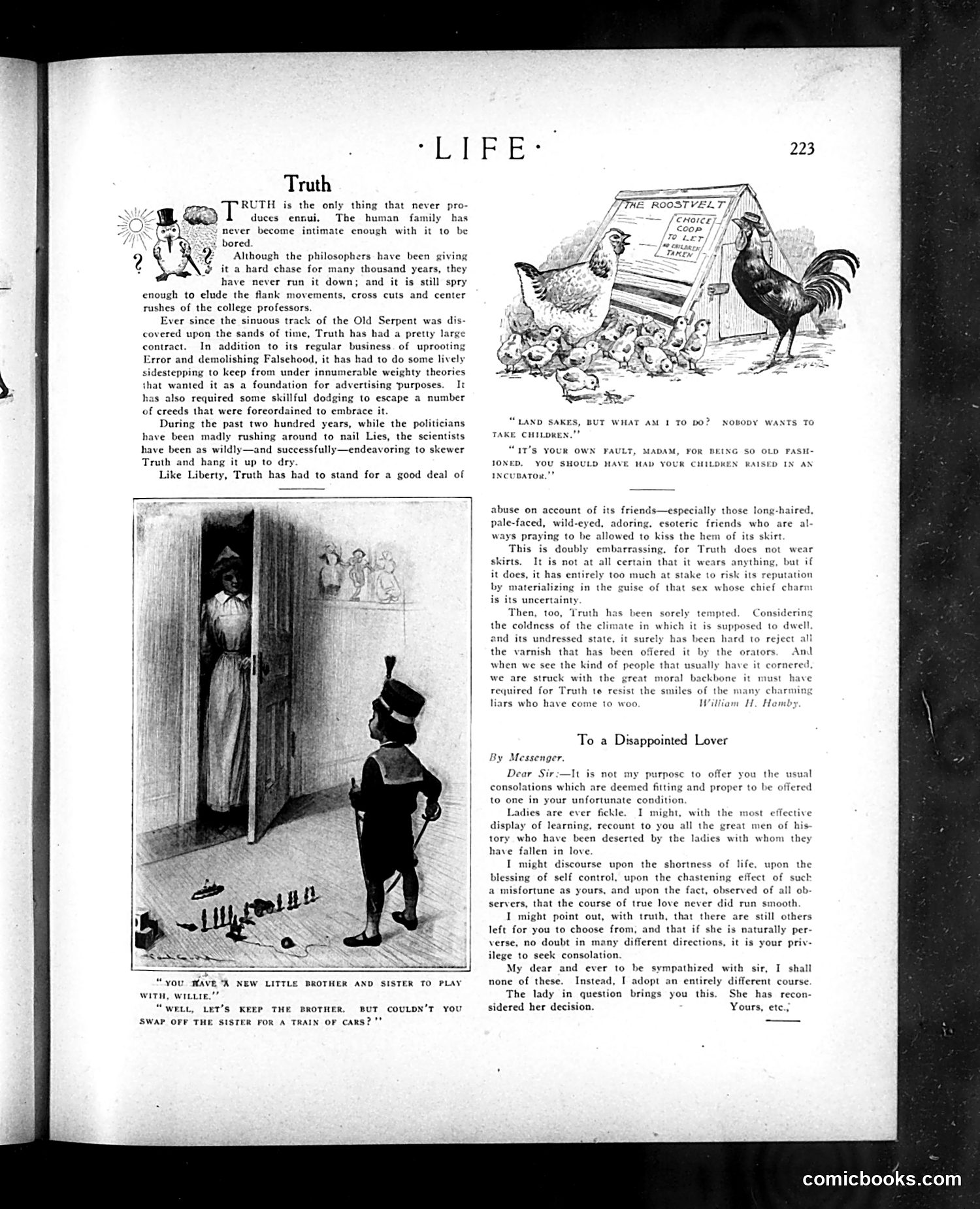
This page from *Life* magazine contains two separate cartoons and articles: **Top cartoon**: Shows a rooster near a coop labeled "The Roosevelt Credo" with text about "Land Sakes" and children. This appears to satirize President Theodore Roosevelt's prolific family—he had six children—through the metaphor of a rooster, a traditional symbol of fertility and virility. **Bottom cartoon**: Depicts a young boy holding toy soldiers, confronting what appears to be an adult. The caption references keeping "the brother" and trading "the sister for a train of cars"—satirizing commercialism and childhood bargaining, likely critiquing materialistic values in early 20th-century America. Both pieces use visual humor to comment on contemporary social attitudes toward family, procreation, and consumer culture.
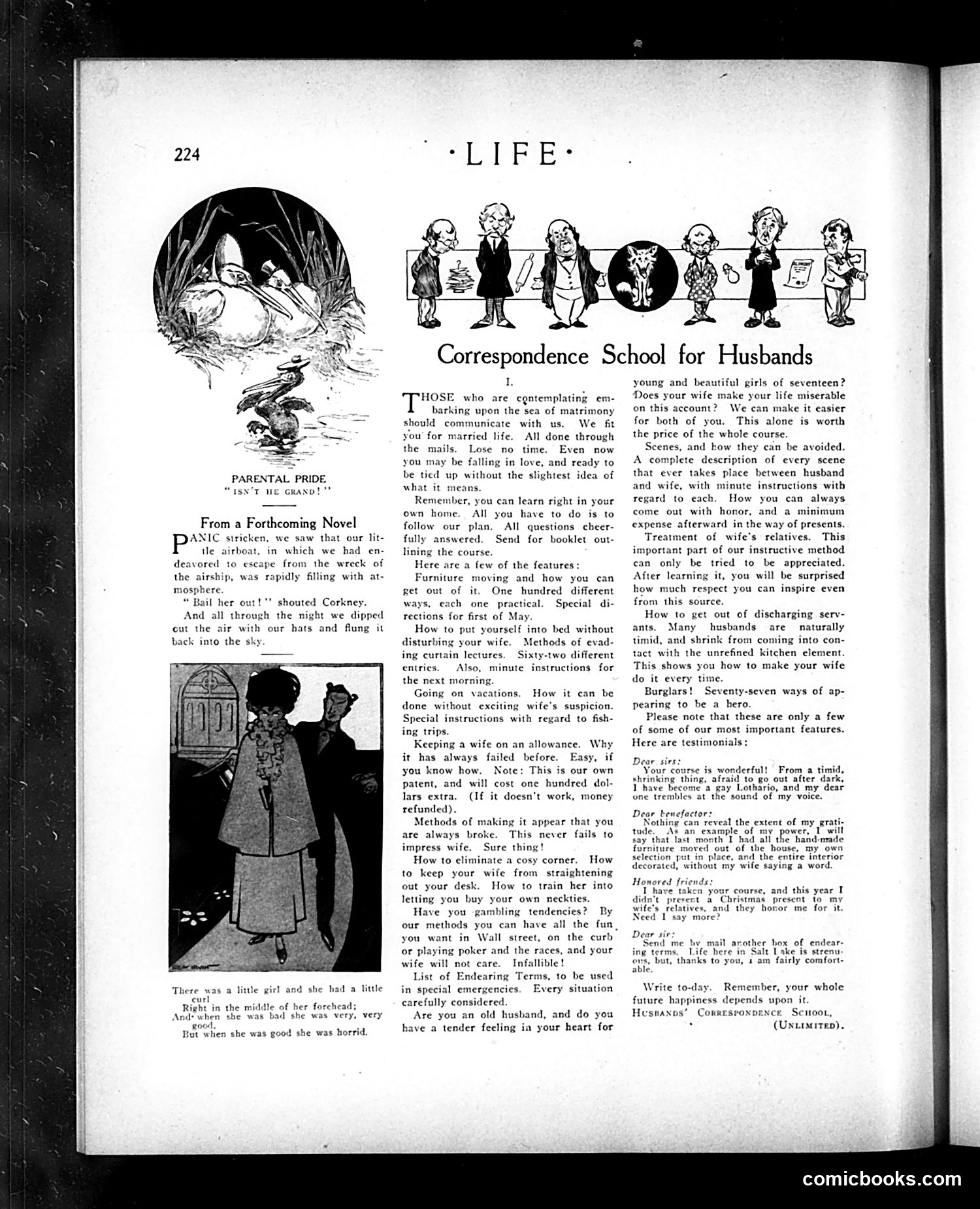
This page satirizes marital discord through a fake advertisement for a "Correspondence School for Husbands." The cartoon mocks men's domestic incompetence, advertising lessons on furniture moving, putting oneself into bed without "exciting wife's suspicion," eliminating cozy corners, training wives to stop nagging, gambling habits, and handling "cosy corners" and desk clutter. The accompanying illustration and testimonial letters from supposed wives (complaining about husbands' behavior) reinforce the joke: wives endure lazy, inconsiderate, financially irresponsible husbands. The satire targets early-1900s gender dynamics—implying husbands need remedial instruction in basic household cooperation and consideration. The fictional school "solves" marital problems by suggesting men require training to be tolerable partners, mocking both male domestic uselessness and women's resigned acceptance.
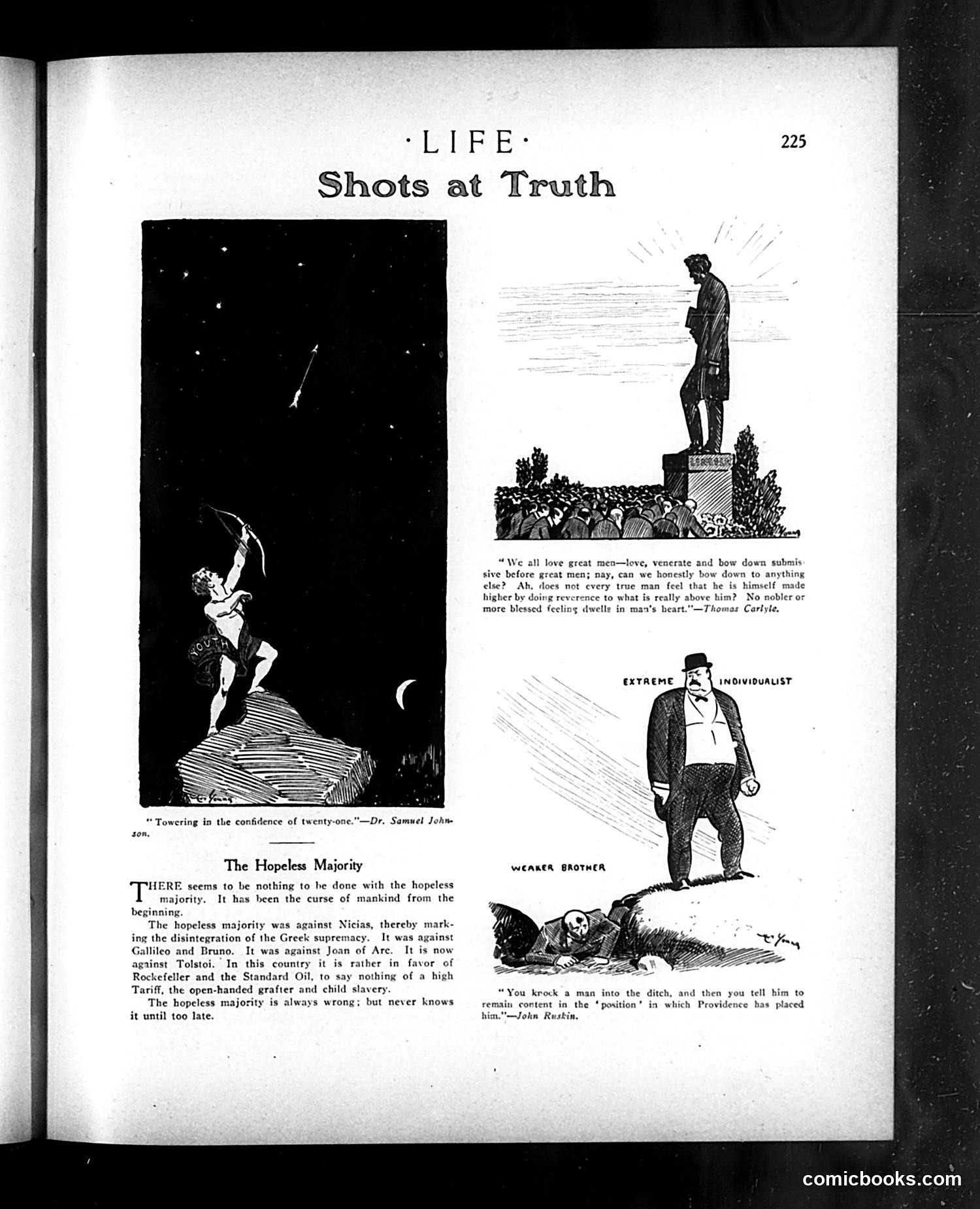
This page satirizes blind reverence for great men and authority. The main illustration shows a statue of an unnamed figure with a crowd below, accompanied by a Thomas Carlyle quote about proper veneration of greatness. The satirical cartoons below critique extremes: "Extreme Individualist" depicts a stout man labeled as a "Weaker Brother," shown trampling a prone figure. The accompanying John Ruskin quote suggests this represents someone who brutally dominates others while claiming moral justification through providence. The section titled "The Hopeless Majority" argues that common people perpetually support the wrong causes throughout history—opposing scientific progress, religious reformers, and progressive policies. The satire targets both uncritical hero-worship and cynical individualism that exploits the powerless.
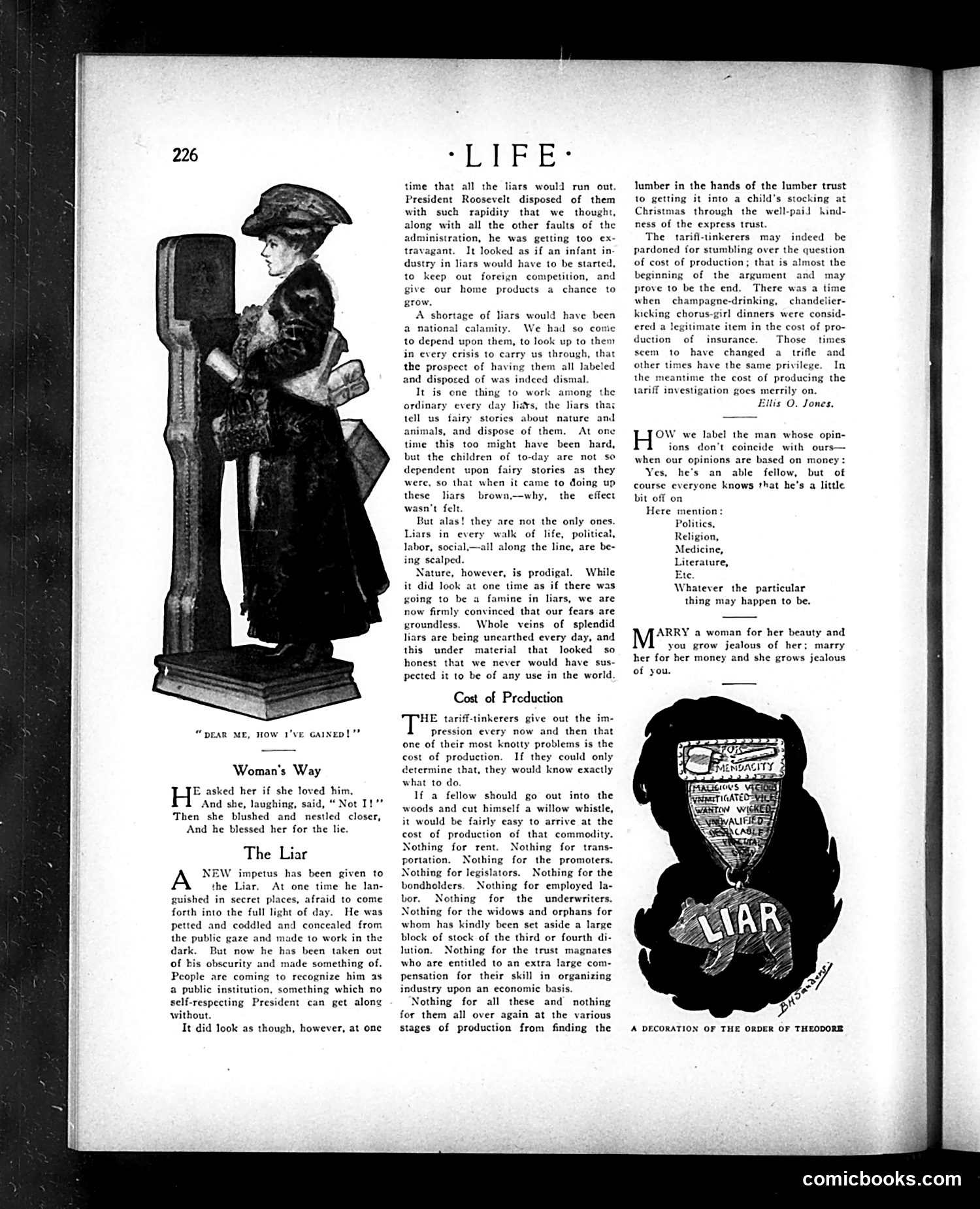
This page contains three distinct pieces satirizing American politics and society circa the Roosevelt era. **"The Liar"** section mocks President Roosevelt's administration for aggressively eliminating political liars—only to discover that lying remains endemic across all walks of life. The satire suggests that despite Roosevelt's efforts, dishonesty continues flourishing in politics, labor, and society generally. The figurine illustration captioned "Dear Me, How I've Gained!" appears to represent a portly figure—likely symbolizing a politician or corrupt official who has profited from deception. **"Cost of Production"** attacks tariff policy by ridiculing economists' inability to calculate true production costs. The author sardonically traces a product (lumber becoming a Christmas whistle) through layers of profit-taking—trust magnates, legislators, bondholders, widows' stock dividends—demonstrating that "cost of production" is meaningless when so many unproductive parties extract compensation. This critiques protectionist economics as deliberately obscuring reality. The short poem "Woman's Way" offers mild romantic humor about female deception in courtship.
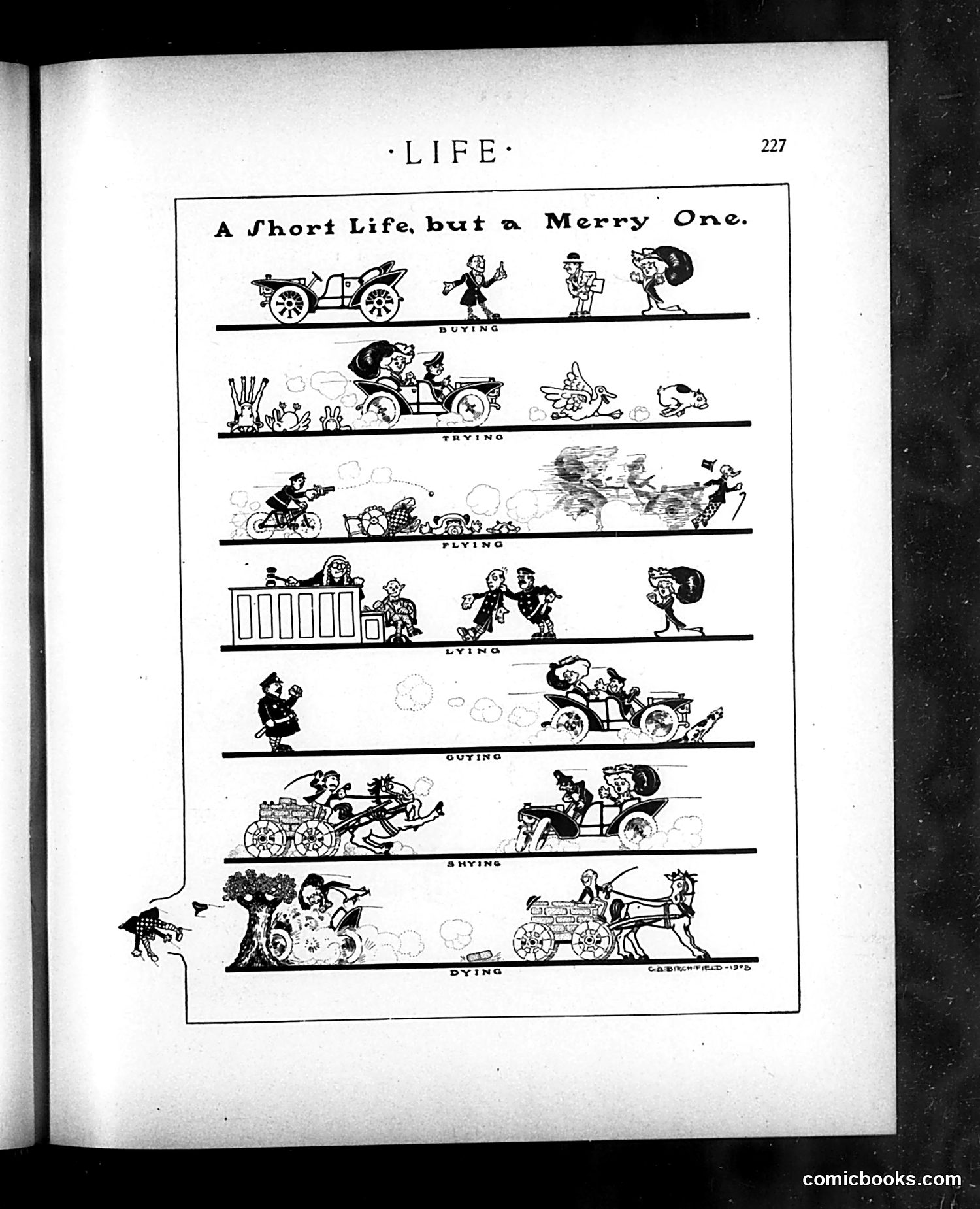
This page presents a sequential comic strip depicting the life cycle of what appears to be a wealthy person or aristocrat, progressing through stages labeled: BUYING, TRYING, FLYING, LYING, GOING, SHYING, and DYING. The humor satirizes the indulgent lifestyle of the rich—beginning with purchasing luxuries (automobiles, goods), progressing through reckless enjoyment (flying, showing off), dishonesty ("lying"), evasion of consequences ("shying"), and finally death. The visual metaphor of a motorcar journey frames life as a wild, hedonistic ride that inevitably ends. This reflects early 20th-century satirical commentary on wealth, excess, and moral decay among the privileged classes. The repeated vehicles and increasingly chaotic scenes emphasize the frivolous, unsustainable nature of such living. It's a memento mori wrapped in social critique—a tongue-in-cheek warning that pleasure-seeking without substance leads nowhere.
This satirical cartoon depicts a courtroom or judicial proceeding where a small figure stands before seated officials wearing decorative sashes. The title suggests commentary on newly coined or fashionable terminology. The cartoon likely satirizes the adoption of new political or social vocabulary by establishment figures—perhaps mocking how authorities use trendy language while maintaining traditional power structures. The contrast between the standing commoner and the seated, formally-dressed officials emphasizes hierarchical authority. The specific "new words" referenced remain unclear without additional context, but the satire targets how institutional figures co-opt contemporary language while their actual practices remain unchanged. This appears to be French-language satire, consistent with *Life* magazine's sophisticated European-influenced humor from the early 20th century.
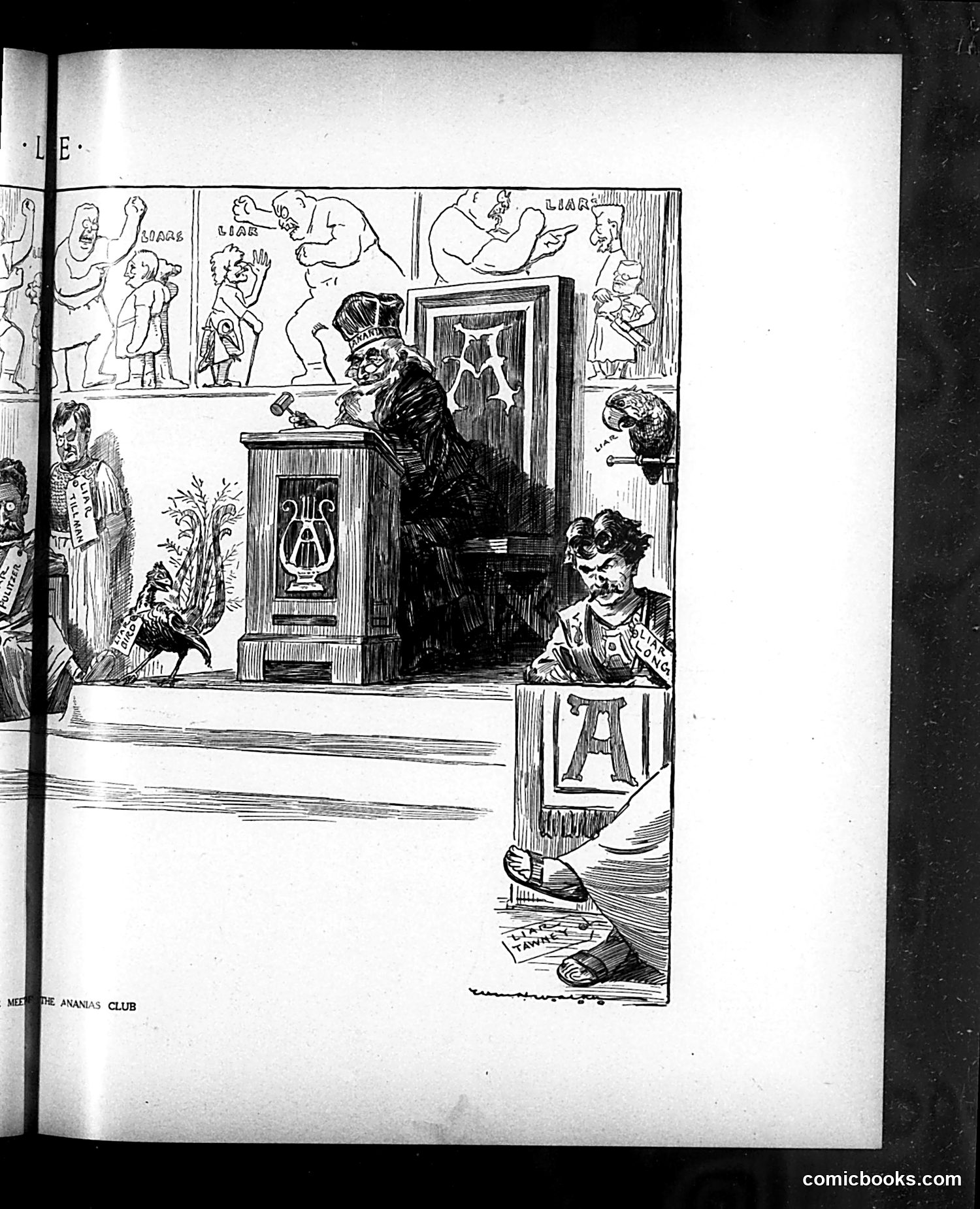
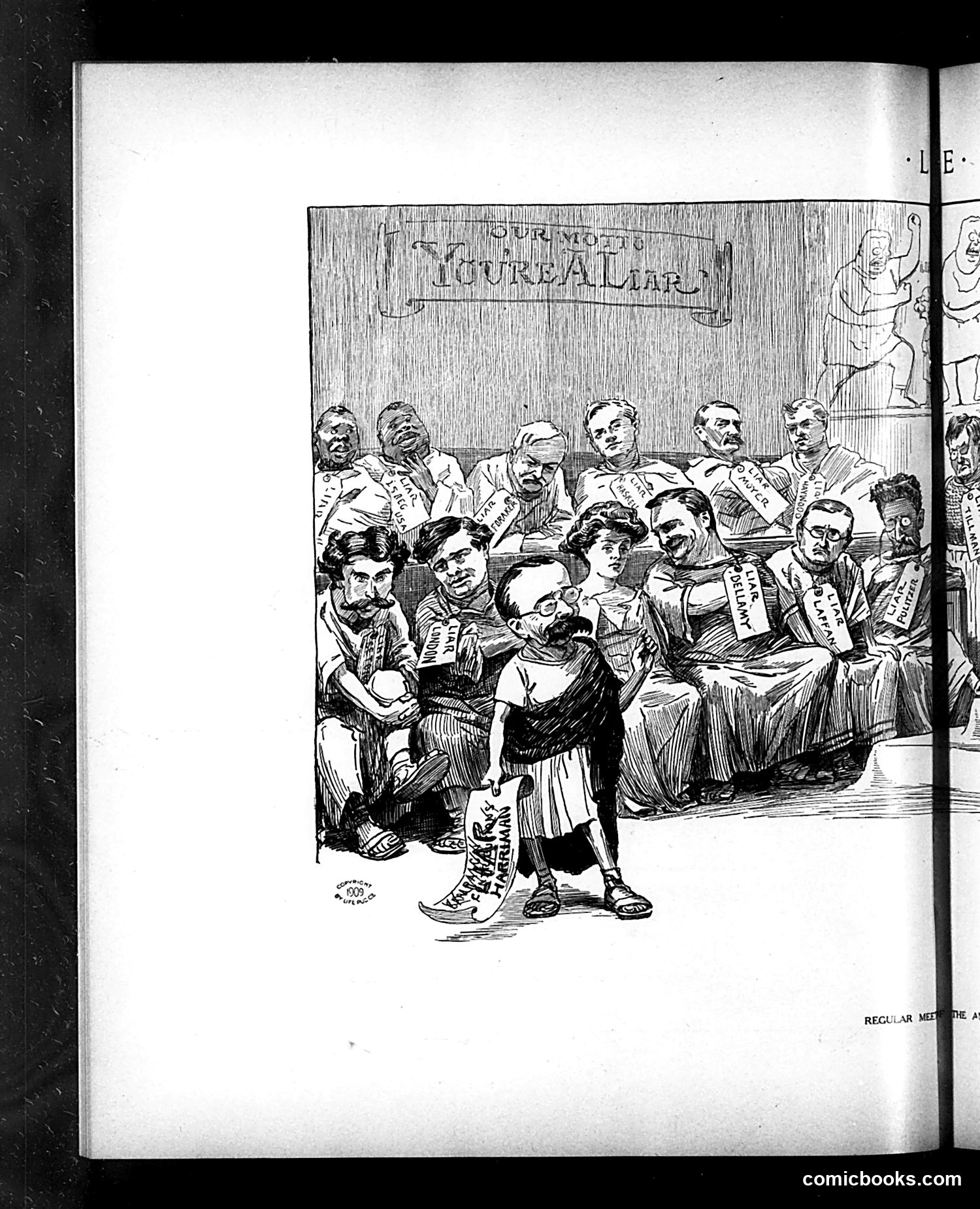
This appears to be a satirical courtroom or judicial scene, likely from early 20th-century *Life* magazine. A figure in judicial robes presides over proceedings at a podium decorated with a lyre symbol (suggesting Apollo or justice). The scene depicts what looks like an Anagrams Club meeting or competition, based on the visible text "ANAGRAMS CLUB" at the bottom. The satire likely mocks either the pretentiousness of such clubs or judicial/legal proceedings themselves—possibly commenting on how seriously people take word games, or perhaps satirizing specific club politics or scandals of the era. The theatrical staging and exaggerated character expressions emphasize the comedic absurdity. Without clearer text or additional context, the specific target of the satire remains unclear, though it's clearly poking fun at social institutions or contemporary public figures involved with such clubs.
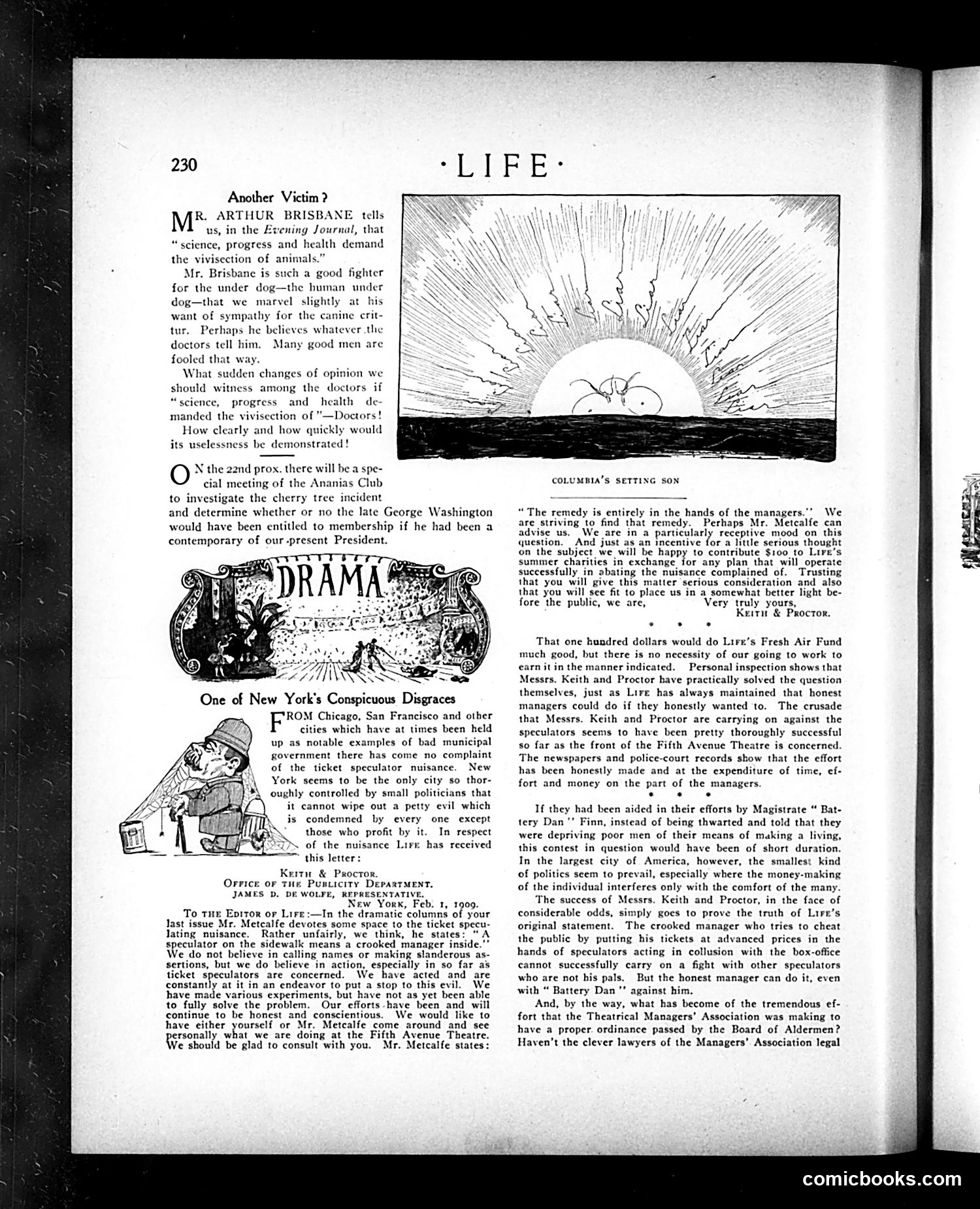
**Top Section - "Another Victim?"** Arthur Brisbane, a newspaper editor, is criticized for contradicting himself. He advocates for animal protection ("under dog") yet supports vivisection (animal experimentation) in the name of science. The satire mocks his inconsistency and suggests doctors manipulate public opinion for their own interests. The jab about "vivisection of Doctors" implies the hypocrisy would vanish if physicians themselves faced experimentation. **Middle Section - "Ananias Club"** References George Washington's cherry-tree legend to satirize President Theodore Roosevelt's honesty, implying modern political standards have declined. **Bottom Section - Ticket Speculation** The main content addresses NYC's "ticket scalper" problem—a widespread corruption issue where small-time politicians profited from unregulated ticket resales. The Keith & Proctor theater company's letter defends their management integrity while acknowledging the difficulty of eliminating the practice, offering $100 to anyone suggesting solutions. Life's response validates their efforts while maintaining that honest managers could stop it if truly committed.
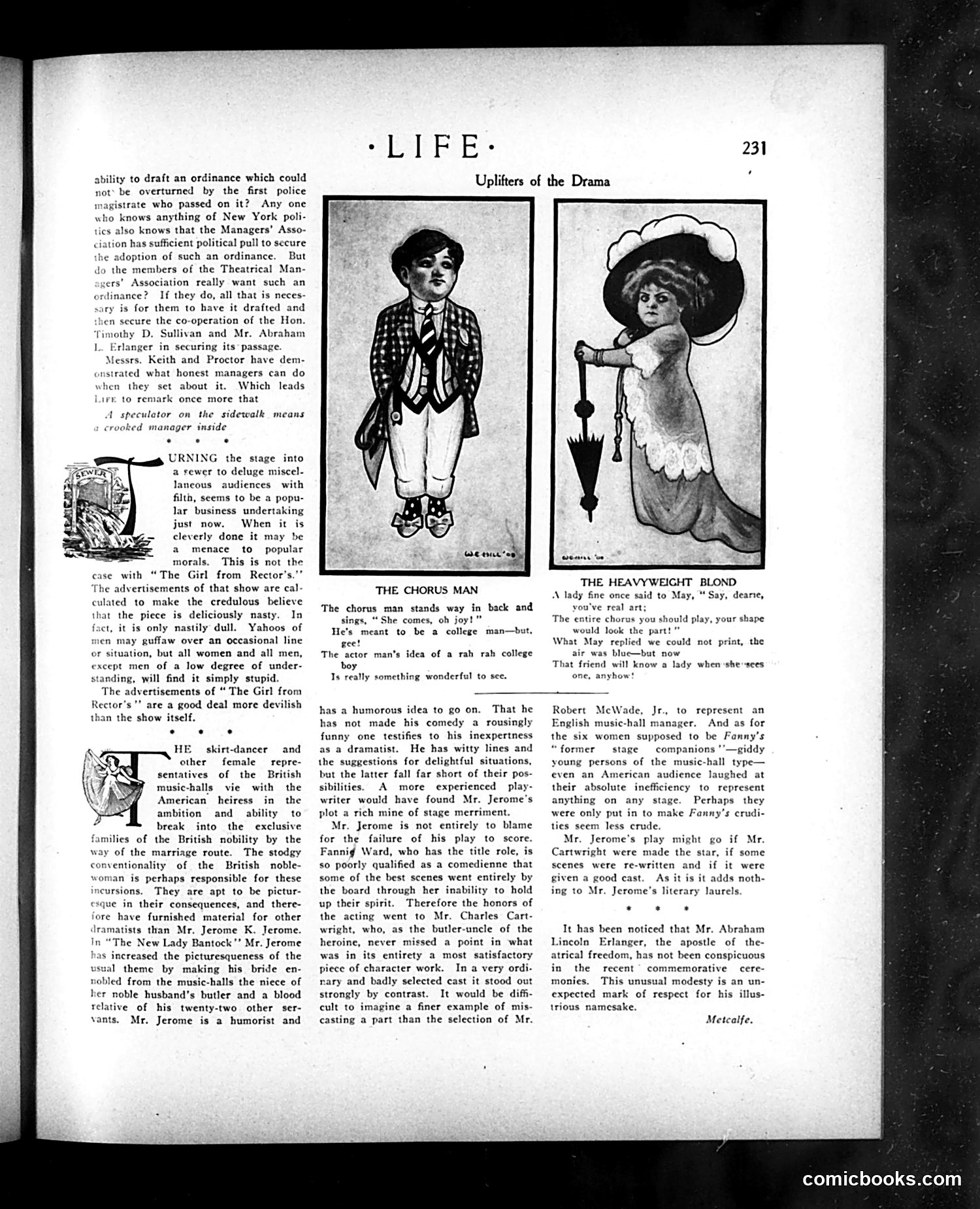
This page contains theater reviews critiquing contemporary stage productions. Two illustrated caricatures accompany the text: **"The Chorus Man"** depicts a stereotypical college-boy chorus member—apparently meant to look collegiate but appearing ridiculous instead. **"The Heavyweight Blond"** shows a woman in a large feathered hat, illustrating a joke about a lady's figure being suited to chorus work rather than leading roles. The reviews themselves are scathing critiques of current Broadway productions, particularly condemning "The Girl from Rector's" as "nastily dull" despite provocative advertising. The author also criticizes playwright Jerome K. Jerome's "The New Lady Bantock" and actor Fanny Ward's inadequate performance, while praising Charles Cartwright's character work. The overall tone sarcastically positions these reviews as "uplifters" of drama—implying contemporary theater was morally and artistically degraded.
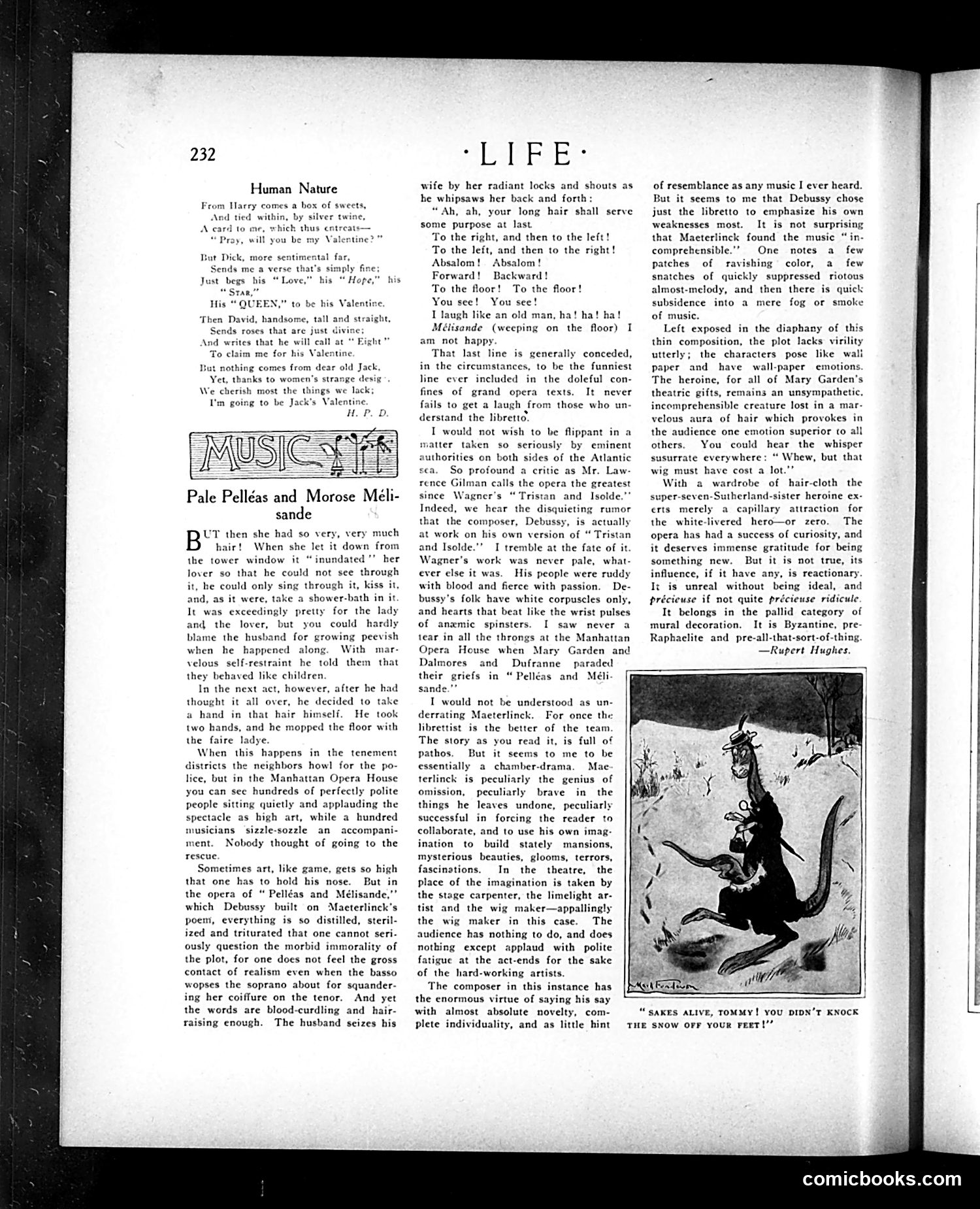
This page contains two distinct pieces satirizing early 20th-century opera culture. **"Human Nature"** (top): A light verse poem about a woman receiving Valentine's Day gifts from multiple suitors—candy from Harry, flowers from David—but treasuring most the *absence* of a gift from "dear old Jack." It's a gentle joke about contrary female psychology. **"Pelléas and Mélisande"** (main article): The critic mocks Claude Debussy's opera adaptation of Maurice Maeterlinck's symbolist play. The satire targets the work's morbid passivity: a husband literally whips his wife with her own hair while she weeps that she's "not happy"—presented as the funniest line ever in opera. The author argues that while Wagner's operas were passionate and bloody, Debussy's characters are bloodless and anemic ("white corpuscles only"). High art is defended by serious critics (Lawrence Gilman), yet the actual plot is absurd when described plainly. The joke: critics take it seriously precisely *because* it's so rarefied and emotionally thin that reality feels irrelevant. The cartoon (right) illustrates the hair-whipping scene.
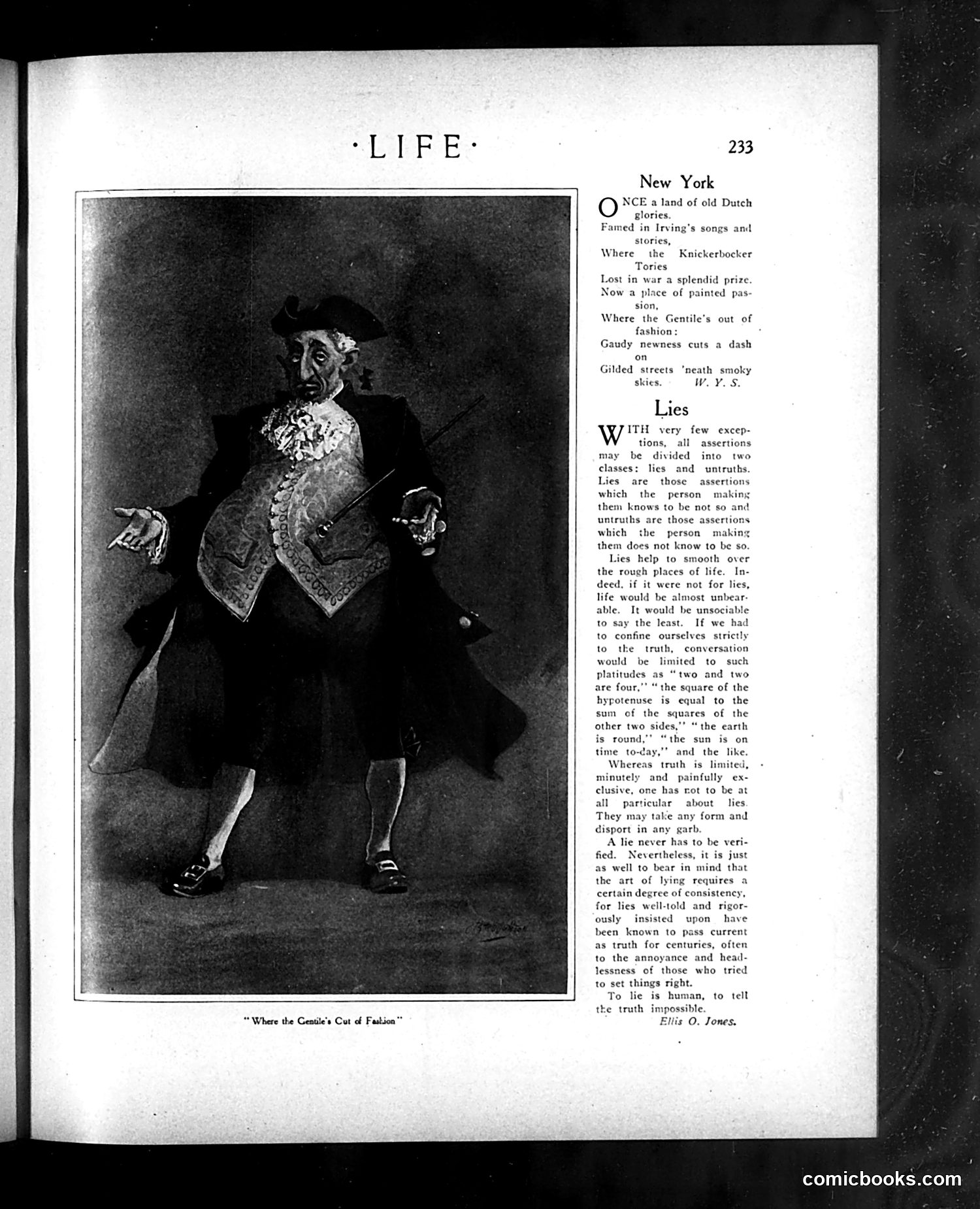
This page satirizes New York's transformation from its Dutch colonial heritage into a gilded, modern city dominated by newly wealthy gentiles (non-Jewish New Yorkers). The poem laments that old Knickerbocker aristocratic values have been replaced by "gaudy newness" and "painted passion"—a critique of the city's rapid commercialization and social climbing. The accompanying article by Ellis O. Jones is a philosophical essay on lying, arguing that dishonesty is practically necessary for civilized society, unlike rigid truth. This pairs ironically with the image: the fashionable figure represents the pretense and artificiality of New York's nouveau riche, whose "painted" personas exemplify the social lies the essay discusses. The satire targets both vulgar materialism and the hypocrisy of upper-class New York society during the Gilded Age.
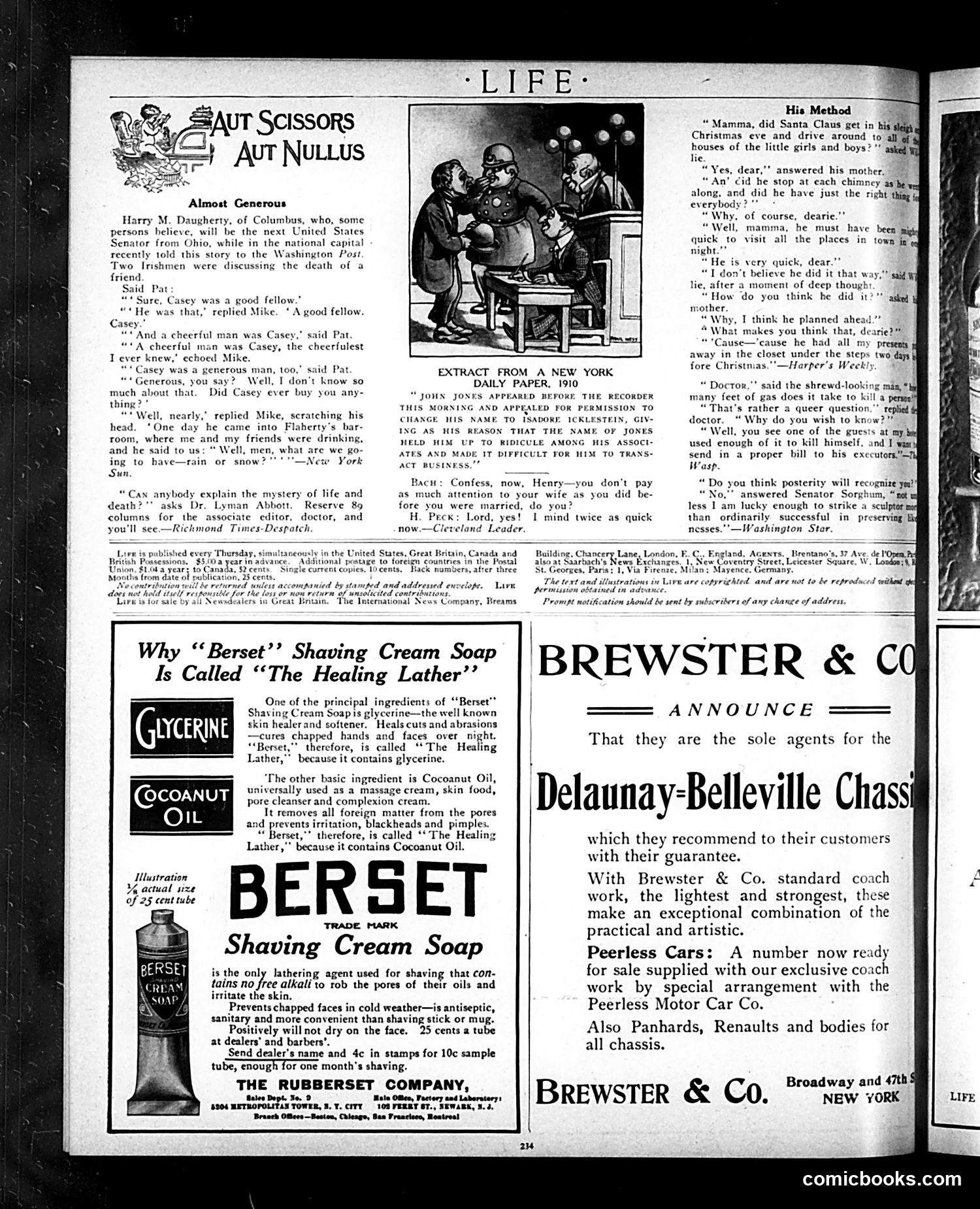
This page from *Life* contains satirical humor pieces and period advertisements. The main cartoon section (upper right) shows a dialogue titled "His Method," depicting a child's skeptical interrogation of his mother about Santa Claus's logistics. The satire hinges on the child's deduction that Santa must have planned ahead—evidenced by the child discovering wrapped presents hidden in the closet weeks earlier. The joke mocks parental explanations while subtly suggesting Santa's "method" involves advance preparation rather than magical efficiency. The page also includes several brief humorous anecdotes, including one about an Irishman named Casey and a story about someone named John Jones seeking to change his name to avoid ridicule. The remainder consists of period advertisements for Berset Shaving Cream Soap (emphasizing glycerine and coconut oil ingredients) and Brewster & Co. automobiles (Delaunay-Belleville chassis and Peerless cars), reflecting early-1900s consumer marketing.
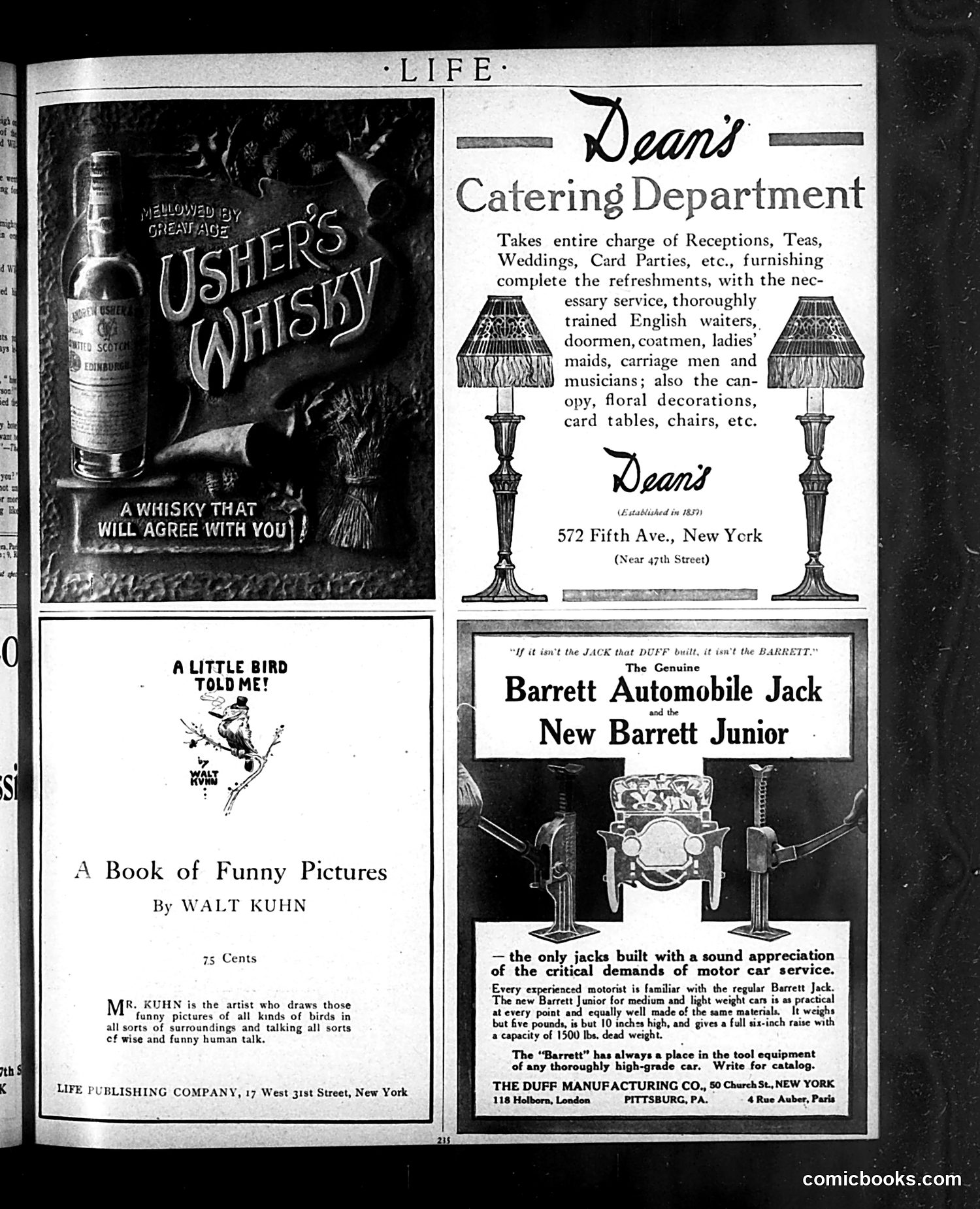
This is primarily an **advertising page** from Life magazine, containing four distinct ads with minimal editorial content. **Notable ads:** 1. **Usher's Whisky** (left): A straightforward liquor advertisement featuring a bottle with the tagline "A Whisky That Will Agree With You"—a common sales pitch emphasizing digestibility. 2. **Walt Kuhn's "A Little Bird Told Me!"** (lower left): Promotes a 75-cent book of humorous bird illustrations by cartoonist Walt Kuhn, described as anthropomorphic birds in various situations delivering "wise and funny human talk." 3. **Dean's Catering** (upper right): Service advertisement for high-end event planning in New York, emphasizing trained English staff. 4. **Barrett Automobile Jack** (lower right): Technical product ad for car jacks, featuring a play on words ("If it isn't the JACK that DUFF built...") and specifications. The page reflects early 20th-century consumer advertising focused on luxury goods and services rather than satire or political commentary.
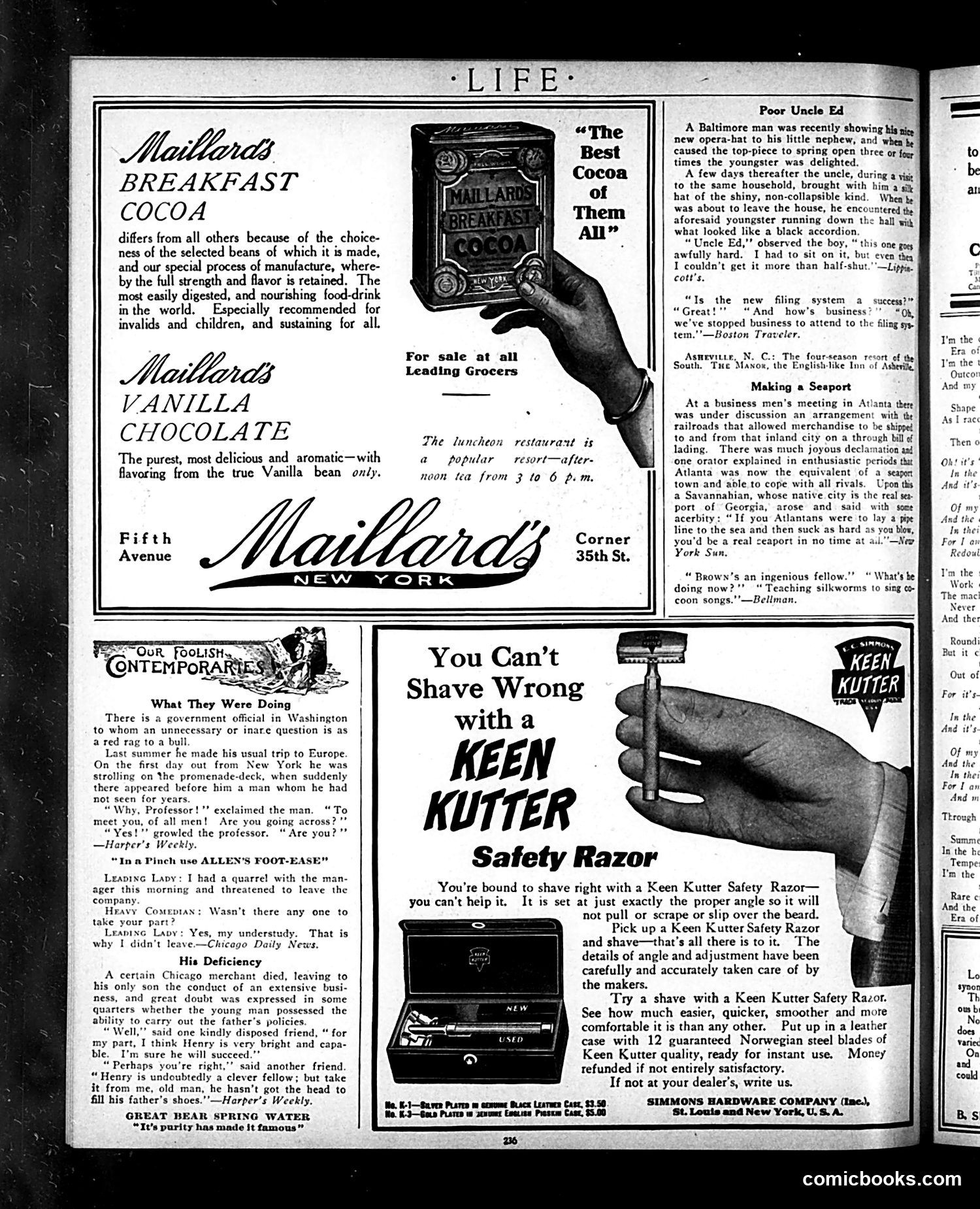
This page contains **primarily advertisements and brief humorous anecdotes**, not political cartoons. The main satirical content appears in the "Our Foolish Contemporaries" section, which collects short, ironic stories mocking human behavior: - A story about a Baltimore uncle's collapsible opera hat that a child tries to compress, treating it like a toy - A joke about confusing a new filing system with actual business work - An anecdote mocking Atlanta businessmen claiming their inland city is now a "seaport" (a Savannahian retorts that they'd need to literally pipe water there) - A professor annoyed at being recognized by an acquaintance on a ship These are **gentle social satire** typical of Life magazine's humor—poking fun at everyday absurdities, pretension, and human folly rather than targeting specific political figures or events. The remainder consists of **product advertisements**: Maillard's cocoa and chocolate, and Keen Kutter safety razors, which were typical magazine revenue sources of the era.
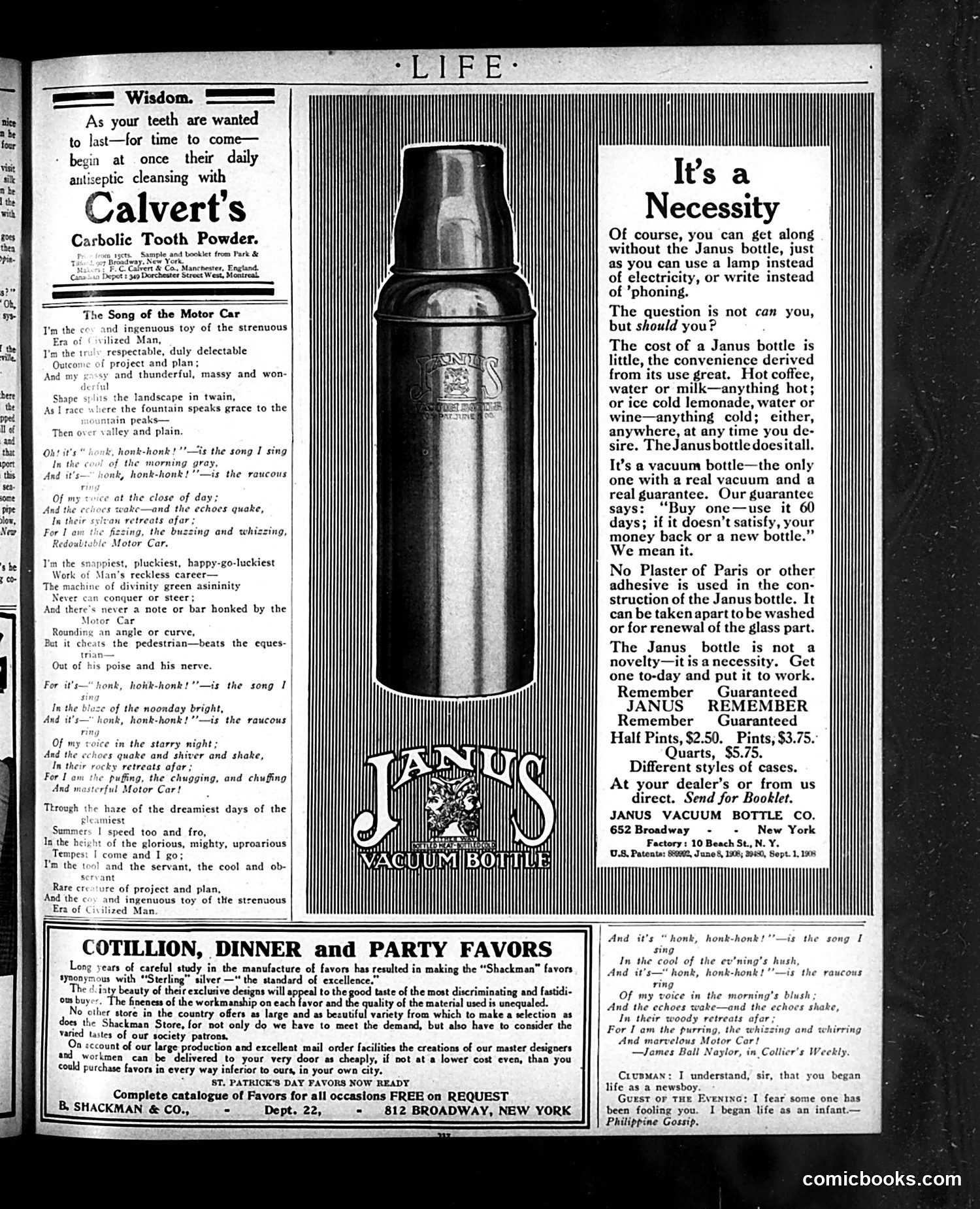
This page consists primarily of **advertisements and poetry**, not political satire requiring historical context. **Main Content:** 1. **"The Song of the Motor Car"** — A lengthy, romanticized poem celebrating the automobile as a marvel of modern civilization. It personifies the car as powerful, impressive, and central to "civilized man's" life, with repeated "honk-honk" refrains. The poem reflects early 20th-century enthusiasm for motorized transportation. 2. **Product Advertisements** dominate the page: - Calvert's Carbolic Tooth Powder - Janus Vacuum Bottle (with detailed sales pitch about convenience and guarantee) - B. Shackman & Co.'s party favors and cotillion supplies **Historical Context:** This reflects a period when automobiles were still novelties inspiring wonder, and advertising emphasized practical modern conveniences for middle-class consumers. No specific political figures or satirical commentary are present—it's a straightforward commercial and entertainment page typical of the era.
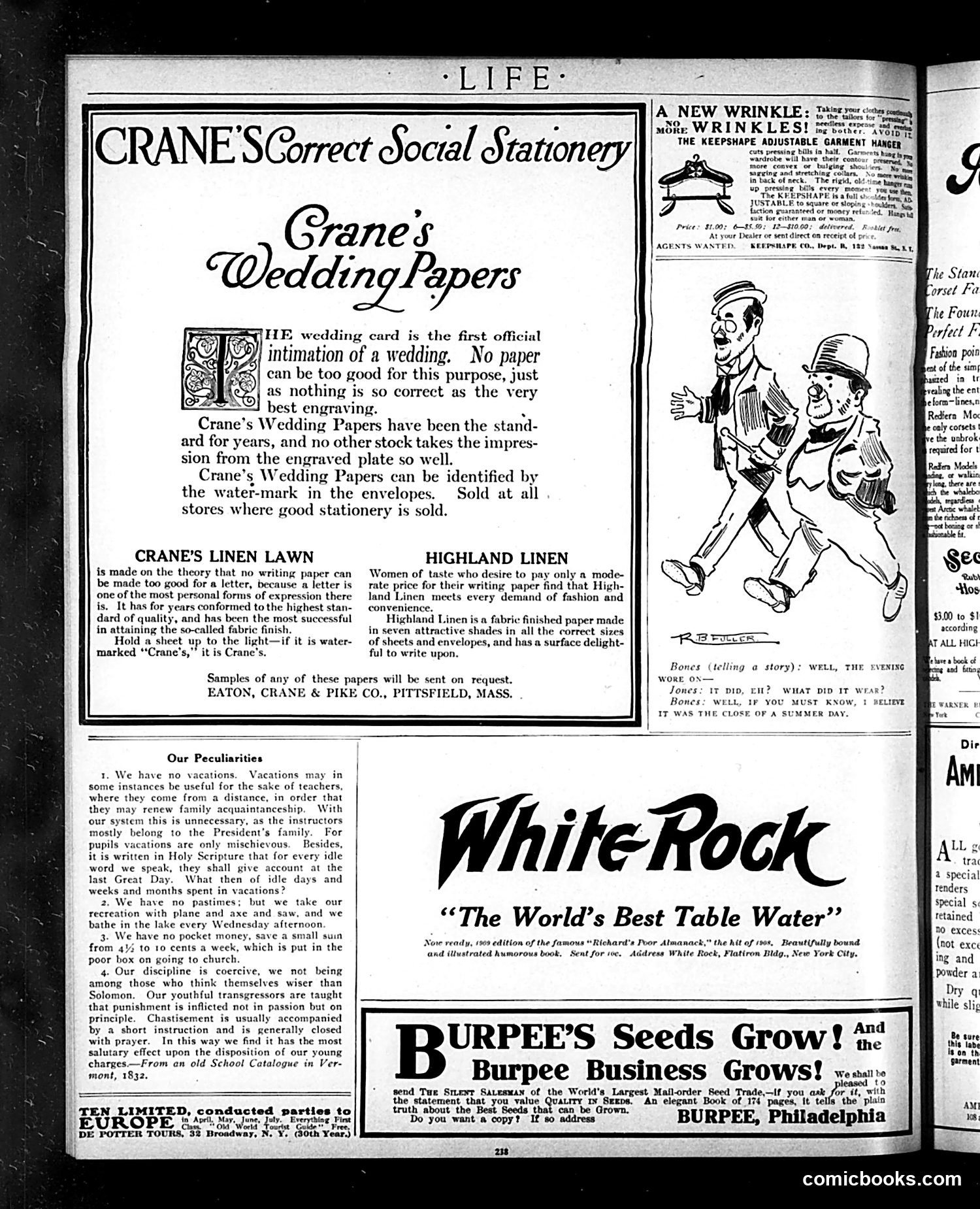
This page is primarily **advertising and filler content**, not satirical cartoons. The main elements are: 1. **Crane's Stationery ads** (top): Promoting high-quality wedding papers and writing supplies—positioning them as markers of social correctness and good taste. 2. **Small cartoon** (center-right): Shows two men ("Bones" telling a story to "Jones"). The joke is a pun: when asked what the evening wore, Bones replies it was "the close of a summer day"—a play on "close" (clothing/dress) versus the time of day. This is mild vaudeville-style humor. 3. **"Our Peculiarities"** section: Satirizes a rigid, austere school's discipline policies—no vacations, no pastimes, corporal punishment justified theologically. The satire targets overly strict educational institutions. 4. **Advertisements**: White Rock water, Burpee Seeds, and European tours round out the page. The page reflects early 20th-century concerns with social propriety, merchandise marketing, and gentle institutional critique rather than sharp political satire.
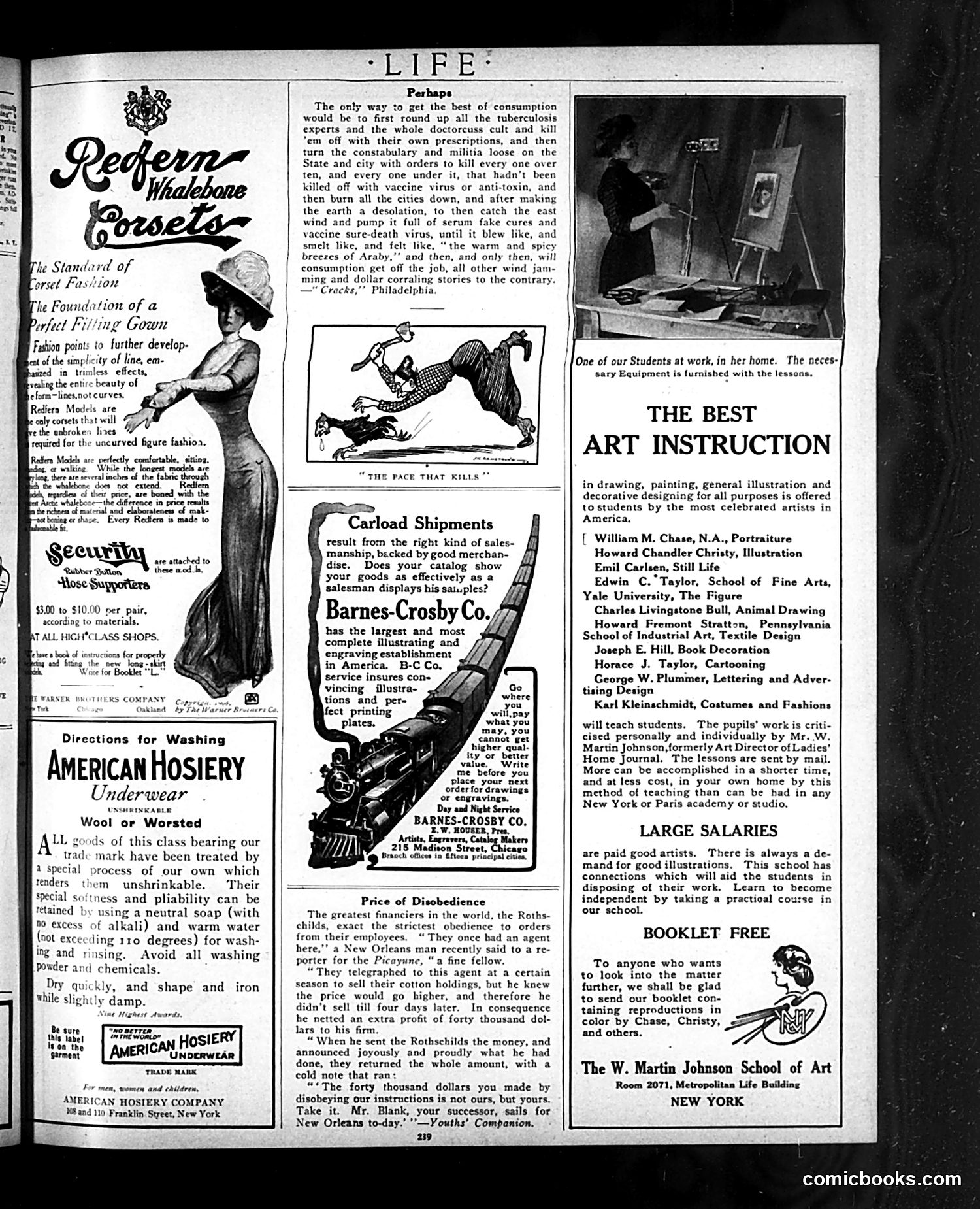
This page from *Life* magazine contains primarily advertisements and editorial content rather than political cartoons. The main notable piece is the titled editorial "Perhaps," which is a sarcastic attack on the medical/scientific establishment's approach to tuberculosis. The author mocks tuberculosis experts, doctors, vaccine programs, and antitoxins as ineffective, proposing outrageously that the only solution would be mass killing and destruction. This reflects the contemporary era's skepticism toward public health measures and medical authority—a sentiment not uncommon in the early 20th century before antibiotics proved these treatments effective. The rest of the page contains typical period advertisements: Redfern corsets, American Hosiery, art instruction schools, and commercial printing services. There is one small illustration labeled "The Face That Kills" depicting a reclining figure, likely a satirical drawing about consumption (tuberculosis), but its specific meaning is unclear without additional context. The page reflects early 1900s consumer culture and emerging debates about medical authority.
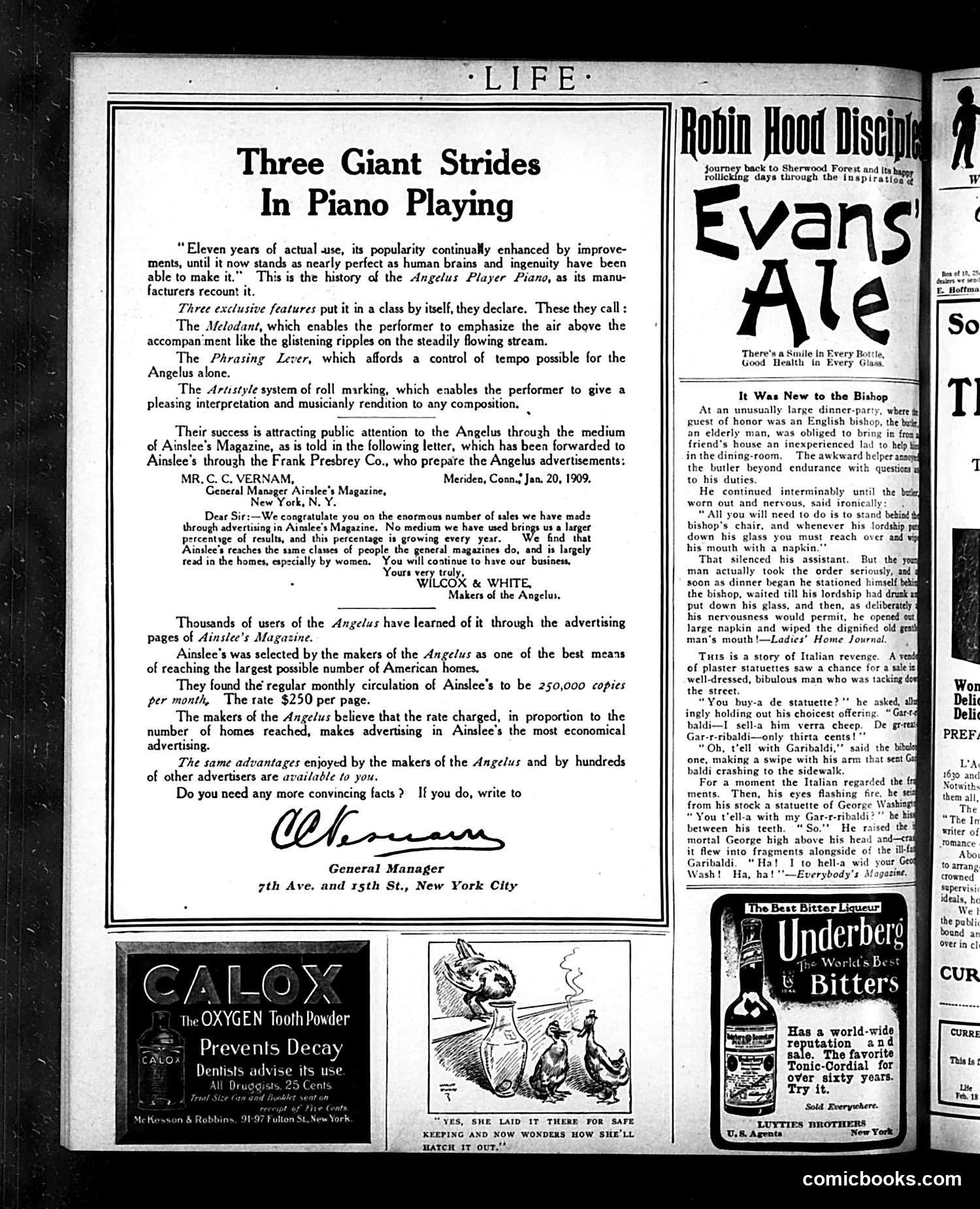
This page is primarily **advertising and promotional content**, not political satire. The main article advertises the **Angelus Player Piano**, promoting three mechanical features (Melodant, Phrasing Lever, Artistyle) that supposedly enable even non-skilled players to perform music expressively. It includes a testimonial letter from piano manufacturers praising *Ainslee's Magazine* as an effective advertising medium, reaching 250,000 homes monthly at $250 per page. The accompanying cartoons and stories are light entertainment: a caption cartoon about a woman hiding something, a humorous anecdote about an English bishop and a clumsy servant misinterpreting instructions, and product advertisements (Calox toothpowder, Evans Ale, Underberg Bitters). **Context for modern readers**: This reflects early-1900s automation marketing—the player piano promised middle-class homes access to "cultured" music without training. The advertising strategy targets women readers of general-interest magazines, reflecting assumptions about household purchasing decisions.
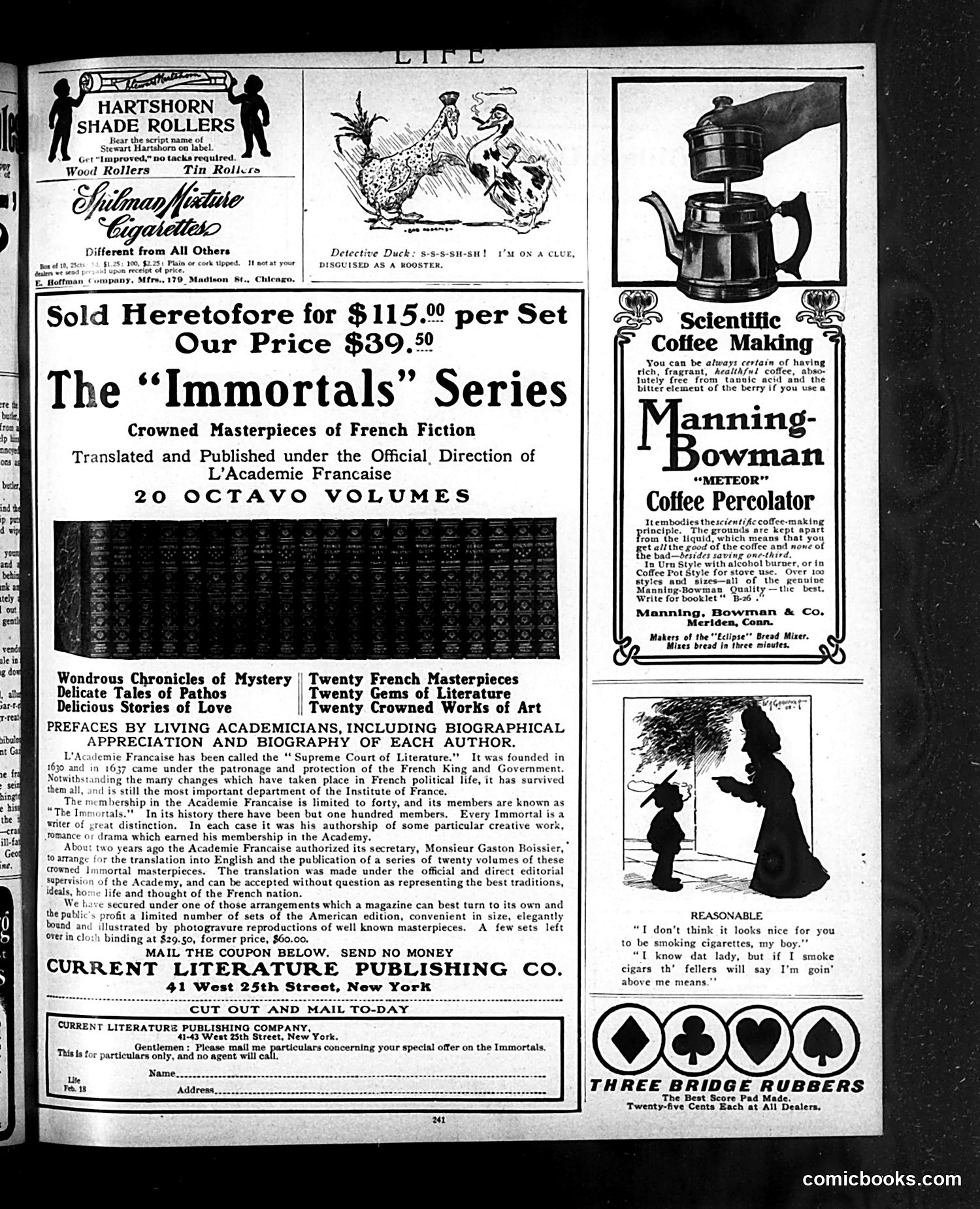
This page is primarily **advertising**, not political satire. The main content showcases: 1. **"The Immortals" Series** — A 20-volume set of French literary masterpieces endorsed by L'Academie Francaise, reduced from $115 to $39.50. The ad emphasizes cultural prestige and official academic approval. 2. **Small cartoon** (top center): "Detective Duck" disguised as a rooster, a simple visual gag with no political meaning—just humor about mistaken identity. 3. **Manning-Bowman Coffee Percolator** — A product advertisement emphasizing scientific coffee-making. 4. **"Reasonable" cartoon** (bottom right): A dialogue between a mother and son about smoking cigarettes, where the boy claims smoking cigars would make him seem pretentious ("above me means"). This reflects early 20th-century social anxieties about class and smoking habits. 5. **Three Bridge Rubbers** — A playing card score pad advertisement. The page reflects turn-of-the-century consumer culture and genteel anxieties rather than political commentary.
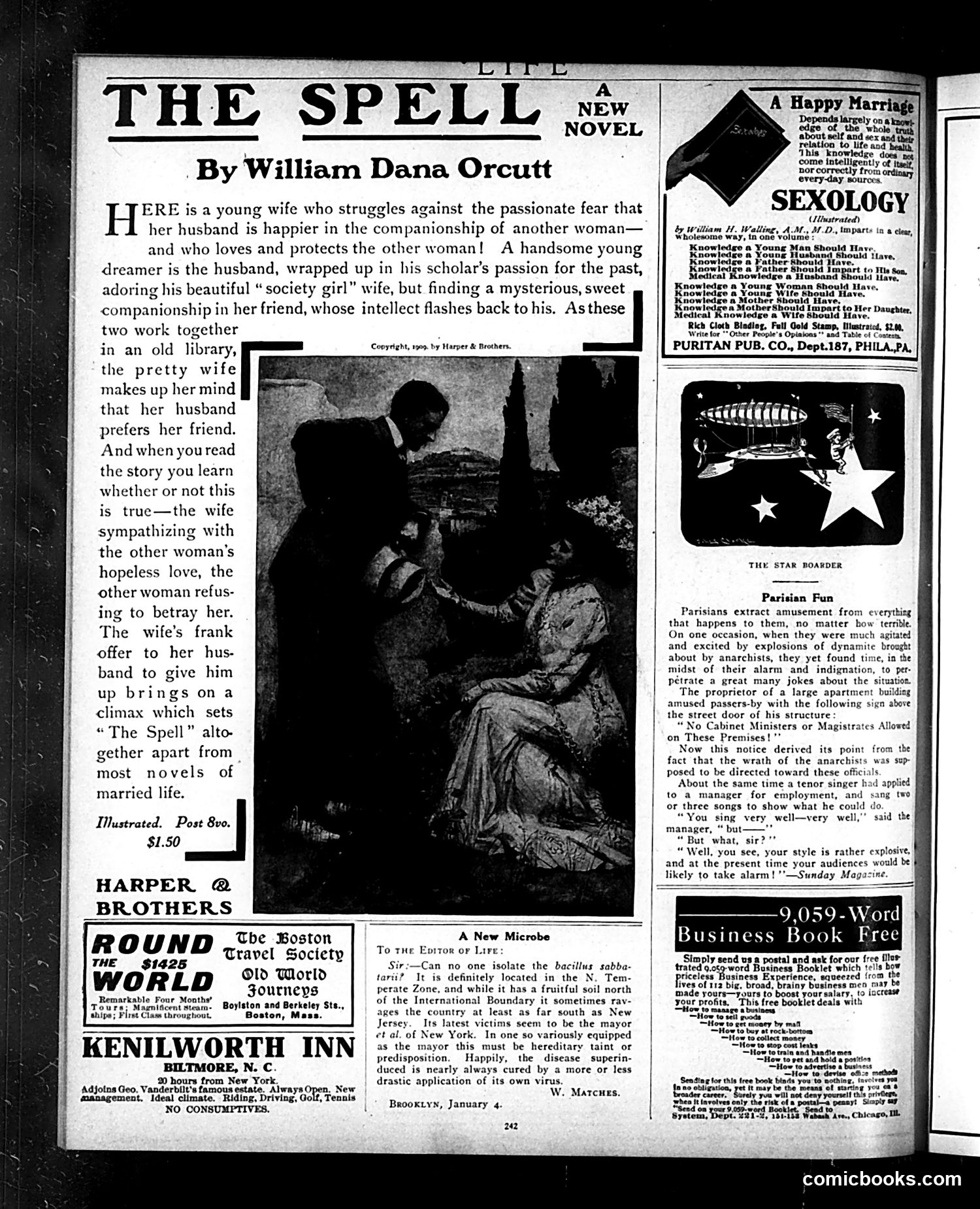
This page is primarily **book and product advertising** from Life magazine (circa 1909). The main feature advertises *"The Spell,"* a novel by William Dana Orcutt about marital jealousy and emotional triangulation. The plot concerns a wife who suspects her husband prefers her friend intellectually, though the wife sympathizes with her rival's "hopeless love." The novel promises drama centered on whether the husband actually prefers the other woman. The accompanying illustration shows three figures in what appears to be a library setting, depicting the emotional tension described. The page also advertises unrelated products: a book on "Sexology" (intimate relations), a round-the-world tour, the Kenilworth Inn resort, and a free business guide. There's a humorous letter-to-editor about a "bacillus sabbatari" (likely referencing New York political corruption), using disease metaphor as satire—a common early-20th-century journalistic technique. The content reflects period concerns: marital fidelity, female intellectual companionship outside marriage, and sexual knowledge as publishable topics.
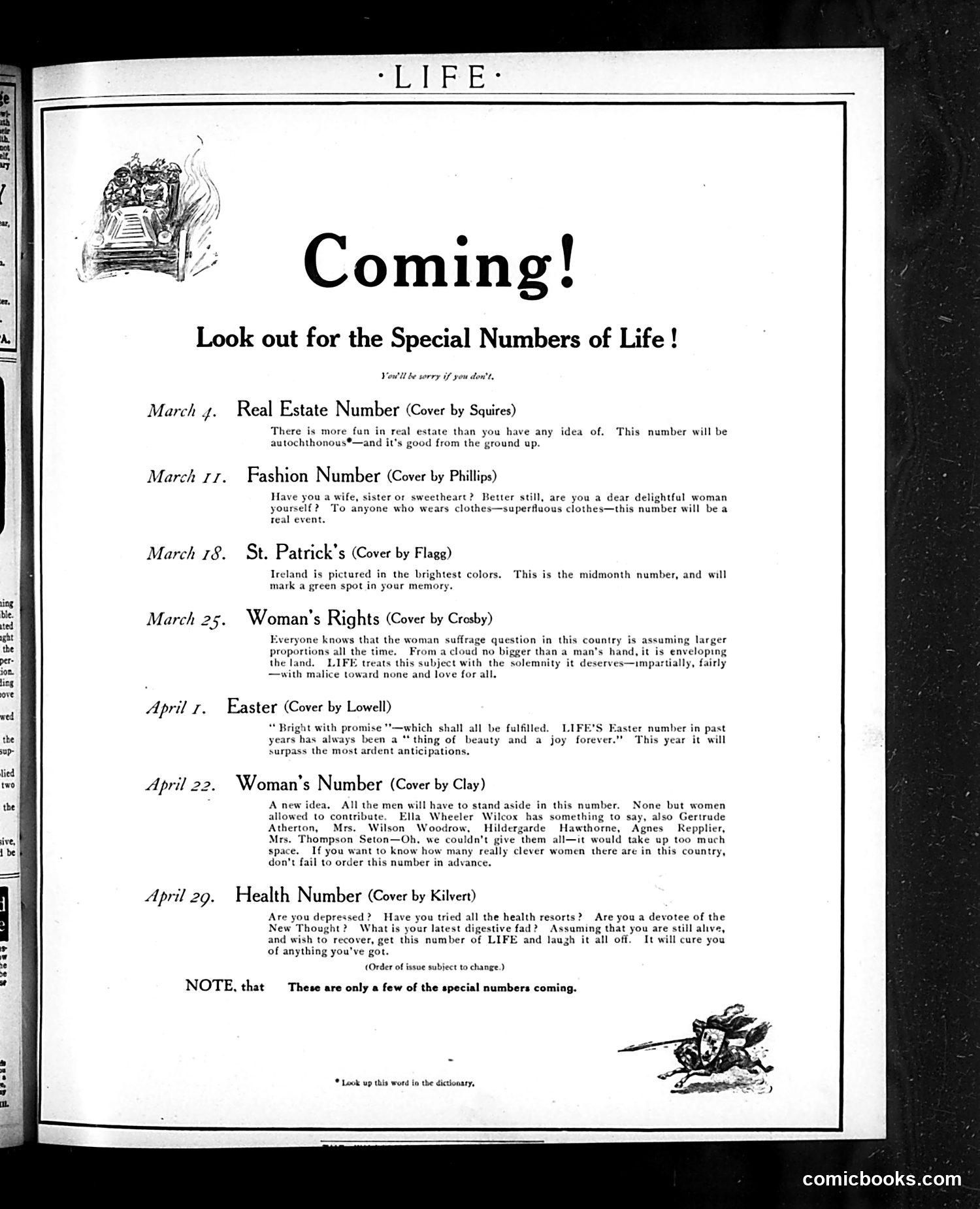
This is a promotional page announcing upcoming themed issues of *Life* magazine, a satirical publication. The page advertises seven special numbers from March through April, each with different covers by named artists. The satire targets contemporary social interests: real estate speculation ("good from the ground up"), fashion and clothing culture, Irish-American identity (St. Patrick's Day), the women's suffrage movement (treated with mock solemnity), Easter sentimentality, and women's contributions to literature (featuring prominent female writers like Ella Wheeler Wilcox and Gertrude Atherton). The "Health Number" satirizes the era's obsession with health fads and "New Thought" wellness trends by promising laughter as medicine. The humor lies in *Life*'s self-aware mockery of these fashionable preoccupations and the magazine's own commercial appeals to diverse readerships. This reflects early 20th-century American consumer culture and emerging social movements.
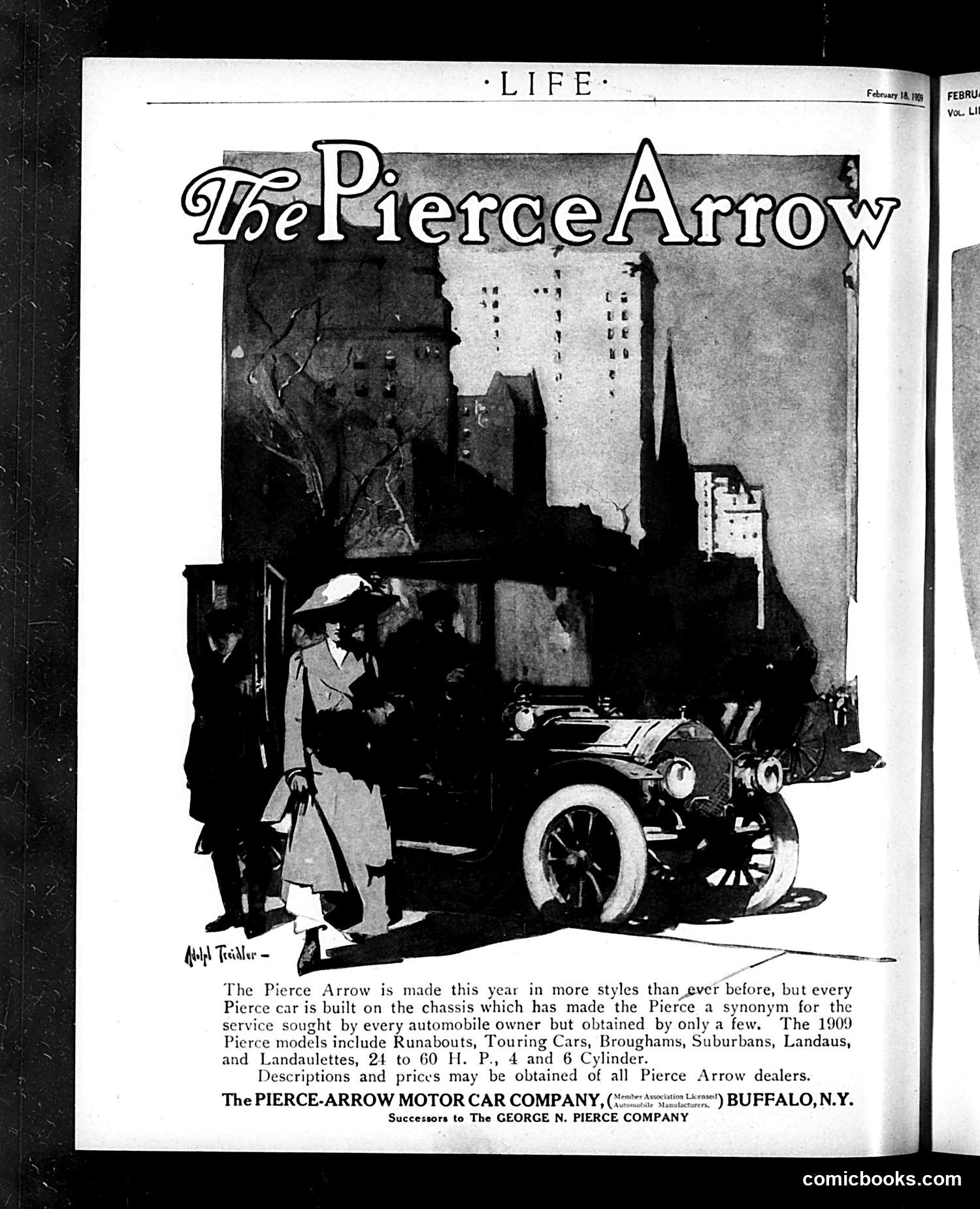
This page is primarily a **product advertisement**, not political satire. It's a 1909 Pierce-Arrow Motor Car Company ad from *Life* magazine, dated February 18. The illustration depicts an elegant early automobile with well-dressed figures in period clothing standing beside it, set against a stylized urban skyline. The artistic composition emphasizes the car's prestige and sophistication. The text promotes Pierce-Arrow's 1909 model lineup, emphasizing that while they offer "more styles than ever before," every vehicle shares a chassis known for reliability—a quality the ad claims "only a few" automobile owners actually obtain. This positions Pierce-Arrow as a premium brand. The ad lists various body styles (Runabouts, Touring Cars, Broughams, etc.) and engine options (24-60 horsepower, 4 and 6 cylinder), targeting affluent buyers seeking quality automobiles during the early automotive era.