
Life, 1909-02-18 · page 14 of 32
Life — February 18, 1909 — page 14: what you’re looking at
What you’re looking at
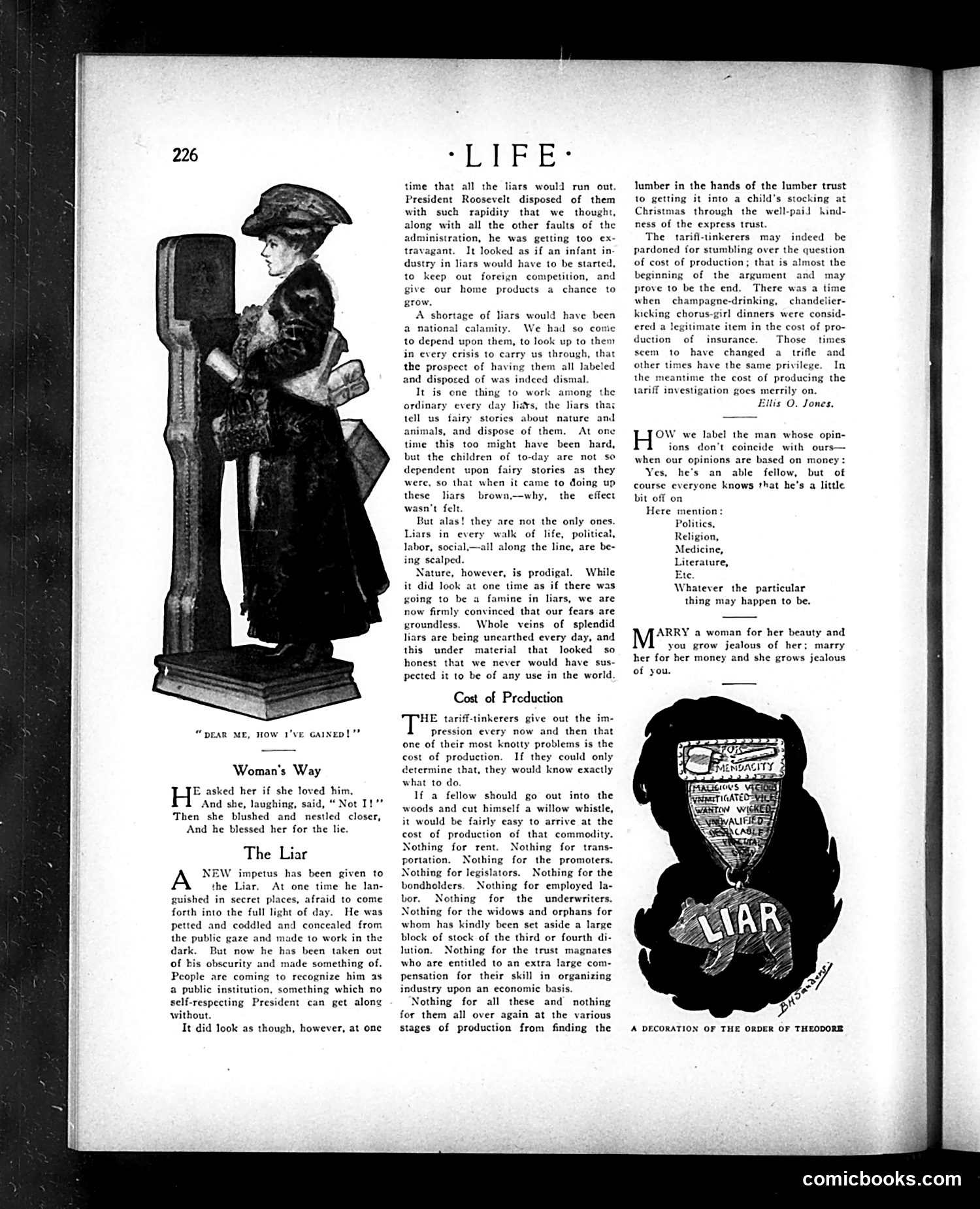
This page contains three distinct pieces satirizing American politics and society circa the Roosevelt era. **"The Liar"** section mocks President Roosevelt's administration for aggressively eliminating political liars—only to discover that lying remains endemic across all walks of life. The satire suggests that despite Roosevelt's efforts, dishonesty continues flourishing in politics, labor, and society generally. The figurine illustration captioned "Dear Me, How I've Gained!" appears to represent a portly figure—likely symbolizing a politician or corrupt official who has profited from deception. **"Cost of Production"** attacks tariff policy by ridiculing economists' inability to calculate true production costs. The author sardonically traces a product (lumber becoming a Christmas whistle) through layers of profit-taking—trust magnates, legislators, bondholders, widows' stock dividends—demonstrating that "cost of production" is meaningless when so many unproductive parties extract compensation. This critiques protectionist economics as deliberately obscuring reality. The short poem "Woman's Way" offers mild romantic humor about female deception in courtship.
📄 Transcribed text from this page (OCR, searchable)
Machine-transcribed from the original scan — historical spelling and the odd misread are preserved.
“DEAR ME, Now I’ve GaineD!'? Woman's Way H* asked her if she loved him. And she, laughing, said, “ Not I! Then she blushed and nestled closer, And he blessed her for the lie. The Liar EW impetus has been given to A the Liar. At one time he lan- guished in secret places, afraid to come forth into the full light of day. He was petted and coddled and concealed from the public gaze and made to work in the dark. But now he has been taken out of bis obscurity and made something of. People are coming to recognize him as a public institution, something which no self-respecting President get along without. It did look as though, however, at one oid Ub ee time that all the liars would run out. President Roosevelt disposed of them with such rapidity that we thought, along with all the other faults of the administration, he was getting too ex- travagant. It looked as if an infant in dustry in liars would have to be started, to keep out foreign competition, and give our home products a chance to rtage of liars would have been a national calamity. We had so conic to depend upon them, to look up to then in every crisis to carry us through, that the prospect of having them all labeled and disposed of was indeed dismal. It is one thing to work among the ordinary every day lists, the liars thas tell us fairy stories about nature and animals, and dispose of them. At one time this too might have been hard, but the children of to-day are not so dependent upon fairy stories as they were, so that when it came to doing up these liars brown,—why, the effect wasn't felt. But alas! they are not the only ones. walk of life, political, ail along the line, are be- Liars in every labor, social ing scalped. Nature, however, is prodigal. While it did look at one time as if there was going to be a famine in liars, we are now firmly convinced that our fears are groundless. Whole veins of splendid liars are being unearthed every day, and this under material that looked so honest that we never would have sus- pected it to be of any use in the world. Cost of Preduction HE tariff-tinkerers give out the im- pression every now and then that one of their most knotty problems is the cost of production. If they could only determine that, they would know exactly what to do. If a fellow should go out into the woods and cut himself a willow whistle, it would be fairly easy to arrive at the cost of production of that commodity. Nothing for rent. Nothing for tran portation. Nothing for the promoters. Nothing for legislators. Nothing for the bondholders. Nothing for employed la- bor. Nothing for the underwriters. Nothing for the widows and orphans for whom has kindly been set aside a large block of stock of the third or fourth di- lution. Nothing for the trust magnates who are entitled to an extra large com- pensation for their skill in organizing industry upon an economic basis Nothing for all these and nothing for them all over again at the various stages of production from finding the lumber in the hands of the lumber trust to getting it into a child's stocking at Christmas through the well-paid hind- ness of the express trust. The tarifi-tinkerers may indeed be pardoned for stumbling over the question of cost of production; that is almost the beginning of the argument and may prove to be the end. There was a time when champagne-drinking, chandelier- kicking chorus-girl dinners were consid- ered a legitimate item in the cost of pro- duction of insurance. Those times scem to have changed a trifle and other times have the same privilege. In the meantime the cost of producing the tariff investigation goes merrily on. is O. Jones. OW we label the man whose opin- ions don't coincide with ours— when our opinions are based on money: Yes, he’s an able fellow, but of course everyone knows that he's a little bit off on Here mention: Politics, Religion, Medicine, Literature, Ete. Whatever the particular thing may happen to be. ARRY a woman for her beauty and you grow jealous of her; marry her for her money and she grows jealous of you. Taxuciovs Ei gadpect GATE A DECORATION OF THE ORDER OF THEODORE comicbooks.com