
Life, 1909-02-18 · page 20 of 32
Life — February 18, 1909 — page 20: what you’re looking at
What you’re looking at
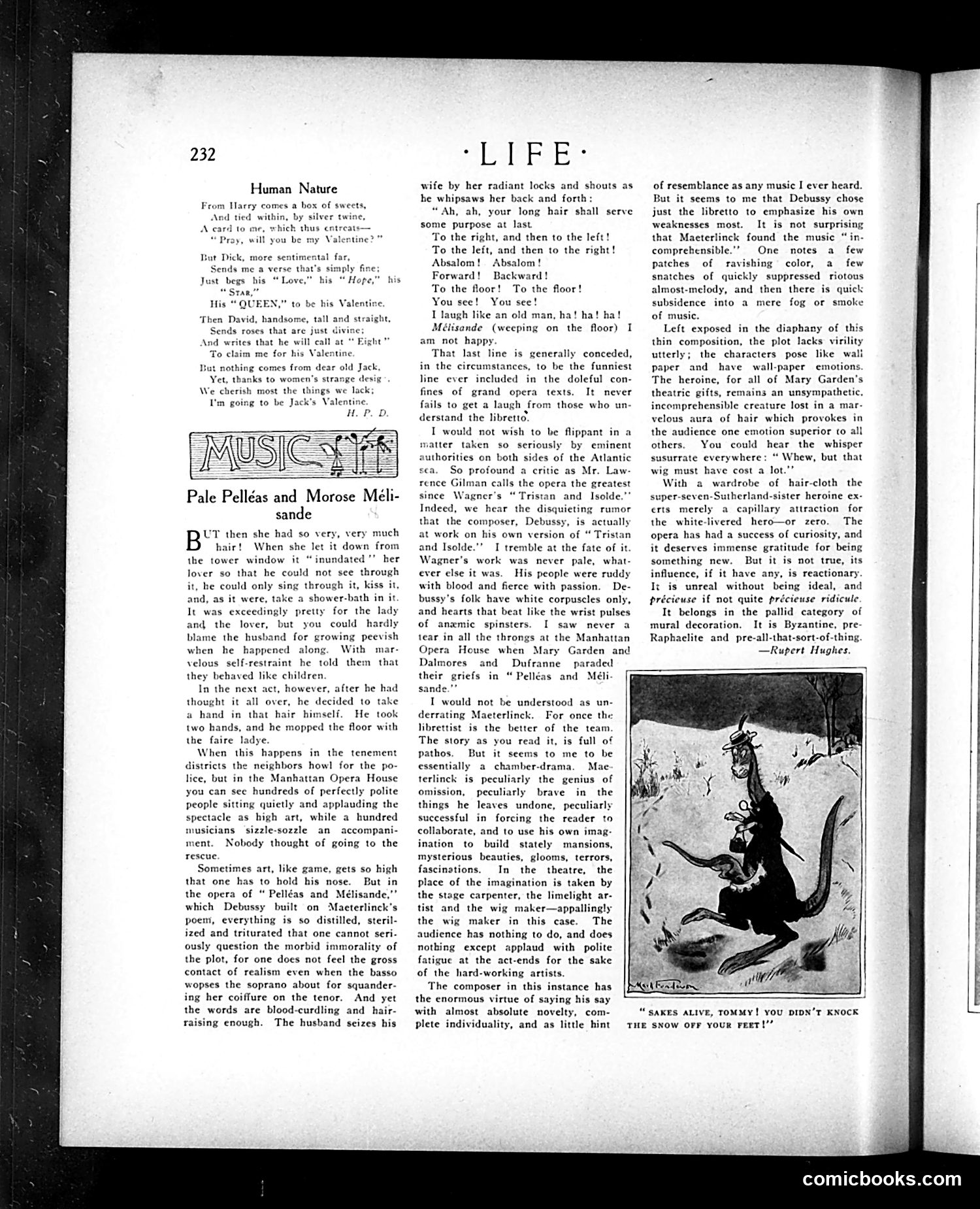
This page contains two distinct pieces satirizing early 20th-century opera culture. **"Human Nature"** (top): A light verse poem about a woman receiving Valentine's Day gifts from multiple suitors—candy from Harry, flowers from David—but treasuring most the *absence* of a gift from "dear old Jack." It's a gentle joke about contrary female psychology. **"Pelléas and Mélisande"** (main article): The critic mocks Claude Debussy's opera adaptation of Maurice Maeterlinck's symbolist play. The satire targets the work's morbid passivity: a husband literally whips his wife with her own hair while she weeps that she's "not happy"—presented as the funniest line ever in opera. The author argues that while Wagner's operas were passionate and bloody, Debussy's characters are bloodless and anemic ("white corpuscles only"). High art is defended by serious critics (Lawrence Gilman), yet the actual plot is absurd when described plainly. The joke: critics take it seriously precisely *because* it's so rarefied and emotionally thin that reality feels irrelevant. The cartoon (right) illustrates the hair-whipping scene.
📄 Transcribed text from this page (OCR, searchable)
Machine-transcribed from the original scan — historical spelling and the odd misread are preserved.
232 Human Nature From Harry comes a box of sweets, And tied within, by silver twi Acard hick thus entreats— “Pray, will you be my Val But Dick more senti Just begs his “ Love, His “ QUEEN," to be his Valent ‘Then David, handsome, tall and straight, Sends roses that are just divine nd writes that he will call at “ F To claim me for his Valentine But nothing comes from dear old Jack, Yet, thanks to women’s strange de We cherish most the lack; I'm going to be Jack's Valentine. H. P. D. ngs we Pale Pelléas and Morose Meéli- sande T then she had so very, very much hair! When she let it down from the tower window it “inundated '" her lover so that he could not see through it, he could only sing through it, kiss it, and, as it were, take a shower-bath in it It was exceedingly pretty for the lady and the lover, but you could hardly blame the husband for growing peevish when he happened along. With mar- velous self-restraint he told them that they behaved like children In the next act, however, after he had thought it all over, he decided to take a hand in that hair himself. He took two hands, and he mopped the floor with the faire ladye When this happens in the tenement districts the neighbors howl for the po- lice, but in the Manhattan Opera House you can see hundreds of perfectly polite people sitting quietly and applauding the spectacle as high art, while a hundred musicians sizzle-sozzle an accompani ment. Nobody thought of going to the rescue Sometimes art, like game, gets so high that one has to hold his nose. But in the opera of “ Pelléas and Mélisande,”* which Debussy built on Maeterlinck’s poem, everything is so distilled, steril- ized and triturated that one cannot seri- ously question the morbid immorality of the plot, for one does not feel the gross contact of realism even when the basso wopses the soprano about for squander- ing her coiffure on the tenor. And yet the words are blood-curdling and hair- raising enough. The husband seizes his Piles ele wife by her radiant locks and shouts as he whipsaws her back and forth: “Ah, ah, your long hair shall serve some purpose at last To the right, and then to the left! To the left, and then to the right! Absalom Absalom! Forward! Backward! To the floor! To the fioo You see! You see! I laugh like an old man, ha! ha! ha! Mélisande (weeping on the floor) I am not happy That last line is generally conceded, in the circumstances, to be the funniest line ever included in the doleful con- fines of grand opera texts. It never fails to get a laugh from those who un- derstand the libretto. I would not wish to be flippant in a matter taken so seriously by eminent authorities on both sides of the Atlantic sea. So profound a critic as Mr. Law- rence Gilman calls the opera the greatest since Wagner's “Tristan and Isolde,’* Indeed, we hear the disquieting rumor that the composer, Debussy, is actually at work on his own version of “Tristan and Isolde.’’ I tremble at the fate of it. Wagner's work was never pale, what- ever else it was. His people were ruddy with blood and fierce with passion. De- bussy’s folk have white corpuscles only, and hearts that beat like the wrist pulses of anxmic spinsters. I saw never a tear in all the throngs at the Manhattan Opera House when Mary Garden and Dalmores and Dufranne paraded of resemblance as any music I ever heard. But it seems to me that Debussy chose just the libretto to emphasize his own weaknesses most. It is not surprising that Maeterlinck found the music “i comprehensible.” One notes a few patches of ravishing color, a few snatches of quickly suppressed riotous almost-melody, and then there is quick subsidence into a mere fog or smoke of music. Left exposed in the diaphany of this thin composition, the plot lacks virility utterly; the characters pose like wali paper and have wall-paper emotions. The heroine, for all of Mary Garden's theatric gifts, remains an unsympathetic, incomprehensible creature lost in a mar- velous aura of hair which provokes in the audience one emotion superior (o all others. You could hear the whisper susurrate everywhere: “ Whew, but that wig must have cost a lot.”’ With a wardrobe of hair-cloth the super-seven-Sutherland-sister heroine ex- certs merely a capillary attraction for the white-livered hero—or zero. The opera has had a success of curiosity, and it deserves immense gratitude for being something new. But it is not true, its influence, if it have any, is reactionary Ix is unreal without being ideal, and précieuse if not quite précieuse ridicule It belongs in the pallid category of mural decoration. It is Byzantine, pre- Raphaelite and pre-all-that-sort-of-thing —Rupert Hughes. their griefs in “Pelléas and Méli sande.” I would not be understood as un- derrating Maeterlinck. For once the librettist is the better of the team The story as you read it, is full of pathos. But it seems to me to be essentially a chamber-drama. Mae terlinck is peculiarly the genius of omission, peculiarly brave in the things he leaves undone, peculiarly successful in forcing the reader to collaborate, and to use his own imag- ination to build stately mansions, mysterious beauties, glooms, terrors, fascinotions. In the theatre, the place of the imagination is taken by the stage carpenter, the limelight ar- tist and the wig maker—appallingly the wig maker in this case. The audience has nothing to do, and does nothing except applaud with polite fatigue at the act-ends for the sake of the hard-working artists. The composer in this instance has the enormous virtue of saying his say with almost absolute novelty, com- plete individuality, and as little hint “ SAKES ALIVE, TOMMY! YOU DIDN’T KNOCK THE SNOW OFF YouR FEET!’” comicbooks.com