
Life, 1909-02-18 · page 21 of 32
Life — February 18, 1909 — page 21: what you’re looking at
What you’re looking at
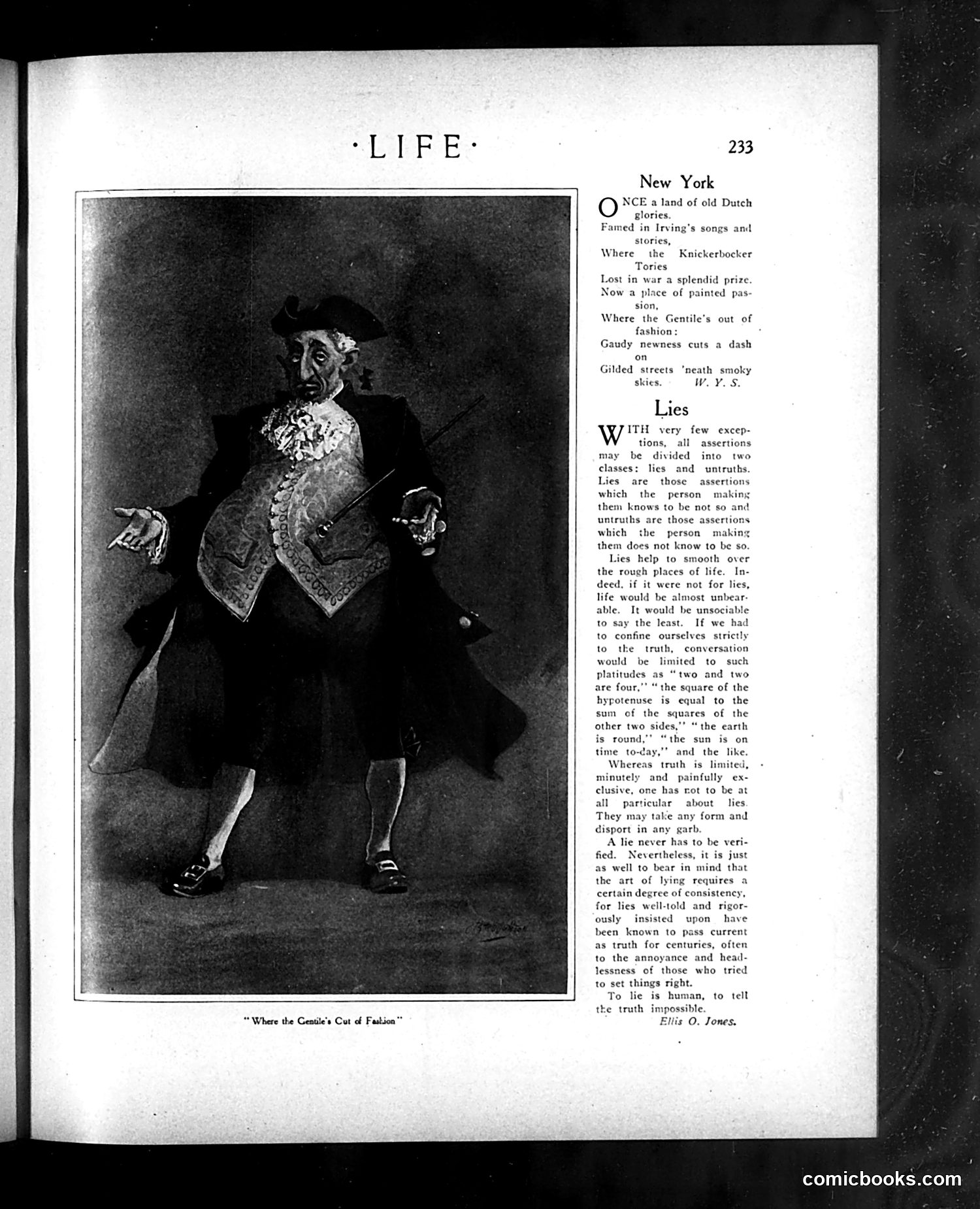
This page satirizes New York's transformation from its Dutch colonial heritage into a gilded, modern city dominated by newly wealthy gentiles (non-Jewish New Yorkers). The poem laments that old Knickerbocker aristocratic values have been replaced by "gaudy newness" and "painted passion"—a critique of the city's rapid commercialization and social climbing. The accompanying article by Ellis O. Jones is a philosophical essay on lying, arguing that dishonesty is practically necessary for civilized society, unlike rigid truth. This pairs ironically with the image: the fashionable figure represents the pretense and artificiality of New York's nouveau riche, whose "painted" personas exemplify the social lies the essay discusses. The satire targets both vulgar materialism and the hypocrisy of upper-class New York society during the Gilded Age.
📄 Transcribed text from this page (OCR, searchable)
Machine-transcribed from the original scan — historical spelling and the odd misread are preserved.
“ Where the Centile’s Cut of Fashion” a land of old Dutch glories. Famed in Irving's songs and storie: Where the Knickerbocker Tories Lost in war a splendid prize Now a place of painted pa sion, Where the Gentile’s out of fashion: Gaudy newness cuts a dash on Gilded streets ‘neath smoky skies. WOYOS: Lies ITH very few excep- tions, all assertions may be divided into two classes: lies and untruths. Lies are those assertions which the person making them knows to be not so and untruths are those assertions which the person making them does not know to be so Lies help to smooth over the rough places of life. In- deed, if it were not for lies, life would be almost unbear- able. It would be unsociable to say the least. If we had to confine ourselves strictly to the truth, conversation would be limited to such platitudes as “two and two are four,”’ “the square of the hypotenuse is equal to the sum of the squares of the other two side the earth is round," “the sun is on time to-day,’ and the like. Whereas truth is limited, minutely and painfully ex- clusive, one has rot to be at all particular about lies y may take any form and port in any garb. A lie never has to be veri fied. Nevertheless, it is just as well to bear in mind th: the art of lying requires a certain degree of consistency for lies well-told and rigor- ously insisted upon have been known to pass current as truth for centuries, often to the annoyance and head- lessness of those who tried to set things right. To lie is human, to tell the truth impossible Ellis O. Jones. comicbooks.com