
Life, 1909-02-18 · page 13 of 32
Life — February 18, 1909 — page 13: what you’re looking at
What you’re looking at
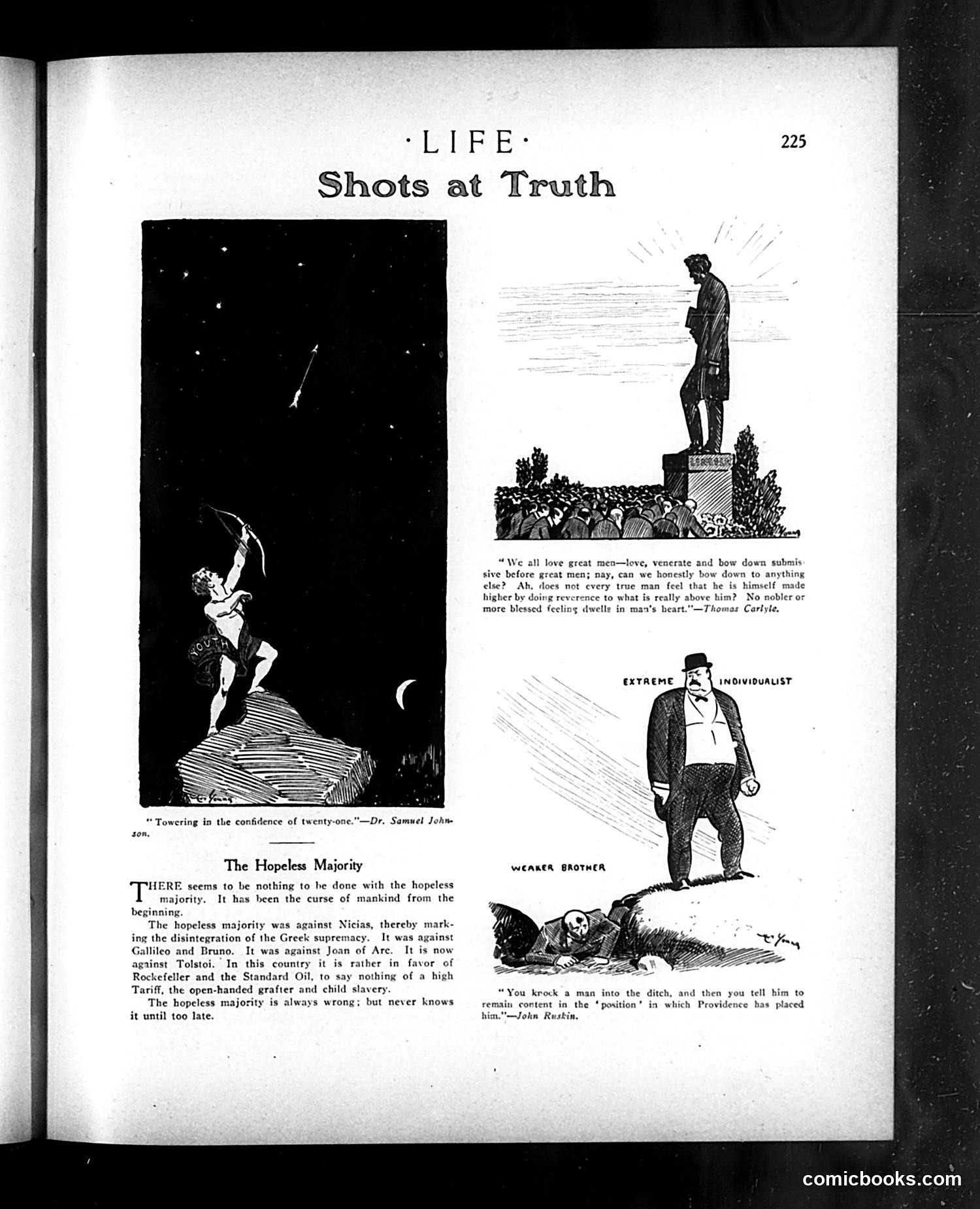
This page satirizes blind reverence for great men and authority. The main illustration shows a statue of an unnamed figure with a crowd below, accompanied by a Thomas Carlyle quote about proper veneration of greatness. The satirical cartoons below critique extremes: "Extreme Individualist" depicts a stout man labeled as a "Weaker Brother," shown trampling a prone figure. The accompanying John Ruskin quote suggests this represents someone who brutally dominates others while claiming moral justification through providence. The section titled "The Hopeless Majority" argues that common people perpetually support the wrong causes throughout history—opposing scientific progress, religious reformers, and progressive policies. The satire targets both uncritical hero-worship and cynical individualism that exploits the powerless.
📄 Transcribed text from this page (OCR, searchable)
Machine-transcribed from the original scan — historical spelling and the odd misread are preserved.
*-LIFE: Shots at Truth “We all love great men—love, venerate and bow down submis sive before great men; nay, can we honestly bow down to anything else? Ah, does not every true man feel that he is himself made higher by doi erence to what is really ove him? No nobler or more blessed feeling dwells in man’s heart."—Thomas Carlyle, EXTREME INOIVIDUALIST “Towering in the confidence of twenty-one."—Dr. Samuel John son, The Hopeless Majority WEAKER BROTHER HERE seems to be nothing to he done with the hopeless majority. It has been the curse of mankind from the beginning. The hopeless majority was against Nicias, thereby mark- ing the disintegration of the Greek supremacy. It was against Galileo and Bruno, It was against Joan of Arc. It is now against Tolstoi. In this country it is rather in favor of Rockefeller and the Standard Oil, to say nothing of a high Tariff, the open-handed grafter and child slavery. You krock a man into the ditch, and then you tell him to __ The hopeless majority is always wrong; but never knows main content in the ‘position’ in which Providence has placed it until too late. John Ruskin, comicbooks.com