
Life, 1909-02-18 · page 19 of 32
Life — February 18, 1909 — page 19: what you’re looking at
What you’re looking at
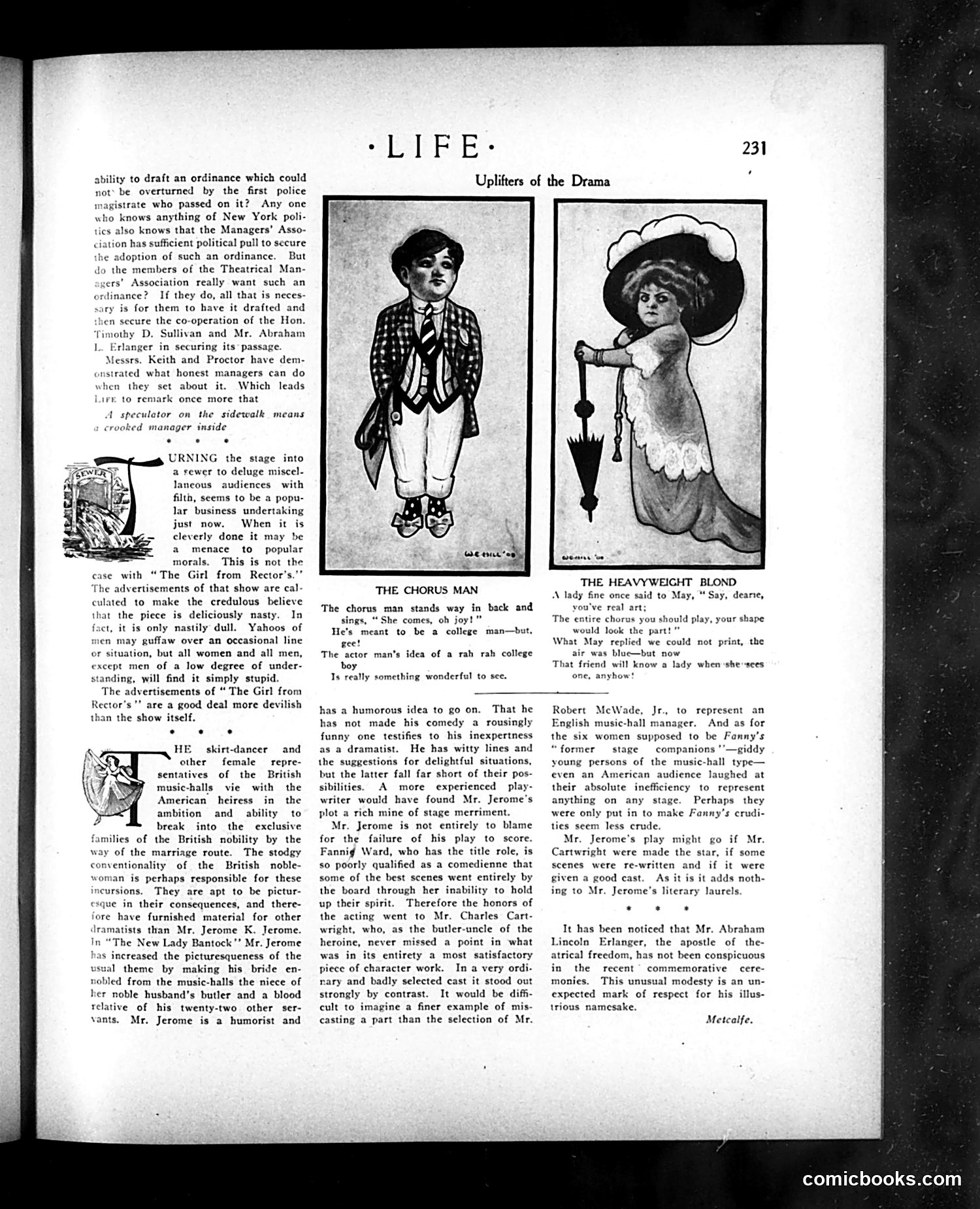
This page contains theater reviews critiquing contemporary stage productions. Two illustrated caricatures accompany the text: **"The Chorus Man"** depicts a stereotypical college-boy chorus member—apparently meant to look collegiate but appearing ridiculous instead. **"The Heavyweight Blond"** shows a woman in a large feathered hat, illustrating a joke about a lady's figure being suited to chorus work rather than leading roles. The reviews themselves are scathing critiques of current Broadway productions, particularly condemning "The Girl from Rector's" as "nastily dull" despite provocative advertising. The author also criticizes playwright Jerome K. Jerome's "The New Lady Bantock" and actor Fanny Ward's inadequate performance, while praising Charles Cartwright's character work. The overall tone sarcastically positions these reviews as "uplifters" of drama—implying contemporary theater was morally and artistically degraded.
📄 Transcribed text from this page (OCR, searchable)
Machine-transcribed from the original scan — historical spelling and the odd misread are preserved.
ability to draft an ordinance which could not® be overturned by the first police magistrate who passed on it? Any one who knows anything of New York poli- tics also knows that the Managers’ Asso- ciation has sufficient political pull to secure he adoption of such an ordinance. But do the members of the Theatrical Man- gers’ Association really want such an inance? If they do, all that is neces- sary is for them to have it drafted and en secure the co-operation of the Hon. ‘Timothy D, Sullivan and Mr. Abraham er in securing its passage. Messrs. Keith and Proctor have dem- onstrated what honest managers can do when they set about it. Which leads Lire to remark once more that wletor on the sidewalk means ed manager inside URNING the stage into a sewer to deluge miscel- lancous audiences with filth, seems to be a popu- lar business undertaking just now. When it is cleverly done it may be a menace to popular morals. This is not the case with “The Girl from Rector’s.”” The advertisements of that show are cal- culated to make the credulous believe that the piece is deliciously nasty. In fact, it is only nastily dull. Yahoos of in may guffaw over an occasional line or situation, but all women and all men, except men of a low degree of under- ding, will find it simply stupid. The advertisements of “ The Girl from Rector’s” are a good deal more devilish than the show itself. « Sayrtis HE skirt-dancer and other female repre- sentatives of the British music-halls vie with the American heiress in the ambition and ability to break into the exclusive families of the British nobility by the way of the marriage route. The stodgy conventionality of the British noble- woman is perhaps responsible for these incursions. They are apt to be pictur- esque in their consequences, and there- ore have furnished material for other dramatists than Mr, Jerome K. Jerome. In “The New Lady Bantock’? Mr. Jerome 18 increased the picturesqueness of the al theme by making his bride en- nobled from the music-halls the niece of her noble husband’s butler and a blood relative of his twenty-two other ser- vants. Mr, Jerome is a humorist and EES Uplifters of the Drama THE CHORUS MAN The chorus man stands way in back and sings, “She comes, oh joy!” He's meant to be a college man—but, gee! The actor man's boy Is really something wonderful to see. jea of a rah rah college has a humorous idea to go on. That he has not made his comedy a rousingly funny one testifies to his inexpertness as a dramatist. He has witty lines and the suggestions for delightful situations, but the latter fall far short of their pos- sibilities. A more experienced play- writer would have found Mr. Jerome's plot a rich mine of stage merriment. Mr. Jerome is not entirely to blame for the failure of his play to score. Fannig Ward, who has the title role, is so poorly qualified as a comedienne that some of the best scenes went entirely by the board through her inability to hold up their spirit. Therefore the honors of the acting went to Mr. Charles Cart- wright, who, as the butler-uncle of the heroine, never missed a point in what was in its entirety a most satisfactory piece of character work. In a very ordi- rary and badly selected cast it stood out strongly by contrast. It would be difi- cult to imagine a finer example of mis- casting a part than the selection of Mr. THE HEAVYWEIGHT BLOND ‘A lady fine once said to May, “ Say, deane, you've real ar The entire chorus you should play, your shape would look the part!” What May replied we could not print, the air was blue—but now That friend will know a lady when she-sees fone, anyhow! Robert McWade, Jr, to represent an English music-hall manager. And as for the six women supposed to be Fanny's “former stage companions ’’—giddy young persons of the music-hall type— even an American audience laughed a their absolute inefficiency to represent anything on any stage. Perhaps they were only put in to make Fanny’s crudi- ties seem less crude. Mr. Jerome's play might go if Mr. Cartwright were made the star, if some scenes were re-written and if it were given a good cast. As it is it adds noth- ing to Mr. Jerome’s literary laurels. It has been noticed that Mr. Abraham Lincoln Erlanger, the apostle of the- atrical freedom, has not been conspicuous in the recent commemorative cere- monies. This unusual modesty is an un- expected mark of respect for his illus- trious namesake. Metcalfe, comicbooks.com