
Life, 1909-02-18 · page 8 of 32
Life — February 18, 1909 — page 8: what you’re looking at
What you’re looking at
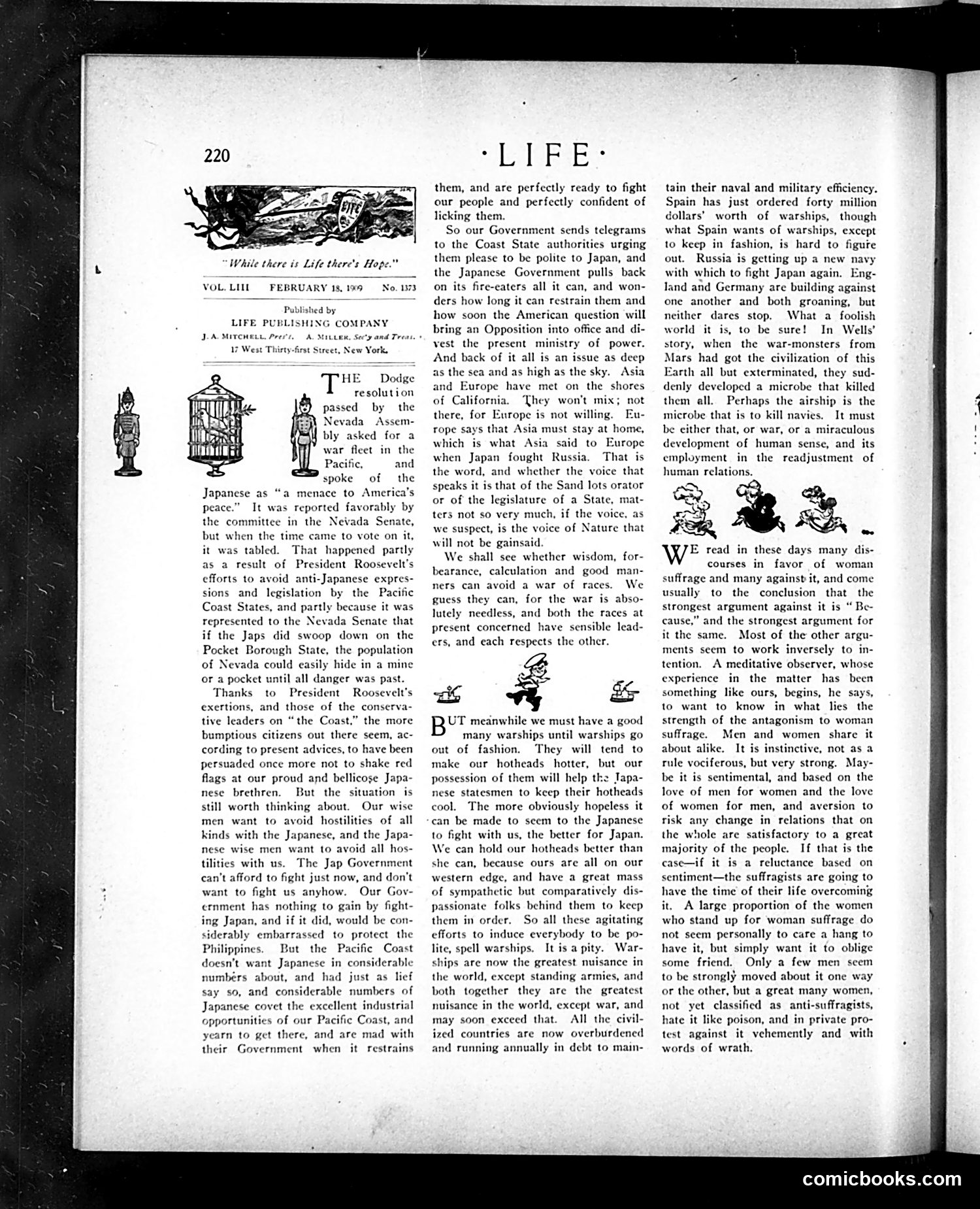
This page addresses the contemporary debate over women's suffrage. The illustrated figures (appearing to be caricatured women) accompany an editorial discussing arguments both for and against voting rights for women. The text presents suffrage advocates' claims that women represent a "cause" worthy of support, while acknowledging opponents' arguments. The author argues that most anti-suffrage rhetoric operates "inversely to intention"—that opposition actually strengthens the movement. The piece also discusses broader geopolitical concerns, including tensions with Japan and naval military buildups, suggesting Life magazine addressed multiple political issues simultaneously. The satirical tone typical of Life's editorial approach is evident in how it presents these competing viewpoints on a contentious social issue of the Progressive Era.
📄 Transcribed text from this page (OCR, searchable)
Machine-transcribed from the original scan — historical spelling and the odd misread are preserved.
While there is Life there's Hop: VOL. LIL FEBRUARY 18, 199 Published by LIFE PUBLISHID DA MiTeMRLL Prev, 8 No. 1573 COMPANY Len, See‘y and Trew. HE Dodge resolution passed by the Nevada Assem- bly asked for a war fleet in the Pacific, and spoke of the Japanese as “a menace to America’s peace.” It was reported favorably by the committee in the Nevada Senate, but when the time came to vote on it, it was tabled. That happened partl as a result of President Roosevelt's efforts to avoid anti-Japanese expres- sions and legislation by the Pacific Coast States, and partly because it was represented to the Nevada Senate that if the Japs did swoop down on the Pocket Borough State, the population of Nevada could easily hide in a mine or a pocket until all danger was past. Thanks to President Roosevelt's exertions, and those of the conserva- tive leaders on “the Coast,” the more bumptious citizens out there seem, ac- cording to present advices, to have been persuaded once more not to shake red flags at our proud and bellicose Japa- nese brethren. But the situation is still worth thinking about. Our wise men want to avoid hostilities of all kinds with the Japanese, and the Japa- nese wise men want to avoid all hos- tilities with us. The Jap Government can't afford to fight just now, and don't want to fight us anyhow. Our Gov- ernment has nothing to gain by fight- ing Japan, and if it did, would be con- siderably embarrassed to protect the Philippines. But the Pacific Coast doesn't want Japanese in considerable numbers about, and had just as lief say so, and considerable numbers of Japanese covet the excellent industrial opportunities of our Pacific Coast, and yearn to get there, and are mad with their when it restrains =} Ss mee Government “ERSES them, and are perfectly ready to fight our people and perfectly confident of licking them. So our Government sends telegrams to the Coast State authorities urging them please to be polite to Japan, and the Japanese Government pulls back on its fire-eaters all it can, and won- ders how long it can restrain them and how soon the American question will bring an Opposition into office and di- vest the present ministry of power. And back of it all is an issue as deep as the sea and as high as the sky. Asia and Europe have met on the shores of California. [hey won't mix; not there, for Europe is not willing. Eu- rope says that Asia must stay at home, which is what Asia said to Europe when Japan fought Russia. That is the word, and whether the voice that speaks it is that of the Sand lots orator or of the legislature of a State, mat- ters not so very much, if the voice, as we suspect, is the voice of Nature that will not be gainsaid. We shall see whether wisdom, for- bearance, calculation and good man- ners can avoid a war of races. We guess they can, for the war is abso- lutely needless, and both the races at present concerned have sensible lead- ers, and each respects the other. a & & UT meanwhile we must have a good many warships until warships go out of fashion. They will tend to make our hotheads hotter, but our possession of them will help the Tapa- nese statesmen to keep their hotheads cool. The more obviously hopeless it can be made to seem to the Japanese to fight with us, the better for Japan. We can hold our hotheads better than she can, because ours are all on our western edge, and have a great mass of sympathetic but comparatively dis- passionate folks behind them to keep them in order, So all these agitating efforts to induce everybody to be po- lite, spell warships. It is a pity. War- ships are now the greatest nuisance in the world, except standing armies, and both together they are the greatest nuisance in the world, except war, and may soon exceed that. All the civil- ized countries are now overburdened and running annually in debt to main- tain their naval and military efficiency. Spain has just ordered forty million dollars’ worth of warships, though what Spain wants of warships, except to keep in fashion, is hard to figure out. Russia is getting up a new navy with which to fight Japan again. Eng- land and Germany are building against one another and both groaning, but neither dares stop. What a foolish world it is, to be sure! In Wells’ story, when the war-monsters from Mars had got the civilization of this rth all but exterminated, they sud- denly developed a microbe that killed them all. Perhaps the airship is the microbe that is to kill navies, It must be either that, or war, or a miraculous development of human sense, and its employment in the readjustment of human relations. E read in these days many dis- courses in favor of woman suffrage and many against it, and come usually to the conclusion that the strongest argument against it is “ Be- cause,” and the strongest argument for it the same. Most of the other argu- ments seem to work inversely to in- tention. A meditative observer, whose experience in the matter has been something like ours, begins, he says, to want to know in what lies the strength of the antagonism to woman suffrage. Men and women share it about alike. It is instinctive, not as a rule vociferous, but very strong. May- be it is sentimental, and based on the love of men for women and the love of women for men, and aversion to risk any change in relations that on the whole are satisfactory to a great majority of the people, If that is the case—if it is a reluctance based on sentiment—the suffragists are going to have the time of their life overcoming it, A large proportion of the women who stand up for woman suffrage do not seem personally to care a hang to have it, but simply want it to oblige some friend. Only a few men seem to be strongly moved about it one way or the other, but a great many women, not yet classified as anti-suffragists, ate it like poison, and in private pro- test against it vehemently and with words of wrath, comicbooks.com