
A complete issue · 28 pages · 1908
Life — December 17, 1908
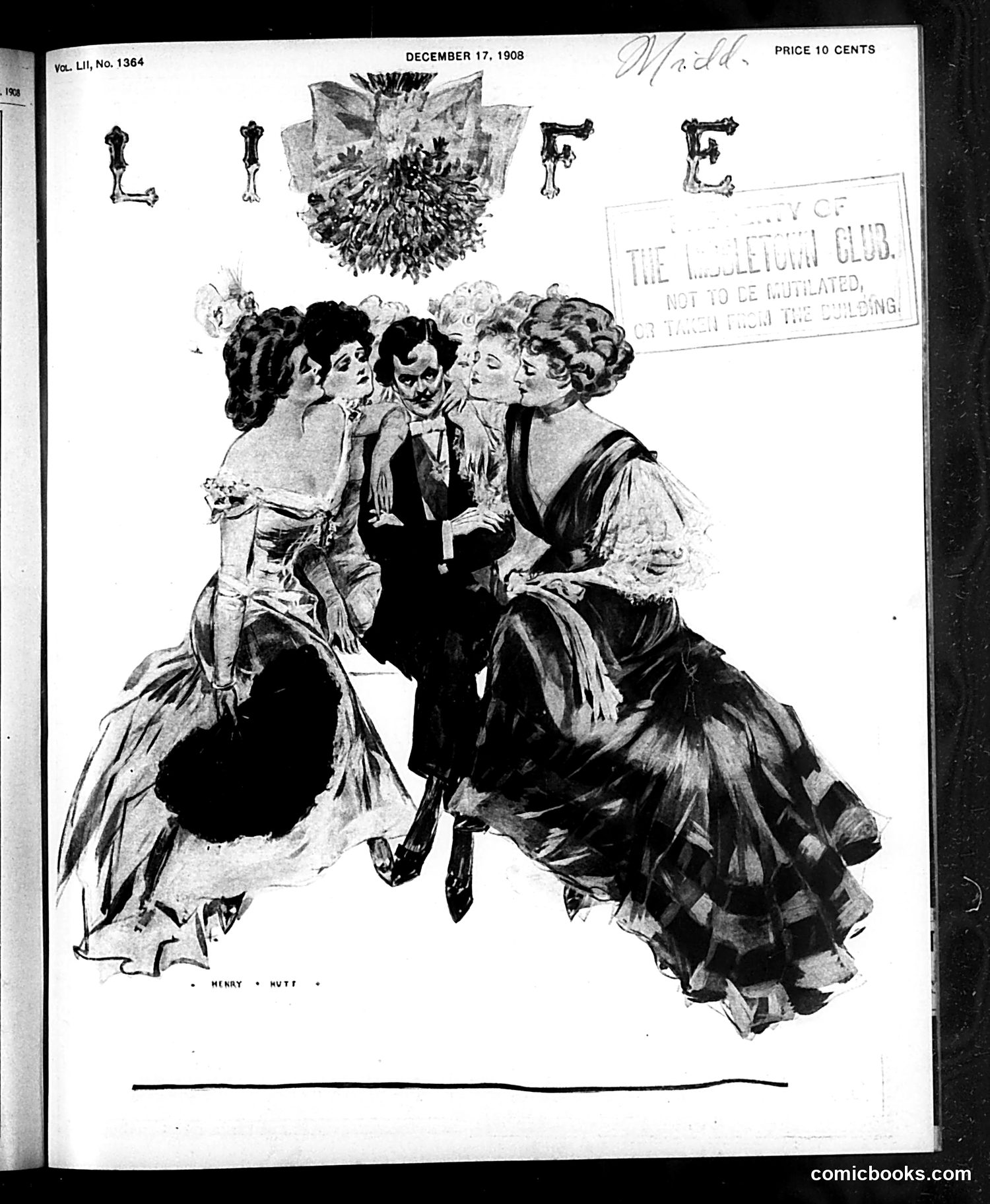
This is a satirical illustration by Henry Hutt depicting five elegantly dressed women in Edwardian fashion gathered around a central male figure. The man appears to be a dandy or fashionable gentleman, suggesting commentary on masculine fashion or social pretension of the era. The large decorative mistletoe at top signals Christmas/holiday season context. The stamp reading "THE MUSSELTOWN CLUB - NOT TO BE MUTILATED OR TAKEN FROM THE BUILDING" indicates this was likely library property. The specific satire remains unclear without additional context, but the composition—with four women attending to one man amid holiday imagery—likely comments on social dynamics, courtship rituals, or gender relations during this period. The elaborate clothing emphasizes the artificiality of high society.
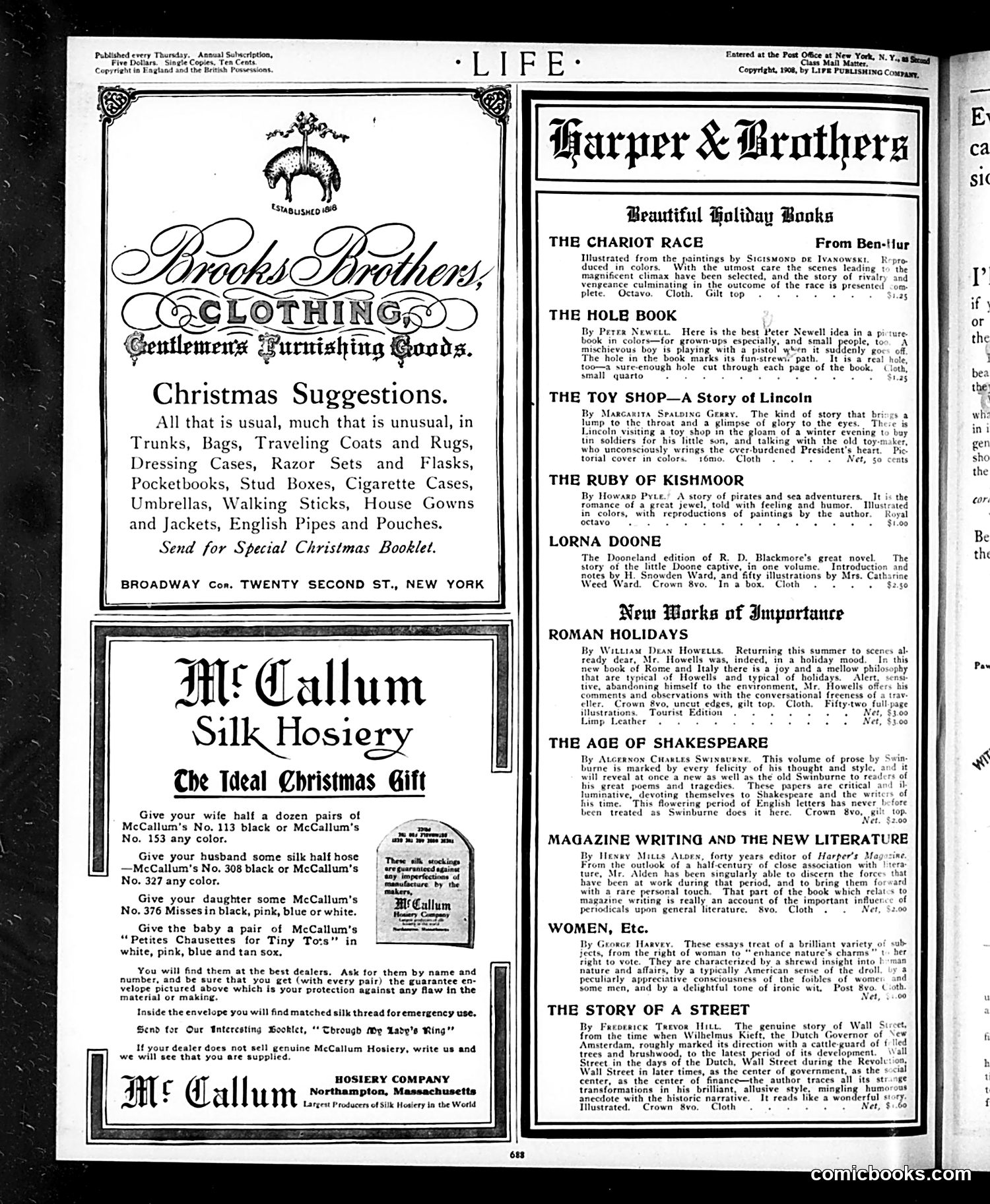
This page is primarily **advertising**, not editorial content or satire. It contains three major advertisements: 1. **Brooks Brothers** (top left): Christmas gift suggestions for gentlemen's clothing and accessories. 2. **McCullum Silk Hosiery** (bottom left): Positioned as "The Ideal Christmas Gift," advertising silk stockings for wives, husbands, and daughters in various colors. 3. **Harper & Brothers** (right side): A book publisher showcasing holiday gift books, including titles like "The Chariot Race," "The Hole Book," and "Roman Holidays." The page reflects early 20th-century consumer culture and gift-giving practices. There are no political cartoons or satirical content visible—this is a commercial page designed to capitalize on Christmas shopping season.
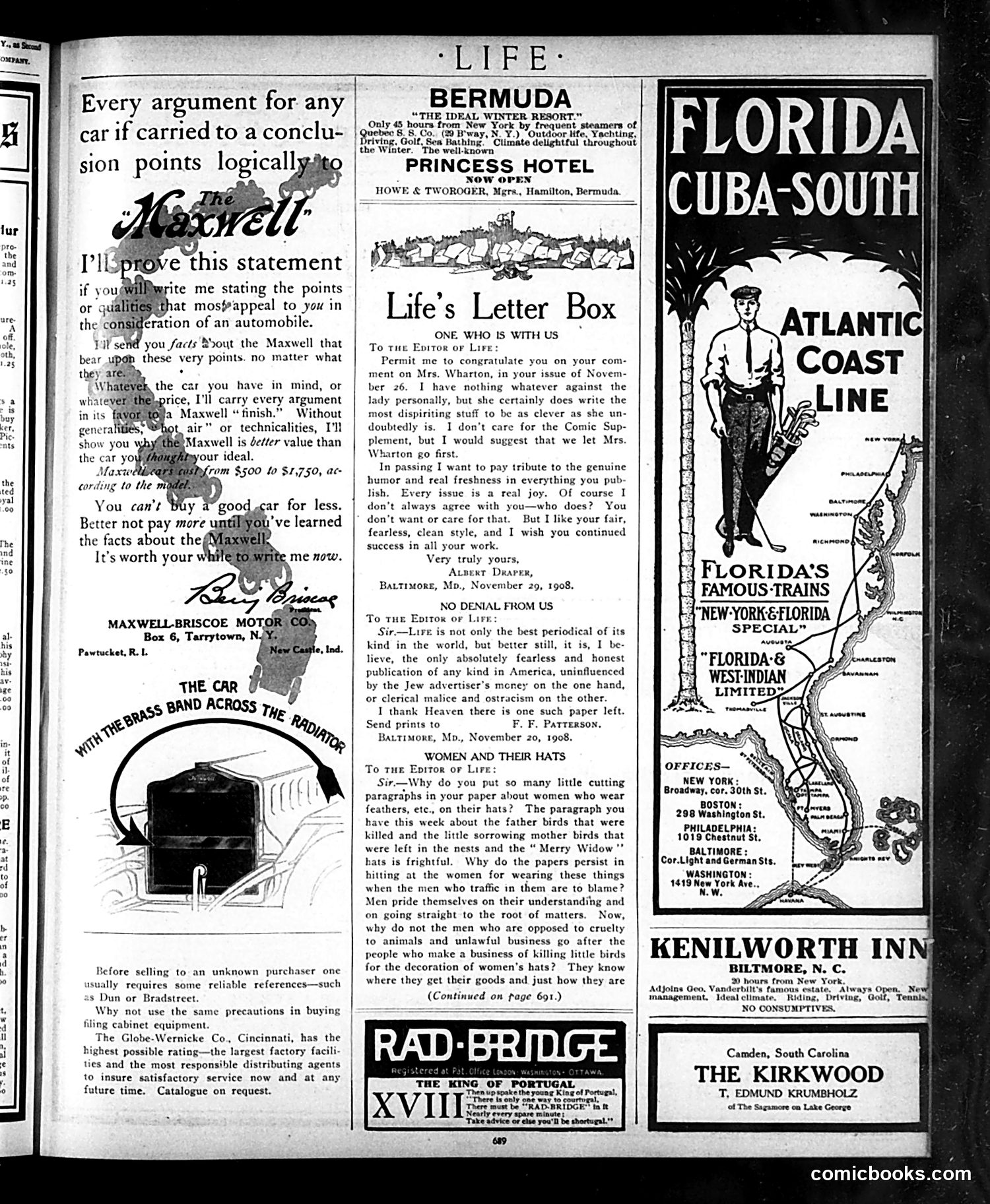
This page is primarily **advertising and travel promotion**, not political satire. The dominant content includes: - A **Maxwell automobile advertisement** emphasizing the car's logical superiority - Tourism ads for **Bermuda, Florida, Cuba, and South Carolina** resorts - A **RAD-Bridge product advertisement** (appears to be a cabinet component) - The **Kenilworth Inn and Kirkwood hotel promotions** The only editorial content is **"Life's Letter Box,"** containing reader correspondence about publication quality and a social complaint about newspaper paragraphs regarding women and bird-hunting. This reflects early 1900s attitudes about gender and animal welfare rather than political satire. The page reflects 1908 consumer culture and leisure travel marketing to affluent readers, with minimal satirical intent.
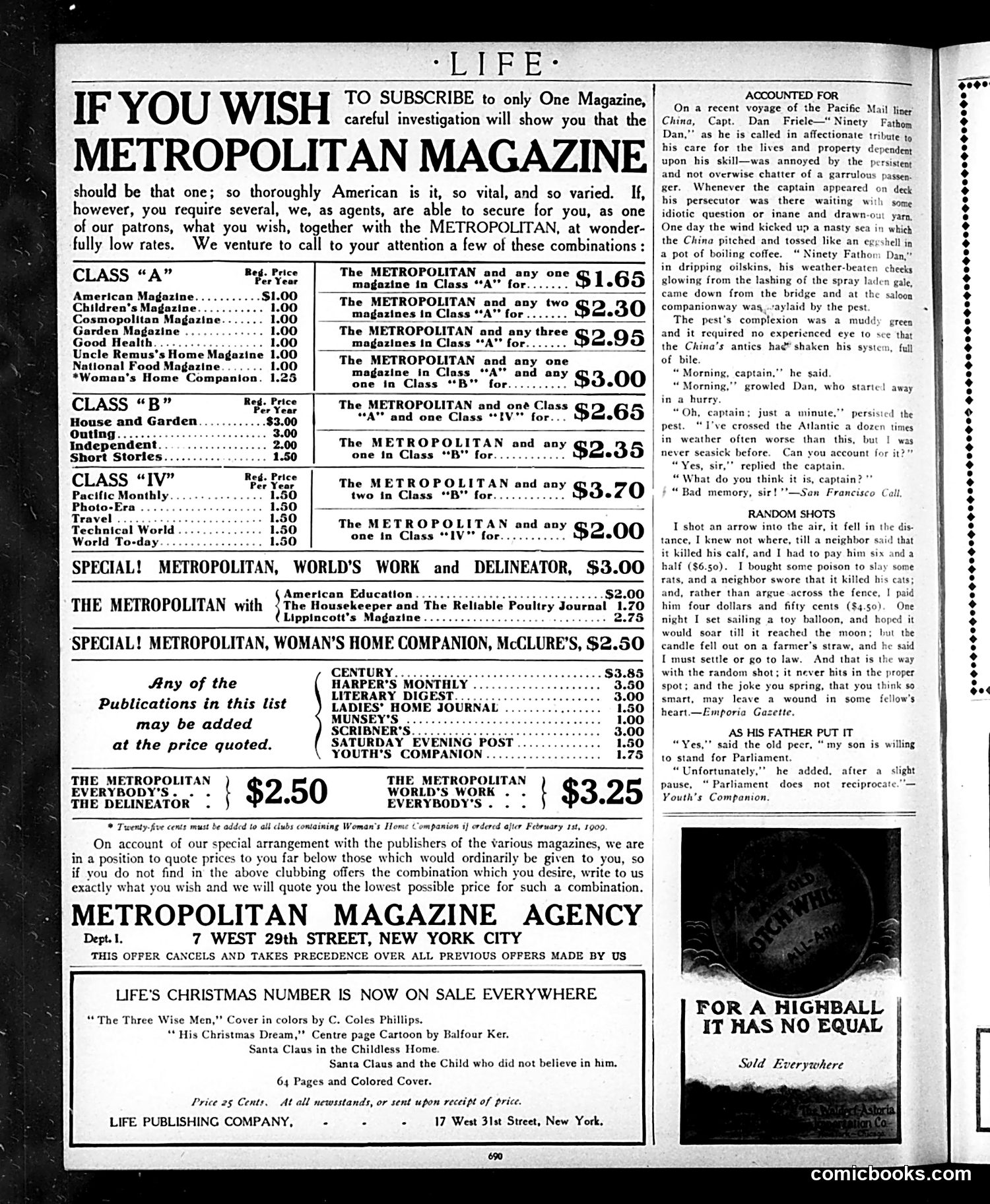
This page is primarily advertising for magazine subscriptions through the Metropolitan Magazine Agency, located at 7 West 29th Street in New York City. It lists various subscription bundles combining Metropolitan Magazine with other publications in different price classes (A, B, and IV), ranging from $1.65 to $3.70 annually. The only editorial content visible is a brief anecdote titled "Random Shots" and another piece titled "As His Father Put It," both appearing to be humorous short stories rather than political cartoons or satire. There is also an advertisement for a highball glass at the bottom right. This is primarily a commercial page rather than one featuring political or social satire.
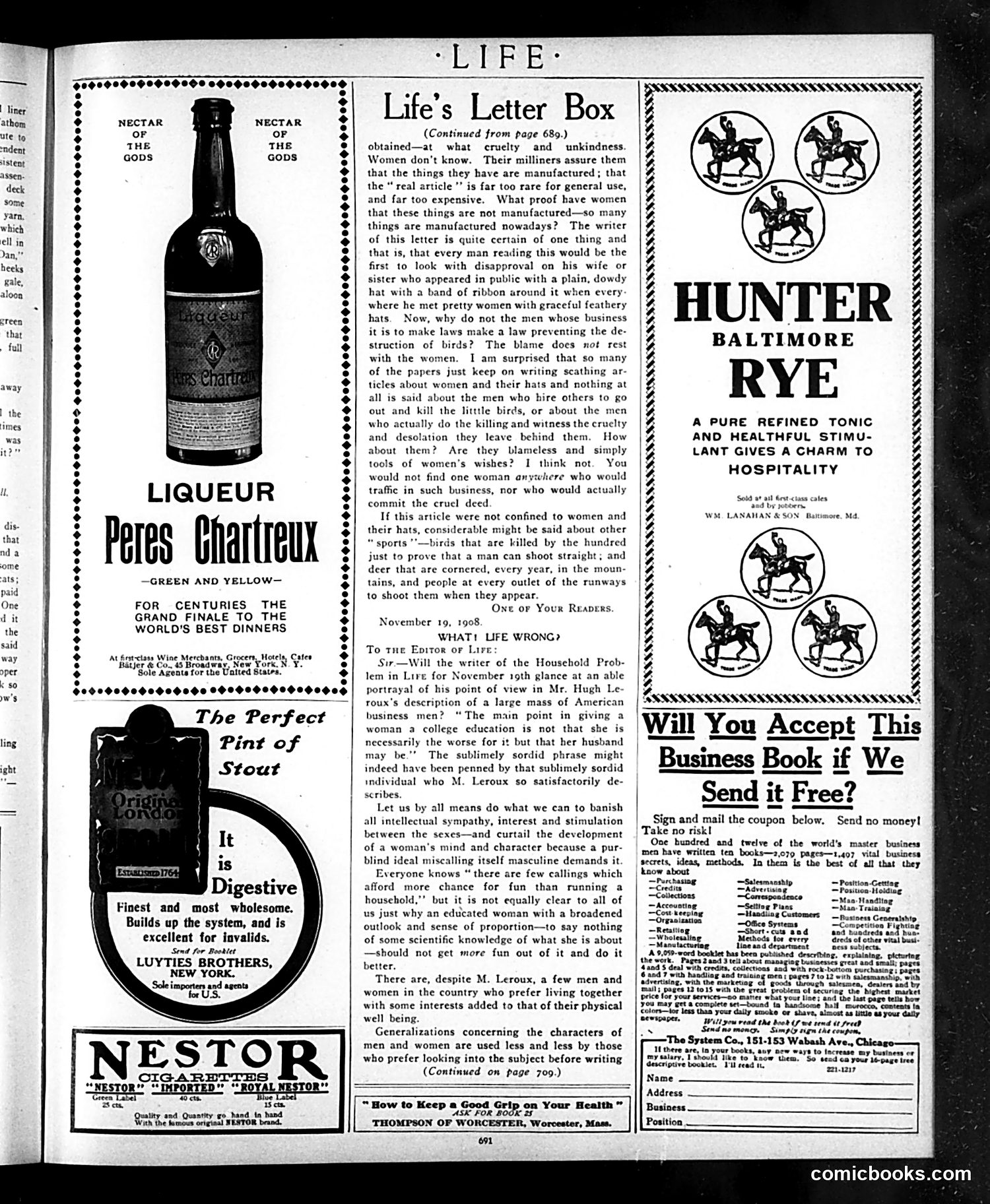
This page is primarily **advertisements** interspersed with a brief "Life's Letter Box" advice column. The main content addresses a reader's complaint about women wearing plain clothing and hats in public, contrasting with men's elaborate hunting attire. The editor responds by defending women's practicality and arguing men shouldn't blame women for social customs men themselves enforce. He suggests women should pursue more intellectually stimulating interests. The **advertisements** promote liquor (Peres Chartreux, stout), cigarettes (Nestor), and a business book offer—typical early-20th-century products. The satirical point appears to be the editor's gentle mockery of the letter writer's priorities: complaining about women's plain dress while men engage in blood sports like bird-hunting. The page reflects period gender norms and consumer culture of 1908.
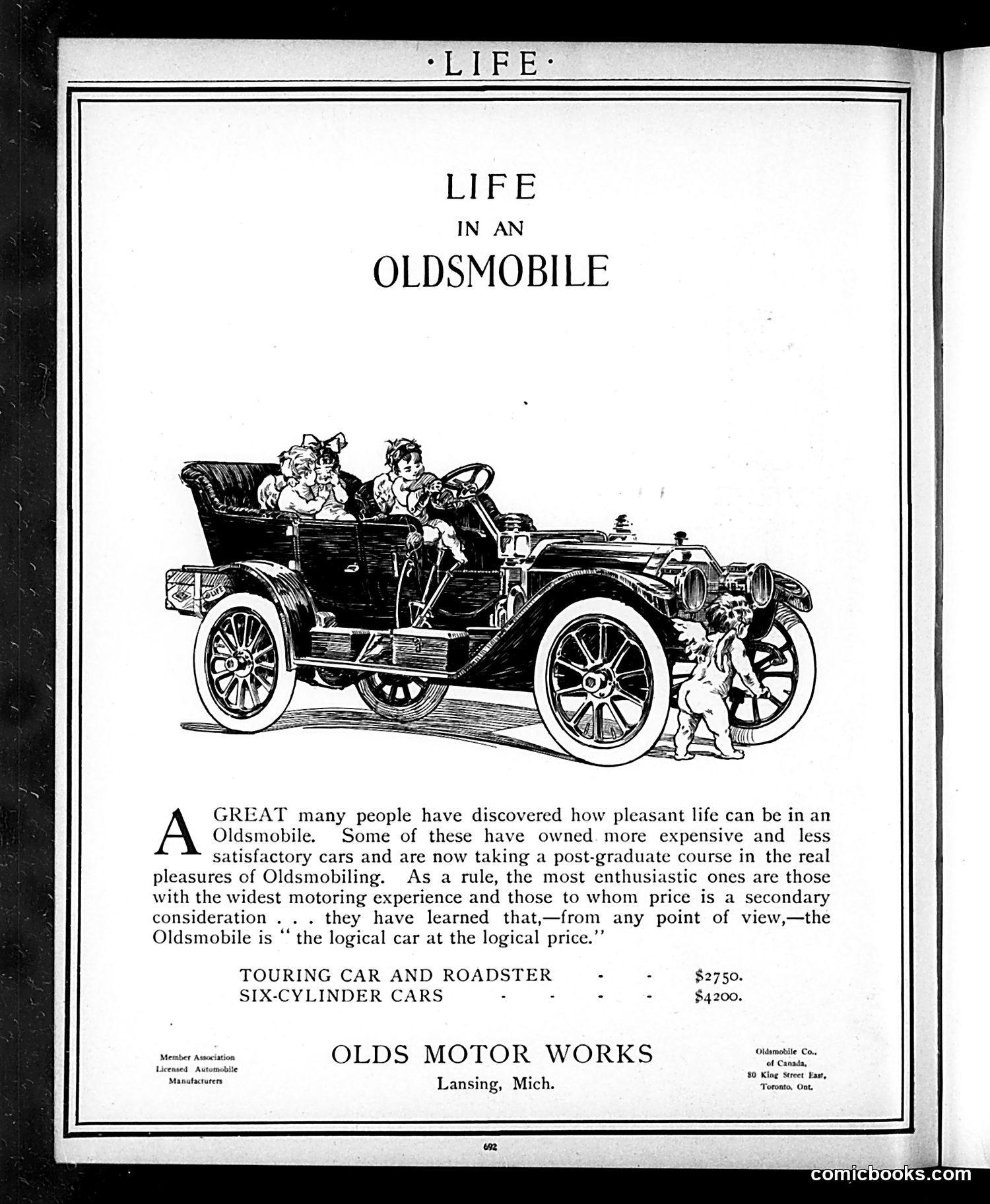
This is **not a satirical cartoon, but rather a straightforward advertisement** for Oldsmobile automobiles, published in *Life* magazine. The image shows an early 1900s touring car with passengers and a cherub figure, illustrating the leisure and pleasure of automobile ownership. The ad's text argues that Oldsmobile offers "the logical car at the logical price"—positioning it as a sensible choice for middle-class buyers who want motorcar enjoyment without excessive expense. The pricing listed ($2750 for touring cars, $4200 for six-cylinder models) reflects early automotive costs. The ad targets experienced drivers who value practicality over prestige, emphasizing that many luxury car owners have switched to Oldsmobile after discovering its value proposition. This represents mainstream early-20th-century automobile marketing rather than political satire.
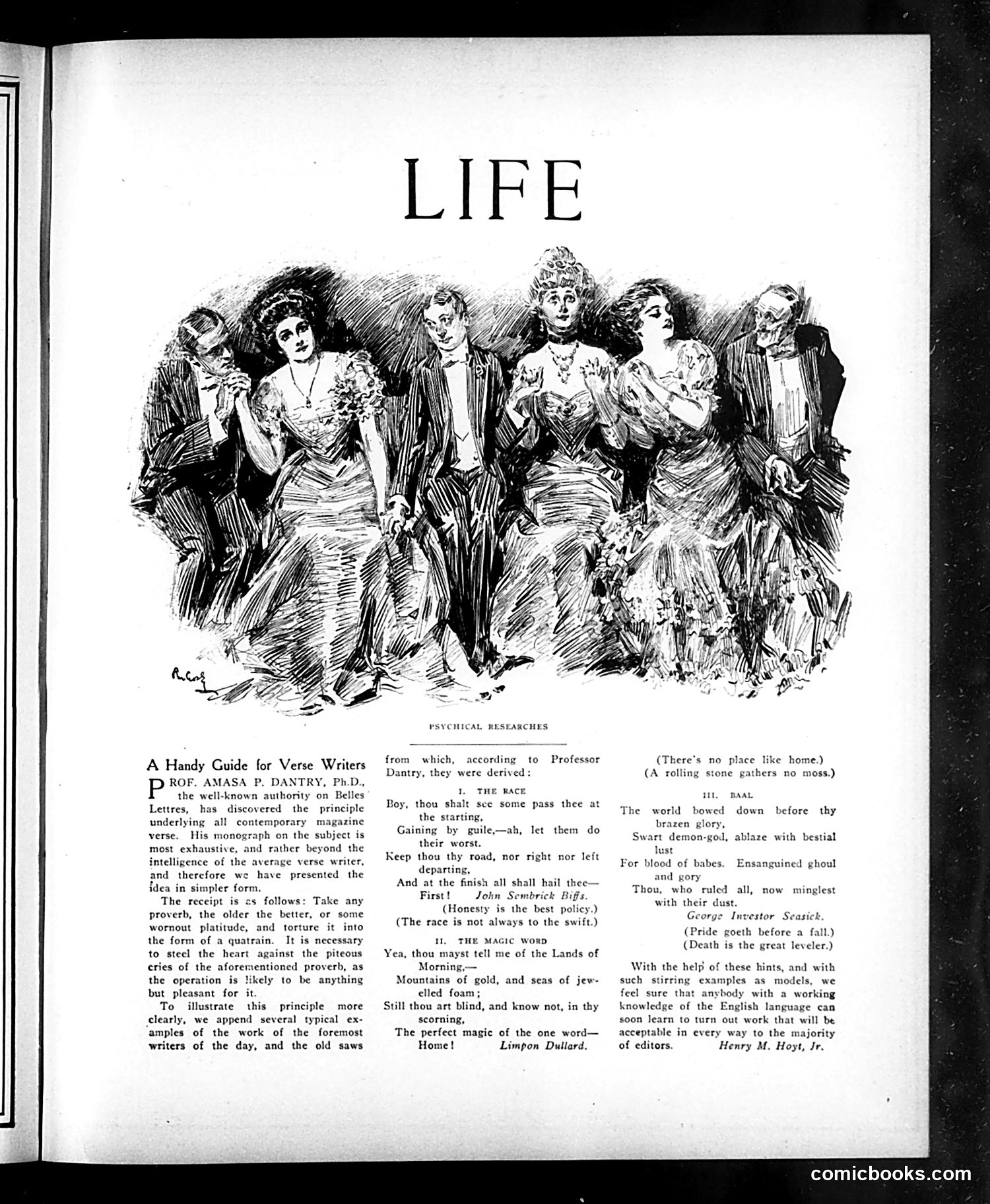
This page presents "A Handy Guide for Verse Writers" by Prof. Amasa P. Dantry, offering satirical advice on composing contemporary magazine poetry. The illustration shows six fashionably dressed figures representing typical subjects and personas in popular verse of the era. The satire mocks formulaic poetry by reducing it to simple recipes: "The Race," "The Magic Word," and "Baal" are presented as interchangeable templates using clichéd imagery (mountains of gold, seas of jeweled foam, demon angels). The guide suggests that contemporary verse-writers simply torture proverbs and old sayings into predictable forms rather than creating original work. The joke targets the mass production of sentimental, derivative poetry flooding American magazines, suggesting that serious literary work had been replaced by manufactured sentiment designed for popular consumption.
This page discusses New York City political corruption under Mayor Richard Croker, the Democratic Tammany Hall boss. The text criticizes Croker's administration as worse than his predecessor's, noting that judges attended a dinner honoring Croker—which the article calls shameful. The cartoons (small illustrations) appear to depict scenes of political malfeasance and bribery, though specific figures are unclear in reproduction. The central argument: Tammany Hall's system of using government power for private profit is rotten, and even good men become corrupted by it. The article advocates for systemic reform rather than relying on individual virtue, and criticizes newspapers for sensationalizing political scandals while failing to effectively combat corruption. This reflects Progressive Era criticism of urban political machines.
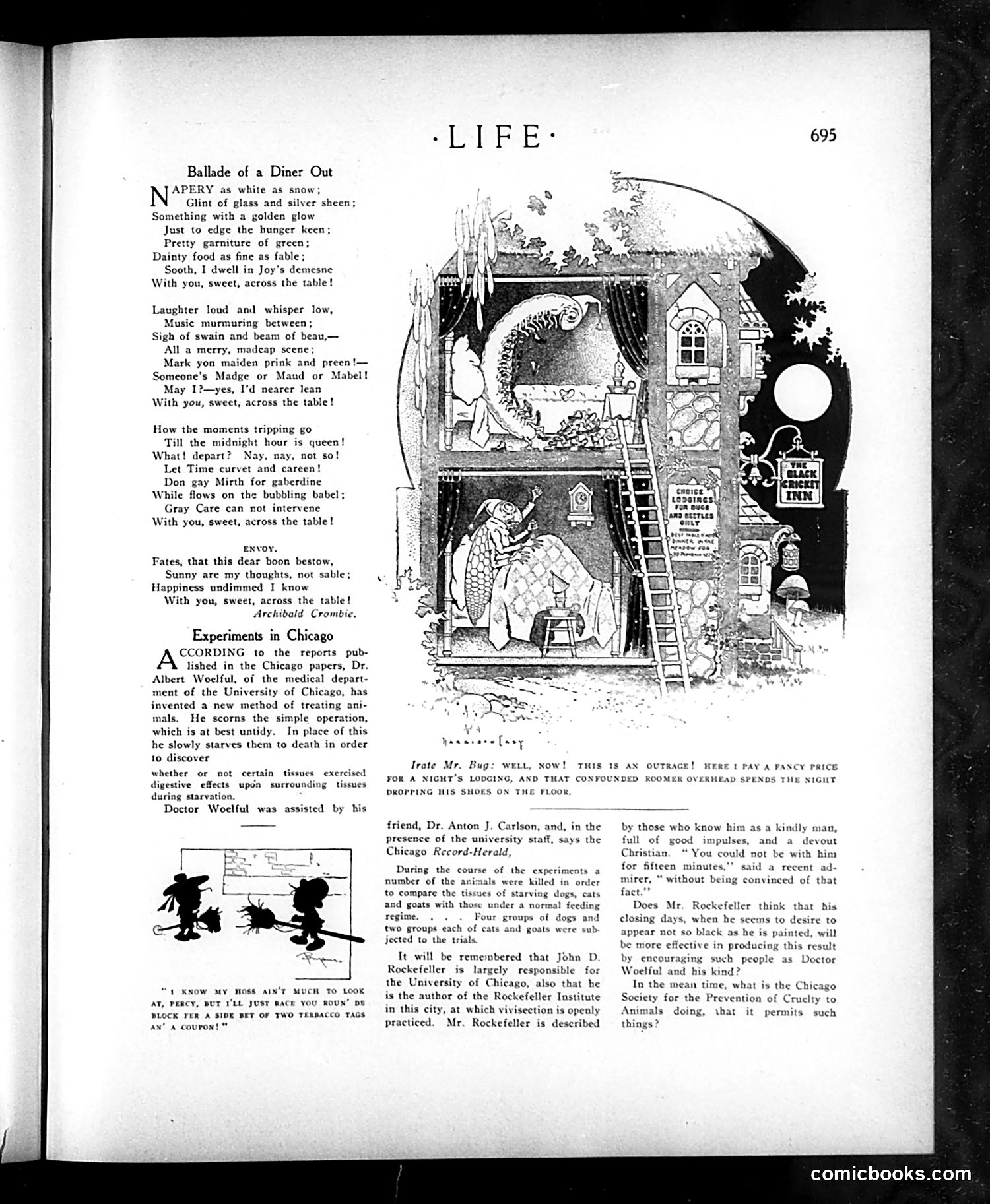
The page contains two distinct items: **"Ballade of a Diner Out"** (top left) is a poem celebrating the pleasures of dining out—napery white as snow, glinting glassware, dainty food, laughter, and music. It's romantic satire of upscale restaurant culture. **"Experiments in Chicago"** (main text) reports on Dr. Albert Woeful's controversial method of treating animals by starving them to death to study digestive effects. The article appears critical, questioning the ethics while noting Dr. Woeful had assistance from Dr. Anton Carlson and tacit approval from John D. Rockefeller's University of Chicago. **The illustration** (right) depicts a whimsical, crowded interior—possibly a restaurant or home—rendered in detailed pen-and-ink style typical of early 20th-century Life magazine humor. The juxtaposition of fine dining celebration with animal cruelty experiments creates dark satirical contrast about scientific progress and moral standards.
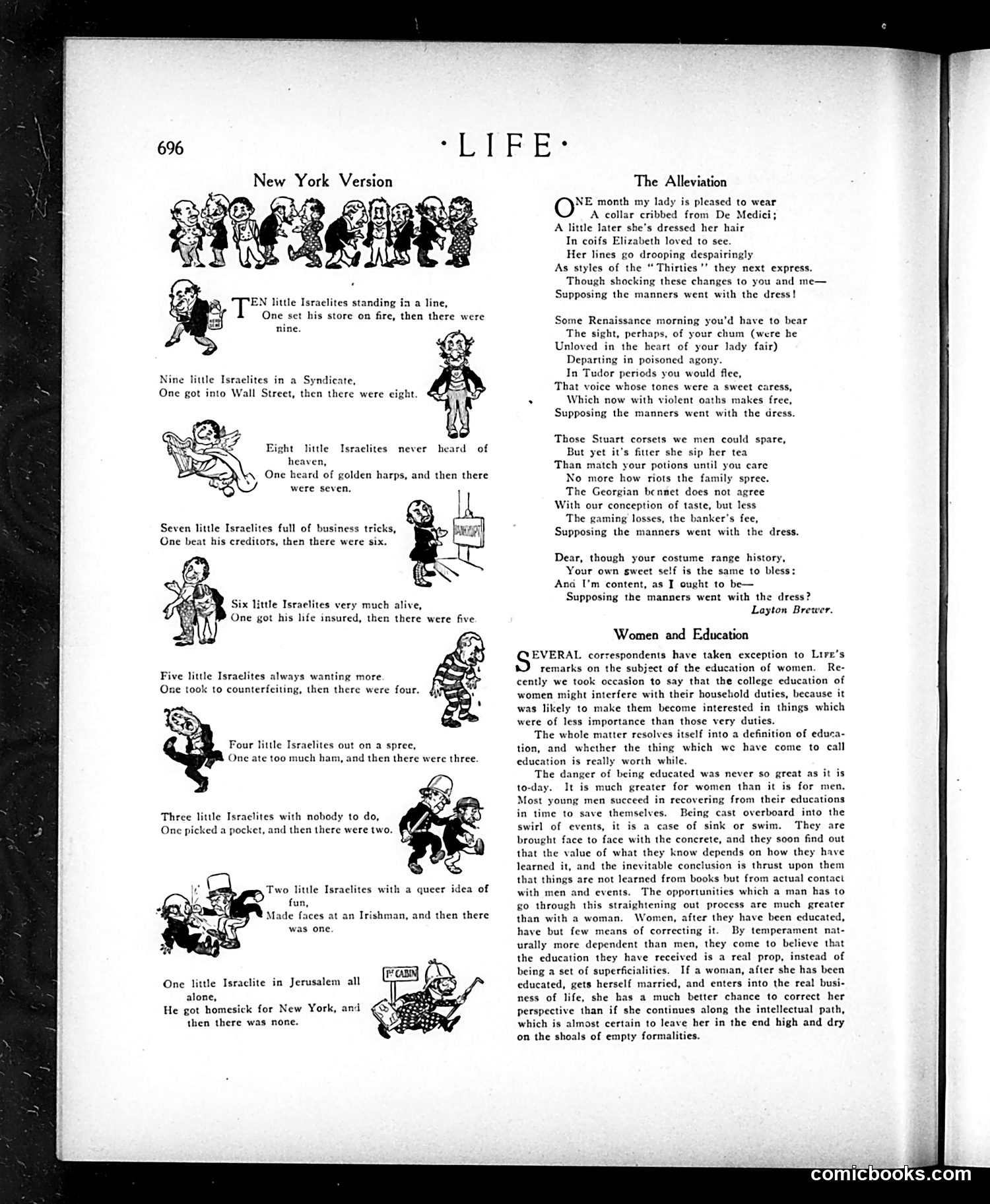
The left side features "New York Version," a humorous counting-out rhyme using Jewish children ("little Israelites") that parodies the traditional "Ten Little Indians" format. Each verse describes a child leaving through various misadventures—getting into Wall Street, losing creditors, getting insured, counterfeiting, pickpocketing, etc.—until none remain. The accompanying illustrations show stereotyped caricatured children. This is ethnic humor typical of early 20th-century American satire, mocking both Jewish immigrants and contemporary urban vices (financial schemes, crime, etc.). The right side, "The Alleviation," is a serious poem about changing women's fashion and manners, followed by "Women and Education," a substantive essay arguing that college education for women needn't distract them from domestic duties—reflecting period anxieties about female education.
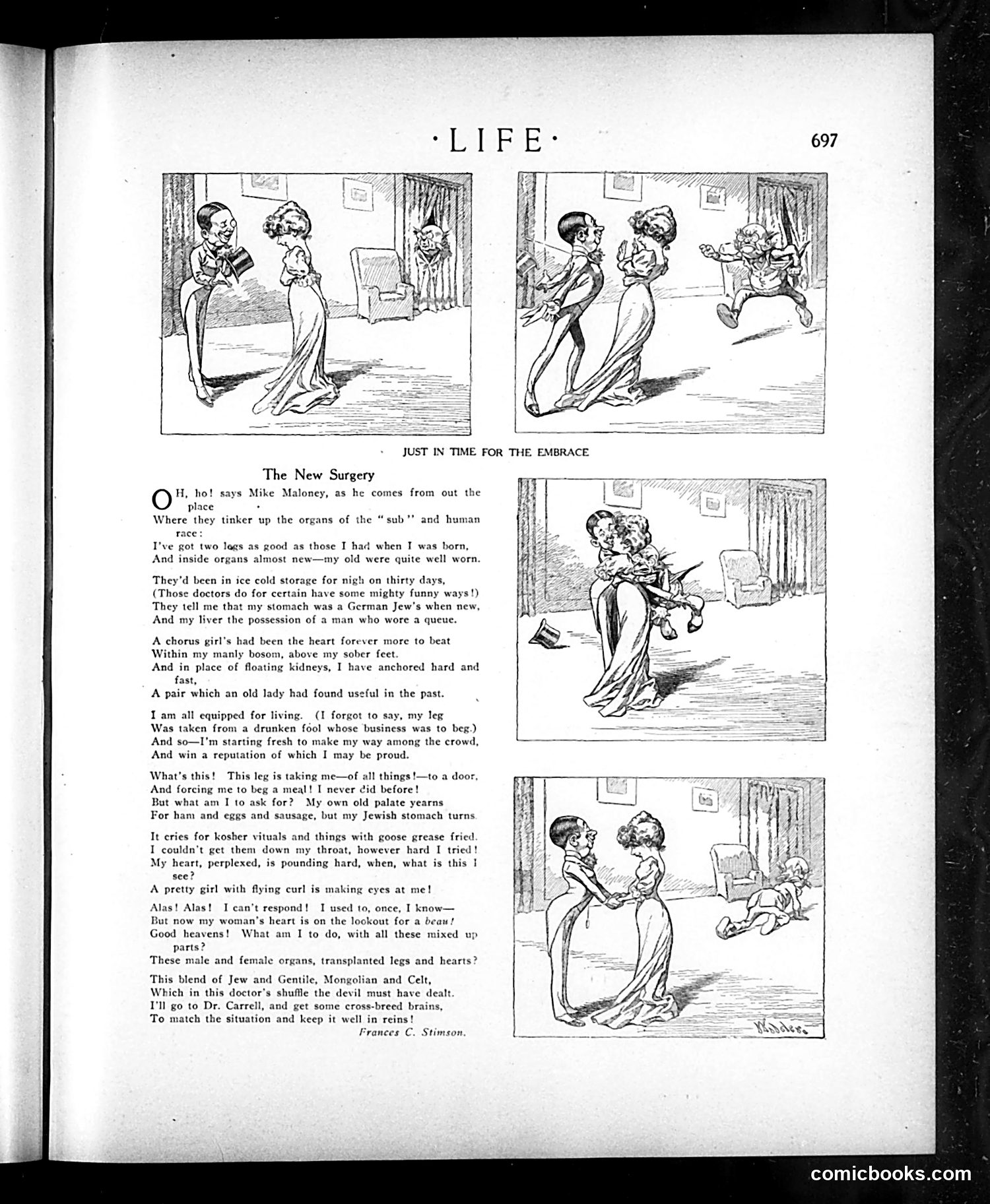
This page combines a four-panel comic strip showing a romantic couple's interrupted embrace with a poem by Francis C. Simson titled "The New Surgery." The comic depicts a man and woman attempting to kiss while children repeatedly interrupt them—a relatable domestic humor scenario common to early 20th-century Life magazine. The poem is a satirical monologue from someone who has undergone transplant surgery, receiving organs from various ethnic groups ("Jew and Gentile, Mongolian and Celt"). The speaker humorously catalogs their new mixed-heritage body parts and the resulting identity confusion, culminating in the plea to "Dr. Carroll" for help managing this bewildering biological mismatch. The satire mocks both contemporary transplant surgical ambitions and anxieties about ethnic/religious mixing in American society.
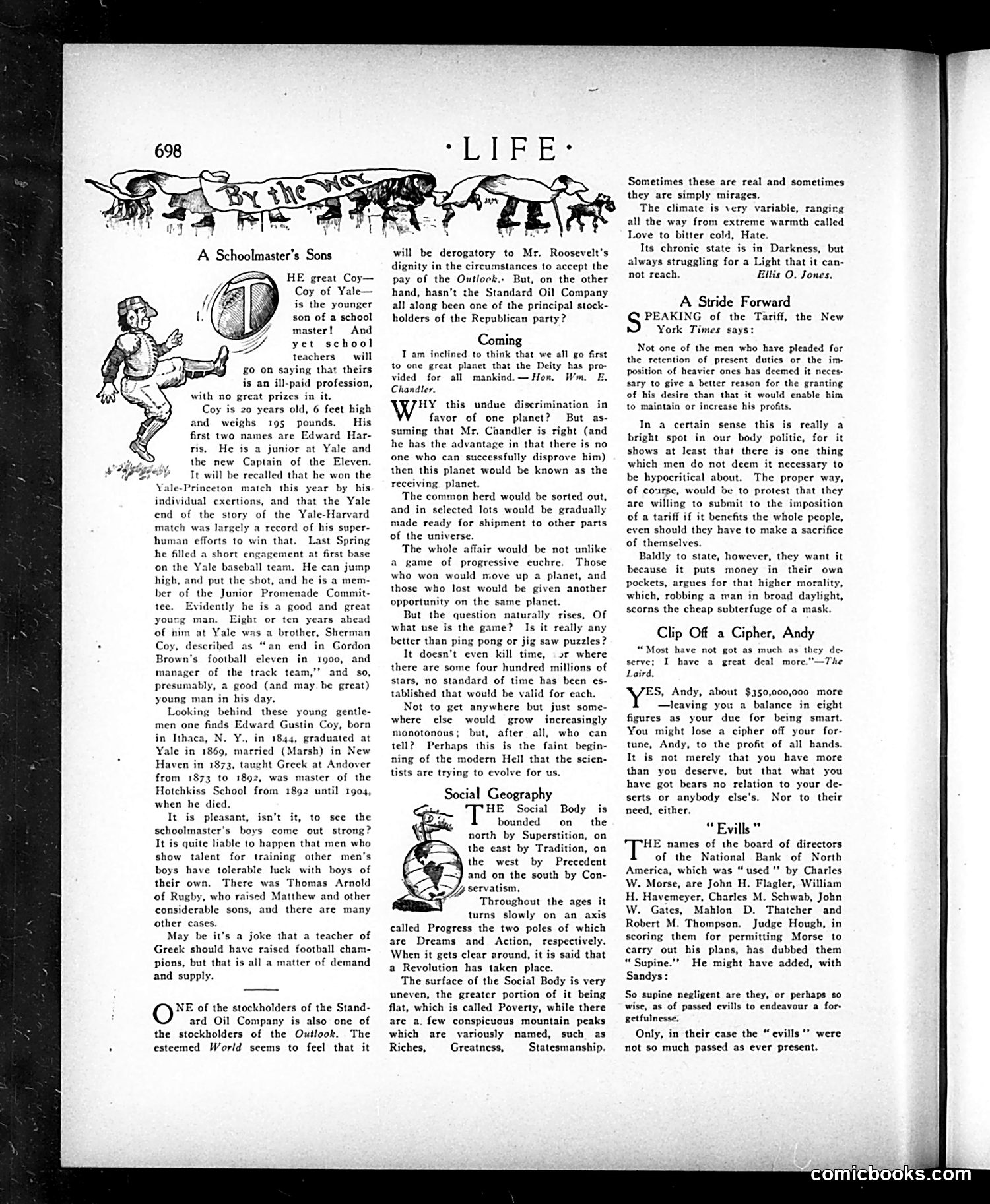
This page contains several satirical articles rather than political cartoons. The main pieces include: **"A Schoolmaster's Sons"** features a cartoon of a young boy, likely satirizing educational expectations. The text discusses a Yale student whose father was a schoolmaster, noting the irony that despite his prestigious education, he struggled professionally—a jab at inherited advantage not guaranteeing success. **"A Stride Forward"** discusses tariff debates, suggesting critics of tariff policy face pressure to remain silent to protect profits. **"Clip Off a Cipher, Andy"** appears to reference Andrew Carnegie (implied by "Andy"), critiquing wealthy industrialists' charitable donations as insufficient relative to their vast fortunes. **"Evills"** mocks the board of directors of the National Bank of North America, listing members' names while suggesting their governance is negligent. The satire targets privilege, economic inequality, and institutional incompetence.
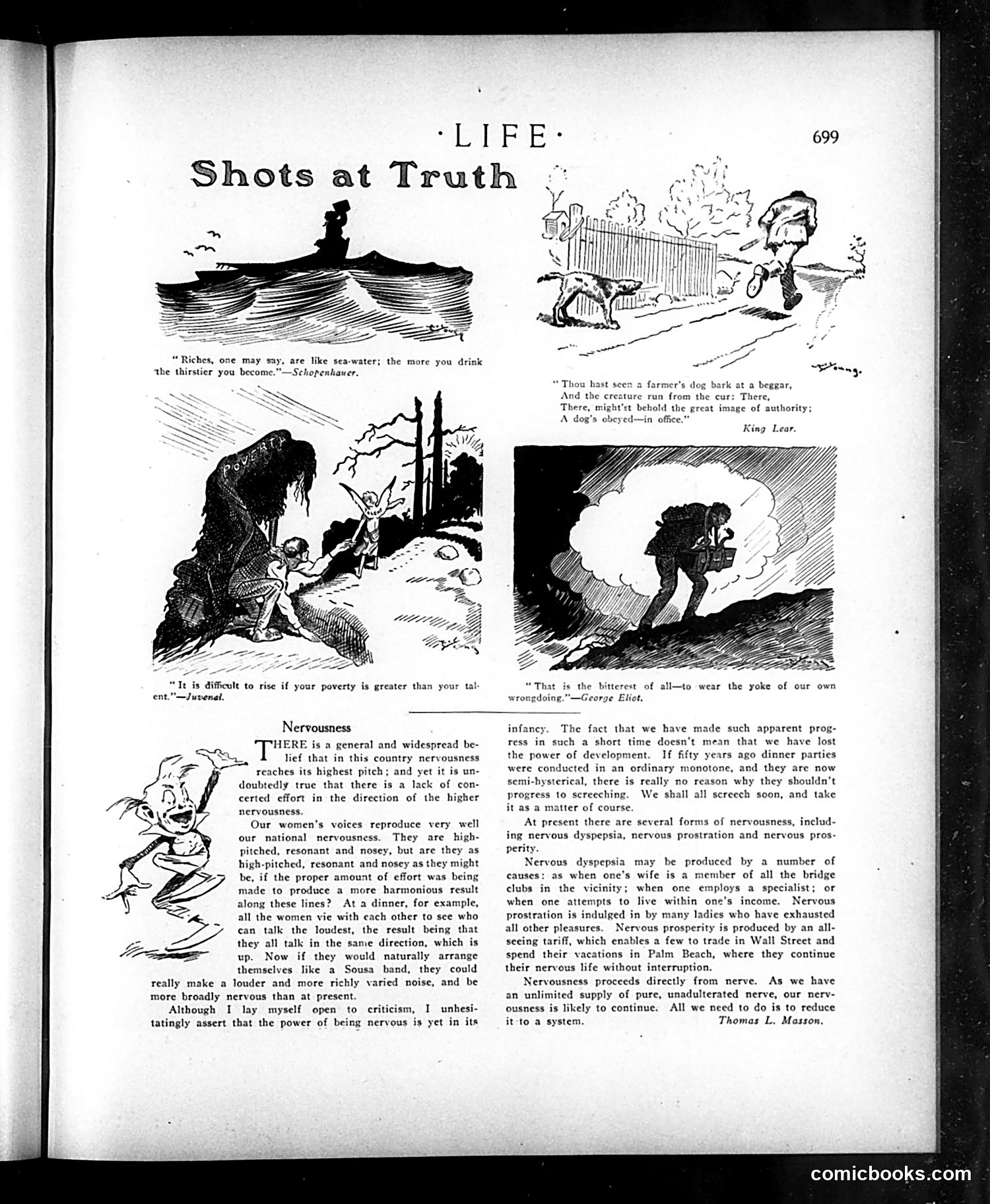
This page presents four cartoons paired with literary quotes attacking social hypocrisy: 1. **Top left**: A drowning man illustrates Schopenhauer's quote about wealth and drinking, suggesting the rich become moral "thirstier." 2. **Top right**: A beggar and dog reference King Lear, contrasting human authority with animal obedience. 3. **Bottom left**: A dark scene shows poverty, citing Juvenal on difficulty escaping humble origins. 4. **Bottom right**: A figure struggles under a burden, quoting George Eliot on self-imposed constraints. Below, an article titled "Nervousness" discusses anxiety disorders in modern society, particularly among the wealthy. It argues nervousness stems from nerve exhaustion caused by competitive living, lavish spending, and overstimulation—essentially satirizing upper-class complaints while suggesting systemic reduction is necessary.
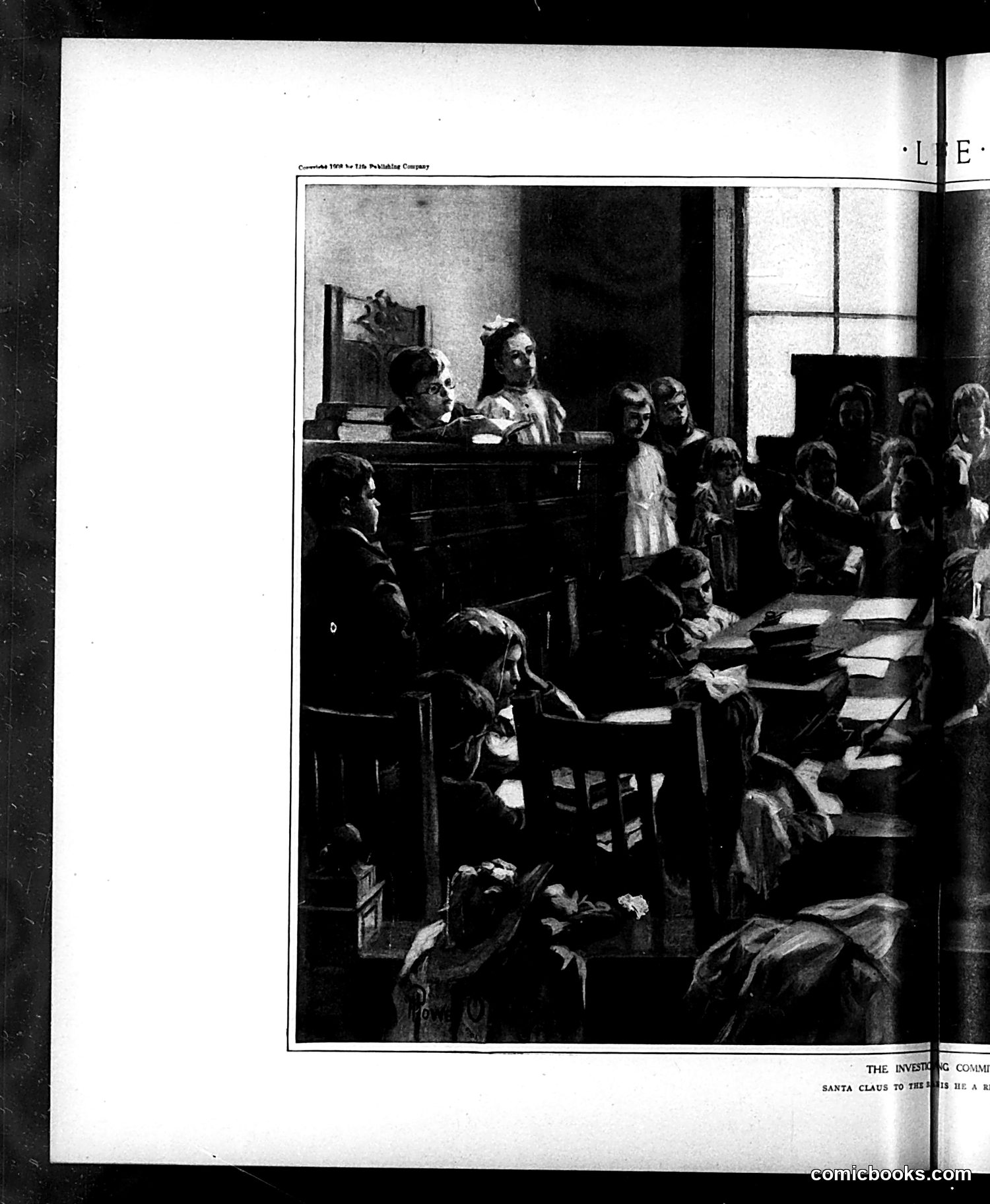
This page shows a black-and-white illustration titled "THE INVESTIGATING COMMITTEE" with a partial caption mentioning "SANTA CLAUS TO TELL IF HE A R..." (text cut off). The image depicts what appears to be a courtroom or official hearing scene. A figure sits at an elevated bench (likely a judge or committee official), while multiple children are gathered in the room as witnesses or observers. The scene suggests a satirical commentary on formal investigations or interrogations involving children—possibly mocking overly serious government investigations of the era. The Santa Claus reference in the caption suggests this cartoon satirizes the absurdity of officially investigating or questioning Santa Claus before children, perhaps commenting on post-war government investigations or committee hearings that seemed excessive or ridiculous to Life magazine's editors. The specific historical context of which investigation is unclear without the complete caption.
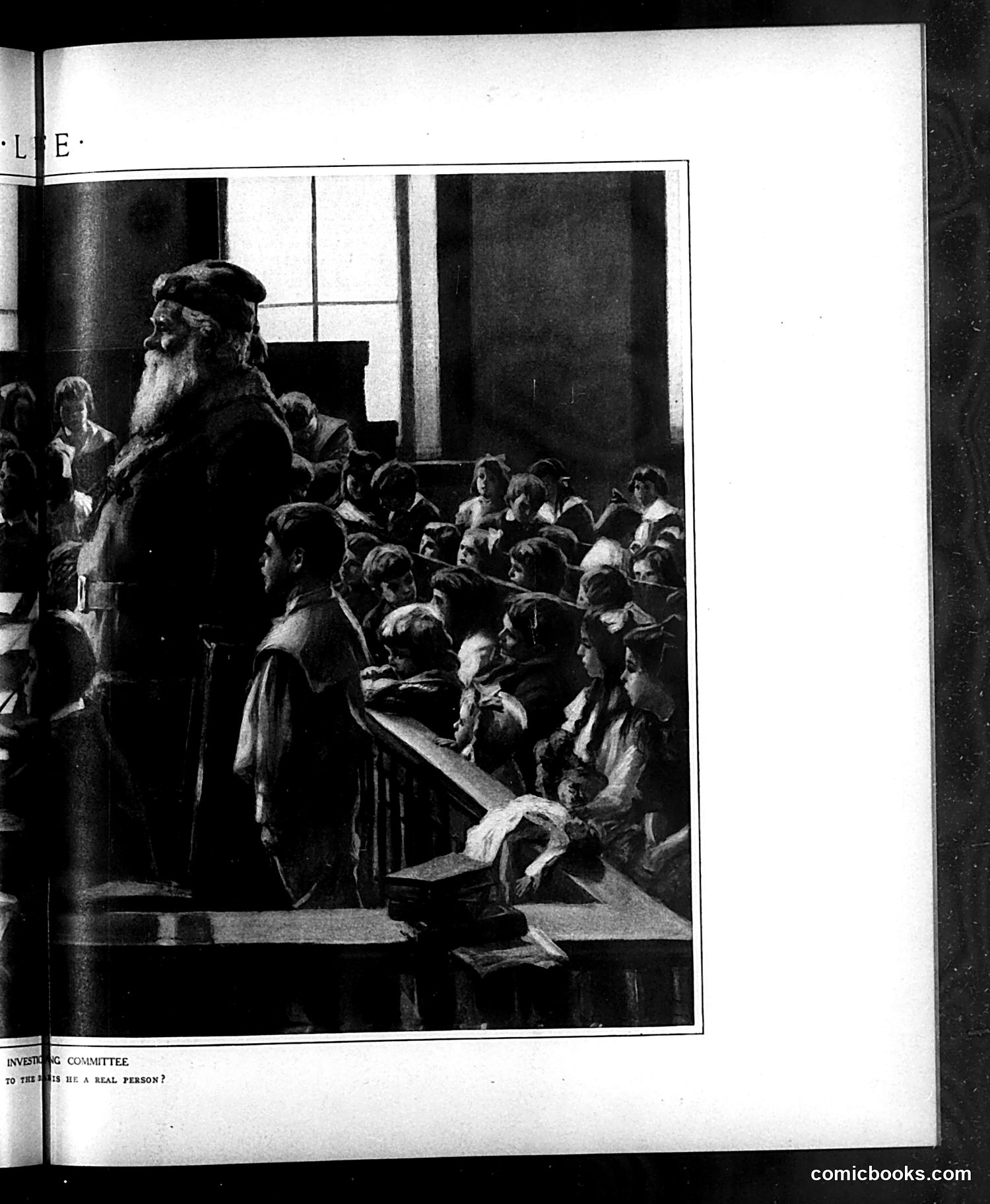
This page shows a black-and-white illustration of an elderly man with a long beard addressing a large crowd of seated people in what appears to be an indoor venue. The caption reads "IS HE A REAL PERSON?" The image likely satirizes a public figure of Life magazine's era (early 20th century) whose authenticity or legitimacy was questioned by contemporary critics. The crowded audience suggests this depicts a popular speaker or leader whose followers believed in him, while skeptics questioned whether he was genuine or a charlatan. Without additional context about the specific figure or date, I cannot definitively identify who is being caricatured or what particular controversy is being referenced. The satire's point appears to be mocking either the figure's credibility or his followers' credulity.
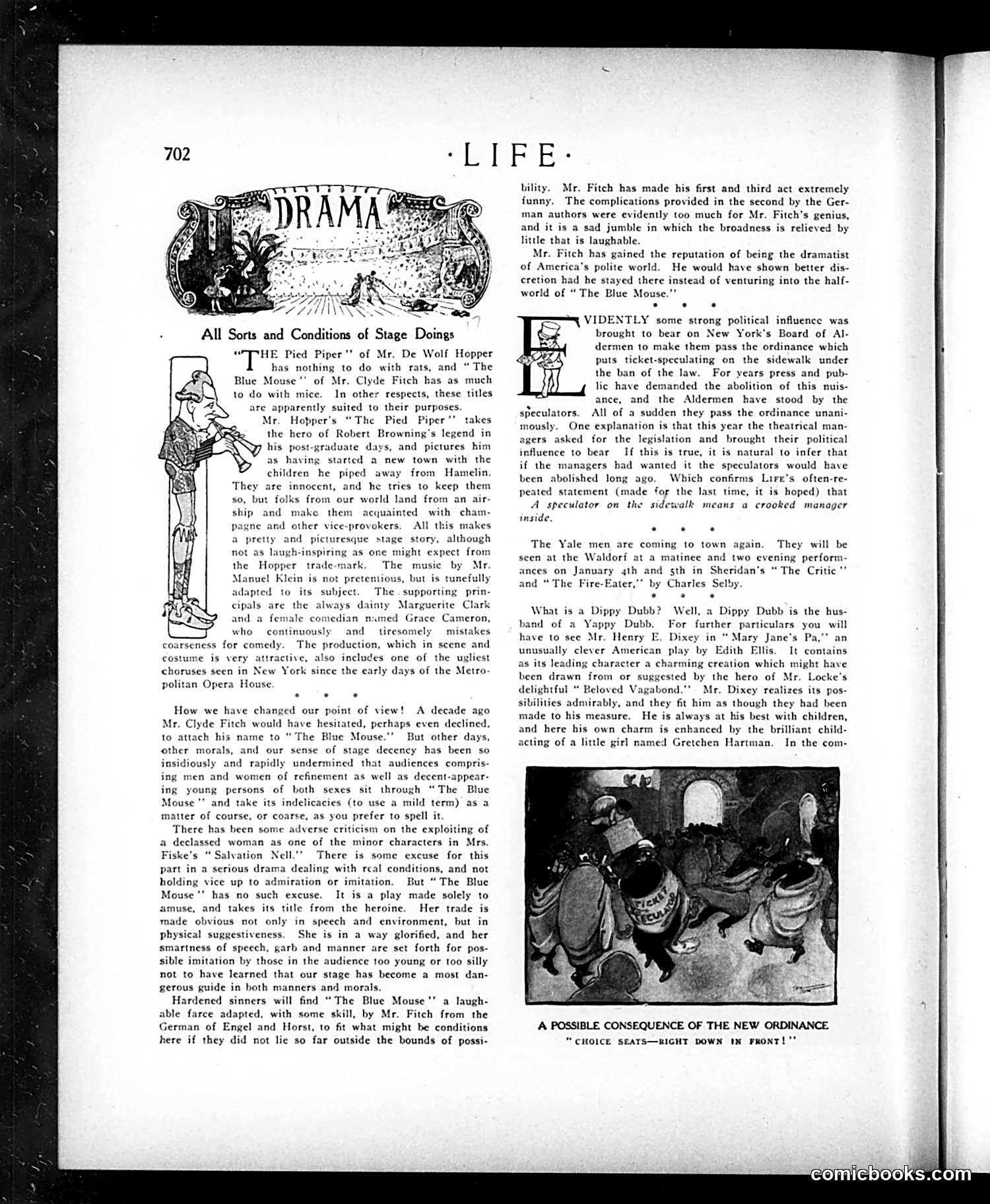
This page critiques two theatrical productions and addresses ticket speculation legislation. **The Drama Section** reviews "The Blue Mouse," a Clyde Fitch play adapted from German sources. The critic argues the play glorifies a sex worker ("declassed woman") purely for entertainment and moral corruption—unlike serious dramas addressing real social conditions. The reviewer laments how theater standards have declined, with mixed-sex audiences now accepting "indelicacies" without objection. Fitch, known for refined comedies, is criticized for abandoning his reputation by venturing into this "half-world." **The Political Cartoon** (bottom) satirizes sudden passage of an anti-ticket-speculation ordinance by New York's Board of Aldermen. The caption suggests "strong political influence" forced passage after years of public and press demands went ignored. The cartoon depicts the absurd outcome: theater patrons forced into front-row "choice seats" against their preference—implying unintended consequences of poorly considered legislation or that corrupt influence merely produces ridiculous rather than genuinely protective laws. Both segments reflect Progressive-era concerns about morality, legislative corruption, and cultural standards.
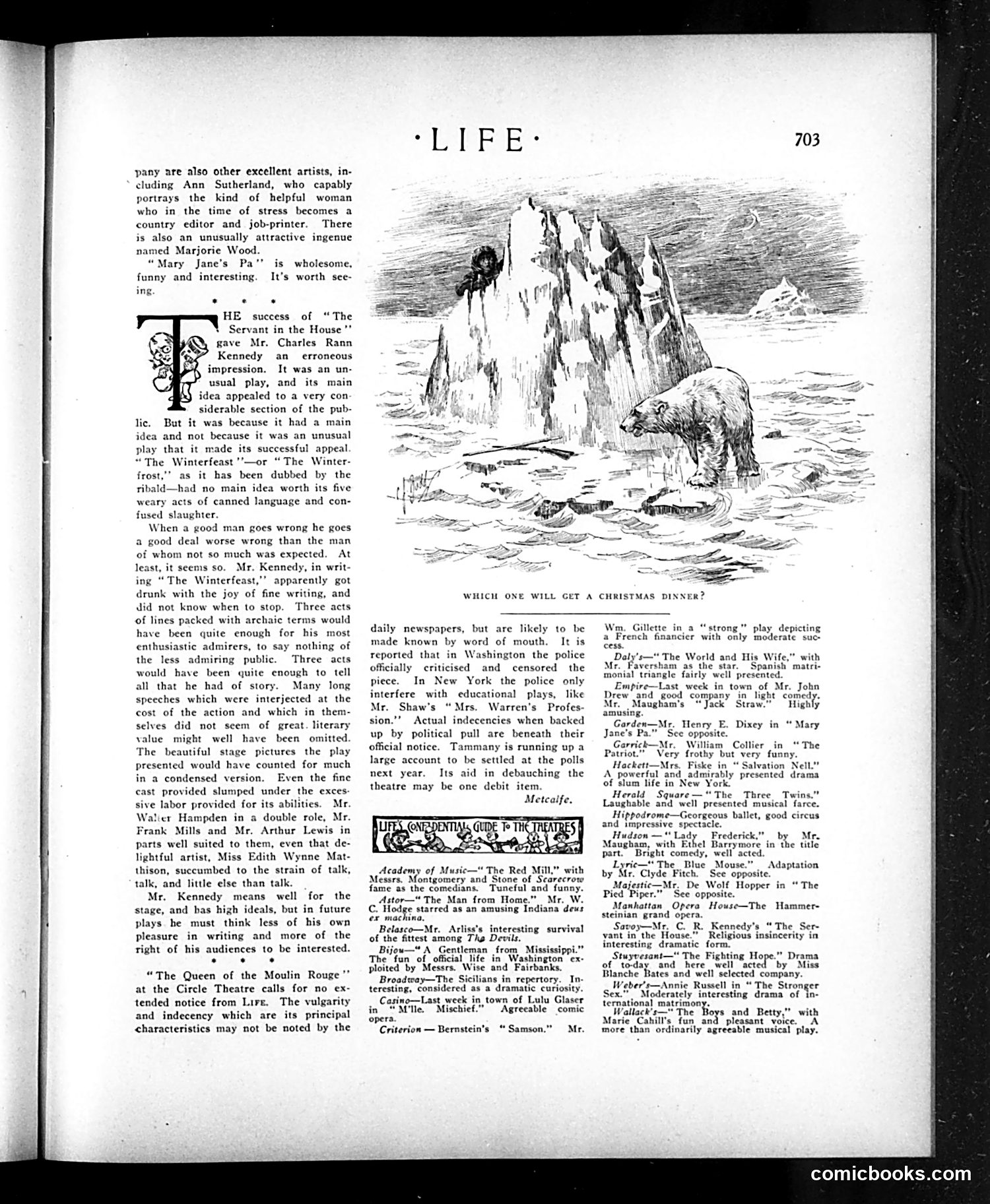
This page is primarily **theatre criticism and reviews**, not political satire. The main content critiques Broadway plays from the early 1900s. The **cartoon** (captioned "Which One Will Get a Christmas Dinner?") depicts a dramatic seaside cliff scene with figures perched precariously—likely illustrating a scene from one of the reviewed plays, though the specific reference is unclear from the text. The **critical focus** is Charles Rann Kennedy's play "The Winterfeast" (mockingly called "The Winterfrost"). The reviewer demolishes it, arguing Kennedy mistook the success of his earlier play "The Servant in the House" as validation for experimental writing rather than recognizing its actual appeal. The critique attacks the play's excessive dialogue, archaic language, and lengthy speeches that exhausted even talented actors like Walter Hampden and Edith Wynne Matthison. The page also briefly condemns "The Queen of the Moulin Rouge" for vulgarity, suggesting **Tammany Hall political corruption** enables such indecent theatre in New York while police censor educational plays elsewhere.
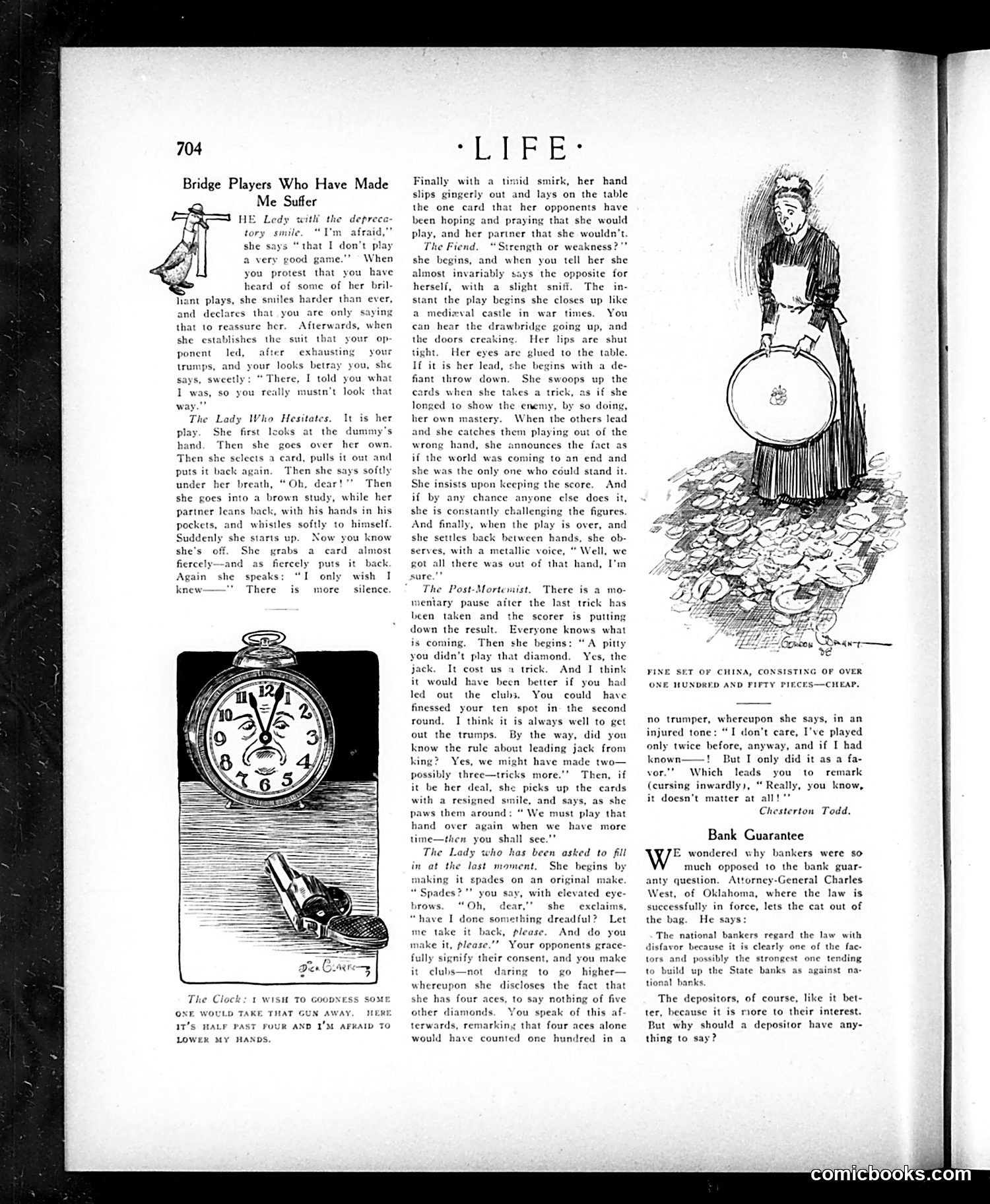
This page satirizes stereotypical female bridge players and their annoying behavioral patterns. The text describes several caricatured types: **The Self-Deprecating Lady** - falsely claims poor skill, then plays brilliantly, making partners uncomfortable. **The Hesitator** - agonizes over every card choice, creating tension at the table. **The Fiend** - plays with dramatic flair, becomes silent and hostile during play, insists on keeping score. **The Post-Mortemist** - after hands end, relentlessly criticizes partners' plays with unsolicited advice. **The Last-Minute Fill-in** - makes foolish bids then reveals she actually holds excellent cards. The illustrations (a woman at a bridge table, a clock, a rabbit) support these portraits. This is gentle domestic satire targeting social bridge culture and women's bridge-playing quirks—common entertainment fare in early 20th-century *Life* magazine.
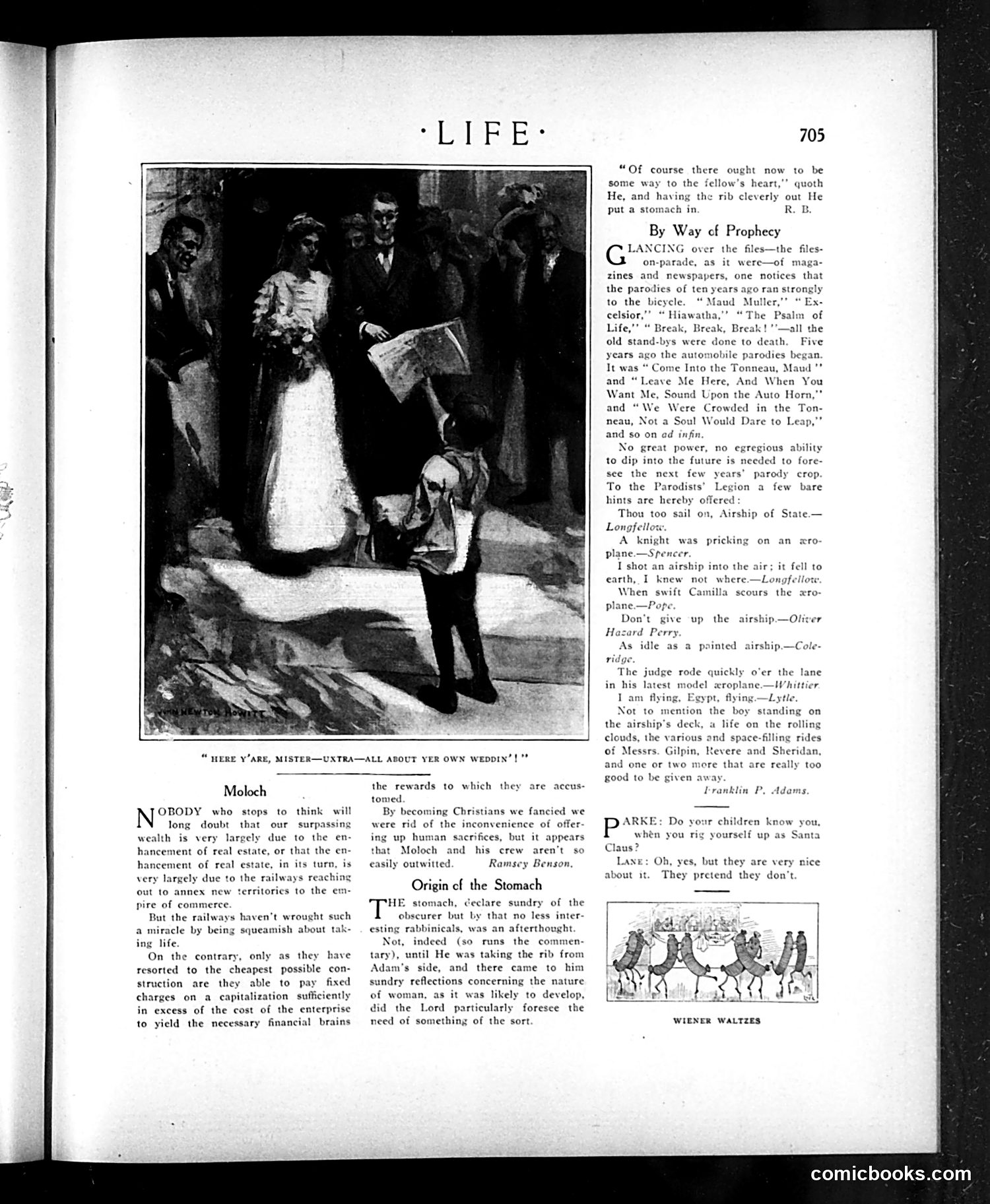
The main cartoon critiques American railways' indifference to human casualties in pursuit of profit. The caption "HERE Y'ARE, MISTER—UXTRA—ALL ABOUT YER OWN WEDDIN'!" suggests a newsboy hawking papers about a wedding, but the imagery shows a darker reality. The "Moloch" section argues that while Americans believed themselves civilized Christians, railways perpetuate human sacrifice comparable to the ancient god Moloch—killing workers and passengers through cheap construction to maximize shareholder returns. The satire equates capitalist greed with pagan bloodlust. The secondary content includes aviation-themed parodies (mocking the 1910s trend of parodying older literature through new technologies like airships) and a humor piece titled "Origin of the Stomach" with classical theology wordplay. This represents Life magazine's muckraking tradition—using sharp satire to expose industrial negligence and corporate immorality as fundamentally immoral, not merely practical problems.
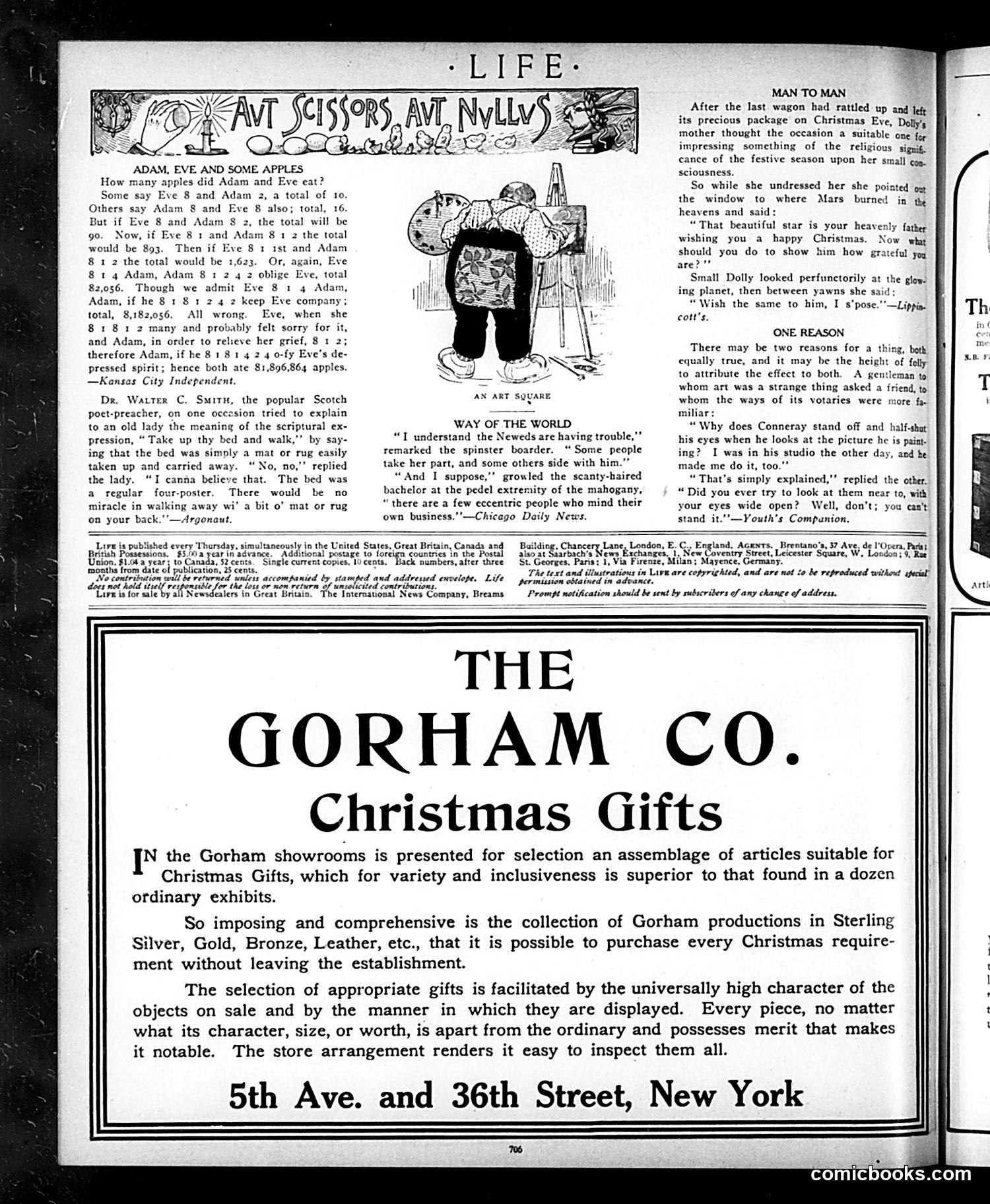
This page is primarily **advertising and filler content** rather than political satire. The masthead "Aut Scissors, Aut Nullus" (Scissors or Nothing) signals humorous miscellany. The main content consists of **light humor pieces**: 1. **"Adam, Eve and Some Apples"** — A mathematical wordplay joke exploiting the homophone "8" (ate) and the number 8, calculating absurdly large apple quantities through puns. 2. **"An Art Square"** — A brief anecdote mocking folk skepticism about miracles. 3. **"Way of the World"** and **"One Reason"** — Short observational humor about domestic disputes and artistic practice. 4. **"Man to Man"** — A sentimental Christmas story about a child's innocent misinterpretation of religious instruction. The **Gorham Co. advertisement** for Christmas gifts occupies the lower half—luxury goods in Sterling Silver, Gold, and Bronze. There is **no political satire** here. This appears to be a standard humor and advertisement page from *Life* magazine's lighter fare, typical of early 20th-century American periodicals.
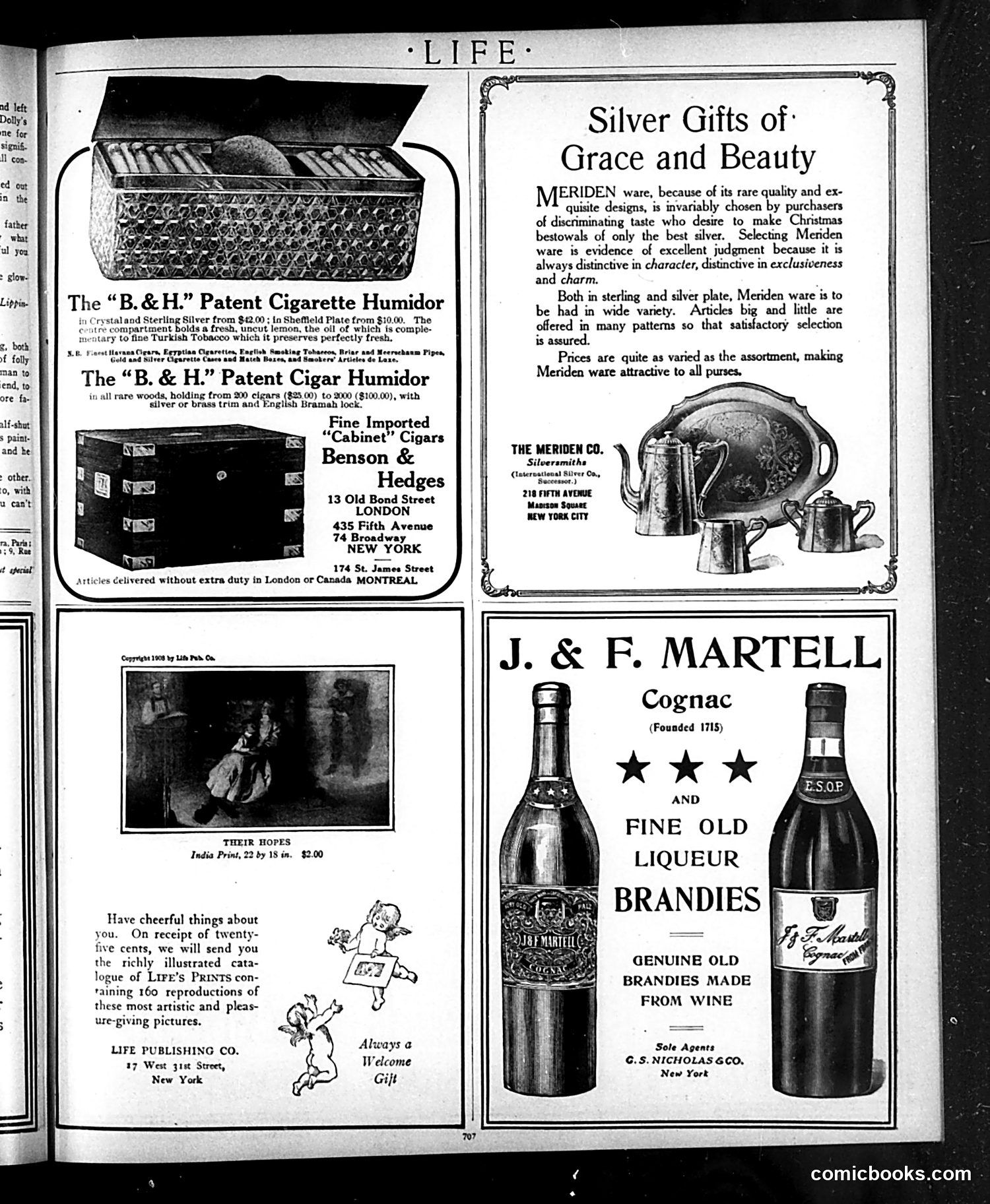
This page contains **no political cartoons or satire**—it is primarily a collection of luxury goods advertisements from the early 20th century, aimed at affluent readers seeking high-end Christmas gifts. The ads promote: - **Cigarette and cigar humidors** by Benson & Hedges (sterling silver and rare woods) - **Meriden silverware** (flatware and decorative pieces in sterling and silver plate) - **J. & F. Martell cognac and brandies** (established 1715) - **Life's Prints catalogue** (160 reproductions of artwork, 25 cents) The single non-advertising image, titled "Their Hopes," appears to be a sentimental scene—likely depicting figures in poverty or hardship as a foil to the luxury products surrounding it, emphasizing Life's charitable or philanthropic mission. The overall page reflects Gilded Age consumer culture: expensive imports, precious metals, and liquor marketed to wealthy Americans as status symbols and gifts.
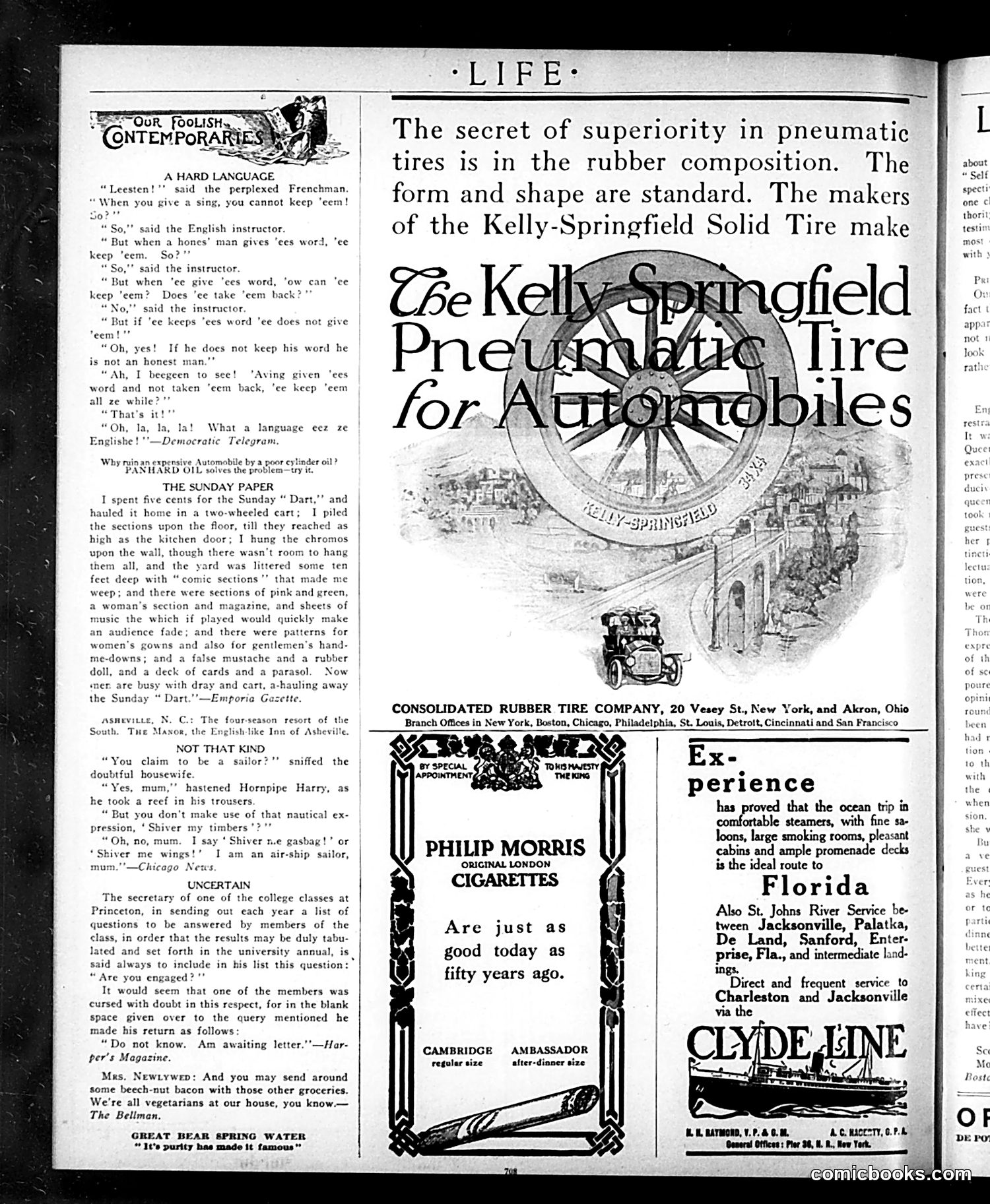
This page contains several satirical "Our Foolish Contemporaries" short humor pieces, plus advertisements. The main cartoons/jokes are: **"A Hard Language"**: A Frenchman struggles with English grammar, confused by the idiom "keep one's word" — he thinks the English literally *hold onto* words they've given, rather than understanding it means honoring commitments. The satire mocks foreigners' difficulty with English's illogical phrases. **"The Sunday Paper"**: Satirizes the enormous bulk of Sunday newspapers and their chaotic mix of content — comics, fashion patterns, ads, music sheets — that litter homes. The joke exaggerates how much space the Sunday edition occupies. **"Not That Kind"**: A sailor avoids the nautical phrase "shiver my timbers," saying he's now an "air-ship sailor" (aviator). This jokes on changing technology making old expressions obsolete. **"Uncertain"**: A college class member, asked if engaged, responds "Do not know. Am awaiting letter" — suggesting romantic uncertainty. The page is primarily **advertising** (Kelly-Springfield tires, Philip Morris cigarettes, steamship lines).
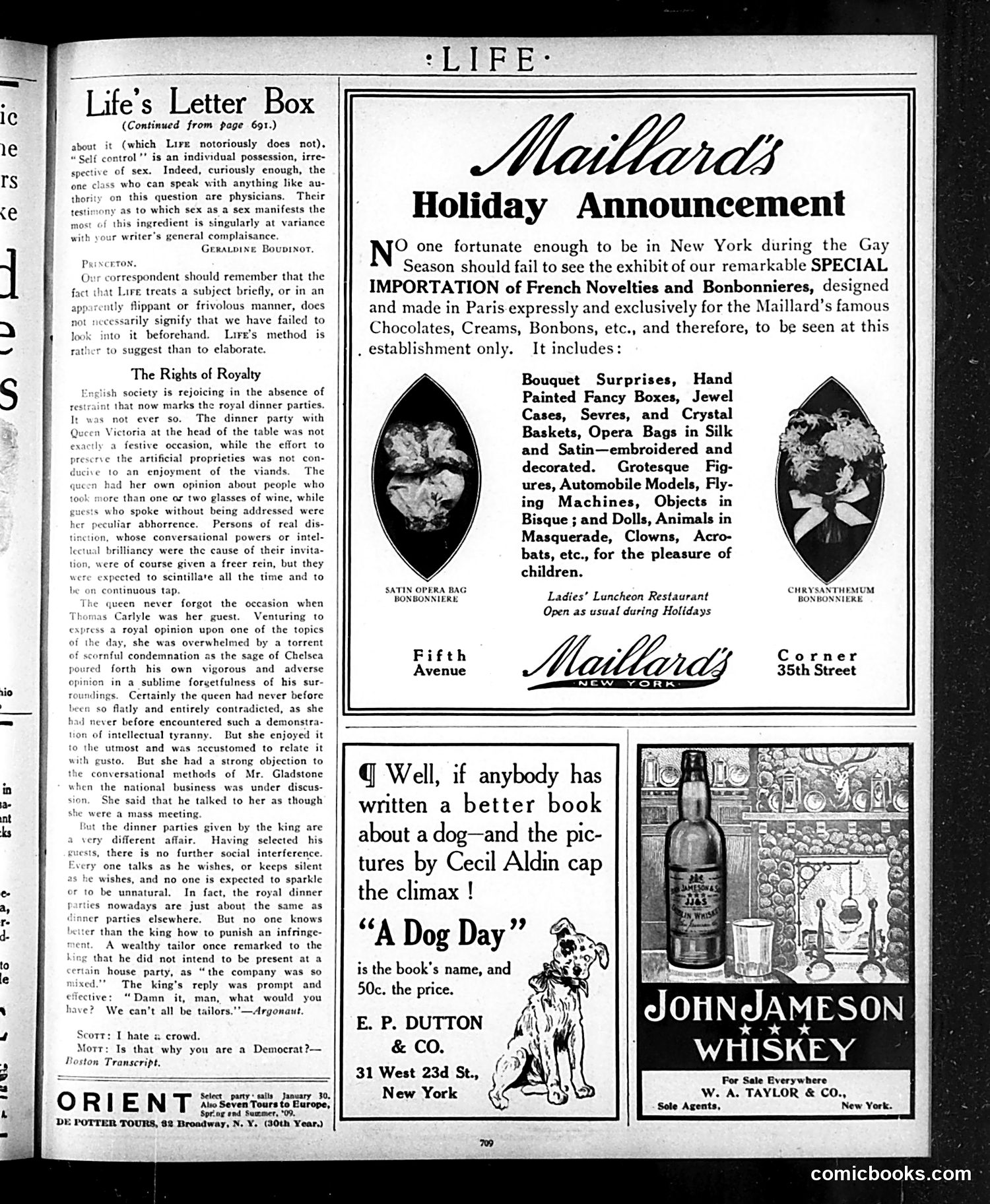
This page is primarily **advertisements and reader letters**, not political satire. The main content includes: **"Life's Letter Box"** - Reader correspondence debating "self-control" and discussing Queen Victoria's dinner parties. One letter describes Victoria enjoying being contradicted by Thomas Carlyle, contrasting formal Victorian etiquette with more relaxed modern dinner customs. This reflects early 20th-century nostalgia for Victorian-era formality. **Maillard's Holiday Advertisement** - A luxury chocolate shop promoting French imports (fancy boxes, jewelry cases, novelties) positioned as exclusive holiday gifts for the wealthy. **"A Dog Day" book advertisement** - E.P. Dutton promoting a children's book about a dog illustrated by Cecil Aldin, priced at 50 cents. **John Jameson Whiskey advertisement** - Standard spirits promotion. There are **no political cartoons** on this page. The modest social commentary in the letters reflects class attitudes about proper conduct rather than satire.
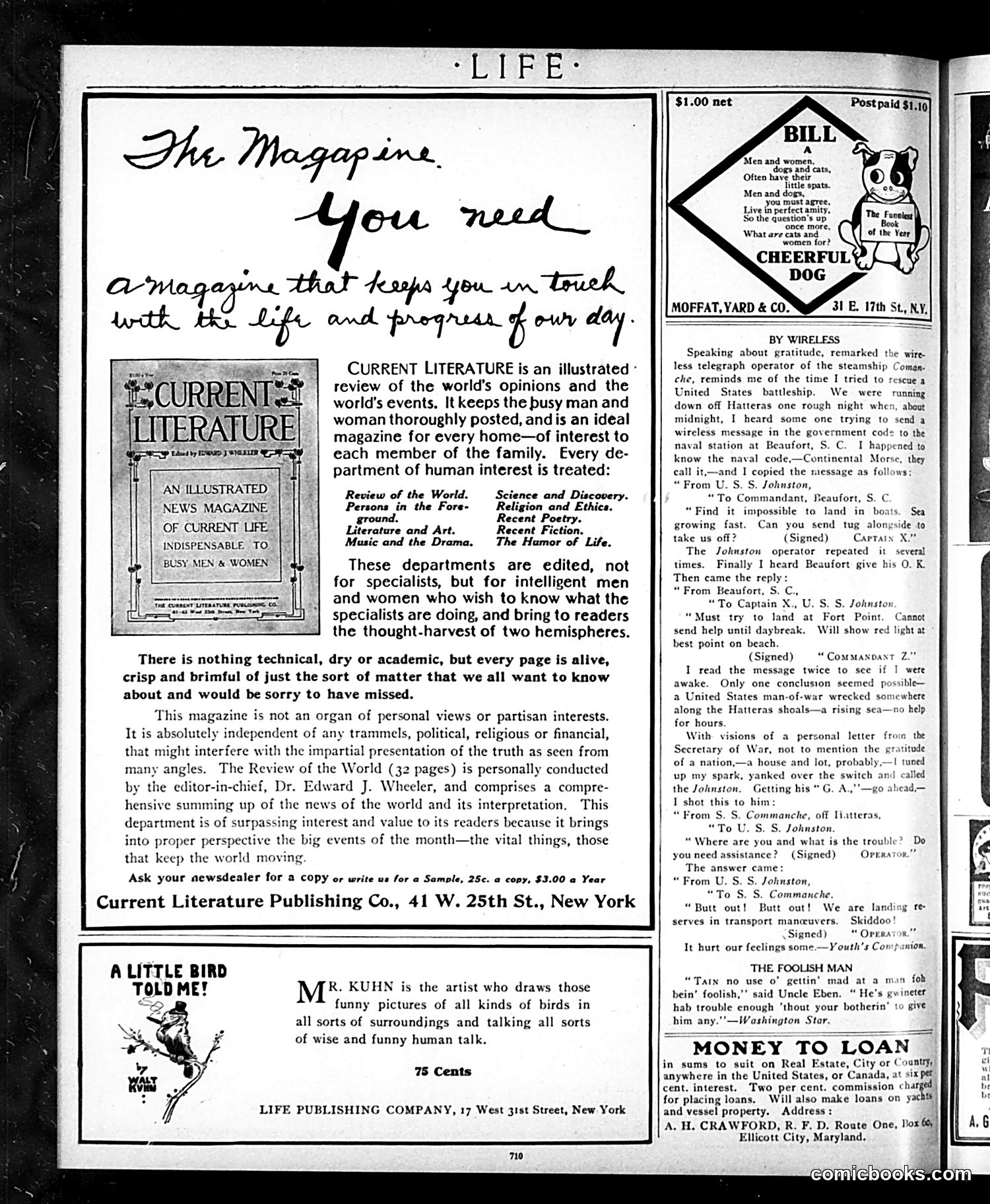
This page consists primarily of **magazine advertisements and promotional content**, not political satire. The main elements are: 1. **Current Literature magazine ad** — promoting an illustrated news review claiming editorial independence and broad appeal to "busy men & women" 2. **Cheerful Dog book ad** — a humorous illustrated book about cats and dogs, with light verse ("What are cats and women for?") 3. **"A Little Bird Told Me" — promoting cartoonist R. Kuhn's bird illustrations with anthropomorphic humor** 4. **"By Wireless" story** — a fictional anecdote about a telegraph operator on a steamship overhearing a distressed naval vessel (U.S.S. Johnston) off Hatteras and attempting rescue communication The wireless story appears to be a serialized narrative rather than satire—emphasizing the operator's heroic impulse and technological drama of early wireless communication. There is **no clear political cartoon or satirical commentary** on this page; it's essentially a period magazine's ads and light entertainment content.
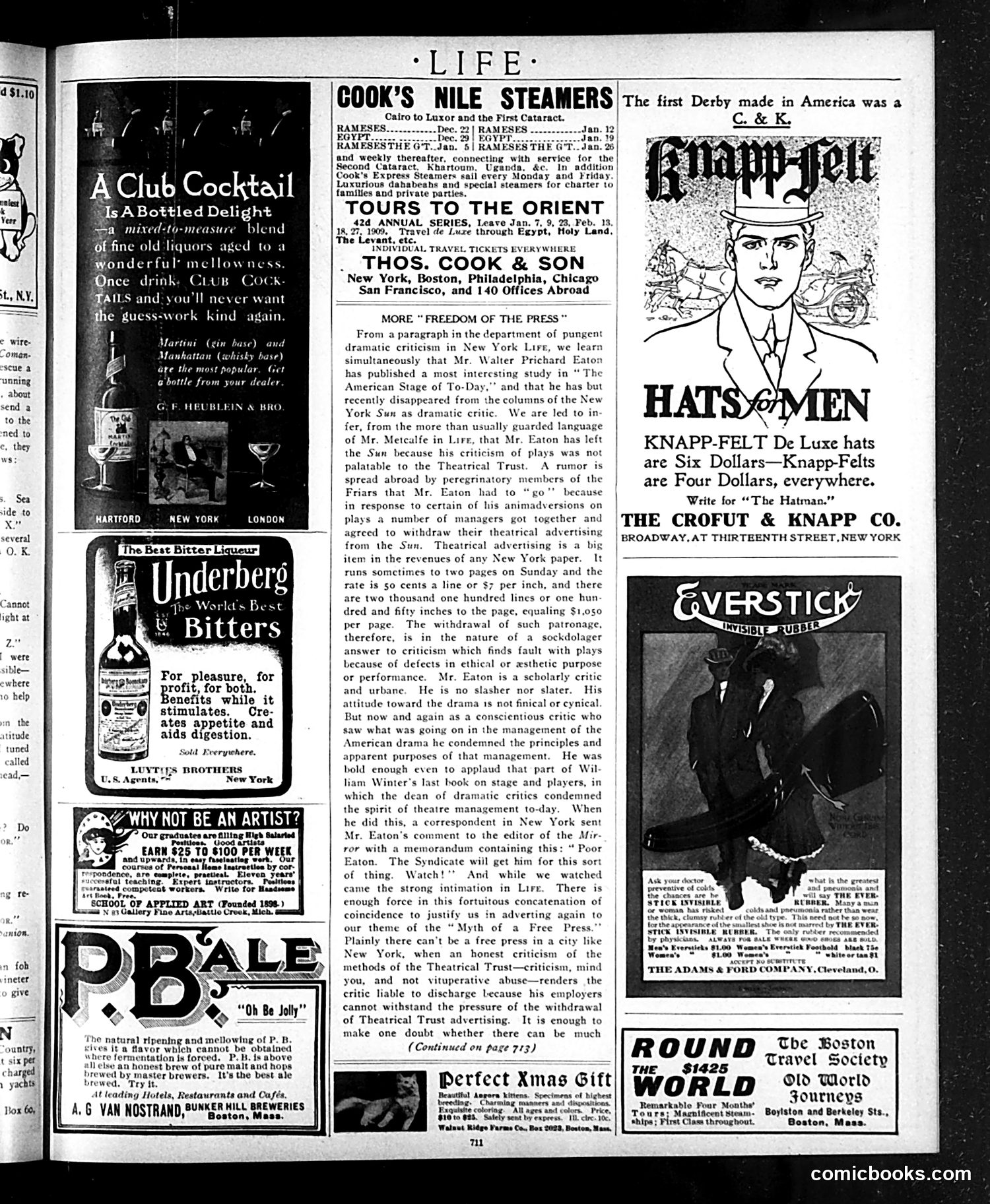
This page is primarily **advertisements and travel notices** with one significant editorial commentary piece. The main satirical content is "MORE 'FREEDOM OF THE PRESS'" — a critique of theatrical censorship. It reports that dramatic critic **Walter Prichard Eaton** was apparently forced out from the *New York Sun* because his negative reviews of plays displeased theater managers. Life alleges that the Theatrical Trust (a powerful monopoly controlling American theater) pressured advertisers to withdraw from the *Sun*, costing the paper substantial revenue (calculated as $1,050+ per page). The satire is bitter: Life mocks the concept of "freedom of the press" by documenting how financial leverage — not official censorship — silences honest criticism. Eaton is praised as a serious, fair critic whose only offense was condemning plays with ethical/aesthetic problems. The surrounding advertisements (liquor, steamship tours, art schools, bitters) are unrelated commercial content typical of the era.
This page is a magazine advertisement, not a cartoon or satirical content. It's a promotional piece for *The World To-Day*, published by Life magazine's parent company, advertising a three-month trial subscription offer for 25 cents (with money-back guarantee). The pitch emphasizes the magazine's quality and value, claiming it's "indispensable to every home" while being cheaper than competitors at $1.50/year rather than $3.00. The appeal to "honor" and the money-back guarantee were sales tactics designed to overcome reader skepticism about mail subscriptions—common in early 1900s publishing. There's self-aware humor in acknowledging publisher bias ("every publisher thinks his magazine is the best"), but the page is fundamentally commercial advertising rather than satire. The target audience is busy professionals seeking world news and entertainment combined in one affordable publication.
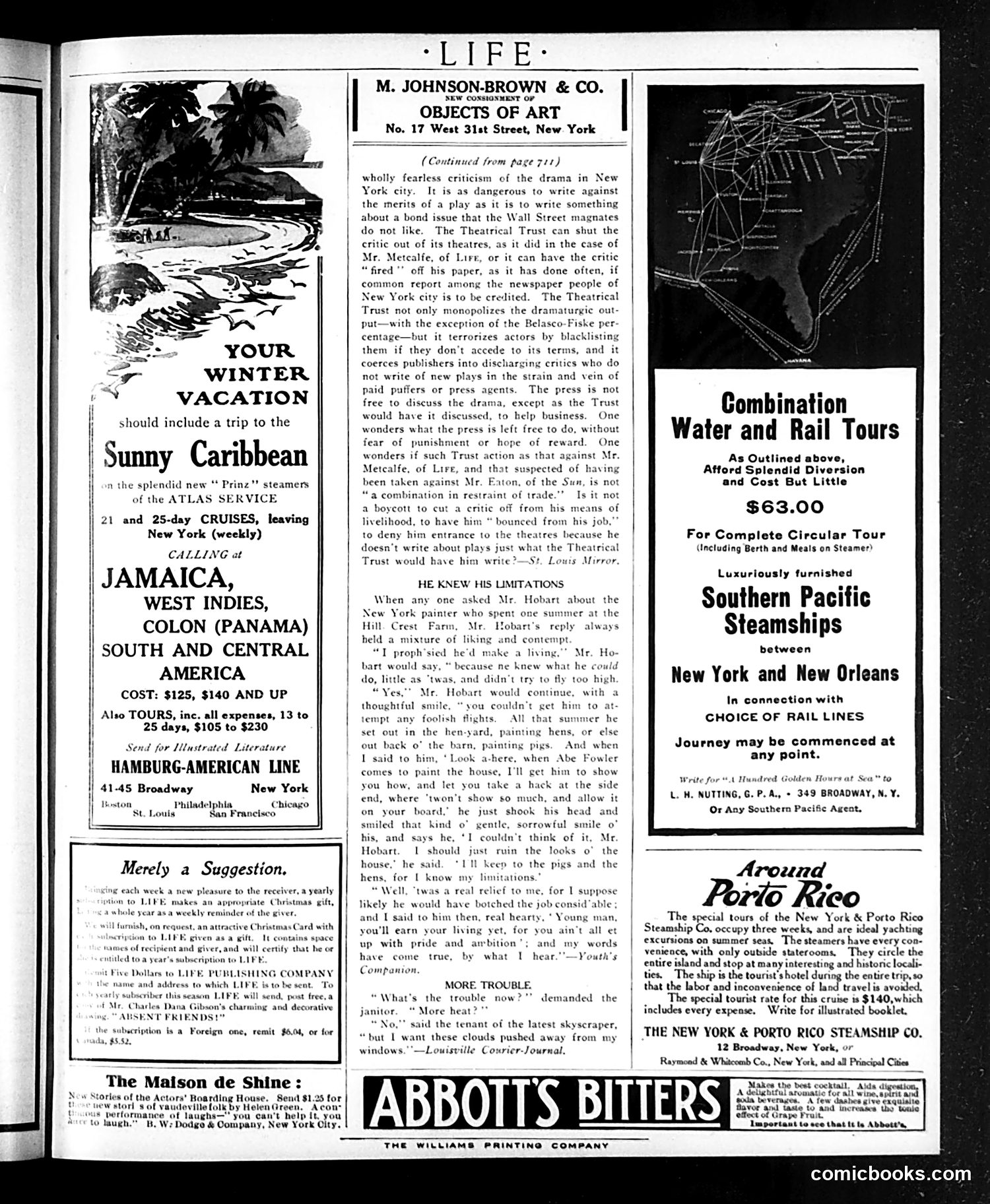
This is primarily an **advertising and editorial page** rather than a political cartoon page. The main content consists of: 1. **Travel advertisements** (Hamburg-American Line cruises to the Caribbean and Southern Pacific steamship tours) — typical early 20th-century luxury leisure marketing. 2. **A literary essay** (continued from page 711) criticizing the **Theatrical Trust**—a real monopoly that controlled New York theater production and distribution. The author argues the Trust censors drama criticism by threatening critics' jobs and blacklisting actors who don't comply, citing cases of critics fired from newspapers for negative reviews. 3. **A humorous anecdote** about a painter named Hobart who accepts his modest talents, painting only hens and pigs rather than attempting grander work. The page illustrates **Progressive Era concerns** about monopolistic control of American industries—here, theater rather than railroads or oil. The satire targets corporate power suppressing free speech through economic intimidation.
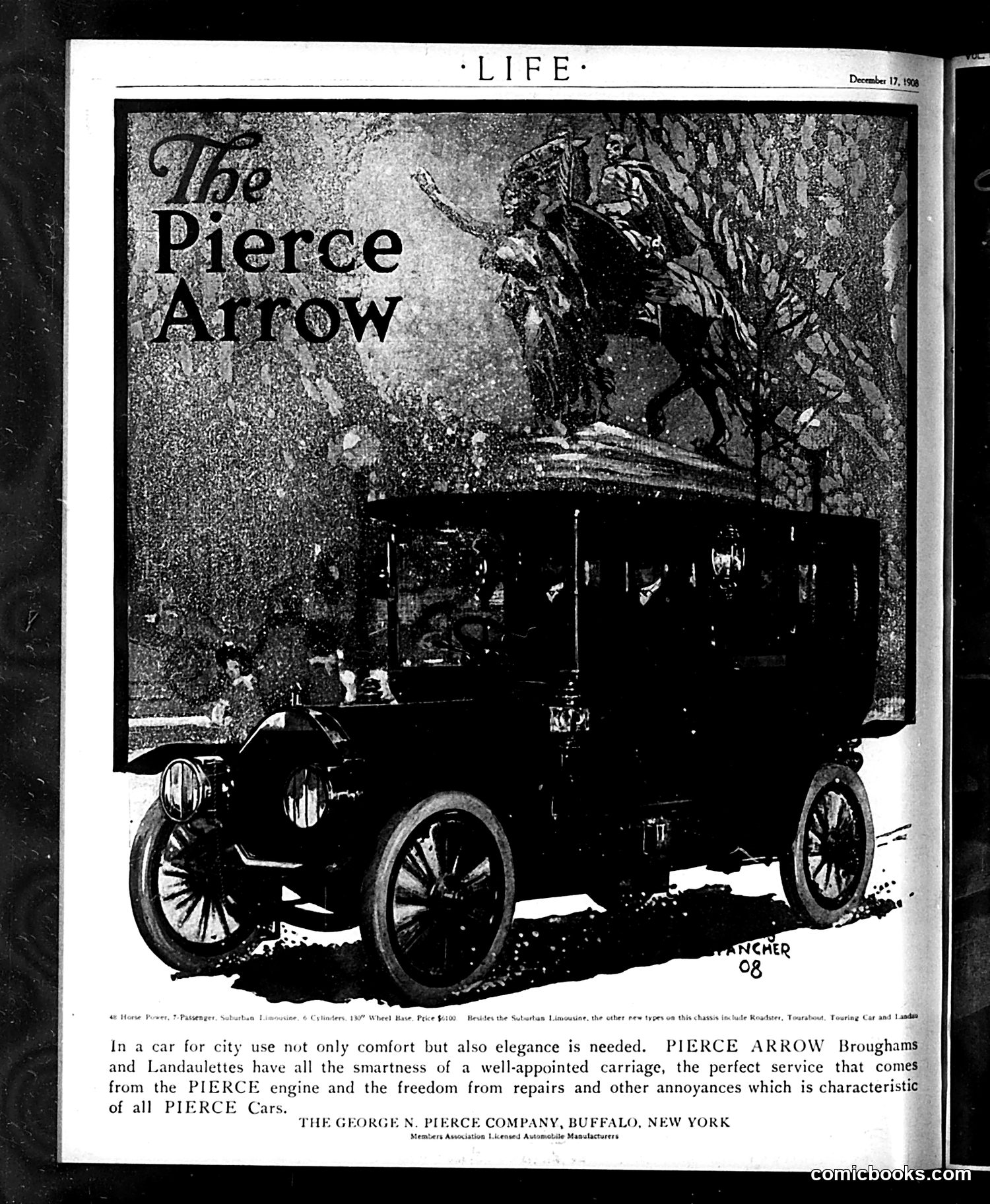
This is primarily an **advertisement**, not political satire. The page promotes the Pierce Arrow automobile, specifically its Broughams and Landaulettes models, dated December 17, 1908. The imagery shows a horse-drawn carriage silhouette at top (representing traditional transportation) contrasted with a modern Pierce Arrow motorcar below. The ad's pitch emphasizes that automobiles now offer "comfort" and "elegance" comparable to carriages—appealing to wealthy buyers accustomed to fine horse-drawn vehicles. The text stresses reliability ("freedom from repairs") and refined service, positioning Pierce Arrow as the sophisticated choice for urban transportation. This reflects the early auto industry's strategy of marketing cars to the wealthy by comparing them favorably to established luxury carriages, easing the transition from traditional to motorized transport.