
Life, 1908-12-17 · page 17 of 28
Life — December 17, 1908 — page 17: what you’re looking at
What you’re looking at
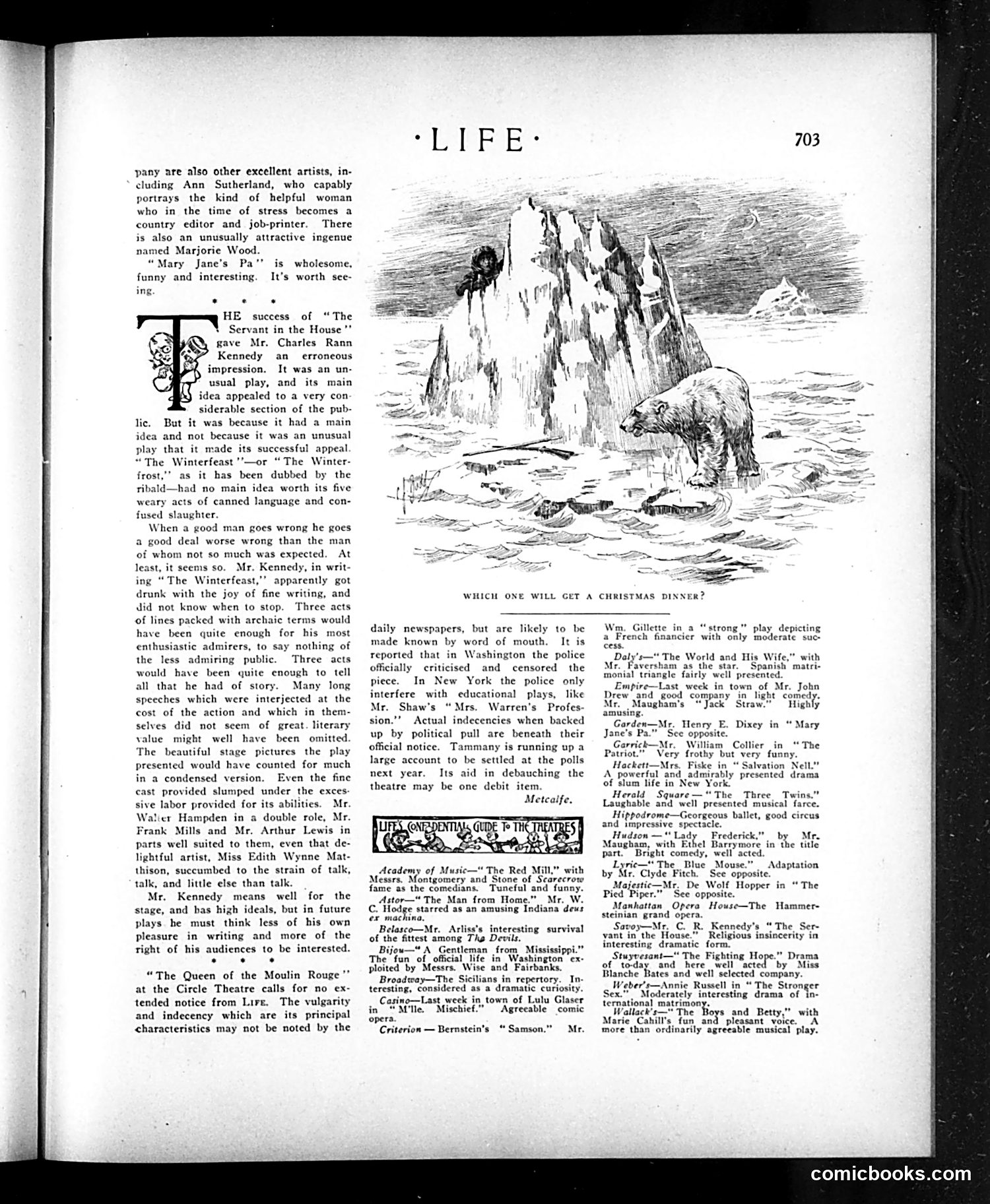
This page is primarily **theatre criticism and reviews**, not political satire. The main content critiques Broadway plays from the early 1900s. The **cartoon** (captioned "Which One Will Get a Christmas Dinner?") depicts a dramatic seaside cliff scene with figures perched precariously—likely illustrating a scene from one of the reviewed plays, though the specific reference is unclear from the text. The **critical focus** is Charles Rann Kennedy's play "The Winterfeast" (mockingly called "The Winterfrost"). The reviewer demolishes it, arguing Kennedy mistook the success of his earlier play "The Servant in the House" as validation for experimental writing rather than recognizing its actual appeal. The critique attacks the play's excessive dialogue, archaic language, and lengthy speeches that exhausted even talented actors like Walter Hampden and Edith Wynne Matthison. The page also briefly condemns "The Queen of the Moulin Rouge" for vulgarity, suggesting **Tammany Hall political corruption** enables such indecent theatre in New York while police censor educational plays elsewhere.
📄 Transcribed text from this page (OCR, searchable)
Machine-transcribed from the original scan — historical spelling and the odd misread are preserved.
pany are also other excellent artists, in- cluding Ann Sutherland, who capably portrays the kind of helpful woman who in the time of stress becomes a country editor and job-printer. There is also an unusually attractive ingenue named Marjorie Wood. Mary Jane’s Pa is wholesome, funny and interesting. It’s worth see- ing. ee HE success of “The Servant in the House" gave Mr. Charles Rann Kennedy an erroneous impression. It was an un- usual play, and its main idea appealed to a very con siderable section of the pub- lic. But it was because it had a main idea and not because it was an unusual play that it made its successful appeal “The Winterfeast''—or “The Winter- frost,"’ as it has been dubbed by the ribald—had no main idea worth its five weary acts of canned language and con- fused slaughter. When a good man goes wrong he goes a good deal worse wrong than the man of whom not so much was expected. At least, it seems so. Mr. Kennedy, in writ- ing “The Winterfeast,’’ apparently got drunk with the joy of fine writing, and did not know when to stop. Three acts of lines packed with archaic terms would have been quite enough for his most enthusiastic admirers, to say nothing of the less admiring public. Three acts would have been quite enough to tell all that he had of story. Many long speeches which were interjected at the cost of the action and which in them- selves did not seem of great. literary value might well have been omitted. The beautiful stage pictures the play presented would have counted for much in a condensed version. Even the fine cast provided slumped under the exces sive labor provided for its abilities. Mr. Water Hampden in a double role, Mr. Frank Mills and Mr. Arthur Lewis in parts well suited to them, even that de- lightful artist, Miss Edith Wynne Mat- thison, succumbed to the strain of talk, talk, and little else than talk. Mr. Kennedy means well for the stage, and bas high ideals, but in future plays he must think less of his own pleasure in writing and more of the right of his audiences to be interested. SRL et ce “The Queen of the Moulin Rouge’ at the Circle Theatre calls for no ex- tended notice from Lire, The vulgarity and indecency which are its principal characteristics may not be noted by the WHICH ONE WILL GET A CHRISTMAS DINNER? daily newspapers, but are likely to be made known by word of mouth. It is reported that in Washington the police officially criticised and censored the piece. In New York the police only interfere with educational plays, like Mr. Shaw’s “Mrs. Warren's Profes- sion.”’ Actual indecencies when backed up by political pull are beneath their official notice. Tammany is running up a large account to be settled at the polls next year. Its aid in debauching the theatre may be one debit item. Metcalfe. Academy of Music—" The Red Mill,” with Messrs. Montgomery and Stone of Scarecro} fame as the comedians. Tuneful and funn; Astor—" The Man from Home.” Mr. W. C, Hodge starred as an amusing Indiana deus er machina, Belasco—Mr. Arliss's interesting survival of the fittest among The Devils, Bijou—" A Gentleman from Mississippi.” The fun of official life in Washington ex- ploited by Messrs. Wise and Fairbanks. Broadway—The Sicilians in repertory. In- teresting, considered as a dramatic curiosity. Casino—Last week in town of Lulu Glaser {'lle, Mischief." Agreeable comic in opera. Criterion — Bernstein's “Samson.” Mr. Wm. Gillette in a “strong play depicting a French financier with only moderate suc: cess Daly’s—" The World and His Wife," with Mr. Faversham as the star. Spanish’ matri- monial tri fairly well presented. Empire—Last week in town of Mr. John Drew and good company in light comedy. Mr. Maugham’s “Jack” Straw” “Highly Mr. Henry E. Dixey in “ Ma: Jane's Pa.” See opposite. i is Garrick—Mr, William Collier Patriot.” Very frothy but very fi Hackett—Mrs. Fiske in “ Salvation Nell." A powerful and admirably presented drama of slum life in New York. Herald Square—“ The Three Twins.” Laughable and well presented musical farce. Hippodrome—Georgeous ballet, good circus and impressive spectacle. Hudson —* Lady | Frederick,” | by | Mr. Maugham, with Ethel Barrymore in the title art Bright comedy, well acted. Lyric—" The Blue Mouse.” Adaptation by Mr. Clyde Fitch. See opposite. Majestic—Mr. De Wolf Hopper Pied Piper.” See opposite. Manhattan Opera House—The Hammer- steinian grand opera. Savoy—Mr. C. R. Kennedy's “The Ser yant in the House.” Religious insincerity in interesting dramatic form. Stuyvesant" The Fighting Hope.’ Drama of today and here well acted Miss Manche Hates and well selected company, Weber’s—Annie Russell in “ The Stronger Sex.” Moderately interesting drama of in- ternational matrimony Wallack’s—" The Boys and Betty, Marie Cahill’s fun and pleasant voice. more than ordinarily agreeable musical play. in The comicbooks.com