
Life, 1908-12-17 · page 18 of 28
Life — December 17, 1908 — page 18: what you’re looking at
What you’re looking at
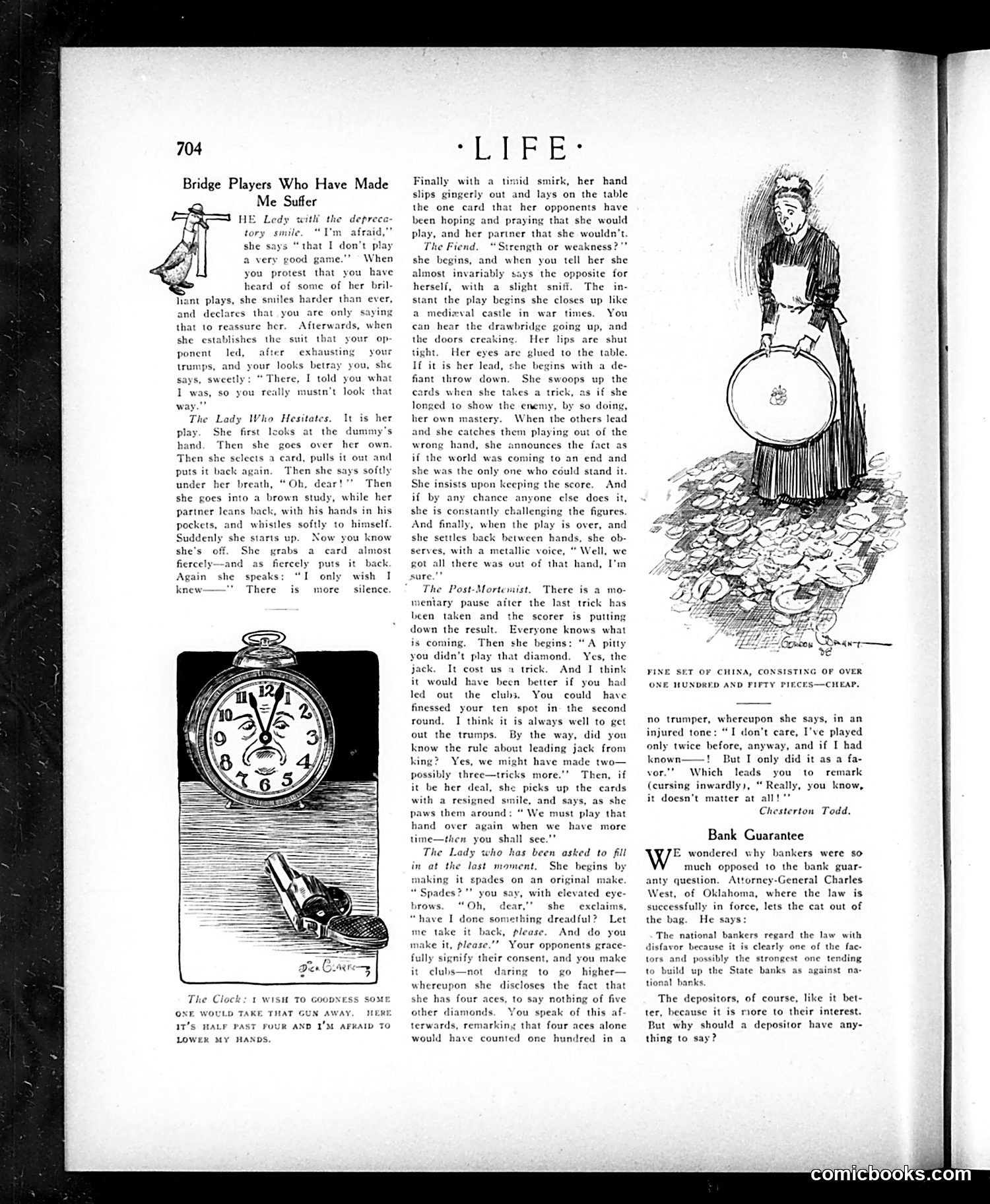
This page satirizes stereotypical female bridge players and their annoying behavioral patterns. The text describes several caricatured types: **The Self-Deprecating Lady** - falsely claims poor skill, then plays brilliantly, making partners uncomfortable. **The Hesitator** - agonizes over every card choice, creating tension at the table. **The Fiend** - plays with dramatic flair, becomes silent and hostile during play, insists on keeping score. **The Post-Mortemist** - after hands end, relentlessly criticizes partners' plays with unsolicited advice. **The Last-Minute Fill-in** - makes foolish bids then reveals she actually holds excellent cards. The illustrations (a woman at a bridge table, a clock, a rabbit) support these portraits. This is gentle domestic satire targeting social bridge culture and women's bridge-playing quirks—common entertainment fare in early 20th-century *Life* magazine.
📄 Transcribed text from this page (OCR, searchable)
Machine-transcribed from the original scan — historical spelling and the odd misread are preserved.
704 Bridge Players Who Have Made Me Suffer HE Ledy with the depreca- tory § “T'm afraid,” she says “that I don’t play a very good game."? © When you protest that you have heard of some of her bril- Trant plays, she smiles harder than ever, and declares that you are only saying that to reassure her. Afterwards, when she establishes the suit that your op led, after ex! nd your looks betray you, she “There, I told you what mustn't look that ponent stingy trumps, says, sweetly : I was, so you rea way The Lady Who Hesitates. It is her Icoks at the dummy's own, play. She first hand. Then she goes over her Then she selects a card, pulls it out and puts it back again. Then she says softly under her breath, “Oh, dear!"’ Then she goes into a brown study, while her partner leans back, with his hands pockets, Sudden| she’s off. She grabs a fiercely—and as fiercely Again she speaks: “I knew There is n his nd whistles softly to himself. Now you know almost puts it back. wish | silence. she starts up. card only more The Clock ONE WOULD TAKE 17'S HALF PAST FOUR AND I’M AFRAID 70 LOWEK MY HANDS. 1 WISH TO Gi THAT GUN DDNESS SOME AWAY, ERE “PRE Finally with a timid smirk, her hand slips gingerly out and lays on the table the one card that her opponents have been hoping and praying that she would play, and her partner that she wouldn't The Fiend. “Strength or weakness?" she begins, and when you tell ber she almost invariably says the opposite for herself, with a slight sniff. The in- stant the play begins she closes up li You can hear the drawbridge going up, and the doors creakin Her lips are shut tight. Her eyes are glued to the table. If it is her lead, she begins with a de- fant throw down. She swoops up the trick, as if she longed to show the enemy, by so doing, y. When the others lead ches them playing out of the wrong hand, she announces the fact as if the world was coming to an end and she was the only one who could stand it. She insists upon keeping the score. Ani ‘one else does it a medixval castle in war times. cards when she takes her own mast and she ¢: chance antly challenging the figure: And finally, when the play if by any she is con s over, and she settles back between hands, she ob- serves, with a metallic voice, “ Well, we got all there was out of that hand, I'm sure."" The Post-Mortemist mentary pause aiter the last trick has heen taken and the scorer is putting down the result. Everyone knows what is coming. Then she begins: “A pitty you didn’t play that diamond. Yes, the jack. It cost us a trick. And I think it would have been better if you had led out the clubs. You could have finessed your ten spot in the second round. I think it is always well to get out the trumps. By the way, did you know the rule about leading jack from king? Yes, we might have made two— possibly three—tricks more."’ Then, if it be her deal, she picks up the cards with a resigned smile, and says, as she paws them around: “ We must play that hand over again when we have time—then you shall see The Lady who has been asked to fill in at the last moment. There is a mo- more She begins by making it spades on an original make. ades?" you say, with elevated eye- “Oh, dear,’ she exclaims, “have I done something dreadful? Let me take it back, please. And do you make it, please.’” Your opponents grace- fully si their consent, and you make it clubs—not daring to go higher— whereupon she discloses the fact that she has four aces, to say nothing of five ‘ou speak of this af rkin that four aces alone would have counted one hundred in a brows. other diamonds terwards, re FINE SET OF CHINA, CONSISTING OF OVER ONE MUNDRED AND FIFTY PIECES—CHEAP. no trumper, whereupon she says, in an injured tone: “I don’t care, I've played only twice before, anyway, and if I had known——! But I only did it as a fa- vor."’ Which leads you to remark (cursing inwardly), “Really, you know, it doesn’t matter at all! Chesterton Todd. Bank Guarantee wondered why bankers were so much opposed to the bank guar- Attorney-General Charles W anty question. West, of Oklahoma, where the law is successfully in force, lets the cat out of the bag. He says: The national bankers regard the law with disfavor because it is clearly one of the fac- tors and possibly the strongest one tending wild up the State banks as against na- 1 hanks The depositors, of course, like it bet- ecause it is riore to their interest. But why should a depositor have any- thing to say?