
Life, 1908-12-17 · page 10 of 28
Life — December 17, 1908 — page 10: what you’re looking at
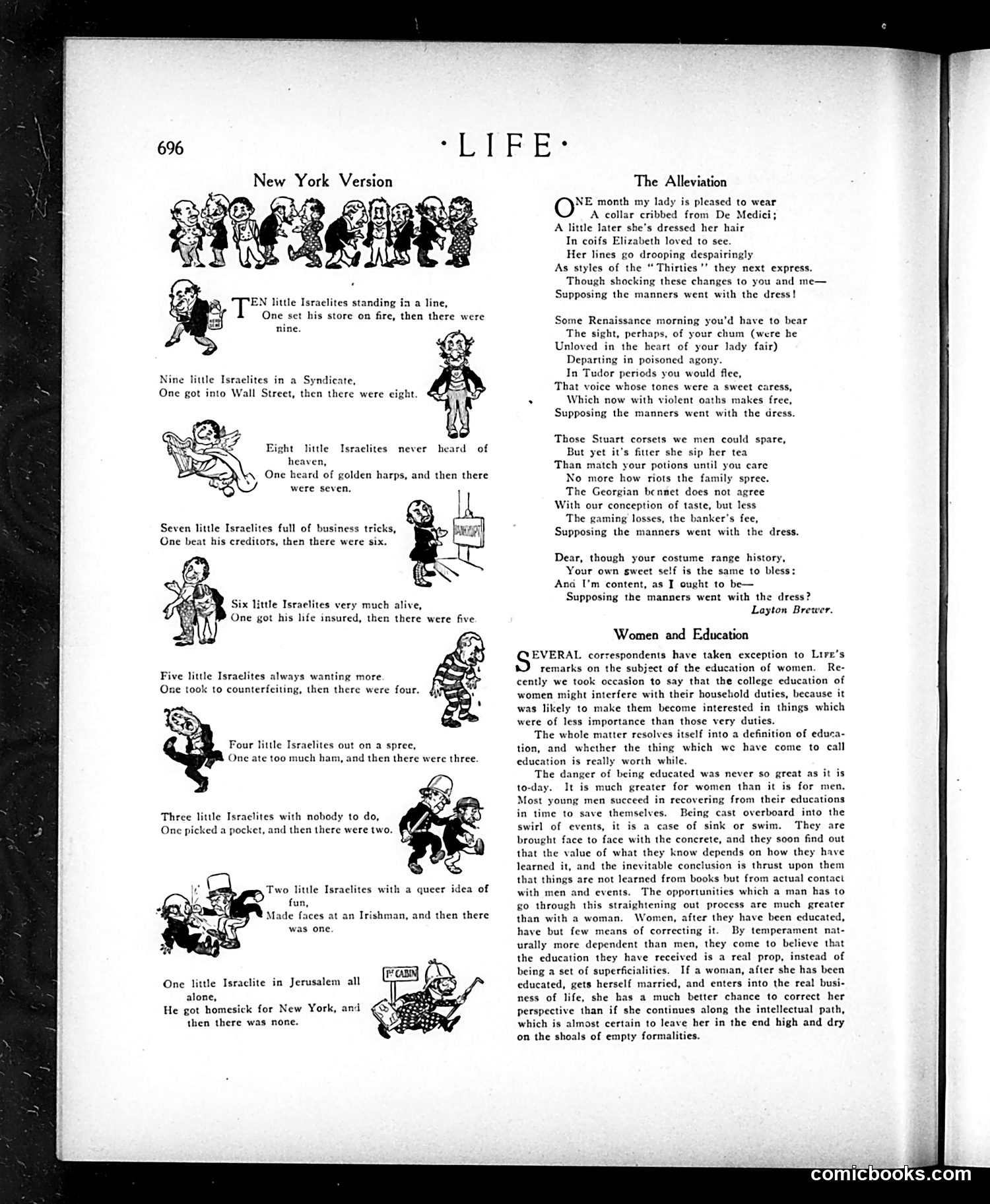
What you’re looking at
The left side features "New York Version," a humorous counting-out rhyme using Jewish children ("little Israelites") that parodies the traditional "Ten Little Indians" format. Each verse describes a child leaving through various misadventures—getting into Wall Street, losing creditors, getting insured, counterfeiting, pickpocketing, etc.—until none remain. The accompanying illustrations show stereotyped caricatured children. This is ethnic humor typical of early 20th-century American satire, mocking both Jewish immigrants and contemporary urban vices (financial schemes, crime, etc.). The right side, "The Alleviation," is a serious poem about changing women's fashion and manners, followed by "Women and Education," a substantive essay arguing that college education for women needn't distract them from domestic duties—reflecting period anxieties about female education.
📄 Transcribed text from this page (OCR, searchable)
Machine-transcribed from the original scan — historical spelling and the odd misread are preserved.
'EN little Israelites standing ia a line, One set his store on fire, then there were Nine little Israelites in a Syndicate, One got into Wall Street, then there were eight. Eight little Israclites never heard of heaven, \ One heard of bs were seven, Iden harps, and then there Seven little Israelites full of business tricks, One beat his creditors, then there were six. ~ Six little Israelites very much alive, One got his life insured, then there were five. Five little Israelites always wanting more One took to counterfeiting, then there were four. Four little Israelites out on a spree, One ate too much ham, and then there were three. Three little Israclites with nobody to do, icked a pocket, and then there were two. pm Two little Israelites with a queer idea of fun, Made faces at an Irishman, and then there was one. One little Israclite in Jerusalem all alone, He got homesick for New York, and then there was none. The Alleviation NE month my lady is pleased to wear A collar cribbed from De Medici; A little later she’s dressed her hair In coifs Elizabeth loved to see. Her lines go drooping despairingly As styles of the “Thirties "” they next express. Though shocking these changes to you and me— Supposing the manners went with the dress! Some Renaissance morning you'd have to bear The sight, perhaps, of your chum (were he Unloved in the beart of your lady fair) Departing in poisoned agony. In Tudor periods you would flee, That voice whose tones were a sweet caress, Which now with violent oaths makes free, Supposing the manners went with the dress. Those Stuart corsets we men could spare, But yet it’s fitter she sip her tea Than match your potions until you care No more how riots the family spree. The Georgian benact does not agree With our conception of taste, but less The gaming losses, the banker's fee, Supposing the manners went with the dress. Dear, though your costume range history, Your own sweet self is the same to bless: Ana I'm content, as I ought to be— Supposing the manners went with the dress? Layton Brewer. Women and Education GEVERAL correspondents have taken exception to Lire’s remarks on the subject of the education of women. Re- cently we took occasion to say that the college education of women might interfere with their houseliold duties, because it was likely to make them become interested in things which were of less importance than those very duties. The whole matter resolves itself into a definition of educa- tion, and whether the thing which we have come to call education is really worth while. The danger of being educated was never so great as it is to-day. It is much greater for women than it is for men. Most young men succeed in recovering from their educations in time to save themselves. Being cast overboard into the swirl of events, it is a case of sink or swim. They are brought face to face with the concrete, and they soon find out that the value of what they know depends on how they have learned it, and the inevitable conclusion is thrust upon them that things are not learned from books but from actual contact with men and events. The opportunities which a man has to go through this straightening out process are much greater than with a woman. Women, after they have been educated, have but few means of correcting it. By temperament nat- urally more dependent than men, they come to believe that the education they have received is a real prop, instead of being a set of superficialities. If a woman, after she has been educated, gets herself married, and enters into the real busi- ness of life, she has a much better chance to correct her perspective than if she continues along the intellectual path, which is almost certain to leave her in the end high and dry on the shoals of empty formalities. comicbooks.com