
Life, 1908-12-17 · page 13 of 28
Life — December 17, 1908 — page 13: what you’re looking at
What you’re looking at
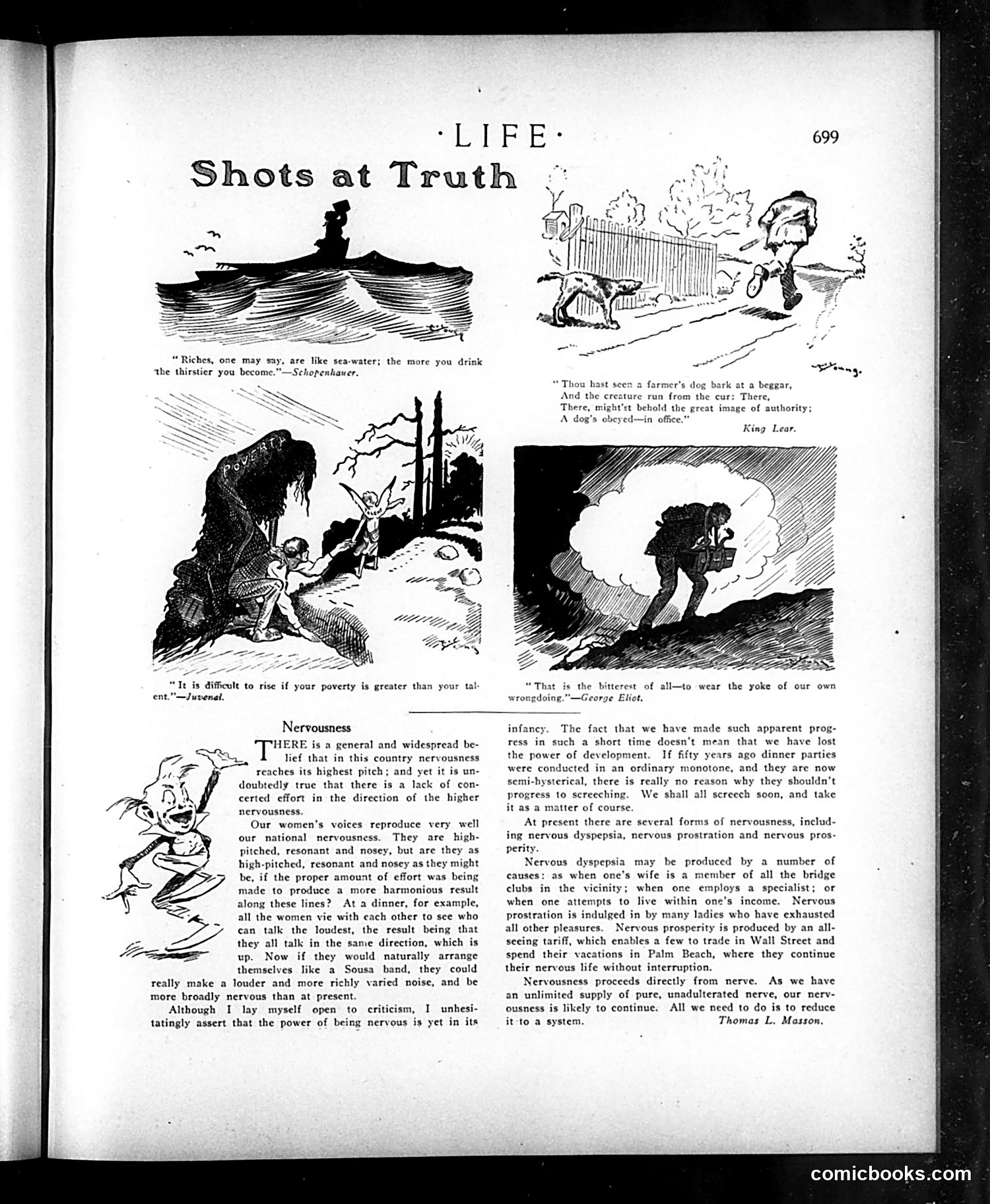
This page presents four cartoons paired with literary quotes attacking social hypocrisy: 1. **Top left**: A drowning man illustrates Schopenhauer's quote about wealth and drinking, suggesting the rich become moral "thirstier." 2. **Top right**: A beggar and dog reference King Lear, contrasting human authority with animal obedience. 3. **Bottom left**: A dark scene shows poverty, citing Juvenal on difficulty escaping humble origins. 4. **Bottom right**: A figure struggles under a burden, quoting George Eliot on self-imposed constraints. Below, an article titled "Nervousness" discusses anxiety disorders in modern society, particularly among the wealthy. It argues nervousness stems from nerve exhaustion caused by competitive living, lavish spending, and overstimulation—essentially satirizing upper-class complaints while suggesting systemic reduction is necessary.
📄 Transcribed text from this page (OCR, searchable)
Machine-transcribed from the original scan — historical spelling and the odd misread are preserved.
“LIFE: Shots at Truth “Riches, one may sa; ‘the thirstier you become.” “It is difficult to rise if your poverty is greater than your tal ent.”"—Juvenel, Nervousness HERE is a general and widespread be- on 4 Ne lief that in this country nervousness FE A teaches its highest pitch; and yet it is un- doubtedly true that there is a lack of con- certed effort in the direction of the higher nervousness. Our women’s voices reproduce very well our national nervousness. They are high- pitched, resonant and nosey, but are they as high-pitched, resonant and nosey as they might be, if the proper amount of effort was being made to produce a more harmonious result along these lines? At a dinner, for example, all the women vie with each other to see who can talk the loudest, the result being that they all talk in the same direction, which is up. Now if they would naturally arrange themselves like a Sousa band, they could really make a louder and more richly varied noise, and be more broadly nervous than at present. Although I lay myself open to criticism, I unhesi- tatingly assert that the power of being nervous is yet in its “w BA a beggar, ure run from the cur: There, ‘st behold the great image of authority; King Lear. “That is the bitterest of all—to wear the yoke of our own doing.”"—George Eliot. infancy. The fact that we bave made such apparent prog- ress in such a short time doesn't mean that we have lost the power of development. If fifty years ago dinner parties were conducted in an ordinary monotone, and they are now semi-hysterical, there is really no reason why they shouldn't progress to screeching. We shall all screech soon, and take it as a matter of course. At present there are several forms of nervousness, includ- ing nervous dyspepsia, nervous prostration and nervous pros- perity. Nervous dyspepsia may be produced by a number of causes: as when one’s wife is a member of all the bridge clubs in the vicinity; when one employs a specialist; or when one attempts to live within one’s income. Nervous prostration is indulged in by many ladies who have exhausted all other pleasures. Nervous prosperity is produced by an all- seeing tariff, which enables a few to trade in Wall Street and spend their vacations in Palm Beach, where they continue their nervous life without interruption. Nervousness proceeds directly from nerve. As we have an unlimited supply of pure, unadulterated nerve, our nerv- ousness is likely to continue, All we need to do is to reduce it-to a system. Thomas L, Masson. comicbooks.com