
Life, 1908-12-17 · page 12 of 28
Life — December 17, 1908 — page 12: what you’re looking at
What you’re looking at
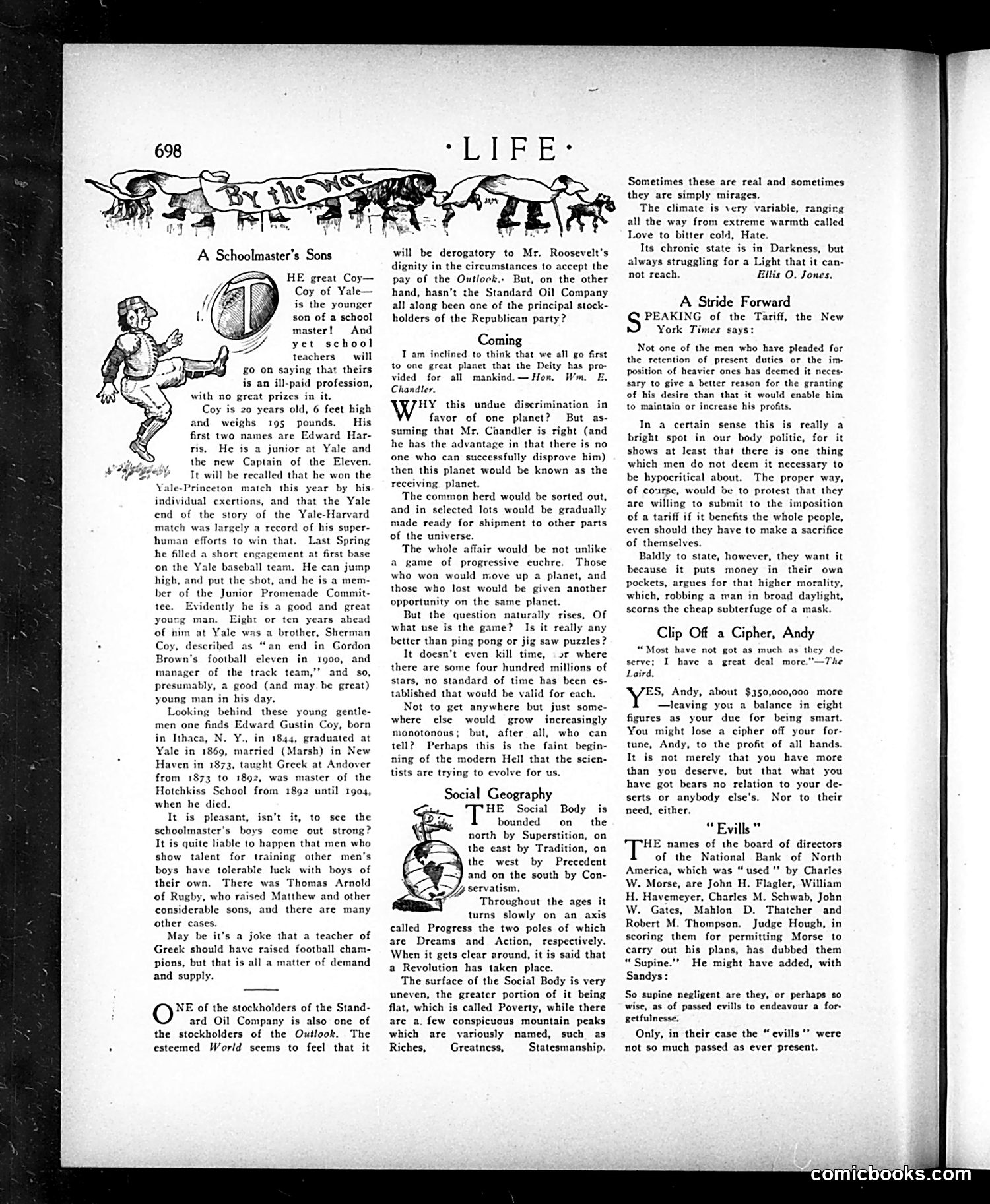
This page contains several satirical articles rather than political cartoons. The main pieces include: **"A Schoolmaster's Sons"** features a cartoon of a young boy, likely satirizing educational expectations. The text discusses a Yale student whose father was a schoolmaster, noting the irony that despite his prestigious education, he struggled professionally—a jab at inherited advantage not guaranteeing success. **"A Stride Forward"** discusses tariff debates, suggesting critics of tariff policy face pressure to remain silent to protect profits. **"Clip Off a Cipher, Andy"** appears to reference Andrew Carnegie (implied by "Andy"), critiquing wealthy industrialists' charitable donations as insufficient relative to their vast fortunes. **"Evills"** mocks the board of directors of the National Bank of North America, listing members' names while suggesting their governance is negligent. The satire targets privilege, economic inequality, and institutional incompetence.
📄 Transcribed text from this page (OCR, searchable)
Machine-transcribed from the original scan — historical spelling and the odd misread are preserved.
HE great Coy— Coy of Yale— is the younger son of a school master! And yet school teachers — will go on saying that theirs is an ill-paid profession, with no great prizes in it. Coy is 20 years old, 6 feet high and weighs 195 pounds. His first two names are Edward Har- ris. He is a junior at Yale and the new Captain of the Eleven. It will be recalled that he won the ceton match this year by his individual exertions, and that the Yale end of the story of the Yale-Harvard match was largely a record of his super- human efforts to win that. Last Spring he filled a short engagement at first base on the Yale baseball team. He can jump high, and put the shot, and he is a mem- ber of the Junior Promenade Comm tee. Evidently he is a good and great young man. Eight or ten years ahead of nim at Yale was a brother, Sherman Coy, described as “an end in Gordon Brown's football eleven in 1900, and manager of the track team,’ and so, presumably, a good (and may. be great) young man in his day. Looking behind these young gentle- men one finds Edward Gustin Coy, born in Ithaca, N. Y., in 1844, graduated at Yale in 1869, married (Marsh) in New Haven in 1873, taught Greek at Andover from 1873 to 1892, was master of the Hotchkiss School from 1892 until 1904, when he died. It is pleasant, isn't it, to see the schoolmaster’s boys come out strong? It is quite liable to happen that men who show talent for training other men’s boys have tolerable Iuck with boys of their own. There was Thomas Arnold of Rugby, who raised Matthew and other considerable sons, and there are many other cases. May be it’s a joke that a teacher of Greek should have raised football cham- pions, but that is all a matter of demand and supply. NE of the stockholders of the Stand- ard Oil Company is also one of the stockholders of the Outlook. The esteemed World scems to feel that it will be derogatory to Mr. Roosevelt's dignity in the circumstances to accept the pay of the Outlock.» But, on the other hand, hasn’t the Standard Oil Company all along been one of the principal stock- holders of the Republican party? Coming T am inclined to think that we all go first to one great planet that the Deity has pro- vided for all mankind.—Hon. Wm. E. Chandler. HY this undue discrimination in favor of one planet? But as- suming that Mr. Coandler is right (and he has the advantage in that there is no one who can successfully disprove him) then this planet would be known as the receiving planet. The common herd would be sorted out, and in selected lots would be gradually made ready for shipment to other parts of the universe. The whole affair would be not unlike a game of progressive euchre. Those who won would move up a planet, and those who lost would be given another opportunity on the same planet. But the question naturally rises, Of what use is the game? Is it really any better than ping pong or jig saw puzzles? It doesn’t even kill time, or where there are some four hundred millions of stars, no standard of time has been es- tablished that would be valid for each. Not to get anywhere but just where else would grow increa: monotonous; but, after all, who can tell? Perhaps this is the faint begin- ning of the modern Hell that the scien- tists are trying to evolve for us. Social Geography HE Social Body is bounded on the north by Superstition, on the east by Tradition, on @ the west by Precedent and on the south by Con- servatism. Throughout the ages it turns slowly on an axis called Progress the two poles of which are Dreams and Action, respectively. When it gets clear around, it is said that a Revolution has taken place. The surface of the Social Body is very uneven, the greater portion of it being flat, which is called Poverty, while there are a. few conspicuous mountain peaks which are variously named, such as Riches, Greatness, Statesmanship. Sometimes these are real and sometimes they are simply mirages. The climate is very variable, rangirg all the way from extreme warmth called Love to bitter cold, Hate. Its chronic state is in Darkness, but always struggling for a Light that it can- not reach. fis O. Jones. A Stride Forward PEAKING of the Tariff, the New York Times says: Not one of the men who have pleaded for the retention of present duties or the im position of heavier ones has deemed it neces- sary to give a better reason for the granting of his desire than that it would enable him to maintain or increase his profits. In a certain sense this is really a bright spot in our body politic, for it shows at least that there is one thing which men do not deem it necessary to be hypocritical about. The proper way, of course, would be to protest that they are willing to submit to the imposition of a tariff if it benefits the whole people, even should they have to make a sacrifice of themselves. Baldly to state, however, they want it because it puts money in their own pockets, argues for that higher morality, which, robbing a man in broad daylight, scorns the cheap subterfuge of a mask. Clip Of a Cipher, Andy Most have not got as much as they de- serve; I have a great deal more."—The Laird. ES, Andy, about $350,000,000 more —leaving you a balance in eight figures as your due for being smart. You might lose a cipher off your for- tune, Andy, to the profit of all hands. It is not merely that you have more than you deserve, but that what you have got bears no relation to your de- serts or anybody else's. Nor to their need, either. “ Evills” HE names of the board of directors of the National Bank of North America, which was “used "’ by Charles W. Morse, are John H. Flagler, William H. Havemeyer, Charles M. Schwab, John W. Gates, Mahlon D, Thatcher and Robert M. Thompson. Judge Hough, in scoring them for permitting Morse to carry out his plans, has dubbed them “Supine.” He might have added, with Sandys: So supine negligent are they, or perhaps so wise, as of passed evills to endeavour a for- getfulnesse. Only, in their case the “evils” were not so much passed as ever present.