
Life, 1908-12-17 · page 16 of 28
Life — December 17, 1908 — page 16: what you’re looking at
What you’re looking at
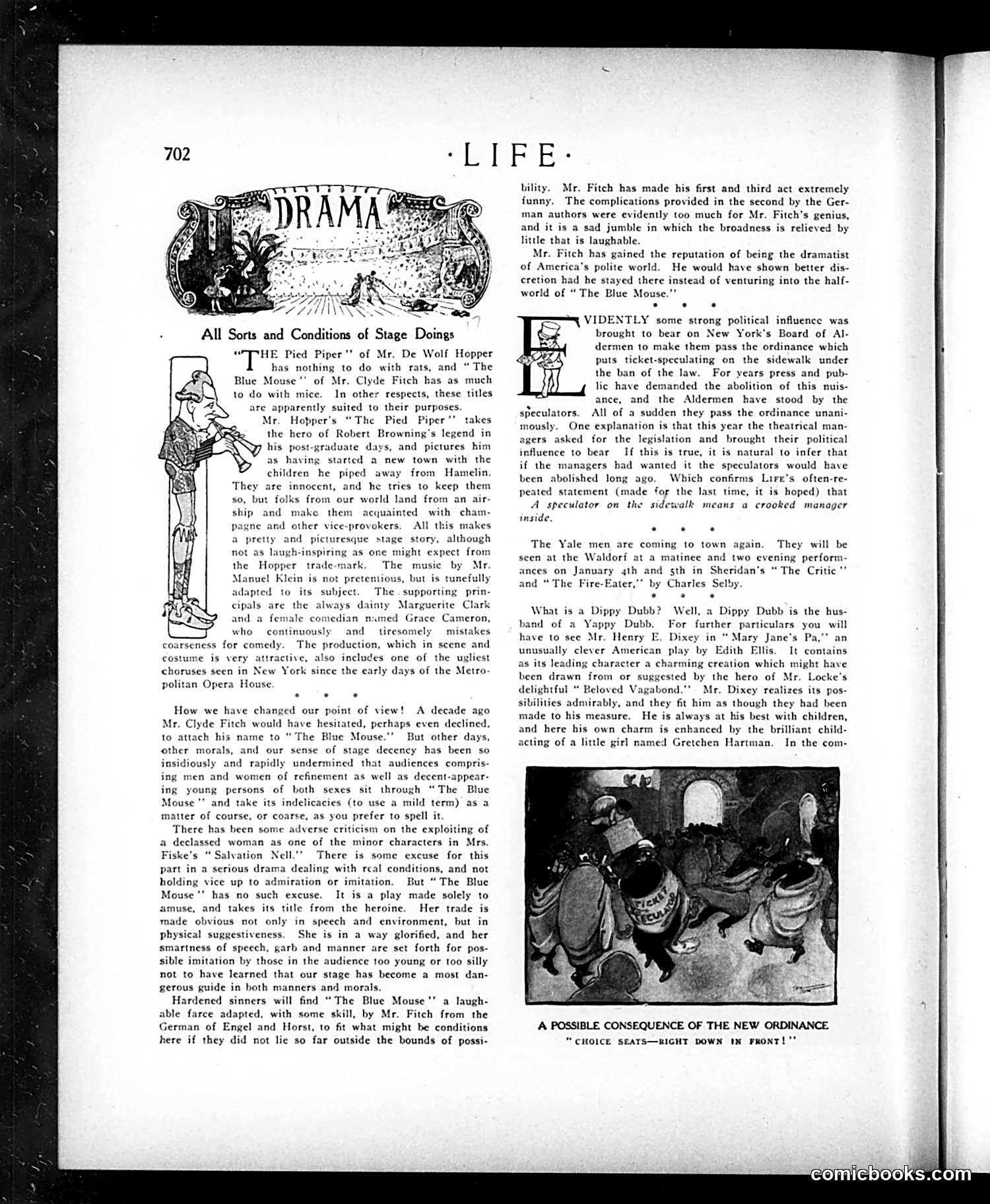
This page critiques two theatrical productions and addresses ticket speculation legislation. **The Drama Section** reviews "The Blue Mouse," a Clyde Fitch play adapted from German sources. The critic argues the play glorifies a sex worker ("declassed woman") purely for entertainment and moral corruption—unlike serious dramas addressing real social conditions. The reviewer laments how theater standards have declined, with mixed-sex audiences now accepting "indelicacies" without objection. Fitch, known for refined comedies, is criticized for abandoning his reputation by venturing into this "half-world." **The Political Cartoon** (bottom) satirizes sudden passage of an anti-ticket-speculation ordinance by New York's Board of Aldermen. The caption suggests "strong political influence" forced passage after years of public and press demands went ignored. The cartoon depicts the absurd outcome: theater patrons forced into front-row "choice seats" against their preference—implying unintended consequences of poorly considered legislation or that corrupt influence merely produces ridiculous rather than genuinely protective laws. Both segments reflect Progressive-era concerns about morality, legislative corruption, and cultural standards.
📄 Transcribed text from this page (OCR, searchable)
Machine-transcribed from the original scan — historical spelling and the odd misread are preserved.
“ESP RSEC f Stage Doings “THE Pied Piper’’ of Mr. De Wolf Hopper has nothing to do with rats, and “The Blue Mouse "’ of Mr. Clyde Fitch has as much to do with mice. In other respects, these titles arently suited to their purposes. Hopper's “The Pied Piper’? takes the hero of Robert Browning’s | i his post-graduate days, and pictur: as having started a new town with the children he piped away from Hamelin. They are innocent, and he tries to keep them so, but folks from our world land from an air- ship and make them acquainted with cham- pagne and other vice-provokers. All this makes a pretty and picturesque stage story, although not as laugh-inspiring as one might expect from the Hopper trade-mark. The music by Mr. Manuel Klein is not pretentious, but is tunefully pted to its subject. The. supporting prin- always dainty Marguerite Clark dian named Grace Cameron, who nuously and tiresomely mistakes The production, which in scene and one of the ugliest cipals are th and a female co coarseness for comedy. costume is very attractive, also includ choruses seen in New York since the early days of the Metro. politan Opera House. How we have changed our point of view! A decade ago Mr. Clyde Fitch would have hesitated, perhaps even declined, to attach his name to “The Blue Mouse."’ But other other morals, and our sense of stage decency has been so insidiously and rapidly undermined that audiences compris- ing men and women of refinement as well as decent-appear- ing young persons of both sexes sit through “The Blue Mouse "’ and take its indelicacies (to use a mild term) as a matter of course, or coarse, as you prefer to spell it There has been some adverse criticism on the exploiting of a declassed woman as one of the minor characters in Mrs. Fiske’s “Salvation Nell.” There is some excuse for this part in a serious drama dealing with rcal conditions, and not holding vice up to admiration or imitation. But “The Blue Mouse"? has no such excuse. It is a play made solely to amuse, and takes its title from the heroine. Her trade is made obvious not only in speech and environment, but in physical suggestiveness. She is in a way glorified, and her smartness of speech, garb and manner are set forth for pos- sible imitation by those in the audience too young or too silly not to have learned that our stage has become a most dan- gerous guide in both manners and morals Hardened sinners will find “The Blue Mouse’? a laugh- able farce adapted, with some skill, by Mr. Fitch from the German of Engel and Horst, to fit what might be conditions here if they did not lie so far outside the bounds of possi- bility. Mr. Fitch has made his first and third act extremely funny. The complications provided in the second by the Ger- man authors were evidently too much for Mr. Fitch's genius, and it is a sad jumble in which the broadness is relieved by little that is laughable. Mr. Fitch has gained the reputation of being the dramatist of America's polite world. He would have shown better dis- cretion had he stayed there instead of venturing into the half- world of “The Blue Mouse.”” 8 8 VIDENTLY some strong political influence was brought to bear on New York's Board of Al- dermen to make them pass the ordinance which puts ticket-speculating on the sidewalk under the ban of the law. For years press and pub- lic have demanded the abolition of this nuis- ance, and the Aldermen have stood by the speculators. All of a sudden they pass the ordinance unani- mously. One explanation is that this year the theatrical man- agers asked for the legislation and brought their political influence to bear If this is true, it is natural to infer that if the managers had wanted it the speculators would have been abolished long ago. Which confirms Lire’s often-re- peated statement (made for the last time, it is hoped) that A speculator on the sidewalk means a crooked manager inside. The Yale men are coming to town again. They will be seen at the Waldorf at a matinee and two evening perform- ances on January 4th and sth in Sheridan's “The Critic and “The Fire-Eater,"” by Charles Selby. What is a Dippy Dubb? Well, a Dippy Dubb is the hus- band of a Yappy Dubb, For further particulars you will have to see Mr. Henry E. Dixey in “ Mary Jane's Pa,’? an unusually clever American play by Edith Ellis. It contains a its leading character a charming creation which might have been drawn from or suggested by the hero of Mr. Locke’s delightful “ Beloved Vagabond.’? Mr. Dixey realizes its pos- 's admirably, and they fit him as though they had been made to his measure. He is always at his best with children, and here his own charm is enhanced by the brilliant child- acting of a little girl named Gretchen Hartman. In the com- A POSSIBLE CONSEQUENCE OF THE NEW ORDINANCE “CHOICE SEATS—RIGHT DOWN IN FRONT!"