
Life, 1908-12-17 · page 8 of 28
Life — December 17, 1908 — page 8: what you’re looking at
What you’re looking at
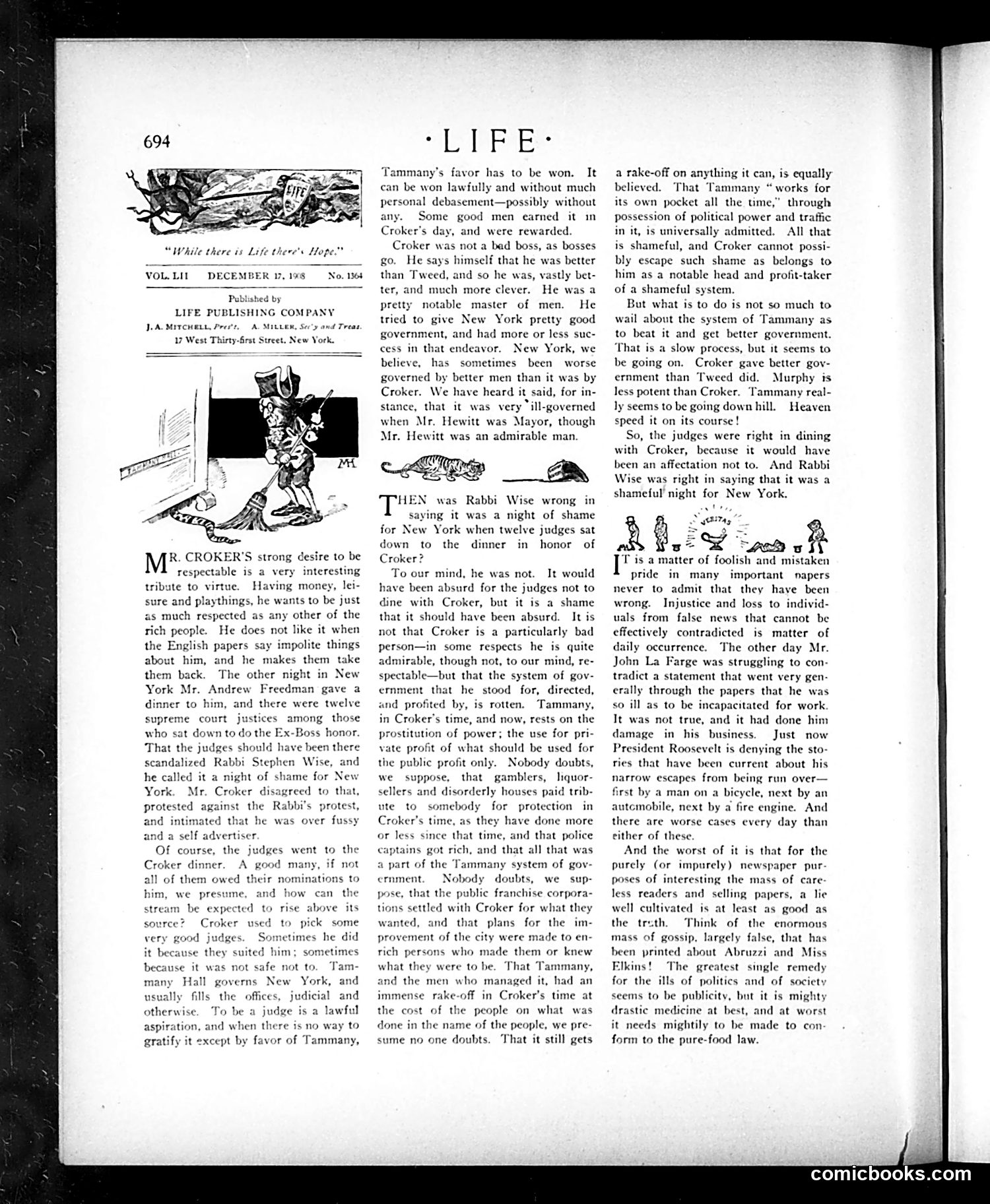
This page discusses New York City political corruption under Mayor Richard Croker, the Democratic Tammany Hall boss. The text criticizes Croker's administration as worse than his predecessor's, noting that judges attended a dinner honoring Croker—which the article calls shameful. The cartoons (small illustrations) appear to depict scenes of political malfeasance and bribery, though specific figures are unclear in reproduction. The central argument: Tammany Hall's system of using government power for private profit is rotten, and even good men become corrupted by it. The article advocates for systemic reform rather than relying on individual virtue, and criticizes newspapers for sensationalizing political scandals while failing to effectively combat corruption. This reflects Progressive Era criticism of urban political machines.
📄 Transcribed text from this page (OCR, searchable)
Machine-transcribed from the original scan — historical spelling and the odd misread are preserved.
“While there is Life ther VOL.LIL DECEMBER 17, 198 Published by LIFE PUBLISHING COMPANY JA. MITCHELL Preet, A. MILLER, Sec'y ond Treas 17 West Thirty-frst Street. New Vork. R. CROKER respectable is a very interesting tribute to virtue. Having money, lei- sure and playthings, he wants to be just as much respected as any other of the rich people. He does not like it when the English papers say impolite things about him, and he makes them take them back. The other night in New York Mr. Andrew Freedman gave a dinner to him, and there were twelve supreme court j among those who down to do the Ex-Boss honor. That the judges should have been there scandalized Rabbi Stephen Wise, and he called it a night of shame for New York. Mr. Croker disagreed to that, protested against the Rabbi's protest, strong desire to be stices and intimated that he was over fussy and a self advertiser. Of course, the judges went to the Croker dinner. A good many, if not all of them owed their nominations to him, we presume, and how can the stre be expected to rise above its Croker used to pick some udges. Sometimes he did source? very good it because they suited him; sometimes because it was not safe not to. Tam- many Hall governs New York, and usually fills the offices, judicial and otherwise. To be a judge wful aspiration, and wv to gratify it except by favor of Tammany, ga by Le) Tammany’s favor has to be won. It can be won lawfully and without much personal debasement—possibly without any. Some good men earned it in Croker’s day, and were rewarded. Croker was not a bad boss, as bosses go. He says himself that he was better than Tweed, and so he was, vastly bet- ter, and much more clever. He was a pretty notable master of men. He tried to give New York pretty good government, and had more or less suc- cess in that endeavor. New York, we believe, has sometimes been worse governed by better men than it was by Croker. We have heard it said, for in- stance, that it was very ‘ill-governed when Mr. Hewitt was Mayor, though Mr. Hewitt was an admirable man. aS. ae HEN was Rabbi Wise wrong in saying it was a night of shame for New York when twelve judges sat down to the dinner in honor of Croker? To our mind, he was not. It would have been absurd for the judges not to dine with Croker, but it is a shame that it should have been absurd. It is not that Croker is a particularly bad person—in some respects he is quite admirable, though not, to our mind, re- spectable—but that the system of gov- ernment that he stood for, directed, and profited by, is rotten. Tammany, in Croker’s time, and now, rests on the prostitution of power; the use for pri- vate profit of what should be used for the public profit only. Nobody doubts, we suppose, that gamblers, liquor- sellers and disorderly houses paid trib- ute to somebody for protection in Croker’s time, as they have done more or less since that time, and that police captains got rich, and that all that was a part of the Tammany system of gov- ernment. Nobody doubts, we sup- pose, that the public franchise corpora- tions settled with Croker for what they wanted, and that plans for the im- provement of the city were made to en- rich persons who made them or knew what they were to be. That Tammany, d the men whe immense rake-off in Croker’s time at of the people on what was done in the name of the people, we pre- That it still gets the cost sume no one doubts. a rake-off on anything it can, is equally believed. That Tammany “works for its own pocket all the time,” through possession of political power and traffic in it, is universally admitted. All that is shameful, and Croker cannot possi- bly escape such shame as belongs to him as a notable head and profit-taker of a shameful system. But what is to do is not so much to wail about the system of Tammany as to beat it and get better government. ‘That is a slow process, but it seems to be going on. Croker gave better gov- ernment than Tweed did. Murphy is less potent than Croker. Tammany real- ly seems to be going down hill. Heaven speed it on its course! So, the judges were right in dining with Croker, because it would have been an affectation not to. And Rabbi Wise was right in saying that it was a shameful’ night for New York. sa matter of foolish and mistaken pride in many important papers never to admit that they have been wrong. Injustice and loss to individ- uals from false news that cannot be effectively contradicted is matter of daily occurrence. The other day Mr. John La Farge was struggling to con- tradict a statement that went very gen- erally through the papers that he was so ill as to be incapacitated for work It was not true, and it had done him damage in his business. Just now President Roosevelt is denying the sto- ries that have been current about his narrow escapes from being run over— first by a man on a bicycle, next by an automobile, next by a fire engine. And there are worse cases every day than either of thes And the worst of it is that for the purely (or impurely) newspaper pur- poses of interesting the mass of care- less readers and selling papers, a lie well cultivated is at least as good as the treth. Think of the enormous mass of gossip, largely false, that has been printed about Abruzzi and Miss Elkins! The greatest single remedy for the ills of politics and of society seems to be publicity, but it is mighty drastic medicine at best, and at worst it needs mightily to be made to con- form to the pure-food law. comicbooks.com