
A complete issue · 24 pages · 1908
Life — March 19, 1908
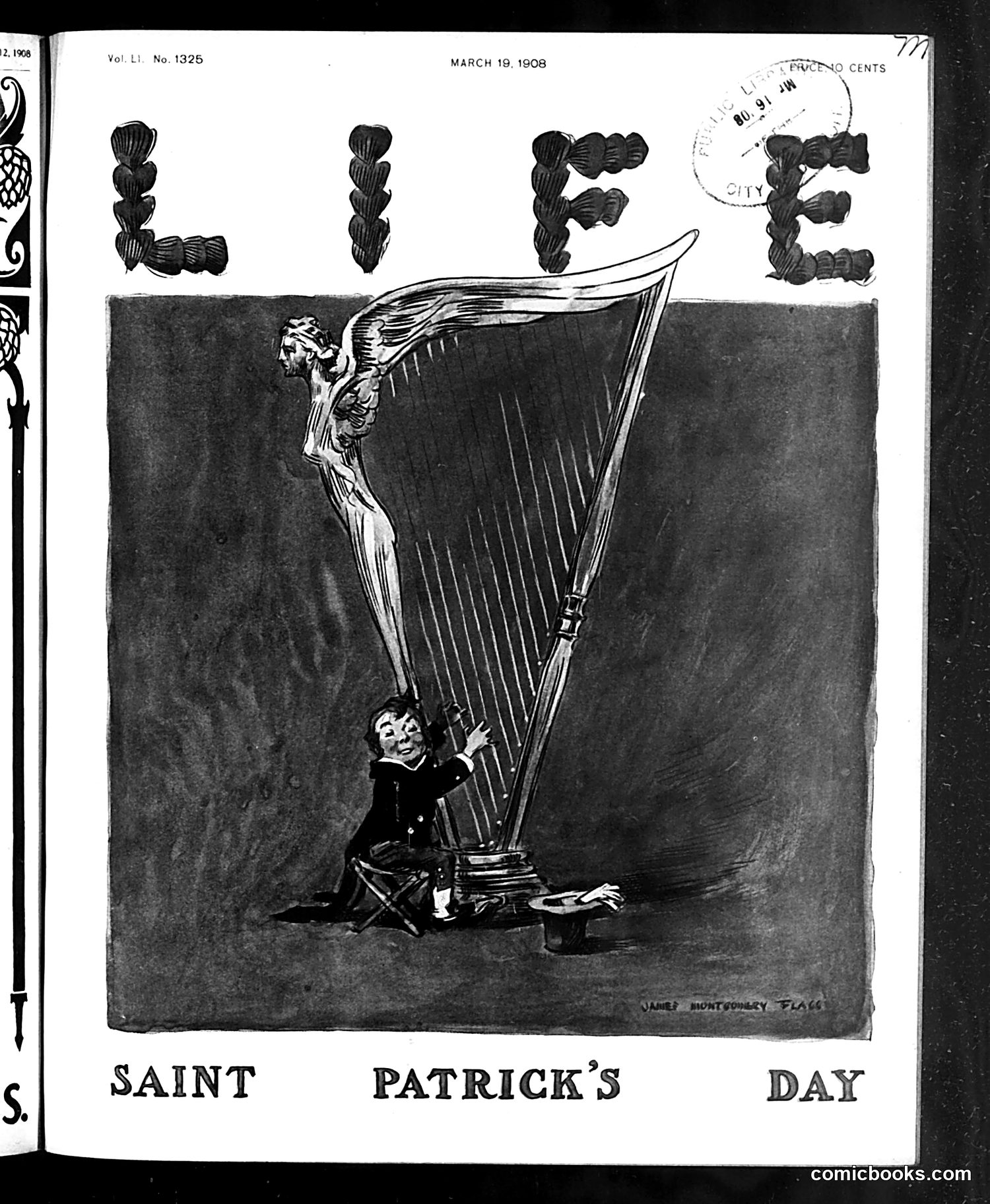
This is a Life magazine cover illustration for Saint Patrick's Day. The cartoon depicts a cherubic child playing a large harp, positioned above a winged angelic or allegorical female figure. The letters "LIFE" appear spelled out at the top in decorative block letters made from ornamental designs. The illustration uses classical artistic imagery—the harp-playing child and ethereal female form—to create an idealized, whimsical representation of the holiday. The style is typical of early 20th-century satirical magazine cover art, employing allegorical figures rather than direct political commentary or caricature. The artistic approach appears celebratory rather than satirical, presenting Saint Patrick's Day as a subject for artistic appreciation rather than social or political critique.
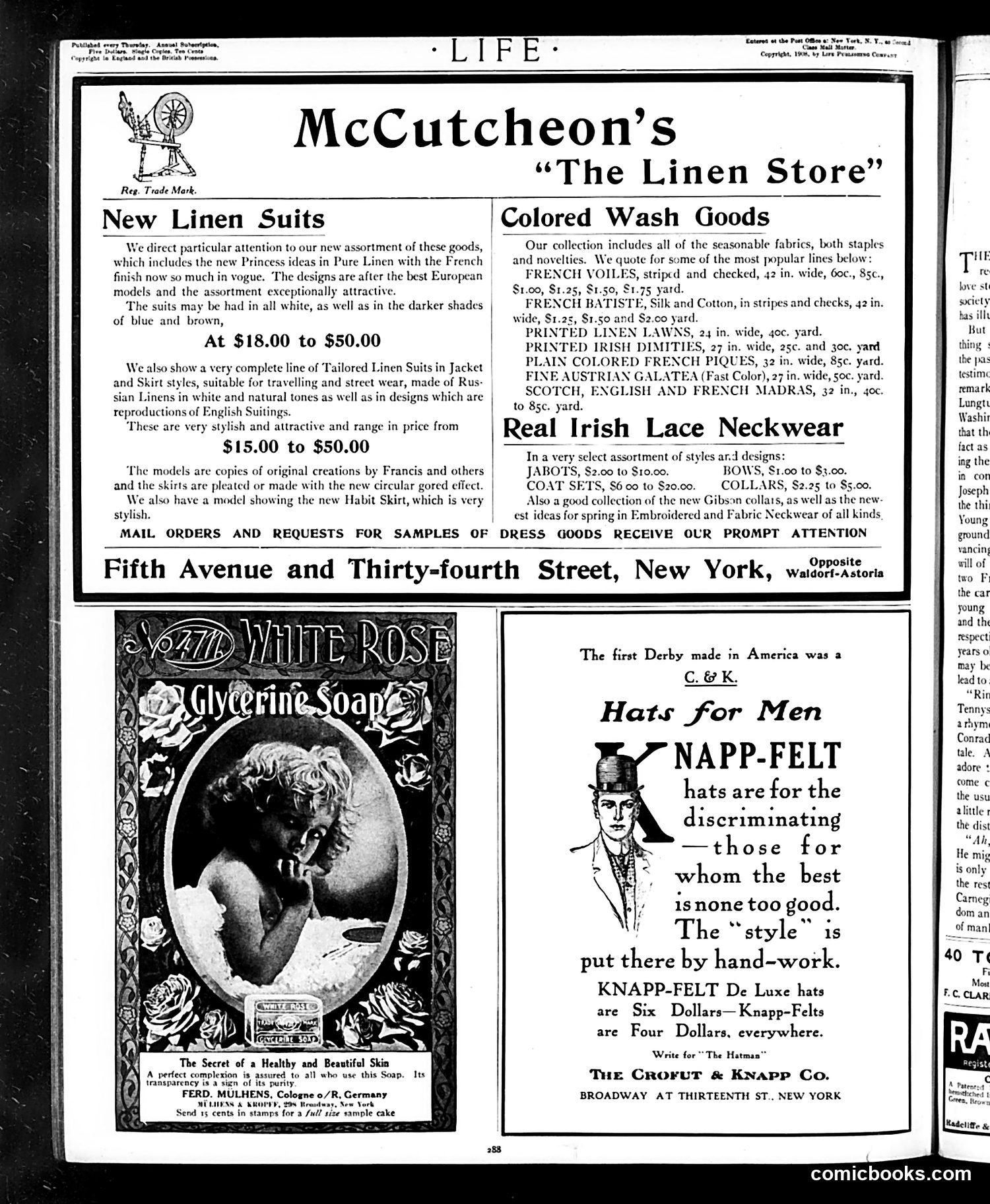
This page is primarily **advertising, not satire or political commentary**. It contains three advertisements: 1. **McCutcheon's "The Linen Store"** (top): Promotes linen suits and Irish lace neckwear at Fifth Avenue and 34th Street, New York. 2. **White Rose Glycerine Soap** (bottom left): Features a classical portrait of a woman and claims to be "The Secret of a Healthy and Beautiful Skin," manufactured in Cologne, Germany. 3. **Napp-Felt Hats** (bottom right): Advertises men's hats as handcrafted luxury goods for "the discriminating," priced at $4-6. There is no political cartoon or satirical content visible. The page reflects early 20th-century consumer advertising, targeting affluent readers with luxury goods for clothing, grooming, and personal care.
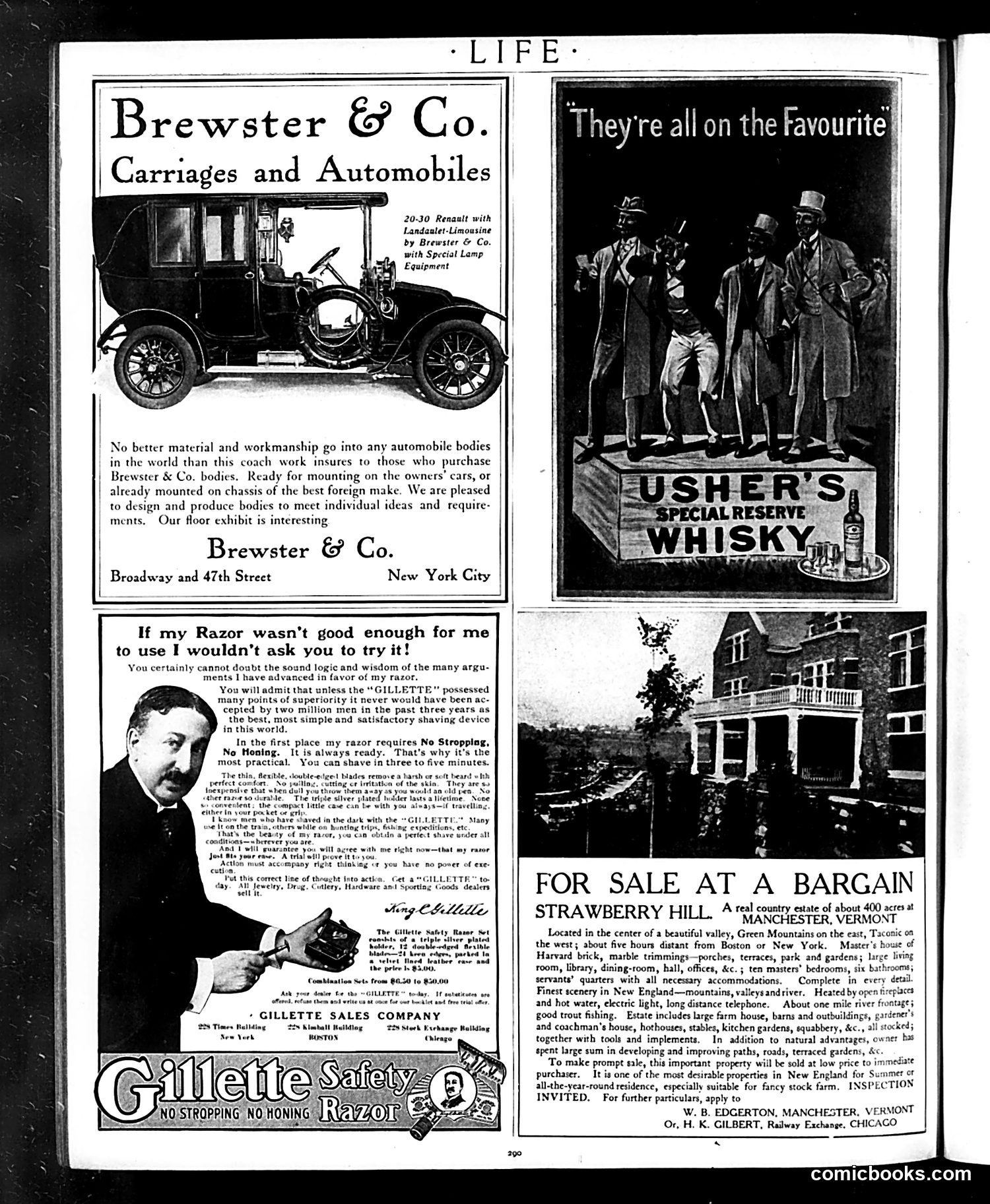
This page is **primarily advertising** with no discernible political cartoons or satire. The content includes: 1. **Brewster & Co.** - Advertisement for luxury automobiles and carriage bodies, emphasizing craftsmanship and customization 2. **Usher's Special Reserve Whisky** - Ad featuring well-dressed gentlemen, capitalizing on the product's popularity 3. **Gillette Safety Razor** - The largest ad, featuring a testimonial (attributed to a signature, possibly a celebrity endorsement) promoting the razor's ease of use and superiority over stropping methods 4. **Strawberry Hill Property** - Real estate listing for a Vermont country estate The page reflects early 20th-century consumer culture, targeting affluent readers with luxury goods and services. There is no identifiable political commentary or satirical content visible.
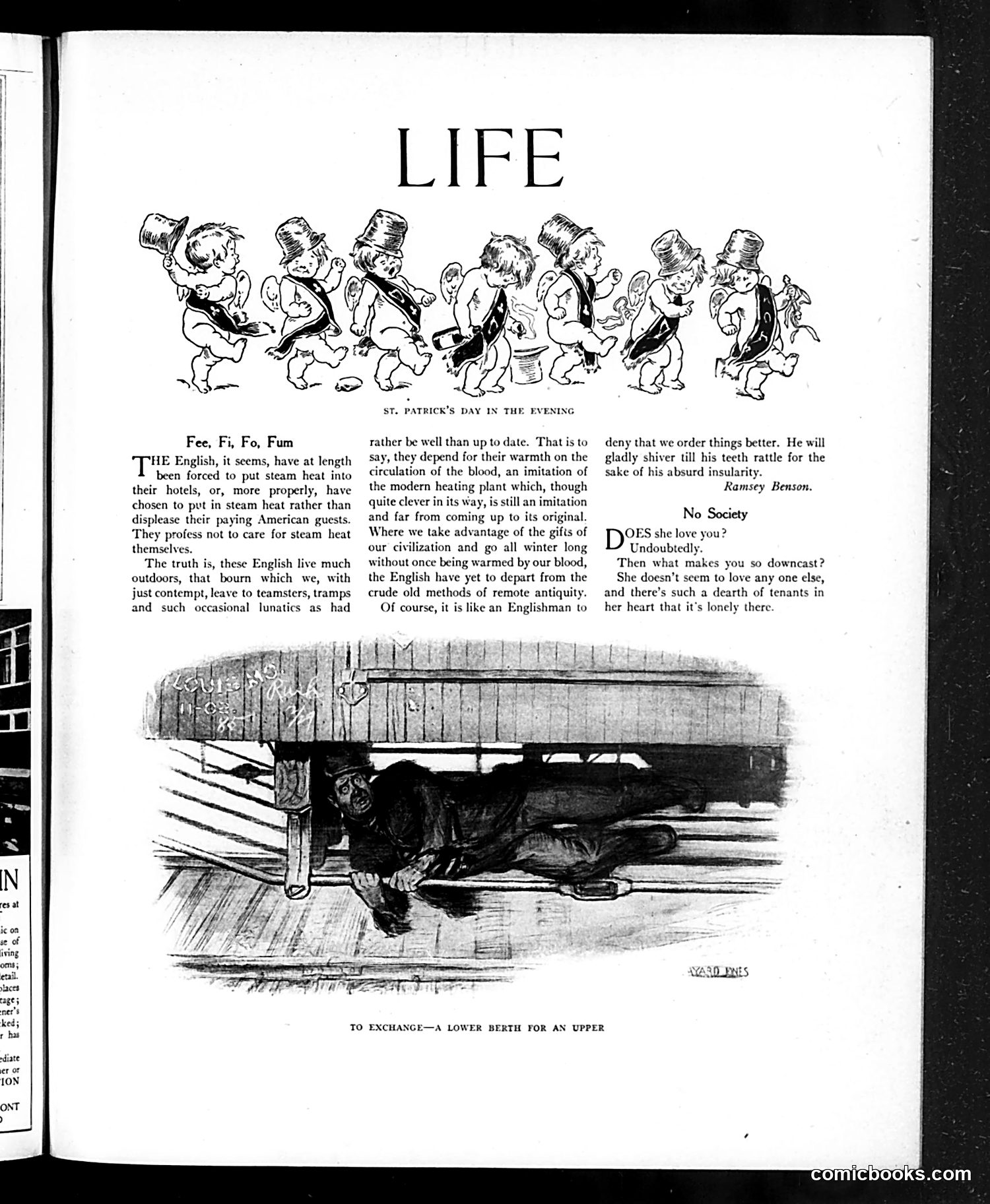
**Top Cartoon ("St. Patrick's Day in the Evening"):** Eight cherubic figures in formal attire with top hats parade in a line, appearing festive and progressively intoxicated. This satirizes St. Patrick's Day celebrations, particularly among English and Irish immigrants, mocking the holiday's association with excessive drinking. **Main Illustration ("To Exchange—A Lower Berth for an Upper"):** A disheveled man lies beneath a train berth in cramped quarters, depicted miserably. The caption suggests dark humor about travel discomfort or perhaps a social commentary on class distinctions in railway accommodations. **Text Section:** Discusses English attitudes toward steam heating versus traditional methods, suggesting cultural resistance to modern conveniences. The overall page uses humor to critique social customs and technological attitudes of the era.
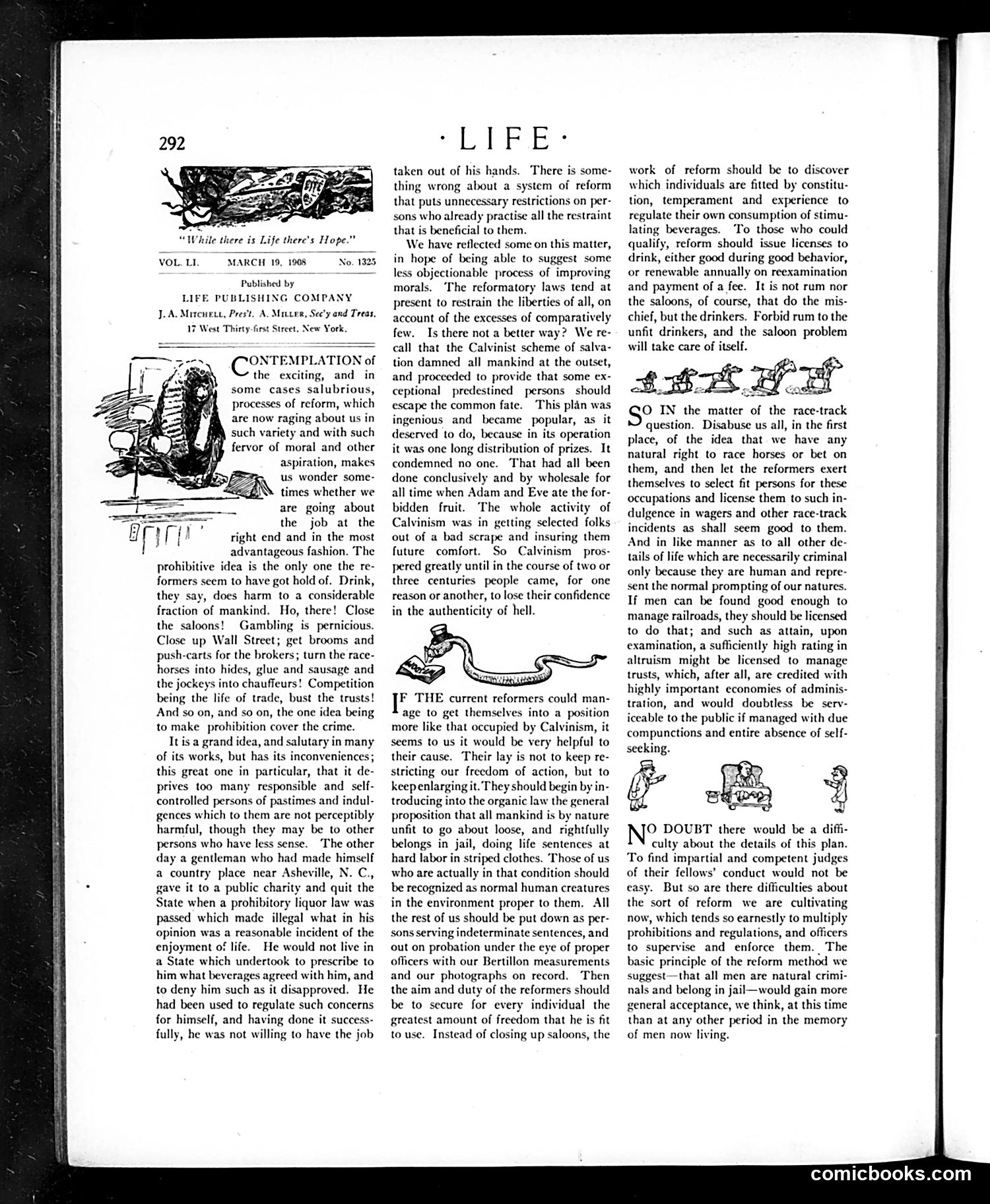
The page contains an article titled "Contemplation of the Exciting, and in Some Cases Salubrious, Processes of Reform" with three small illustrations integrated into the text. The illustrations appear to satirize various reform movements of the Progressive Era. One sketch shows what appears to be a person in distress or confined conditions. Another depicts a snake-like figure. A third shows multiple figures in what seems to be a domestic or institutional setting. The article's tone is skeptical of overzealous reformers, arguing that reform should be practical rather than idealistic. It critiques Calvinism and gambling prohibitions while suggesting that some reforms (like railroad management and prison reform) require expert licensing and judgment rather than blanket prohibition. The satire mocks reform movements that seem impractical or moralistic rather than addressing genuine social problems.
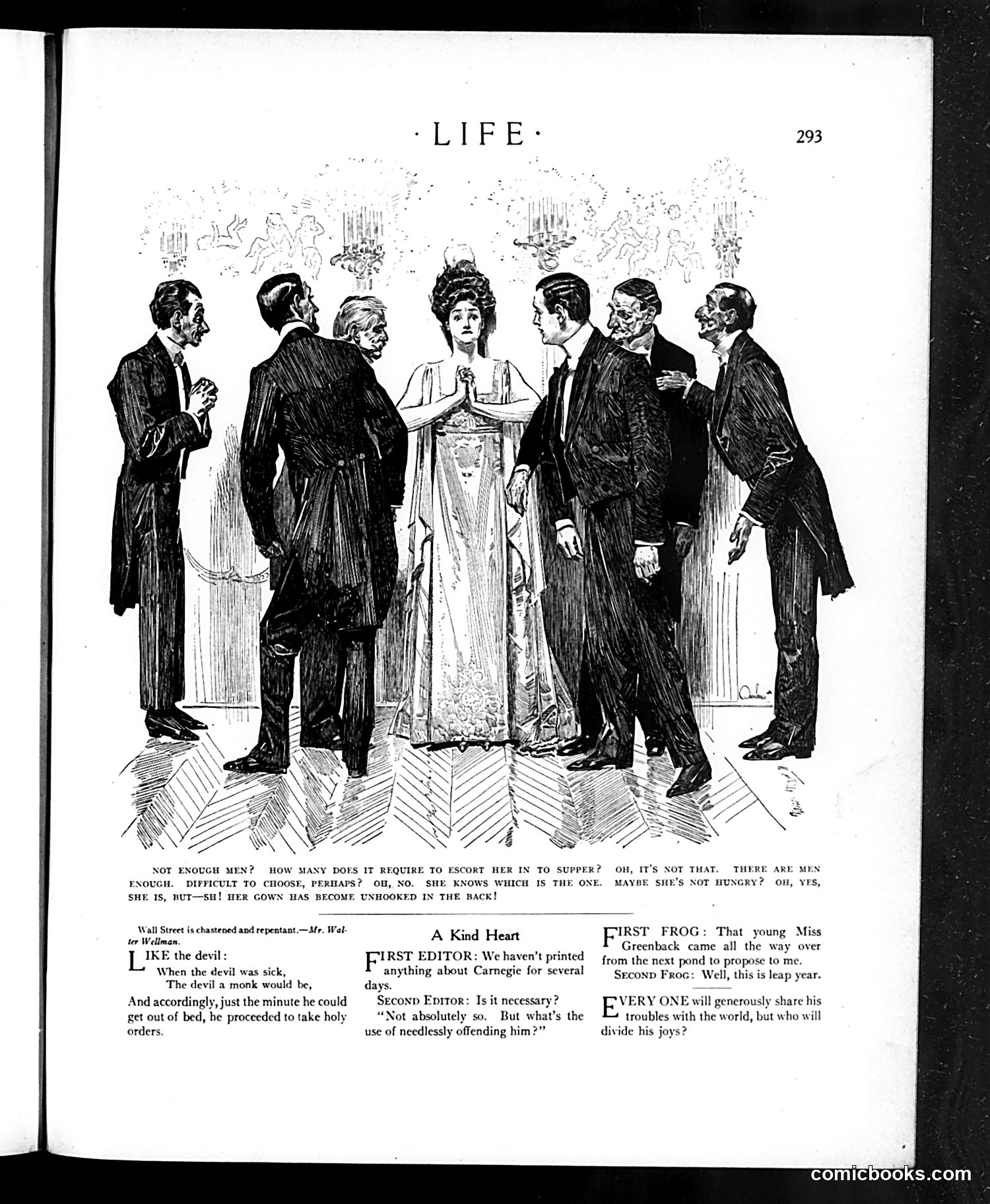
This Life magazine page contains two separate pieces of social satire. The **main illustration** depicts a woman in an elegant gown surrounded by five men in formal attire, likely at a social event. The caption humorously addresses the practical problem of escorting a woman to dinner—joking that while there are "enough men," choosing which one is difficult. The satire mocks upper-class social conventions and the awkwardness of formal courtship rituals. Below are two brief comic dialogues: "Like the Devil" (a religious joke about monks and illness) and "A Kind Heart" (about sharing troubles and joys). These are simple moral humor pieces typical of early 20th-century magazines. The page satirizes Victorian-era social etiquette and gender dynamics around formal entertainment and companionship among the wealthy.
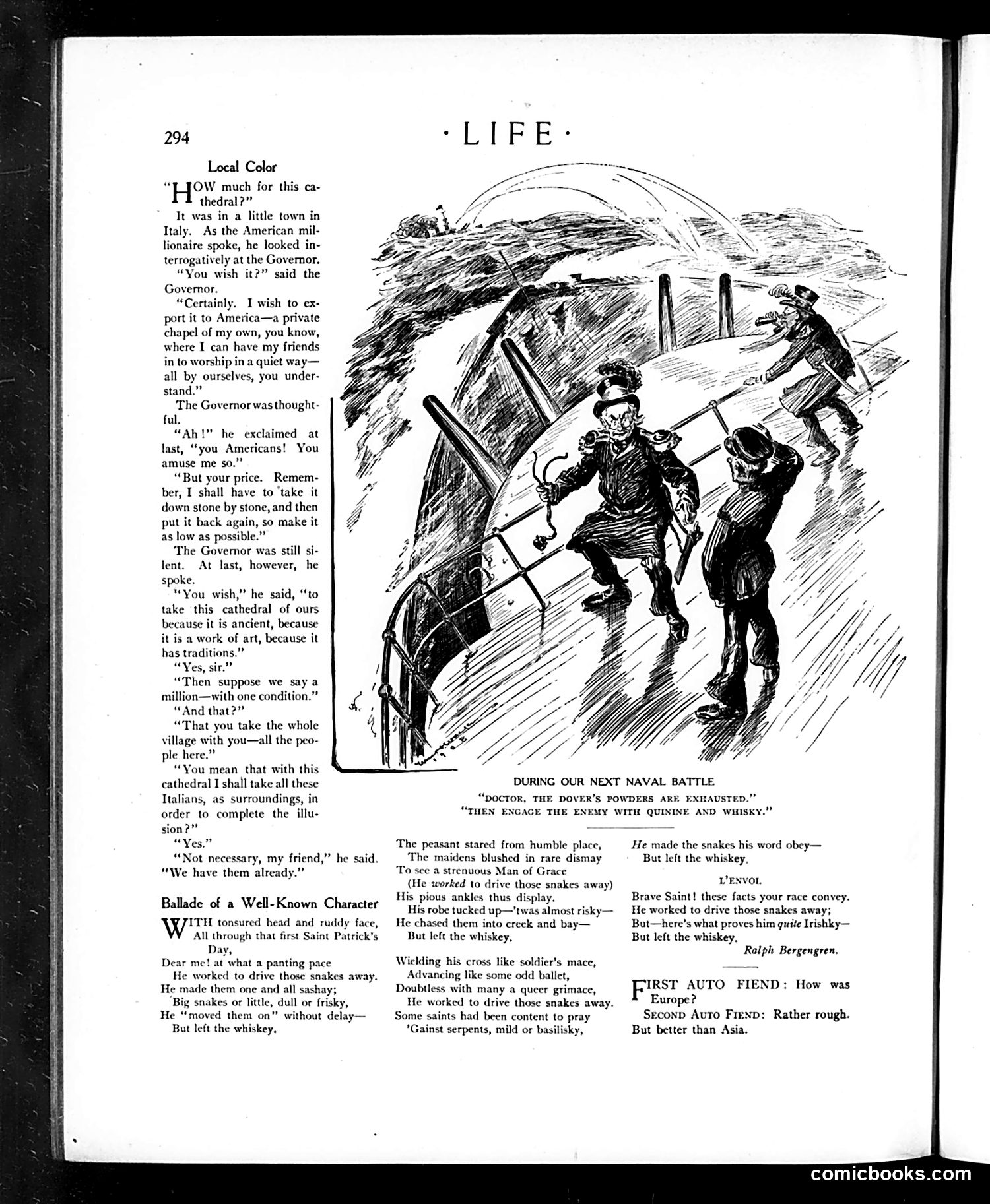
This page from *Life* magazine contains satirical text and an illustration mocking American attitudes toward acquiring European cultural treasures. The main dialogue ("Local Color") depicts an American millionaire negotiating to buy an Italian cathedral—literally disassembling and exporting it stone-by-stone to America. The Governor's agreement to sell "the whole village with you" satirizes both American wealth-driven acquisitiveness and European willingness to commodify their heritage. The accompanying illustration shows figures with surveying equipment examining a cathedral, literalizing the absurd premise. Below are poems mocking religious pretense and military incompetence ("the dove's powders are exhausted"), with a concluding exchange trivializing European conflicts as less important than American industrial progress. The satire targets American materialism and cultural imperialism of the early 20th century.
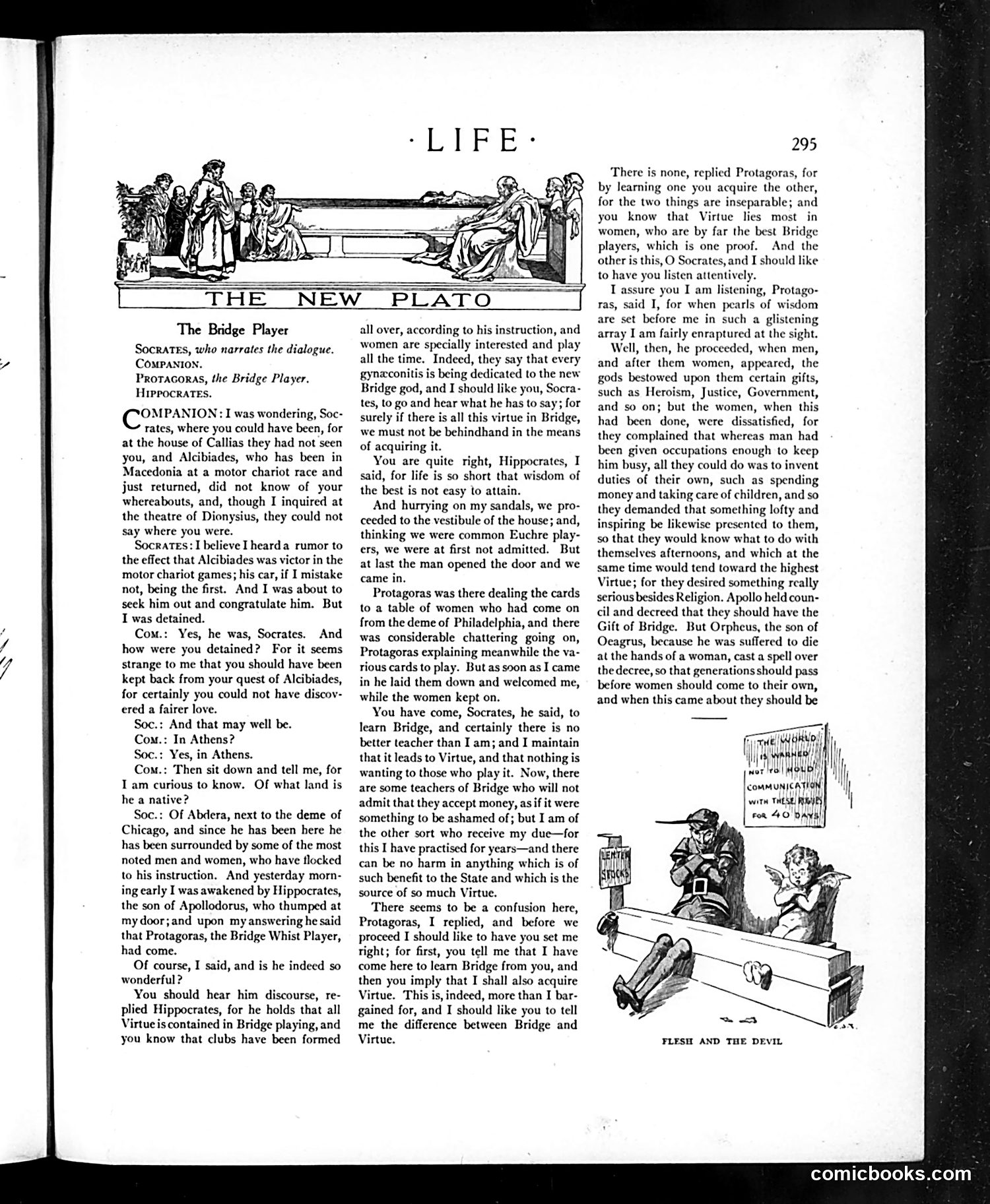
This page presents "The Bridge Player," a Platonic dialogue where Socrates questions Protagoras and Hippocrates about Bridge—a card game that was apparently becoming culturally significant enough to merit philosophical treatment. The satire mocks the pretension of treating a parlor game with serious philosophical weight. The dialogue humorously debates whether Bridge teaching requires payment, whether it leads to Virtue, and the distinction between Bridge skill and actual Virtue itself. The bottom cartoon, "Flesh and the Devil," appears unrelated—a separate satirical illustration about temptation. The overall joke: elevating a mere card game to the status of ancient Greek philosophical inquiry, poking fun at both Bridge's cultural importance and contemporary intellectual pretension.
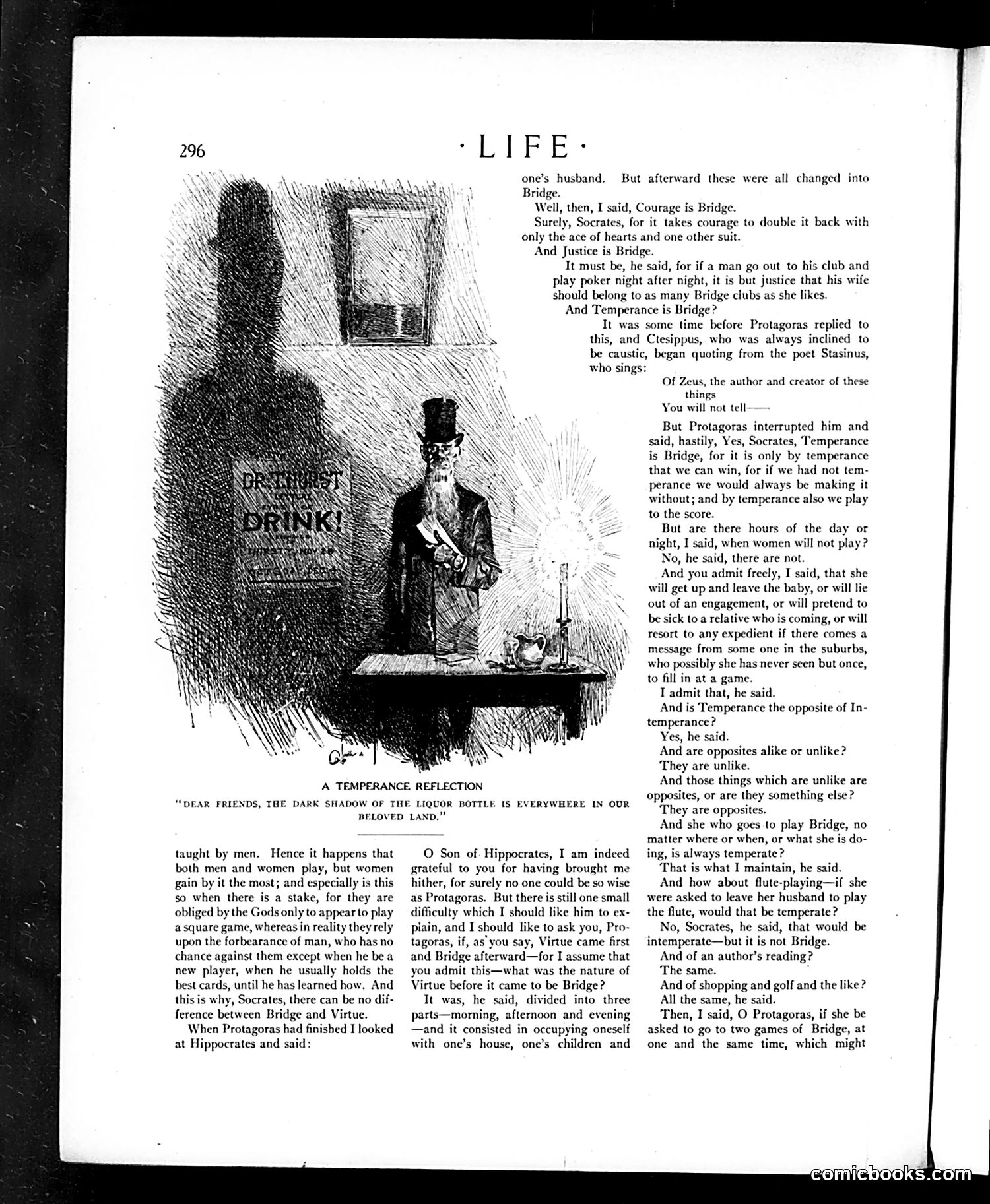
This cartoon satirizes the temperance movement's hypocrisy regarding gender and social rules. The illustration shows a man at a window labeled "DRINK!" — suggesting he frequents bars despite temperance advocacy. The accompanying dialogue presents Socrates debating whether women should play Bridge (a card game). The satire argues that temperance advocates claim virtue requires women to avoid Bridge entirely, yet these same men frequent drinking establishments without similar restrictions. The caption quote — "the dark shadow of the bottle is everywhere in our beloved land" — mocks temperance rhetoric while the cartoon exposes the double standard: men lecture women about moral discipline while exempting themselves from equivalent restraint. The satire criticizes both temperance extremism and gender hypocrisy.
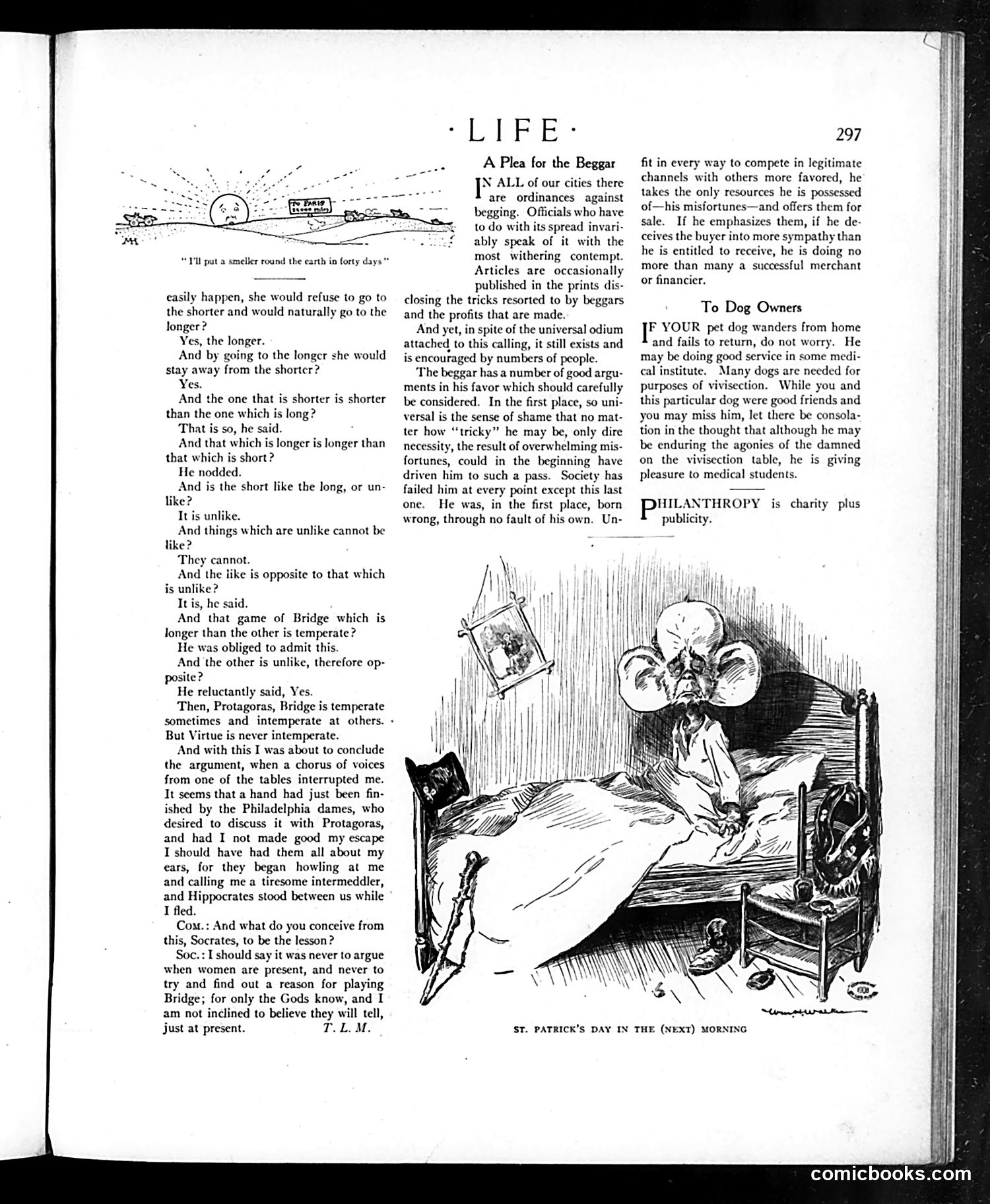
This page contains philosophical dialogue and social commentary rather than political cartoons. The left column presents a Socratic debate about Bridge (the card game), discussing whether virtue can be "temperate" (moderation) or must be absolute. The dialogue references Protagoras and Hippocrates, suggesting classical philosophical discourse. The right side offers two separate pieces: "A Plea for the Beggar" argues that beggars deserve sympathy despite city ordinances against them, and "To Dog Owners" humorously advises that lost dogs will return home. The illustration depicts a sick child in bed with a dog at the foot, captioned "St. Patrick's Day in the (Next) Morning"—likely satirizing how dogs might be blamed for spreading illness or causing mischief in households. The overall page blends philosophical debate with practical social commentary typical of early 20th-century satirical magazines.
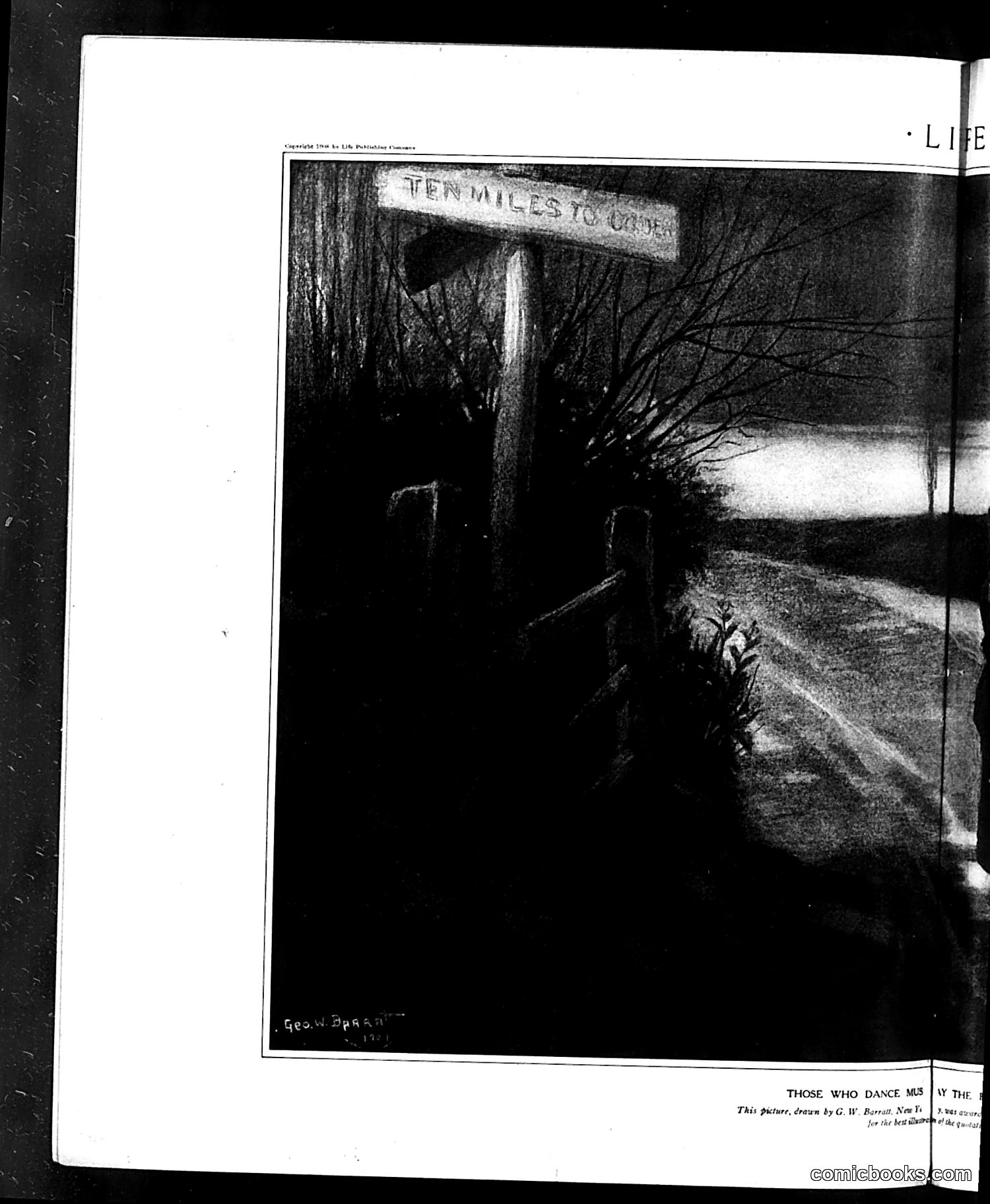
This page from *Life* magazine features a dark, atmospheric photograph titled "Those Who Dance Must Pay the Piper" with a caption crediting the image to G.W. Burratt. The image shows a nighttime scene at what appears to be "Ten Miles to Dinner" (visible on a sign), depicting a rural or roadside location with bare trees and a path. The phrase "Those Who Dance Must Pay the Piper" is a proverbial expression meaning consequences follow pleasure or indulgence. Without additional context or visible satirical elements, the cartoon's specific political or social commentary remains unclear from this image alone. The metaphorical title suggests commentary on some form of indulgence or misbehavior and its repercussions, though the exact subject is not determinable from what's visible.
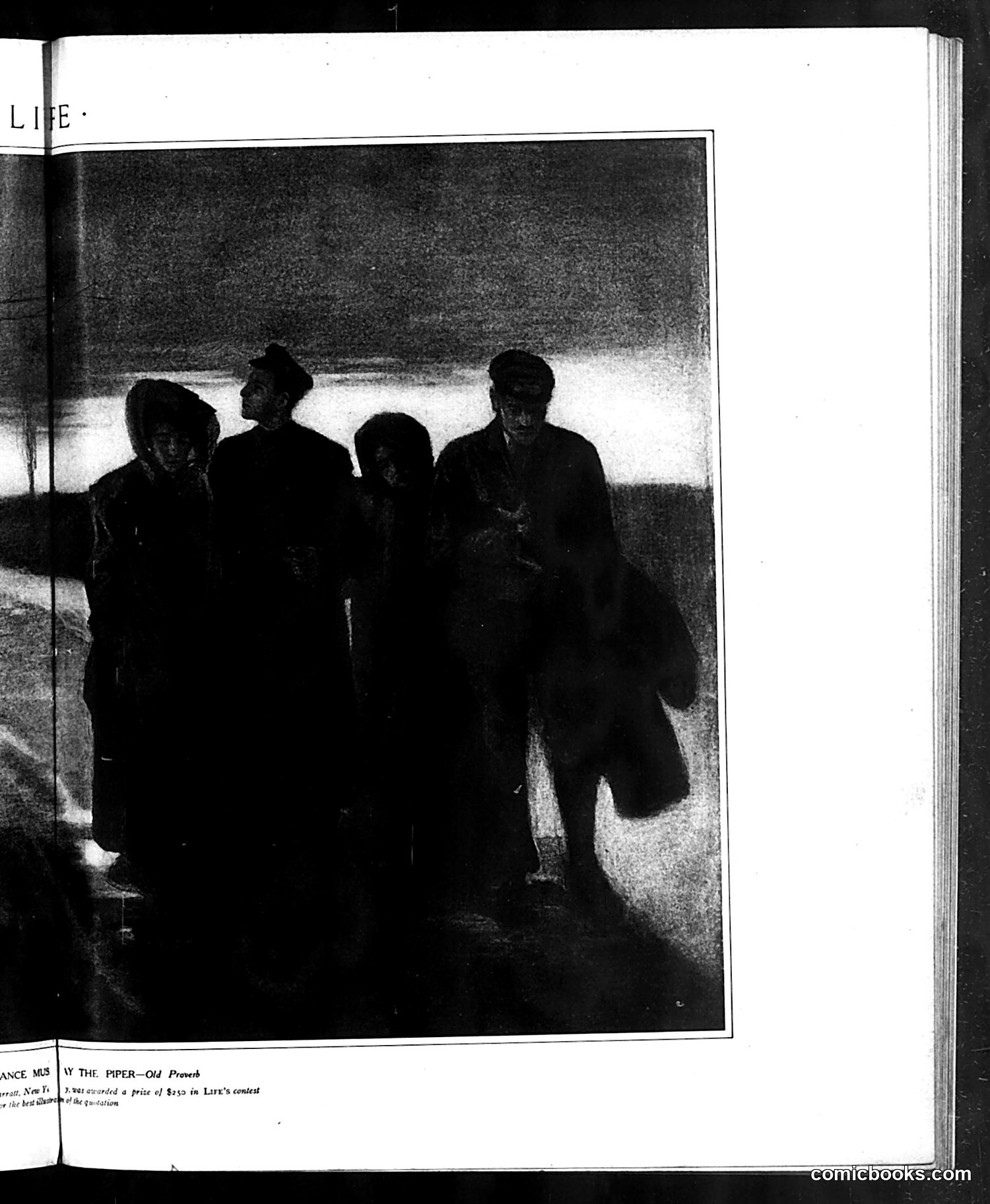
This page from *Life* magazine shows a photograph of four silhouetted figures against a light background, appearing to be from a theatrical or artistic work. The caption references "THE PIPER—OH Proverb" and mentions that the work "received a prize of $750 in LIFE's contest," suggesting this is documentation of a contest-winning artistic piece or photograph. The silhouettes' poses and grouping suggest they may represent figures from a literary or biblical narrative—possibly referencing the "Pied Piper" legend. However, without clearer text visibility, the specific political or social satire intended remains unclear. The image itself appears to be primarily documentary rather than overtly satirical in nature.
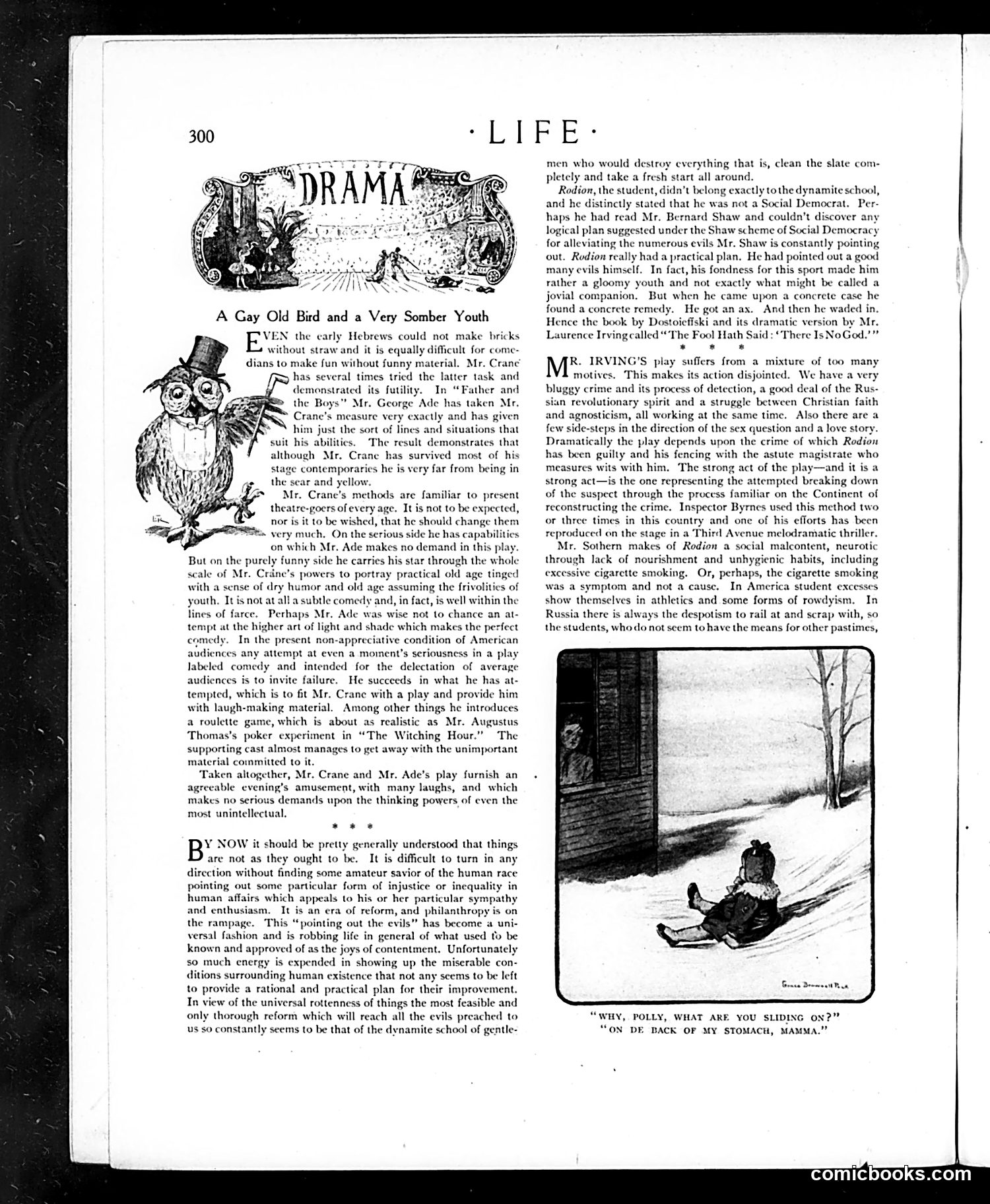
This page reviews a stage play starring **William Crane** (the owl caricature), paired with playwright **George Ade**. The critic praises their lightweight farce as appropriate entertainment—acknowledging Crane's comedic talents while noting the play makes no intellectual demands on audiences. The second article satirizes the era's reform movements and radical politics. It references **Rodion**, apparently a character from Dostoevsky's *Crime and Punishment*, critiquing "dynamite school" anarchists and Social Democrats who spend energy denouncing societal evils without proposing practical solutions. The satirist suggests these reformers are more interested in destruction than actual improvement. The accompanying illustration (captioned "Why, Polly, what are you sliding on? / On de back of my stomach, Mamma") appears to be unrelated comedic filler—a child sledding on an adult's belly. The satire targets both impractical radical philosophy and the era's obsession with "pointing out evils" without constructive remedies.
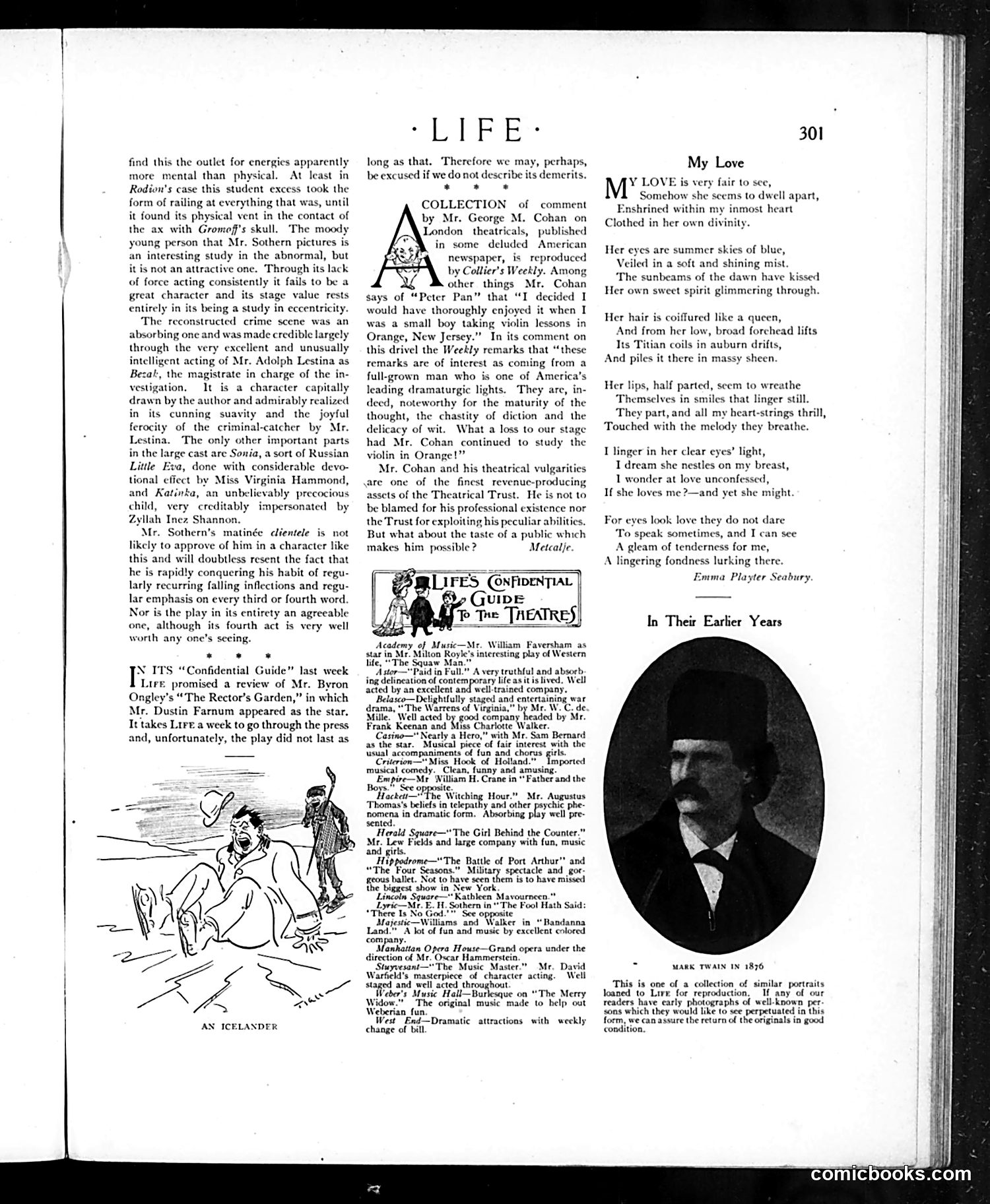
This page contains theater reviews and criticism. The main satirical content targets **George M. Cohan**, a prominent American playwright and producer. **The Joke:** Cohan publicly commented that he would have "thoroughly enjoyed" *Peter Pan* if he'd seen it as a child taking violin lessons in Orange, New Jersey. Life's critic mocks this as absurdly immature commentary from a "full-grown man" and "one of America's leading dramaturgic lights," sarcastically suggesting Cohan should have stuck with violin. **The Broader Point:** The critic argues Cohan represents theatrical vulgarity that's nonetheless profitable for the Theatrical Trust (a monopolistic production company). Rather than blame Cohan personally, the writer blames the public's poor taste for enabling him. **Visual Element:** An illustration labeled "An Icelander" appears unrelated to the text—likely a separate satirical cartoon about an Icelandic figure, though its specific reference is unclear without additional context.
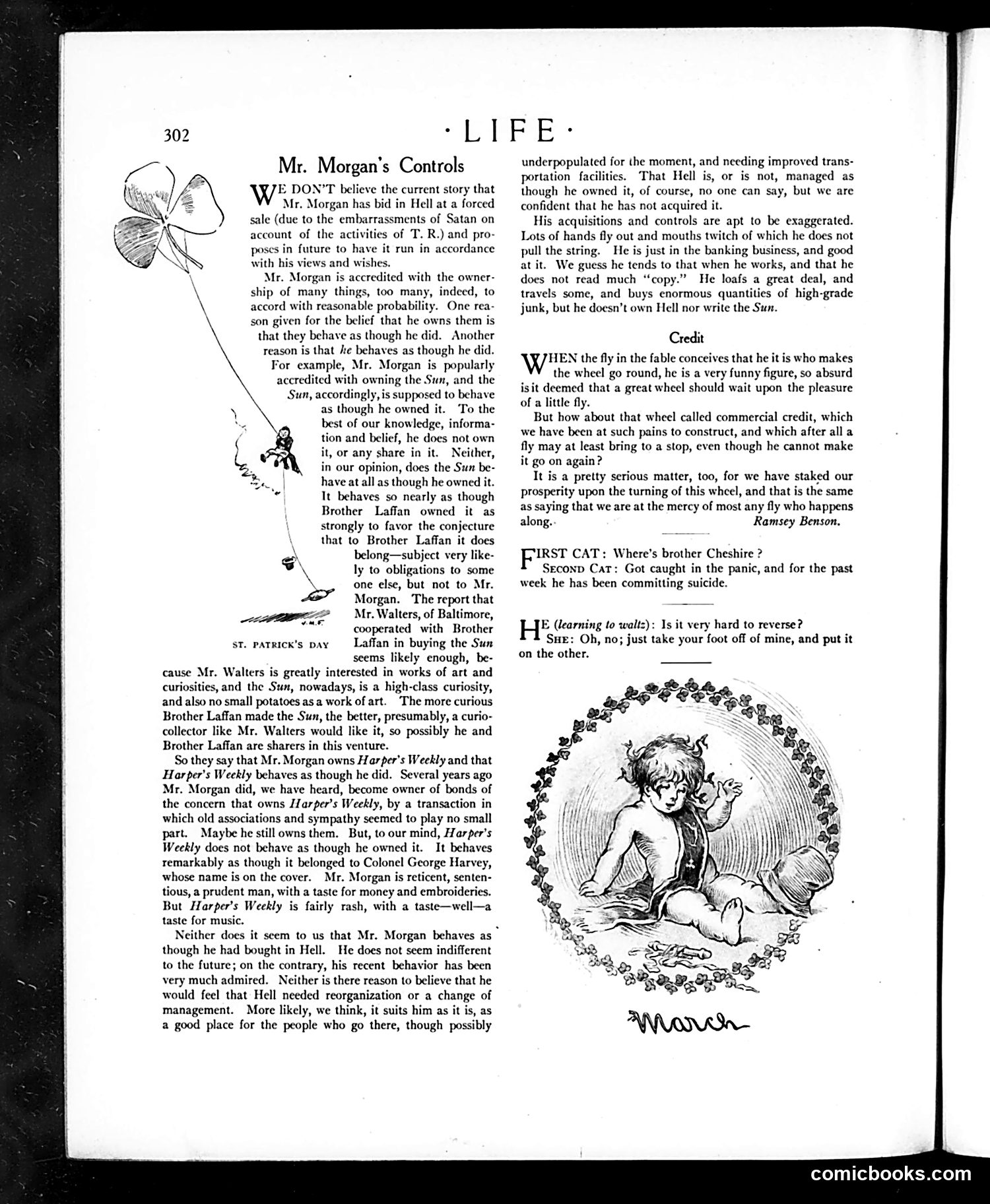
This page mocks the widespread belief that banker J.P. Morgan controls numerous major institutions—the Sun newspaper, Harper's Weekly magazine, and even (jokingly) "Hell" itself. The satire appears to reference Theodore Roosevelt ("T.R."), suggesting Morgan's influence extends into political spheres. The article argues Morgan doesn't actually own or control these entities as directly as rumors suggest. It compares exaggerating his power to Aesop's fable where a fly believes it propels a wagon wheel—absurdly inflating minor influence into total control. Real figures mentioned include Colonel George Harvey (Harper's Weekly editor) and Baltimore art collector Mr. Walters, who the piece credits with actual influence over publications Morgan only partially owns through bonds. The accompanying illustrations (St. Patrick's Day imagery and cherub) appear decorative rather than directly satirical. The piece's central point: Morgan is "just in the banking business"—powerful but not the omnipotent puppet-master popular imagination has created.
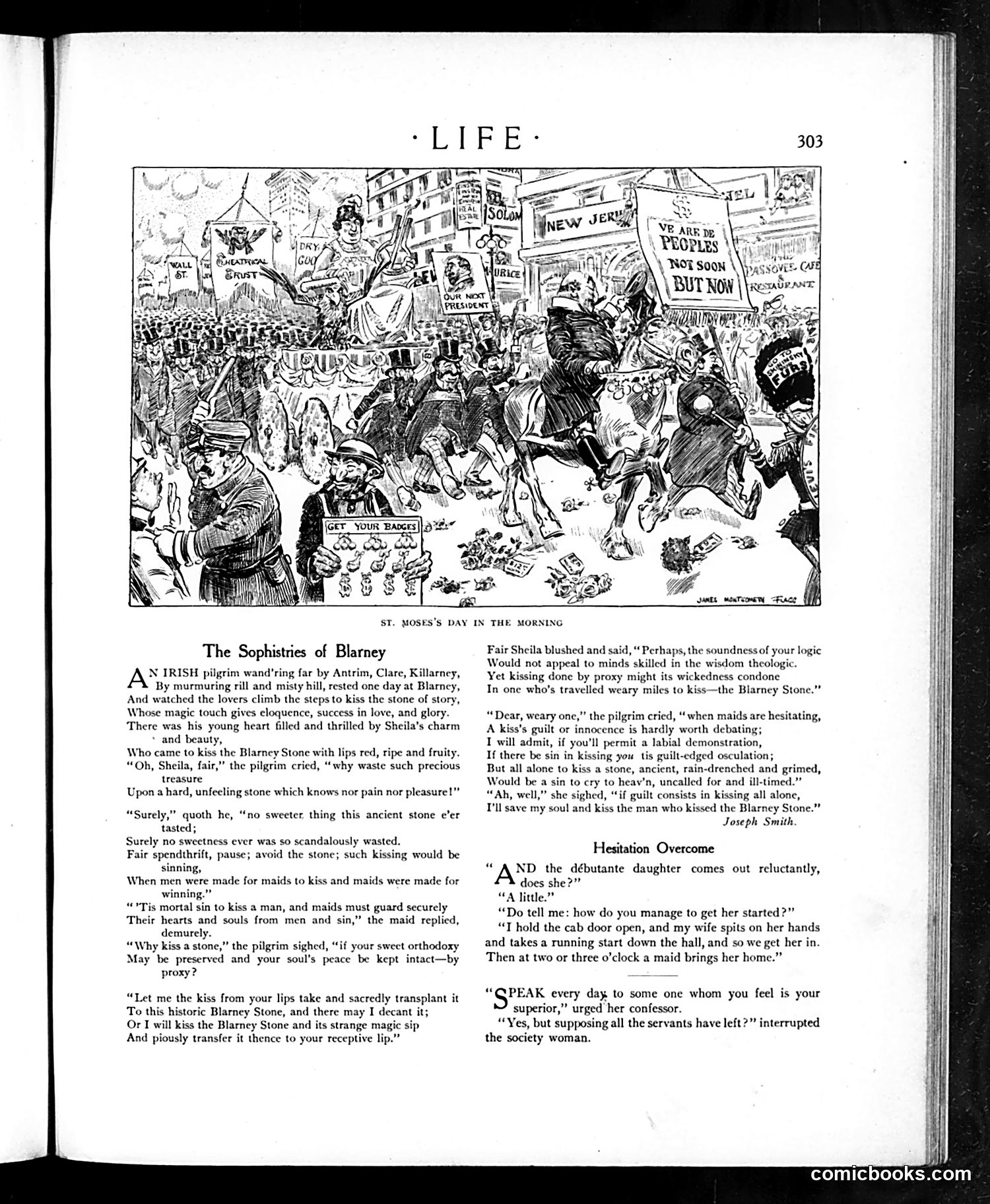
## The Cartoon ("St. Moses's Day in the Morning") This satirical cartoon depicts a crowded street scene of Irish-American immigrants or working-class people, with signs referencing poverty ("We are in poor"), establishments, and social commentary. The artist appears to be mocking Irish-American urban life and stereotypes. ## The Poems **"The Sophistries of Blarney"** is a humorous poem about an Irish pilgrim and a young woman (Sheila) at the Blarney Stone in Ireland. The pilgrim uses increasingly absurd logical arguments to convince Sheila to kiss him by claiming it's morally acceptable if done "by proxy" through the stone first—essentially using mock-theological reasoning to justify physical contact. The satire ridicules both flowery Irish rhetoric and the sophistry used to justify romantic/sexual pursuits. **"Hesitation Overcome"** is a brief satirical joke about upper-class debutante social life, mocking wealthy young women's reluctance and their dependence on servants and family to manage their social obligations.
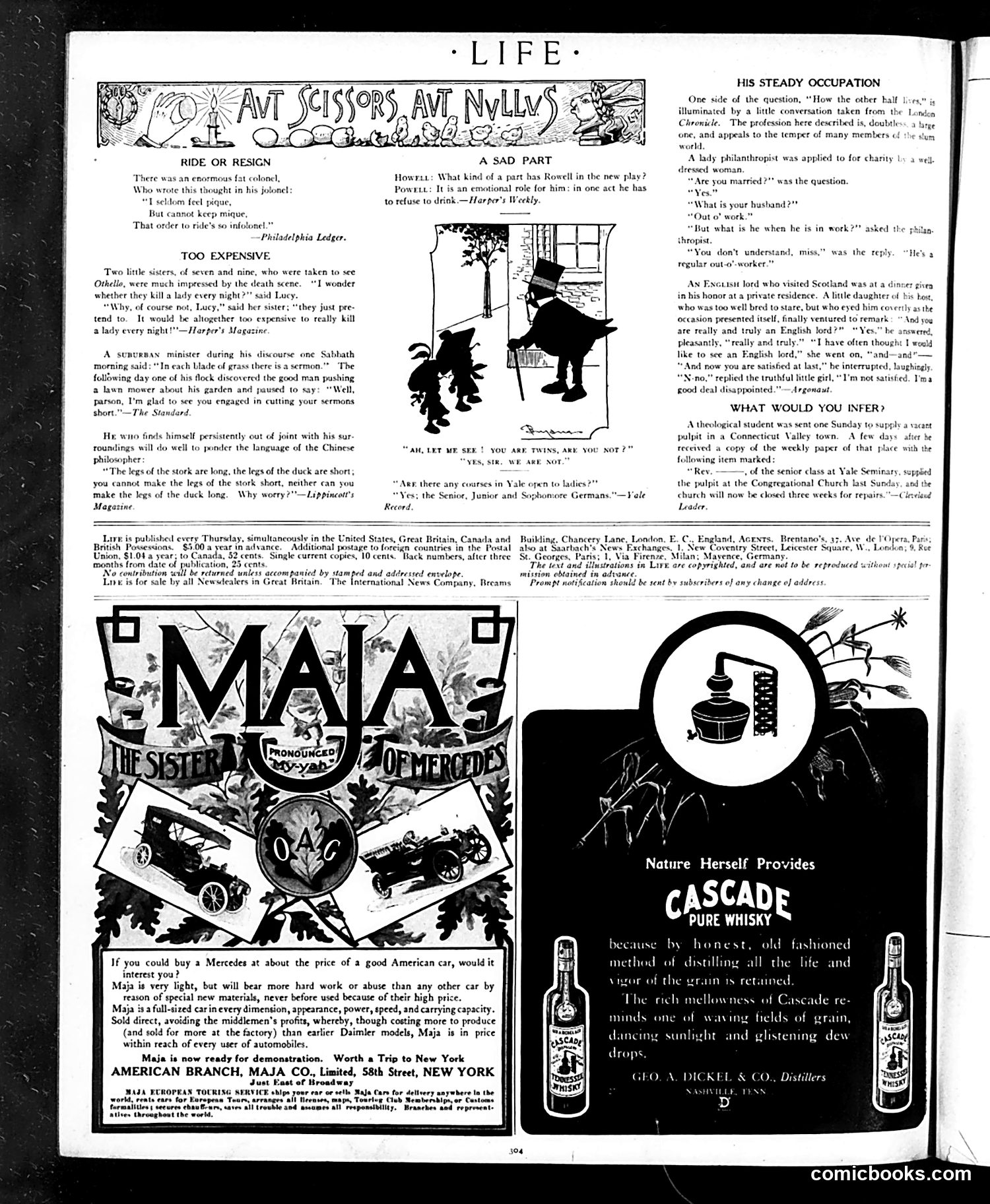
This page from *Life* magazine contains several brief humorous anecdotes satirizing Victorian-era social attitudes and human folly: **"Ride or Resign"** mocks military pomposity through an officer's overwrought complaint about riding. **"Too Expensive"** uses children's innocent logic to parody theatrical excess—two young girls assume actors actually kill women nightly in performances, accepting this as normal theatrical practice. **"His Steady Occupation"** satirizes both charity work and working-class poverty through dialogue between a philanthropist and a poor woman, highlighting the gap between wealthy benefactors' superficial questions and harsh economic reality. **"What Would You Infer?"** uses clerical mishap for humor—a seminary student's pulpit appearance somehow leads to church closure "for repairs," leaving readers to draw amusing conclusions. The advertisements below promote luxury automobiles and whisky, typical of the era's consumer culture targeting wealthy readers. The overall tone is lighthearted social observation rather than hard political satire.
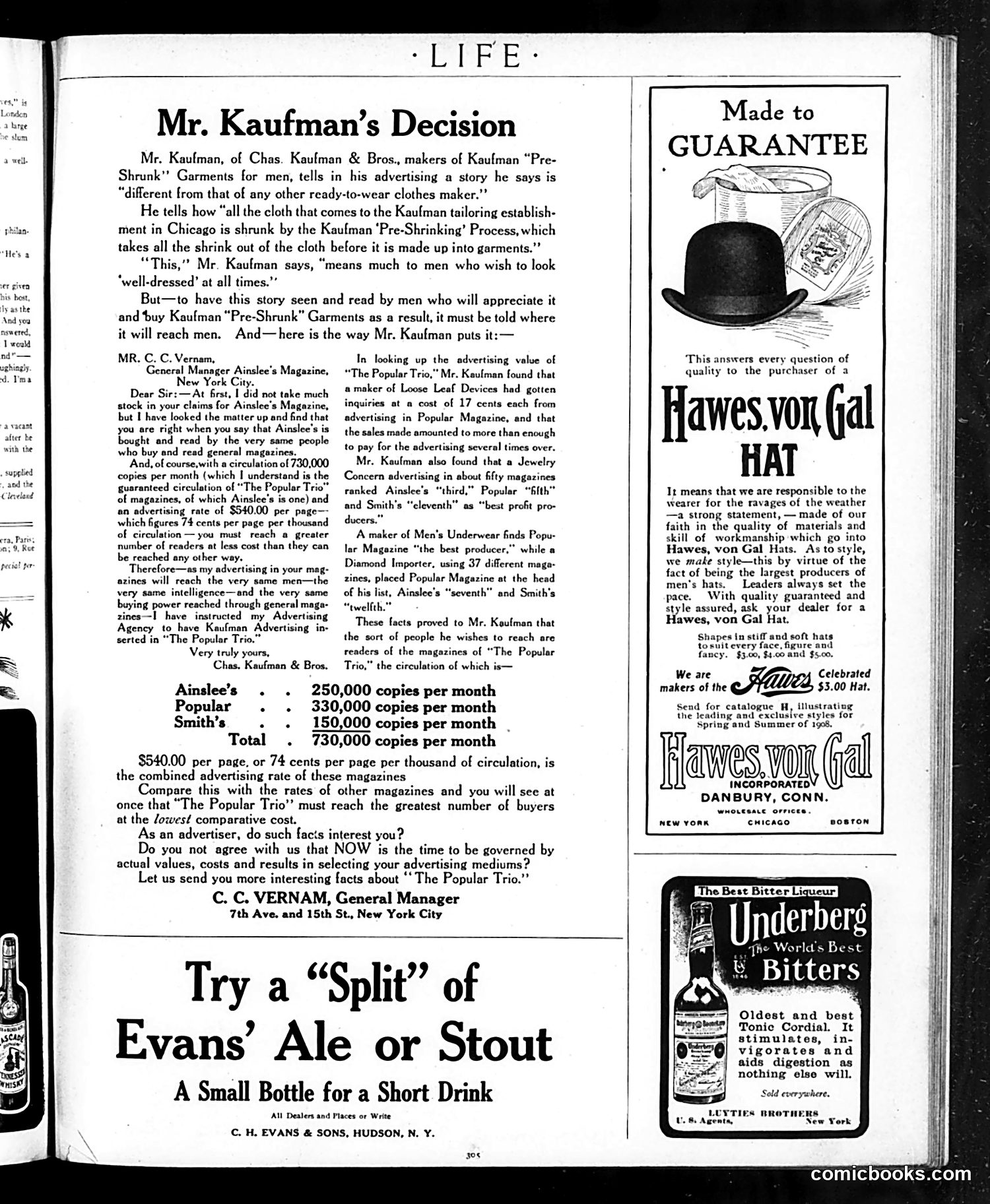
This page is **primarily advertising**, not satire or political commentary. **Main Content:** Mr. Kaufman's letter is a case study in advertising effectiveness. Kaufman, a men's clothing manufacturer, explains his decision to advertise in "The Popular Trio" (three magazines: Ainslee's, Popular, and Smith's) based on circulation data and cost-per-reader metrics. He presents evidence from other advertisers (loose-leaf devices, jewelry, men's underwear, diamonds) showing these publications deliver results at competitive rates. **The "Point":** This is a straightforward B2B advertisement from Life magazine itself, using Kaufman's testimonial to sell advertising space to other potential clients. It argues that data-driven advertising decisions—measuring circulation and cost-efficiency—should guide modern marketing choices. **No satire is evident.** The page demonstrates early 20th-century advertising logic: reach potential customers cost-effectively through publications they actually read.
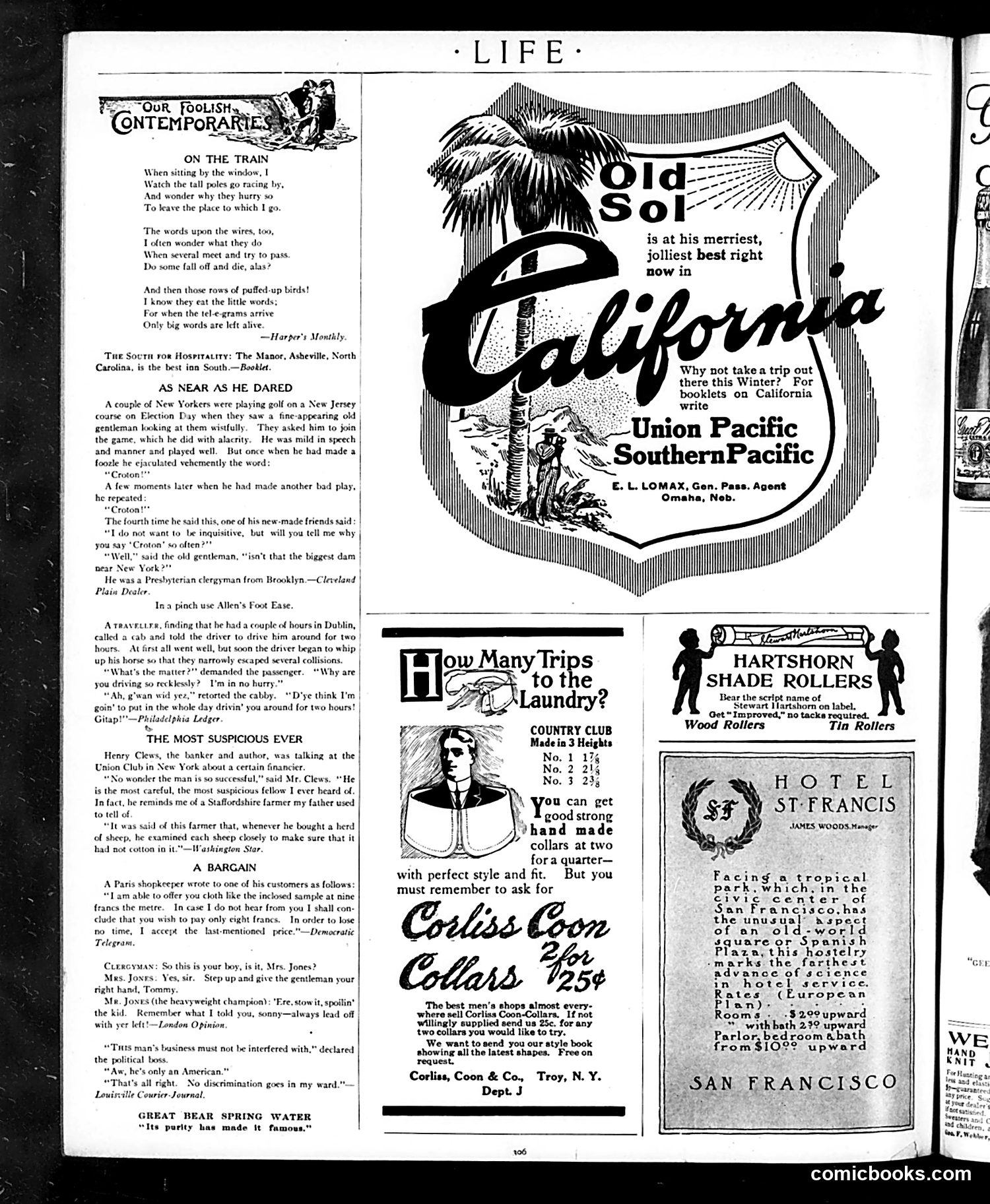
This page contains several humorous anecdotes satirizing contemporary American social behavior and character types: **"On the Train"** mocks the philosophical musings of train passengers—people who ponder mundane observations (telegraph poles, wires, birds) with mock-serious wonder. **"As Near as He Dared"** satirizes hypocrisy: a Presbyterian clergyman from Brooklyn, who normally maintains proper decorum, lets loose with a crude curse ("Croton"—referencing New York's water supply) during a golf game, revealing his true nature when his guard drops. **"The Most Suspicious Ever"** jokes about obsessive paranoia in businessmen—a wealthy banker so suspicious he examines sheep for hidden cotton, reflecting Gilded Age capitalist neuroses. **"A Bargain"** presents a cunning French merchant's psychological sales trick: offering cloth at nine francs, then "accepting" eight francs to force the customer's hand through apparent generosity. The remaining anecdotes target Irish taxi drivers, boxing champions, and political bosses—all stock characters of early 20th-century humor. The page is primarily satirical content with surrounding advertisements.
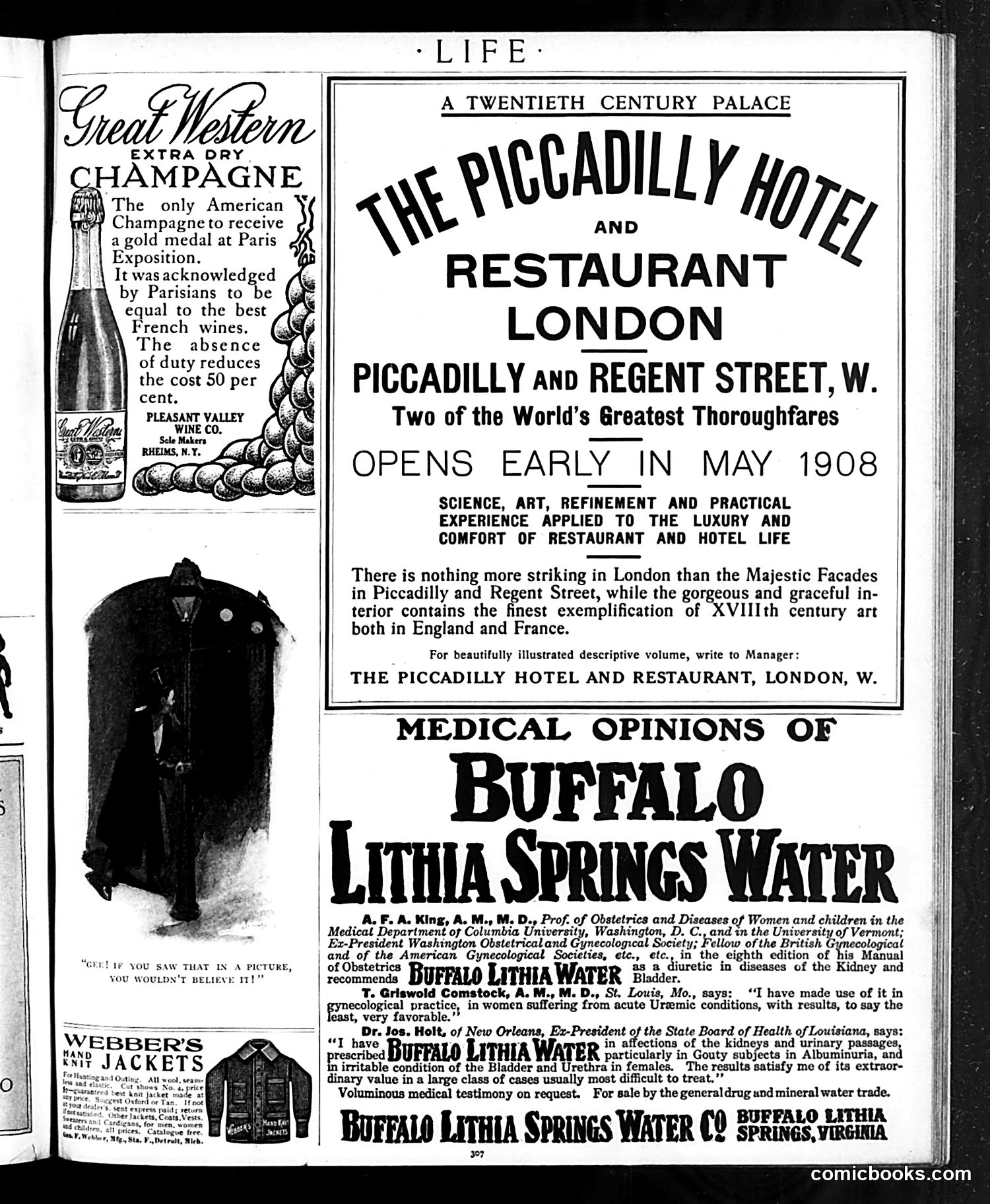
This is primarily an **advertising page**, not a satirical cartoon section. The page contains four distinct advertisements: 1. **Great Western Champagne**: Promotes an American champagne that won a gold medal at the Paris Exposition, claiming it equals French wines while costing 50% less due to absent import duties. 2. **The Piccadilly Hotel and Restaurant** (London): Announces a May 1908 opening, emphasizing "twentieth century" luxury combined with eighteenth-century French-inspired interior design. 3. **Webber's Jackets**: A partial advertisement (left margin) for clothing. 4. **Buffalo Lithia Springs Water**: The largest advertisement, presenting medical endorsements from university professors and doctors claiming the water treats kidney disease, uremia, and bladder conditions in women. The single cartoon image—captioned "Gee! If you saw that in a picture, you wouldn't believe it!"—appears to show a dramatic figure but lacks clear context on this page. The overall content reflects early 1900s marketing emphasizing scientific authority and European sophistication to appeal to affluent American readers.
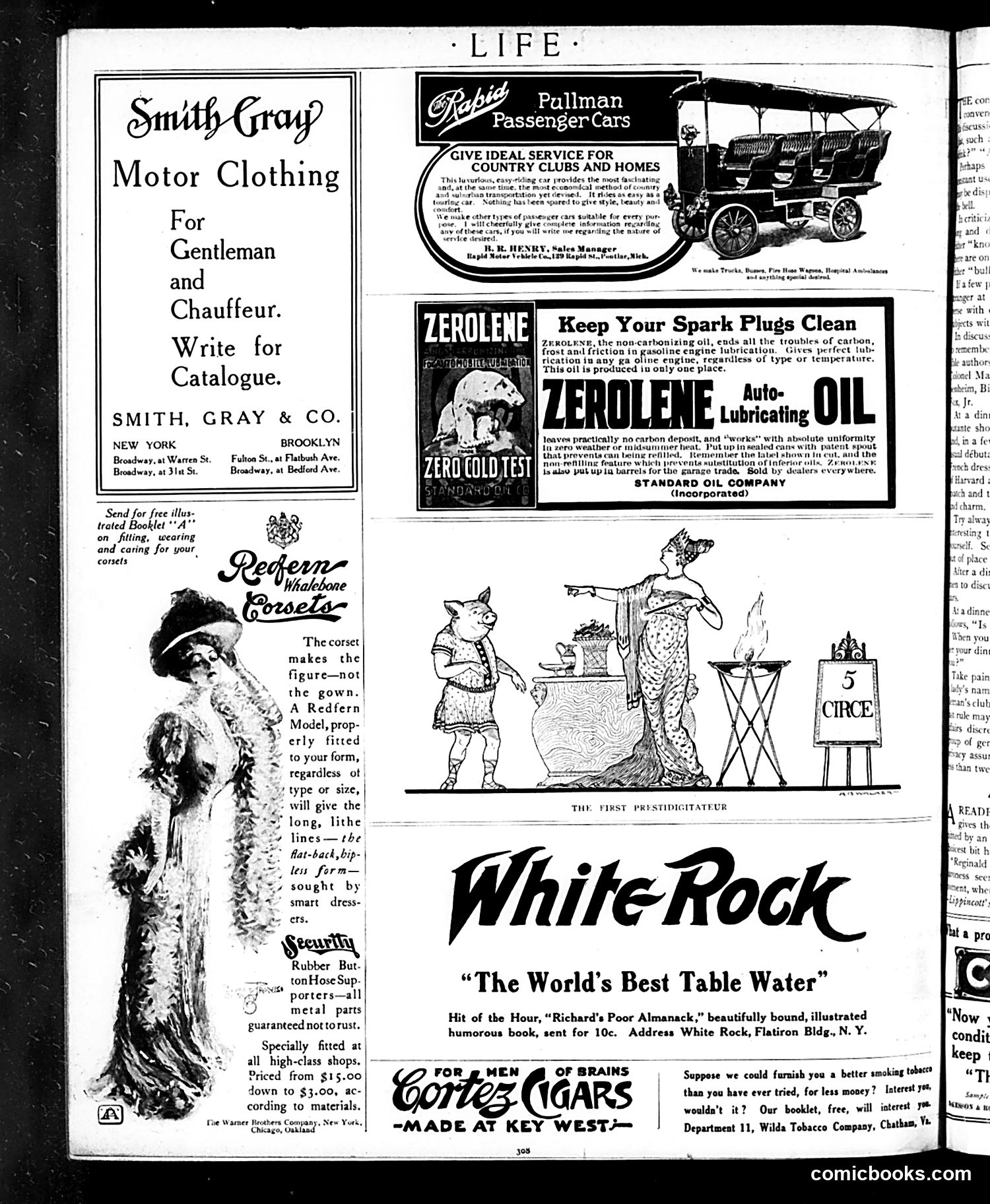
This is primarily an **advertising page** from an early 20th-century issue of Life magazine, with one small cartoon illustration. The main cartoon, titled "The First Prestidigitateur," depicts a woman performing magic tricks for children—she appears to be making objects disappear or manipulate them. "Prestidigitateur" means a magician or sleight-of-hand performer. The joke likely references a woman's domestic "magic" in managing household tasks or entertaining children, playing on period stereotypes of feminine domestic roles. The rest of the page contains period product advertisements: Smith-Gray motor clothing for chauffeurs, Rabid Pullman passenger cars, Zerolene motor oil, Redfern corsets, White Rock table water, and Cortez cigars. These ads reflect early automotive industry growth and upper-class consumer goods marketed to gentlemen and households of means. The corset advertisement notably emphasizes that proper corseting creates the "figure," reflecting early 20th-century beauty standards.
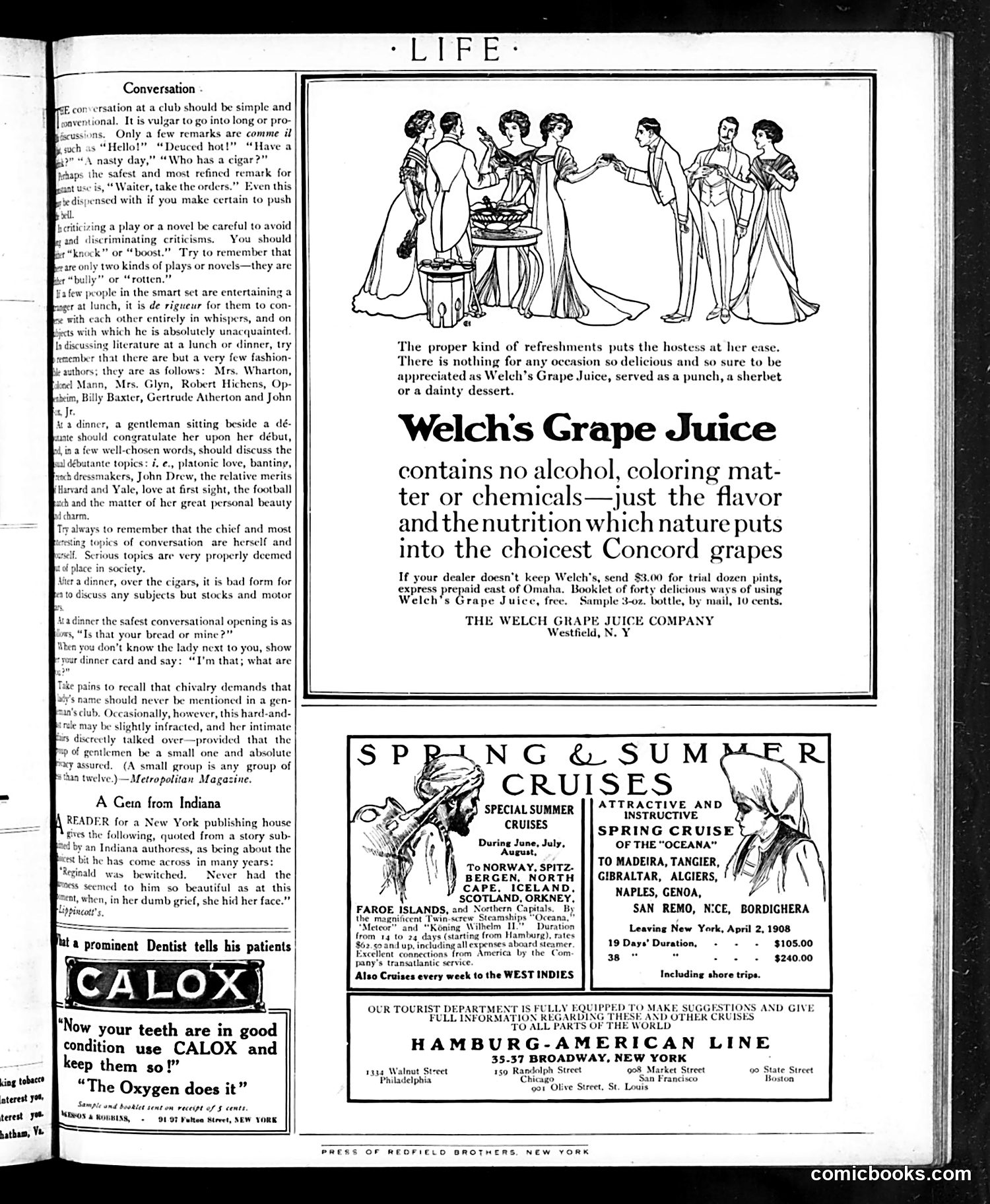
This page is primarily **advertising and advice columns** rather than political satire. The main content includes: **"Conversation" Advice Column**: A satirical etiquette piece mocking upper-class social conventions. It humorously prescribes bland, safe dinner conversation topics (weather, cigars, "Is that your bread or mine?") while condemning substantive discussion of literature, politics, or other serious subjects. The satire targets the intellectual emptiness of wealthy society's rigid social codes. **Advertisements**: The page features multiple ads including Welch's Grape Juice (emphasizing it contains "no alcohol"), Calox toothpaste, dental services, and cruise lines (Hamburg-American, Spring & Summer Cruises). These reflect early 1900s consumer culture. **Literary Excerpt**: A brief passage titled "A Gem from Indiana" describing a romantic scene. The satire here mocks **upper-class pretension and conformity** rather than specific political figures or events. The humor derives from exposing how wealthy society enforces trivial conversation while suppressing genuine intellectual engagement.
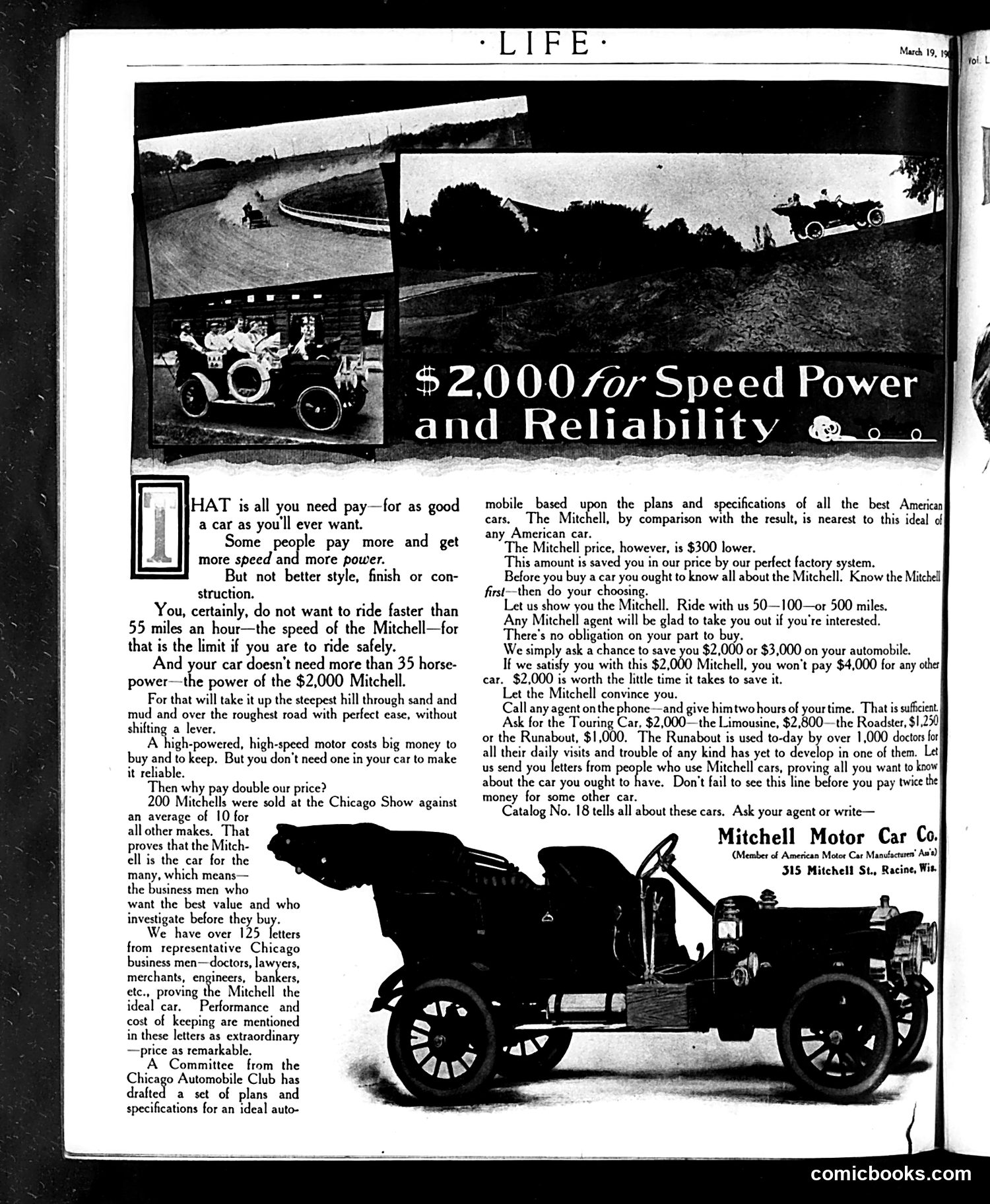
This is **not a cartoon or satire** but rather a straightforward automobile advertisement from Life magazine (dated March 19, based on visible header). The page promotes the **Mitchell Motor Car**, a real American automobile manufactured in Racine, Wisconsin. The ad's central argument targets practical-minded buyers—particularly Chicago businessmen (doctors, lawyers, merchants, engineers, bankers)—claiming the Mitchell offers superior *value* rather than unnecessary performance. The key pitch: $2,000 buys "speed power and reliability" equal to more expensive competitors. The ad argues that 55 mph and 35 horsepower suffice for safe driving, making higher-powered cars wasteful expenditures. To support credibility, it cites 200 Mitchell sales at the Chicago Auto Show versus 10 for competitors, plus 125 testimonial letters from prominent Chicago professionals. The advertisement emphasizes economy and practicality over ostentation—a resonant message for early-1900s middle-class consumers concerned with value and sensible purchasing decisions.