
Life, 1908-03-19 · page 8 of 24
Life — March 19, 1908 — page 8: what you’re looking at
What you’re looking at
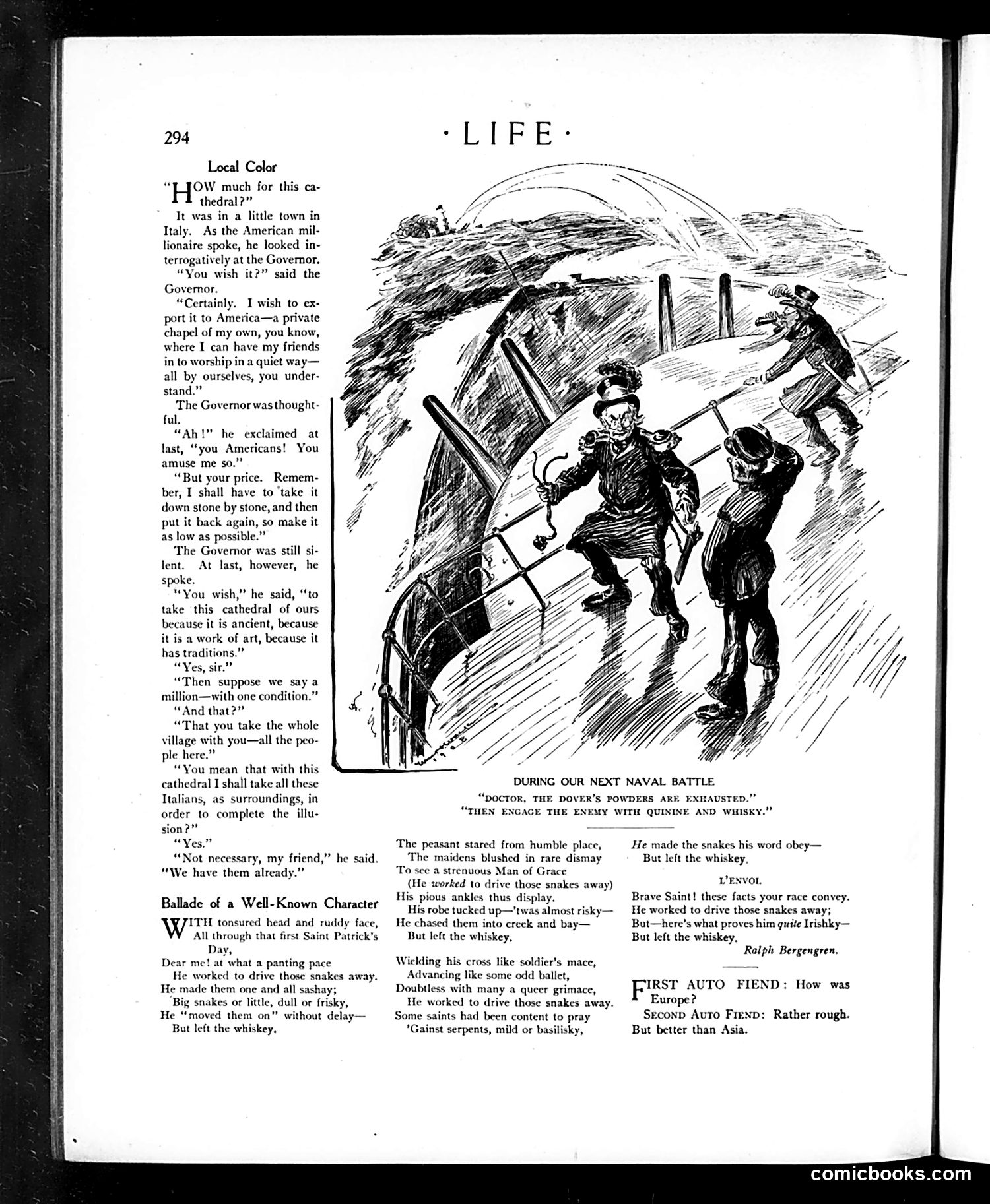
This page from *Life* magazine contains satirical text and an illustration mocking American attitudes toward acquiring European cultural treasures. The main dialogue ("Local Color") depicts an American millionaire negotiating to buy an Italian cathedral—literally disassembling and exporting it stone-by-stone to America. The Governor's agreement to sell "the whole village with you" satirizes both American wealth-driven acquisitiveness and European willingness to commodify their heritage. The accompanying illustration shows figures with surveying equipment examining a cathedral, literalizing the absurd premise. Below are poems mocking religious pretense and military incompetence ("the dove's powders are exhausted"), with a concluding exchange trivializing European conflicts as less important than American industrial progress. The satire targets American materialism and cultural imperialism of the early 20th century.
📄 Transcribed text from this page (OCR, searchable)
Machine-transcribed from the original scan — historical spelling and the odd misread are preserved.
294 Local Color ‘OW much for this ca- thedral?”” It was in a little town in Italy. As the American mil- lionaire spoke, he looked in- terrogatively at the Governor. “You wish it?” said the Govermor. “Certainly. I wish to ex- port it to America—a private chapel of my own, you know, where I can have my friends in to worship in a quiet way— all by ourselves, you under- stand.” The Governor was thought- ful. “Ah!” he exclaimed at last, “you Americans! You amuse me so.”” “But your price. Remem- ber, I shall have to ‘take it down stone by stone, and then put it back again, so make it as low as possible.” The Governor was still si- lent. At last, however, he spoke. “You wish,” he said, ‘to take this cathedral of ours because it is ancient, because it is a work of art, because it has traditions.” “Yes, sir.” “Then suppose we say a million—with one condition.” “And that?” “That you take the whole village with you—all the peo- ple here.” “You mean that with this cathedral I shall take all these Italians, as surroundings, in order to complete the illu- sion?” “Yes.” “Not necessary, my friend,” he said. “We have them already.” Ballade of a Well-Known Character ITH tonsured head and ruddy face, All through that first Saint Patrick's Day, Dear me! at what a panting pace He worked to drive those snakes away. He made them one and all sashay; ‘Big snakes or little, dull or frisky, He “moved them on” without delay— But left the whiskey, DURING OUR NEXT NAVAL BATTLE XHAUSTED.”” “THEN ENGAGE THE ENEMY WITH QUININE AND WHISKY.” The peasant stared from humble place, ‘The maidens blushed in rare dismay To sec a strenuous Man of Grace (He worked to drive those snakes away) His pious ankles thus display. His robe tucked up—'twas almost risky— He chased them into creck and bay— But left the whiskey. Wielding his cross like soldier’s mace, Advancing like some odd ballet, Doubtless with many a queer grimace, He worked to drive those snakes away. Some saints had been content to pray *Gainst serpents, mild or basilisky, He made the snakes his word obey— But left the whiskey, Brave Saint! these facts your race convey. He worked to drive those snakes away; But—here’s what proves him guite Irishky— But left the whiskey, Ralph Bergengren. IRST AUTO FIEND: How was Europe? Seconp Auto Fr But better than Asia. : Rather rough. comicbooks.com