
Life, 1908-03-19 · page 15 of 24
Life — March 19, 1908 — page 15: what you’re looking at
What you’re looking at
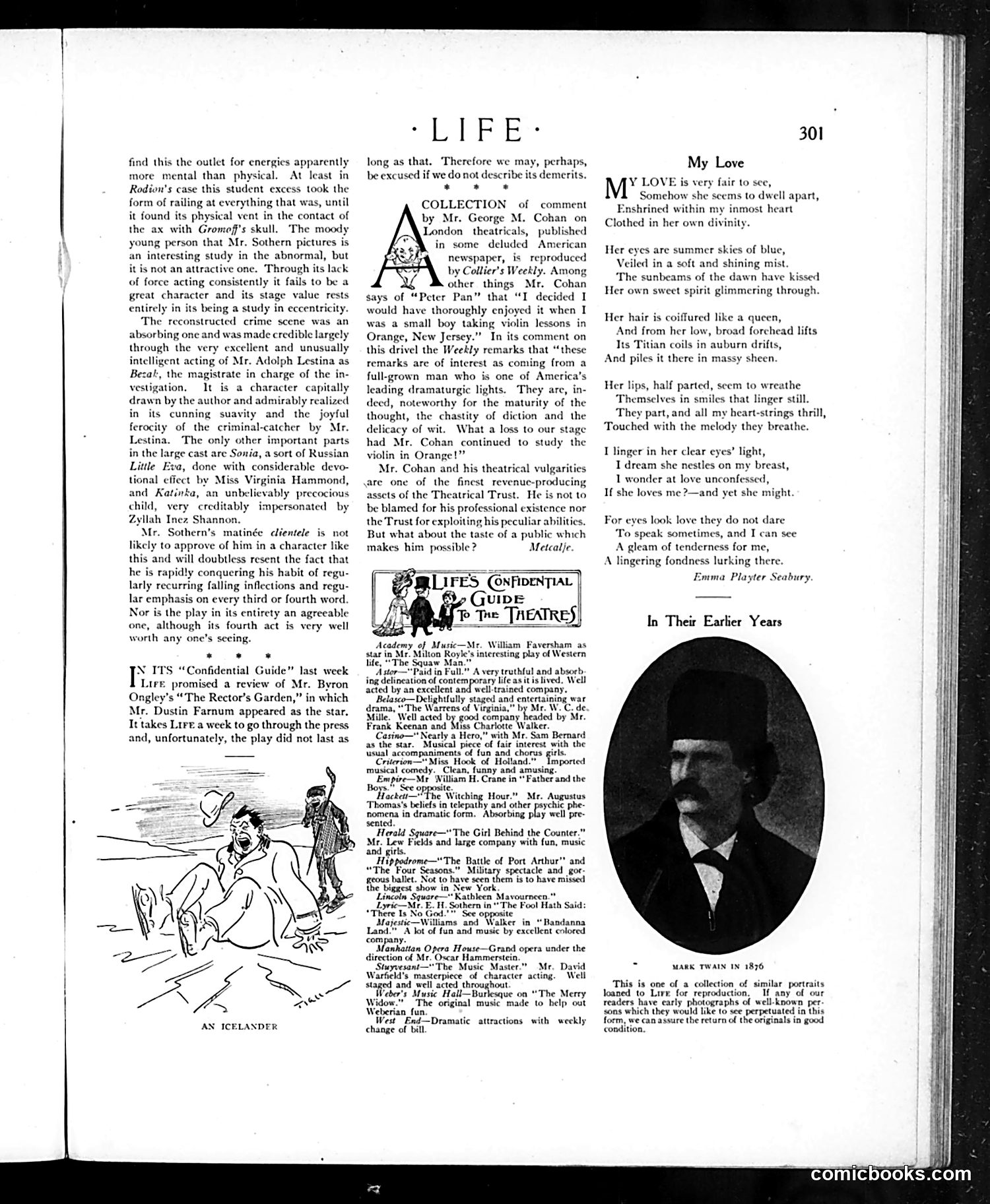
This page contains theater reviews and criticism. The main satirical content targets **George M. Cohan**, a prominent American playwright and producer. **The Joke:** Cohan publicly commented that he would have "thoroughly enjoyed" *Peter Pan* if he'd seen it as a child taking violin lessons in Orange, New Jersey. Life's critic mocks this as absurdly immature commentary from a "full-grown man" and "one of America's leading dramaturgic lights," sarcastically suggesting Cohan should have stuck with violin. **The Broader Point:** The critic argues Cohan represents theatrical vulgarity that's nonetheless profitable for the Theatrical Trust (a monopolistic production company). Rather than blame Cohan personally, the writer blames the public's poor taste for enabling him. **Visual Element:** An illustration labeled "An Icelander" appears unrelated to the text—likely a separate satirical cartoon about an Icelandic figure, though its specific reference is unclear without additional context.
📄 Transcribed text from this page (OCR, searchable)
Machine-transcribed from the original scan — historical spelling and the odd misread are preserved.
find this the outlet for energies apparently more mental than physical. At least in Rodion’s case this student excess took the form of railing at everything that was, until it found its physical vent in the contact of the ax with Gromof’s skull. The moody young person that Mr. Sothern pictures is an interesting study in the abnormal, but it is not an attractive one. Through its lack of force acting consistently it fails to be a great character and its stage value entirely in its being a study in eccentricity. The reconstructed crime scene was an absorbing one and was made credible largely through the very excellent and unusually intelligent acting of Mr. Adolph Lestina as Bezal:, the magistrate in charge of the in- vestigation. It is a character capitally drawn by the author and admirably realized in its cunning suavity and the joyful ferocity of the criminal-catcher by Mr. Lestina. The only other important parts in the large cast are Sonia, a sort of Russian Little Eva, done with considerable devo- tional effect by Miss Virginia Hammond, and Katinka, an unbelievably precocious child, very creditably impersonated by Zyllah Inez Shannon. Mr. Sothern’s matinée clientele is not likely to approve of him in a character like this and will doubtless resent the fact that he is rapidly conquering his habit of regu- larly recurring falling inflections and regu- lar emphasis on every third or fourth word. Nor is the play in its entirety an agreeable one, although its fourth act is very well worth any one’s seeing. * 8 N ITS “Confidential Guide” last week Lire promised a review of Mr. Byron Ongley’s “The Rector’s Garden,” in which Mr. Dustin Farnum appeared as the star. It takes Lire a week to go through the press. and, unfortunately, the play did not last as AN ICELANDER -LIFE- long as that, Therefore we may, perhaps, be excused if we do not describe its demerits. * * « COLLECTION of comment by Mr. George M. Cohan on London theatricals, published i ¢ deluded American aper, is reproduced by Collier's Weekly. Among other things Mr. Cohan says of “Peter Pan” that “I decided I would have thoroughly enjoyed it when I was a small boy taking violin lessons in Orange, New Jersey.” In its comment on this drivel the Weekly remarks that “these remarks are of interest as coming from a full-grown man who is one of America leading dramaturgic lights. They are, in- deed, noteworthy for the maturity of the thought, the chastity of diction and the delicacy of What a loss to our stage had Mr. Cohan continued to study the violin in Orange!” Mr. Cohan and his theatrical vulgarities are one of the finest revenuc-producing assets of the Theatrical Trust. He is not to be blamed for his professional existence nor the Trust for exploiting his peculiar abilities. But what about the taste of a public which makes him possible? Metcalfe 1 FES (ONFiveNTIAL | GuiIDpE | Fe Pee THEATRES) Academy of Music—Mr. William Faversham as star in Mr. Milton Royle’s interesting play of Western life, “The Squaw Man.” A ster—"*Paid in Full.” A very truthful and absorb: ing delineation of contemporary life as it is lived. Well acted by an excellent and well-trained company. Belasco—Delightlully staged and entertaining war drama, “The Warrens of Virginia,” by Mr. W. C. de. Mille. Well acted by good company headed by Mr. Frank Keenan and Miss Charlotte Walker. Casino—" Nearly a Hero,” with Mr. Sam Bernard as the star. Musical piece of fair interest with the usual accompaniments of fun and chorus girls. Criterion—" Miss Hook of Holland.” Imported musical comedy. Clean, funny and amusing. Empire—Mr William H. Crane in “Father and the Boys.” See opposit Hackett" Phe Witching Hour.” Mr. Augustus ‘Thomas's beliefs in telepathy and other psychic phe- nomena ia dramatic for. Atnorting ploy well pre seated. Herald Sguare—" The Girl Behind the Counter.” Mr. Lew Fields and large company with fun, music and girls. Hippodrome—“The Battle of Port Arthur’ and “The Four Seasons.” Military spectacle and gor- geous ballet. Not to have seen them is to have missed the biggest show in New York Lincoln Square—"* Kathleen Mavourncen.” Lyric—Mr. E. H. Sothern in The Fool! Hath Said: “There Is No God.""" See opposite Majestic—Williams and Walker in “ Bandanna Land.” A lot of fun and music by excellent colored company. ‘Manhattan Opera House—Grand opera under the direction of Mr. Oscar Hammerstein. Stuyvesant—""The Music Master.” Mr. David Warfield's masterpiece of character acting. Well staged and well acted throughout. Weber's Music Hall—Burlesque on “The Merry Widow. ‘The original music made to help out Weberian fun. West End—Dramatic attractions with weekly change of bill. 301 My Love Y LOVE is very fair to see, Somehow she scems to dwell apart, nshrined within my inmost heart Clothed in her own divinity. Her eyes are summer skies of blue, Veiled in a soft and shining mist. ‘The sunbeams of the dawn have kissed Her own sweet spirit glimmering through. Her hair is coiffured like a queen, And from her low, broad forehead lifts Its Titian coils in auburn drifts, And piles it there in massy sheen. Her lips, half parted, seem to wreathe ‘Themselves in smiles that linger still. They part, and all my heart-strings thrill, Touched with the melody they breathe. I linger in her clear eyes? light, I dream she nestles on my breast, I wonder at love unconfessed, If she loves me?—and yet she might. For eyes look love they do not dare To speak sometimes, and I can see A gleam of tenderness for me, A lingering fondness lurking there. mma Playter Seabury. In Their Earlier Years MARK TWAIN IN 1876 This is one of a collection of similar portraits loaned to Live. for reproduction, If any of our readers have early photographs of well-known per sons which they would like to see perpetuated in this, form, we can assure the return of the originals in good condition. , b comicbooks.com