
Life, 1908-03-19 · page 6 of 24
Life — March 19, 1908 — page 6: what you’re looking at
What you’re looking at
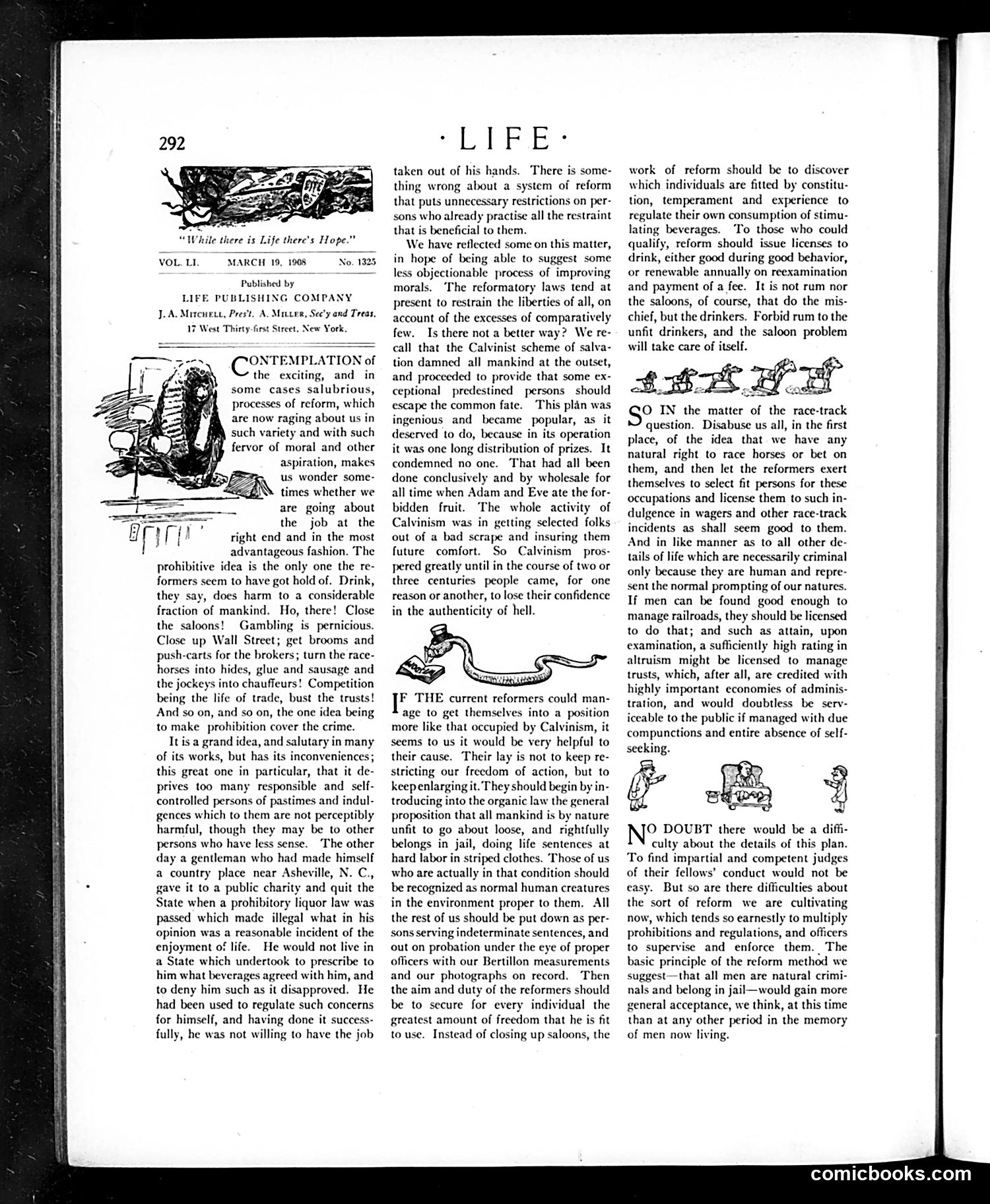
The page contains an article titled "Contemplation of the Exciting, and in Some Cases Salubrious, Processes of Reform" with three small illustrations integrated into the text. The illustrations appear to satirize various reform movements of the Progressive Era. One sketch shows what appears to be a person in distress or confined conditions. Another depicts a snake-like figure. A third shows multiple figures in what seems to be a domestic or institutional setting. The article's tone is skeptical of overzealous reformers, arguing that reform should be practical rather than idealistic. It critiques Calvinism and gambling prohibitions while suggesting that some reforms (like railroad management and prison reform) require expert licensing and judgment rather than blanket prohibition. The satire mocks reform movements that seem impractical or moralistic rather than addressing genuine social problems.
📄 Transcribed text from this page (OCR, searchable)
Machine-transcribed from the original scan — historical spelling and the odd misread are preserved.
“While there is Life there's Hope.” MARCH 19, 1908 No, 1325 VOL. LI. Published by LIFE PUBLISHING COMPANY J. A. Mircnene, Pres't. A. Minter, Sec’y and Treas, 7 West Thirty-first Street, New York, ONTEMPLATION of the exciting, and in some cases salubrious, processes of reform, which are now raging about us in such variety and with such fervor of moral and other aspiration, makes us wonder some- times whether we are going about the job at the right end and in the most advantageous fashion. The prohibitive idea is the only one the re- formers seem to have got hold of. Drink, they say, does harm to a considerable fraction of mankind. Ho, there! Close the saloons! Gambling is pernicious. Close up Wall Street; get brooms and push-carts for the brokers; turn the race- horses into hides, glue and sausage and the jockeys into chauffeurs! Competi being the life of trade, bust the tr And so on, and so on, the one idea being to make prohibition cover the crime. It is a grand idea, and salutary in many of its works, but has its inconveniences; this great one in particular, that it de- prives too many responsible and self- controlled persons of pastimes and indul- gences which to them are not perceptibly harmful, though they may be to other persons who have less sense. ‘The other day a gentleman who had made himself a country place near Asheville, N. C., gave it to a public charity and quit the State when a prohibitory liquor law was passed which made illegal what in his opinion was a reasonable incident of the enjoyment of life. He would not live in a State which undertook to prescribe to him what beverages agreed with him, and to deny him such as it disapproved. He had been used to regulate such concerns for himself, and having done it success- fully, he was not willing to have the job taken out of his hands. There is some- thing wrong about a system of reform that puts unnecessary restrictions on per- sons who already practise all the restraint that is beneficial to them. We have reflected some on this matter, in hope of being able to suggest some less objectionable process of improving morals. ‘The reformatory laws tend at present to restrain the liberties of all, on account of the excesses of comparatively few. Is there not a better way? We re- call that the Calvinist scheme of salva- tion damned all mankind at the outset, and proceeded to provide that some ex- ceptional predestined persons should escape the common fate. This plan was ingenious and became popular, as it deserved to do, because in its operation it was one long distribution of prizes. It condemned no one. That had all been done conclusively and by wholesale for all time when Adam and Eve ate the for- bidden fruit. The whole activity of Calvinism was in getting selected folks out of a bad scrape and insuring them future comfort. So Calvinism pros- pered greatly until in the course of two or three centuries people came, for one reason or another, to lose their confidence in the authenticity of hell. F THE current reformers could man- age to get themselves into a position more like that occupied by Calvinism, it seems to us it would be very helpful to their cause. Their lay is not to keep re- stricting our freedom of action, but to keep enlarging it. They should begin by in- troducing into the organic law the general proposition that all mankind is by nature unfit to go about loose, and rightfully belongs in jail, doing life sentences at hard labor in striped clothes. ‘Those of us who are actually in that condition should be recognized as normal human creatures in the environment proper to them. All the rest of us should be put down as per- sons serving indeterminate sentences, and out on probation under the eye of proper officers with our Bertillon measurements and our photographs on record. Then the aim and duty of the reformers should be to secure for every individual the greatest amount of freedom that he is fit to use. Instead of closing up saloons, the work of reform should be to discover which individuals are fitted by constitu- tion, temperament and experience to regulate their own consumption of stimu- lating beverages. To those who could qualify, reform should issue licenses to drink, either good during good behavior, or renewable annually on reexamination and payment of a fee. It is not rum nor the saloons, of course, that do the mis- chief, but the drinkers. Forbid rum to the unfit drinkers, and the saloon problem will take care of itself. ABEL O IN the matter of the race-track question. Disabuse us all, in the first place, of the idea that we have any natural right to race horses or bet on them, and then let the reformers exert themselves to select fit persons for these occupations and license them to such in- dulgence in wagers and other race-track incidents as shall seem good to them. And in like manner as to all other de- tails of life which are necessarily criminal only because they are human and repre- nt the normal prompting of our natures. If men can be found good enough to manage railroads, they should be licensed to do that; and such as attain, upon examination, a sufficiently high rating in altruism might be licensed to manage trusts, which, after all, are credited with highly important economies of adminis tration, and would doubtless be serv- iceable to the public if managed with due compunctions and entire absence of self- secking. O DOUBT there would be a diffi- culty about the details of this plan. To find impartial and competent judges of their fellows’ conduct would not be . But so are there difficulties about the sort of reform we are cultivating now, which tends so earnestly to multiply prohibitions and regulations, and officers to supervise and enforce them. The basic principle of the reform method we suggest—that all men are natural crimi- nals and belong in jail—would gain more general acceptance, we think, at this time than at any other period in the memory of men now living. comicbooks.com